Reviewed by our editorial team Published
Vilnius is a genuinely easy city to get around without a car, even though it runs a public transport system unlike almost any other European capital’s. There is no metro and no tram network, so every journey across the city rests on a combination of buses and trolleybuses operated by JUDU, the state-run mobility authority formerly branded as Vilniaus viešasis transportas. That single fact surprises a lot of first-time visitors who arrive expecting a rail link waiting outside the terminal or a tram rattling past the Cathedral.
What Vilnius lacks in rail, it makes up for with one of the more substantial trolleybus networks still running in the European Union, alongside a dense grid of ordinary diesel and electric buses covering every corner of the city. The two together reach well beyond what the compact, largely pedestrianised Old Town could ever need on its own, since most of a visitor’s actual sightseeing happens on foot once they arrive there.
Ticketing has also moved a long way from the paper strips of a decade ago. A single ticket, a reloadable Vilniečio kortelė, the long-standing m.Ticket app, a brand new unified JUDU app, or simply tapping a contactless bank card on the reader are all live options today, and this guide works through exactly which one makes sense depending on how long you are staying and how much you plan to ride.
If you are still working out how to reach the city in the first place, our Vilnius Airport Transfers guide covers the bus routes, taxis and Bolt pickups from the terminal itself, since that is a separate question from the network this page focuses on. Once you are through the door of your hotel, everything below is about moving around the city on the buses and trolleybuses that actually get you there.
| Ticket Type | Price | Validity |
|---|---|---|
| 30-minute ticket | €1.00 (£0.86/$1.10) | Single 30-minute journey window |
| 60-minute ticket | €1.25 (£1.08/$1.38) | Single 60-minute journey window |
| 24-hour pass | €7.50 (£6.50/$8.30) | 24 hours from first activation |
| 72-hour pass | €13.50 (£11.70/$14.90) | 72 hours from first activation |
| 30-day pass | €38 (£33/$42) | 30 consecutive days |
| Contactless tap | Standard per-tap fare, no discount | One ticket per tap, no capping confirmed |
Which Vilnius Ticket Should You Buy?
The right ticket in Vilnius depends almost entirely on how much of your trip happens outside the Old Town. Anyone spending most of a short break wandering between Cathedral Square, Gediminas Tower and Užupis on foot may barely need a ticket at all, since that whole stretch is comfortably walkable without a single bus ride.
Once your plans reach further out, to the TV Tower, a shopping centre on the ring road, or a museum in a quieter district, a single 30 or 60-minute ticket at €1.00 (£0.86/$1.10) or €1.25 (£1.08/$1.38) covers an occasional trip without any commitment. For a handful of journeys spread across one day, this remains the simplest and cheapest approach for most visitors.
Travellers riding four or more times in a single day, perhaps combining a morning at the museums with an afternoon trip out to the TV Tower and an evening in Užupis, will usually come out ahead on the €7.50 (£6.50/$8.30) 24-hour pass instead of buying singles each time. The €13.50 (£11.70/$14.90) 72-hour pass follows the same logic for a longer city break with regular riding across each day.
For anyone staying a full week or longer, or relocating temporarily, the 30-day pass at €38 (£33/$42) starts to make sense, though this is really aimed at residents rather than short-stay tourists. Whichever option you land on, the same ticket works across every bus and trolleybus in the city, so there is never a separate fare to think through mode by mode.
Buses and Trolleybuses: How the Network Fits Together
Vilnius genuinely has no metro and no tram line, a detail that catches out visitors used to Baltic neighbours or Western European capitals with a rail-based core. Every journey across the city instead runs on one of two rubber-tyred modes, ordinary diesel and electric buses on one side, and electric trolleybuses drawing power from overhead wires on the other.
The bus network is the larger of the two by route count, spreading across roughly eighty routes that reach nearly every residential district, with up to around 420 vehicles working on a typical weekday. Buses tend to cover the outer suburbs and less central corridors that the trolleybus wires never reached, filling in the gaps between the denser core routes.
Trolleybuses, covered in more detail below, concentrate on around sixteen routes through the busier central and inner-suburban corridors, generally running more frequently than a comparable bus route on the same stretch. Both modes share the exact same ticket, validators and fare structure, so there is no separate system to learn once you already understand one.
Regular daytime service generally runs from around 5am to 11pm, which comfortably covers a normal sightseeing day without needing to plan around a last train. Route numbers and destinations are posted clearly at every stop, and most vehicles display the next few stops on an internal screen, which helps considerably if you are still learning Lithuanian place names.
Best for two or three nights. The widest choice of rooms, with filters for free cancellation and included breakfast.
View staysBest for families, or any stay past about four nights. A kitchen and a washing machine start paying for themselves.
Browse rentalsBest as a last check before booking. Compares hotel rates across several sites in one search.
Compare ratesVilnius’s Trolleybus Network: A Baltic Rarity
Trolleybuses have run in Vilnius since November 1956, when the first route linked Antakalnis with the railway station using a modest fleet of 25 vehicles and under eight kilometres of overhead wire. Seven decades later, the network has grown into one of the more substantial trolleybus systems still operating anywhere in the European Union, a genuine rarity now that most Western cities replaced theirs with diesel buses decades ago.
The current fleet runs into the hundreds of vehicles across around sixteen routes, carrying roughly 200,000 passengers on an average day, according to figures reported by the operator. Older Škoda 14Tr models still share the streets with newer Škoda 32Tr SOR and Solaris Trollino trolleybuses delivered in recent years, part of an ongoing modernisation programme that has added dozens of new vehicles since 2024.
City authorities have continued placing orders for further batches of new trolleybuses rather than winding the system down, which is a genuinely unusual commitment among European capitals. Some newer vehicles are also designed to run for short stretches without contact with the overhead wire, letting routes extend slightly beyond the existing network of cables without a full rebuild.
For a visitor, the practical upshot is simple: a trolleybus is not a novelty tram ride, it is a normal, frequent, everyday way to cross the city, sharing the same ticket as every bus. Riding one along a central corridor is a quietly interesting way to see a piece of transport history that most of Europe retired long ago.
Tickets, Fares and Validation Explained
Vilnius priced its fares in a package of changes that took effect on 1 July 2025, and the figures in this guide reflect that current structure rather than older prices still floating around some travel blogs. A standard 30-minute ticket costs €1.00 (£0.86/$1.10), while a 60-minute ticket costs €1.25 (£1.08/$1.38), and either covers unlimited transfers between buses and trolleybuses within that window rather than a single ride only.
For a fuller day of riding, the 24-hour pass at €7.50 (£6.50/$8.30) and the 72-hour pass at €13.50 (£11.70/$14.90) both cover unlimited travel for their duration rather than counting individual trips. Longer options exist too, including 30, 90 and 365-day passes, though these are pitched squarely at residents and commuters rather than short-stay visitors.
Discounted fares of roughly 50% or 80% off the standard price apply to eligible groups such as students, pensioners and people with disabilities, but these require proof of eligibility and a locally issued card, so they are not realistically available to a passing tourist. Children under a certain age typically travel free, though it is worth confirming the current age threshold directly with JUDU before relying on it.
Whichever ticket you buy, it must be validated at the start of each journey, either by tapping a card or phone at the on-board reader or activating a digital ticket in an app before boarding. An unvalidated ticket, even a genuine one already paid for, is treated the same as travelling without one at all if an inspector checks.
Buying Tickets: Kiosks, m.Ticket and the New JUDU App
Paper and kiosk tickets remain a genuinely simple fallback for visitors who would rather not touch an app at all. Narvesen kiosks and similar newsstands around the city sell standard tickets, and the airport terminal itself has one of these kiosks a short walk from arrivals, useful if your very first Vilnius ticket needs to happen before you have even left the building.
For years, the m.Ticket app has been the standard way to buy and activate a ticket from a phone, letting you purchase several tickets of any type in advance without registering an account. Boarding requires activating the ticket and waiting roughly fifteen seconds before it becomes valid, and an inspector checking your ticket will ask you to display a QR code on screen rather than a printed slip.
In July 2026, JUDU began rolling out a new unified JUDU app, intended to gradually replace both m.Ticket and the separate m.Parking app under one platform covering tickets, journey planning and parking together. The transition is ongoing rather than instant, so depending on exactly when you visit, either app may be the one actually pushed to new downloads, and it is worth checking which one is current in the app store before you fly.
The reloadable Vilniečio (JUDU) card, covered in more detail below, offers a third route to a ticket, sold and topped up at kiosks and the JUDU client service centre. It suits a longer stay far better than a single weekend, since the card itself has to be bought before it can carry any credit.

Contactless Bank Card Payment on Buses and Trolleybuses
Vilnius has followed the wider Baltic trend of accepting a contactless bank card as a ticket in its own right, without ever needing an app or a physical card bought in advance. Visa, Visa Electron, Mastercard and Maestro cards all work directly at the validators fitted on board, alongside Apple Pay and Google Pay on a linked phone or watch.
A single tap buys exactly one standard ticket at the ordinary fare, with no automatic discount applied and no ability to stack several journeys onto one tap. This is a more basic system than the daily fare-capping some other European cities offer contactless riders, so a visitor making many short trips in one day may still find a 24-hour pass cheaper overall.
Behind the scenes, the system reserves a small holding amount on your card the moment you tap, typically nothing for a Visa card and around a euro for Mastercard or Maestro, before settling the actual fare at the end of the day. This is a routine bank authorisation process rather than a real charge, though it is worth knowing about if you check your balance shortly after boarding and see an unfamiliar figure.
Contactless works on every validator across the bus and trolleybus network, with no routes excluded, which makes it the closest thing Vilnius has to a truly zero-effort ticket for a first-time visitor. Full detail on the exact mechanics sits directly on JUDU’s own site, worth a glance before you rely on it for an entire trip.
The Vilniečio Kortelė and the Vilnius Pass Explained
Two very different cards get lumped together by visitors researching Vilnius transport, and it is worth being clear about which is which before you buy either. The Vilniečio kortelė, sometimes called the JUDU card, is a reloadable plastic transport card primarily aimed at residents and regular commuters, storing single tickets or longer passes that can be topped up at kiosks and the JUDU client service centre.
It is not formally restricted to residents only, and a visitor staying long enough to justify buying and topping up a physical card can use one, but the discounted fares tied to the card require proof of local eligibility such as student or pensioner status. For a typical city-break visitor, a contactless bank card or the m.Ticket app almost always ends up simpler than acquiring a Vilniečio kortelė specifically for a short trip.
The Vilnius Pass, formerly marketed as the Vilnius City Card, is a completely different product built around museums and attractions rather than day-to-day commuting. It bundles free or discounted entry to dozens of sights across the city, with public transport offered only as an optional add-on layered on top of the attraction pass itself, priced at roughly the same as a standalone 24-hour transport ticket.
In practice, that means the Vilnius Pass is worth considering only if you are already planning several paid attractions and want transport folded into the same purchase, not as a transport product in its own right. Anyone whose trip is mostly about riding buses and trolleybuses between sights they are visiting for free is better served by the ordinary ticket options above.
Fines, Inspections and Late-Night Travel
There are no ticket barriers anywhere in the Vilnius network, on buses or trolleybuses alike, which makes it easy to assume checks are rare. In practice, plain-clothes and uniformed inspectors do work the network regularly, asking to see a validated ticket, a scanned QR code, or the tap confirmation on a contactless card.
Under Lithuania’s Code of Administrative Offences, a passenger caught without a valid ticket, or travelling on a discounted fare they are not entitled to, faces a fine of between roughly €16 and €30 (£14-26/$18-33). As an alternative, an inspector can instead sell an on-the-spot control ticket priced at €15 (£13/$16.50), payable only by bank card rather than cash, which resolves the issue immediately rather than escalating to a formal fine.
Regular daytime service runs roughly from 5am until around 11pm, comfortably covering a normal day of sightseeing without needing a late-night contingency plan. A more limited weekend night service has operated on Friday and Saturday nights until around 3am on some routes, along with extended hours around New Year’s Eve, though it is worth checking current timetables directly since night coverage is thinner than the daytime network.
Outside those hours, a taxi or Bolt is the realistic fallback, exactly as covered in more detail in our airport transfers guide below. Building in a buffer for a very late return, rather than assuming a bus will still be running, avoids an unwelcome surprise on a quiet street corner.
Best for finding routes the airlines do not sell as a single ticket. Combines carriers to bring the fare down.
Search flightsBest for short trips. Install the eSIM at home and arrive with working data, no shop queue.
Browse eSIMsBest after a long flight or a late landing. Price agreed before you travel, and no taxi queue.
Check transfersWalking the Old Town vs Riding the Network
Vilnius’s Old Town is one of the largest surviving medieval old towns in Northern Europe, and almost the whole of it is genuinely walkable, with large stretches around Pilies Street, Cathedral Square and the university quarter pedestrianised outright. For a visitor staying centrally, a bus or trolleybus is rarely the fastest way to get from one Old Town sight to another a few streets away.
Where the network genuinely earns its fare is crossing into the wider city, reaching sights that sit well beyond comfortable walking distance from the historic core. The hilltop TV Tower, the bohemian district of Užupis on the Old Town’s fringe, and shopping centres and residential districts further out all make far more sense by bus or trolleybus than on foot.
Crossing the river to reach the northern bank, or heading out towards the railway and bus stations for an onward day trip, is another case where the network saves genuine time over walking. Several routes converge on those stations, making it straightforward to combine a morning in the centre with an afternoon train out to somewhere like Trakai.
The practical rule of thumb is simple: treat the Old Town itself as a walking city, and treat the bus and trolleybus network as the tool for everything just beyond it. Trying to do the reverse, hopping on a bus for a five-minute walk between two Old Town churches, usually costs more time waiting at a stop than it saves in transit.
Major Bus and Trolleybus Lines and Key Interchanges
Most visitors only ever need to learn a handful of routes out of the roughly eighty buses and sixteen trolleybuses running across the city. The 3G express and the 88 bus, covered fully in our airport transfers guide, already handle the single most useful journey for anyone arriving by air, so the lines below are the ones worth knowing once you are already in the city itself.
The single most useful interchange to understand is Stotis, the cluster of stops right outside the railway and bus stations just south of the Old Town. Several trolleybus routes, including routes 2, 7, 16 and 20, converge there alongside a wide spread of bus routes, which makes it the natural point to change onto or off the network for the onward rail and coach journeys covered in the next section.
Heading north across the river toward the Šnipiškės business district and the residential districts beyond it means crossing the Neris, and most central routes do this over the Green Bridge (Žaliasis tiltas), a short walk from the eastern edge of the Old Town. It is a genuinely busy crossing by Vilnius standards, so a route bound for the northern bank is rarely far from a stop near Cathedral Square or Gedimino Avenue.
Exact numbers for reaching one specific sight such as the TV Tower or Užupis can shift as JUDU periodically reshuffles routes, so it is more reliable to check the current line on the JUDU journey planner or the Trafi app, covered in our Local Transport Apps guide, than to rely on a number from an older source. Treat any route number in this guide as a solid starting point to confirm on the day rather than a fixed fact.
Vilnius Railway Station and Bus Station
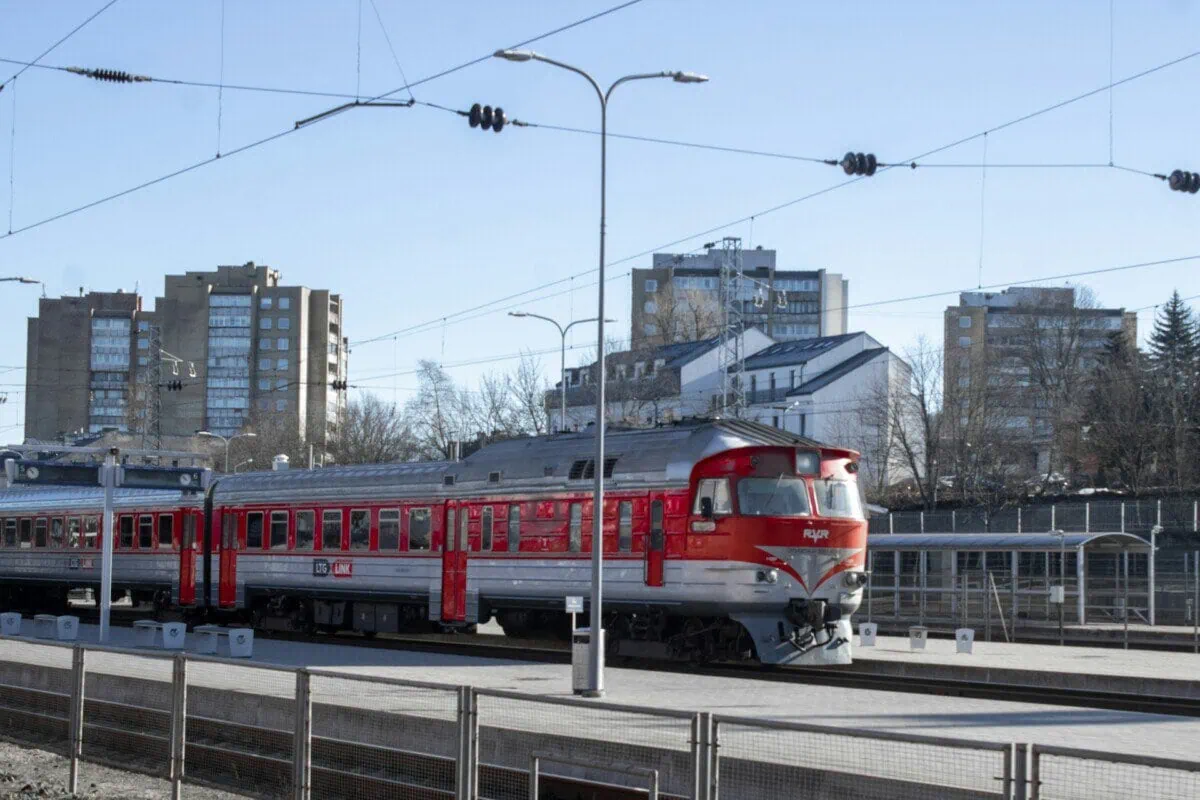
Vilnius’s two main terminals sit almost on top of each other, roughly 180 metres apart, on the southern edge of the Old Town where the Naujininkai and Naujamiestis districts meet. The railway station (Vilniaus geležinkelio stotis) handles trains, while the separate bus station (Vilniaus autobusų stotis) next door handles coaches, and mixing the two up is an easy mistake for a first-time visitor scanning a map.
The railway station serves domestic routes to Kaunas, Trakai and Klaipėda, plus international services toward Riga, on to Tallinn, and across the border to Warsaw and Kraków via Mockava. Rail Baltica, the planned high-speed line intended to link the three Baltic capitals, is due to route through this same station once built, though that project remains some years away from carrying passengers.
The bus station covers far more ground for sheer breadth of destinations, since local and regional coaches reach almost every town in Lithuania the railway does not, while a separate set of long-distance and international coaches run onward to Riga, Tallinn and cities across Western Europe. Anyone connecting onward from our Best Day Trips from Vilnius guide is just as likely to be starting from a platform here as from the railway station itself.
Both stations feed straight into the bus and trolleybus network covered throughout this guide, since the Stotis stop cluster outside them is the same interchange described in the lines and interchanges section above. A ticket bought for the city network does not cover a train or intercity coach fare, so budget for that separately once you know which platform you actually need.
Getting Here vs Getting Around
It is worth being clear about what this guide covers and what it does not, since the journey into Vilnius is a genuinely separate question from moving around once you have arrived. This page is entirely about the bus and trolleybus network within the city, not about reaching it from the airport in the first place.
Our dedicated Vilnius Airport Transfers guide covers the 3G express and 88 bus routes from the terminal, along with taxis and Bolt, since Lithuania has no metro or rail link to fall back on there either. Once that journey ends, generally somewhere near the Old Town or the railway station, everything on this page picks up from that point onward.
Staying connected makes the whole system easier to use in practice, since checking a live departure or activating a digital ticket depends on a working data connection. Our Local Transport Apps guide covers Trafi, the mobility platform that already brings Vilnius, Kaunas and Klaipėda together in one interface, worth pairing with the more ticket-focused m.Ticket or JUDU apps covered above.
Once the city itself is sorted, it is worth thinking about where the network can take you beyond it. Our Best Day Trips from Vilnius guide covers Trakai, Kaunas and the Hill of Crosses, all reached by train or coach rather than the city bus network, but starting from the same central stations this guide’s routes connect into.

Rupert’s Handy Travel Tips
Rupert always says Vilnius’s transport looks unusual on paper, no metro and no trams, but it works far more smoothly than that sounds once you’ve ridden it once.
- Tap your bank card and skip the app entirely: a contactless Visa, Mastercard or Maestro card works straight on the validator, so you never need to touch m.Ticket at all for a short visit.
- Buy a day pass once you’re making four trips or more: the €7.50 24-hour pass beats stacking singles the moment your day includes more than three or four rides.
- Walk the Old Town, ride for everything else: Cathedral Square, Pilies Street and Gediminas Tower are all a short walk apart, so save the bus for reaching the TV Tower or the stations.
- Check which app is current before you fly: JUDU is gradually replacing m.Ticket, so glance at the app store shortly before your trip rather than assuming last year’s download still applies.
- Validate every single time, even with a paid ticket: inspectors do check, and an unvalidated ticket is treated the same as no ticket at all.
- Don’t confuse the two cards: the Vilniečio kortelė is for transport, the Vilnius Pass is for museums with transport as an optional extra, and they solve different problems.
Want to meet the reindeer behind our travel tips? Find out more in our page Who is Rupert?.




Frequently Asked Questions About Vilnius Public Transport
Does Vilnius have a metro or tram network?
No. Vilnius runs entirely on buses and trolleybuses, with no metro line and no tram network of any kind, which makes it different from most other European capitals.
How much is a single bus ticket in Vilnius?
A standard 30-minute ticket costs €1.00 (£0.86/$1.10) and a 60-minute ticket costs €1.25 (£1.08/$1.38), both valid for unlimited transfers within that window.
Can I pay with a contactless bank card on the bus?
Yes. Visa, Visa Electron, Mastercard and Maestro cards, along with Apple Pay and Google Pay, all work directly at the on-board validator for one standard ticket per tap.
What is the difference between the Vilniečio kortelė and the Vilnius Pass?
The Vilniečio kortelė is a reloadable transport card aimed mainly at residents, while the Vilnius Pass is a museums and attractions pass that offers transport only as an optional add-on, not the other way around.
Is the m.Ticket app still the right one to use?
It still works and remains widely used, but JUDU began rolling out a new unified JUDU app in July 2026 intended to gradually replace it, so it is worth checking which app is current shortly before you travel.
How big is Vilnius’s trolleybus network?
The network dates back to 1956 and now covers around sixteen routes with a fleet running into the hundreds of vehicles, making it one of the more substantial trolleybus systems still operating in the European Union.
What happens if I forget to validate my ticket?
An unvalidated ticket is treated the same as travelling without one, and an inspector can either issue a fine of roughly €16-30 (£14-26/$18-33) or sell an on-the-spot control ticket for €15 (£13/$16.50) payable by card.
Do I need public transport to see the Old Town?
Not really. Most of the Old Town is pedestrianised and comfortably walkable, and the bus and trolleybus network is far more useful for reaching sights beyond it, such as the TV Tower or the railway station.
Further Reading
If you are still planning the journey into the city rather than around it, our Vilnius Airport Transfers guide covers the bus routes, taxis and Bolt pickups from the terminal, since Lithuania’s lack of a rail link applies just as much to the airport run as it does to the city network covered here. Pairing the two guides together gives a complete picture from landing to your first ride on a city bus.
Once you have the network itself figured out, our Best Things to Do in Vilnius guide pulls together the sights this page’s buses and trolleybuses can take you to, from Gediminas Tower to Užupis. Anyone with a spare day should also read our Best Day Trips from Vilnius guide, which covers Trakai, Kaunas and the Hill of Crosses using the trains and coaches that start where this city network ends.
For onward rail travel across Lithuania, our Interrail Lithuania Pass guide explains the pricing and routes worth knowing about beyond Vilnius itself. Staying connected throughout makes all of this easier in practice, so our Local Transport Apps guide covers Trafi and the wider tools worth having installed before you land.
Vilnius completes a natural Baltic trio alongside the other two capitals covered on the site: our Riga Public Transport guide and Tallinn Public Transport guide cover the same ticket-by-ticket detail for their own cities.