Reviewed by our editorial team Published
Tallinn is one of the easiest capital cities in the Baltics to explore without a car, and its compact medieval core means many visitors barely need transport at all for a short stay. The city’s buses, trams and trolleybuses are run by Tallinna Linnatransport, known locally as TLT, and the entire network runs on one shared ticketing system.
A single ticket or pass covers every mode, so a tram ride into town and a bus transfer out to a suburb use exactly the same fare rules. This makes the practical side of getting around genuinely simple once you understand which ticket actually suits your trip.
The one detail that catches almost every first-time visitor off guard is that Tallinn has offered free public transport to its own registered residents since 2013, one of only a handful of European capitals to do this. That headline fact gets repeated constantly online, and it leads a fair number of tourists to assume the trams and buses are simply free for everyone who steps aboard.
They are not, and clearing up exactly where that line sits between residents and visitors is one of the main jobs of this guide. Anyone travelling on a passport rather than a Tallinn residence permit still needs to buy and validate a proper ticket, exactly as in any other European city.
Beyond that headline policy, this guide covers the Ühiskaart smart card system, current single fares and day passes, whether the Tallinn Card earns its price purely on transport, and how the tram network’s genuinely old routes fit into a typical sightseeing day. It also covers the reality of getting around the Old Town on foot, since a lot of the medieval centre was never built with wheeled transport in mind.
If you are still working out how to get from the airport into the centre before any of this becomes relevant, our dedicated Tallinn Airport Transfers guide covers that first leg in full, leaving this page free to focus entirely on getting around once you’ve already arrived.
| Ticket Type | Price | Validity |
|---|---|---|
| 1-hour ticket | €2 (£1.75/$2.20) | 60 minutes, unlimited tram/bus/trolleybus transfers |
| 1-day ticket | €5.50 (£4.75/$6) | 24 hours from first validation |
| 3-day ticket | €9 (£7.75/$9.80) | 72 hours from first validation |
| 5-day ticket | €11 (£9.50/$12) | 120 hours from first validation |
| 30-day ticket | €30 (£26/$33) | Calendar month from first use |
| Ühiskaart card deposit | €2 (£1.75/$2.20) | One-off, refundable |
Trams: Tallinn’s Historic Network
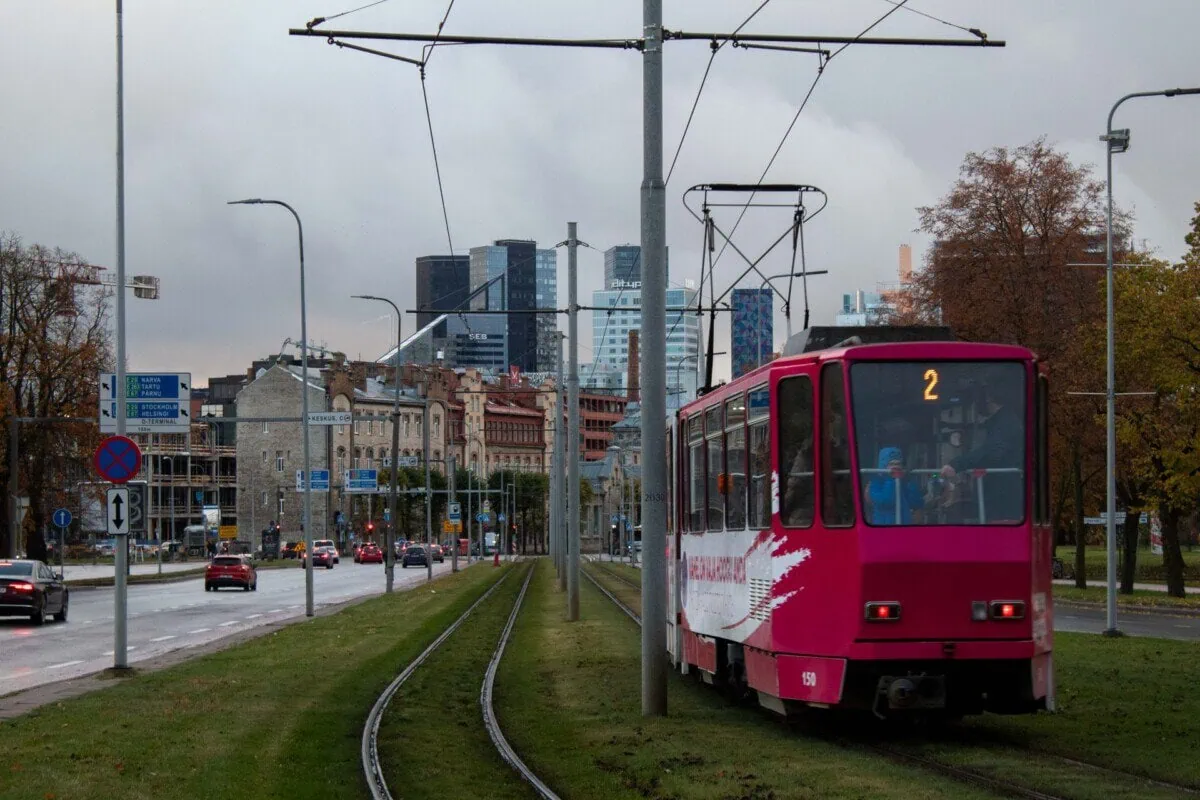
Tallinn’s tram network is genuinely historic, tracing back to a horse-drawn line that opened in 1888, which makes it one of the oldest continuously running systems anywhere in the Baltics. Electric trams took over in the 1920s, and the network has been steadily rebuilt and extended ever since, most recently with a new line out to the Old City Harbour.
Today the system runs six lines across the city, most converging near Hobujaama close to the edge of the Old Town, which makes changing between routes straightforward for visitors staying centrally. Two lines run out to Kadriorg Park, home to the Kadriorg Palace and several of the city’s better museums, giving trams a genuine sightseeing use beyond simple transport.
Two further lines connect the city centre directly to Tallinn Airport, one of them continuing on to the Old City Harbour where the main Baltic ferry terminals sit. That direct link is covered in far more depth in our dedicated airport guide, but it’s worth knowing here that the same tram tickets described on this page apply to that journey too.
Modern low-floor trams now share the tracks with older rolling stock still doing everyday work, and both types validate tickets the same way, via a card reader by the door. Stops are marked clearly with route numbers, and most services run at intervals of roughly ten minutes through the day.
For a visitor without a car, the tram is usually the fastest way to cover any real distance across the city, since it avoids the same road traffic that slows down taxis and buses at peak times. Riding one is also, in its own right, one of the more pleasant low-key ways to see residential Tallinn beyond the postcard streets of the centre.
Buses and Trolleybuses Filling the Gaps
Where the tram network doesn’t reach, TLT’s bus and trolleybus routes pick up the slack, covering the wider city on numbered services that run well beyond the compact centre most visitors see. Buses reach outer districts, ferry terminals not directly served by tram, and residential neighbourhoods that would otherwise need a taxi.
Trolleybuses, which draw power from overhead wires rather than running on rails, cover several of the busiest central corridors and are a distinctly Tallinn detail for anyone used to a purely rail-and-bus system elsewhere in Europe. They run on the exact same ticket as trams and standard buses, so there’s no separate fare or app to think about.
For most visitors sticking to the Old Town, Kadriorg and the harbour area, buses are more of a useful backup than a primary way to travel, filling in the occasional gap where a tram stop is a longer walk than it looks on a map. They’re particularly handy for reaching a hotel a little further out, or a specific ferry terminal that the tram doesn’t pass directly.
Validation works the same way as on the trams, by tapping a contactless bank card or Ühiskaart at the reader near the doors, and the same time-based ticket rules apply across every mode. This is genuinely convenient in practice, since one ticket can cover a bus, a short walk, and a tram within the same journey without paying twice.
Timetables and live arrivals for every route are published through TLT’s own journey planner, which is worth bookmarking before a trip that involves anything beyond the handful of central tram lines most guides mention. It’s a small extra step that saves a genuinely confusing wait at an unfamiliar stop.
Best for a short trip. Compare rooms by neighbourhood, price and guest rating before you book.
Compare hotelsBest for families, or any stay past about four nights. A kitchen and a washing machine start paying for themselves.
Browse rentalsBest as a last check before booking. Compares Tallinn hotel rates across several sites in one search.
Compare ratesMajor Lines and Interchanges
For a short stay, only a handful of Tallinn’s six tram lines actually matter, and the two pairs already covered above account for most tourist journeys: the two lines out to Kadriorg Park and its museums, and the two linking the centre to the airport and the Old City Harbour. The remaining routes exist mainly to move residents between outer districts, and a visitor can generally ignore them without missing anything useful.
Hobujaama, right on the edge of the Old Town, is where most of those lines physically converge, which makes it the easiest single point to change trams without walking any real distance. Visitors staying centrally can treat it as a default starting point whenever a route isn’t obvious from a map alone.
The tram stop at Viru, on the opposite edge of the Old Town from Hobujaama, works as a second interchange in practice, since the Viru Keskus shopping centre above it has a bus terminal built directly underneath, serving a wide spread of routes out to the suburbs. Between the two, most places the tram and bus network reaches are workable with no more than one change.
Trolleybuses add a third layer along some of the busiest central corridors, running on exactly the same ticket as trams and buses, though which numbered route covers which street shifts occasionally as the network is adjusted. Checking TLT’s journey planner before boarding an unfamiliar route is a safer habit than relying on a printed map or an old guidebook.
Balti Jaam, the Coach Station and How They Connect
Two further transport hubs are worth knowing about if your trip reaches beyond the Old Town and its trams. Balti jaam, Tallinn’s central railway station, sits right on the edge of the historic core on Toompuiestee, close enough that the medieval walls are a short walk away, and it backs onto the increasingly popular Kalamaja and Telliskivi Creative City neighbourhoods.
The station handles Elron’s domestic network, with regular trains to Tartu, Narva, Viljandi and several smaller towns, plus a newer daily service continuing on from Tartu to Riga, with a connection onward to Vilnius for anyone travelling overland between the Baltic capitals. Pärnu is a notable exception: despite being one of Estonia’s larger towns, it currently has no passenger rail link to Tallinn at all, and is reached by intercity bus instead.
Balti jaam is also a genuine tram interchange in its own right, with several of the lines already covered on this page calling at the stop right outside, so arriving by train drops you straight into the same network the rest of this guide describes. City buses serve the station too, making it a workable starting point for journeys that don’t begin or end in the Old Town.
Tallinn’s intercity and international coaches use a separate bus terminal, Tallinna bussijaam, on Lastekodu street just over a kilometre from the Old Town, distinct from the city bus stops covered earlier in this guide. It’s the departure point for domestic routes to towns like Pärnu, and for international operators such as Lux Express and Ecolines running to Riga, Vilnius and beyond.
Getting between the coach station and the centre is straightforward, since tram lines 2 and 4 stop right outside on Tartu Road and reach the Old Town within a few minutes, with several city buses covering the same route for anyone who’d rather not wait for a tram. The same tickets and validation rules covered earlier in this guide apply on that short hop exactly as they do everywhere else on the network.
Free Transport for Residents and What It Means for Visitors
Tallinn made global headlines in 2013 when it became one of the first European capitals to make public transport entirely free for its own residents, and the policy has stayed in place ever since. Anyone officially registered as living in the city travels on trams, buses and trolleybuses at no cost, provided they carry a personalised Ühiskaart validated at every boarding.
The scheme was designed to widen access for lower-income residents and pull commuters out of cars, and the city has repeatedly reported that it more than pays for itself through the wider registration and tax benefits of formally registering as a Tallinn resident. It remains current policy as of this writing, not a scheme that quietly lapsed after the initial headlines faded.
Where this genuinely trips visitors up is the assumption that “free public transport in Tallinn” applies to them too, since that’s usually how the policy gets reported internationally. It does not: a tourist or short-term visitor without Estonian residency status is not covered by the scheme under any circumstances, no matter how the ticket machine or card looks.
In practice, this means every visitor still needs to buy and validate a proper ticket exactly as they would in Berlin, Vienna or Copenhagen, whether that’s a single QR ticket, a loaded Ühiskaart, or a contactless bank card tapped at the reader. Riding without one and getting caught by an inspector is treated the same as fare evasion anywhere else, free-city reputation or not.
The upside for visitors is that Tallinn’s own fares are still comparatively low by Northern European standards, even without the residents’ discount, so the practical gap between “technically free for locals” and “cheap for everyone else” is smaller than it might sound. The rest of this guide covers exactly what those visitor fares actually are.
Ticketing for Visitors: The Ühiskaart and Your Options
The backbone of Tallinn’s ticketing system is the Ühiskaart, a reloadable smart card that works across trams, buses and trolleybuses citywide. Buying one costs a refundable €2 (£1.75/$2.20) deposit, and it can then be loaded with either pay-as-you-go credit or a specific time-based e-ticket.
Loaded as pay-as-you-go, the card automatically deducts a standard hour ticket each time you validate, and the system caps your total spend for the day once you’ve paid the equivalent of a day ticket. This works well for a visitor unsure exactly how many journeys they’ll make, since it quietly finds the cheaper option without any extra effort.
Alternatively, the card can hold a fixed-duration e-ticket covering one, three, five or thirty days, which is usually the simpler choice for anyone planning several journeys across a short city break. These tickets activate on first use and then cover unlimited travel across every mode until they expire, with no need to validate a fresh ticket each time you board.
Visitors who’d rather skip the card entirely can also tap a contactless bank card or phone wallet directly at the reader, which charges an hour ticket automatically without any need to buy or top up anything in advance. This is the fastest option for a short stay, though it doesn’t offer the day-ticket cap that a loaded Ühiskaart does.
Cards and e-tickets are sold through the Pilet.ee ticketing platform, at machines near major stops, and through some kiosks, though cash is not accepted anywhere in the system. Whichever method you choose, the ticket only counts once it has actually been validated, not simply purchased.
Which Ticket Should You Buy?
The right choice depends mostly on how many journeys you’ll realistically make each day, not on any complicated fare calculation. For a single tram ride or two, tapping a contactless card at the reader is the simplest option, since it charges the standard fare automatically with nothing to plan in advance.
Once your day involves three or more separate rides, a day ticket almost always works out cheaper than paying per journey, and it removes the small hassle of validating a fresh ticket every time you board. A standard 1-day ticket costs €5.50 (£4.75/$6) and covers every tram, bus and trolleybus from first validation until the transport day ends.
For a longer city break, the 3-day ticket at €9 (£7.75/$9.80) or the 5-day ticket at €11 (£9.50/$12) both offer clear value over buying singles, particularly if your itinerary includes trips out to Kadriorg or repeated journeys back and forth to the harbour. Anyone staying closer to a month, such as a longer working stay, is better served by the 30-day ticket at €30 (£26/$33).
If you expect to spend most of your visit walking the Old Town, which this guide covers separately below, it’s worth resisting the urge to buy a multi-day pass out of habit. A pass only pays for itself once you’re actually using it several times a day, and a compact sightseeing itinerary inside the medieval walls often doesn’t need one at all.
The Tallinn Card and Whether It’s Worth It
The Tallinn Card is the city’s official all-in-one tourist pass, bundling unlimited public transport with free entry to more than 50 attractions and museums, including the TV Tower observation deck, the Estonian Open Air Museum and Kadriorg Art Museum. It’s sold in 24, 48 and 72-hour versions, activating from the first time you use it rather than from the moment of purchase.
Current adult pricing runs from €45 (£39/$49) for 24 hours up to €78 (£67.50/$85) for 72 hours, with child pricing roughly two-thirds of the adult rate at each duration. Two children under seven travel and enter free alongside a paying adult, which makes the card noticeably better value for a family than for a solo traveller doing the same maths.
Transport coverage is genuinely comprehensive, including the tram and bus connections to the airport and harbour described elsewhere on this page, so cardholders don’t need to think about tickets at all for the duration of their visit. On transport alone, though, the card is poor value against the ordinary day passes covered above, since a standard 3-day transport ticket costs a fraction of the card’s price.
The card only earns its cost once you’re genuinely combining transport with several paid attractions in the same window, typically three or more museums or sights in a single day, at which point the bundled admission quickly outweighs the transport premium. Anyone planning a transport-only trip, or just one or two attractions, is almost always better off buying a standalone travel ticket and paying attraction entry separately.
Best if you can move a day either way. Shows how the fare to Tallinn changes across the month.
Compare flightsBest if you want maps and messaging working the moment you switch your phone on.
See eSIM plansBest after a long flight or a late landing. Price agreed before you travel, and no taxi queue.
Check transfersGetting Around Old Town on Foot
Tallinn’s Old Town is one of the best-preserved medieval city centres in Northern Europe, and it is, without much argument, the one part of the city genuinely built for walking rather than wheels. Narrow cobbled lanes, steep sections around Toompea Hill, and stone courtyards that predate any form of motorised transport make trams and buses largely irrelevant once you’re inside the walls.
No tram line actually enters the historic core itself, and the closest useful stops, such as Viru on the edge of the centre, are a short walk from most of the Old Town’s main sights rather than directly outside them. This is by design rather than an oversight, since running rail lines through streets this narrow and this old simply isn’t practical.
Comfortable, flat footwear matters more here than almost anywhere else covered in this guide, particularly in winter when snow and ice can make the cobbles genuinely slippery. Visitors travelling with cases or pushchairs should expect the final stretch into their accommodation to be on foot regardless of which tram or bus they use to reach the area.
Most of the core sights sit within a fifteen-minute walk of each other, which means a visitor spending most of their trip inside the walls may barely need a ticket at all beyond the initial journey in from the airport or harbour. Public transport becomes far more relevant the moment your plans stretch out to Kadriorg, the suburbs, or beyond the city itself.
Buying and Validating Your Ticket
Buying a ticket in Tallinn is straightforward, though it helps to know the cash is never accepted rule before you arrive, since it catches a fair number of first-time visitors off guard. Every ticket type, from a single hour fare to a loaded Ühiskaart, is bought either digitally, through a vending machine, or by tapping a contactless card directly at the reader.
The Pilet.ee platform, available as a website and mobile app, lets you buy and manage e-tickets, top up an Ühiskaart, and check a card’s remaining balance from a phone rather than hunting for a machine. This is generally the most convenient option for a short visit, since it avoids finding a physical sales point at all.
Ticket machines are located at major tram and bus stops across the city, particularly around the Old Town’s edges and the airport, and most accept card payment directly. Whichever method you use, a ticket only becomes valid once it has actually been validated at the start of the journey, by tapping it or the card at the reader near the vehicle doors.
This validation step matters more than it might seem, since simply holding a valid-looking ticket or a topped-up card is not the same as having validated a journey. An unvalidated ticket, or a card with credit but no tap recorded for that specific ride, is treated exactly the same as travelling with no ticket at all if an inspector checks.
Ticket Inspections and Fines
Ticket inspectors do genuinely check on Tallinn’s trams and buses, more often than the city’s free-for-residents reputation might suggest, and visitors are not exempt from those checks simply because they’re passing through. Inspections happen at random across the network, on both busy central routes and quieter outer services.
The confirmed penalty for travelling without a valid, validated ticket is a fine of up to €40 (£34.50/$43.50), payable on the spot or afterwards depending on the circumstances of the check. This applies equally to a tourist who genuinely didn’t realise the rules and a resident who forgot to tap their card.
It’s worth being honest that fine amounts and enforcement practices can shift over time, and any figure quoted here should be treated as the most recently confirmed level rather than a permanent guarantee. Checking the current policy directly with TLT before a longer stay is sensible if avoiding any ambiguity matters to you.
In practice, the simplest way to avoid the issue entirely is the habit already covered above: validate every single boarding, even on a card you’ve already loaded with credit or an active day ticket. It takes a couple of seconds and removes any risk of an unwelcome conversation with an inspector partway through your trip.
Apps Worth Downloading
Beyond the Pilet.ee app already covered for buying and managing tickets, a couple of other apps are genuinely worth having on your phone before you land. TLT’s own journey planner, run through transport.tallinn.ee, covers live timetables and route planning across every tram, bus and trolleybus line in the city.
It’s a plain, functional tool rather than a polished consumer app, but it’s the most accurate source for real-time departures and service changes, which matters more in winter when weather can disrupt the usual schedule. Bookmarking the site on your phone before a trip saves searching for it at an unfamiliar stop.
For getting around outside the public transport network entirely, Bolt is worth having installed too, since the ride-hailing app originated in Estonia and remains the dominant option for taxis across the city. It’s particularly useful late at night or when travelling with heavy luggage, when a tram or bus simply isn’t the practical choice.
None of these tools replace actually understanding the ticket and validation rules covered earlier in this guide, but together they remove most of the guesswork that can otherwise make a new city’s transport system feel more complicated than it actually is. A few minutes setting them up before you travel pays off quickly once you’re moving around for real.
Connecting to and from the Airport
This guide focuses entirely on getting around once you’re already in Tallinn, so the fuller detail on reaching the city from Lennart Meri Tallinn Airport lives in its own dedicated page rather than repeated here. What’s worth knowing on this page is simply that the airport sits on the same tram network covered above, so the same tickets and fares apply for that first journey too.
Two of the city’s tram lines run directly between the airport and the centre, making it one of the more genuinely convenient airport-to-city links in the Baltic region, without needing an airport-specific express fare of any kind. Buses also serve the airport for travellers heading to districts the trams don’t reach directly.
For the full breakdown of journey times, which specific tram or bus to take, and how the airport connects onward to the ferry terminals, our dedicated Tallinn Airport Transfers guide covers all of it in far more depth than makes sense to repeat here. It’s worth reading alongside this page if your trip starts or ends at the airport rather than already inside the city.

Rupert’s Handy Travel Tips
Rupert says the biggest thing to unlearn about Tallinn is the idea that any of this is free just because it’s free for the neighbours.
- Validate every single tap: a loaded Ühiskaart or an active day ticket doesn’t count until you’ve actually tapped it at the start of the journey.
- Don’t assume “free” applies to you: Tallinn’s residents’ scheme has run since 2013, but visitors still need a proper ticket every time.
- Skip the Tallinn Card for transport alone: buy it only if you’re combining several paid attractions with your travel, otherwise a standard day ticket is far cheaper.
- Wear proper shoes for the Old Town: cobbled lanes and the climb up Toompea Hill are no fun in the wrong footwear, especially in icy weather.
- Keep Bolt installed as a backup: it’s Estonia’s own ride-hailing app and the easiest fallback once trams and buses have stopped for the night.
Want to meet the reindeer behind our travel tips? Find out more in our page Who is Rupert?.




Frequently Asked Questions About Tallinn Public Transport
How much is a single ticket on Tallinn’s public transport?
A standard hour ticket costs €2 (£1.75/$2.20) and covers unlimited transfers between trams, buses and trolleybuses for 60 minutes from validation.
Is public transport really free in Tallinn?
Only for officially registered Tallinn residents, a policy running since 2013; tourists and other short-term visitors still need to buy and validate a normal ticket.
What is the Ühiskaart and do I need one?
It’s Tallinn’s reloadable smart card for public transport, useful for a longer stay, though a contactless bank card tapped at the reader works just as well for a short visit.
Is the Tallinn Card worth buying just for transport?
No, a standard day or multi-day transport ticket is far cheaper; the card only pays off once it’s combined with several paid museums or attractions.
What happens if I don’t validate my ticket?
Inspectors do check, and an unvalidated ticket is treated as travelling without one, carrying a fine of up to €40 (£34.50/$43.50).
Can I walk everywhere in the Old Town without using transport?
Mostly yes, since no tram line enters the historic core and most of its sights sit within a fifteen-minute walk of each other.
Best for solo travellers and anyone watching the budget. Dorm beds and private rooms in the same search.
Browse hostelsBest if you have ever given up on a claim. AirHelp checks whether the flight qualifies and pursues it for you.
See the benefitsBest if your room is not ready yet. Left luggage booked in advance, so you are not hunting for a locker.
Check storageFurther Reading & Related Guides
If you haven’t yet sorted the journey from the airport into the city, our Tallinn Airport Transfers guide is the natural place to start, covering the tram, bus and taxi options in full. Once that first leg is sorted, everything on this page covers moving around the city itself.
For a wider look at what those trams and buses can actually take you to, our Best Things to Do in Tallinn guide pulls together the city’s main sights, including several reached easily by the routes described above. It’s a useful companion to read alongside this page rather than in isolation.
Travellers planning to head beyond the capital should also look at our Day Trips from Tallinn guide, since journeys outside the city generally need a different ticket to the ones covered here. For anyone arriving or leaving by sea, our Ferry Routes from Tallinn guide explains the wider Baltic ferry network the harbour tram line connects into.
Finally, for a deeper look at the historic core this guide keeps returning to on foot, our Tallinn UNESCO Guide covers the Old Town’s medieval architecture and heritage status in far more detail than a transport-focused page like this one really should.
Tallinn is one of three Baltic capitals covered in this style on the site: our Riga Public Transport guide and Vilnius Public Transport guide cover the same ground for the other two, useful reading for anyone combining a trip across all three.