Reviewed by our editorial team Published
Kaunas is Lithuania’s second-largest city and a place with real confidence in its own identity, sitting at the confluence of the Nemunas and Neris rivers roughly in the country’s geographic centre. Its Old Town has none of the polish of a capital purpose-built for tourists, and that rougher, lived-in feel is exactly what makes wandering it worthwhile.
Between 1920 and 1939, when Vilnius was under Polish control, Kaunas served as Lithuania’s provisional capital, and that two-decade stretch left behind an enormous body of interwar modernist architecture that UNESCO recognised as a World Heritage Site in 2023. Few Baltic cities can point to a single architectural chapter this cohesive, which gives Kaunas a genuinely different flavour from Vilnius’s Baroque Old Town or Riga’s Art Nouveau streets.
Many visitors first encounter Kaunas as a day trip from the capital, and our guide to day trips from Vilnius covers exactly that option for anyone based there. Kaunas rewards a longer stay in its own right though, with enough genuinely distinct sights, museums and one seriously sobering historical site to fill two or three full days.
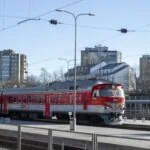
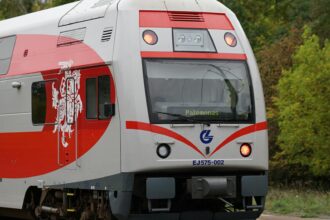
Getting there is straightforward. Regular trains connect Kaunas with Vilnius in about an hour, and travellers combining several Lithuanian stops are often better off checking our Interrail Lithuania Pass guide before buying individual tickets, since a pass can cover this route alongside onward travel to Klaipėda or the coast. Kaunas also has its own international airport, a short drive from the centre, useful for anyone flying in directly rather than routing through Vilnius.
This guide works through Kaunas’s essential sights in a sensible order: the Old Town and its castle first, then the cathedral, the city’s grand museums and the quietly extraordinary Devils’ Museum, the interwar Presidential Palace and the wider modernist heritage that earned the UNESCO listing, the two historic funiculars, Pažaislis Monastery outside the centre, the genuinely difficult history at the Ninth Fort, and the Lithuanian Zoo for anyone travelling with children.
Kaunas Attractions at a Glance
| Attraction | What It’s For / Why Visit | Time to Spend |
|---|---|---|
| Kaunas Old Town and Town Hall Square | Cobbled streets and the Baroque Town Hall at the city’s historic core | 1-2 hours |
| Kaunas Castle | One of Lithuania’s oldest fortresses, with a small museum and riverside park | 30-45 minutes |
| Laisvės Alėja | Long pedestrian boulevard linking the Old Town to Žaliakalnis | 45 minutes to 1 hour |
| Kaunas Cathedral Basilica | Lithuania’s largest Gothic church, free to enter | 20-30 minutes |
| The House of Perkūnas | Gothic merchant house with a pagan-god legend behind its name | 10-15 minutes |
| Vytautas the Great War Museum | Military history museum, home to the Lituanica aircraft wreckage | 1 hour or more |
| M. K. Čiurlionis National Art Museum | Lithuania’s main fine art museum, built around painter Čiurlionis’s work | Around 2 hours |
| Mykolas Žilinskas Art Gallery | International art collection spanning Ancient Egypt to European Old Masters | Around 1 hour |
| The Devils’ Museum | Quirky collection of devil figurines gathered from across the world | 1 hour or more |
| Historical Presidential Palace | Interwar seat of government, furnished as it stood at the time | 30-45 minutes |
| Modernist Kaunas walking route | Self-guided tour of the city’s UNESCO-listed interwar architecture | 2-3 hours |
| Žaliakalnis and Aleksotas Funiculars | Two working 1930s funiculars with hilltop river views | 15-20 minutes for both |
| Pažaislis Monastery and Church | Lithuania’s finest Italian Baroque complex, on the reservoir shore | Half a day including travel |
| The Ninth Fort | Sobering Holocaust and Soviet-era history museum and memorial | 1 hour or more |
| Lithuanian Zoo | The country’s principal zoo, set in a wooded Žaliakalnis park | 2-3 hours |
Kaunas Old Town and Town Hall Square
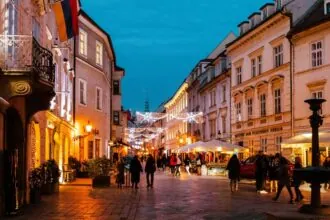
Kaunas’s Old Town sits at the tip of the peninsula where the Nemunas and Neris rivers meet, a compact grid of cobbled streets that has served as the city’s centre since the fourteenth century. It is smaller and less manicured than Vilnius’s Old Town, which is part of its appeal, since ordinary bars, bakeries and repair shops still operate alongside the historic facades.
The square at its heart, Rotušės aikštė, is dominated by Kaunas Town Hall, a Baroque and Classical building first raised in 1542 and rebuilt several times since, whose slender white tower climbs 53 metres above the rooftops. Locals nicknamed it the White Swan for its pale, elegant silhouette, and the tower remains the tallest structure in the Old Town.
The Town Hall has done almost everything over its history, serving as a prison, a warehouse, a Russian-language theatre and an Orthodox storeroom before settling into its current role as a wedding registry and a branch of the Kaunas City Museum. Couples still marry there most weekends, and the small museum inside displays the city’s historic mayoral chain and old civic flags.
Around the square, narrow streets radiate out past merchant houses, churches and small museums, most of them easily covered on foot within an hour or two. Vilniaus gatvė, the main artery linking the Old Town to Freedom Avenue, is lined with cafes and independent shops that make a good stop between sights.
The Old Town works best as a starting point rather than a single stop, since nearly everything else in this guide sits within a short walk or tram ride of Rotušės aikštė. Arriving in the late afternoon, when the square empties out and the Town Hall is lit, is the easiest way to see it without the daytime tour groups.
Best if you want daily housekeeping and a front desk. Filter by area first, then by price.
Check availabilityBest for families, or any stay past about four nights. A kitchen and a washing machine start paying for themselves.
Browse rentalsBest if you have already picked a hotel. Checks the big booking sites for the same room and shows who is cheapest.
Check dealsKaunas Castle and Its Riverside Ruins
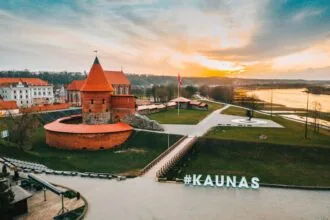
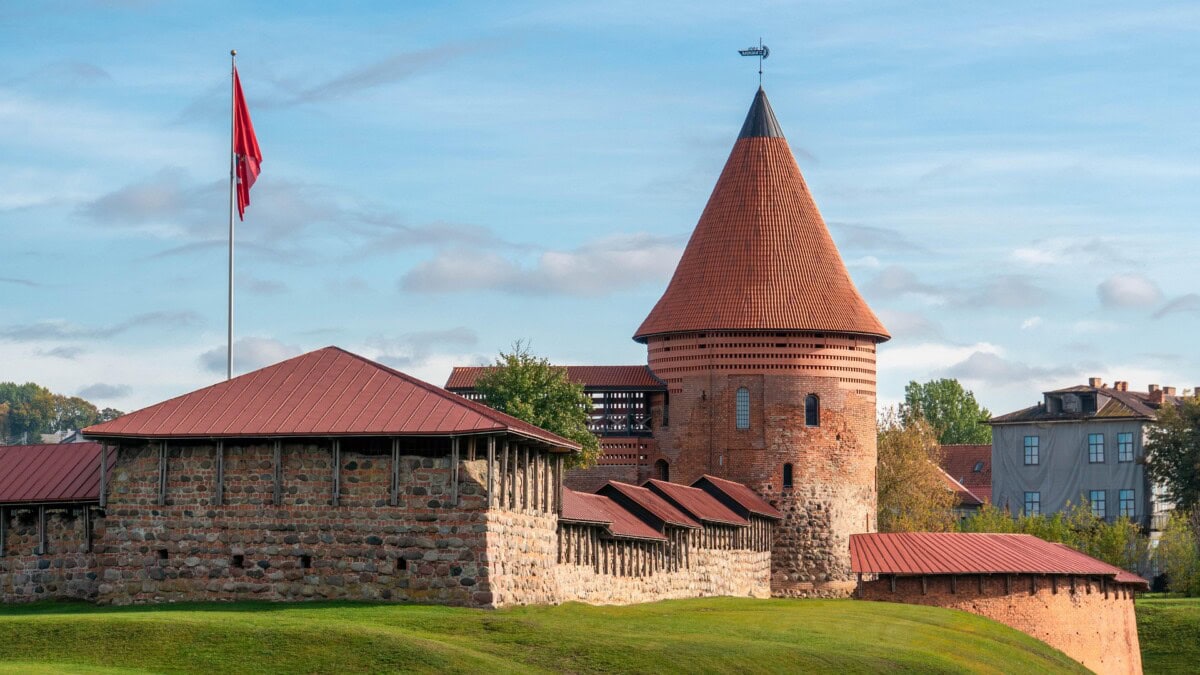
Kaunas Castle is one of Lithuania’s oldest surviving masonry fortresses, built in the mid-fourteenth century on a low bluff overlooking the river confluence to guard the young state’s western frontier. Only a fraction of the original structure survives, since the Nemunas eroded much of it centuries ago, but the restored northern wall and corner tower still give a real sense of scale.
The castle has changed use more than once since then, serving at various points as a garrison and a prison before opening as a museum. Inside, exhibitions cover the site’s archaeology alongside paintings and artefacts, and the museum periodically hosts archery and crossbow demonstrations that give the courtyard a more lived-in feel than a typical roped-off ruin.
Entry costs a modest €4 (£3.50/$4.50) for a regular ticket and €2 (£1.75/$2.25) for students and seniors, with several categories, including school groups and visitors with disabilities, admitted free. The castle keeps shorter hours on Sundays outside the summer months, so it is worth checking the current schedule before building it into a tight itinerary.
The castle sits inside Santaka Park, the green wedge of land at the exact point where the two rivers join, which makes it an easy add-on to a walk through the Old Town rather than a separate outing. Benches along the riverbank give a good vantage point for photographing the walls without paying for entry, useful for anyone travelling on a tighter budget.
Because the castle is genuinely small, most visits take no more than thirty to forty-five minutes unless a festival or workshop is running. Pairing it with the Town Hall and a walk down to the confluence itself makes a natural first stop for anyone arriving in Kaunas for the day.
Laisvės Alėja: Kaunas’s Grand Pedestrian Boulevard
Laisvės alėja, or Freedom Avenue, is the 1.6-kilometre pedestrian boulevard that runs from the edge of the Old Town out towards Žaliakalnis, and it is regularly described as one of the longest pedestrian streets in Eastern Europe, though exact rankings against other cities’ boulevards vary by source. Whatever its precise standing, walking its full length end to end is one of the best ways to understand how Kaunas is laid out.
Lined with linden trees down a central median and flanked by buildings mostly two or three storeys tall, a restriction originally imposed to keep sightlines clear for the nineteenth-century Kaunas Fortress, the avenue only became fully pedestrianised in 1982. Today cars cross it only at intersections, which keeps the whole length genuinely walkable rather than just nominally car-free.
The avenue runs past the Kaunas State Musical Theatre, the National Kaunas Drama Theatre and a run of cafes, shops and interwar facades that reward slowing down rather than walking straight through. At its eastern end it meets St. Michael the Archangel’s Church, a Neo-Byzantine landmark built for the Russian garrison in the 1890s, giving the walk a clear architectural bookend.
This is also the natural link between the Old Town and Žaliakalnis, the hillside district reached by the Žaliakalnis Funicular, so it works well as a spine for a full day’s walking rather than a detour in its own right. Public benches and outdoor seating from the avenue’s many cafes make it easy to break the walk into stages.
Evenings bring out a different crowd, with restaurant terraces filling along the stretch nearest the Old Town, making it as much a place to eat and people-watch as to sightsee. Anyone short on time could reasonably walk just the central third and still get a fair sense of the avenue’s character.
Kaunas Cathedral Basilica and Its Gothic Origins
The Cathedral Basilica of St. Peter and St. Paul is the largest Gothic church in Lithuania, a red-brick structure that Grand Duke Vytautas the Great helped establish by 1413, though building work continued in stages until 1624. At 84 metres long, it dominates the southern end of the Old Town’s main street even before visitors step inside.
Fire and war repeatedly damaged the building, most seriously a blaze in 1732 that forced repairs incorporating Renaissance and Rococo details onto the original Gothic shell, which is why the interior reads quite differently from the plain brick exterior. Pope Leo XIII raised it to cathedral status in 1895, and it was granted the honorific title of minor basilica in 1921.
Inside, nine side altars and a richly decorated high altar sit beneath a vaulted ceiling, and several notable Lithuanian churchmen, including Bishop Motiejus Valančius, are buried within. Pope Francis visited the cathedral in September 2018 during his tour of the Baltic states, a detail still mentioned proudly by local guides.
The cathedral sits at the point where the pedestrianised Old Town meets Vilniaus gatvė, making it an easy stop between the Town Hall and Laisvės alėja rather than a special trip of its own. Entry to the main body of the church is free, though a small donation is customary.
Mass times mean parts of the interior are sometimes closed to sightseeing, so visiting outside a service gives the most freedom to look around properly. Even a brief stop is worth it for the scale of the nave alone, which is unusual for a church this far from Lithuania’s larger cities.

The House of Perkūnas
Tucked into a quiet Old Town street, the House of Perkūnas is one of the finest surviving examples of Gothic residential architecture in Lithuania, built in the late fifteenth century for a Hanseatic League merchant trading through Kaunas’s river port. Its patterned brick facade, put together from as many as sixteen differently profiled brick types, is the kind of detail easy to miss unless pointed out.
The building takes its name from a carved figure of Perkūnas, the pagan god of thunder, discovered inside its walls during renovation work in the nineteenth century, long after Lithuania’s official conversion to Christianity. That discovery cemented its current name and gave the house a small mythological footnote that most Old Town buildings lack.
In 1843 the house became home to Kaunas’s first drama theatre, adding another layer to a building that had already passed through several merchant and religious owners by then. Today it functions on a smaller, low-key scale, without the queues or ticketing of the city’s bigger museums, which makes it an easy stop to fold into an Old Town walk.
It sits on Aleksoto gatvė, just a short walk from both Town Hall Square and the riverside path down to the Vytauto Didžiojo bridge, so there’s no need to plan a special detour to see it. The exterior is the main draw and can be appreciated from the street even outside opening hours.
Because it’s small and easy to overlook, the House of Perkūnas rewards travellers who like Old Towns for these kinds of quiet architectural curiosities rather than headline sights. Pair it with a coffee stop on the same street to make the most of the area.
Vytautas the Great War Museum
The Vytautas the Great War Museum traces Lithuanian military history from prehistoric times through to the present day, housed in an imposing Art Deco building on Vienybės aikštė that opened in its current form in February 1936. Vladas Nagevičius founded the collection in 1921, and it now ranks among the country’s most visited museums.
Its single most famous exhibit is the wreckage of the Lituanica, the aircraft that pilots Steponas Darius and Stasys Girėnas flew across the Atlantic from New York in 1933 before crashing in Germany just short of their goal, a flight still commemorated across Lithuania. Alongside it sit collections of historic weapons, including seventeenth-century cannons and Kaunas Fortress defence material from the First World War.
The museum shares its building with the M. K. Čiurlionis National Art Museum next door, and a restored 49-bell carillon, rebuilt from an original cast in Belgium in 1935, still rings out over the square on set occasions. A crypt beneath the building, first built in 1938 and restored in 1998, honours those who died fighting for Lithuania’s independence.
Outside, Vienybės aikštė itself holds the Tomb of the Unknown Soldier with its eternal flame, along with statues of Lithuanian cultural and military figures set among the museum garden’s trees. The whole square works as a single, connected visit rather than separate stops.
The museum received the European Heritage Label in 2015 and forms part of the wider group of interwar buildings recognised in Kaunas’s 2023 UNESCO World Heritage listing, which is worth knowing before dismissing it as just a military collection. Give it at least an hour, longer for anyone with a specific interest in the Lituanica story.
The M. K. Čiurlionis National Art Museum
The M. K. Čiurlionis National Art Museum is Lithuania’s principal fine art institution, founded in 1921 primarily to preserve the work of the painter and composer Mikalojus Konstantinas Čiurlionis, who died in 1911 having produced a body of symbolist, almost musical paintings unlike anything else in Lithuanian art. His canvases, drawn from cosmic and folk themes alike, remain the museum’s core draw.
Beyond Čiurlionis’s own rooms, the museum’s holdings run to more than 355,000 items spanning Lithuanian folk art, applied arts from the fifteenth to twentieth centuries, ancient world artefacts and foreign fine art, making it far larger in scope than its name alone suggests. Numismatics and decorative arts collections round out a museum that easily fills a couple of hours.
The building itself, completed in the interwar Art Deco and early functionalist style typical of 1920s and 1930s Kaunas, earned the European Heritage Label in 2015 and sits within the UNESCO-listed modernist heritage covered later in this guide. Its location on V. Putvinskio gatvė places it a short walk from Vienybės aikštė and the War Museum.
The museum operates several branch sites across the city, including the Historical Presidential Palace and the Mykolas Žilinskas Art Gallery covered separately below, so a single ticket type or combined pass can sometimes cover more than one stop in a day. Checking current branch opening days before visiting is worthwhile, since not every branch keeps identical hours.
For anyone with limited time in Kaunas, the main Čiurlionis building is the single best introduction to Lithuanian art history available in the city, and it rewards a slower visit over a rushed one given how unusual Čiurlionis’s own work is compared with better-known European movements of the same period.
Best for long or awkward journeys. Builds one itinerary out of separate flights.
View flightsBest for anyone whose home plan charges by the megabyte abroad. Pay a fixed price up front.
Check eSIMsBest after a long flight or a late landing. Price agreed before you travel, and no taxi queue.
Check transfersThe Mykolas Žilinskas Art Gallery
The Mykolas Žilinskas Art Gallery grew out of a private collection donated to the city between 1974 and 1988 by Mykolas Žilinskas, a Lithuanian-born collector who spent much of his life abroad before giving his holdings to Kaunas. A dedicated gallery building opened on Independence Square in 1989 to house the growing collection properly.
Its roughly 1,683 works range far beyond Lithuania, taking in Ancient Egyptian pieces, European decorative arts from the seventeenth to twentieth centuries and Italian paintings from the same broad period, giving Kaunas a genuinely international art collection that few visitors expect to find here. The gallery also runs a Contemporary Art Information Centre and a small cinema alongside its permanent rooms.
As a branch of the M. K. Čiurlionis National Art Museum, it sits within the same institutional family as the main museum and the Presidential Palace, though its Independence Square location puts it a short walk from Freedom Avenue rather than immediately beside the War Museum. That makes it easy to combine with an afternoon spent on Laisvės alėja.
Temporary exhibitions rotate through the gallery regularly, so the permanent Egyptian and European collections are usually only part of what’s on display at any given time. It is a good option on a wet afternoon when outdoor sightseeing loses its appeal.
Given how few visitors expect an Egyptian and Old Master collection in a mid-sized Baltic city, the gallery is one of Kaunas’s better surprises, and it rarely gets crowded even when the Old Town nearby is busy.
The Devils’ Museum
Officially the A. Žmuidzinavičius Creations and Collections Museum, but universally known as the Devils’ Museum, this collection began almost by accident when the Lithuanian artist Antanas Žmuidzinavičius received a small devil figurine as a gift at a folk art exhibition in 1906. He kept collecting for the rest of his life, and by the time he died in 1966 the hoard had grown into something genuinely unique.
Žmuidzinavičius originally set himself the target of collecting thirteen baker’s dozens, 169 devil figures, but friends and acquaintances kept sending contributions until the total reached twenty dozens, 260 pieces, all gifted rather than bought. Among them, an eighteenth-century wooden carving known as the Trampled Devil, showing Saint Michael standing over a defeated demon, remains one of the collection’s oldest and most striking pieces.
The museum has expanded considerably since Žmuidzinavičius’s death, now displaying several thousand devil figures, masks and folk carvings sourced from across Europe, the Americas, Asia and Africa across its upper floors, alongside the original Lithuanian folk art collection on the level below. Lithuanian folklore alone accounts for more than 5,000 devil-related legends and roughly 400 place names, context the museum uses to explain why this figure looms so large in local culture.
It’s one of the more unusual stops in this guide, and precisely because of that, it tends to appeal to visitors who might otherwise skip a fine art museum, particularly families with older children drawn in by the sheer strangeness of the collection. The building sits a short tram or taxi ride from the Old Town rather than within easy walking distance, so it’s worth building into a half-day plan rather than a quick add-on.
Photography is generally permitted throughout, and the sheer density of exhibits, arranged floor to ceiling in places, means a visit can easily run to an hour or more for anyone who reads the accompanying labels rather than skimming past. It remains one of the most distinctive small museums anywhere in the Baltics.
The Historical Presidential Palace of Lithuania
When Kaunas served as Lithuania’s provisional capital between the wars, this modest but dignified building on Vilniaus gatvė functioned as the country’s presidential residence, home in turn to Antanas Smetona, Aleksandras Stulginskis and Kazys Grinius as each held the office. It is one of the few interwar government buildings in the city still furnished and displayed roughly as it would have looked at the time.
The palace witnessed one of the darkest moments in Lithuania’s twentieth-century history on the night of 14 to 15 June 1940, when the government held its final meeting there before Soviet forces occupied the country. That single event gives the otherwise elegant rooms a genuine historical weight beyond their architecture and furnishings.
Since 2005 the building has operated as a branch of the M. K. Čiurlionis National Art Museum, with exhibitions dedicated individually to Stulginskis and Grinius alongside a broader history of the palace itself. Display cases hold period currency, postage stamps, diplomatic gifts and personal belongings that give a real sense of interwar Lithuanian statehood rather than a generic history lesson.
It’s a smaller, quieter museum than the War Museum or the main Čiurlionis building, and it usually takes no more than thirty to forty-five minutes to see properly, which makes it easy to combine with a wider Old Town walk rather than treating it as a standalone destination. Its Vilniaus gatvė address puts it directly on the route between Town Hall Square and Laisvės alėja.
For anyone interested in how Lithuania governed itself during the two decades it had genuine independence between the World Wars, this palace offers a far more personal window into that period than the larger, more object-heavy museums elsewhere in the city.
Modernist Kaunas: The City’s UNESCO Architectural Heritage
In 2023, UNESCO inscribed “Modernist Kaunas: Architecture of Optimism, 1919-1939” as a World Heritage Site, recognising roughly 1,500 buildings raised across the Naujamiestis and Žaliakalnis districts during the two brief decades Kaunas served as the country’s provisional capital. It is one of the most complete surviving records of interwar modernism anywhere in Europe, precisely because postwar Soviet planning largely built around it rather than over it.
What makes the listing distinctive is not a single showpiece building but an entire urban fabric: the Central Post Office, the Bank of Lithuania, the Kaunas State Musical Theatre and hundreds of ordinary apartment blocks and villas, all raised within a couple of decades as a small, newly independent state tried to build a capital-worthy city almost from scratch. UNESCO’s citation specifically praises how the architecture evolved to fit the existing hills and street layout rather than bulldozing through them.
Much of the best of it sits in Žaliakalnis, the hillside district reached by the Žaliakalnis Funicular, where wooden villas sit alongside Art Deco apartment blocks along quiet residential streets rather than in a single museum-like enclave. The House of Antanas Jokimas, a 1925 neo-Baroque villa, is one of the more distinctive individual buildings worth seeking out on a walking route through the district.
A self-guided walking route covering the highlights of Naujamiestis and Žaliakalnis realistically takes two to three hours, longer with stops, and the city’s tourism office publishes maps identifying the more significant addresses for anyone who wants structure rather than wandering freely. Several of the buildings mentioned elsewhere in this guide, including the War Museum and the Čiurlionis Museum, count among the listed structures themselves.
This UNESCO status is genuinely recent, and Kaunas has not yet become a fixture on the well-worn Baltic modernism trail the way Tel Aviv or parts of Miami have, which means visiting now still feels like a discovery rather than a well-trodden circuit. That, more than any single building, is the strongest reason to build time into a Kaunas visit specifically for this.
The Historic Funiculars of Žaliakalnis and Aleksotas
Kaunas is one of the few cities in Europe still running two working funiculars, both built in the 1930s to connect the low-lying centre with hillside districts too steep for comfortable everyday walking. The Žaliakalnis Funicular opened in 1931 and the Aleksotas Funicular followed in 1935, and both still use much of their original mechanical equipment.
The Žaliakalnis line runs a short, roughly hundred-second ride up to the Basilica of the Resurrection, a striking Art Deco church built as a monument to Lithuanian independence and reachable within a couple of minutes of leaving the lower station. The ride itself is brief enough that most visitors treat it as a novelty rather than a destination, but it’s a genuinely functioning piece of public transport rather than a tourist reconstruction.
On the opposite side of the river, the Aleksotas Funicular climbs Aleksotas Hill to an observation deck with sweeping views back across the Old Town and the river confluence, close to a university building known locally for a smiling sundial set into its facade. Both funiculars charge a low, single-journey fare, and both keep more limited hours than the city’s main sights, so checking the current timetable before making a special trip out is worth doing.
Riding either funicular takes only a few minutes each way, but the views from the top, particularly from Aleksotas, are among the best in the city and cost far less than any paid observation deck. Combining a funicular ride with a walk through the surrounding modernist streets covered in the previous section makes efficient use of the same trip.
These aren’t headline attractions in the way the castle or cathedral are, but as working pieces of nearly century-old infrastructure still doing their original job, they’re a distinctive small detail that separates Kaunas from cities that have let this kind of heritage transport fall out of use entirely.
Pažaislis Monastery and Church
Pažaislis Monastery, set on a wooded peninsula jutting into the Kaunas Reservoir a few kilometres outside the centre, is widely considered the finest example of Italian Baroque architecture anywhere in Lithuania. Grand Chancellor Krzysztof Zygmunt Pac founded it in 1664 as a hermitage for the Camaldolese order, and construction, overseen by Italian architects including Pietro Puttini and Giovanni Battista Frediani, continued in phases until around 1712.
The church’s hexagonal plan and concave facades, influenced by the Roman architect Francesco Borromini, are unusual enough within Lithuania that the interior’s frescoes and marble pillars come as a genuine surprise after the relatively plain exteriors common elsewhere in the country. Little about the setting or the architecture prepares first-time visitors for quite how ornate the interior turns out to be.
Today the complex houses a convent of St. Casimir nuns, who maintain the buildings and grounds, and it doubles as the venue for the Pažaislis Music Festival each summer, an international programme of roughly thirty classical concerts held across the June-to-August season since 1996. The setting, half religious site and half concert venue, gives it a different rhythm from Kaunas’s other churches.
Reaching Pažaislis from the centre takes around twenty to twenty-five minutes by local bus or a similar length by taxi, since it sits well outside the Old Town on the reservoir’s shore rather than within easy walking distance. Visitors planning to combine it with a longer riverside or reservoir walk should allow at least half a day for the round trip.
Checking the monastery’s own published opening hours and festival dates before visiting is worthwhile, since access to parts of the complex can vary depending on the convent’s own schedule. Even a shorter visit focused on the church interior alone justifies the trip out.
Best for short city stops where being central matters more than the room. Dorms and private rooms both listed.
See hostelsBest for anyone flying more than once or twice a year. Handles the compensation claim so you are not chasing the airline.
See AirHelp+Best for a day with a suitcase and nowhere to put it. Find a storage point near where you already are.
View storageThe Ninth Fort and Its Wartime History
The Ninth Fort sits around twenty-five minutes north of central Kaunas by local bus, and it is one of the most significant, and most difficult, historical sites anywhere in the Baltic states. Built between 1902 and the years before the First World War as part of Kaunas’s outer fortification ring, it was repurposed as a prison from 1924 and later became a site of mass killing under both Soviet and Nazi occupation.
On 29 October 1941, the Nazi occupying authorities and their Lithuanian collaborators carried out the single largest massacre at the site, killing 9,200 people, 2,007 men, 2,920 women and 4,273 children, most of them Jewish residents of the nearby Kaunas Ghetto rounded up in what became known as the Great Action. Over the following years, further transports brought Jewish victims from France, Austria and Germany to be killed at the same site, and a memorial inscription at the mass grave records more than 30,000 Jewish victims from Lithuania and elsewhere in Europe murdered there in total, though estimates of the full number killed across the entire occupation range higher, up to around 50,000 by some accounts.
In late 1943, a group of prisoners forced to exhume and burn the remains of earlier victims staged an escape on the eve of 1944, and their testimony afterward became crucial evidence in documenting what had happened at the fort. A museum opened on the site in 1958, addressing both the Nazi and Soviet periods of the fort’s history, and a 32-metre memorial sculpture, unveiled in 1984, now dominates the surrounding memorial park.
The Ninth Fort Museum’s official site lists current opening hours and admission, including free entry on the last Sunday of each month, and a permanent exhibition called Saviours specifically covers Lithuanians who risked their lives rescuing Jews during the occupation. Guided tours run in English for around €11 (£9.50/$12), or a discounted €6 (£5/$6.50) per person, and are worth booking for the historical context alone.
This is not a casual sightseeing stop, and it shouldn’t be treated as one. Visitors typically need at least an hour to take in the museum and the memorial grounds properly, and most leave the site in a noticeably different mood than they arrived in, which is exactly the point of a place built to make sure this history is not forgotten.
The Lithuanian Zoo and Its Wooded Grounds
The Lithuanian Zoo, sometimes still called Kaunas Zoo locally, opened on 1 July 1938 with an initial collection of just 40 animals assembled by the pioneering Lithuanian zoologist Tadas Ivanauskas. It remains the country’s principal zoo, and a visit here works well as the one clearly child-focused stop among Kaunas’s otherwise history- and art-heavy attractions.
Set within roughly 15.66 hectares of mature oak grove in the Žaliakalnis district, the zoo now houses more than 2,000 animals representing over 230 species, a scale that puts it comfortably among the larger zoos in the Baltic region. The wooded setting means much of the walk between enclosures happens under genuine tree cover rather than open, paved paths.
Its location in Žaliakalnis puts it a short bus or taxi ride from the funicular and the modernist heritage streets covered earlier in this guide, making it realistic to combine a zoo visit with an afternoon spent exploring the surrounding hillside district. Families splitting a day between culture and something more obviously kid-friendly tend to find this pairing works well.
A full visit typically takes two to three hours depending on how thoroughly children want to work through the enclosures, and the zoo’s café and picnic areas make it easy to turn the visit into most of an afternoon rather than a quick stop. Checking seasonal hours before visiting is worthwhile, since opening times shift between summer and winter.
While it won’t be the reason most travellers visit Kaunas in the first place, the zoo is a genuinely useful pressure valve on a trip otherwise built around museums, churches and one seriously heavy historical site, and it rounds out this guide as the practical, family-friendly counterweight to everything else on it.
Things to Do in Kaunas in the Rain
Kaunas has enough indoor sights that a wet forecast rarely needs to derail a visit. Nearly every major museum covered earlier in this guide, from the Vytautas the Great War Museum to the Devils’ Museum, sits fully under cover and works just as well on a grey afternoon as a sunny one.
The M. K. Čiurlionis National Art Museum, its branch galleries and the Ninth Fort’s museum building all stay fully indoors and can easily absorb a couple of hours each, though the fort’s surrounding memorial park is best kept for a drier day.
For shopping under cover, the Central Market of Kaunas offers around 7,000 square metres of covered stalls selling produce and household goods, while the Akropolis shopping centre adds a cinema and an ice rink to its 240 shops across four floors.
Kaunas Castle, the Old Town’s outdoor squares, the funiculars’ hilltop viewpoints and the Modernist Kaunas walking route are the clearest outdoor-only exceptions here, since their whole appeal lies in walking around exposed courtyards, streets and hillsides rather than anything sheltered.
Cafes along Laisvės Alėja and Vilniaus gatvė give an easy covered fallback between stops, and shifting the museums and covered market earlier in a trip if rain is forecast is the simplest way to keep a multi-day visit on track regardless of what the sky does.

Food Scene and Food Halls
Kaunas doesn’t have a single glossy food hall the way some Nordic capitals do, but its food culture runs deep once you look past the obvious. The Central Market of Kaunas, roughly 7,000 square metres of covered stalls on Pramonės prospektas, is the city’s real food-shopping hub, selling fresh produce, cheeses and flowers to locals rather than tourists.
Traditional Lithuanian cooking is heavy and built for a cold climate, and cepelinai, potato dumplings stuffed with minced meat or curd cheese and topped with sour cream, are the dish most visitors try first. Šaltibarščiai, a chilled beetroot and buttermilk soup usually served with boiled potatoes, is the lighter summer alternative worth trying in season.
Smaller options include kibinai, savoury hand pies originally from the Trakai region, and kepta duona, deep-fried rye bread rubbed with garlic and served as a beer snack. Varškės spurgos, sugared curd-cheese doughnuts, cover dessert, sold from bakeries across the Old Town.
The Old Town and Vilniaus gatvė carry the highest concentration of casual restaurants and cafes, many occupying the ground floors of the historic buildings covered earlier in this guide. Evenings bring outdoor terraces along Laisvės alėja, where the choice runs from traditional Lithuanian kitchens to standard European cafe fare.
Prices are modest by Western European standards, with a casual, no-frills meal nationally averaging somewhere around €8 to €15 (£7 to £13/$9 to $16), and Kaunas typically sits at or below that. Lithuanian cuisine leans heavily on dairy, pork and potatoes, so vegetarian options thin out the further a restaurant sits from the Old Town.
Nightlife and After Dark
Kaunas keeps its evenings low-key compared with Vilnius, and that’s largely the point. The Old Town’s main square, Rotušės aikštė, and the streets running off it fill with outdoor tables through the warmer months, giving the area a relaxed, unhurried feel rather than a loud bar-crawl atmosphere.
Lithuania’s strong craft beer scene has a genuine foothold here, with taprooms like Genys and Godo pouring locally brewed beer alongside more familiar imports, and Nisha adding another well-regarded option nearby. Cocktail drinkers tend to head to Klimas Restobaras, while Hop DOC covers the gastropub end with food alongside its drinks list.
Volfas Engleman, one of Lithuania’s oldest breweries, runs its own bar on the brewery premises near the transport terminals, a different experience from the Old Town clusters since it sits closer to the station. It’s a reasonable stop before a train or bus rather than a dedicated night out.
Laisvės alėja takes over from the Old Town as the evening moves on, its restaurant terraces filling with a mixed crowd rather than a single nightlife strip. The boulevard’s central stretch, nearest Rotušės aikštė, stays the more reliably lively choice after dark than its quieter far end.
Kaunas doesn’t run to Vilnius’s density of clubs, and visitors expecting a big clubbing scene should adjust expectations, since the appeal here is good beer and unpretentious bars rather than loud, all-night venues. Booking ahead is rarely needed outside the Pažaislis Music Festival season each summer, when nearby restaurants and accommodation fill up.
Shopping and Markets
Kaunas splits its shopping cleanly between the historic centre’s small boutiques and a handful of large out-of-town malls, and which one suits a visit best depends on what’s being looked for. Vilniaus gatvė and Laisvės alėja carry most of the independent shops and cafes worth browsing on foot.
For food shopping and a genuinely local scene, the Central Market of Kaunas on Pramonės prospektas is the city’s main marketplace, roughly 7,000 square metres of covered stalls selling produce, flowers and cheese to residents rather than tourists. It keeps shorter hours on Sundays, so an early Saturday visit gives the fullest picture.
Akropolis, on Karaliaus Mindaugo Avenue near Žalgirio Arena, is the largest mall inside the city itself, spanning roughly 80,000 square metres across four floors with around 240 shops alongside a cinema and an ice rink. Its exterior incorporates fragments of the former Kauno Audiniai textile factory, a small nod to the site’s industrial past.
Further out, Mega, on the highway linking Vilnius, Kaunas and Klaipėda, is even larger at roughly 102,000 square metres and suits anyone driving through rather than staying centrally. Urmas, developed from an older marketplace into a shopping-park format, offers a more practical, locals-first alternative to the other two.
None of Kaunas’s malls are attractions in their own right, but they’re a useful fallback on a wet day, while small shops around Rotušės aikštė and Vilniaus gatvė stock better local crafts and amber jewellery than any of them. Given how compact the centre is, combining a morning at the market with an afternoon browsing on foot needs no transport at all.

Rupert’s Handy Travel Tips
Kaunas doesn’t hand you its highlights the way a capital built for tourists might, so a little planning goes a long way. Here are a few tips before setting off.
- Base yourself between the Old Town and Laisvės alėja: nearly every sight in this guide except Pažaislis, the Ninth Fort and the zoo sits within a twenty-minute walk of that stretch.
- Check which Čiurlionis Museum branch you’re heading to: the main museum, the Žilinskas Art Gallery and the Presidential Palace all operate as separate branches with their own hours, so confirm the specific one is open before setting off.
- Carry small change for the funiculars: both the Žaliakalnis and Aleksotas lines charge a low single-journey fare and don’t always take cards.
- Give the Ninth Fort a proper morning or afternoon: it’s a short bus ride out and deserves a slower, unhurried visit rather than being squeezed between other sights.
- Book ahead during the Pažaislis Music Festival season: concerts through June to August draw crowds and can affect access to parts of the monastery grounds.
- Wear comfortable shoes for Žaliakalnis: the district’s modernist streets sit up a genuine hill, and the funicular only covers part of the climb.
Want to meet the reindeer behind our travel tips? Find out more in our page Who is Rupert?.





Frequently Asked Questions About Things to Do in Kaunas
How many days do you need in Kaunas?
One full day covers the Old Town, castle and cathedral, but two to three days lets you add the Ninth Fort, Pažaislis Monastery and at least one of the city’s art museums without rushing.
Is Kaunas worth visiting if you’ve already seen Vilnius?
Yes. Kaunas’s interwar modernist architecture, its two working funiculars and the Ninth Fort give it a genuinely different character from Vilnius’s Baroque Old Town, rather than covering similar ground a second time.
How do you get from Vilnius to Kaunas?
Regular trains cover the roughly hour-long journey between the two cities’ central stations, and buses run just as frequently. Anyone combining several Lithuanian stops should also check whether a rail pass covers the route.
Is the Ninth Fort suitable for children?
It covers a genuinely difficult chapter of Holocaust and Soviet-era history, so it suits older children and teenagers able to engage with that context rather than very young visitors. The Lithuanian Zoo is a better family-focused alternative on the same trip.
Does Kaunas have its own airport?
Yes, Kaunas Airport sits a short drive from the centre and handles a growing number of international routes, offering an alternative to flying into Vilnius and travelling onward by train or bus.
What is Kaunas best known for?
Its confident interwar architecture, recognised by UNESCO in 2023, alongside the White Swan Town Hall, the Devils’ Museum’s unusual collection and the sobering history preserved at the Ninth Fort.
Further Reading
Kaunas is one of the most popular options covered in our Day Trips from Vilnius guide, useful for anyone still deciding whether to base themselves in the capital and visit for a single day rather than staying overnight in Kaunas itself.
For travellers planning to move around Lithuania and the wider Baltics by rail, our Interrail Lithuania Pass guide covers the train connections linking Kaunas with Vilnius, Klaipėda and destinations beyond the border, including whether a pass genuinely pays for itself on a shorter Baltic trip.
Anyone flying directly into Kaunas rather than routing through the capital should also look out for our dedicated guide to Kaunas Airport Transfers, covering the practical options for getting from the airport into the city centre, alongside our existing Vilnius Airport Transfers guide for anyone arriving that way instead.