Reviewed by our editorial team Updated
Vilnius sits at the eastern edge of Lithuania, but the country’s small size means some of its best sights are barely an hour away by train or bus. A handful of destinations, from a fairytale island castle to Lithuania’s compact interwar capital, make for an easy day out and back without ever needing a car.
LTG Link runs the country’s regional and InterCity trains, while a handful of coach operators, including Kautra and TOKS, cover routes the railway doesn’t reach. Between the two, almost every worthwhile day trip from Vilnius is doable on public transport, usually for a few euros each way.
The standout is Trakai, a lakeside island castle around half an hour from the city, but it’s far from the only option. Kaunas, Lithuania’s confident second city, and the spa town of Druskininkai both reward a full day, while the UNESCO listed mounds at Kernavė and the lakes of Aukštaitija National Park suit a slower, greener pace.
For something heavier, the WWII memorial forest at Paneriai sits barely ten minutes from the city centre by train, while the Hill of Crosses near Šiauliai is a genuinely long haul best reserved for an early start or a stopover on the way to Riga.
Below, an at-a-glance table compares journey times and transport options for each destination, followed by a dedicated section on every place covered in this guide. A final section explains exactly how Lithuania’s regional trains and buses work, so you can plan the simplest route for your own trip.
| Destination | Journey Time | How to Get There | Best For |
|---|---|---|---|
| Trakai | About 40 minutes | Direct bus or train from Vilnius | Island castle and Lake Galvė |
| Kaunas | Around an hour (as little as 59 minutes on the new express) | Direct LTG Link train from Vilnius | Old Town and interwar “Temporary Capital” architecture |
| Druskininkai | Around 2 to 2.5 hours | Direct bus from Vilnius Bus Station (no direct train) | Spa town, Grūtas Park and Snow Arena |
| Kernavė | Around 45 minutes to an hour | Bus from Vilnius Bus Station (no train) | UNESCO listed medieval mounds |
| Paneriai Memorial | About 10 minutes by train, plus a short walk | Direct train from Vilnius on the Kaunas line | WWII history, a sobering half-day trip |
| Aukštaitija National Park | About 1 hour 20 to 1 hour 30 minutes to Ignalina | Train to Ignalina, then local bus or taxi | Lakes, forest trails and canoeing |
| Rumšiškės | Around 1 hour to the nearest stop, plus a walk or taxi | Bus or train towards Kaunas, then onward transfer | Open-air folk museum |
| Hill of Crosses | Around 2 to 2.5 hours to Šiauliai, plus a further transfer | Train or bus to Šiauliai, then local bus, taxi or a short walk | Pilgrimage site and photography, best with an early start |
Trakai: A Lakeside Island Castle and Karaite Kibinai
Trakai Island Castle is easily the most photographed sight anywhere near Vilnius, a red brick fortress rebuilt on its own island in Lake Galvė after centuries as a ruin. It was once a seat of the Grand Duchy of Lithuania, and today its courtyards and towers house a museum covering the castle’s medieval history.
Trakai is also home to Lithuania’s small Karaim (Karaite) community, a Turkic ethnic and religious minority brought to the town in the fourteenth century as royal guards. Their descendants still run several of the lakeside cafes, where the local specialty is kibinai, a crescent shaped pastry stuffed with minced meat and onion.
Trakai sits around 28km west of Vilnius, and both the bus and the train take about 40 minutes. Buses leave from Vilnius Bus Station roughly every 20 to 30 minutes for around €2 (£1.70/$2.30), while trains run about 11 times daily for around €1.80 (£1.55/$2.10), though the small station only opens Wednesday to Sunday.
Once you’ve toured the castle, rowing boats and pedal boats can be hired from the shore opposite the island through the warmer months, and guided canoe trips run on the lake between April and October. It’s a relaxed way to see the castle from the water rather than just from the causeway.
Kaunas: Lithuania’s Confident Second City
Kaunas is Lithuania’s second largest city and, for much of the twentieth century, was its capital in every way but name. When Vilnius was under Polish control between the wars, Kaunas served as the country’s “Temporary Capital,” and the confidence of that era is still stamped across its streets.
That period left Kaunas with one of Europe’s larger collections of interwar modernist architecture, a mix of Art Deco, functionalist and neoclassical buildings put up during the 1920s and 1930s. The Bank of Lithuania and the former Officers’ Club are among the best preserved examples.
Kaunas’s Old Town is older still, a compact tangle of Gothic, Renaissance and Baroque streets centred on Kaunas Castle, the oldest surviving structure in the city, and a lively Town Hall Square lined with cafes. It’s a smaller, quieter counterpart to Vilnius’s own old town.
On the western edge of the city, the Ninth Fort is a sobering WWII memorial and museum documenting Soviet deportations and the mass execution of Jewish people between 1941 and 1944, with entry costing around €3 (£2.60/$3.50). It’s a heavier stop, but one of the most important historical sites in the country.
Direct trains from Vilnius reach Kaunas in around an hour, with tickets typically costing €7 to €9 (£6 to £8/$8 to $10) one way. Since March 2026, a new non-stop LTG Link express service has cut the fastest journeys to under an hour, so it’s worth checking timetables for the quickest option.
Best if you want daily housekeeping and a front desk. Filter by area first, then by price.
Check availabilityBest for groups who want one address and separate bedrooms rather than three hotel rooms.
See holiday homesBest as a last check before booking. Compares hotel rates across several sites in one search.
Compare ratesDruskininkai: Spa Town, Soviet Statues and an Indoor Ski Slope
Druskininkai is Lithuania’s best known spa town, built around mineral springs that have drawn visitors since the nineteenth century. Today it’s a genuinely relaxed mix of spa hotels, riverside parks and modern attractions, a different pace of trip entirely from Vilnius or Kaunas.
Around 8km outside town, Grūtas Park is one of the more unusual sights in the Baltics, a wooded sculpture park where dozens of Soviet-era statues of Lenin, Stalin and other communist leaders were relocated after independence rather than destroyed. Entry costs around €7.50 (£6.50/$8.80) for adults and €4 (£3.40/$4.70) for children.
Druskininkai is also home to Snow Arena, one of the largest indoor ski slopes in the world, with a 460 metre main run kept at a constant sub-zero temperature year round. It’s a genuinely odd but popular way to ski in the middle of summer, complete with lifts, rental gear and a restaurant overlooking the slope.
There’s no direct train to Druskininkai, since the old rail line closed in 2000, so the bus is the only realistic option. Coaches leave Vilnius Bus Station roughly hourly between around 7:20am and 8:30pm, taking about 2 to 2.5 hours and costing roughly €12 to €14 (£10 to £12/$14 to $17).
Kernavė: Lithuania’s First Capital, Frozen in Mounds
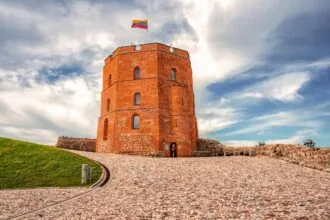
Kernavė was the first capital of the Grand Duchy of Lithuania, first mentioned in written records in 1279, long before Vilnius took over that role. What survives today isn’t a town but a landscape: five grassy hillforts rising out of the Neris valley, alongside the remains of the medieval settlement they once protected.
The whole site has been a UNESCO World Heritage Site since 2004, recognised for the depth of history layered into one place, with evidence of settlement stretching back to the Palaeolithic era. A small museum near the site explains the archaeology before you walk out onto the mounds themselves.
Kernavė sits around 35km northwest of Vilnius, and there’s no train service, so a bus is the only public transport option. Around six buses a day run from Vilnius Bus Station, with the journey taking roughly 45 minutes to an hour, though it’s worth double checking the timetable since services run less often than on busier routes.
Because there’s no town to speak of and the site itself is entirely outdoors, Kernavė works best as a half day trip, either combined with Trakai on a longer day out or paired with a picnic if the weather holds. Some guided day tours from Vilnius already combine Kernavė with Trakai and the Paneriai memorial in a single itinerary.
Paneriai Memorial: A Sobering Half-Day Trip Minutes from Vilnius
The Paneriai Memorial marks the forest where more than 100,000 people, most of them Jewish, were murdered between 1941 and 1944 by Nazi occupiers and local collaborators. It sits barely 10km southwest of Vilnius, making it the quickest entry on this list rather than a full day out.
The site includes several execution pits, a small museum documenting the killings with photographs, recovered documents and personal belongings, and memorial stones marking Jewish, Polish, Roma and Soviet victims separately. Entry to both the grounds and the museum is free, and the outdoor memorial itself stays open at all hours.
The museum keeps more limited hours, roughly Tuesday to Friday from 9am to 5pm and Sunday from 11am to 4pm, closed on Mondays and Saturdays, so check before planning a visit around it specifically. Give yourself an hour or so on site, since much of the visit is quiet walking between memorials in the forest rather than an indoor exhibition.
Paneriai has its own train station on the Vilnius to Kaunas line, with regular services taking around 10 minutes from Vilnius, making this the fastest journey on the entire list. From the station it’s roughly a ten to fifteen minute walk following signposts to reach the memorial, so it comfortably works as a half day add-on to a morning or afternoon in the city rather than a trip needing a full day.

Aukštaitija National Park: Lakes and Forest Beyond Ignalina
Aukštaitija National Park is Lithuania’s oldest national park, a dense patchwork of forest and more than 100 lakes stretching across the northeast of the country. It’s the greenest and most rural entry on this list, better suited to a full day out than a quick city stop.
The park is built around walking and canoe trails linking its lakes, alongside traditional wooden villages like Palūšė, where a lakeside timber church dates back to the eighteenth century. Hiking, cycling and canoe rental are all easy to arrange locally, and the visitor centre in Palūšė is the natural starting point.
The gateway town is Ignalina, reached from Vilnius by direct LTG Link train in around one hour twenty to one hour thirty minutes, for roughly €7 to €10 (£6 to £9/$8 to $12). From Ignalina, the park’s villages and trailheads are a further local bus or taxi ride, so this is the destination on this list that most rewards an early start.
Because onward transport from Ignalina is limited outside peak summer months, this trip works best between May and September, and it’s worth confirming local bus times before you travel rather than assuming a connection will be waiting. It’s a slower, wilder day out than the others on this list, and worth it for that reason alone.
Rumšiškės: An Open-Air Museum of Old Lithuania
The Open-Air Museum of Lithuania at Rumšiškės is one of the largest museums of its kind in Europe, a recreated rural landscape of farmhouses, windmills, churches and a reconstructed nineteenth century town, all relocated here from across the country. It’s an easy way to see centuries of Lithuanian vernacular architecture in a single visit.
The museum sits around 79km from Vilnius on the road towards Kaunas, and it’s genuinely easier with a car or a tour than public transport alone. Both the bus and the train towards Kaunas pass nearby, but both leave a walk of roughly 1.8km to 5km to reach the museum entrance, so budget extra time either way.
If you’re relying on public transport, an intercity bus towards Kaunas can drop you on the main highway around 1.8km from the entrance, while trains towards Kaunas stop at Pravieniškės, about 5km away. Neither is a difficult walk in good weather, but a taxi from either stop is the more comfortable option, particularly with children in tow.
Given the awkward last leg, Rumšiškės works best as a half day add-on to a Kaunas trip rather than a destination on its own, especially if you’re travelling by car anyway. It’s the one stop on this list where checking your own transport options in advance genuinely pays off.
Hill of Crosses: Lithuania’s Most Powerful Pilgrimage Site
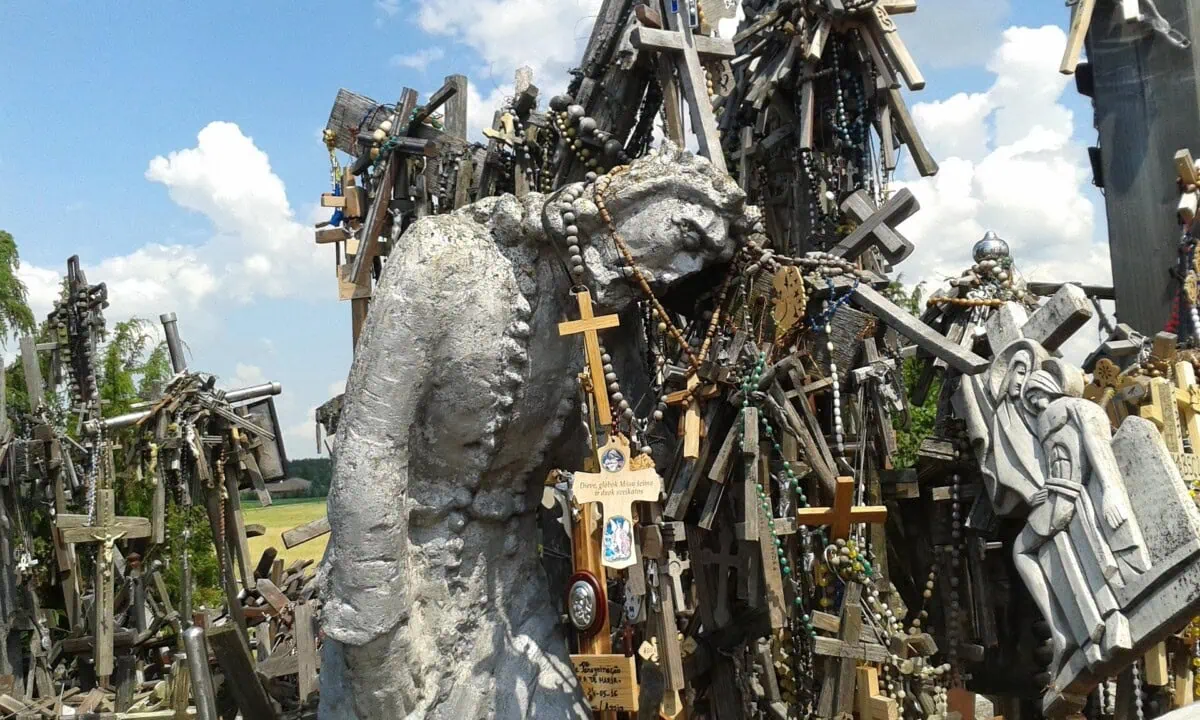
The Hill of Crosses (Kryžių kalnas) is a small hillside near Šiauliai covered in an estimated hundreds of thousands of crosses, crucifixes, rosaries and statues left by pilgrims since the nineteenth century. Everything from tiny hand carved wooden crosses to towering crucifixes has been added over time, making it one of the strangest and most moving religious sites in Europe.
The tradition is thought to date back to the 1831 uprising against Russian rule, and the hill grew into a powerful symbol of Lithuanian faith and national identity. Soviet authorities bulldozed it repeatedly, including in 1961 and 1975, yet crosses reappeared within days each time, planted overnight by Lithuanians as a quiet act of defiance.
Pope John Paul II visited the site in 1993, shortly after Lithuania regained independence, and described it as a place of hope, peace, love and sacrifice. That visit cemented the hill’s status as a site of national and international pilgrimage, and it remains an active place of worship rather than a museum piece today.
Be honest with yourself about the distance before treating this as a simple day trip: the Hill of Crosses sits around 230km north of Vilnius, near Šiauliai, making it by far the most demanding journey on this list. The most reliable route is a direct train to Šiauliai, taking around 2 to 2.5 hours, followed by a local bus or taxi covering the final stretch of around 12km to the hill itself.
Trains run several times a day for around €7 to €11 (£6 to £9.50/$8 to $13) each way, while direct coaches cover the same route in 3.5 to 4 hours for a broadly similar fare. Whichever you choose, this only really works as a day trip with an early start, since the round journey alone can eat up half the day.
Because of the distance, many travellers treat the Hill of Crosses as a stopover between Vilnius and Riga rather than a pure there-and-back trip, since Šiauliai sits roughly on that route north. If your itinerary already includes Riga, it’s worth checking whether a scheduled coach or private transfer can combine the two legs rather than backtracking to Vilnius the same day.
Best if you can move a day either way. Shows how the fare changes across the month.
Compare flightsBest if you want maps and messaging working the moment you switch your phone on.
See eSIM plansBest when public transport has stopped, or when you are travelling with children and bags.
Book a transferGetting Around: Trains and Buses
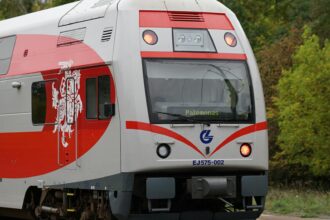
Lithuania’s passenger trains are run by a single operator, LTG Link, which covers everything from InterCity services to Kaunas and Klaipėda down to slower regional trains towards Trakai and Ignalina. Having one operator makes journey planning simple, since timetables, tickets and reservations all sit in the same app and website.
Where the railway doesn’t reach, coach operators fill the gaps. Kautra and TOKS are two of the largest, running the routes to Druskininkai, Kernavė and Grūtas Park that have no rail service at all, alongside faster intercity coaches on busier corridors.
Unlike Germany’s Bayern-Ticket or similar regional day passes elsewhere in Europe, Lithuania doesn’t currently have a flat rate unlimited day ticket for casual day trippers. The closest equivalent is the Interrail Lithuania Pass, but that’s designed for multi-day, multi-city rail itineraries rather than single day trips, and it isn’t better value than a standard ticket for a one-off journey like Trakai or Kaunas.
For most of the destinations in this guide, a standard single or return ticket bought through the LTG Link app, at a station machine, or via a bus operator’s site works out simplest. Tickets for regional trains and most buses can be bought on the day without booking ahead, though it’s worth reserving InterCity seats to Kaunas in advance on peak summer weekends.
Which Day Trip Should You Choose?
If you only have a few hours to spare, Paneriai takes barely half a day round trip, while Trakai and Kernavė both fit comfortably into a morning or afternoon without an early start. Save Druskininkai, Aukštaitija National Park and the Hill of Crosses for days when you can leave first thing, since all three involve two hours or more of one-way travel.
For history and architecture, Kaunas and Kernavė cover very different eras, interwar modernism against medieval hillforts, while Paneriai and the Hill of Crosses both deal with heavier, more reflective history. Nature lovers should prioritise Aukštaitija National Park for lakes and forest trails, with Trakai offering a gentler, more scenic lakeside stop if a full wilderness day isn’t practical.
Everything on this list is reachable by public transport, but a car genuinely simplifies Rumšiškės and Aukštaitija National Park, both of which leave an awkward final leg on foot or by taxi. Without a car, Trakai, Kaunas, Kernavė and Paneriai are the most straightforward choices, and the Hill of Crosses is manageable by train and local bus provided you commit to an early start.
As a rule of thumb, pick one longer trip and one shorter one rather than trying to fit everything into a single visit to Vilnius. Pairing Trakai or Paneriai with a slower day at Druskininkai or the Hill of Crosses makes for a far more relaxed week than chasing every destination on this list back to back.

Rupert’s Handy Travel Tips
Day trips from Vilnius are refreshingly cheap and simple, but a few destinations have quirks worth knowing about before you set off.
- Double check Trakai’s train station hours: it’s small and only open Wednesday to Sunday, so confirm timings before relying on the train rather than the bus.
- Skip the train to Druskininkai altogether: the old line closed years ago, so the bus from Vilnius Bus Station is genuinely the only sensible way in, and it takes a good two hours plus.
- Combine Kernavė with Trakai if you’re short on time: both are quick, outdoor focused stops, and several guided day tours from Vilnius already pair them together.
- Give Aukštaitija a full day and an early start: the train to Ignalina alone takes around ninety minutes, and onward buses to the lakes and trails run less often outside summer.
- Book a taxi in advance for Rumšiškės: both the bus and train leave a walk of a mile or more to the museum entrance, so it’s worth arranging a pickup rather than hoping one turns up.
- Download the Trafi app before you leave Vilnius: it covers local buses and connections in Kaunas and Druskininkai too, and it’s far easier than working out routes on the spot.
Want to meet the reindeer behind our travel tips? Find out more in our page Who is Rupert?.




Frequently Asked Questions About Day Trips from Vilnius
What is the best day trip from Vilnius?
Trakai is usually considered the best single day trip from Vilnius, combining a genuinely spectacular lakeside castle with a short 40 minute journey and a local food culture, kibinai, that’s hard to find outside the town.
Can I visit Trakai and Kernavė in the same day?
Yes, both are close to Vilnius and quick to see, and several guided day tours already combine the two, though travelling independently means checking bus times carefully since neither route runs as frequently as the Trakai line.
Do I need a car to see everywhere on this list?
No, but a car makes Rumšiškės and Aukštaitija National Park considerably easier, since both involve a final leg beyond the nearest train or bus stop that’s more comfortable by taxi or hire car.
Is there a day pass for trains and buses in Lithuania?
Not currently. Unlike Germany’s Bayern-Ticket, Lithuania doesn’t have a flat rate unlimited day ticket, so standard single or return tickets bought through LTG Link or a bus operator’s app remain the simplest option.
How far is Kaunas from Vilnius?
Kaunas is around 100km from Vilnius, and direct trains cover the journey in about an hour, with a new non-stop express introduced in March 2026 cutting some services to under an hour.
Is Druskininkai worth visiting without a car?
Yes, though it takes some patience. Buses run roughly hourly from Vilnius Bus Station and take around two to two and a half hours, since the town’s old rail line has been closed since 2000.
What should I eat in Trakai?
Kibinai are the essential try, a crescent shaped pastry stuffed with meat and onion that originated with Trakai’s Karaim community, sold fresh from several lakeside cafes near the castle.
Is it easy to travel around Lithuania independently?
Yes. Lithuania has a single national rail operator, straightforward coach companies and English widely spoken at stations and tourist sites, making it one of the more approachable countries in the Baltics for independent day tripping.
Is the Hill of Crosses worth the trip from Vilnius?
It’s worth it for anyone with a genuine interest in pilgrimage sites or photography, but be honest with yourself about the distance, since it’s around 230km each way and involves changing onto a local bus or taxi near Šiauliai, so it suits an early start or a stopover on the way to Riga more than a casual half day out.
Further Reading
For the full breakdown of Lithuania’s regional rail pass and how it compares with buying individual tickets, our Interrail Lithuania Pass guide covers pricing, seat reservations and the Vilnius to Kaunas to Klaipėda corridor in more depth, useful reading if your trip extends beyond a single day out. For current opening hours and ticket prices at the castle itself, the Trakai History Museum’s official site is worth checking before you go.
Once your day trips are planned, our Local Transport Apps guide covers the buses and trolleybuses you’ll need to get around Vilnius, Kaunas and Druskininkai once you arrive, while our Train Booking Apps guide rounds up the wider tools worth having for booking LTG Link services and beyond.
Before heading out of the city, our Best Things to Do in Vilnius guide and Vilnius Airport Transfers guide cover the city itself and getting in from the terminal. Visiting between late November and Christmas? Our Christmas in Vilnius guide is worth reading before you plan a day trip around the Cathedral Square market’s dates.