Reviewed by our editorial team Updated
Munich sits right in the middle of the best day-trip country Germany has to offer, ringed by a fairy-tale castle, a vast alpine lake, Germany’s highest mountain, and a former Nazi concentration camp that demands a visit of its own. Few German cities put so much genuinely different territory within a single morning’s train ride, from Ludwig II’s storybook towers to a mountaintop teahouse built for a very different kind of history.
Deutsche Bahn regional trains cover almost every route in this guide, and Bavaria’s own Bayern-Ticket is worth knowing about before you set off: it covers unlimited travel on regional trains and buses across the whole state for a flat group rate, and it beats individual fares on several of the trips below, particularly Neuschwanstein and Zugspitze. One thing to plan around: it isn’t valid before 9am on weekdays, only opening up from midnight on Saturdays, Sundays and public holidays, so an early weekday start needs a standard fare for that leg instead. Munich Hauptbahnhof is the starting point for practically everything on this list.
The single most popular day trip from the city is unquestionably Neuschwanstein Castle, Ludwig II’s nineteenth-century fantasy that inspired Disney’s own castle and draws visitors from every corner of the world. The Dachau Memorial Site sits barely half an hour north and deserves its own dedicated day rather than a rushed add-on, while Chiemsee trades castles for a boat trip across Bavaria’s largest lake to a palace built to rival Versailles.
Further out, Berchtesgaden and the mountaintop Eagle’s Nest combine Alpine scenery with a heavier slice of twentieth-century history, Regensburg offers a genuinely lived-in UNESCO old town with far fewer coach parties than Rothenburg, and Zugspitze puts Germany’s highest peak within reach of a long single day. Rounding out the list, an Austrian afternoon in Salzburg, the world’s oldest social housing barely half an hour away in Augsburg, a proper local escape at Lake Starnberg, and a quieter ducal capital in Landshut bring the total to ten genuine options. Below, an at-a-glance table compares journey times and transport for every destination, followed by a dedicated section on each place and a final verdict on which trip suits which kind of traveller.
| Destination | How to Get There | Journey Time | Suggested Time Needed |
|---|---|---|---|
| Neuschwanstein Castle & Füssen | Direct RE train from Munich Hbf, then bus 73/78 to Hohenschwangau | About 2 hours by train, plus an 8-minute bus | Full day |
| Dachau Memorial Site | S-Bahn S2 to Dachau, then bus to the memorial | Around 25 to 30 minutes, plus onward transfer | Half day |
| Chiemsee (Prien am Chiemsee) | Direct EC/ICE or RE train from Munich Hbf, then a lake boat | About 50 to 55 minutes by train, plus a 20-minute boat | Full day |
| Berchtesgaden & Eagle’s Nest | Regional train via Freilassing, then bus 849 up the mountain | About 2.5 to 3 hours by train, plus a 20-minute bus | Full day, early start |
| Regensburg | Direct RE or ICE train from Munich Hbf | About 1 hour 20 minutes to 1 hour 25 minutes | Full day |
| Zugspitze | Train to Garmisch-Partenkirchen, then cogwheel railway or cable car | About 1 hour 15 minutes to 1 hour 30 minutes, plus the mountain ascent | Full day, early start |
| Salzburg, Austria | Direct Railjet or EuroCity train from Munich Hbf | About 1 hour 30 minutes on Railjet, up to 1 hour 45 minutes on regional trains | Full day |
| Augsburg | Direct regional train from Munich Hbf | About 26 to 40 minutes | Half day |
| Lake Starnberg | S-Bahn S6 from Munich Hbf to Starnberg | About 30 minutes | Half day |
| Landshut | Direct regional train from Munich Hbf | About 45 to 50 minutes | Half day |
Neuschwanstein Castle and Füssen: Bavaria’s Fairy-Tale Icon
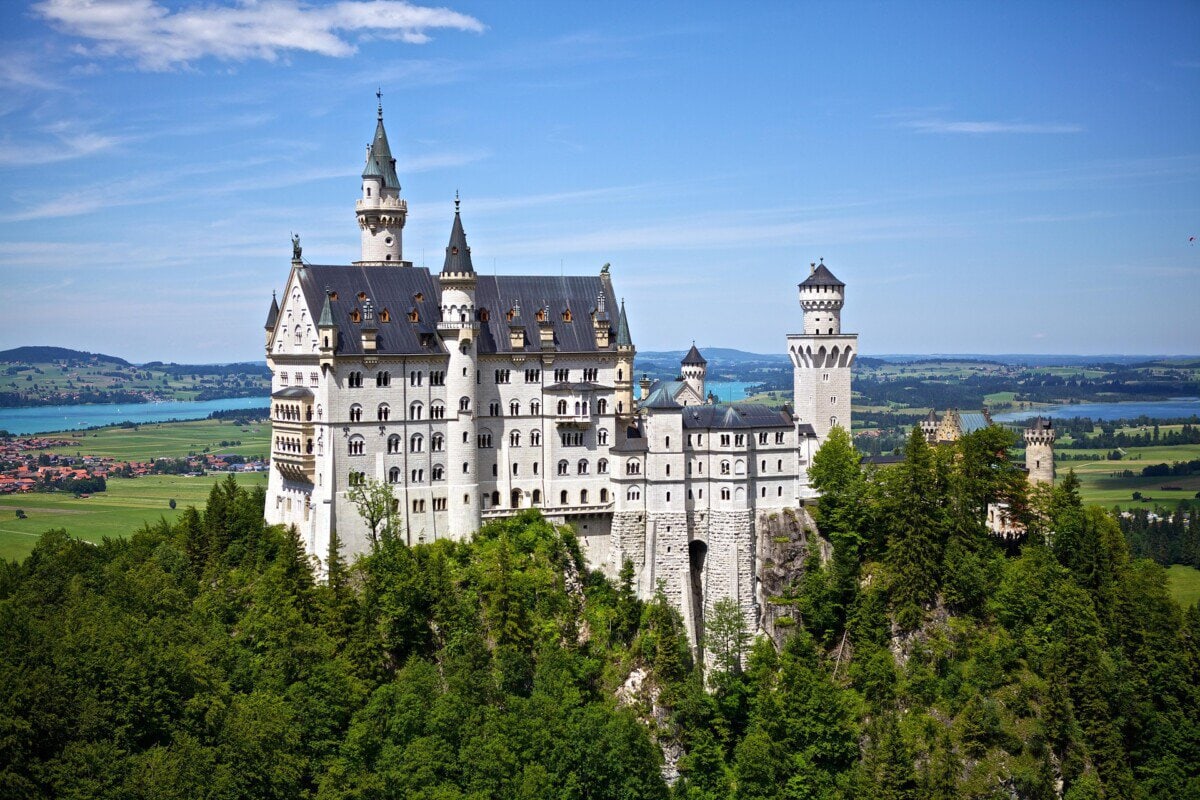
No destination near Munich is more famous than Neuschwanstein Castle, the turreted nineteenth-century fantasy built for the reclusive King Ludwig II of Bavaria and the single image most people picture when they think of a German castle. Ludwig never intended it as a functioning royal residence so much as a private stage set for his own romantic obsessions, and he died before it was even finished.
Getting there starts with a straightforward regional train from Munich Hauptbahnhof to Füssen, run by Deutsche Bahn roughly every hour throughout the day and taking around 2 hours without any need to reserve a seat in advance. From Füssen station, buses 73 and 78 run twice an hour directly to Hohenschwangau, the village at the foot of the castle, in a journey of about 8 minutes.
Travelling as a couple or a small group makes the Bayern-Ticket genuinely worth buying, priced at €34 (£29/$40) for the first passenger plus around €10 (£9/$12) for each additional traveller up to five people, covering unlimited regional trains and buses across the whole of Bavaria for the day. It comfortably covers both the train to Füssen and the bus onward to Hohenschwangau on a single fare.
From Hohenschwangau village, the castle itself sits on a wooded hill above, reachable by a 40-minute uphill walk, a 20-minute horse-drawn carriage, or the quickest option, a 10-minute shuttle bus that drops passengers a short walk from the entrance. The classic photograph everyone comes home with is taken from Marienbrücke, a bridge spanning a gorge just above the castle, and it is worth the short extra walk even for visitors short on time.
Admission to the castle interior costs €21 (£18/$25) for a standard adult ticket, and visits only happen on a strict, timed guided tour lasting around 30 minutes, since Neuschwanstein’s popularity means entry slots sell out well in advance in summer. Book through the official Hohenschwangau ticket centre website at least two days ahead, since walk-up tickets at the village office are genuinely not guaranteed on a busy day.
Anyone with time to spare should consider the Swan Ticket, priced at €56 (£48/$66), which adds neighbouring Hohenschwangau Castle, Ludwig’s childhood home and a rather less famous but genuinely handsome building in its own right, alongside the Museum of the Bavarian Kings down by the lake. Pairing both castles into one day makes the long train journey feel considerably more worthwhile.
Give this trip a full day rather than trying to squeeze it into a half-day round trip. Between the two-hour train ride each way, the timed castle tour, and the walk up and down the hill, most visitors find the whole outing comfortably fills eight or nine hours, and it remains the single best reason to base yourself in Munich for a few extra days.
Dachau Memorial Site: A Sobering, Necessary Half-Day
The Dachau Memorial Site occupies the grounds of the first Nazi concentration camp, opened in 1933 and later used as a model for the wider camp system built across occupied Europe. It sits around 16 kilometres north-west of central Munich, in the town of Dachau, and is one of the most visited Holocaust memorial sites in Germany.
The grounds include preserved guard towers, reconstructed barrack buildings, and a permanent exhibition documenting the camp’s history and the experiences of the people imprisoned there. Most visitors describe it as a slow, quiet walk rather than a typical museum visit, and it is not somewhere to approach casually or rush through between other plans.
Reaching the memorial from central Munich is straightforward: take S-Bahn line S2 to Dachau station, a ride of around 25 to 30 minutes, then continue by a short connecting bus to the memorial entrance. The whole journey is covered by a standard two-zone MVV ticket, priced at around €8.10 (£7/$9) for a single adult fare. Our Munich Public Transport guide explains how the city’s ring-based MVV zones work in full, which is worth a look before working out fares for any of the other day trips on this page.
Admission to both the memorial grounds and the museum exhibitions is completely free, a deliberate choice that keeps the site accessible to as many visitors as possible. It is open daily from 9am to 5pm, though the former crematorium area closes slightly earlier at 4:30pm, and English-language guided tours run regularly for anyone wanting the historical context that the site’s own signage does not always cover.
Because of the weight of the subject matter, this is a day to treat as its own standalone outing rather than pairing it with something lighter beforehand or immediately afterwards. A proper visit realistically needs a minimum of three to four hours including travel, and comfortable shoes are worth wearing given how much of the site is outdoors.
Munich’s own visitor guides deliberately keep their coverage of Dachau brief, pointing readers here for a proper account of the journey and what to expect. It is not a day for entertainment, but it is one of the more genuinely important places anyone spending real time in Bavaria can visit.
Best for two or three nights. The widest choice of rooms, with filters for free cancellation and included breakfast.
View staysBest for families, or any stay past about four nights. A kitchen and a washing machine start paying for themselves.
Browse rentalsBest for double-checking. Runs the same search across several booking sites so you are not leaving money behind.
Compare pricesChiemsee: A Palace Fit for Versailles on Bavaria’s Largest Lake
Chiemsee, nicknamed the “Bavarian Sea” for its sheer size, is Bavaria’s largest lake and home to one of Ludwig II’s other great extravagances, a palace modelled directly on Versailles that he never lived to see completed. The lake itself, ringed by low hills and small resort towns, makes a genuinely relaxed change of pace from the castles and cities elsewhere on this list.
Direct EC, ICE and RE trains run from Munich Hauptbahnhof to Prien am Chiemsee roughly every hour, taking around 50 to 55 minutes for the fastest services, with advance fares from about €18 (£15/$21) and a standard walk-up fare running considerably higher. The train fare itself is also comfortably covered by a single Bayern-Ticket for two or more people travelling together, though the lake boat to Herreninsel remains a separate ticket either way. From Prien station, the lake harbour at Stock is a short walk, or a fun detour on the narrow-gauge Chiemsee-Bahn, a genuine nineteenth-century steam railway still running the same short route today.
From the harbour, Chiemsee Schifffahrt boats run a round trip out to Herreninsel, the island holding Ludwig’s New Palace, priced at €11.50 (£10/$13) for a standard adult return, or €13.40 (£12/$16) for a combined route that also calls at the neighbouring island of Frauenchiemsee. The crossing itself takes around 20 minutes and offers a proper view back across the lake to the mountains beyond.
The New Palace (Neues Schloss) itself is only open on a combined ticket covering a guided tour of the palace, the King Ludwig II Museum, and the island’s Augustinian Monastery, priced at €14 (£12/$16) for a standard adult. The interior, including a Hall of Mirrors deliberately built to outdo the original at Versailles, is a genuine surprise for anyone expecting something more modest given the palace was never actually finished.
Anyone with a spare hour should carry on to Frauenchiemsee, the smaller of the two main islands and home to a working Benedictine convent and a genuinely pretty fishing village, a world away from the palace crowds on Herreninsel. It rarely gets more than a fraction of the visitors the New Palace does, despite being just a short hop further by boat.
Between the train, the boat, the palace tour, and a wander around either island, this trip comfortably fills a full day, and it works especially well for families or anyone wanting a lake and a boat trip alongside the history rather than another straight museum crawl.
Berchtesgaden and the Eagle’s Nest: Alpine Scenery and a Heavier History
Berchtesgaden sits deep in the Bavarian Alps close to the Austrian border, a genuinely spectacular mountain setting that also happens to carry one of the heaviest slices of twentieth-century history anywhere in the country. The Eagle’s Nest (Kehlsteinhaus), a mountaintop teahouse built for Adolf Hitler and now open as a restaurant and viewpoint, is the reason most visitors make the trip in the first place.
From Munich, the journey is the longest on this list: driving takes around two hours via the German motorway network, while rail travellers take a regional train from Munich Hauptbahnhof, usually changing at Freilassing, for a total journey of around 2.5 to 3 hours. The regional train there and back is well within the Bayern-Ticket’s coverage for two or more people, though the seasonal Kehlsteinhaus bus and lift combination below remains a separate ticket regardless of which rail pass you’re travelling on. Note the Bayern-Ticket isn’t valid before 9am on Mondays to Fridays, so a genuinely early weekday departure for this longer trip needs a standard fare for that one leg, or a weekend start instead. Given the distance, this is a trip that rewards an early start far more than any other destination in this guide.
Private cars are banned beyond Hintereck on the mountain road, so every visitor continues the final stretch on the dedicated bus route 849, a roughly 20-minute ride through a genuinely dramatic mountain landscape from the Obersalzberg area. At the top, an entrance tunnel leads to a brass-plated lift that carries visitors the final few metres up into the building itself.
The round-trip bus and lift ticket costs €34.70 (£30/$41) for a standard adult fare, and the whole operation only runs seasonally, typically from around May to October, since snow closes the mountain road for the rest of the year. It is worth double-checking current dates before building a Berchtesgaden day trip around the Eagle’s Nest specifically.
Beyond the Eagle’s Nest itself, the wider Obersalzberg area holds a documentation centre covering the region’s Nazi-era history in more depth, while the emerald waters of Königssee nearby offer a lovely, considerably lighter add-on for anyone with time left in the day. The two together give the destination a genuinely unusual mix of scenery and history that few other Alpine towns can match.
Given how much ground this covers, our dedicated Visiting Eagle’s Nest & Berchtesgaden guide goes into far more detail on routes, the Salt Mine, and Königssee, and is well worth reading in full for anyone considering more than a single rushed day here.
Compare Trains and Buses with Omio
Choosing between trains and buses is not always obvious. Some routes are faster by train, while others are cheaper or easier by bus. Omio helps you compare routes, journey times, prices, and tickets in one place.
It is useful for city-to-city travel, cross-border journeys, and trips where flexibility matters. You can quickly see which option works best for your route, budget, and schedule before booking.
Regensburg: A Working UNESCO Old Town on the Danube
Regensburg rarely gets the attention that Rothenburg or Nuremberg do among first-time visitors to Bavaria, and that is exactly what makes it worth the trip. Its medieval old town has been a UNESCO World Heritage Site since 2006, and unlike some of Germany’s more heavily restored showpieces, much of it survived the Second World War largely intact.
Direct RE and ICE trains run from Munich Hauptbahnhof to Regensburg Hauptbahnhof throughout the day, taking around 1 hour 20 to 1 hour 25 minutes for the fastest services, with advance fares from around €18 (£15/$21) and standard fares running closer to €35 (£30/$41). A Bayern-Ticket covers the same route on the slower RE service for a flat group rate, and is well worth comparing against the ICE advance fare above for two or more people travelling together. Regensburg’s own station sits an easy ten-minute walk from the old town’s edge.
The obvious centrepiece is the Stone Bridge (Steinerne Brücke), a twelfth-century crossing over the Danube that was considered an engineering marvel in its day and still offers one of the best views back over the old town’s towers and rooftops. A short walk away, the twin-spired Regensburg Cathedral (Dom St. Peter) is one of Germany’s finest Gothic buildings, free to enter outside of services.
Right beside the bridge sits the Historische Wurstkuchl, widely claimed to be the oldest continuously operating sausage kitchen in the world, serving grilled Regensburger sausages from a tiny riverside building that has fed bridge workers and travellers for centuries. It is a genuinely good, cheap lunch stop rather than a tourist trap dressed up as one.
Beyond the bridge and cathedral, the old town’s narrow lanes are dotted with medieval merchant towers, a legacy of the city’s wealthy trading past, and it rewards simply wandering rather than following a rigid checklist. Because Regensburg is still a genuinely lived-in city rather than a museum piece, it feels considerably less crowded than some of Bavaria’s other famous old towns.
Give Regensburg a full day given the round-trip travel time, though the city itself is compact enough that a relaxed afternoon of walking, a cathedral visit, and lunch by the bridge covers the essentials comfortably without feeling rushed.
Zugspitze: Getting to Germany’s Highest Peak from Munich
Zugspitze, rising to 2,962 metres on the Austrian border, is Germany’s highest mountain and a genuinely popular add-on for anyone based in Munich for more than a couple of days. The journey there starts with a regional train from Munich Hauptbahnhof to Garmisch-Partenkirchen, running roughly hourly and taking around 1 hour 15 to 1 hour 30 minutes. As the intro to this guide mentions, the Bayern-Ticket is one of the best value options for this specific route when there are two or more of you, covering the regional train to Garmisch on the same flat group fare. One catch worth knowing: the Bayern-Ticket isn’t valid before 9am on weekdays, so an early train aimed at beating the crowds on the summit needs a standard fare instead, or a Saturday or Sunday departure, when the ticket opens up from midnight.
From Garmisch, the ascent itself happens via the Bayerische Zugspitzbahn, either the cogwheel mountain railway, a cable car, or a combination of both, with a standard adult return ticket covering the whole mountain transport system priced at €78 (£67/$91). Because the train to Garmisch and the mountain ascent together eat up most of a day before any time on the summit itself, this is one trip where an early departure from Munich genuinely matters.
Given how much there is to get right here, from choosing between the German and Austrian ascent routes to picking the best weather window, our dedicated Visit Zugspitze guide covers the full mountain transport system, ticket strategy, and seasonal conditions in proper depth.
Treat this as a genuinely long day from Munich rather than a quick half-day detour, and check the weather forecast the evening before, since a summit hidden in cloud makes for a considerably less rewarding day than the ticket price justifies.
Salzburg: Crossing the Border for an Austrian Afternoon
Technically this one leaves Bavaria altogether. Salzburg sits just across the Austrian border, close enough that it has become one of the most popular day trips from Munich despite not being in Germany at all, and its baroque old town, wedged beneath a hilltop fortress on the banks of the Salzach river, is a genuinely different city rather than more of the same Bavarian scenery.
Direct Railjet and EuroCity trains connect Munich Hauptbahnhof to Salzburg Hauptbahnhof roughly twice an hour, with the fastest Railjet services covering the route in around 1 hour 30 minutes and slower EuroCity and regional services taking closer to 1 hour 45 minutes. Advance fares start from around €18 (£15/$21) each way, though a standard walk-up fare on the express trains runs considerably higher.
Budget travellers should know that the Bayern-Ticket also covers this route, but only on the slower regional Meridian service rather than the Railjet or EuroCity, and it is worth remembering to carry a passport since border checks, while rare, do still happen on this crossing. Currency and language stay the same, since Austria also uses the euro and German, which makes the whole trip feel far less like a border crossing than the journey time might suggest.
Once in the city, the obvious anchor is Hohensalzburg Fortress, reachable by a short funicular ride and offering sweeping views back over the old town’s domes and spires. Below it, the Altstadt is a genuine UNESCO World Heritage old town, packed with Mozart’s birthplace, the manicured Mirabell Gardens, and the narrow shopping lane of Getreidegasse, all comfortably covered on foot in a single afternoon.
Give Salzburg a full day given the round-trip travel time alone, and try to catch one of the earlier morning departures so the return journey does not eat into the evening. It pairs awkwardly with anything else on this list given the distance, so treat it as a destination in its own right rather than a stop on a longer loop.
Augsburg: The World’s Oldest Social Housing, Barely Half an Hour Away
Augsburg is easy to overlook simply because it sits so close to Munich, but Bavaria’s third-largest city has a genuinely old core, a Roman founding date, and one attraction found nowhere else on earth. The Fuggerei, a walled district of mustard-coloured cottages founded in 1521 by the banker Jakob Fugger, is the oldest social housing complex still in continuous use anywhere in the world, and its 142 residents famously still pay the original symbolic rent of €0.88 a year (roughly £0.76/$1.03), unchanged in essence since the sixteenth century.
Getting there could not be more convenient: direct regional trains leave Munich Hauptbahnhof roughly every 20 minutes throughout the day, with the fastest services reaching Augsburg Hauptbahnhof in as little as 26 minutes and the typical journey taking around 30 to 40 minutes. A standard single fare runs to about €13 (£11/$15) each way, and the trip is comfortably covered by both the Bayern-Ticket and the nationwide Deutschland-Ticket.
A small museum inside the Fuggerei brings the history to life for €4 (£3/$5), but the district itself is worth a slow walk regardless. Beyond it, Augsburg’s compact old town holds the striking Renaissance facade of the Rathaus, the adjoining Perlachturm watchtower with a viewing platform near the top, and the twin-towered Augsburg Cathedral, all within easy walking distance of each other along the pedestrianised Maximilianstraße.
Because the journey is so short, Augsburg works well as a genuine half-day trip, either as a relaxed morning before heading back to Munich for the afternoon or as a stop worth building into a longer day if the train schedule allows it. It is the easiest destination on this entire list to fit around other plans.
Best if you can move a day either way. Shows how the fare changes across the month.
Compare flightsBest if you want maps and messaging working the moment you switch your phone on.
See eSIM plansBest when public transport has stopped, or when you are travelling with children and bags.
Book a transferLake Starnberg: The Lake Locals Actually Go To
Long before Chiemsee, Lake Starnberg was the royal family’s own backyard, and it remains the lake most Munich residents actually head for on a free weekend rather than the one most visitors have heard of. It is also, more darkly, where King Ludwig II himself died in mysterious circumstances in 1886, drowned in shallow water not far from the shore he had grown up walking.
Getting there is about as simple as a day trip gets: the S-Bahn line S6 runs directly from Munich Hauptbahnhof to Starnberg station every 20 minutes throughout the day, with the journey taking around 30 minutes, and the whole route sits within the standard MVV network covered by a Deutschland-Ticket or an ordinary day pass.
Once at the lakefront, Bayerische Seenschifffahrt runs scheduled boat tours around the lake, with a short cruise priced at around €14 (£12/$16) for an adult and a full circuit of the lake’s grander shoreline running to about €27 (£23/$32). For anyone who would rather stay on land, a lakeside promenade leads to Roseninsel, a small rose-covered island connected by a short ferry hop and once a private royal retreat.
This is deliberately the lightest half-day on this whole list, and it suits anyone who wants a genuine break from castles, memorials, and museum queues rather than another packed itinerary. Bring swimwear in summer, since locals treat the lake’s clear water as their own informal outdoor pool the moment the weather turns warm.
Landshut: Bavaria’s Other Ducal Capital
Munich only became Bavaria’s undisputed capital relatively late, and for centuries Landshut was the seat of its own ruling dukes, a history that still shows in a hilltop castle and a skyline dominated by what is widely cited as the tallest brick tower in the world. It is one of the least crowded destinations on this entire list, despite being genuinely worth the visit.
Direct regional trains run from Munich Hauptbahnhof roughly twice an hour, with the fastest services reaching Landshut in around 45 minutes and the typical journey taking closer to 50 minutes. The station sits a short walk from the old town, and the whole trip is covered by both the Bayern-Ticket and the Deutschland-Ticket.
The centrepiece is St. Martin’s Church, whose brick tower rises to 130.6 metres above the old town’s pastel merchant houses, a genuinely startling sight given the modest size of the city around it. Above the rooftops, Trausnitz Castle was the original seat of the Bavarian dukes and now houses a Renaissance art museum, with a combined admission of €6 (£5/$7) covering both the castle and its collection.
Anyone visiting in 2027 should check the dates for the Landshuter Hochzeit, a lavish historical re-enactment of a 1475 royal wedding held only once every four years and drawing hundreds of thousands of visitors in medieval costume when it runs. Outside of festival years, Landshut stays a genuinely relaxed half-day trip, easily combined with a slow lunch in the old town before the train back.
Which Day Trip Should You Choose?
If you only have one day to spare from Munich, make it Neuschwanstein. It is the single most complete day trip on this list, the image most people already have in their head before they arrive in Bavaria, and substantial enough to fill a whole day without feeling like padding.
Castle and fairy-tale fans should stick with Neuschwanstein, ideally paired with Hohenschwangau on the Swan Ticket, while anyone with a genuine interest in twentieth-century history has two very different options: Dachau for a sobering, essential half-day, and Berchtesgaden for a heavier history wrapped around genuinely spectacular Alpine scenery.
Families tend to get the most out of Chiemsee, where the boat trip turns the day into an activity rather than a museum crawl, and the two islands give children something to look forward to beyond another palace interior. Active and outdoor travellers should head for Zugspitze, where the mountain transport itself becomes as much a part of the day as the summit views.
Travellers short on time should stick to Dachau or Chiemsee, both comfortably doable without sacrificing the rest of a Munich itinerary, while Berchtesgaden and Zugspitze both need a day when you can leave early and have nothing else planned. Regensburg sits in between, an easy full day for anyone who has already covered Munich’s own sights and wants a genuinely different Bavarian city rather than another Alpine excursion.
As a general rule, pair one relaxed, nearby trip with one longer, more demanding one rather than trying to fit everything into a single week. Neuschwanstein plus Dachau makes a genuinely varied pairing across two very different sides of Bavarian history, while saving Berchtesgaden or Zugspitze for a day with an early alarm and no other plans tends to produce a far better visit than squeezing either one in as an afterthought.
The four newer additions to this list fill specific gaps rather than duplicating what is already here. Anyone wanting a taste of another country without a long trip should pick Salzburg, while Augsburg and Lake Starnberg both work as easy half-day trips that leave the rest of the day free for Munich itself. Landshut rewards travellers who have already ticked off the obvious names and want a quieter, less touristed old town with a genuinely startling skyline of its own.

Rupert’s Handy Travel Tips
Day trips from Munich cover a huge amount of ground, so a few quirks are worth knowing before you set off.
- Buy a Bayern-Ticket for Neuschwanstein or Zugspitze if there are two or more of you: it covers unlimited regional trains and buses across Bavaria for a flat group rate that usually beats individual fares.
- Book Neuschwanstein Castle tickets online at least two days ahead: walk-up tickets at the village office are genuinely not guaranteed on a busy summer day.
- Treat Dachau as its own day, not an add-on: it is a memorial to a genuine atrocity, and rushing it to fit in something lighter afterwards does the visit a disservice.
- Check the Eagle’s Nest is actually open before planning a Berchtesgaden day around it: the bus up the mountain only runs from around May to October, weather permitting.
- Give Berchtesgaden and Zugspitze an early start: both eat up two to three hours of travel each way before you even reach the main attraction.
- Check the weather forecast the night before a Zugspitze trip: a summit hidden in cloud makes for a far less rewarding day than the ticket price justifies.
Want to meet the reindeer behind our travel tips? Find out more in our page Who is Rupert?.



Frequently Asked Questions About Day Trips from Munich
What is the best day trip from Munich?
Neuschwanstein Castle is generally considered the best single day trip from Munich, combining Bavaria’s most famous fairy-tale castle with a journey of around two hours each way by direct regional train.
Do I need to book Neuschwanstein Castle tickets in advance?
Yes, booking through the official Hohenschwangau ticket centre at least two days ahead is strongly recommended, since entry runs on strict timed slots that sell out well in advance in summer.
Is the Dachau Memorial Site free to visit?
Yes, admission to both the memorial grounds and the museum exhibitions is free, though many visitors book a paid guided tour for the extra historical context it provides.
Is the Eagle’s Nest open all year round?
No, the Kehlsteinhaus and the bus route up the mountain typically only operate from around May to October, since snow closes the road for the rest of the year.
What is the Bayern-Ticket and is it worth buying for these trips?
The Bayern-Ticket covers unlimited regional trains and buses across Bavaria for a flat group rate, priced at €34 (£29/$40) for the first passenger plus around €10 (£9/$12) per extra traveller, and it is genuinely good value for Neuschwanstein or Zugspitze if there are two or more of you.
How far is Zugspitze from Munich?
Reaching the summit involves a regional train to Garmisch-Partenkirchen of around 1 hour 15 to 1 hour 30 minutes, followed by a cogwheel railway or cable car ascent, making it a genuinely long full day out.
Is Chiemsee suitable for a family day trip?
Yes, the train journey followed by a lake boat to Herreninsel gives children a genuine sense of adventure, and the New Palace’s Hall of Mirrors tends to impress younger visitors as much as adults.
Do I need a car for any of these day trips?
No, every destination in this guide is reachable by direct or near-direct train from Munich Hauptbahnhof, and driving would add very little beyond flexibility, particularly since the road up to the Eagle’s Nest is closed to private cars entirely.
Do I need a passport for the Salzburg day trip?
Yes, it is worth carrying a passport even though Germany and Austria share the Schengen open border, since spot checks on this specific crossing, while uncommon, do still happen from time to time.
What is special about the Fuggerei in Augsburg?
It is the oldest social housing complex still in continuous use anywhere in the world, founded in 1521, and its residents today still pay a symbolic rent of under one euro a year.
Further Reading & Related Guides
Landing at the airport before any of these trips? Our Munich Airport Transfers guide covers every realistic way of reaching the city centre from MUC, while our Best Things to Do in Munich guide rounds up the sights worth prioritising in the city itself before you head out on any of the trips above.
Visiting between late November and Christmas? Our Munich Christmas Markets guide covers the Christkindlmarkt at Marienplatz and the city’s other festive markets, worth reading alongside this one if a winter day trip is part of the plan.
For the wider picture on getting around by rail, our German Rail Tickets Explained guide breaks down the Bayern-Ticket, the Deutschland-Ticket, and how they compare with buying single fares for trips like these.
Continuing your trip through the country’s new Germany cluster on AST? Our Best Things to Do in Nuremberg guide covers Bavaria’s other great historic city, a useful comparison if your itinerary covers both ends of the region.