Reviewed by our editorial team Updated
Why Visit Eagle’s Nest and Berchtesgaden?
Nestled amongst the towering peaks of the Bavarian Alps, Eagle’s Nest and Berchtesgaden offer one of the most rewarding mountain destinations in Central Europe. Combining dramatic Alpine scenery, fascinating twentieth-century history, crystal-clear lakes, traditional Bavarian culture, and some of Germany’s most spectacular viewpoints, the region attracts millions of visitors every year.
Many travellers first discover the area because of the fame of Eagle’s Nest (Kehlsteinhaus). However, those who make the journey quickly realise there is far more to the region than a single historic building. The surrounding landscape is breathtaking, with rugged mountains, deep valleys, traditional villages, dense forests, and pristine lakes creating scenery that rivals some of Europe’s most famous national parks.
One of the greatest advantages of visiting is its accessibility. Located just over the border from Salzburg, the area is easy to reach from both Austria and Germany. Visitors can comfortably explore the region as a day trip, although many find there is enough to justify spending several days discovering everything the area has to offer.
The combination of history and scenery is what makes the destination unique. In a single day, visitors can stand on a mountain summit overlooking the Alps, cruise across one of Germany’s most beautiful lakes, explore a traditional Bavarian town, and learn about some of the most significant events of the twentieth century. Few destinations offer such a varied experience within such a compact area.
Whether you are interested in mountain landscapes, photography, history, hiking, or simply escaping the city for a day, Eagle’s Nest and Berchtesgaden deliver an unforgettable experience.
What is Eagle’s Nest?
Perched at an altitude of approximately 1,834 metres, Eagle’s Nest (Kehlsteinhaus) is one of the most famous mountain buildings in Europe. Sitting high above the valleys of the Bavarian Alps, it combines extraordinary scenery with a unique place in modern history.
The building was completed in 1938 and presented to Adolf Hitler as a gift for his 50th birthday. Constructing the site was an extraordinary engineering achievement. Workers blasted a road into the mountainside, created a tunnel through solid rock, and installed a luxurious brass-lined elevator that still transports visitors through the mountain to the summit building today.
Despite its association with Hitler, Eagle’s Nest was reportedly used far less frequently than many visitors assume. Much of the political activity connected to the area actually took place elsewhere on the nearby Obersalzberg mountain. Nevertheless, Eagle’s Nest became one of the most recognisable locations associated with Germany’s leadership during the years leading up to and during the Second World War.
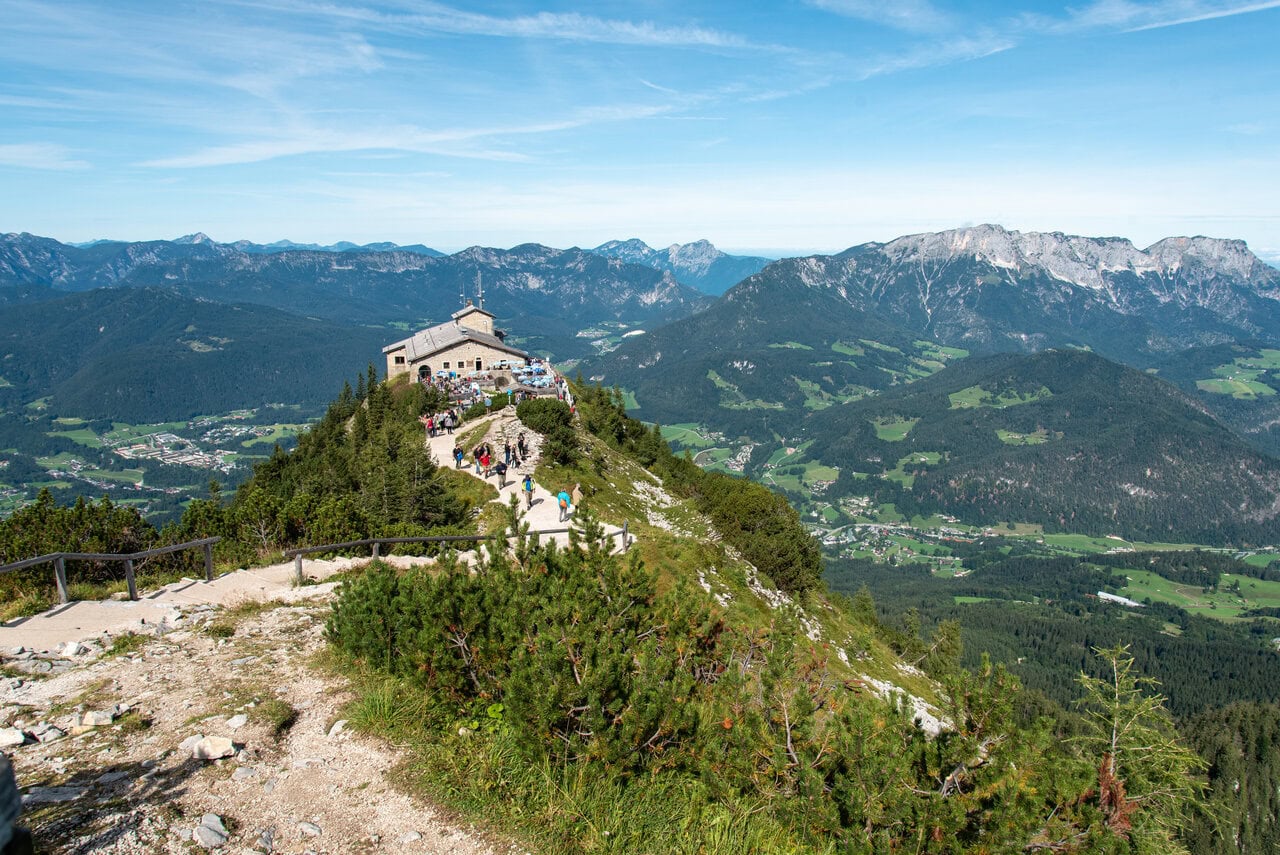
Today, the building functions as a visitor attraction and mountain restaurant. While many visitors arrive because of its historical significance, most leave talking about the views. The terraces surrounding the building offer extraordinary panoramas across Bavaria, Austria, and the wider Alpine region.
On clear days, the scenery is simply spectacular. Snow-capped peaks stretch towards the horizon, forests cover the valleys below, and villages appear tiny beneath the surrounding mountains. It is one of the finest viewpoints in Germany and one of the most memorable mountain experiences available from either Salzburg or Munich.
Compare hotels and other places to stay for your trip.
Check availabilityBrowse apartments, homes and self-catering accommodation.
Browse rentalsCompare prices from multiple hotel booking sites.
Check dealsExplore Berchtesgaden
Although Eagle’s Nest often receives most of the attention, the charming Alpine town of Berchtesgaden deserves to be considered a destination in its own right. Surrounded by mountains and steeped in Bavarian culture, it provides a perfect base for exploring the wider region.
The town’s history stretches back more than a thousand years, and much of its traditional character remains intact today. Colourful buildings, historic churches, inviting cafés, and attractive squares create an atmosphere that feels distinctly Bavarian. Unlike larger German cities, Berchtesgaden retains the relaxed feel of a mountain community while still offering excellent facilities for visitors.
The heart of the town is the attractive Market Square, where visitors can admire traditional architecture while enjoying views of the surrounding mountains. Restaurants serve regional specialities, bakeries offer fresh pastries, and independent shops provide opportunities to browse local products and souvenirs.
Beyond the town centre, Berchtesgaden acts as the gateway to some of Germany’s finest outdoor attractions. Hiking trails, mountain railways, scenic drives, lakes, and viewpoints can all be reached within a short distance. This combination of culture and nature makes it one of Bavaria’s most attractive destinations.
Many travellers initially visit as part of an Eagle’s Nest excursion but quickly discover that Berchtesgaden itself is worthy of far more than a brief stop. Its unique blend of Alpine scenery, history, and Bavarian charm makes it one of southern Germany’s hidden gems.
Visit Königssee
Few lakes in Europe can match the beauty of Königssee. Hidden amongst the mountains of Berchtesgaden National Park, this remarkable lake is often described as Germany’s most beautiful body of water and is frequently compared to a Norwegian fjord because of its steep-sided setting.
Stretching deep into the mountains, the lake is surrounded by towering cliffs, dense forests, waterfalls, and rugged Alpine peaks. Strict environmental protections have helped preserve its natural beauty, resulting in exceptionally clear water and a peaceful atmosphere that feels far removed from modern city life.
The most popular way to experience Königssee is aboard one of the famous electric passenger boats. These silent vessels glide across the lake, allowing visitors to fully appreciate the scenery without the noise associated with conventional engines. During the journey, boat captains traditionally demonstrate the famous echo created by the surrounding mountains, a tradition that has delighted visitors for generations.
Most boat trips stop at St. Bartholomä, the iconic red-domed church that has become one of Bavaria’s most recognisable landmarks. Sitting on a narrow peninsula surrounded by mountains, the church provides one of the most photographed scenes in Germany. The surrounding walking trails, lakeside viewpoints, and mountain scenery make it easy to spend several hours exploring the area.
For many visitors, Königssee becomes the highlight of their trip to Berchtesgaden. The combination of crystal-clear water, dramatic mountain landscapes, and peaceful surroundings creates an experience that perfectly captures the natural beauty of the Bavarian Alps.
Facilities at Königssee
Despite its location within the spectacular Berchtesgaden National Park, Königssee is extremely visitor-friendly and well equipped for both day-trippers and longer stays.
Most visitors begin their journey at the main Königssee Boat Terminal in the village of Schönau am Königssee, located just a few kilometres from Berchtesgaden. Here you will find the primary ticket offices for the electric boat services, visitor information points, toilets, cafés, restaurants, and souvenir shops. During the summer season, ticket desks can become busy, particularly between 10am and 2pm, so arriving early is often advisable.
The famous electric boats operate regularly throughout the day, with services travelling to St. Bartholomä and continuing onwards to Salet during the main tourist season. Sailings are generally frequent, although waiting times can increase during busy weekends and holiday periods.
Visitors will find a good range of food and drink options around the lakeshore. Traditional Bavarian restaurants, cafés, ice cream stands, and snack kiosks are available near the departure area, while additional dining options can be found at St. Bartholomä. Many visitors choose to enjoy lunch overlooking the lake and surrounding mountains.
Modern toilet facilities are available both at the main departure area and at several points around the lake. Families travelling with children generally find the facilities well maintained and easy to access.
Large public car parks are located close to the boat terminal, although they can fill quickly during peak summer periods. Visitors arriving by public transport can use regular bus services from Berchtesgaden Hauptbahnhof, with journey times typically around 15 minutes.
Mobile phone coverage is generally good around the main visitor areas, although signal strength can vary in some of the more remote parts of the national park. Most visitors experience no difficulties using maps, mobile data, or photography apps throughout their visit.
For those planning to spend several hours exploring the lake, comfortable footwear is recommended. While the boat journey itself is accessible to most visitors, many of the most rewarding viewpoints, lakeside walks, and photography locations involve additional walking once you leave the boat.
A typical visit to Königssee lasts between 3 and 5 hours, although travellers combining the lake with hiking, St. Bartholomä, or the Obersee area can easily spend an entire day exploring one of Germany’s most beautiful landscapes.

Discover Obersalzberg
Long before visitors began travelling to the region for mountain scenery and panoramic views, Obersalzberg was already known as one of Bavaria’s most attractive mountain retreats. Located above Berchtesgaden, the area enjoys spectacular views across the surrounding valleys and mountains, making it one of the most scenic locations in southern Germany.
Today, Obersalzberg serves as the gateway to Eagle’s Nest, but there is much more to explore than the famous summit building. Visitors will find mountain roads winding through forests, hiking trails leading towards spectacular viewpoints, and several attractions that help explain the area’s complex past.
The region is also home to the modern Documentation Centre Obersalzberg, which examines the area’s role during the years leading up to and during the Second World War. For visitors interested in understanding the history of the region, the centre provides important context before travelling onwards to Eagle’s Nest.
Many visitors are surprised by how beautiful the landscape is. The mountain setting, fresh Alpine air, and extensive walking opportunities mean that Obersalzberg appeals equally to history enthusiasts, photographers, and outdoor lovers.
For those spending a full day in the region, it is worth allowing time to explore Obersalzberg rather than simply travelling directly to Eagle’s Nest. The mountain scenery alone makes it one of the highlights of any visit to Berchtesgaden.
The History of Eagle’s Nest and Obersalzberg
Although the region is celebrated today for its natural beauty, Eagle’s Nest and Obersalzberg also occupy an important place in twentieth-century history.
During the 1920s, Obersalzberg was already a popular mountain retreat, attracting visitors seeking clean air and Alpine scenery. In the years that followed, Adolf Hitler became closely associated with the area, eventually establishing a residence known as the Berghof overlooking the surrounding mountains.
As the importance of the area grew, a number of government buildings and supporting infrastructure were developed throughout Obersalzberg. The most ambitious project was Eagle’s Nest, which was completed in 1938 as a 50th birthday gift for Hitler.
Constructing Eagle’s Nest required extraordinary engineering. Workers carved a dramatic mountain road into the cliffs, built a tunnel through the rock, and installed the famous brass-lined elevator that remains in operation today. Even by modern standards, the achievement is impressive.
Contrary to popular belief, Hitler reportedly spent relatively little time at Eagle’s Nest itself. The building was used more frequently for receiving guests and showcasing the spectacular Alpine location than as a regular residence.
Towards the end of the Second World War, the Obersalzberg area was heavily damaged during Allied bombing raids. Many of the original buildings were later demolished, while others gradually disappeared as the region was redeveloped in the decades that followed.
Today, only limited traces of the original complex remain. Modern visitors are more likely to encounter museums, educational exhibits, hiking trails, and mountain attractions than the political structures that once occupied the area. The emphasis is now on understanding the history while preserving the region as a place of education, remembrance, and tourism.
The result is a destination where visitors can appreciate both the remarkable Alpine landscape and the important historical events connected with it.
Getting to Eagle’s Nest and Berchtesgaden
Despite its dramatic location high in the Bavarian Alps, reaching Eagle’s Nest and Berchtesgaden is surprisingly straightforward. The region sits just across the German border from Salzburg, making it one of the easiest international day trips in Central Europe. Whether you are travelling by train, bus, organised tour, or car, there are several convenient ways to reach the area.
For most visitors, Salzburg is the most practical starting point. By road, the journey to Berchtesgaden takes approximately 30 to 40 minutes, while regular public transport connections operate throughout the day. Train travellers can take services from Salzburg Hauptbahnhof to Berchtesgaden Hauptbahnhof, typically changing at Freilassing, with total journey times usually ranging from 45 minutes to 1 hour 15 minutes depending on connections.
Bus route 840 also operates directly between Salzburg and Berchtesgaden, making it one of the simplest and cheapest options. Many visitors choose organised tours from Salzburg, which remove the need to coordinate trains, buses, mountain transport, and admission tickets independently.
Visitors travelling from Munich can reach Berchtesgaden by both road and rail. Driving normally takes around two hours, following the German motorway network through some beautiful Alpine scenery. Rail travellers can take regional trains from Munich Hauptbahnhof, usually changing at Freilassing before continuing to Berchtesgaden. Total journey times are typically around 2.5 to 3 hours. For those spending time in Bavaria, Berchtesgaden combines particularly well with destinations such as Neuschwanstein Castle, Garmisch-Partenkirchen, and Nuremberg.
From Vienna, the easiest route is by high-speed train to Salzburg using Railjet, ÖBB, or WESTbahn services. Journey times between Vienna and Salzburg are usually around 2 hours 30 minutes, after which passengers continue onwards to Berchtesgaden by regional train or bus. While technically possible as a long day trip, most travellers will enjoy the experience far more by spending at least one night in either Salzburg or Berchtesgaden.
Travellers arriving from Innsbruck can also reach Berchtesgaden relatively easily. Rail journeys generally involve travelling east through Austria towards Salzburg before connecting onwards. The route passes through some of Austria’s most impressive mountain scenery, including sections of the WESTbahn and ÖBB networks. Driving typically takes around 2.5 to 3 hours, depending on traffic and border conditions.
Even visitors staying in Hallstatt can comfortably reach Berchtesgaden. The most practical route is via Salzburg, using a combination of regional trains and local connections. Although the journey requires more planning than travelling from Salzburg itself, combining Hallstatt, Salzburg, and Berchtesgaden creates one of the most spectacular travel itineraries in the Alps, linking lakes, mountains, historic cities, and some of the most famous attractions in both Austria and Germany.
It is important to remember that reaching Berchtesgaden is only the first stage of visiting Eagle’s Nest. Private vehicles are not permitted on the final mountain road leading to the summit. Instead, visitors travel to the Obersalzberg Visitor Centre, where dedicated mountain buses operate to Eagle’s Nest.
These specially designed buses climb the steep mountain road before passengers continue through the historic tunnel and brass-lined elevator that leads directly into the summit building. Many organised tours include this transport automatically, which is one reason they remain such a popular option for first-time visitors.
For most travellers, the easiest independent route is train or bus to Berchtesgaden, followed by local transport to Obersalzberg and the official Eagle’s Nest mountain buses. However you choose to travel, the journey is part of the experience, with stunning Alpine scenery accompanying you long before you reach the famous summit itself.
Search flights and useful route combinations in one place.
View flightsBrowse Airalo eSIM options for convenient travel data.
Check eSIMsCheck private airport pickup options and plan the first part of your journey in advance.
View transfersVisiting Eagle’s Nest Independently
Many visitors assume they can simply drive directly to Eagle’s Nest, but reaching the summit is actually part of the experience. Unlike many mountain attractions, private cars and motorhomes are not permitted on the final section of road leading to the summit, meaning every visitor must complete the final stage of the journey using the official transport system.
Most independent travellers arrive first at Berchtesgaden Hauptbahnhof, the town’s main railway station. From here, the easiest option is to take local bus services towards Obersalzberg, the mountain area where Eagle’s Nest access begins. The journey typically takes around 15 to 20 minutes, depending on the service and time of year. Taxis are also available outside the station and usually reach the visitor centre in around 10 minutes.
Visitors arriving by car should follow signs for the Dokumentation Obersalzberg and the Kehlstein Bus Departure Point. Large visitor car parks are available near the departure area, allowing travellers to leave their vehicles before continuing upwards by mountain bus.
The next stage of the journey begins at the Obersalzberg Visitor Centre, where tickets for the official Eagle’s Nest buses are purchased. These specially designed buses are the only vehicles authorised to use the final mountain road. During the summer operating season, departures run regularly throughout the day, with increased frequency during peak visitor periods.
The bus journey itself is one of the highlights of the visit. The road climbs approximately 700 metres in altitude over a relatively short distance, passing through dramatic mountain scenery while negotiating a series of tight bends, steep gradients, tunnels, and cliffside sections. The engineering required to construct the route remains impressive nearly a century after it was completed.
Upon reaching the upper bus terminal, visitors still have one final stage before arriving at Eagle’s Nest. A short walk leads through a historic tunnel carved directly into the mountain. At the end of the tunnel sits the famous brass-lined elevator, which carries passengers approximately 124 metres vertically through the rock to the summit building.
Emerging from the elevator is a memorable moment. Within seconds, visitors move from the enclosed mountain interior to one of the most spectacular viewpoints in the Bavarian Alps. The terraces surrounding Eagle’s Nest offer panoramic views across Germany, Austria, and countless Alpine peaks stretching across the horizon.
Most visitors spend between one and three hours at the summit depending on weather conditions, photography opportunities, dining plans, and whether they choose to explore the nearby walking trails. During busy summer weekends and holiday periods, queues can develop for both the buses and elevator, so arriving earlier in the day is generally advisable.
Because Eagle’s Nest only operates seasonally and mountain weather can change rapidly, visitors should always check opening dates, operating hours, and weather forecasts before travelling. Even in summer, temperatures at the summit can be significantly cooler than in Berchtesgaden or Salzburg, so bringing an additional layer is often a good idea.
Eagle’s Nest Opening Dates and Seasonal Closures
Unlike many major tourist attractions, Eagle’s Nest is not open year-round. Due to its exposed mountain location and the severe winter weather experienced in the Bavarian Alps, the attraction normally operates on a seasonal basis.
The season typically runs from early May until late October, although exact opening and closing dates vary slightly each year depending on weather conditions, snow levels, and maintenance requirements. Heavy snowfall can leave the mountain road inaccessible for long periods, making winter operation impractical.
Outside the operating season, visitors can still explore parts of Obersalzberg and the surrounding area, but access to Eagle’s Nest itself is not possible. The mountain buses do not operate, the summit building is closed, and the road remains inaccessible to visitors.
For travellers planning a trip specifically to Eagle’s Nest, checking the official opening dates before booking accommodation or transport is strongly recommended. This is particularly important during the shoulder months of April, May, October, and November, when conditions can change rapidly.
Weather also plays a major role in the visitor experience. A clear summer day can provide visibility stretching for many kilometres across Germany and Austria, while low cloud or mountain fog can reduce visibility dramatically. Some visitors arrive expecting panoramic Alpine views only to find themselves surrounded by cloud.
Morning visits often provide the best conditions. Visibility is frequently better earlier in the day, and arriving before the largest tour groups can make the experience more enjoyable. During peak summer months, visitor numbers increase significantly between late morning and mid-afternoon.
Even during the height of summer, temperatures at 1,834 metres can be noticeably cooler than in Berchtesgaden, Salzburg, or Munich. Visitors should consider bringing an extra layer, particularly if they plan to spend time on the outdoor viewing terraces or walking trails around the summit.
The most popular months are generally June, July, August, and September, when the mountain is fully accessible and daylight hours are longest. However, many experienced travellers consider May and September to offer the best balance of good weather, smaller crowds, and excellent visibility.
Facilities at Eagle’s Nest
Although Eagle’s Nest sits high in the Bavarian Alps, visitors will find a surprisingly good range of facilities once they reach the summit.
The historic building now houses a popular mountain restaurant and beer garden, allowing visitors to enjoy food and drinks while taking in the spectacular Alpine views. Traditional Bavarian dishes, light meals, snacks, coffee, and refreshments are normally available throughout the operating season. During busy summer periods, outdoor seating can be particularly popular due to the panoramic scenery.
Modern toilet facilities are available both at the Obersalzberg Visitor Centre and within the Eagle’s Nest complex itself. Visitors planning longer stays or travelling with children will generally find the facilities more extensive than many mountain attractions.
A gift shop and souvenir area can usually be found at the summit, selling postcards, books, local products, and memorabilia related to both the history of Eagle’s Nest and the wider Berchtesgaden region.
Visitors should be aware that the summit sits at an altitude of approximately 1,834 metres. Weather conditions can change quickly, and temperatures are often significantly cooler than in Berchtesgaden or Salzburg. Bringing a waterproof layer or light jacket is advisable even during summer.
Mobile phone coverage is generally good across much of the site, although signal strength can vary depending on weather conditions and your network provider. Most visitors experience no difficulty using mobile data or taking photographs from the viewing areas.
Those with mobility concerns should note that although the famous elevator removes much of the climb, there is still some walking required between the bus drop-off point, tunnel entrance, elevator, and viewing terraces. The steep mountain location means accessibility can be more challenging than at standard visitor attractions.
Most travellers spend between one and three hours at Eagle’s Nest. This provides enough time to enjoy the views, explore the building, visit the restaurant, take photographs, and appreciate the unique mountain setting before returning to Obersalzberg.
Eagle’s Nest Tours from Salzburg
For many visitors, the easiest way to experience Eagle’s Nest is through an organised tour from Salzburg. Given the attraction’s popularity and the various stages involved in reaching the summit, guided excursions remain one of the most convenient ways to visit.
A typical tour begins in central Salzburg before crossing into Germany and travelling through the spectacular landscapes of the Bavarian Alps. Along the way, guides provide commentary covering the region’s history, culture, geography, and the significance of Eagle’s Nest itself.
One of the main advantages of organised tours is simplicity. Transport, mountain bus arrangements, admission procedures, and timing are all handled for you. Rather than coordinating trains, local buses, mountain buses, and tickets independently, visitors can focus entirely on enjoying the experience.
Many tours also include additional sightseeing opportunities. Depending on the itinerary, travellers may pass through Berchtesgaden, visit parts of Obersalzberg, enjoy scenic viewpoints overlooking Königssee, or spend time exploring the wider Alpine region.
Professional guides often add significant value to the visit. The story of Eagle’s Nest, Obersalzberg, and the surrounding mountains is complex, and many visitors find that guided commentary provides context that would otherwise be missed when travelling independently.
For first-time visitors staying in Salzburg, organised tours often represent the most efficient way to experience Eagle’s Nest within a half-day or full-day itinerary.
Best Time to Visit Eagle’s Nest
Choosing the right time to visit can make a major difference to your experience.
For the best weather and longest opening hours, June through September generally offers the most reliable conditions. During this period, mountain roads are fully operational, hiking trails are accessible, and visibility is often excellent.
Visitors interested primarily in photography should consider travelling during May, June, or September. These months frequently provide clear air, attractive lighting conditions, and smaller crowds than the height of summer.
Peak visitor numbers occur during July and August, particularly when tour coaches arrive from Salzburg and Munich. While the scenery remains spectacular, queues for buses, elevators, restaurants, and viewing terraces can be noticeably longer.
The time of day also matters. Early morning departures often provide the best combination of visibility and lower visitor numbers. Afternoon visits can be equally rewarding, but mountain weather tends to become less predictable as the day progresses.
Ultimately, there is no bad time to visit during the operating season. The mountain scenery remains impressive regardless of the month, but travellers seeking the best overall experience should aim for late spring or early autumn whenever possible.
How Long Do You Need?
The amount of time required depends on how deeply you wish to explore the region.
Visitors focused solely on Eagle’s Nest can comfortably complete the experience in around half a day. This allows sufficient time for the journey to the summit, exploring the building, enjoying the views, taking photographs, and perhaps having a meal at the mountaintop restaurant.
A full day is generally recommended for most travellers. Combining Eagle’s Nest with time in Berchtesgaden, Obersalzberg, or Königssee creates a much more rounded experience and allows visitors to appreciate the wider region rather than simply the summit attraction.
Travellers with a particular interest in Alpine scenery, history, hiking, or photography may benefit from spending one or two nights in Berchtesgaden. This provides enough time to explore the surrounding mountains, enjoy Königssee properly, visit local museums, and experience the area without rushing.
For visitors staying in Salzburg, Eagle’s Nest works exceptionally well as a day trip. However, those exploring Bavaria more extensively may find Berchtesgaden worthy of a dedicated stay in its own right.
Compare hostels and lower-cost accommodation for your trip.
Search hostelsGet help with compensation, eligible lounge access and disruption support.
Explore AirHelp+Leave your luggage somewhere convenient and explore hands-free.
View storageEagle’s Nest or Hallstatt?
Travellers staying in Salzburg often face the same dilemma: should they visit Eagle’s Nest and Berchtesgaden or spend the day exploring Hallstatt? The truth is that both destinations are excellent, but they offer very different experiences.
Hallstatt is all about postcard-perfect scenery. The village sits on the edge of a spectacular Alpine lake, surrounded by mountains that seem to rise directly from the water. Visitors come for lakeside walks, traditional Austrian architecture, photography, and the relaxed atmosphere that has made Hallstatt one of the most famous destinations in Europe. It is particularly popular with travellers seeking romantic scenery, picturesque streets, and a classic Austrian village experience.
Eagle’s Nest and Berchtesgaden offer a broader range of experiences. The region combines dramatic mountain scenery with historical sites, Alpine viewpoints, traditional Bavarian culture, and attractions such as Königssee. Visitors can explore a mountain summit, cruise across a pristine lake, wander through a historic town, and learn about an important period of European history all within the same day.
For travellers interested primarily in photography and traditional Alpine villages, Hallstatt will often be the stronger choice. The scenery is instantly recognisable and the village itself feels like something from a storybook.
For visitors who enjoy mountain landscapes, panoramic viewpoints, engineering achievements, history, and a more varied itinerary, Eagle’s Nest and Berchtesgaden usually provide the more comprehensive day trip.
The good news is that many travellers staying several days in Salzburg choose to visit both. They complement each other remarkably well. Hallstatt showcases Austria’s famous lakes and villages, while Eagle’s Nest and Berchtesgaden reveal the dramatic mountain scenery and cultural history of the wider Alpine region.
If you only have time for one excursion, your decision should largely depend on your interests. Choose Hallstatt for lakeside beauty and village charm. Choose Eagle’s Nest and Berchtesgaden for mountain scenery, viewpoints, history, and variety.

Rupert’s Handy Travel Tips
Planning a trip to Eagle’s Nest and Berchtesgaden? Rupert has a few useful tips:
- Start early: Morning departures often mean clearer views and shorter queues for the mountain buses.
- Bring a jacket: Temperatures at 1,834 metres can be much cooler than Salzburg or Berchtesgaden.
- Allow time for Königssee: Many visitors regret spending all day at Eagle’s Nest and missing Germany’s most beautiful lake.
- Carry your passport: You are crossing between Austria and Germany and occasional border checks can occur.
- Check opening dates: Eagle’s Nest normally operates between May and October and is closed throughout winter.
- Don’t rush Berchtesgaden: The town itself is worth exploring and offers some excellent Bavarian restaurants and cafés.
Want to meet the reindeer behind our travel tips? Find out more in our page Who is Rupert?.




Frequently Asked Questions About Eagle’s Nest and Berchtesgaden
Is Eagle’s Nest worth visiting?
Yes. Eagle’s Nest is one of the most unique attractions in Germany, combining spectacular Alpine scenery, remarkable engineering, and significant historical importance. Even visitors with little interest in history often find the mountain views alone worth the journey.
Can you visit Eagle’s Nest from Salzburg?
Yes. Salzburg is the most popular starting point for visiting Eagle’s Nest. The journey takes approximately 30 to 40 minutes by road, and there are regular train, bus, and organised tour options available throughout the operating season.
How long does it take to get from Salzburg to Eagle’s Nest?
Most visitors can reach the Eagle’s Nest visitor area in around 45 minutes to 1 hour from Salzburg. Additional time is then required for the official mountain buses and elevator journey to the summit.
Can you drive directly to Eagle’s Nest?
No. Private vehicles are not permitted on the final mountain road leading to Eagle’s Nest. All visitors must use the official mountain buses operating from the Obersalzberg Visitor Centre.
How much time should I allow for Eagle’s Nest?
Most visitors spend between 2 and 4 hours visiting Eagle’s Nest itself. If you plan to explore Berchtesgaden or Königssee as well, a full day is recommended.
When is Eagle’s Nest open?
Eagle’s Nest normally operates between May and October each year. Exact opening and closing dates vary depending on weather conditions and maintenance requirements.
Is Eagle’s Nest open during winter?
No. Heavy snow and severe mountain weather mean the attraction closes throughout the winter months. The mountain buses and summit facilities do not operate during this period.
What is the brass elevator at Eagle’s Nest?
After travelling by mountain bus, visitors walk through a tunnel carved into the mountain before boarding a historic brass-lined elevator. The elevator rises approximately 124 metres through solid rock and transports visitors directly into the Eagle’s Nest building.
Is Eagle’s Nest suitable for children?
Yes. Families regularly visit Eagle’s Nest. Children often enjoy the mountain bus ride, tunnel, elevator, and spectacular views. However, parents should supervise young children carefully around the exposed viewing areas.
What is Königssee and is it worth visiting?
Königssee is a stunning Alpine lake located near Berchtesgaden and is widely considered one of the most beautiful lakes in Germany. Many visitors combine it with Eagle’s Nest as part of a full-day itinerary.
Is Berchtesgaden worth visiting on its own?
Absolutely. Berchtesgaden offers traditional Bavarian architecture, mountain scenery, local restaurants, walking trails, and easy access to attractions such as Königssee, Obersalzberg, and Berchtesgaden National Park.
Do I need a passport when visiting Eagle’s Nest from Salzburg?
Yes. Although border crossings between Austria and Germany are usually straightforward, visitors should carry a valid passport or national identity card as checks can occasionally take place.
Can you visit Eagle’s Nest and Hallstatt in the same day?
Technically yes, but it would be a very long day and would feel rushed. Most travellers are better choosing one destination or allocating separate days to each.
What is the best time of day to visit Eagle’s Nest?
Morning visits often provide the best visibility and the smallest crowds. Early departures also reduce the likelihood of encountering afternoon mountain cloud.
Further Reading & Related Guides
If you’re planning to visit Eagle’s Nest and Berchtesgaden by rail, our Germany Interrail Pass Guide explains how to explore Germany’s rail network, including routes connecting Munich, Berchtesgaden, and the wider Bavarian Alps. For travellers extending their trip further into the mountains, our Visit Zugspitze guide covers Germany’s highest peak and pairs naturally with a Berchtesgaden itinerary, while our Germany Travel Apps Guide rounds up the best apps for transport, bookings and getting around the country.
If you’re visiting Eagle’s Nest and Berchtesgaden from Austria, our comprehensive Things To Do In Salzburg Guide is the perfect place to start planning your trip. Visitors arriving by air should also read our Salzburg Airport Transfer Guide, which explains the easiest ways to reach Salzburg city centre before continuing into Bavaria.
If you’re exploring the Alps by rail, our Austria Interrail Pass Guide explains how to travel across the country efficiently, while our WESTbahn Guide covers one of Austria’s most popular private rail operators.
Finally, if you’re travelling internationally, our eSIM Apps Guide compares the best mobile data options for both Austria and Germany, helping you stay connected throughout your journey without expensive roaming charges.
Eagle’s Nest sits alongside a wider collection of WWII and twentieth-century history sites we cover elsewhere in Europe. Codebreaking enthusiasts may also enjoy our Bletchley Park Guide, while travellers interested in how destinations across the continent approach difficult history can browse our full Dark Tourism Travel Guide.