Reviewed by our editorial team Updated
Discover Roman Nîmes
Often described as the most Roman city outside Italy, Nîmes is a destination where 2,000 years of history blend effortlessly with elegant boulevards, lively cafés and the relaxed atmosphere of southern France. While many cities preserve isolated Roman monuments, Nîmes remains a place where ancient temples, amphitheatres and defensive walls continue to shape everyday life.
Originally founded as the Roman colony of Nemausus, the city flourished during the reign of Emperor Augustus, becoming one of the most important settlements in what is now southern France. Wealthy citizens built grand public buildings, impressive monuments and sophisticated water systems, many of which still survive remarkably intact today.
Beyond its Roman heritage, Nîmes offers beautiful public gardens, fascinating museums, bustling food markets and an excellent restaurant scene celebrating the flavours of Provence and Occitanie. Throughout the year, festivals, concerts and cultural events ensure the city feels vibrant rather than simply historic.
Whether you’re exploring one of the world’s best-preserved Roman amphitheatres, relaxing beneath centuries-old trees in the Jardins de la Fontaine, discovering outstanding museums or enjoying dinner beneath illuminated ancient monuments, Nîmes is a city that consistently exceeds expectations.
This guide covers the very best things to do in Nîmes, helping you discover why it deserves a place on every itinerary through southern France.
| Attraction | Time Needed | Admission | Best For |
|---|---|---|---|
| Roman Arena | 1–2 hours | Paid | Roman history and architecture |
| Maison Carrée | 45–60 mins | Paid | Roman heritage |
| Musée de la Romanité | 2–3 hours | Paid | Archaeology and museums |
| Jardins de la Fontaine | 1–2 hours | Free | Gardens and relaxation |
| Tour Magne | 45–60 mins | Paid | Panoramic city views |
| Temple of Diana | 30 mins | Free | Roman ruins |
| Les Halles de Nîmes | 1 hour | Free | Local food and produce |
| Carré d’Art | 1–2 hours | Paid | Contemporary art |
| Historic Old Town | 2–3 hours | Free | Shopping, cafés and architecture |
| Pont du Gard (Day Trip) | Half day | Paid | UNESCO World Heritage Site |
At a Glance: Why Visit Nîmes?
Few cities in France combine ancient history and modern life as successfully as Nîmes. The city is compact enough to explore on foot, yet packed with enough attractions to comfortably fill several days.
Its greatest landmark is undoubtedly the magnificent Roman Arena, one of the best-preserved amphitheatres anywhere in the world. Unlike many ancient monuments that survive only as ruins, the arena still hosts concerts, festivals, sporting events and cultural performances almost two thousand years after it was built.
Only a short walk away stands the extraordinary Maison Carrée, widely regarded as the finest preserved Roman temple anywhere on Earth. Combined with the nearby Musée de la Romanité, visitors can explore both the monuments themselves and the fascinating stories behind them.
Nîmes also surprises visitors with its attractive parks, wide boulevards, elegant shopping streets and lively café culture. The beautiful Jardins de la Fontaine provide a peaceful escape from the city centre, while the Tour Magne rewards visitors with spectacular panoramic views.
Food lovers will appreciate the excellent covered market, traditional restaurants and Provençal cuisine, while those visiting during the famous Feria de Nîmes will experience a city transformed by music, celebrations and cultural events.
Whether you’re passionate about Roman history, architecture, photography or simply enjoying beautiful cities, Nîmes offers one of the richest and most rewarding experiences in southern France.
Best for two or three nights. The widest choice of rooms, with filters for free cancellation and included breakfast.
View staysBest for longer stays. Whole apartments and houses, so you are not eating out three times a day.
View rentalsBest as a last check before booking. Compares hotel rates across several sites in one search.
Compare ratesWhen is the Best Time to Visit Nîmes?
Thanks to its Mediterranean climate, Nîmes is an enjoyable destination throughout the year, although each season offers a slightly different experience.
Spring is one of the finest times to visit. Comfortable temperatures, colourful gardens and fewer visitors make it ideal for exploring the city’s Roman monuments on foot. The Jardins de la Fontaine are particularly beautiful as flowers bloom and fountains begin flowing once again.
During summer, Nîmes enjoys long sunny days and lively evenings. Outdoor cafés remain busy well into the night, while the Roman Arena hosts concerts, performances and special events beneath the stars. Temperatures frequently exceed 30°C, so beginning sightseeing early in the morning and taking a break during the hottest part of the afternoon is highly recommended.
Autumn brings slightly cooler weather while retaining plenty of sunshine. It’s an excellent time to explore both the city and the surrounding countryside, with fewer crowds and pleasant conditions for walking.
One of the most exciting times to visit is during the Feria de Nîmes, held each year over Pentecost and again in September. The city comes alive with music, parades, markets and celebrations, creating an unforgettable atmosphere that attracts visitors from across France and beyond.
Even during winter, Nîmes remains an attractive destination. The mild climate allows comfortable sightseeing, while quieter streets provide an opportunity to enjoy the city’s remarkable Roman heritage without the larger tourist crowds found during summer.
How to Get to Nîmes
Reaching Nîmes is straightforward thanks to excellent rail, road and air connections. Its location between Montpellier, Avignon and Arles makes it an ideal stop on any journey through southern France.
Travelling by train is particularly convenient. Nîmes Centre Station is served by regular regional and high-speed TGV services connecting the city with Paris, Marseille, Montpellier, Avignon, Lyon and numerous other destinations. From the station, the Roman Arena is only around 10 minutes’ walk, allowing visitors to begin sightseeing almost immediately.
If you’re driving, Nîmes is easily reached via the A9 and A54 motorways, making it a natural stop on a Provence or Occitanie road trip. Several public car parks are located close to the historic centre, allowing visitors to leave their vehicle before exploring on foot.
The nearest airport is Nîmes Alès Camargue Cévennes Airport, although many international visitors also arrive via Montpellier, Marseille Provence Airport or Avignon, all of which offer straightforward onward rail and road connections.
Nîmes also works exceptionally well as a day trip from nearby cities including Avignon, Montpellier, Arles and Marseille, making it one of the easiest Roman cities in France to include in a wider itinerary.
Getting Around Nîmes
One of the greatest advantages of visiting Nîmes is how easy it is to explore. The city’s main attractions are located close together, meaning you can comfortably discover almost everything on foot without needing public transport.
The Roman Arena, Maison Carrée, Musée de la Romanité, Nîmes Cathedral, Les Halles, Jardins de la Fontaine and Tour Magne are all within a pleasant 10 to 20-minute walk of one another. Wide boulevards, attractive squares and pedestrianised streets make walking one of the highlights of visiting the city.
If you’re arriving by train, the Roman Arena is only around 10 minutes from Nîmes Centre Station, while the historic centre begins just beyond the arena itself. This makes Nîmes one of the easiest historic cities in France to explore without a car.
For attractions further from the centre, Tango Nîmes operates an extensive local bus network covering the city and surrounding suburbs. Services are frequent throughout the day, with tickets available from ticket machines, selected retailers and through the official Tango mobile app. Contactless payment is also available on many services, making it simple for visitors to use the network.
Cycling is another excellent option. Nîmes has an increasing number of cycle routes, particularly around the city’s parks and wider boulevards, while bicycle hire is available from several local providers.
If you’re travelling by car, it’s generally best to park in one of the city’s public car parks before exploring on foot. The historic centre is far more enjoyable without worrying about traffic, and most of the major attractions are only a short walk from the nearest parking facilities.

Explore the Roman Arena
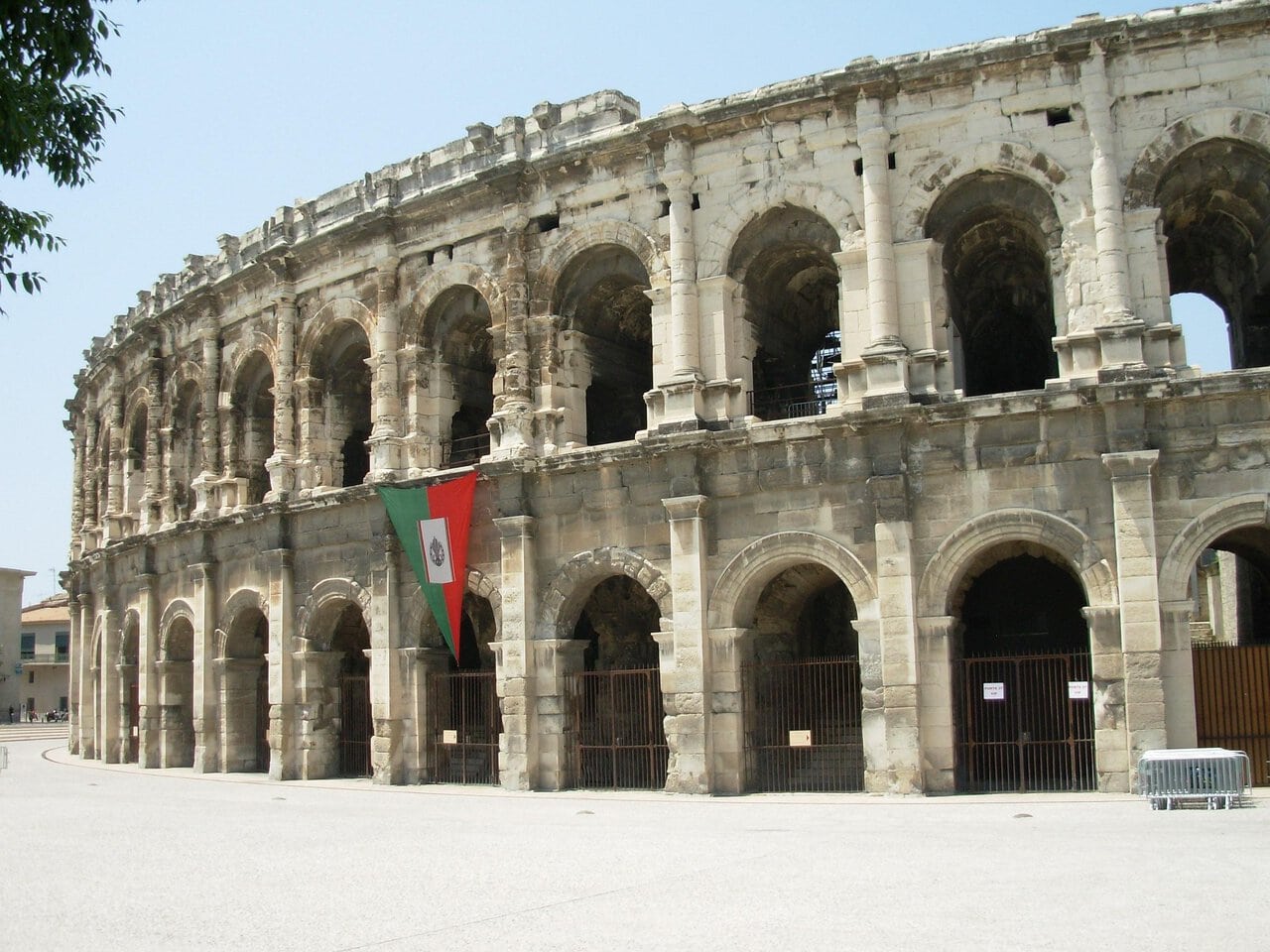
Standing proudly in the heart of the city, the magnificent Roman Arena of Nîmes (Arènes de Nîmes) is one of the finest preserved Roman amphitheatres anywhere in the world. Built at the end of the 1st century AD, shortly after the Colosseum in Rome, it remains an extraordinary example of Roman engineering and is undoubtedly the city’s most famous landmark.
Unlike many ancient amphitheatres that survive only as ruins, the arena remains remarkably complete. Its elegant stone façade, towering arches and vast seating areas still closely resemble the building that welcomed more than 20,000 spectators almost two thousand years ago.
Walking through the entrances and climbing into the seating tiers gives an immediate appreciation of the scale of Roman entertainment. Gladiatorial contests, animal hunts and public spectacles once took place here, drawing huge crowds from across the region.
Today, the arena continues to serve its original purpose as a venue for major public events. Throughout the year it hosts concerts, festivals, historical re-enactments and cultural performances, making it one of the oldest continually used entertainment venues in the world.
Visitors can explore much of the amphitheatre independently, with informative displays explaining its construction, history and later use as a fortified medieval settlement after the collapse of the Roman Empire. Audio guides and family-friendly exhibits help bring the arena’s fascinating past to life.
Whether you’re passionate about Roman history or simply appreciate remarkable architecture, the Roman Arena is one of the greatest surviving monuments from the ancient world and the undisputed highlight of any visit to Nîmes.
Visit the Maison Carrée
Just a few minutes’ walk from the Roman Arena stands another architectural masterpiece. The Maison Carrée is widely considered to be the best-preserved Roman temple anywhere in the world and is one of the most important surviving buildings from the Roman Empire.
Constructed in the early first century AD, the temple was dedicated to Gaius and Lucius Caesar, the adopted heirs of Emperor Augustus. Its elegant proportions, beautifully carved Corinthian columns and perfectly balanced design have inspired architects for centuries, influencing the construction of famous buildings across Europe and the United States.
One reason for its exceptional condition is the fact that it has been continuously used for almost two thousand years. Over the centuries it has served as a church, town hall, archive, museum and administrative building, ensuring it was carefully maintained rather than abandoned.
Today visitors can step inside to watch an engaging multimedia presentation explaining the history of Roman Nîmes and the importance of the temple within the ancient city of Nemausus. The film provides an excellent introduction before continuing your exploration of the surrounding Roman monuments.
Outside, take time to admire the temple from every angle. Its remarkably clean lines, harmonious architecture and impressive setting beside the modern Carré d’Art create one of the most striking contrasts between ancient and modern architecture anywhere in France.
Whether viewed in bright sunshine, illuminated after dark or framed by the lively cafés surrounding the square, the Maison Carrée remains one of the defining images of Nîmes and a masterpiece of classical architecture.
Discover the Jardins de la Fontaine
A short walk from the historic centre brings you to the beautiful Jardins de la Fontaine, one of Europe’s earliest public parks and one of the most elegant green spaces in France.
Created during the eighteenth century, the gardens combine formal French landscaping with some of the city’s most important Roman remains. Wide avenues, ornamental pools, graceful staircases, fountains and shaded walking paths make this one of the most relaxing places to spend a few hours away from the busy streets.
At the heart of the gardens lies the Source of Nemausus, the natural spring that first attracted settlers to this location thousands of years ago and ultimately gave birth to the Roman city. Even before the arrival of the Romans, the spring was considered sacred, and it remained central to the city’s development throughout antiquity.
As you explore, you’ll discover elegant statues, beautifully maintained flower beds and impressive stone terraces leading gradually uphill towards the Tour Magne. The peaceful atmosphere makes the gardens popular with both visitors and local residents, whether enjoying a morning walk, reading beneath the trees or simply relaxing beside the water.
Hidden among the landscaped gardens are several important Roman monuments, including the mysterious Temple of Diana, making the park far more than simply a place to relax.
Combining history, nature and beautiful landscaping, the Jardins de la Fontaine provide the perfect contrast to Nîmes’ monumental Roman architecture and are an essential stop during any visit to the city.
Best if you can move a day either way. Shows how the fare changes across the month.
Compare flightsBest for short trips. Install the eSIM at home and arrive with working data, no shop queue.
Browse eSIMsBest if you would rather not work out the transport on arrival. Book it now and forget it.
View transfersClimb the Tour Magne
Standing proudly at the highest point in Nîmes, the Tour Magne offers one of the finest panoramic views in southern France. Rising above the treetops of the Jardins de la Fontaine, this impressive Roman tower is the last remaining structure from the city’s ancient defensive walls and has watched over Nîmes for almost 2,000 years.
Originally built during the reign of Emperor Augustus, the tower once formed part of a vast network of fortifications surrounding the Roman city of Nemausus. It originally stood even taller than it does today and served both as a defensive lookout and a powerful symbol of Rome’s authority.
Reaching the tower involves a pleasant uphill walk through the gardens before climbing the internal staircase to the viewing platform. While there are several steps, the effort is richly rewarded.
From the summit you’ll enjoy spectacular 360-degree views across Nîmes, the surrounding countryside and, on clear days, as far as the Cévennes Mountains, the Camargue and even Mont Ventoux. Looking down over the rooftops, it’s easy to appreciate how the Roman city evolved into the modern Nîmes visitors see today.
The Tour Magne is also one of the best places to understand the original scale of Roman Nîmes. From above, you can trace the layout of the ancient city and spot many of the monuments you’ll have visited throughout the day.
Whether you’re interested in history, architecture or simply looking for the city’s best viewpoint, the Tour Magne is well worth the climb.
Explore the Musée de la Romanité
Directly opposite the Roman Arena stands one of France’s finest archaeological museums. The award-winning Musée de la Romanité combines cutting-edge technology with an extraordinary collection of Roman artefacts, making it the perfect companion to the ancient monuments scattered throughout the city.
Opened in 2018, the museum’s striking contemporary architecture provides a dramatic contrast to the neighbouring amphitheatre. Its flowing glass façade was designed to resemble the folds of a Roman toga, symbolically linking the city’s ancient past with its modern future.
Inside, more than 5,000 archaeological objects tell the story of Nîmes from prehistoric times through the Roman Empire and into the Middle Ages. Beautifully preserved mosaics, statues, coins, pottery, jewellery, funerary monuments and everyday household items help bring ancient Nemausus vividly to life.
Interactive displays, multimedia presentations and immersive exhibitions make the museum engaging for visitors of all ages. Rather than simply displaying artefacts, the galleries explain how people lived, worked, worshipped and entertained themselves during the Roman period, helping you better appreciate the monuments you’ve already explored.
Don’t miss the spectacular rooftop terrace, which offers one of the finest views of the Roman Arena. Seeing the ancient amphitheatre framed by the museum’s modern architecture creates one of the most striking scenes in the city and is a favourite spot for photographers.
If you only have time for one museum in Nîmes, this should be your choice. Together with the Roman Arena and Maison Carrée, it completes one of the finest collections of Roman heritage anywhere in Europe.
Wander Through the Historic Old Town
Although Roman Nîmes steals much of the attention, the city’s Old Town is every bit as rewarding to explore. Away from the famous monuments you’ll discover elegant squares, lively shopping streets, hidden courtyards and centuries of architecture reflecting Nîmes’ long and fascinating history.
Begin around the attractive Place de l’Horloge, one of the city’s liveliest squares. Surrounded by cafés, restaurants and shaded terraces, it’s an excellent place to stop for coffee while watching everyday life unfold beneath the warm southern French sunshine.
From here, wander through the network of narrow streets lined with boutiques, artisan shops, delicatessens and traditional buildings. Elegant façades, decorative balconies and hidden courtyards appear around almost every corner, while numerous fountains help create the relaxed atmosphere for which Nîmes is known.
As you explore, you’ll frequently encounter reminders of the city’s Roman past. Ancient stonework has been incorporated into later buildings, while archaeological remains appear unexpectedly between modern shops and cafés, demonstrating how closely the city’s past and present remain connected.
Take time to browse the independent shops selling Provençal products, olive oils, local wines, lavender gifts, handmade soaps and regional delicacies. The streets are also filled with bakeries where you can sample freshly baked pastries before continuing your exploration.
One of the greatest pleasures of Nîmes is simply wandering without a map. The compact city centre encourages exploration, and some of the most memorable discoveries come from quiet streets and hidden squares that rarely appear in guidebooks. Combined with the city’s outstanding Roman monuments, these charming streets help make Nîmes one of the most enjoyable cities to explore on foot in southern France.
Visit Nîmes Cathedral
Standing in the heart of the Old Town, Nîmes Cathedral (Cathédrale Notre-Dame-et-Saint-Castor) has watched over the city for almost a thousand years. While it may be overshadowed by Nîmes’ spectacular Roman monuments, it remains one of the city’s most important historic buildings and is well worth adding to your itinerary.
Construction began during the eleventh century, although the cathedral has been altered and restored many times following wars, fires and religious conflicts. As a result, the building combines elements of Romanesque, Gothic and later architectural styles, reflecting the changing fortunes of the city over the centuries.
The richly decorated Romanesque façade is particularly impressive, featuring beautifully carved stonework depicting scenes from the Bible. Inside, the atmosphere is calm and peaceful, with elegant vaulted ceilings, impressive stained-glass windows and several beautifully decorated side chapels providing a welcome contrast to the busy streets outside.
Throughout its history the cathedral has witnessed some of the most significant events in Nîmes, surviving the French Wars of Religion, the French Revolution and numerous periods of restoration. Today it remains an active place of worship while welcoming visitors from around the world.
Its central location makes it easy to include during a leisurely walk through the historic centre, and it provides another fascinating layer to the city’s history beyond its famous Roman heritage.
Shop at Les Halles de Nîmes
If you want to experience everyday life in Nîmes, spend some time exploring Les Halles de Nîmes, the city’s vibrant covered market. Located just a short walk from the Roman Arena, it’s one of the best places to discover the flavours and traditions of Occitanie.
Inside you’ll find more than 70 independent traders selling an incredible variety of local produce. Counters overflow with fresh fruit and vegetables, artisan cheeses, charcuterie, fresh seafood, olive oils, tapenades, herbs, pastries, cakes and locally baked bread. The colourful displays and lively atmosphere make the market an attraction in its own right.
Several stalls prepare freshly cooked meals throughout the day, allowing visitors to enjoy authentic regional dishes in an informal setting. Whether you’re looking for a leisurely breakfast, a quick lunch or simply somewhere to sample local specialities, Les Halles is an excellent choice.
Food lovers should look out for regional favourites including Brandade de Nîmes, the city’s famous creamy salt cod speciality, together with Pélardon goat’s cheese, local olives and wines produced throughout the surrounding Languedoc vineyards.
Even if you don’t intend to buy anything, wandering through the market provides a wonderful insight into local life and showcases the rich culinary traditions that make southern France such an enjoyable destination.
Relax in the Esplanade Charles-de-Gaulle
Just a few minutes’ walk from the Roman Arena, the elegant Esplanade Charles-de-Gaulle offers a pleasant place to relax between sightseeing stops. Lined with mature plane trees, attractive fountains and wide pedestrian walkways, it’s one of the city’s most popular meeting places.
Originally created during the eighteenth century, the esplanade has long served as a social hub for local residents. Today, visitors will find cafés with outdoor terraces, ice cream shops and plenty of benches beneath the shade of the trees, making it an ideal place to pause after exploring the nearby Roman monuments.
At the centre of the esplanade stands the impressive Pradier Fountain, one of Nîmes’ best-known landmarks. Surrounded by beautifully maintained gardens, the fountain provides an attractive focal point and is a popular place to meet before continuing into the historic centre.
Throughout the year the esplanade also hosts markets, seasonal events and public celebrations, particularly during the famous Feria de Nîmes, when the entire area comes alive with music, entertainment and festival stalls.
Although often overlooked by visitors eager to see the Roman monuments, the Esplanade Charles-de-Gaulle perfectly captures the relaxed atmosphere of modern Nîmes and is an excellent place to experience everyday life in the city.
Best if you would rather spend the money on the trip than on the room. Compare hostels by location and rating.
Search hostelsBest for anyone flying more than once or twice a year. Handles the compensation claim so you are not chasing the airline.
See AirHelp+Best for a day with a suitcase and nowhere to put it. Find a storage point near where you already are.
View storageDiscover the Temple of Diana
Hidden within the beautiful Jardins de la Fontaine stands one of Nîmes’ most intriguing Roman monuments. Despite its name, the Temple of Diana almost certainly wasn’t a temple at all, and its original purpose continues to fascinate historians today.
Dating from the first century AD, the building formed part of the extensive Roman sanctuary surrounding the sacred spring that gave birth to the ancient city of Nemausus. Although only partially preserved, its impressive vaulted ceilings, massive stone walls and beautifully carved architectural details remain remarkably atmospheric.
Archaeologists believe the structure may have served as a library, meeting hall or ceremonial building rather than a temple dedicated to the goddess Diana. Whatever its original purpose, it formed an important part of one of the Roman world’s most significant religious complexes.
Visitors are free to walk through the ruins, examining the enormous arches, niches and surviving stonework up close. Unlike many archaeological sites where monuments are viewed from behind barriers, here you can truly appreciate the scale and craftsmanship of Roman engineering.
Surrounded by trees, fountains and landscaped gardens, the Temple of Diana provides one of the most peaceful corners of Nîmes. Combined with the nearby Source of Nemausus and the Tour Magne, it forms one of the city’s most rewarding historic walks and offers another reminder that Roman history is woven into almost every part of modern Nîmes.
Visit the Castellum Divisorium
One of Nîmes’ most overlooked Roman monuments is also one of its most remarkable. Hidden away in a quiet corner of the city, the Castellum Divisorium is the only surviving Roman water distribution basin in the world, making it an essential stop for anyone interested in Roman engineering.
Built during the first century AD, the circular stone basin formed the final stage of the city’s sophisticated water supply. Fresh water travelled almost 50 kilometres from the famous Pont du Gard aqueduct before arriving here, where it was divided into ten separate channels that distributed water throughout the Roman city of Nemausus.
Standing beside the monument today, you can still clearly see the original stone basin and the openings where water once flowed into the underground pipe network. It’s astonishing to think that this ingenious system supplied homes, fountains, baths and public buildings nearly 2,000 years ago.
Although smaller than the Roman Arena or Maison Carrée, the Castellum Divisorium tells an equally important story about everyday life in Roman Nîmes. It demonstrates the extraordinary level of planning, engineering and organisation that allowed one of the Roman Empire’s most prosperous cities to flourish.
Because it’s slightly removed from the main tourist trail, you’ll often have the site almost entirely to yourself, making it a peaceful and fascinating place to appreciate one of the Roman world’s greatest engineering achievements.
Experience Nîmes’ Markets and Southern French Cuisine
Exploring Nîmes isn’t just about Roman history. The city is also one of the best places in Occitanie to experience authentic southern French cuisine, lively markets and regional specialities that reflect centuries of culinary tradition.
Start your day with coffee and a freshly baked croissant at one of the cafés surrounding the Place de l’Horloge, before wandering through the nearby streets where bakeries, delicatessens and artisan food shops tempt visitors with local produce.
For lunch or dinner, look out for regional dishes including Brandade de Nîmes, a rich blend of salted cod, olive oil and milk that originated in the city and remains its best-known speciality. Other local favourites include Gardianne de Taureau, a slow-cooked Camargue beef stew, Pélardon goat’s cheese, fresh olives, tapenades and dishes featuring herbs grown throughout Provence and Occitanie.
The surrounding countryside also produces excellent wines. Restaurants and wine bars throughout the city serve bottles from nearby Costières de Nîmes, Languedoc and Rhône Valley vineyards, making it easy to sample some of southern France’s finest wines alongside traditional local cuisine.
If your visit coincides with one of the city’s regular outdoor markets, take time to browse the colourful stalls selling fresh fruit, vegetables, flowers, cheeses, artisan breads, lavender products and handmade crafts. These markets provide an excellent opportunity to experience everyday life in Nîmes while supporting local producers.
Whether you’re dining in an elegant restaurant or enjoying a simple meal on a sunny terrace, the food and wine are an essential part of any visit to this beautiful southern French city.

Explore the Carré d’Art Museum
Standing directly opposite the ancient Maison Carrée, the striking Carré d’Art creates one of the most fascinating architectural contrasts in France. Designed by internationally renowned architect Sir Norman Foster, the sleek glass and steel building demonstrates how modern architecture can successfully complement one of the world’s finest Roman monuments.
Opened in 1993, the building houses both the city’s Museum of Contemporary Art and its public library. Inside, visitors will find an impressive collection of modern and contemporary works by leading French and international artists, with exhibitions changing regularly throughout the year.
The museum showcases paintings, sculptures, photography, installations and multimedia artworks spanning the second half of the twentieth century through to the present day. Even if contemporary art isn’t usually your first choice, the carefully curated exhibitions provide an interesting contrast to the ancient history found elsewhere in Nîmes.
One of the highlights is the rooftop terrace, which offers outstanding views across the Maison Carrée and surrounding city centre. Looking down on one of the world’s best-preserved Roman temples from one of France’s most celebrated modern buildings perfectly captures the unique character of Nîmes, where ancient history and modern culture exist side by side.
Whether you visit for the exhibitions, the architecture or simply the panoramic views, the Carré d’Art is a fitting reminder that Nîmes continues to evolve while proudly celebrating its remarkable past.
Best Photography and Viewpoints
With its extraordinary collection of Roman monuments, elegant gardens and attractive historic streets, Nîmes offers countless opportunities for memorable photographs.
The city’s most iconic viewpoint is undoubtedly inside the Roman Arena, where the perfectly preserved seating tiers and towering arches provide dramatic perspectives in every direction. Early morning is the ideal time to visit, when the warm sunlight illuminates the ancient stone and visitor numbers remain relatively low.
For panoramic views, make the climb to the top of the Tour Magne. From the summit you’ll enjoy sweeping vistas across the rooftops of Nîmes towards the Cévennes, the Camargue and the surrounding countryside. It’s easily the best viewpoint in the city.
The elegant Maison Carrée is particularly photogenic during the golden hour, when the soft evening light highlights its beautifully carved Corinthian columns. For a unique perspective, head to the rooftop terrace of the Carré d’Art, where the contrast between ancient and modern architecture creates one of the city’s most striking compositions.
The peaceful Jardins de la Fontaine also reward photographers throughout the year. Ornamental pools, graceful staircases, fountains and Roman ruins combine to create beautiful scenes, particularly during spring when flowers are in bloom or autumn when the trees take on rich seasonal colours.
Finally, don’t overlook the Old Town itself. Quiet side streets, elegant squares, bustling cafés and beautifully restored historic buildings provide endless opportunities to capture the relaxed atmosphere that makes Nîmes one of southern France’s most rewarding cities to explore.

Rupert’s Handy Travel Tips
Nîmes is one of the world’s best places to experience Roman history, but there’s much more to the city than ancient monuments. Here are a few tips to help you make the most of your visit.
- Buy a combined attractions ticket: If you’re planning to visit the Roman Arena, Maison Carrée and Tour Magne, a combined pass usually offers better value than purchasing individual tickets.
- Start early at the Arena: Visiting first thing in the morning gives you the best opportunity to explore one of the world’s finest Roman amphitheatres before the busiest crowds arrive.
- Don’t skip the museum: The Musée de la Romanité adds valuable context to everything you’ll see around the city, making the Roman monuments even more impressive.
- Leave time for the gardens: The Jardins de la Fontaine provide a peaceful contrast to the city’s historic sites and include the fascinating Temple of Diana and the climb to the Tour Magne.
- Use Nîmes as a base: Excellent rail connections make it easy to combine your visit with nearby destinations such as Montpellier, Avignon, Arles and the magnificent Pont du Gard.
Want to meet the reindeer behind our travel tips? Find out more in our page Who is Rupert?.




Frequently Asked Questions
Is Nîmes worth visiting?
Absolutely. Nîmes is one of the finest Roman cities outside Italy, combining world-class ancient monuments with excellent museums, beautiful gardens, lively markets and outstanding southern French cuisine.
How many days do you need in Nîmes?
A full day is enough to see the main highlights, including the Roman Arena, Maison Carrée, Jardins de la Fontaine and Tour Magne. If you also want to visit the museums, markets and enjoy the local food scene, two days is ideal.
Can you walk around Nîmes?
Yes. The historic centre is compact and most major attractions are within 10 to 20 minutes’ walk of one another, making Nîmes an excellent city to explore on foot.
What is Nîmes famous for?
Nîmes is famous for its exceptionally well-preserved Roman monuments, particularly the Roman Arena, Maison Carrée, Tour Magne and its connection to the nearby Pont du Gard aqueduct.
When is the best time to visit Nîmes?
Spring and autumn offer pleasant temperatures and fewer crowds. Summer is ideal for evening events in the Roman Arena, while the Feria de Nîmes creates one of the city’s liveliest annual celebrations.
Is the Roman Arena still used today?
Yes. Nearly 2,000 years after it was built, the Roman Arena continues to host concerts, festivals, historical events and major cultural performances throughout the year.
What local food should I try in Nîmes?
Don’t miss Brandade de Nîmes, together with Gardianne de Taureau, Pélardon goat’s cheese, local olives and wines from the nearby Costières de Nîmes vineyards.
Can you visit Pont du Gard from Nîmes?
Yes. The magnificent Pont du Gard is approximately 30 minutes by car from Nîmes and is one of the most popular day trips from the city.
Further Reading
Continue planning your journey with our guide to Things to Do in Montpellier, one of the easiest cities to combine with Nîmes on a wider trip through southern France. If you’re exploring further into Occitanie, our guides to Carcassonne and Toulouse are also well worth a look.
As Nîmes is so easy to reach by train, our Interrail France Pass Guide and Carte Avantage France guide explain how to save on TGV and TER journeys around the country, while our Eurostar Guide covers connections from the UK.