Reviewed by our editorial team Updated
Cetinje: Montenegro’s Historic Royal Capital
Tucked beneath the slopes of Lovćen National Park, Cetinje doesn’t look or feel like anywhere else in Montenegro. While most visitors are drawn to the beaches of Budva or the medieval walls of Kotor, Cetinje offers something quieter: a chance to understand the country’s history and identity rather than just admire its coastline.
Known as Montenegro’s Royal Capital, Cetinje was the political and cultural heart of the country for centuries. The capital later moved to Podgorica, but many of the nation’s most important institutions, royal buildings and religious sites are still here, which gives the town an atmosphere that feels genuinely steeped in heritage rather than dressed up for visitors.
Walking through Cetinje really does feel like stepping back a century or so. Former embassies sit alongside royal palaces, quiet monasteries and tree-lined streets, and the town’s museums do a good job of explaining Montenegro’s long push for independence and its place in wider European history.
If you want to understand Montenegro beyond its scenery, Cetinje is where that happens. Whether that’s a morning spent in the museums, a slow coffee in one of the squares, or using the town as your gateway into Lovćen National Park, it offers a genuinely different side of the country.
It’s a strange feeling, standing outside a former Russian or French embassy building in a town this size, but that’s Cetinje’s charm in a nutshell. Nothing here is quite on the scale you’d expect, yet almost everything has an outsized story behind it. Give it a full day rather than a rushed morning stop between the coast and Lovćen, and the town has a habit of quietly winning people over who arrived expecting little more than a photo of the monastery.
Why Cetinje Deserves More Than a Quick Stop
Plenty of travellers pass through Cetinje purely on their way up to Lovćen, and that’s a shame, because it deserves more than a quick stop. It’s one of the few places in the country where you can really trace how Montenegro grew from a small mountain principality into the independent nation it is today.
Unlike Montenegro’s coastal towns, Cetinje isn’t really built around tourism. Locals go about their day among grand historic buildings, museums and leafy streets, and the pace is noticeably slower than the busy promenades of Budva or the narrow lanes of Kotor.
History lovers in particular will find a lot to like. Royal palaces, former diplomatic buildings, monasteries and museums all sit within easy walking distance of each other, so it’s entirely possible to cover centuries of Montenegrin history in a single unhurried afternoon.
Cetinje also works well as a base for exploring the centre of the country. Lovćen National Park, the dramatic mountain road down towards Kotor, and Lake Skadar National Park are all within easy reach, so it slots naturally into a wider Montenegro itinerary rather than sitting off to one side.
There’s also something to be said for visiting a Montenegrin town that isn’t organised around the tourist season. Shops keep the same hours in January as they do in July, restaurants serve locals as readily as visitors, and the overall atmosphere feels considerably less rehearsed than the busiest parts of the coast. For anyone who’s spent a few days on the beaches and wants a change of pace, Cetinje delivers that shift almost immediately.
See hotel options and places to stay in Montenegro.
Browse hotelsBrowse apartments, holiday homes and self-catering stays in Montenegro.
View rentalsSee hotel prices from multiple booking sites in one search.
Compare ratesWandering Cetinje’s Wide Avenues and Former Embassy Streets
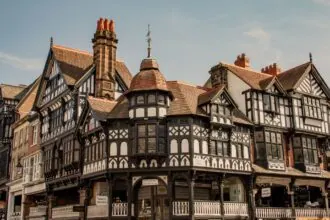
One of the simple pleasures of Cetinje is just wandering its compact, elegant centre. Unlike a lot of historic European towns, it’s laid out with wide avenues, tree-lined streets and open squares, which practically invites you to slow down rather than rush between sights.
Many of the buildings date from the late nineteenth and early twentieth centuries, when Cetinje was the capital of an independent Montenegro. Former embassies from France, Russia, Britain and Italy still line the streets, an odd but charming reminder of how diplomatically important this small town once was.
The pedestrian centre is dotted with cafés, restaurants, bakeries, boutique shops and small galleries, easily enough to fill a few hours. Outdoor terraces get particularly busy in the warmer months, and sitting with a traditional Montenegrin coffee watching the town go about its day is time well spent.
Cetinje has held onto an authentic feel that some of Montenegro’s busier destinations have lost. It’s best explored without a fixed plan, since historic buildings, hidden courtyards and small museums tend to turn up around almost every corner.
Look up as you walk, since a lot of the detail here is in the upper floors and rooflines rather than at street level: faded diplomatic crests above doorways, wrought-iron balconies and the occasional flagpole bracket left over from an embassy that closed its doors a century ago. The town is small enough that you’ll likely pass the same square more than once in a day, and that’s no bad thing, since it tends to look completely different in morning light than it does at dusk.
Cetinje Monastery: Relics and the Seat of the Montenegrin Church
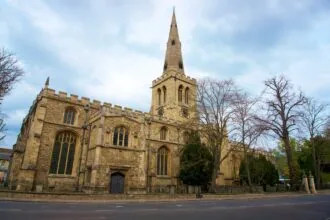
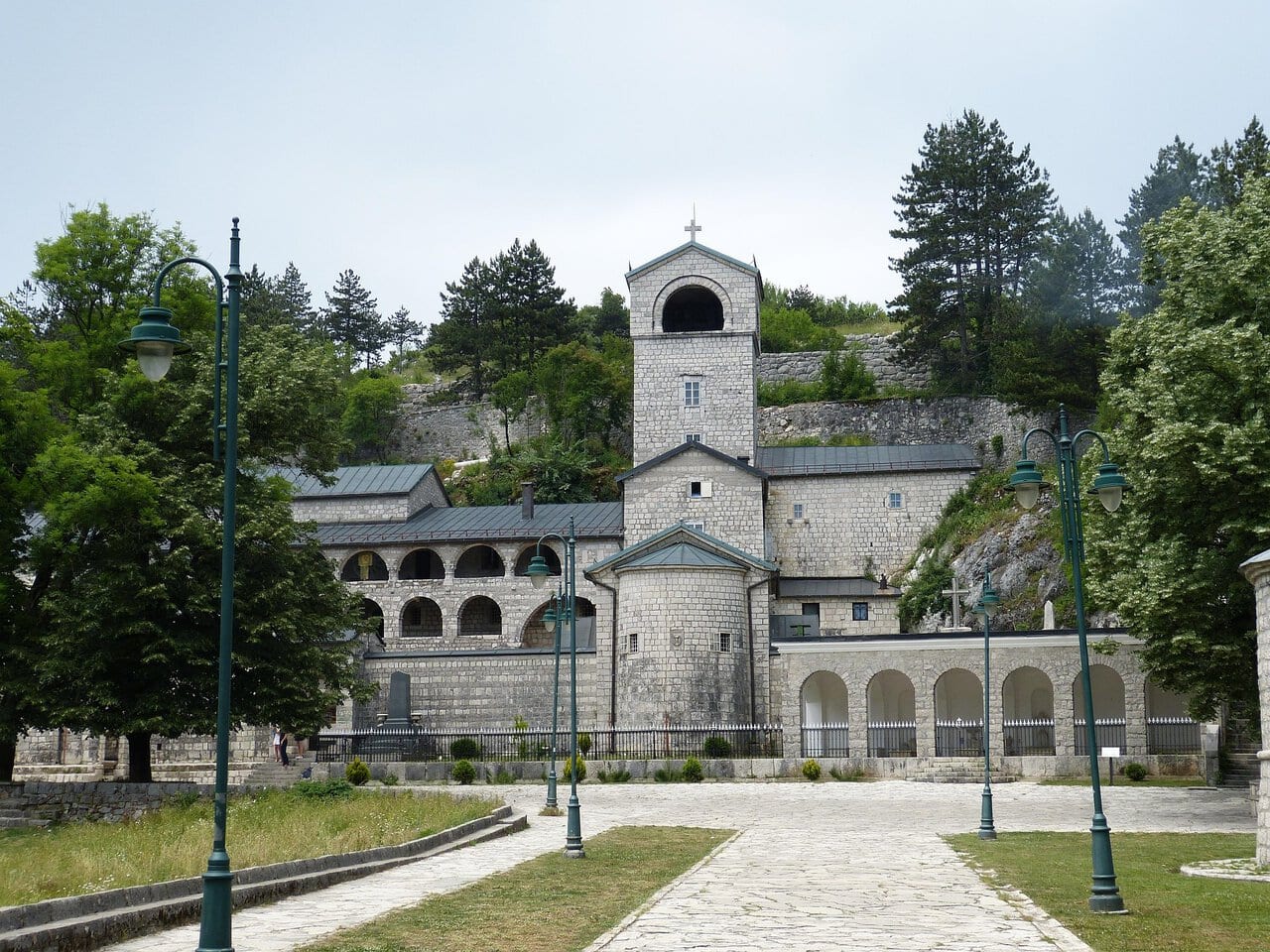
At the centre of town stands Cetinje Monastery, one of Montenegro’s most important religious sites and the spiritual home of the Montenegrin Orthodox Church.
Originally founded in the fifteenth century, the monastery has been destroyed and rebuilt more than once, which says a fair amount about the turbulent history of this region. The current building dates largely from the early eighteenth century and remains an active place of worship rather than a museum piece.
Inside, it holds some of Orthodox Christianity’s most treasured relics, including what’s believed to be the right hand of Saint John the Baptist and a fragment of the True Cross, which makes it a genuine pilgrimage site for Orthodox visitors from across the region.
Visitors are welcome, provided you dress respectfully and remember this is still a working monastery rather than an attraction. Even without any religious connection, the quiet courtyards and long history make it one of Cetinje’s essential stops.
The monastery’s small treasury and museum room, tucked just off the main courtyard, is easy to walk past but worth seeking out, holding vestments, manuscripts and religious artefacts that rarely get much attention outside specialist guidebooks. Photography is generally restricted inside the churches themselves, so it’s worth simply taking a few minutes to sit in the courtyard afterwards rather than rushing off, particularly given how few other visitors tend to linger.
Services are held regularly and visitors are welcome to observe from the back of the church, provided you arrive quietly and stay for the duration rather than wandering in and out. It’s one of the few places in Cetinje where the atmosphere genuinely shifts the moment you step through the door, from the ordinary bustle of the street outside to something noticeably more solemn within.
King Nikola’s Museum: Inside Montenegro’s Last Royal Palace
One of Cetinje’s genuinely fascinating stops is King Nikola’s Museum, housed inside the beautifully preserved palace of King Nikola I Petrović-Njegoš, Montenegro’s last king.
Built in the 1860s, the palace remained the royal residence until Montenegro was absorbed into the Kingdom of Serbs, Croats and Slovenes after the First World War. Stepping inside now gives a real sense of what life looked like for the royal family during one of the country’s most pivotal periods.
Many of the original rooms survive, with period furniture, paintings, royal portraits, weapons and gifts from other European monarchs still in place. Walking through the reception rooms and private apartments is a good way to understand just how closely tied Montenegro’s rulers were to the rest of Europe’s royal houses.
If you have any interest in Montenegrin history or royal heritage, this is easily one of the highlights of a visit to Cetinje.
Look out for the throne room in particular, along with the collection of gifts sent by European royal houses, which says a lot about how seriously Montenegro’s tiny court was once taken on the continental stage. An audio guide or a knowledgeable local guide adds a great deal here, since the palace’s information panels cover the basics but the more interesting stories tend to come from context that isn’t always written down.
Allow at least an hour if you want to read the display information properly, longer if you’re travelling with anyone particularly interested in European royal history. The gift shop near the entrance sells a handful of books on Montenegro’s royal family in English, which make a good souvenir if you’d like to read more once you’re back home.

The National Museum of Montenegro’s Scattered Collections
Cetinje is often called Montenegro’s museum town, and the National Museum of Montenegro is the best example of why.
Rather than one building, it’s actually several separate collections spread across town, each covering a different slice of Montenegro’s history, culture and art. Together, they add up to one of the most complete introductions to the country you’ll find anywhere.
Between the various sites, you can work through Montenegrin history, traditional costume, archaeological finds, fine art and ethnography, tracing the development of the modern nation as you go. Several collections are housed in former royal residences and government buildings, which adds its own character to the visit.
If you’re planning on seeing more than one museum, it’s worth checking whether a combined ticket is available. It usually works out better value and lets you move between collections at your own pace, whether your interest is politics, history, archaeology or art.
Because the collections are spread across separate buildings rather than housed under one roof, it’s worth planning your visit a little rather than trying to see everything in one go. Most sites are within a ten-minute walk of each other, so it’s entirely possible to visit two or three in a single morning without feeling rushed, leaving the afternoon free for the monastery, the palace or simply a long lunch.
English-language information is available in most of the main collections, though it can be sparser in the smaller specialist sites, so a guidebook or a downloaded map with background notes is worth having if you want the fuller picture. Photography rules vary between buildings, so it’s worth checking at the entrance desk of each site rather than assuming the same policy applies everywhere.
The Blue Palace and Cetinje’s Historic Embassy Quarter
Stroll through Cetinje for long enough and you’ll notice that a lot of its grandest buildings aren’t churches or palaces at all, they’re former foreign embassies.
During the late nineteenth and early twentieth centuries, when Cetinje was Montenegro’s capital, countries across Europe set up diplomatic missions here. Despite the town’s small size, Britain, France, Russia, Italy and Austria-Hungary all built imposing embassy buildings, and quite a few of them are still standing.
Among the most notable is the Blue Palace, originally built as the residence of Crown Prince Danilo. It now serves as the official residence of Montenegro’s president, making it one of the country’s more significant government buildings.
Walking the old embassy district is a nice way to get a feel for Cetinje’s diplomatic past. The architecture, quiet streets and well-kept buildings make it one of the more distinctive corners of the country to explore on foot.
Because the Blue Palace remains a working presidential residence, you won’t be able to go inside, but the surrounding gardens and streets are still worth a slow walk. Several of the old embassy buildings now house government offices, cultural institutes or small galleries, so it’s worth peering through open doors and gates rather than assuming everything is off limits.
A short walk in either direction from the palace takes you past several more of these grand old buildings, many now marked with small plaques explaining their original diplomatic purpose. It’s the kind of area that rewards a slow, aimless wander rather than a checklist, since half the pleasure is simply noticing how much history is packed into streets that most visitors walk straight past.
Cetinje’s Cafés and Restaurants: A Slower Pace of Dining
After a few hours of museums and history, it’s worth setting aside time for Cetinje’s relaxed café culture. Unlike the busy waterfront restaurants along the coast, dining here has a distinctly local feel, with residents lingering over coffee and chatting rather than rushing between courses.
Traditional restaurants serve hearty Montenegrin cooking, grilled meats, slow-cooked stews, local cheeses, smoked Njeguški pršut and good fresh bread. The surrounding mountains and countryside supply a lot of the ingredients, which comes through in the flavour.
The cafés are just as welcoming, whether you’re after a quick espresso, homemade cake or a longer lunch on a terrace between sightseeing stops.
Sitting in one of Cetinje’s leafy squares with a coffee is, honestly, one of the best ways to take in the town’s atmosphere. It’s unhurried in a way that gives you a real sense of everyday life in what was once Montenegro’s royal capital.
A few restaurants around the centre specialise in Njeguši-style cured meats and cheeses, produced in the nearby village the style is named after, and are worth seeking out if you want a genuinely local meal rather than something aimed squarely at passing visitors. Portions tend to be generous by Western European standards, so sharing a few dishes between two or three people is often the better approach than ordering individually.
Vegetarian options are more limited than on the coast, though most menus include at least a few suitable dishes, and staff are generally happy to adapt something simple if you ask. Card payment is increasingly common but not universal, so it’s worth carrying some cash for smaller family-run places, particularly outside the main square.
Compare routes and fares for your journey to Montenegro.
Compare flightsBrowse Airalo eSIM options for convenient travel data.
Check eSIMsArrange a private airport pickup for your trip to Montenegro.
Check transfersWhere to Stay in Cetinje
Cetinje is small enough that most accommodation sits within walking distance of the museums and monastery, and a night or two here makes a nice change of pace from Montenegro’s busier coastal resorts. Guesthouses and small family-run hotels around the historic centre tend to be the most convenient option, putting you close to the cafés and squares without needing a car.
Because Cetinje isn’t a big tourist town, choice is more limited than in Budva or Kotor, so it’s worth booking ahead if you’re visiting during the Lovćen hiking season or a national holiday, when rooms can fill up quickly for a town this size.
Prices are noticeably lower than along the coast, which makes Cetinje a sensible overnight stop if you’re trying to balance a Montenegro budget rather than a genuinely limited destination. Most properties are small enough that booking directly by phone or email still works, and owners are often happy to help arrange a taxi up to Lovćen or a local guide for the museums if you ask when you arrive.
Don’t expect large resort-style hotels here; the appeal of staying in Cetinje is precisely that it isn’t set up that way. A handful of properties occupy converted historic townhouses close to the museums, which adds a nice sense of place to an overnight stay and makes the short walk back from dinner feel like part of the experience rather than an inconvenience.
If you’d rather have more choice, staying in Budva or Kotor and visiting Cetinje as a day trip works just as well, particularly if you’re only planning a few hours here rather than a full overnight stop.
Visit Lovćen National Park from Cetinje
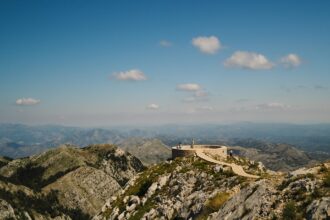
Just twenty minutes from Cetinje, Lovćen National Park is one of Montenegro’s great natural attractions and pairs naturally with a visit to the former royal capital.
The scenic road climbs steadily through forest and mountain before reaching the park’s best-known landmark, the Njegoš Mausoleum. Perched on the summit of Jezerski Vrh, it honours Petar II Petrović-Njegoš, Montenegro’s great ruler and poet, and rewards anyone who climbs its 461 stone steps with genuinely breathtaking views over the country.
Beyond the summit, the park has quiet walking trails, picnic spots, dense forest and some of the best scenic drives in the Balkans. Whether your interest is history, photography or just the mountain scenery, it complements Cetinje perfectly.
Our dedicated Lovćen National Park guide covers the Njegoš Mausoleum, hiking trails, scenic drives, viewpoints and entrance fees in more detail, so it’s worth a read before you set off.
Because the two destinations sit so close together, a lot of visitors base themselves in Cetinje for a night specifically to get an early start up the mountain, avoiding both the midday heat and the coach tours that tend to arrive from Kotor and Budva later in the morning. If you only have time for one national park in central Montenegro, this pairing with Cetinje is usually the easiest and most rewarding way to fit it in.
Bring layers regardless of the season, since temperatures on the mountain can be noticeably cooler than down in Cetinje itself, especially once the wind picks up around the summit car park.
Getting to Cetinje from Podgorica, Kotor and Budva
Although Cetinje sits away from the coast, it’s well connected by road and public transport, making it an easy addition to a visit to almost any of Montenegro’s popular towns.
| Starting Point | Bus | Car | Typical Journey |
|---|---|---|---|
| Podgorica | ✔ | ✔ | Around 40 minutes |
| Kotor | ✔ | ✔ | Around 45 minutes |
| Budva | ✔ | ✔ | Around 35 minutes |
| Tivat Airport | ✔ | ✔ | Around 45 minutes |
| Lovćen National Park | Limited | ✔ | Around 20 minutes |
Regular intercity buses connect Cetinje with Podgorica, Budva, Kotor and several other Montenegrin towns throughout the day, making it one of the easier historic destinations to reach without a car.
If you’re driving, you’ll find several public car parks close to the historic centre, so you can explore comfortably on foot once you arrive. Having a car also gives you the flexibility to combine Cetinje with Lovćen National Park or the dramatic mountain road down to the coast in the same day, and for the full driving route around the bay, our Bay of Kotor Scenic Drive guide is worth reading alongside this one.
Plenty of organised tours from Kotor, Budva and Tivat combine Cetinje with Lovćen National Park in a single trip, which is a solid option for cruise passengers or anyone staying along the coast without their own transport.
If you’re travelling by taxi rather than bus, agree a price before setting off, since meters aren’t always used for longer journeys between towns. Car parks near the centre tend to fill up during festivals and national holidays, so arriving a little earlier than planned is sensible if your visit coincides with one of Cetinje’s occasional cultural events.

Organise Your Montenegro Coach Trip with Busbud
You can use Busbud to research bus travel for Montenegro, check timetables and compare ticket options before booking.
Having the available operators together can make it much easier to plan connections and work out which service fits your schedule.
Best Time to Visit Cetinje
Cetinje is worth visiting throughout the year, though each season brings a slightly different mood.
Spring is one of the nicer times to come. The parks and gardens start blooming, temperatures are comfortable for walking, and the town stays fairly quiet, so you can take the museums and historic streets at a relaxed pace.
Summer brings slightly cooler temperatures than the coast, which makes Cetinje a welcome escape from the heat in Budva, Kotor or Bar. Outdoor cafés get lively, and the longer daylight hours make it easy to combine the town with Lovćen National Park in a single day.
Autumn brings colourful trees and a calmer atmosphere, good for photography and sightseeing as visitor numbers start to drop. Winter is quieter again, but the museums, monasteries and cafés stay open, and Lovćen occasionally gets a dusting of snow, which makes for a striking contrast with the historic streets below.

Rupert’s Handy Travel Tips
Planning a visit to Cetinje? Here are a few tips to make the most of Montenegro’s historic royal capital:
- Allow at least half a day: While the town is compact, its museums, monasteries and historic buildings deserve time to explore properly.
- Buy a combined museum ticket if available: If you’re planning to visit several museums, a combined ticket often offers excellent value.
- Wear comfortable shoes: The historic centre is easy to explore on foot, and wandering the quiet streets is one of the highlights of visiting Cetinje.
- Combine it with Lovćen National Park: The two attractions are only a short drive apart and together make one of Montenegro’s best day trips.
- Enjoy the slower pace: Cetinje isn’t a destination to rush through. Take time to relax in a local café and soak up the atmosphere of Montenegro’s former royal capital.
Want to meet the reindeer behind our travel tips? Find out more in our page Who is Rupert?.




Frequently Asked Questions
Is Cetinje worth visiting?
Yes, easily. Cetinje is one of Montenegro’s most historically significant towns and offers a genuinely different experience from the coastal resorts. Its royal palaces, museums, monasteries and relaxed atmosphere make it well worth the detour for anyone wanting to understand the country’s history and culture.
Why was Cetinje the capital of Montenegro?
For centuries it was the political, cultural and spiritual centre of the country, serving as the seat of Montenegro’s rulers and later its royal family. Many government institutions, embassies and royal residences were built here during the nineteenth century.
How long should I spend in Cetinje?
Allow at least half a day to see the historic centre, the monastery and one or two museums. A full day works well if you’re also planning to visit Lovćen National Park.
Is Cetinje Monastery free to visit?
Yes, entry is free, though donations are welcomed to support the monastery. As it’s an active place of worship, dress respectfully and keep noise down.
Can you visit Cetinje from Kotor?
Yes, it’s around 45 minutes by car and one of the more popular day trips from the Bay of Kotor. Regular buses and organised tours run between the two as well.
Is Cetinje walkable?
Yes. The historic centre is compact, and most museums, palaces, cafés and attractions are within a short walk of one another.
Should I combine Cetinje with Lovćen National Park?
Definitely. The two are only twenty minutes apart and complement each other well. Most visitors spend the morning in Cetinje before heading up into Lovćen for the afternoon.
Are there good museums in Cetinje?
Yes, several. Cetinje is widely seen as Montenegro’s cultural capital, with museums covering royal history, archaeology, art, ethnography and the country’s development over the centuries.
Can you reach Cetinje by public transport?
Yes. Frequent buses run to Podgorica, Budva, Kotor and several other towns, so a car isn’t essential.
Is Cetinje suitable for families?
Yes. The pedestrian-friendly streets, museums, parks and cafés work well for families, and older children in particular often enjoy the royal palaces and the trip up to Lovćen National Park.
Further Reading
The mountains right above Cetinje are the natural next stop, Lovćen National Park covers the Njegoš Mausoleum, hiking trails and scenic drives that most visitors add on.
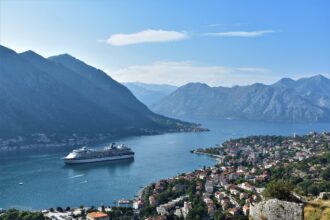
Combining the old capital with the coast, Kotor and its cruise port cover the Bay of Kotor side, and if you’re driving yourself between the two, this route guide is worth having on hand.
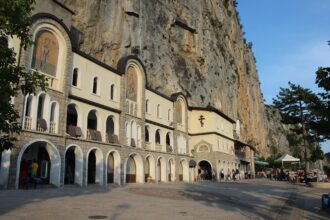
Central Montenegro has plenty more nearby: Lake Skadar and Ostrog Monastery both work as realistic additions, and further north, the Tara River Canyon shows a completely different, more mountainous side of the country.
For the full picture, this 14-day itinerary shows exactly where Cetinje sits within a longer route around Montenegro.