
Reviewed by our editorial team Updated
Discover Manchester with the Best Travel Apps
Manchester combines history, creativity, sport, nightlife, and modern convenience in a way few UK cities can match, and using the best travel apps for Manchester makes the experience far smoother from the moment you arrive. Whether you are stepping off a train at Manchester Piccadilly, landing at Manchester Airport, or arriving for a football match, festival, or city break, the right apps can save time, reduce stress, and help you experience more of the city with less friction.
This is a city that rewards spontaneity, but it also works brilliantly for travellers who like to plan. With the right Manchester travel apps, you can check tram and bus times in real time, find the quickest route across the city centre, reserve a restaurant table, book attraction tickets, order food to your hotel, or monitor delays before heading to a stadium or venue.
In practical terms, that means you can move from Salford Quays to the Northern Quarter, from a museum visit to a late dinner, or from an airport arrival to a city-centre hotel without wasting unnecessary time.
Manchester itself is especially well suited to this style of travel. Over the last decade, it has grown into a major destination for students, creatives, football fans, business travellers, and short-break visitors, and the city’s transport and hospitality systems have increasingly adapted to app-based, mobile-first travel. That makes it particularly easy to explore if you are comfortable using your phone as your main planning tool.
The city also offers an unusually strong mix of experiences within a relatively compact area. You can spend the day exploring industrial heritage, galleries, football landmarks, shopping districts, canalside walks, and independent cafés, then switch seamlessly into an evening of theatre, music, or nightlife. With the best apps to use in Manchester, that entire experience becomes easier to navigate and far more flexible.
When you are equipped with the right Manchester travel apps, the city feels more open, more efficient, and more rewarding. Instead of getting slowed down by tickets, timetables, or last-minute confusion, you can focus on discovering what makes Manchester memorable in the first place.
Quick Facts Table
| Category | Details |
|---|---|
| Country | United Kingdom |
| Region | North West England |
| Population | ~553,000 (City); ~2.8 million (Greater Manchester metro) |
| Main Station | Manchester Piccadilly |
| Nearest Airport | Manchester Airport (MAN) – ~15 minutes by train |
| Currency | British Pound (£) |
| Time Zone | GMT (UTC+0) / BST (UTC+1 summer) |
| Top Attractions | Old Trafford, Science & Industry Museum, Northern Quarter, The Lowry |
| Local Specialties | Boddingtons beer, Curry Mile dishes, Manchester tart |
| Known For | Music (Oasis, The Smiths), football, industrial heritage, nightlife |
| Transport Network | Metrolink trams, Bee Network buses, local/regional trains |
| Essential Travel Apps | Bee Network, Metrolink, Citymapper, Trainline, Uber, Deliveroo |
With those essentials covered, it helps to understand how Manchester became the city it is today before diving into transport, attractions, and practical planning.
Browse hotels and accommodation for your visit to Manchester.
View staysBrowse apartments, holiday homes and self-catering stays in Manchester.
View rentalsCompare prices for Manchester hotels across multiple booking sites.
Check dealsBrief History
Manchester’s story is one of constant reinvention, and understanding that history makes the city much more rewarding to explore. Its origins stretch back to the Roman era, when a fort known as Mamucium was established around AD 79. For centuries it remained relatively modest, but that changed dramatically during the Industrial Revolution, when Manchester emerged as one of the most important urban centres in the world.
By the 19th century, Manchester had become the world’s first industrial city, driving global trade through textile production, engineering, manufacturing, and scientific innovation. The city’s mills, warehouses, canals, railways, and factories reshaped not only the local landscape but also the wider global economy. This rapid industrial growth brought workers from across Britain and beyond, contributing to the city’s diversity and helping shape its resilient, often politically active identity.
Manchester also became known for ideas as much as industry. It played a central role in debates around workers’ rights, free trade, suffrage, and social reform, helping build its reputation as a place of argument, activism, and intellectual energy. That political character remains part of the city’s identity today.
The 20th century brought both hardship and renewal. Manchester experienced the decline of traditional industry, economic restructuring, and major wartime damage during the Manchester Blitz. Yet it continued to reinvent itself, drawing strength from education, culture, sport, and music. The city became internationally associated with bands such as The Smiths and Oasis, while Manchester United and Manchester City grew into two of the world’s most famous football clubs.
Today, Manchester is a city where Victorian buildings, industrial remnants, modern towers, independent cultural spaces, and major global brands exist side by side. It is precisely this mix of history and reinvention that makes the city so engaging to explore, especially when supported by the best travel apps for Manchester, which help you move between its older layers and newer energy with ease.
Getting There & Around
Manchester is one of the easiest cities in the UK to reach and navigate, which is one reason it works so well for both short breaks and longer stays. It has strong air, rail, coach, road, tram, bus, taxi, and cycle connections, and combining the right local and national apps can make the whole process far more efficient.
For most travellers, the experience begins either at Manchester Airport, at one of the city’s major rail stations, or through long-distance coach services. Once you arrive, local travel within the city is supported by a growing app-based system that makes route planning, ticket purchases, and real-time updates much easier than they used to be. The most useful approach is usually to combine broader national tools such as Trainline with local options such as the Bee Network app, which ties together trams, buses, bike hire, and real-time planning.
Manchester is especially strong for multi-modal travel, meaning it is easy to combine different forms of transport in a single day. You might arrive by train, switch to a tram, walk between attractions, then use a taxi app late at night. For visitors, this flexibility is a major strength. It means you do not need to rely on a car, and in many cases using public transport is simpler than driving in the city centre.
The city’s walkability also matters. Many of Manchester’s main attractions sit within a relatively compact central area, so walking often works well for shorter distances. At the same time, the tram and bus systems make it easy to reach places such as Old Trafford, MediaCityUK, Heaton Park, Didsbury, or the airport without much difficulty.
The key to moving around Manchester well is not just understanding the transport network, but knowing which apps support each part of it. With the right combination in place, arrival, city-centre movement, and onward day trips all become much easier to manage.
Arriving via Manchester Airport (MAN)
Manchester Airport is the main air gateway to the city and one of the most important airports in the United Kingdom. As the third-busiest airport in the UK, it serves as a major hub for the North of England and offers strong connections to both short-haul and long-haul destinations. Located around 9 miles south of central Manchester, it is close enough to make arrival into the city relatively straightforward.
The airport hosts more than 50 airlines, including major full-service carriers such as British Airways, Emirates, Lufthansa, Qatar Airways, and Singapore Airlines, alongside low-cost operators like Ryanair, easyJet, and Jet2. Together, they connect Manchester with more than 200 destinations worldwide, covering Europe, North America, Asia, Africa, and the Middle East.
Popular routes include major hubs such as Dubai, Amsterdam, Frankfurt, New York JFK, Doha, and Singapore, while shorter leisure routes include destinations such as Paris, Dublin, Barcelona, and Palma de Mallorca. Manchester also offers some less obvious seasonal or specialist routes, including flights to places such as Innsbruck, Fez, Sal Island, and smaller Greek island destinations that are not always served directly from London airports.
The airport is spread across two terminals and has a broad range of facilities, including lounges, duty-free shopping, cafés, restaurants, currency exchange, family facilities, and business-oriented services. The on-site Radisson Blu Hotel, connected by covered walkway, is especially convenient for early departures or late arrivals.
Getting from the airport into central Manchester is relatively easy. The fastest option is usually the train, with direct services to Manchester Piccadilly running roughly every 10 to 20 minutes and taking around 20 minutes.
The Metrolink Airport Line is slower but useful for some travellers, especially those staying outside the core centre, with journeys to places such as Deansgate and St Peter’s Square taking around 50 to 60 minutes. Taxis and ride-hailing services usually take around 25 to 30 minutes, depending on traffic, while local buses such as the Stagecoach 43 provide a cheaper but slower alternative and operate around the clock.
For travellers arriving by air, using the right apps makes a real difference. Flight-tracking tools can help with gate changes, delays, and arrival timing, while local transport apps help you move from the terminal to the city with much less guesswork. Manchester Airport is large enough to feel busy, but well connected enough that, with the right preparation, it is one of the easier UK airports to use for a city break.
Getting into the City from Manchester Airport
Getting from Manchester Airport into the city centre is straightforward, and one of the reasons the airport works so well for visitors is the range of options available. Whether you prioritise speed, budget, convenience, or direct access to a particular neighbourhood, there is usually a suitable route from the terminal to the city.
The fastest and most popular option is the train. The airport station, located between Terminals 1 and 2, offers direct services to Manchester Piccadilly roughly every 10 to 20 minutes, with the journey usually taking around 20 minutes. For many travellers, this is the easiest way to reach the centre quickly after landing, especially if they are staying near Piccadilly, the Northern Quarter, or other central districts.
The Metrolink tram is slower but still useful, particularly for travellers staying somewhere outside the immediate city-core rail zones. The Airport Line runs approximately every 12 minutes and reaches areas such as Deansgate, St Peter’s Square, and suburban districts like Chorlton in around 50 to 60 minutes depending on destination. Tickets can be bought through the Bee Network app, which is particularly useful if you want live updates and integrated onward travel planning.
For door-to-door ease, taxis and ride-hailing services are another strong option. Black cabs are available outside the terminals, while app-based operators such as StreetCars, Uber, and Free Now also serve the airport. A typical journey into central Manchester takes around 25 to 30 minutes in normal traffic, though this can vary at busier times. For many travellers carrying luggage or arriving late in the evening, this is the most comfortable option.
If cost is the main concern, the Stagecoach 43 bus provides one of the cheapest connections into the city and runs 24 hours a day. It takes longer than rail or taxi, but it is a dependable option for budget travellers or those arriving when other services are less frequent.
The best choice depends on where you are staying and how much you are carrying. For most visitors heading straight into the centre, the train is the best balance of speed and simplicity, while the tram works well for wider local connections and taxis offer the easiest direct transfer when convenience matters most.
By Train
Manchester is one of the United Kingdom’s most important rail hubs, and for many visitors, arriving by train is the most efficient way to reach the city. The main station is Manchester Piccadilly, which serves as the principal gateway for intercity arrivals and long-distance rail travel. It connects directly with the local tram, bus, and taxi network, which means stepping off a national train and continuing into the city is usually very smooth.
In addition to Piccadilly, other major stations such as Manchester Victoria, Oxford Road, and Deansgate help distribute rail traffic across the city. These stations are especially useful for regional and commuter services, while smaller suburban stations provide links to outer parts of Greater Manchester and nearby towns.
For visitors using the best travel apps for Manchester, combining national ticketing and journey-planning tools with the Bee Network app creates a particularly effective setup. You can check a long-distance train, reserve a seat, and then move immediately into live local transport planning without having to switch your whole travel system.
Journey times to Manchester are strong by UK standards. Services from London Euston to Manchester Piccadilly take around 2 hours 10 minutes on Avanti West Coast. Birmingham New Street to Manchester Piccadilly is typically around 1 hour 30 minutes, while Liverpool to Manchester can take roughly 50 minutes depending on route and station. These connections make Manchester an easy city to reach for both short breaks and multi-city itineraries.
There are also good ways to save money. Advance fares are often substantially cheaper than buying a ticket on the day, especially on longer routes, and a UK Railcard can reduce eligible fares by around 30 percent. For travellers planning more than one rail journey, regional products such as the Northern Explorer ticket can also offer decent value.
Accessibility at the major stations is generally good, with step-free access, lifts, tactile paving, induction loops, and bookable assistance services. Onboard comfort also varies by service type. Long-distance trains often include Wi-Fi, luggage racks, power sockets, and refreshments, while regional services are usually more basic but still practical for short journeys.
For anyone travelling from elsewhere in Britain, Manchester’s rail connections make it one of the easiest major northern cities to reach, and once you arrive, the city is well set up to help you continue your journey quickly.
Coach Travel
For travellers focused on value, coach travel can be one of the cheapest ways to reach Manchester. It is slower than rail on many routes, but the lower fares make it especially attractive for budget-conscious visitors, students, and those booking at short notice. Manchester is well placed for coach arrivals because its main intercity coach facilities are close to the city centre and within easy reach of public transport.
The main hub is Manchester Central Coach Station on Chorlton Street, which sits close to Piccadilly Gardens, the Gay Village, and city-centre tram and bus links. Shudehill Interchange, near the Northern Quarter, also handles some coach movements and gives immediate access to the wider Bee Network. This means that even if your coach journey is long, getting from the drop-off point to your hotel or next stop is usually easy.
The principal operators are National Express, Megabus, and FlixBus. National Express offers extensive UK coverage and often includes practical onboard features such as Wi-Fi, toilets, and charging points. Megabus is known for low promotional fares, sometimes starting from £1 during sales (approx. €1.15 / $1.25), while FlixBus adds both domestic and some European routes, including long-distance travel to cities such as London, Paris, and Amsterdam.
Typical coach fares can be very competitive. Journeys from Liverpool or Leeds may cost around £5 to £15 (approx. €6–€17 / $6–$19), while London is often in the £10 to £25 (approx. €12–€29 / $13–$32) range depending on timing and booking window. International services can start from around £25 (approx. €29 / $32), which makes coach travel worth considering for those travelling on tighter budgets.
Coaches also have practical advantages beyond price. They often run day and night, making them useful when rail services are reduced or when you want a late departure. Luggage allowances can be more generous than on some low-cost flights, and modern vehicles usually include reclining seats, air conditioning, and pre-bookable seat options.
Accessibility support is also available, with wheelchair-accessible coaches offered when requested in advance and assistance available at major departure points. While coaches do require more travel time, they remain a highly practical choice for visitors who want to reach Manchester cheaply without sacrificing too much comfort.

Check Bus Routes for Manchester with Busbud
If your plans include travelling by bus to or from Manchester, Busbud provides a convenient way to search routes and compare tickets.
Instead of checking individual operator websites, you can see several options together and choose the journey that best fits your itinerary.
Search routes and flight options for your trip to Manchester.
Search flightsUse an eSIM to get online without hunting for a local SIM after arrival.
See eSIM optionsHave a private airport pickup arranged before you travel.
Book a transferGetting Around Manchester by Tram (Metrolink)
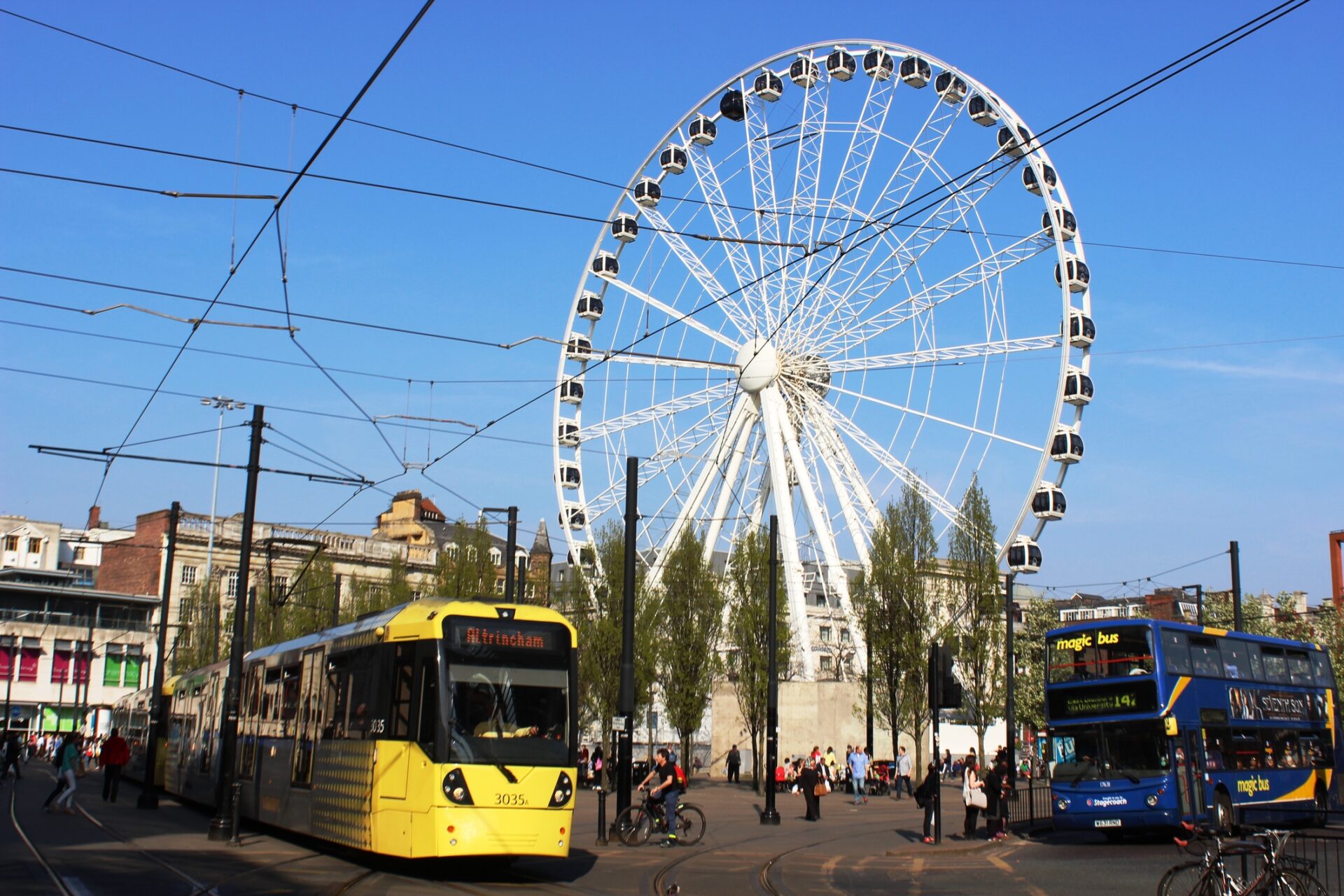
The Metrolink is one of the most useful transport systems for visitors and a major reason Manchester is easy to navigate without a car. It is the largest light rail network in the United Kingdom, with more than 99 stops connecting the city centre to suburbs, business districts, stadiums, shopping areas, parks, and the airport. For many visitors, it becomes the backbone of getting around.
The network reaches places that matter to travellers, including Old Trafford, MediaCityUK, Heaton Park, East Didsbury, Rochdale, Altrincham, and Manchester Airport. Because the system is easy to understand and well integrated with local buses and trains, it works especially well for visitors trying to move between several different parts of the city in a single day.
The most important local tool for using the tram is the Bee Network app, which acts as the key hyper-local app for live route planning, ticketing, and service updates. For anyone building a list of the best travel apps for Manchester, this is one of the essential downloads. It helps with fare planning, route checks, and connection timing, all of which become especially useful during football matchdays, major concerts, and rush-hour travel.
Fares are zone-based, with single trips generally ranging from around £1.40 to £4.60 (approx. €1.60–€5.35 / $1.75–$5.80). Day travelcards can cost from around £3.40 for one zone up to £7.10 for all zones (approx. €3.95–€8.25 / $4.30–$8.95), and family or weekend passes can offer better value depending on your plans. Tickets can be bought via the app, from station machines, or through contactless tap-in and tap-out, and daily fare caps help prevent overspending.
Accessibility is strong across the network. All stops are step-free, and platforms include tactile paving, visual information screens, and audio announcements. Trams also provide priority seating and wheelchair spaces, making the system practical for a wide range of users.
A few simple habits help make the experience better. On busy event days, it is sensible to activate tickets before boarding to avoid queues. If you expect to make several journeys in one day, a day travelcard is usually better value than multiple singles. Off-peak fares can also help reduce cost if your schedule is flexible.
For most visitors, Metrolink is one of the easiest and most efficient ways to experience Manchester beyond the immediate city-centre core.

App availability and prices vary by country. Some of these may not appear in your local App Store or Google Play.
Getting Around Manchester by Bus (Bee Network)
Manchester’s bus system has become much simpler for visitors since the rollout of the unified Bee Network, which now brings local bus travel together under one recognisable structure. This matters because buses are often the most flexible way to reach areas not directly served by the tram, and the simplification of fares and app-based planning has made them far easier for non-locals to use.
The Bee Network app is the essential tool here. It provides real-time arrivals, mobile ticketing, and multi-modal journey planning, allowing users to switch smoothly between buses, trams, and walking routes. For visitors trying to understand which apps to use in Manchester, this is easily one of the most useful because it covers so much of everyday urban movement in one place.
The network itself includes hundreds of routes, from short inner-city services to wider connections across Greater Manchester. Since fare structures have been simplified, buses are now much easier to budget for. Standard adult fares include a Single Hopper ticket for £2 (approx. €2.30 / $2.50), which allows unlimited travel within 60 minutes, and a Day Bus ticket for £5 (approx. €5.80 / $6.30).
A 7-day ticket costs £20 (approx. €23 / $25), and an annual pass is £800 (approx. €928 / $1,008), which works out to roughly £2.20 per day (approx. €2.55 / $2.75) across the year.
Tickets can be bought through the app, using contactless payment, or through selected outlets. Contactless fare caps are particularly helpful because they reduce the risk of overpaying if you are making several trips across the day. For visitors spending a week in the city, the 7-day pass can work out well, while the Hopper ticket is especially good for short, practical movements where you may need to change buses.
Accessibility is another strength. Bee Network buses are low-floor, with wheelchair access, priority seating, and audio-visual stop announcements. This makes them more user-friendly than older bus systems that relied heavily on local knowledge.
Buses are also useful beyond standard daytime travel. Late-evening and night routes cover many main corridors, which can be especially helpful after concerts, bars, or other late events when tram services are less convenient for a particular destination.
For visitors willing to use the app and pay attention to live updates, the Bee Network bus system is a practical, affordable, and increasingly straightforward way to move around Manchester well beyond the main tourist zones.
Free City Centre Buses
Manchester offers one of the most useful (and often overlooked) perks for visitors: free city centre buses. These services are part of the Bee Network and run on two circular routes, making it easy to move between major landmarks, stations, shopping areas, and cultural districts without paying a fare.
There are two main routes, both running in a clockwise loop. If you miss your stop, you can simply stay on board and complete the loop again, which usually takes around 25 to 30 minutes depending on traffic. This makes the service especially useful for first-time visitors who want to get a feel for the city layout before walking.
Route 1 (Pink Loop) connects Manchester Piccadilly with key areas including Oxford Road, Deansgate, Spinningfields, and the Science and Industry Museum. It is particularly useful if you are moving between transport hubs and cultural attractions or heading towards the west side of the city centre.
Route 2 (Teal Loop) focuses more on the Northern Quarter, Manchester Victoria, Shudehill Interchange, and shopping areas like the Arndale Centre. It is a great option for linking retail districts, nightlife areas, and cultural sites such as the National Football Museum.
Both routes run frequently throughout the day, typically every 10 to 15 minutes during peak hours, with reduced frequency in the evening. Because they are free, they are often busy, especially at weekends or during events, but they remain a highly practical option for short hops across the city.
All buses are wheelchair accessible, with low floors and audio-visual stop announcements. For best results, use the Bee Network app to track buses in real time and avoid unnecessary waiting.
Taxis and Ride-Hailing
Manchester has a wide range of taxi and ride-hailing options, making it easy to travel quickly, especially late at night or when carrying luggage. Whether you prefer traditional black cabs or app-based services, the system is flexible and generally reliable.
Black cabs are licensed, metered, and can be hailed on the street or picked up from taxi ranks at key locations such as Manchester Piccadilly, Manchester Victoria, the AO Arena, and major hotels. Drivers are trained in local routes, which makes them a good option if you are unfamiliar with the city or want a straightforward journey without relying on navigation apps.
For app-based travel, StreetCars is the main local operator and is widely used across the city. It offers fixed fares, pre-booking, and cashless payment, which can be particularly useful for airport transfers or early departures. Global platforms such as Uber and Free Now are also widely available and often have short wait times in central areas.
Typical fares are reasonable by UK city standards. A short journey within the city centre might cost £5 to £10 (approx. €6–€12 / $6–$13), while airport transfers are usually in the £25 to £35 range (approx. €29–€41 / $32–$44) depending on traffic and time of day. During busy periods such as football matches or major concerts, surge pricing can increase costs on app-based services.
A few simple strategies can improve your experience. Pre-booking is recommended for early mornings or late nights, especially during busy weekends. If accessibility is important, request a wheelchair-accessible vehicle in advance. While most taxis accept cards, it is still worth confirming before the journey begins.
Overall, taxis and ride-hailing services provide a flexible fallback when public transport is less convenient, and they are particularly useful for journeys outside tram or bus routes.

App availability and prices vary by country. Some of these may not appear in your local App Store or Google Play.
For more national and global options, see our Must-Have Taxi Hailing Apps page.
Cycling & Bike Hire
Cycling is becoming a more viable way to get around Manchester, thanks to the gradual expansion of dedicated cycle lanes and public bike hire schemes. While the city is not as cycle-dominant as some European destinations, it is improving steadily and offers a good mix of urban and scenic routes.
The public bike hire system is integrated into the Bee Network app, allowing users to unlock bikes using a QR code. Pricing is simple, usually involving a small unlock fee (around £1) (approx. €1.15 / $1.25) followed by a per-minute rate. For frequent use, day passes or bundles can reduce overall costs.
Cycling works especially well for certain types of routes. The Fallowfield Loop is a popular off-road path stretching for over 8 miles, while canal-side routes along the Rochdale Canal and Bridgewater Canal provide quieter, traffic-free journeys. These are ideal for relaxed exploration rather than fast commuting.
Within the city, cycle lanes now connect central areas with suburbs such as Didsbury, Chorlton, and Salford Quays, making it possible to combine cycling with public transport. Bikes are also allowed on Metrolink trams outside peak hours, which can extend your range further.
Safety remains important. Wearing a helmet is recommended, especially in busier areas. At night, lights are essential, and in wet conditions extra care is needed around tram tracks and painted road markings, which can become slippery. Secure locking is also important when leaving a bike unattended.
For visitors who enjoy a more active way of exploring, cycling offers flexibility and access to quieter parts of Manchester that are not always reached by public transport.
Ferries & Cruises
Although Manchester is an inland city, it has a strong historical connection to maritime trade through the Manchester Ship Canal, which was completed in 1894 to link the city directly to the Irish Sea. Today, that legacy can still be experienced through a range of canal cruises and nearby ferry connections.
One of the most distinctive experiences is the Manchester Ship Canal cruise, operated by Mersey Ferries. These seasonal journeys travel between Manchester and Liverpool, passing through locks, industrial zones, and regenerated waterfront areas. Trips typically last 6 to 7 hours and include onboard commentary explaining the canal’s history and its role in transforming Manchester into a global industrial centre.
Shorter leisure cruises operate around Salford Quays, offering views of landmarks such as MediaCityUK, the Lowry, and the Imperial War Museum North. These are more relaxed, shorter experiences and are ideal if you want a different perspective on the city without committing to a full-day trip.
For onward ferry travel, the nearest major port is Liverpool, around an hour away by train. From there, services connect to destinations such as Dublin, Belfast, and the Isle of Man, operated by companies including Stena Line, Irish Ferries, and the Steam Packet Company. Many of these routes can be booked through dedicated ferry apps or travel platforms.
While ferries are not part of everyday travel within Manchester, they offer a unique way to explore the region’s history and extend your journey beyond the city.
Browse hostels and budget-friendly stays around Manchester.
See hostelsGet help with compensation, eligible lounge access and disruption support.
Explore AirHelp+Use convenient luggage storage around Manchester between arrival, check-in and departure.
Check storageCar Hire in Manchester
Hiring a car in Manchester can make sense if you plan to explore beyond the city rather than stay in the centre. For most visitors spending their time around the Northern Quarter, Deansgate, the museums, football stadiums, and main shopping areas, public transport, trams, trains, and taxis are usually easier than driving. Central Manchester has busy roads, one-way systems, bus gates, limited parking, and regular congestion, so a rental car can feel more like a burden than a benefit for a city break.
Where car hire becomes useful is for travellers heading further out. If you want to visit the Peak District, Lyme Park, Chatsworth, the Yorkshire Dales, North Wales, Chester, or smaller towns that are less convenient by rail, having your own vehicle gives you far more flexibility. It is also handy for families, people carrying lots of luggage, or travellers arriving in Manchester and continuing on a wider northern England road trip.
Most visitors pick up rental cars either at Manchester Airport or from branches in and around the city centre. Airport collection is often the easiest option if you are flying in, while city branches can work well if you spend a day or two in Manchester first and only hire a car when leaving the city. Before booking, check whether your rate includes mileage limits, fuel rules, excess charges, and fees for automatic vehicles, as automatics are often more expensive and less widely available than manuals in the UK.
Parking is the main thing to think about. Many central hotels charge extra for parking, and some do not have on-site spaces at all. If you only need a car for one day, it is often better to hire it just for that portion of your trip instead of keeping it parked in the city. Also remember that UK drivers keep to the left-hand side of the road, and Manchester’s traffic can feel quite intense during peak hours.
For most people, the smartest approach is simple: do not hire a car for central Manchester itself; hire one only if you are using Manchester as a launch point for regional travel.
Book Car Hire for Your Manchester Trip
If your plans in Manchester include day trips, rural areas or several stops, having your own car can make the itinerary much easier to manage.
Discover Cars and EconomyBookings both let you compare available vehicles and prices from a range of rental companies.
Driving & Parking
Driving in Manchester can work well if you plan ahead, but it is rarely the easiest way to move around the city centre. Roads can be busy, layouts are sometimes confusing, and parking is limited in high-demand areas. For most visitors, driving is best used selectively rather than as a primary way to get around.
Parking is available across the city through operators such as NCP, Q-Park, and APCOA, many of which allow pre-booking. This is often the smartest approach, especially if you are arriving during peak hours or for a major event. Using a dedicated parking app can also help you find spaces that are not obvious from the street, including private car parks, hotel spaces, and smaller off-street locations.
Typical parking costs in central Manchester range from around £3 to £5 per hour (approx. €3.50–€5.80 / $3.80–$6.30), with 24-hour rates between £15 and £25 (approx. €17–€29 / $19–$32) depending on location and timing. Evening rates are often lower, sometimes dropping to around £5 after 6pm (approx. €5.80 / $6.30). Prices can increase significantly on matchdays or concert nights, particularly near venues such as Old Trafford, the Etihad Stadium, or the AO Arena.
If you want to avoid city-centre parking altogether, park-and-ride options are a strong alternative. Locations such as Sale Water Park or East Didsbury allow you to leave your car outside the busiest zones and complete the journey by tram, which is often faster and less stressful.
A few practical tips make a big difference. Avoid driving during rush hours, as congestion can slow progress considerably. Pay close attention to bus lanes and traffic cameras, which are widely enforced. If you are unfamiliar with the layout, using a navigation app with live traffic updates is essential.
Driving in Manchester is manageable, but it works best when combined with other transport options rather than relied on exclusively.

App availability and prices vary by country. Some of these may not appear in your local App Store or Google Play.
Transport Attractions
Manchester is not just easy to get around, it is also a city where transport itself is part of the story. From railways that helped shape the Industrial Revolution to heritage tramways and modern stadium connections, there are several transport-related attractions worth building into your itinerary.
One of the most important sites is the Science and Industry Museum, located on the site of the world’s first passenger railway station at Liverpool Road. The museum explores Manchester’s role in the Industrial Revolution, with exhibits covering steam engines, textile machinery, early computing, and transport history. It is free to enter and offers a strong mix of education and hands-on displays.
Rail enthusiasts may also enjoy exploring Manchester Piccadilly Station and Manchester Victoria Station, both of which reflect different eras of railway architecture. Victoria, in particular, has been carefully restored and retains elements of its historic character.
For something more unusual, the Heaton Park Tramway offers rides on restored heritage trams through one of the city’s largest parks. These operate on selected weekends and provide a glimpse into early 20th-century transport.
Football fans can also combine transport with sport by taking the tram to Old Trafford or Etihad Stadium, both of which are well connected by the Metrolink system and become major transport hubs on matchdays.
Just outside the city, the East Lancashire Railway offers a heritage rail experience with steam and vintage diesel trains running through scenic countryside. It is an easy day trip via tram to Bury and adds a completely different dimension to Manchester’s transport story.

Mini Trains, Trams & Tourist Shuttles
Manchester’s main public transport is modern and extensive, but visitors looking for slower, more scenic rides will find smaller-scale and heritage services that offer a different perspective on the city.
The Heaton Park Tramway is a highlight for families and enthusiasts, running restored early 20th-century trams through one of the city’s largest green spaces. Services run on select weekends and bank holidays, and details are published through local heritage transport sites and apps.
In summer, the East Lancashire Railway offers heritage steam and diesel train rides from nearby Bury to picturesque towns like Ramsbottom and Rawtenstall. While not strictly within Manchester city limits, it’s easily reached via the Metrolink and makes for a great day trip. Tickets and timetables are available online, with some third-party travel apps providing package deals that include meals or attraction entry.
City sightseeing services, such as hop-on hop-off buses, operate seasonally and give visitors an easy way to cover major landmarks. Routes typically include the Town Hall, Salford Quays, MediaCityUK, and the Northern Quarter. The Bee Network app can assist in finding connection points between these tourist services and the regular tram and bus network.
Top Attractions
Manchester offers a broad mix of attractions, from industrial heritage and world-class museums to football landmarks and creative districts. The city is compact enough that many of its highlights can be visited in a single trip, especially when supported by good planning.
One of the most important cultural sites is the Science and Industry Museum, which explores the city’s role in shaping the modern world. Nearby, the Manchester Art Gallery houses an extensive collection of British and international art, including works from the Pre-Raphaelite movement through to contemporary exhibitions.
For architecture and atmosphere, the John Rylands Library stands out. Its neo-Gothic interior is often compared to a cathedral and holds rare manuscripts and historic texts.
Football is a major part of Manchester’s identity, and both Old Trafford and Etihad Stadium offer tours that provide insight into the city’s sporting culture.
For something more contemporary, the Northern Quarter is a creative district filled with street art, independent shops, cafés, and music venues. Meanwhile, Salford Quays offers waterside attractions including theatres, galleries, and modern developments.
Together, these sites show the range of experiences Manchester offers, from history and culture to sport and modern creativity.
Follow our self-guided Manchester Walking Tour to discover most of the attractions listed above.
Historical Highlights & Landmarks
Manchester’s history is visible across the city, from Roman origins to industrial expansion and modern regeneration. Exploring these landmarks helps give context to everything else you see.
The area of Castlefield is widely regarded as the city’s birthplace. It contains reconstructed Roman fort remains alongside canals, warehouses, and viaducts from the industrial era. The combination of ancient and industrial history in one location makes it a particularly interesting place to explore.
The Manchester Town Hall is one of the city’s most recognisable buildings. Completed in 1877, it reflects the wealth and ambition of Victorian Manchester. Although parts of it are currently under renovation, its exterior and surrounding Albert Square remain important landmarks.
Nearby, Chetham’s Library offers a completely different perspective. Founded in 1653, it is the oldest public library in the English-speaking world and retains much of its original atmosphere, including historic reading rooms and chained books.
Another notable site is Victoria Baths, often called the “Water Palace”. Although no longer used as a public bath, it is preserved as a heritage venue and occasionally opens for tours and events.
Finally, the former Free Trade Hall, now part of a hotel, played a major role in both political history and music culture. It hosted important debates as well as legendary concerts, linking Manchester’s industrial past with its cultural influence.
These landmarks together tell the story of a city that has constantly evolved, shaped by industry, ideas, and creativity.
For official city visitor information, see Visit Manchester.

Hidden Gems & Local Secrets
Manchester really rewards anyone willing to look beyond the obvious. Once you move past the headline attractions, you start to see a more local, creative, and slightly rough-edged version of the city that gives it real character.
One of the best places to experience that shift is Ancoats. Once the heart of the Industrial Revolution, it has been transformed into one of the city’s most exciting food and drink neighbourhoods. Old red-brick mills now sit alongside independent bakeries, coffee spots, and some of the best casual dining in the city. It is the kind of place where menus change regularly and where booking ahead through apps can make a big difference, especially at weekends.
Nearby, Mackie Mayor offers a completely different experience. This restored Victorian market hall combines architecture and street food in a way that feels very Manchester. You can move between vendors, try different dishes, and sit in a shared dining space under a glass roof that feels both historic and modern at the same time.
For something quieter, the city’s canals are one of its most underrated features. Walks along the Rochdale Canal or Bridgewater Canal give you a break from traffic and noise, while still keeping you close to the centre. These routes are especially good early in the morning or late in the day when the city slows down a little.
If you want a classic pub with real character, the The Peveril of the Peak is hard to beat. Its distinctive green-tiled exterior makes it easy to spot, and inside it still feels like a proper Victorian pub rather than a modern rework.
For a mix of culture and green space, the Whitworth Art Gallery is another strong option. It blends indoor exhibitions with outdoor sculpture spaces and parkland, making it a good place to slow down after a busy stretch in the city centre.
These are the kinds of places that do not always appear in quick itineraries but often end up being the most memorable parts of a visit.

Indoor Attractions & Rainy-Day Ideas
Manchester’s weather is unpredictable, so having strong indoor options is essential. The city handles this well, with a wide range of cultural, entertainment, and interactive spaces that keep your plans on track even when the rain arrives.
One of the best places to start is the National Football Museum. This is far more than a niche attraction for fans. It tells the story of football as a global cultural force, with historic memorabilia, iconic trophies, and interactive exhibits that let you test your own skills. It is engaging, well laid out, and suitable for all ages.
For a more modern cultural experience, HOME Manchester is one of the city’s standout venues. This multi-use arts space combines cinema, theatre, gallery exhibitions, and a social café environment under one roof. It is an excellent choice if you want to spend a few hours indoors without feeling stuck in a traditional museum setting.
If you are travelling with friends or want something more interactive, Manchester has a strong escape room scene. Venues such as Breakout Manchester and Escape Hunt Manchester offer immersive, themed experiences that are easy to book and ideal for groups. These are particularly useful when you want a structured activity rather than casual browsing.
The Whitworth Art Gallery is another excellent option because it blends indoor and outdoor space. You can move between contemporary exhibitions, historic collections, and parkland views, making it flexible depending on the weather.
For something more alternative, head to Afflecks in the Northern Quarter. This multi-floor indoor market is packed with independent traders, vintage clothing, art, and niche collectibles. It is less polished than a shopping centre, but far more interesting if you want something unique.
Rain in Manchester rarely stops your plans. It just shifts the focus indoors, where the city is just as strong.
Shopping and Markets
Manchester offers a broad shopping experience, combining large retail centres with independent districts that give the city its character.
For mainstream retail, the Manchester Arndale is the central hub. With over 200 stores, it covers everything from fashion and electronics to everyday essentials. Just outside, Market Street provides a busy, pedestrian-friendly shopping area with familiar high-street brands.
If you are looking for something more refined, Spinningfields offers a more polished experience. This area is known for designer stores, premium brands, and a quieter, more curated atmosphere compared to the main shopping streets.
For something more distinctive, the Northern Quarter is where Manchester really stands out. This area is packed with independent shops, vintage clothing stores, record shops, and creative studios. It is less predictable and far more rewarding if you are looking for something different.
Markets add another layer to the experience. Places like Hatch combine street food, pop-up retail, and small creative businesses in a constantly changing environment. Seasonal events such as the Christmas markets bring even more variety, with stalls spread across multiple city squares.
For scale, the Trafford Centre offers one of the largest shopping environments in the UK. It is highly structured, with hundreds of shops, restaurants, and leisure options, making it ideal if you want everything in one place.
Manchester works well for shopping because it gives you both convenience and individuality in the same city.

Nightlife
Manchester’s nightlife is one of its defining strengths, offering a mix of theatre, live music, bars, and late-night venues that suit almost every style.
For theatre, the Royal Exchange Theatre stands out for its unique in-the-round design and strong programme of performances. Larger productions can be found at the Palace Theatre and Manchester Opera House, both of which host major touring shows and musicals.
Live music is central to Manchester’s identity. Venues like Band on the Wall offer more intimate performances, while the AO Arena brings in major global acts. The newer Co-op Live has added another large-scale venue, quickly becoming a key stop for international tours.
For bars and clubs, the Northern Quarter and Deansgate provide a wide range of options, from craft beer spots and cocktail bars to late-night dance venues. The Canal Street area remains one of the UK’s most important LGBTQ+ nightlife districts, known for its inclusive atmosphere and lively energy.
Manchester nightlife works because it is varied. You can move from a theatre show to a live gig to a late drink without needing to over-plan the evening.

App availability and prices vary by country. Some of these may not appear in your local App Store or Google Play.
Seasonal Highlights & Annual Events
Manchester is a genuine year-round city destination, with each season bringing a noticeably different atmosphere, event calendar and travel experience. Rather than having one short tourist season, the city constantly shifts throughout the year depending on football fixtures, concerts, festivals, university activity and major public events.
Spring in Manchester between March and May is one of the city’s most underrated periods. Temperatures begin improving, the parks and canalside areas become noticeably greener and visitor numbers remain relatively manageable compared with the height of summer. This is often the best period for exploring neighbourhoods such as the Northern Quarter, Ancoats and Castlefield on foot without heavy crowds. Events such as the Manchester Marathon and the Manchester Irish Festival also bring extra energy into the city during spring weekends.
Summer in Manchester between June and August is the city’s busiest and most event-heavy season. Outdoor dining areas, beer gardens and terraces across districts such as the Northern Quarter and Spinningfields become packed during warm evenings, while huge concerts regularly take place at venues including Heaton Park and Co-op Live.
One of the biggest annual highlights is Manchester Pride, which transforms large parts of the city centre into a huge celebration of music, nightlife and LGBTQ+ culture. Summer is the best season for atmosphere and nightlife, although hotel prices and accommodation demand can rise sharply during major events.
Autumn in Manchester between September and November gives the city a more local and cultural atmosphere that many repeat visitors actually prefer over summer. The crowds become smaller, temperatures cool and the city feels more relaxed while still remaining lively. Events such as the Manchester Food and Drink Festival and the Manchester Literature Festival attract visitors interested in culture, dining and the arts.
Halloween has also become increasingly important in recent years, with the city’s annual Halloween in the City celebrations bringing giant monsters, illuminated displays, roaming performers and themed installations into central areas such as Exchange Square and Market Street. The cooler weather and darker evenings actually help create a much stronger atmosphere during these events.
Winter in Manchester between December and February transforms the city into one of the UK’s major festive destinations. The famous Manchester Christmas Markets take over large sections of the city centre, filling streets and squares with lights, food stalls, bars and seasonal entertainment. Indoor attractions such as museums, theatres and shopping centres become especially popular during colder weather, while Manchester’s nightlife scene remains active throughout winter. January and February are usually much quieter after the Christmas period, often bringing noticeably lower hotel prices and fewer tourists.
One of the city’s most important public celebrations is Manchester Day, a huge civic event normally held during summer featuring parades, performances, musicians and community organisations across the city centre. Streets around Deansgate, St Peter’s Square and Piccadilly Gardens often become major event spaces during the celebration, giving visitors a much more local and community-focused experience of the city.
Overall, the best time to visit Manchester is usually late spring or early autumn, when the city offers a strong balance between weather, atmosphere, manageable crowds and cultural activity. Summer delivers the biggest events and nightlife energy, while winter is ideal for festive atmosphere, Christmas markets and indoor attractions.
Parks, Gardens & Green Spaces
Manchester balances its urban energy with a surprisingly strong network of green spaces, riverside paths, and parkland. These areas are not just for relaxation, they are an important part of how locals experience the city, especially in better weather.
One of the standout spaces is Heaton Park, one of the largest municipal parks in Europe. It offers a mix of open fields, woodland, a boating lake, and even a historic hall. It is also used for major events, which means it can feel completely different depending on when you visit. On a quiet morning it is peaceful and expansive, while during festivals it becomes one of the city’s busiest venues.
Closer to the centre, Sackville Gardens provides a smaller but culturally significant space. It is closely linked to Manchester’s LGBTQ+ history and is a key location during Pride events. It offers a calm contrast to the surrounding city streets.
For something more botanical and tranquil, Fletcher Moss Botanical Garden in Didsbury is one of the most scenic green spaces in the region. It combines formal gardens with riverside walks and is particularly strong in spring and early summer.
These spaces are not just add-ons to a trip. They are often the best way to break up a busy itinerary, especially if you are moving between museums, shopping areas, and restaurants.

Where & What to Eat
Manchester has developed into one of the UK’s most exciting food cities, with a scene that ranges from independent street food to high-end dining. What makes it stand out is the concentration of quality within a relatively compact area.
The Northern Quarter is the starting point for most visitors. It is packed with independent cafés, brunch spots, and global street food. This is where you will find the most creative and fast-moving food trends, with menus changing regularly and new places opening frequently.
Ancoats has become the city’s premium food district, known for some of the best restaurants in the region. It leans more toward refined dining and reservations, so planning ahead is important, especially at weekends.
The Curry Mile is one of Manchester’s most famous food areas, offering a dense strip of South Asian restaurants and takeaways. It is particularly strong for late-night food, and the variety means you can try multiple cuisines within a short walk.
For something more casual, food halls like Mackie Mayor bring together multiple independent vendors under one roof. These are ideal if you want variety without committing to a single restaurant.
Manchester’s food scene works best when you mix it. A structured dinner one night, street food the next, and something spontaneous in between.
Top Cities Nearby
Manchester is not just a destination in its own right, it is one of the best-connected bases in the UK, making it ideal for building a wider itinerary. Within 30 to 90 minutes, you can reach major cities, historic towns, and national parks, each offering a completely different experience.
Liverpool is the most obvious and rewarding pairing. Just 35 to 45 minutes away, it offers a completely different personality to Manchester, with a strong maritime identity, waterfront setting, and deep cultural heritage. Highlights include the Royal Albert Dock, museums, and music history linked to The Beatles. Many travellers combine Manchester and Liverpool into a two-city trip, as they complement each other well without overlapping.
Chester is the best option if you want something more historic and visually distinctive. Its Roman walls, medieval streets, and unique “Rows” shopping galleries create a much more traditional English feel. It is compact, walkable, and ideal for a slower-paced day trip focused on architecture and heritage.
Leeds offers a more modern, commercial city experience, with excellent shopping, nightlife, and a growing food scene. It feels similar in scale to Manchester but with a slightly more polished, retail-focused centre. This is a good option if you want another urban stop without repeating the same experience.
York is one of the UK’s strongest historical destinations, around 1 hour 15 minutes away. It delivers a full medieval experience, with city walls, narrow streets like The Shambles, and major attractions such as York Minster. If your Manchester trip lacks “classic England” visuals, York fills that gap perfectly.
For nature, the Peak District is the standout. Around 30 to 60 minutes from the city, it offers hiking, viewpoints, villages, and open landscapes that contrast sharply with Manchester’s urban feel. It is one of the easiest national parks in the UK to access without a car.
If you are planning your trip strategically, think in terms of contrast rather than proximity. Manchester already gives you culture, nightlife, and industry, so the best nearby additions are places that offer something different. Liverpool for waterfront culture, Chester or York for history, and the Peak District for nature.
This approach turns a standard city break into a much more complete Northern England experience without adding significant travel time.
Cultural Norms & Etiquette
Manchester is known for being friendly, informal, and direct, but there are still a few cultural norms worth understanding.
Politeness matters. Simple things like saying please, thank you, and acknowledging service staff are expected. Queueing is taken seriously, and ignoring it will be noticed immediately.
Conversation is generally relaxed. Locals are open to chat, especially in pubs or casual settings, but the tone is straightforward rather than overly formal. Football is a major topic, but it is best to avoid strong opinions unless you know who you are talking to.
Tipping is not mandatory but is appreciated in restaurants, usually around 10 to 12 percent if service is good. In bars, tipping is less common.
Public behaviour is generally respectful. Manchester has a strong sense of identity, and areas like the Gay Village carry cultural importance. Visitors are welcome, but awareness and respect go a long way.
Overall, the city is easy to navigate socially. If you are polite and relaxed, you will fit in quickly.
Where to Stay
Manchester offers a wide range of accommodation, and where you stay can shape your entire trip. The city centre is compact, so location is often more important than price alone.
The City Centre is the most practical choice, especially for first-time visitors. It puts you within walking distance of major attractions, transport hubs, and nightlife.
The Northern Quarter is better suited to those who want a more creative and social atmosphere, with independent hotels and easy access to bars and restaurants.
Salford Quays works well if you are visiting venues like The Lowry or MediaCityUK. It is quieter than the centre but still well connected.
For something more relaxed, areas like Didsbury or Chorlton offer a suburban feel with good transport links back into the city.
Manchester’s hotel stock ranges from budget chains to high-end boutique properties. The key is timing. Prices can rise quickly during events, so booking early is often more important than choosing the exact hotel.
In most cases, staying central and using public transport or walking will give you the smoothest overall experience.
| Property Name | Style | Location | Notable Features | Price Range (per night) |
|---|---|---|---|---|
| The Midland | Historic Luxury | City Centre | Spa, fine dining, close to St. Peter’s Square tram stop | £150–£250 (approx. €174–€290 / $189–$315) |
| Hotel Gotham | Boutique | King Street | Art Deco theme, rooftop bar | £160–£280 (approx. €186–€325 / $202–$353) |
| Staycity Aparthotels | Serviced Apartments | Piccadilly | Kitchenettes, ideal for longer stays | £90–£160 (approx. €104–€186 / $113–$202) |
| Premier Inn Manchester City Centre | Budget Chain | Various | Reliable comfort, multiple central locations | £60–£110 (approx. €70–€128 / $76–$139) |
| Dakota Manchester | Modern Luxury | Piccadilly Basin | Upscale restaurant, stylish rooms | £140–£220 (approx. €162–€255 / $176–$277) |
| YHA Manchester | Hostel | Castlefield | Budget dorms, family rooms, canal views | £25–£80 (approx. €29–€93 / $32–$101) |
Major International Hotel Chains Presence Table:
| Hotel Chain | Present in Manchester? | Locations |
|---|---|---|
| Accor (Novotel, ibis, Mercure) | Yes | City Centre, Salford Quays |
| Hilton | Yes | Deansgate, Airport |
| Marriott | Yes | City Centre, Airport |
| IHG (Holiday Inn, Crowne Plaza) | Yes | City Centre, MediaCityUK, Airport |
| Radisson | Yes | Radisson Blu Edwardian, Airport |
| Hyatt | Yes | Hyatt Regency near University of Manchester |
| Wyndham | No | Nearest in Warrington (~20 miles) |
| Best Western | Yes | North Manchester, Airport |
| Choice Hotels | No | Nearest in Stockport (~7 miles) |
Compare hotel prices in Manchester with Vio
Vio compares prices across major booking sites, including Booking.com, Expedia, Agoda and Hotels.com, so you can check whether the same stay is cheaper elsewhere before you book.
Other booking options
Click the map to open a larger interactive view and explore more accommodation options.
Toilets & Accessibility
Planning ahead for facilities can make exploring Manchester far more comfortable, particularly for visitors with Manchester is one of the more accessible major cities in the UK, but like most places, knowing where facilities are in advance will save time and frustration.
Public toilets are available in major transport hubs such as Manchester Piccadilly and Victoria stations, as well as in shopping centres like the Arndale and Trafford Centre. Many require a small fee, though contactless payment is increasingly common. Cafés, museums, and large venues will usually have facilities available for customers or visitors.
Accessibility across the city is generally strong. The tram network is fully step-free, with level boarding at all stops, while buses are low-floor with designated wheelchair spaces and audio announcements. Most major attractions, including museums and galleries, offer lifts, ramps, and accessible toilets, although some older historic buildings may have limitations.
Facilities such as Changing Places toilets are available at key locations including Manchester Central Library and the Science and Industry Museum. These provide additional space and equipment for those with more complex needs.
Overall, Manchester is a straightforward city to navigate, but it is still worth checking individual venues in advance if accessibility is a priority.
Find the nearest clean facilities wherever you are → Toilet Finder Apps Guide
Weather & Best Time to Visit
Manchester’s climate is famously changeable, with light but frequent rain possible at any time of year. Visitors using the best travel apps for Manchester can stay ahead of the weather, checking live forecasts, rain radar maps, and even event schedules to make the most of their trip.
Spring (March–May) – Mild temperatures and blooming parks make spring a pleasant time to explore the city. Average highs range from 10°C in March to around 16°C in May. Outdoor festivals begin to appear, and parks like Heaton Park and Fletcher Moss are at their most colourful. Spring is also less crowded than summer, meaning popular attractions and restaurants are easier to book via apps without long lead times.
Summer (June–August) – The warmest months of the year, with average highs between 18°C and 22°C. Summer is festival season, featuring major events like Parklife and Manchester Pride. Outdoor dining spots and rooftop bars thrive, and apps showing nearby street food pop-ups can help you discover limited-time venues. Accommodation rates tend to rise during large-scale events, so booking platforms with price alerts are invaluable.
Autumn (September–November) – Crisp, cool weather makes autumn ideal for walking tours and cultural events. With average highs between 10°C and 16°C, it’s comfortable for exploring neighbourhoods like the Northern Quarter or taking day trips to York or the Peak District. Local events apps highlight literary festivals, food markets, and seasonal exhibitions during this period.
Winter (December–February) – Cool conditions with average highs from 3°C to 7°C. The festive season draws large crowds to the Manchester Christmas Markets, while indoor attractions like museums, galleries, and escape rooms see peak attendance. Ride-hailing and public transport apps are especially useful for navigating during busy holiday periods.
Rain & Practical Tips – Showers can arrive unexpectedly year-round. Carrying a compact umbrella or waterproof jacket is recommended. Weather apps offering live rain radar help travellers time outdoor activities and choose the driest windows for sightseeing.
Best Overall Time – Late spring and early autumn offer a balance of pleasant temperatures, fewer crowds, and moderate hotel prices, perfect for exploring Manchester’s mix of cultural, historical, and green spaces without battling peak-season congestion.
eSIMs & Connectivity
Staying connected in Manchester is easy, with strong 4G coverage and expanding 5G networks across the city. For most travellers, mobile data will work reliably in both central areas and suburbs.
eSIMs are one of the most convenient options. They allow you to activate data before arrival, avoid roaming charges, and switch between plans without needing a physical SIM card. Most modern smartphones support eSIM, and activation usually takes just a few minutes.
The main UK networks include EE, Vodafone, O2, and Three, all of which offer strong coverage in Manchester. Short-term data plans are widely available, either through international eSIM providers or local prepaid options.
Free Wi-Fi is easy to find in cafés, hotels, transport hubs, and major attractions, though speeds and reliability can vary. For navigation, transport apps, and bookings, having your own data connection is still the most dependable option.
If you are staying for more than a few days, it is worth comparing eSIM plans with local SIM deals, as heavy data users may find better value with UK providers.
For more national and global options, see our Must-Have eSIM Apps page.
Laws, Safety & Warnings
Manchester is a safe and welcoming city, but like any major urban destination, it is important to stay aware of your surroundings and follow basic precautions.
Crime levels in central areas are generally low, but pickpocketing can occur in crowded spaces, particularly during events, on public transport, or in busy nightlife districts. Keeping valuables secure and avoiding obvious displays of expensive items is usually enough to prevent issues.
Nightlife areas such as the Northern Quarter, Deansgate, and the Gay Village are lively and well-policed, but it is still sensible to watch drinks, plan your journey home, and stick to well-lit routes.
Local laws are straightforward. Smoking is banned in indoor public spaces, and while public drinking is generally allowed, certain areas may have restrictions during large events. Drug laws are strict, and penalties can be severe.
Emergency services can be reached by dialling 999 for urgent situations, or 101 for non-emergency police assistance. Healthcare advice is available via NHS 111.
In practical terms, Manchester is easy to navigate safely. A bit of awareness, especially at night or during major events, is all that is needed for a smooth visit.

Rupert’s Handy Travel Tips
Manchester is buzzing with history, football, and nightlife, and the right apps make getting around much easier. Here are my local tips:
- Use the Bee Network app: It brings together trams, buses, and bikes in one place for easy planning.
- Book football tickets early: Whether it’s Manchester United or City, ticketing apps and resale platforms sell out fast.
- Track live music: Use event apps like Dice or Songkick to catch gigs in the Northern Quarter and beyond.
- Go cashless on transport: Contactless cards and mobile wallets are accepted across buses, trams, and trains.
- Explore with walking tours: A self-guided tour app helps uncover the city’s industrial heritage and street art at your own pace.
- Check the weather: Rain showers are common; a reliable weather app saves you from soggy surprises.
Want to meet the reindeer behind our travel tips? Find out more in our page Who is Rupert?.


Frequently Asked Questions
What’s the best way to get around Manchester?
Use the Bee Network app for integrated tram and bus travel. Walking and cycling are also great for short city-centre trips.
Do I need cash in Manchester?
Most shops, restaurants, and transport accept contactless card or phone payments. Carry small change for markets or public toilets.
Is Manchester safe for solo travellers?
Yes, the city is welcoming and safe for solo travel. Stay aware at night, especially around nightlife areas, as you would in any big city.
Can I visit Manchester’s football stadiums without a ticket?
Yes, both Old Trafford (Manchester United) and the Etihad Stadium (Manchester City) run guided tours, bookable via their official apps.
What’s the weather like in Manchester?
Expect mixed conditions with frequent showers. Always check a reliable weather app before heading outdoors.
Planning to explore more of Britain? Our United Kingdom travel guide covers everything you need to make the most of your trip, from essential UK travel apps and transport tips to must-see attractions across England, Scotland, Wales, and Northern Ireland. Discover how to travel smarter, save money, and experience the very best of Britain.
Further Reading & Related Guides
Want to dive deeper into Manchester? These guides will help you explore the city’s history, culture, and community with confidence. Our self-guided Manchester Walking Tour is a great way to see many of the attractions covered above at your own pace, while our Manchester Bee Network Spotlight Guide explains how the tram, bus, and bike-share network fits together across Greater Manchester.
If your visit lines up with one of the city’s big annual events, our Manchester Pride Travel Guide covers the August Bank Holiday festival in detail, and our guide to day trips from Manchester is worth reading if you want to combine the city with the Peak District, Lake District, or nearby northern cities.
For anyone travelling by rail or air, our TransPennine Line Guide covers routes into Manchester from Liverpool, Leeds, and York, while our guides to Manchester Airport parking and cheap direct flights under £100.00 (€115.00/$127.00) from Manchester can help with the practical side of flying in and out. We’re also tracking wider aviation news, including IndiGo’s new Delhi–Manchester route, which adds a fresh long-haul option from the airport.
Further Reading & Related Manchester Travel Guides
If you are planning a trip to Manchester, travelling through the airport, attending events or exploring nearby cities, these guides will help you plan transport, accommodation and things to do around Manchester.
Football in Manchester Travel Guide: Stadium Tours, Museum & Match Tips
Plan a football trip to Manchester including stadium tours, the National Football Museum and match day travel tips.
Manchester to Liverpool: Train, Bus & Travel Guide (2026)
Compare train, bus and driving options between Manchester and Liverpool, including travel times and the cheapest routes.
London to Manchester Bus Guide: Routes, Prices & Companies (2026)
Find long-distance bus routes between London and Manchester, including journey times and budget travel options.
Manchester to London Flight: Is Flying Worth It? (2026 Guide)
Compare flying versus train travel between Manchester and London and find out when flying actually makes sense.
Best Hotels at Manchester Airport: Where to Stay Before You Fly
Find the best hotels at Manchester Airport for early flights, overnight stays and airport terminals.
Halloween in the City Manchester | Events & Monster Parade
Guide to Manchester’s Halloween events, parades, attractions and seasonal activities in the city centre.
Manchester Airport Trains: How to Reach the City Fast (2025)
Learn how to travel between Manchester Airport and the city centre by train, including journey times and ticket tips.
Co-op Live Manchester Spotlight Guide – Events, Access & Travel Tips
Everything you need to know about visiting Co-op Live Manchester, including events, transport and nearby hotels.
AO Arena Manchester Spotlight Guide: Events, Travel & Tips
Guide to visiting AO Arena Manchester including travel, hotels and event tips.
The Manchester Bee Network: Your Complete Transport Guide for 2025
Learn how Manchester’s Bee Network buses, trams and trains work and how to get around the city.











