
Reviewed by our editorial team Updated
Looking for a self-guided walking tour of Manchester that brings together history, culture, innovation, architecture, and creativity? This route is designed to help you experience the city through some of its most distinctive landmarks, moving from the grand civic spaces around St Peter’s Square to the artistic energy of the Northern Quarter and the inclusive spirit of Canal Street.
This Manchester walking tour is planned as a manageable city-centre loop with an estimated duration of 2.5 to 3.5 hours, depending on how long you spend inside attractions, galleries, cafés, and museums along the way. The total walking distance is approximately 3.5 kilometres, making it comfortably walkable for most visitors. The route begins at Manchester Central Library and ends at Sackville Gardens, placing you within easy reach of public transport, restaurants, and evening entertainment once the walk is complete.
What makes this route especially rewarding is its variety. You will begin in Manchester’s civic heart, surrounded by major public buildings and reminders of the city’s intellectual and political importance. From there, the walk moves through spaces shaped by industry, rail travel, science, literature, religion, football, street art, and LGBTQ+ history. It is an excellent introduction for first-time visitors, but it also works well for returning travellers who want a more structured way to explore the city on foot.
Because this is a self-guided Manchester walking tour, you can move at your own pace and adapt the day to suit your interests. You might spend longer at the Science and Industry Museum, pause for coffee around Deansgate, browse shops in the Northern Quarter, or finish with a relaxed drink beside the canal near Canal Street. The route is flexible, central, and full of substance, making it one of the most enjoyable ways to understand modern Manchester while still feeling connected to its older layers of history.
Manchester Central Library
Manchester Central Library, opened in 1934, is one of the city’s most recognisable and architecturally distinctive public buildings. It stands proudly beside St Peter’s Square and immediately sets the tone for the civic and cultural side of Manchester.
The building’s great circular form and domed rotunda were directly inspired by the Pantheon in Rome, giving it a sense of monumentality that still feels impressive today. Its grand porticoed entrance and neoclassical design reflect the confidence of a city that saw knowledge, public life, and access to culture as central to its identity.
Inside, the library combines grandeur with calm. The circular reading room is especially striking, sitting beneath a beautifully detailed coffered dome that creates an atmosphere of quiet focus. Around it, the library houses archives, multimedia spaces, and research facilities used by students, historians, local residents, and visitors. It is not simply a historic building to admire from outside. It remains an active part of Manchester’s intellectual life and continues to serve the city in practical as well as symbolic ways.
The library also has an important civic function. Throughout the year it hosts public exhibitions, talks, displays, and community events, making it one of the most accessible cultural venues in central Manchester. That role gives the building an energy that goes beyond architecture. It is both a landmark and a living institution, making it an ideal place to begin a route that explores the city’s heritage and personality.
Directly opposite stands the Midland Hotel, one of Manchester’s most celebrated historic hotels and another major city-centre landmark. Opened in 1903 by the Midland Railway, it was designed in a grand Edwardian Baroque style to impress travellers arriving at the nearby Central Station.
Over the years it has hosted royalty, politicians, and celebrities, and it is particularly famous as the location where Charles Rolls and Henry Royce agreed to form Rolls-Royce. Its lavish interiors, elegant dining rooms, and long-standing reputation for high service standards add another layer of prestige to this starting point.
From here, walk for around 2 minutes. Exit the library and follow the building round toward Albert Square.
Town Hall and Albert Square
Manchester Town Hall and Albert Square form one of the most important civic spaces in the city and are essential stops on any serious Manchester walking tour. The Town Hall, completed in 1877 and designed by Alfred Waterhouse, is a masterpiece of neo-Gothic architecture and one of the defining symbols of Manchester’s Victorian ambition. Even while renovation works affect access to parts of the building, its exterior remains powerful, with intricate stonework, a commanding façade, and the famous clock tower rising above the square.
Historically, the Town Hall represented Manchester’s self-confidence during the height of the industrial era. It was designed to project authority, prosperity, and civic pride, and it still does exactly that. The Great Hall, though currently closed for renovation, has long been one of the city’s most celebrated ceremonial interiors, reinforcing the building’s role as a centre of political and public life.
In front of it, Albert Square serves as one of Manchester’s principal gathering spaces. Over the years it has hosted political demonstrations, public vigils, seasonal festivals, the Manchester Christmas Markets, and the Manchester Day parade. It is not just an attractive square. It is a place where the city comes together in moments of celebration, protest, remembrance, and civic expression.
The square is also rich in statuary, with monuments to figures including Prince Albert, William Gladstone, John Bright, and Oliver Heywood. These memorials reflect different strands of Manchester’s identity, from commercial achievement to liberal politics and reformist traditions. Taken together, the buildings and monuments here reveal a city deeply shaped by industry, public debate, and municipal confidence.
This stop captures the grandeur and seriousness of Manchester’s civic centre and provides a strong contrast to the more creative, alternative areas later in the route. It is one of the clearest expressions of the city’s architectural ambition and historical self-image.
From Albert Square, walk for around 3 minutes. Head along Princess Street until you reach Mosley Street. Cross the tram tracks, turn left, and you will see Manchester Art Gallery on your right.
Compare hotels and other places to stay in Manchester.
Check availabilityExplore holiday homes and apartments around Manchester.
See holiday homesCompare prices for Manchester hotels across multiple booking sites.
Check dealsManchester Art Gallery
Manchester Art Gallery is a quieter, more reflective stop on this route and offers a welcome cultural pause within the busy city centre. Housed in an elegant historic building on Mosley Street, it is one of Manchester’s major public art institutions and provides free entry, making it an easy and rewarding addition to your walk.
The gallery is known for its strong collections of Pre-Raphaelite art, British painting, decorative arts, fashion, and modern works, and it regularly hosts temporary exhibitions that broaden its appeal even further. This variety makes it accessible to a wide range of visitors. Some come for the iconic paintings, others for the design collections or changing exhibition programme, while many simply appreciate the chance to step indoors and explore a calm, beautifully curated space.
What makes the gallery especially valuable on a self-guided route is the way it shifts the rhythm of the day. After the bold civic architecture of St Peter’s Square and Albert Square, this stop offers a more intimate cultural experience. It is an ideal place to slow down, cool off, and take in a different side of Manchester, one rooted in creativity, collecting, and public access to the arts.
Because entry is free, you can decide how deeply you want to explore. You might make it a brief stop to admire a few major rooms before continuing, or stay longer if you are drawn in by a particular exhibition or collection. Either way, it adds another important dimension to the walking tour by showing that Manchester’s identity is not only industrial or political, but also artistic and imaginative.
From the gallery, walk for around 6 minutes. Exit, turn left, and retrace your steps back to Princess Street. At the junction, turn right and continue until you reach Deansgate. The John Rylands Library will be on your right just after the crossroads.
John Rylands Library
John Rylands Library is one of the most atmospheric and unforgettable buildings in Manchester. Opened in 1900, it was commissioned by Enriqueta Rylands in memory of her late husband, John Rylands, the prominent textile magnate. The library was designed by architect Basil Champneys in a richly detailed neo-Gothic style, and the result feels closer to a cathedral than a conventional library.
Inside, the building is extraordinary. Visitors step into a world of vaulted ceilings, dark carved woodwork, stained glass, and long, dramatic sightlines that create an almost spiritual atmosphere. The main reading room is especially striking and is often described as one of the most beautiful interiors in the city. It is the sort of place that encourages visitors to pause, look upward, and take in the craftsmanship before even thinking about the books.
The collections are equally impressive. Among the library’s most famous treasures is the Rylands Fragment, a tiny papyrus fragment widely believed to be the oldest surviving portion of the New Testament. Alongside it are major holdings of medieval manuscripts, early printed books, and works by William Caxton, making the library important not just architecturally, but intellectually and historically as well.
This is more than a place to browse shelves. It is a place to reflect on Manchester’s connections to learning, philanthropy, religion, and global scholarship. The contrast between the busy city streets outside and the hushed, reverent atmosphere within is part of what makes the stop so memorable.
From here, walk for around 6 minutes. Exit the library and continue along Deansgate. You will soon see the Great Northern Warehouse complex ahead, just beyond the intersection with Peter Street.
Deansgate and Great Northern Warehouse
Deansgate is one of Manchester’s oldest and longest streets, and walking along it gives you a strong sense of the city’s commercial scale and constant reinvention. Historically, this route has served as a major artery through Manchester, connecting different parts of the centre while reflecting the city’s movement from industrial powerhouse to modern urban destination. Today it is lined with shops, offices, bars, restaurants, and transport links, but it still carries traces of the city’s older identity beneath the modern bustle.
One of the most notable landmarks along this stretch is the Great Northern Warehouse, a building that perfectly captures Manchester’s ability to repurpose its industrial legacy. Originally developed as a vast railway goods depot, it was part of the infrastructure that kept the city’s economy moving during its industrial height. Massive in scale and practical in design, it once served the serious business of freight, storage, and railway-linked commerce.
Now, the building has been transformed into a lively leisure, dining, and entertainment complex, and it works well as a natural pause point on this route. It is the sort of place where the city’s past and present sit side by side.
The heavy warehouse architecture still speaks of Victorian industry, while the cafés, food spots, and social spaces reflect today’s Manchester. If you want a break during the walk, this is a sensible place to stop for a coffee or a quick bite before continuing deeper into the city’s story.
This stretch also marks a transition in the route. Up to this point, the walk has focused strongly on civic architecture, public institutions, and cultural landmarks. Here, the atmosphere begins to shift toward the industrial and infrastructural forces that shaped Manchester’s rise. It is a useful reminder that the city’s confidence was not built on civic pride alone, but also on transport, trade, warehouses, railways, and commercial movement on a very large scale.
From here, walk for around 6 minutes. Continue along Deansgate, then turn right onto Liverpool Road, followed shortly by a right onto Lower Byrom Street.
Science and Industry Museum
The Science and Industry Museum is one of the most important stops on this Manchester walking tour, because few places explain the city’s historic significance more clearly. The museum stands on the site of the world’s first passenger railway station, a fact that alone gives it global importance. Manchester was one of the key engines of the Industrial Revolution, and this museum brings that story to life through large-scale exhibits, restored machinery, transport history, and hands-on displays.
Inside, visitors can explore Manchester’s role in the development of textiles, steam power, engineering, computing, communication, and scientific innovation. Restored steam engines, working textile machinery, and interactive galleries help show how the city helped shape the modern industrial world. This is not a dry technical museum. It is a vivid, energetic place that makes clear how Manchester influenced the way people worked, travelled, manufactured goods, and understood technology.
One of the highlights is the opportunity to see machinery in motion, which helps visitors understand that Manchester’s industrial success was driven not only by ideas, but by machines, systems, labour, and infrastructure on a huge scale. Visitors interested in aviation, early computing, or transport history will also find plenty to explore, and the museum works especially well for families because of its interactive and accessible presentation style.
Entry is generally free, although donations are encouraged, and it is worth allowing up to two hours if you want to explore it properly rather than simply pass through. During school holidays and busy weekends, timed entry tickets can be worth booking in advance. This stop can easily become one of the longest on the route if you choose to make the most of it.
There is also an excellent nearby detour for those interested in much older history. If you turn left out of the museum and then take the first right, you will soon reach the remains of Mamucium, the Roman fort that gave Manchester its name. Built around AD 79, the fort once guarded a strategic road between Chester and York and acted as a military and trading outpost.
Today, partially reconstructed walls and interpretive signs offer a compact but worthwhile glimpse into the city’s ancient origins. It is a striking contrast with the industrial heritage around it and reminds visitors that Manchester’s story reaches back nearly two thousand years.
After visiting the museum and, if you wish, the Roman fort remains, head back past the White Lion Pub and turn left onto Liverpool Road. Continue straight, cross over Deansgate at the pedestrian lights, and follow Deansgate north for around 15 to 20 minutes depending on pace. You will pass the John Rylands Library again on your left. At the junction with Victoria Street, bear slightly right until you see Manchester Cathedral ahead.
Manchester Cathedral
Manchester Cathedral is one of the city’s most important historic and spiritual landmarks, with origins dating back to 1421. Standing prominently on Victoria Street, it has served for more than six centuries as a place of worship, ceremony, remembrance, and civic gathering. On a route that explores so many sides of Manchester, the cathedral adds a quieter but deeply significant dimension, connecting the modern city to its medieval and religious roots.
Architecturally, it is a strong example of Perpendicular Gothic design, with a long and complex history of restoration and renewal. The building has not survived unchanged. During the Manchester Blitz in December 1940, bombing caused major damage, including destruction to the roof of the nave and many of the stained-glass windows. The fact that the cathedral was carefully restored after the war adds another layer of meaning to the building. It is not just old. It is a survivor.
Inside, the atmosphere is calm and impressive. Visitors are met by stained-glass windows, a vaulted nave, and intricately carved choir stalls, some of the finest in Europe. One of the most historically important objects inside is the Angel Stone, believed to date from the earlier Saxon church on the site. It provides a tangible connection to Manchester’s earliest Christian past and adds to the sense that this is a place built layer upon layer across centuries.
The cathedral also remains active in the present. It hosts choral performances, organ recitals, exhibitions, and civic events, helping it remain part of Manchester’s living cultural life rather than simply existing as a monument. Entry is generally free, with donations welcomed to help support conservation and upkeep.
For visitors interested in architecture, religious history, music, or simply a pause from the busy streets, Manchester Cathedral offers one of the most reflective moments on the entire route. It also sits close to several other major landmarks, including Chetham’s Library and the National Football Museum, making it a very natural point from which to continue exploring.
From the cathedral, walk for around 3 minutes. Head down Long Millgate toward Chetham’s Library.

Chetham’s Library
Chetham’s Library is one of the most atmospheric and historically rich stops on this route. Founded in 1653, it is recognised as the oldest public library in the English-speaking world, and stepping inside feels like entering a space that time has barely altered. Located beside Manchester Cathedral and housed within a former medieval college, the building is full of stone passageways, low timbered ceilings, oak-panelled rooms, and leaded windows, creating one of the most distinctive interiors anywhere in the city.
This is not simply a historic shell. It remains a working research library, and that continuity adds greatly to its appeal. Scholars still consult collections here at heavy wooden desks set beside mullioned windows, and the rooms retain a remarkable sense of purpose as well as age. The collection contains well over 100,000 volumes, including large numbers of books printed before 1850, covering subjects such as theology, politics, science, travel, and intellectual history.
Among the most memorable features are the chained books, once secured in place to prevent theft or unauthorised borrowing, and the Reading Room associated with Karl Marx and Friedrich Engels, who studied here together in 1845. A simple desk marks the spot where they worked, linking the library not only to literary and scholarly history, but also to ideas that shaped global politics and social thought.
Visits are typically managed through guided access during set hours, and advance booking is often recommended. That controlled access helps preserve the atmosphere and protect the collection, while the guided format adds real value. Knowledgeable guides help draw attention to details that might otherwise be missed, including annotated books, carved woodwork, old catalogues, historic desks, and other surviving objects from daily library life centuries ago.
Chetham’s is one of the most rewarding places on the route for anyone interested in books, intellectual history, architecture, or simply the quiet power of very old spaces. It feels intimate, serious, and almost secretive compared with some of the city’s grander landmarks, and that contrast makes it all the more memorable.
From here, walk for around 3 minutes. Cross the grassed area toward the National Football Museum.
National Football Museum
The National Football Museum offers a completely different kind of cultural history, but it is no less important to understanding modern Britain and Manchester itself. Located in Cathedral Gardens inside the striking glass Urbis building, the museum explores how football grew from a local game into a global phenomenon, and it does so in a way that is lively, accessible, and full of personality.
For a city so closely associated with football, this stop feels especially fitting. Inside, visitors will find a wide range of exhibits covering the sport’s development, from its early formalisation and changing rules to its role in identity, fandom, media, design, and national memory. The collection includes historic trophies, classic shirts, old rule books, match programmes, and objects connected to major moments in football history, including pieces linked to England’s 1966 World Cup triumph.
What makes the museum especially effective is its balance between artefacts and interaction. It is not simply a place to look at cabinets. Visitors can test themselves through interactive experiences such as penalty shootout games, shot-stopper challenges, and commentary booths, while exhibits also explore broader themes such as tactics, crowd culture, football politics, and the sport’s role in everyday life.
The museum works well for a wide audience. Dedicated football fans will appreciate the depth of material and memorabilia, while families and casual visitors often enjoy the hands-on elements and clear, engaging presentation. Temporary exhibitions also help keep the museum fresh, so even repeat visitors may find something new.
Allow around 60 to 90 minutes for a comfortable visit, especially if you want time for the interactive sections rather than simply moving quickly through the galleries. The building’s design and location also make it a visually distinctive stop, with good views back across this part of the city.
From the museum, walk for around 4 minutes. Exit and head along Corporation Street, then swing right past the Corn Exchange toward Shambles Square.
Shambles Square and Sinclair’s Oyster Bar
Shambles Square is one of the most visually distinctive and historically layered areas in central Manchester, offering a sharp contrast to the grand civic buildings and modern developments seen earlier on the route. This compact space brings together some of the city’s oldest surviving structures, alongside a carefully restored piece of Manchester’s commercial past.
At the heart of the area is the Corn Exchange, a striking Victorian building originally opened in 1837 and later rebuilt in 1903. Historically, it functioned as a central trading hub where merchants gathered to buy and sell corn, grain, and agricultural produce, reflecting Manchester’s wider role as a commercial powerhouse.
Today, the building has been transformed into a lively food, dining, and leisure destination, with restaurants and cafés occupying the interior beneath its impressive glass-domed roof. Its central position makes it a natural meeting point and a convenient stop during a walking tour.
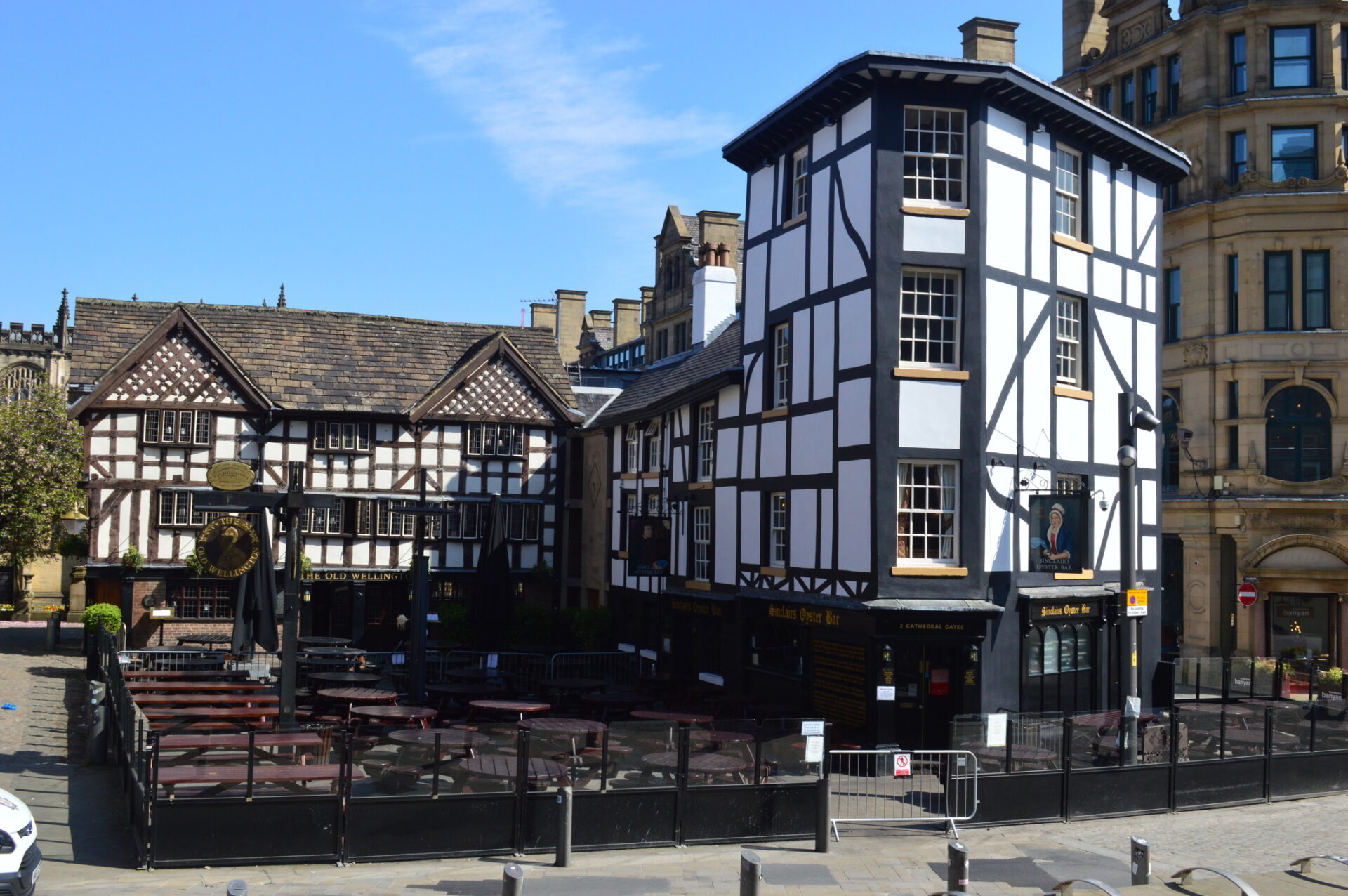
Just outside, Shambles Square itself is known for its cluster of black-and-white timber-framed buildings, including The Old Wellington Inn and Sinclair’s Oyster Bar, both dating back to the late 16th and early 17th centuries.
These buildings were not always located here. In 1999, they were carefully dismantled and relocated as part of a major redevelopment project, preserving them while allowing modern construction to continue around them. Their presence here offers a rare glimpse into Tudor Manchester, something that is otherwise difficult to find in a city so heavily shaped by industrial and modern growth.
The name “Shambles” comes from the historic use of the area as a butchers’ quarter, where meat stalls once lined the streets. Today, the square has a completely different atmosphere. On warmer days it fills with people enjoying outdoor seating, drinks, and conversation, creating a lively but relaxed environment that blends heritage with contemporary city life.
This stop works well as a short pause on the route. It offers both historical interest and a social atmosphere, making it a place where visitors can take a break, look around, and absorb the contrast between Manchester’s medieval past and its modern identity.
From Shambles Square, walk for around 8 minutes. Head back toward Corporation Street, cross at the pedestrian lights, and continue along Withy Grove until you pass Shudehill Tram Stop. Turn right onto Thomas Street, which marks the start of the Northern Quarter.
Compare routes and fares for your journey to Manchester.
Compare flightsChoose an Airalo eSIM and arrange mobile data before you arrive.
Browse eSIMsCheck private pickup options and plan your onward journey before arrival.
View transfersNorthern Quarter Street Art
The Northern Quarter represents the creative and alternative side of Manchester, and it provides one of the most visually engaging sections of this Manchester walking tour. As you enter the area, the atmosphere changes noticeably. Large retail chains give way to independent cafés, vintage shops, record stores, small galleries, and creative studios, creating a neighbourhood that feels distinctly different from the more formal city centre streets.
What defines the Northern Quarter most clearly is its street art. Walls, alleyways, and side streets are covered in constantly evolving murals created by both local and international artists. These artworks range from large-scale portraits and political commentary to abstract designs, pop-art pieces, and playful visual experiments. Because the art is regularly updated or replaced, the area never feels static. Each visit can reveal something new.
Certain streets and squares are particularly known for their visual impact. Stevenson Square often features bold, politically inspired murals, while Tib Street and Oldham Street showcase a mix of styles that reflect Manchester’s independent and creative spirit. This makes the area ideal for photography, casual exploration, and simply wandering without a fixed plan, allowing the experience to unfold naturally.
Beyond the artwork itself, the Northern Quarter reflects Manchester’s identity as a city that values music, creativity, and independent culture. It has long been associated with alternative scenes, from record shops and fashion to design and nightlife. Even during the day, the area has a relaxed but energetic feel, with people moving between cafés, shops, and studios.
This part of the route offers a strong contrast to earlier stops such as the Town Hall or Cathedral. Where those locations emphasise structure, history, and civic pride, the Northern Quarter highlights expression, individuality, and ongoing cultural change. It is one of the most memorable sections of the walk for many visitors.
From here, walk for around 3 minutes. When you reach Tib Street, turn left and continue down to the crossroads with Dale Street.
Afflecks
Afflecks is widely regarded as the cultural heart of the Northern Quarter and stands as one of Manchester’s most recognisable independent shopping destinations. Opened in 1982, it was created as a space for small traders, artists, and creative entrepreneurs, and it has maintained that identity ever since. Unlike conventional shopping centres, Afflecks is built around individuality, variety, and discovery.
The building itself is a red-brick structure on Oldham Street, and inside it opens into a maze of corridors, staircases, and interconnected floors filled with independent stalls, boutiques, and studios. Visitors can browse a wide range of products, including vintage clothing, handmade jewellery, artwork, vinyl records, alternative fashion, collectibles, and custom items. The experience feels less like structured retail and more like a continuous exploration, where each corner reveals something unexpected.
Afflecks is also a place where services and creativity meet. Visitors can find tattoo studios, design workshops, and specialist retailers, many of which are run by local creators. This gives the space a distinctly Manchester character, rooted in independent enterprise rather than large commercial brands.
Visually, the building is as interesting as the shops themselves. Walls and corridors are decorated with murals, graffiti, and bold artwork, reinforcing the connection between the Northern Quarter’s street culture and its indoor creative spaces. The result is an environment that feels lively, unconventional, and constantly changing.
For visitors, Afflecks offers more than just shopping. It provides a snapshot of Manchester’s independent spirit and creative identity, making it an essential stop for anyone wanting to understand the city beyond its historic landmarks.
From Afflecks, walk for around 10 minutes. Exit onto Oldham Street, turn right, and head toward Piccadilly Gardens. Cross the gardens diagonally toward Portland Street, continue straight for 3 to 4 minutes, then turn left onto Minshull Street. Continue until you reach the canal bridge leading to Canal Street.
Gay Village and Sackville Gardens
The Gay Village, centred along Canal Street, is one of Manchester’s most vibrant, inclusive, and internationally recognised neighbourhoods. It forms the final major stop on this Manchester walking tour, bringing together nightlife, history, community, and reflection in a single area.
By day, the Village has a relaxed and welcoming atmosphere, with cafés, bars, and restaurants lining the canal. Outdoor seating areas create an ideal setting for people-watching, particularly on warmer days. By night, the area transforms into one of the city’s most energetic districts, known for its music, nightlife, and open, celebratory environment. This dual character gives the neighbourhood a unique rhythm, balancing calm daytime culture with lively evening activity.
Historically, the Village became a focal point for the LGBTQ+ community in the late 20th century, providing a safe and visible social space at a time when such areas were limited. Its profile grew significantly in the 1990s, partly due to the television series Queer as Folk, which used Canal Street as its backdrop. Today, it remains central to Manchester’s identity as a city that values diversity, openness, and inclusivity, and it hosts major events such as Manchester Pride, one of the largest LGBTQ+ celebrations in the United Kingdom.
Just behind Canal Street lies Sackville Gardens, offering a quieter and more reflective environment. This small green space provides tree-lined paths, benches, and open areas where visitors can pause after the walk. It is also home to two important memorials.
The Alan Turing Memorial, unveiled in 2001, honours the pioneering mathematician and codebreaker whose work was crucial during the Second World War and whose later persecution remains a powerful reminder of social injustice. Nearby, the Beacon of Hope stands as the United Kingdom’s only permanent memorial dedicated to those affected by HIV and AIDS, and it continues to serve as a focal point for remembrance events.
The combination of Canal Street’s energy and Sackville Gardens’ calm creates a meaningful conclusion to the route. It reflects both celebration and reflection, bringing together the themes of community, identity, resilience, and progress that run throughout Manchester’s story.
Hop-On Hop-Off Tour Option
For visitors who prefer a more relaxed way to explore or want to combine walking with transport, the Sightseeing Manchester open-top hop-on hop-off bus offers a practical alternative. Run by TransporaBus Ltd, it takes in Manchester Town Hall, the Science and Industry Museum, the National Football Museum, Manchester Cathedral, Old Trafford, the Imperial War Museum North, and Salford Quays, allowing travellers to cover greater distances without walking the entire route.
Buses leave from outside Bridgewater Hall on Lower Mosley Street, with departures spread through the day and a full loop taking about 90 minutes. There is no dedicated Sightseeing Manchester app, so tickets are booked on the operator’s own site at sightseeingmanchester.com, through the usual booking platforms, or paid by contactless card when you board. Adult tickets are around £15 ($20 / €18) and stay valid for two operating days. This option is particularly useful for those with limited time or for anyone wanting to revisit specific landmarks without retracing steps on foot.
Optional Recommendations
If you have extra time after completing the walk, Manchester offers several excellent additions that expand on the themes of history, culture, and creativity explored along the route. The People’s History Museum provides an engaging look at the development of democracy, protest movements, and social change in Britain, with exhibitions covering topics from the suffragettes to trade unions. Entry is typically free, and the museum is open daily from 10am to 5pm.
For live music, Band on the Wall is one of the city’s most respected venues, hosting performances across genres including jazz, soul, indie, and world music. Events are held regularly, and tickets are usually required, so it is worth checking the schedule in advance.
Another strong option is HOME Manchester, a modern arts venue combining an independent cinema, theatre spaces, contemporary art gallery, and rooftop bar. It is particularly suitable for an evening visit after the walking tour, offering a relaxed way to continue exploring the city’s cultural scene.
For food and atmosphere, Ancoats has become one of Manchester’s most talked-about neighbourhoods. Once a centre of the Industrial Revolution, it has been transformed into a vibrant area known for restaurants, cafés, and open public spaces such as Cutting Room Square. It is especially lively at weekends, when markets and street activity bring the area to life.
Suggested Travel Apps for Your Manchester Walking Tour
Using the right tools can make a noticeable difference when navigating a city like Manchester. A navigation app is particularly useful for following the route, checking distances, and adapting your plans as you go.
Citymapper is one of the most effective options for urban travel. It provides real-time directions for walking, buses, and trams, helping you move efficiently between stops. It also includes live updates and route optimisation, which is especially useful in a city with multiple transport options.
Google Maps remains a reliable all-round tool, allowing you to plan routes, save locations, find nearby restaurants, and read reviews. It is particularly useful if you want to customise your walking route or explore additional stops beyond the planned itinerary.
Together, these apps make it easier to navigate, discover, and adapt your journey throughout the day, ensuring you get the most from your Manchester walking tour.

App availability and prices vary by country. Some of these may not appear in your local App Store or Google Play.

App availability and prices vary by country. Some of these may not appear in your local App Store or Google Play.
Frequently Asked Questions
How long does the Manchester walking tour take?
The self-guided Manchester walking tour usually takes between 2.5 and 3.5 hours, depending on your walking pace and how long you spend at each stop. If you visit museums, cafés, or shops along the way, you could easily turn it into a half-day itinerary.
Is the Manchester walking tour suitable for families?
Yes, the route is family-friendly and mostly flat, making it suitable for children. Many stops are interesting for younger visitors, including the Science and Industry Museum, football-related attractions, and the street art in the Northern Quarter.
Is the walking tour wheelchair accessible?
Most of the route is wheelchair accessible, as Manchester city centre has step-free pavements, dropped kerbs, and pedestrian areas. However, some historic buildings, such as Chetham’s Library, may have limited accessibility due to their age.
Where does the Manchester walking tour start and finish?
The walk usually starts at Manchester Central Library and finishes near Sackville Gardens or the Northern Quarter, which is a great area for cafés, restaurants, and bars. From there, it is easy to walk back towards Piccadilly Station or continue exploring the city centre.
Do I need tickets for the attractions on the tour?
Many stops along the route are free to enter, including Manchester Art Gallery, Manchester Cathedral, and Chetham’s Library. Some attractions, such as the National Football Museum, may charge for special exhibits or activities, so it is worth checking in advance and booking ahead for popular attractions.

Rupert’s Handy Travel Tips
Taking on this self-guided walking tour of Manchester? Here are a few tips to help you get the most from the route.
- Pace yourself: The full loop covers around 3.5 kilometres and takes 2.5 to 3.5 hours, so build in time to linger at the stops that interest you most.
- Plan your finish point: The route begins at Manchester Central Library and ends at Sackville Gardens, so it is worth checking onward transport from there before you set off.
- Check opening times in advance: Manchester Art Gallery, Manchester Cathedral, and Chetham’s Library are free to enter, but the National Football Museum may charge for special exhibits, so it is worth planning ahead.
- Take the Mamucium detour: If Roman history interests you, the short detour to the remains of the Mamucium fort near the Football Museum is easy to fit in without adding much extra walking.
- Leave time for Sackville Gardens: The Alan Turing Memorial and the Beacon of Hope near the end of the route are worth a quieter pause before you finish.
Want to meet the reindeer behind our travel tips? Find out more in our page Who is Rupert?.


Browse hostels and budget-friendly stays around Manchester.
See hostelsGet help with compensation, eligible lounge access and disruption support.
Explore AirHelp+Leave your luggage somewhere convenient and enjoy Manchester hands-free.
View storageFurther Reading on Manchester
Discover more essential tips with our complete Manchester Travel Guide, and learn how the Bee Network is reshaping transport across Greater Manchester with our Manchester Bee Network Spotlight Guide, useful if you want to combine this walk with trips further afield.
Since this route passes the National Football Museum and takes in landmarks connected to Manchester’s footballing history, our Football in Manchester Travel Guide is a natural next stop, covering stadium tours, museum visits, and match day tips in more depth. To celebrate diversity and community spirit, our in-depth Manchester Pride Travel Guide is also well worth reading.











