
Reviewed by our editorial team Updated
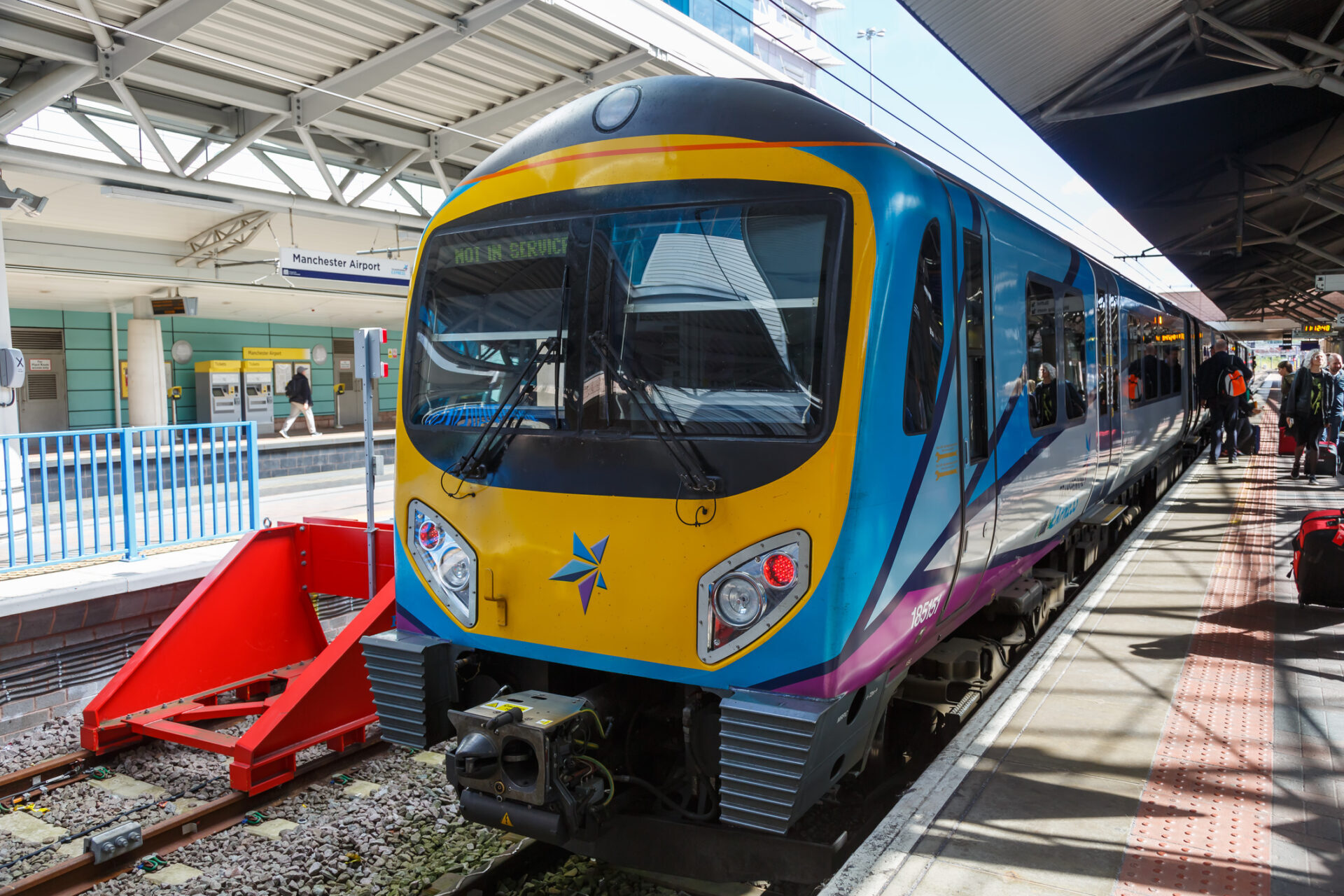
Manchester Airport has one of the most useful airport railway stations in Britain. The station sits inside the airport campus, linked to Terminals 2 and 3 by covered walkways, and direct trains connect the airport with Manchester city centre as well as destinations across the North West, Yorkshire, Wales, Scotland and beyond.
The biggest recent improvement is particularly important for early flights and late arrivals. Trains between Manchester Airport and Manchester Piccadilly now run through the night. TransPennine Express introduced eight additional overnight services from 17 May 2026, creating roughly an hourly airport-to-city rail link throughout the night, seven days a week. Daytime services remain considerably more frequent.
This guide explains how Manchester Airport trains work in practice, including the overnight service, journey times, direct destinations, ticketing, the walk from each terminal, luggage, accessibility, late-night alternatives and what to do when engineering work affects the railway. If you are spending time in Manchester rather than simply changing transport, our Manchester Visitor Guide covers the wider city and our Manchester Bee Network Guide explains local buses and Metrolink.
Manchester Airport Trains at a Glance
| Journey | Typical Time | Service Pattern | Useful For |
|---|---|---|---|
| Manchester Airport to Piccadilly | About 13 to 20 minutes | Very frequent by day, roughly hourly overnight | Manchester city centre |
| Manchester Airport to Oxford Road | Usually around 20 minutes | Selected through services | Universities, Oxford Road and southern city centre |
| Manchester Airport to Liverpool | Varies by service | Direct Northern services | Liverpool city breaks and onward Merseyside journeys |
| Manchester Airport to York | Varies by service | Direct TransPennine Express services | York and Yorkshire |
| Manchester Airport to Chester / North Wales | Varies by destination | Direct Transport for Wales services | Chester and North Wales |
| Manchester Airport to Scotland | Several hours | Selected direct TPE services | Glasgow and Edinburgh without changing in Manchester |
Manchester Piccadilly is the key destination for most passengers. Manchester Airport says trains normally take around 20 minutes and run approximately every ten minutes during the main part of the day. Some services are faster and complete the journey in around 13 to 15 minutes. Overnight, the service is thinner but the airport is no longer cut off from the city by rail for several hours.
The airport’s official train information, the Northern Manchester Airport station page and live National Rail information are the best places to check the exact service on the day you travel.
Manchester Airport Trains Now Run All Night
The old advice about a final train around 1am followed by a several-hour gap is no longer correct. From 17 May 2026, TransPennine Express introduced eight additional overnight services between Manchester Airport and Manchester Piccadilly. The result is a train roughly once an hour throughout the night, every day of the week.
This is a substantial improvement for passengers using very early departures. Previously, someone needing to be at Terminal 2 before the first conventional morning trains might have needed a night bus, taxi, hotel or very early drop-off. The overnight rail service now gives many travellers another practical option.
Do not interpret “all night” as the normal daytime frequency. During the day you may see several trains within an hour; overnight the core Piccadilly connection is roughly hourly. Engineering work is also disproportionately likely to take place late at night, so checking the actual date before relying on an overnight train is essential.
TransPennine Express publishes the current airport timetable and disruption information through its Manchester Airport travel page. Northern also confirms that trains to Manchester Airport operate throughout the night, with lower frequency during late-night hours.
See hotel options and places to stay in Manchester.
Browse hotelsBrowse apartments, holiday homes and self-catering stays in Manchester.
View rentalsCompare prices for Manchester hotels across multiple booking sites.
Check dealsManchester Airport to Manchester Piccadilly
For most visitors, Manchester Piccadilly is the best city-centre station to use. It is Manchester’s main intercity railway station and sits within walking distance of the Northern Quarter, Piccadilly Gardens and much of the central hotel district. It also provides onward trains towards London, Birmingham, Sheffield, Leeds, Liverpool and many other destinations.
The fastest airport trains can take around 13 to 15 minutes, while services making more local stops take closer to 20 minutes. During the daytime, the combined Northern and TransPennine Express timetable creates a very frequent service, so it is rarely worth waiting specifically for the fastest train unless one is already shown on the departure board.
If you are travelling overnight, focus on the departure time rather than the operator. The important change is that there is now a roughly hourly through-night connection. At 2am or 3am, waiting for a preferred train company makes little sense when the next service may be an hour later.
Once you reach Piccadilly, our Manchester Bee Network Guide explains onward trams and buses. If you are visiting for EURO 2028, our Etihad Stadium Travel Guide explains the onward tram and walking options to Manchester City Stadium.
Oxford Road, Deansgate and Other Manchester Stations
Not every airport passenger needs to get off at Piccadilly. Selected through trains continue to Manchester Oxford Road and Deansgate, which can be more convenient depending on where your hotel or destination is located.
Oxford Road is particularly useful for the University of Manchester, Manchester Metropolitan University, the Palace Theatre and hotels around the Oxford Road corridor. Deansgate is useful for Castlefield, Deansgate-Castlefield Metrolink, Manchester Central and the western side of the city centre.
Check the destination and calling pattern before boarding. Some airport trains terminate at Piccadilly, while others continue through the city. If the next train only goes to Piccadilly, it is often quicker to take it and continue by tram or on foot rather than waiting for a later through service.
Direct Trains Beyond Manchester
Manchester Airport is much more than a city-centre shuttle station. Direct trains leave the airport for destinations across northern England, Wales and Scotland, allowing many passengers to avoid changing at Manchester Piccadilly altogether.
| Direction | Examples of Direct Destinations | Main Operator |
|---|---|---|
| North West | Liverpool, Preston, Blackpool, Lancaster, Windermere and Barrow on relevant services | Northern |
| Yorkshire / North East | Huddersfield, Leeds, York and destinations beyond on selected services | TransPennine Express |
| North Wales | Chester and North Wales, with the May 2026 timetable including through services towards Holyhead | Transport for Wales |
| Scotland | Selected direct services towards Edinburgh and Glasgow | TransPennine Express |
Live departures from Manchester Airport regularly show direct trains to destinations such as Liverpool Lime Street, Blackpool North, York, Sheffield, Chester, Llandudno Junction, Edinburgh and Glasgow. The exact pattern changes through the day, so a destination that has a direct afternoon train may still require a change late at night.
If Liverpool is your destination, our Manchester to Liverpool Guide explains the wider rail and coach corridor. For journeys east towards Leeds and York, our TransPennine Line Guide provides more detail about the route.
Which Train Operators Serve Manchester Airport?
Three principal passenger operators serve Manchester Airport: Northern, TransPennine Express and Transport for Wales. They overlap on some sections of the network but serve different longer-distance markets.
Northern provides many of the local and regional services, including Manchester city-centre trains and routes towards Liverpool, Blackpool, Preston, Cumbria and other parts of the North West. TransPennine Express provides airport services through Manchester towards Yorkshire and longer-distance routes including selected trains to Scotland. Transport for Wales links the airport with Chester and North Wales.
You do not normally need to choose an operator in advance for a simple Manchester Airport to Piccadilly journey unless your ticket specifically restricts you. Check the wording on the ticket. An operator-restricted Advance ticket is different from a flexible ticket valid on several services.
Buying Tickets and Using Contactless
The safest approach is still to buy a normal rail ticket for your journey. Tickets are available from station machines, the staffed ticket office when open, rail operator apps and National Rail-linked retailers. Manchester Airport also has ticket machines positioned so arriving passengers can buy before reaching the platforms.
Advance tickets can be cheaper but tie you to particular trains or conditions. That can be awkward after a flight because immigration queues, baggage delivery and delays are unpredictable. A flexible ticket can therefore be worth paying a little more for when you are arriving by air.
Do not confuse Bee Network bus and tram contactless with the airport railway. As of September 2026, the full Manchester Airport stopping line has not yet joined Bee Network rail. TfGM plans for the airport stopping services to be integrated by the end of 2027. Contactless rail expansion is happening in phases, so the simple rule for visitors today is to check whether contactless is explicitly valid for the exact rail journey shown by the retailer or station rather than assuming that the yellow tram and bus tap-in rules apply to every airport train.
If you are continuing by tram or Bee Network bus after reaching Manchester, contactless tap and go is straightforward on those modes. On buses you tap when boarding; on Metrolink you tap in before travelling and tap out at the end using the same card or device.

Travel by Train to Manchester with Omio
For rail journeys involving Manchester, Omio gives you a single place to search available services and compare different travel options.
It can simplify planning when several train companies operate along your route, or when you want to compare rail, coach and flight connections.
Scan to open
on your phone

What Happens If Your Flight Is Delayed?
A flight delay is exactly why an inflexible Advance ticket can be risky. If you miss the booked train because baggage or immigration takes longer than expected, the validity depends on the ticket and operator.
TransPennine Express currently offers a useful airport-specific concession: if you have already bought a TPE ticket and your flight delay causes you to miss the planned service, the operator says you can use a TransPennine Express train up to three hours later without paying extra. Check the current terms before relying on this because ticket conditions can change.
For other operators or ticket types, speak to station staff before boarding if your booked train has been missed. Buying a second ticket first and trying to resolve the issue afterwards can make the situation harder than asking for advice at the station.
Search routes and flight options for your trip to Manchester.
Search flightsBrowse Airalo eSIM options for convenient travel data.
Check eSIMsHave a private airport pickup arranged before you travel.
Book a transferFinding Manchester Airport Train Station
The railway station is part of “The Station”, Manchester Airport’s integrated transport interchange. It also contains bus and coach facilities, so airport signs normally direct you towards The Station rather than simply saying railway station.
Manchester Airport now operates with Terminal 2 and Terminal 3; Terminal 1 closed permanently in March 2026. The airport says Terminal 2 is approximately a ten-minute walk from the station, while Terminal 3 is around five to seven minutes away depending on the route and your walking speed.
The walk is indoors using covered Skylink connections, with lifts, escalators and moving walkways. This makes the train especially convenient in poor weather and avoids hauling luggage across airport roads or car parks.
Allow more than the quoted walking time if you have checked luggage, children or reduced mobility. The ten-minute figure describes the physical terminal-to-station walk, not the time from aircraft door to train platform.
Accessibility at Manchester Airport Station
Manchester Airport is a Category A step-free station. National Rail confirms step-free access from the Ground Transport Interchange to every platform using lifts or ramps. Staff assistance is available 24 hours a day, and the station provides accessible toilets, a Changing Places facility, induction loops and boarding ramps.
A passenger-assistance welcome point sits beside the ticket office. If you have booked Passenger Assist, use the designated meeting instructions supplied with the booking rather than assuming staff will automatically meet you at the terminal.
Railway assistance and airline assistance are separate. National Rail notes that station staff can help rail passengers through the railway station, but passengers needing onward assistance into an airport terminal should also arrange the appropriate service with their airline.
Travelling with Luggage
Airport trains can become heavily loaded with suitcases, particularly around the morning departure bank and late-afternoon arrivals. Use the dedicated luggage areas where available and keep bags away from doorways and aisles.
Northern asks passengers to use luggage spaces, overhead racks or space beneath seats and not to block doors or use seats for bags. On longer-distance TransPennine Express services you may find more substantial luggage areas, but they can still fill quickly when several flights arrive together.
If you are travelling with several large cases, taking the first train to Piccadilly is often easier than waiting for a particular through service across the city. Piccadilly gives you more time and space to reorganise before an onward long-distance journey.
Taking a Bicycle on the Train
Bicycle rules depend on the operator. National Rail specifically warns that cycles on TransPennine Express services require a reservation before travel. Northern and Transport for Wales have their own capacity and reservation rules, so check the operator of your planned train if you are travelling with a full-size bike.
The station itself has cycle storage, but most airport passengers carrying a bicycle will be more concerned with the airline’s packing requirements than local storage. If you are continuing around Manchester by bike, the Bee Network also operates the Starling Bikes hire scheme elsewhere in Greater Manchester.
Engineering Works and Overnight Disruption
The new all-night timetable does not mean a train is guaranteed every night regardless of engineering work. Railway maintenance frequently takes place late at night and early in the morning because fewer passengers are travelling. That makes overnight airport passengers more exposed to planned alterations than someone travelling at 2pm.
Current disruption can affect the airport line itself or a longer route beyond Manchester. A train shown as running from Manchester Airport may terminate early, skip stations or be replaced by a bus on part of its journey. Check the live departure board and National Rail journey planner on the day you travel, particularly if you have an early flight.
If you are travelling overnight, check again before leaving home even if you looked at the timetable several days earlier. Planned works can alter the final timetable and replacement buses take longer than trains.
Train, Tram, Bus or Taxi?
| Option | Typical Advantage | Main Drawback | Best For |
|---|---|---|---|
| Train | Fastest public transport to Piccadilly | Engineering work can affect overnight journeys | Most city-centre passengers |
| Metrolink | Direct access to more tram stops | Much slower than the train | Destinations naturally on the Airport tram line |
| Bee Network bus | Low fares and 24-hour routes | Traffic makes it slower | Budget travel and areas away from rail |
| Taxi / private hire | Door-to-door | Much more expensive | Groups, heavy luggage and awkward destinations |
The train remains the default choice for Manchester Piccadilly. The tram is useful when your final destination sits directly on the Metrolink Airport line, but it takes much longer to reach central Manchester. Bee Network buses provide a genuine 24-hour alternative and become particularly useful when overnight engineering work disrupts rail.
A taxi makes more sense for a family or group splitting the fare, for travellers carrying a large amount of luggage, or when the final destination is well away from a railway or tram stop. If you are driving instead, our Manchester Airport Parking Guide compares the principal airport car parks.
Compare hostels and lower-cost places to stay in Manchester.
Search hostelsFlying to Manchester? Get fast compensation payouts, eligible lounge benefits and expert help when flights go wrong.
See AirHelp+ benefitsArriving before check-in or leaving later? Store your luggage and make more of your time in Manchester.
Store your bagsEarly Flights: Train or Airport Hotel?
The overnight train makes early flights much easier, but it does not automatically make travelling to the airport at 3am the best choice. A roughly hourly service means missing one train can add a significant delay, and engineering work is more common overnight.
If your flight requires check-in around 4am or 5am, compare the overnight train with staying at the airport the evening before. A hotel can remove the risk of a missed train and also avoids trying to sleep after a middle-of-the-night journey.
Our Manchester Airport Hotels Guide covers the hotels within or close to the airport campus and is particularly useful for very early departures.
Manchester Airport Trains for EURO 2028
Manchester Airport will be one of the main international gateways for UEFA EURO 2028. Manchester City Stadium will host five matches, while Liverpool’s Everton Stadium is close enough that some supporters may also choose Manchester Airport for Liverpool fixtures.
The direct rail connection to Piccadilly is particularly useful because supporters can continue by Metrolink to Etihad Campus or walk from Piccadilly to the stadium in around 25 to 30 minutes. Our EURO 2028 Travel Guide links all nine tournament stadiums, while the Etihad Stadium Guide covers Manchester matchday transport in detail.
If you are continuing to Liverpool, direct airport trains may save a city-centre change. During the tournament, however, rail services will be exceptionally busy, so advance planning will matter even though the normal airport timetable is frequent.

Rupert’s Handy Travel Tips
Using Manchester Airport trains? These are the details most worth remembering:
- The train now runs overnight: there is roughly an hourly Piccadilly connection through the night, seven days a week.
- Check overnight engineering work: the all-night timetable can still be altered when Network Rail needs access to the line.
- Do not overbook a flight-arrival Advance ticket: baggage and immigration delays make flexible rail tickets useful after landing.
- Look beyond Piccadilly: a through train to Oxford Road, Liverpool, York, Chester or Scotland may remove an unnecessary change.
- Allow time for the terminal walk: the station is close, but the quoted five to ten minutes begins after you have reached the public arrivals area.
Want to meet the reindeer behind our travel tips? Find out more in our page Who is Rupert?.


Frequently Asked Questions
Do Manchester Airport trains run all night?
Yes. Since 17 May 2026, TransPennine Express has operated additional overnight trains between Manchester Airport and Manchester Piccadilly, creating roughly an hourly rail service through the night, seven days a week. Check your exact date because engineering work can alter overnight services.
How long is the train from Manchester Airport to Manchester Piccadilly?
The fastest trains take around 13 to 15 minutes, while other services take closer to 20 minutes depending on the calling pattern.
How often do trains run during the day?
Manchester Airport says trains to Piccadilly run about every ten minutes during the main daytime timetable. Frequency is lower overnight.
Which terminals are connected to Manchester Airport station?
Terminal 2 and Terminal 3 are connected to The Station by covered walkways. Terminal 2 is roughly a ten-minute walk and Terminal 3 around five to seven minutes. Terminal 1 closed permanently in March 2026.
Can I travel directly from Manchester Airport to Liverpool?
Yes. Northern operates direct airport services towards Liverpool Lime Street, although the exact frequency varies by day and time.
Can I travel directly from Manchester Airport to York or Leeds?
Yes, selected TransPennine Express services run directly from Manchester Airport through Manchester towards Huddersfield, Leeds and York. Check the current timetable because not every train follows the same route.
Can I use Bee Network contactless on Manchester Airport trains?
The airport stopping railway has not yet fully joined Bee Network rail as of September 2026. Integration is planned for the end of 2027. Buy or validate the correct rail ticket for your journey unless your journey planner explicitly confirms contactless rail validity.
Is Manchester Airport station step-free?
Yes. National Rail classifies Manchester Airport as a Category A step-free station, with lifts or ramps to all platforms and 24-hour staff assistance.
What is the best alternative if overnight trains are disrupted?
The 24-hour Bee Network bus network is the most dependable public-transport fallback. Taxis and private hire are also available, while Metrolink is useful when it is operating but does not provide the same all-night pattern as the airport bus network.
Further Reading
If you are staying in the city, our Manchester Visitor Guide and Manchester Bee Network Guide cover local transport, attractions and useful travel apps. For an early departure, compare the options in our Manchester Airport Hotels Guide and Manchester Airport Parking Guide.
For onward rail travel, our TransPennine Line Guide, West Coast Main Line Guide and UK Rail Guide explain the main routes and ticketing system. Visitors coming for the football should also use our EURO 2028 Travel Guide and dedicated Etihad Stadium Travel Guide.











