Reviewed by our editorial team Published
Skiing From Tromsø: Cross-Country, Alpine and Backcountry Touring
Skiing is genuinely part of everyday life in and around Tromsø, not just a tourist activity, and the region offers a wide spread of options from gentle city trails to some of the most highly regarded backcountry ski touring anywhere in Europe.
What Tromsø does not offer is heli-skiing. Helicopter-assisted skiing is illegal in Norway for environmental and wildlife protection reasons, which surprises some visitors used to seeing it offered elsewhere in the Alps or North America. The genuine alternative here is touring on foot, or by boat, into terrain that would otherwise need a helicopter to reach.
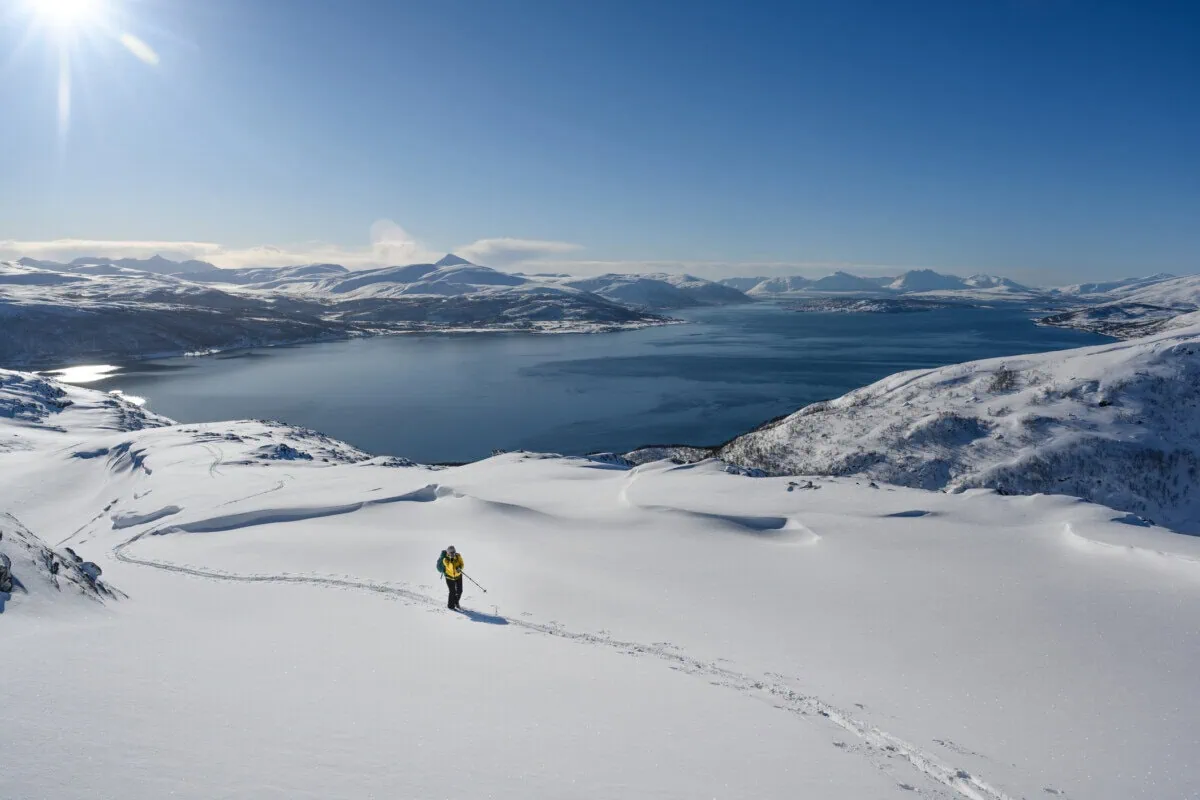
That terrain is a real draw in its own right. The Lyngen Alps, east of Tromsø, are internationally known among ski tourers for peaks that rise almost directly out of the fjord, offering descents that finish practically at sea level.
Few destinations pack quite so many different ways to ski into such a small area, and that is really what sets Tromsø apart, with floodlit cross-country trails, a small alpine centre and world-class backcountry touring all reachable within an hour or two of each other. A visiting skier could realistically try all three disciplines in the same week without changing accommodation, something that is genuinely unusual this far north.
The Arctic light shapes the experience too, since deep midwinter brings the polar night, when the sun never clears the horizon and floodlit trails and pistes become the only practical way to ski. By contrast, the return of the midnight sun in April and May allows long, late backcountry tours under constant daylight, a completely different kind of skiing from the headtorch sessions of December and January.
This guide covers the main ways to ski in the region, from complete beginners to experienced backcountry skiers, without recommending a specific guide, lodge or operator.
The Ski Options Around Tromsø at a Glance
With four genuinely different ways to ski across a small area, it helps to see how the options actually compare before choosing where to start. The table below sets out the experience level each one needs, whether a guide is normally required, and roughly how long each one takes.
| Discipline | Experience Level | Guide Required | Typical Length | Best For |
|---|---|---|---|---|
| Cross-Country (Tromsømarka) | Beginner to advanced | No | 1-3 hours, flexible | First-timers, daily exercise, families |
| Alpine (Tromsø Alpinpark) | Beginner to intermediate | No | A few hours to a full day | Families, a first taste of downhill skiing |
| Backcountry Touring (Lyngen & Tamokdalen) | Intermediate to advanced | Yes, strongly recommended | Full day to multi-day | Experienced off-piste skiers |
| Ski and Sail | Advanced | Yes, always guided | 5 to 9 days | Experienced tourers wanting varied terrain |
Best if you want daily housekeeping and a front desk. Filter by area first, then by price.
Check availabilityBest for families, or any stay past about four nights. A kitchen and a washing machine start paying for themselves.
Browse rentalsBest for double-checking. Runs the same search across several booking sites so you are not leaving money behind.
Compare pricesCross-Country Skiing in Tromsømarka
The hills immediately behind Tromsø, known collectively as Tromsømarka, hold an extensive network of groomed cross-country trails spread across Tromsøya, Tromsdalen and neighbouring Kvaløya, many of them floodlit for the long stretches of winter darkness, and used daily by locals rather than being set up purely for visitors.
Templarheimen, on the mainland side in the Kroken area, is the region’s main ski stadium and a natural trailhead hub, used for races and training alongside a second stadium area up on Tromsøya itself. Floodlit sections stay lit into the evening across all three main trail areas, switching off around midnight on Tromsøya and by around 11:30pm on Kvaløya and in Tromsdalen.
Trails suit a genuine range of ability, from flat, easy loops close to the edge of the city on Tromsøya to longer, more demanding routes further into the hills and along Kvaløya’s tougher coastal route, and equipment rental is generally available locally through operators such as Tromsø Outdoor for anyone without their own gear.
Locals check TUIL’s trail-status page for live grooming and trail-condition updates before heading out, and the same resource is a useful tool for visitors wanting to know which loops have been freshly groomed on any given day.
This is comfortably the most accessible way to ski near Tromsø, requiring no transport beyond a short walk or local bus ride from the city centre itself.
Alpine Skiing at the Local Ski Centre
Tromsø has its own small local alpine ski centre, Tromsø Alpinpark, in the Krokelvdalen area at Jadevegen 129, around a ten-minute drive from the city centre on the mainland side. Four lifts, including a magic-carpet conveyor for complete beginners, serve eleven named runs and a dedicated beginner area, floodlit for evening skiing through the darker months.
Terrain here leans easier, with most of the eleven runs pitched at beginners and intermediates and only a handful of steeper pistes for confident skiers, more a friendly local hill than a resort with serious advanced terrain. Night skiing under floodlights is a normal part of the weekly routine, not a special extra, with lifts and runs open through the evening sessions all winter.
It is a genuinely useful option for a first taste of alpine skiing close to the city, or for children too young for backcountry touring, with a vertical drop of roughly 380 to 420 metres depending on the run. An on-site rental shop covers skis, boots, snowboards, helmets and outerwear for anyone without their own kit, and there is also a dedicated toboggan run for younger visitors, though it is not the reason experienced skiers travel to the region.
An adult day pass costs around NOK 465 (£34/€39/$42), with the centre typically open weekday afternoons and evenings from around midday to 8pm and weekends from around 10am to 5pm. The season usually runs from November through to early May, snow conditions permitting, so it is worth checking current status locally before making it the centrepiece of a trip.
Backcountry Ski Touring in the Lyngen Alps
The Lyngen Alps, reached from Tromsø by road and a ferry crossing at Breivikeidet-Svensby, or a seasonal express boat to Nord-Lenangen, are the real reason serious ski tourers travel to this part of Norway, offering steep, dramatic peaks that drop almost directly into Lyngenfjord, with descents that can genuinely finish at the shoreline.
Jiehkkevárri, at 1,834 metres the highest peak in the range, anchors a landscape of equally striking neighbours such as Store Lenangstind and Piggtinden, with Lyngseidet and touring lodges around Koppangen serving as the main bases for multi-day trips, while some visitors instead day-trip out from Tromsø itself.
This is ski touring in the proper sense, climbing under your own power using touring skis or a splitboard before skiing back down, and it demands genuine backcountry experience, avalanche awareness and, for most visitors, a qualified local guide rather than independent exploration.
Because helicopter access is not an option in Norway, guided touring on foot is the standard way experienced skiers reach the best terrain, making local knowledge of current avalanche conditions genuinely essential rather than optional.
Avalanche safety underpins everything here, and virtually every guiding operation requires clients to carry a transceiver, shovel and probe as standard, alongside a daily briefing on the current avalanche forecast. This is not the place to learn touring from scratch, and it suits confident intermediate to advanced skiers with off-piste experience and reasonable fitness far better than complete beginners.
Trip length varies considerably, from single-day tours out of Lyngseidet or Koppangen that return to a bed the same night, to multi-day hut-to-hut trips linking several peaks and valleys with overnight stays at touring lodges along the way. Longer trips generally reach more remote, less-skied terrain, while day tours suit visitors with limited time or who are based in Tromsø itself.
Tamokdalen: A Second Touring Base
Lyngen isn’t the only place experienced skiers head for backcountry touring near Tromsø. Tamokdalen, a valley running roughly 30 kilometres along the E8 further inland, has built a strong reputation of its own among guided touring operators.
The valley floor sits at around 200 metres, with surrounding peaks rising to roughly 1,600 metres, giving a genuinely alpine landscape without needing a ferry crossing to reach it. Its more continental position, away from the exposed coast, tends to bring calmer weather and steadier snow conditions than Lyngen’s maritime climate.
That relative shelter is exactly why many guiding operations favour Tamokdalen for single-day touring, particularly when coastal conditions are too windy or unsettled for a trip further out to Lyngen. It’s a genuinely useful alternative rather than a consolation prize, and several operators run it as their default day option from Tromsø.
Terrain still demands real backcountry experience, and a qualified guide is strongly recommended here exactly as it is in Lyngen, since avalanche risk doesn’t disappear just because the weather is calmer. What changes is mainly the logistics: a road trip inland rather than a ferry crossing, and a day out rather than a multi-day base.
Visitors weighing up the two areas should think about trip length and weather tolerance as much as terrain. Lyngen suits those with more time who want the dramatic sea-to-summit scenery Tromsø is known for, while Tamokdalen suits a single good touring day when conditions or a shorter visit make that the more sensible choice.
Ski and Sail: Touring by Boat
A distinctive local variation on ski touring, often called ski and sail, uses a sailing yacht, typically 47 to 50 feet with several cabins, as a floating base rather than a fixed lodge, sailing between remote fjords and dropping skiers ashore by zodiac dinghy onto untouched slopes that would otherwise require a long approach on foot.
Trips generally run five to nine days, sailing overnight or between anchorages and touring by day from a fresh shoreline landing each time. It is a genuinely effective way to reach varied, remote terrain across multiple days without helicopter access, and a popular choice among more experienced tourers specifically because of Norway’s ban on heli-skiing.
As with land-based touring, this remains an activity for experienced skiers with genuine backcountry fitness and avalanche awareness, almost always undertaken with a qualified local guide.
A typical day follows a simple rhythm: skiers go ashore in the morning for a tour while the yacht relocates to a new anchorage, then either ski again from a different landing in the afternoon or relax on board as the boat repositions for the next day. Evenings are usually spent back on the yacht, with the crew choosing the next day’s terrain based on overnight weather and snow conditions.
Guiding and group safety equipment, such as transceivers, shovels and probes, are normally built into the package, with a qualified mountain guide assessing terrain and avalanche risk before every landing. This style of touring suits experienced backcountry skiers who want variety and comfort combined, reaching several different fjords and peaks across one trip, though it is less suitable for anyone prone to seasickness.
Getting to Tromsø’s Ski Areas
Each of Tromsø’s ski options sits at a different distance from the city, and getting the transport right saves time better spent on snow. Nothing described on this page needs a long transfer before the skiing itself can begin.
Tromsømarka’s cross-country trails are the easiest to reach, starting within a short walk or a quick local bus ride of the city centre. No dedicated transport planning is really needed here, which is part of why it’s the most popular option for a quick session after work or before dinner.
Tromsø Alpinpark sits in the Krokelvdalen area, roughly a ten-minute drive from the centre, with the local Route 42 bus also serving the Kroken district where the centre is based. Anyone without a car should check the current timetable locally, since evening and weekend services can run less frequently than weekday daytime buses.
The Lyngen Alps are reached by road via the Breivikeidet-Svensby ferry crossing, followed by a short drive on to Lyngseidet, or by the longer ferry-free route further round the coast. A couple of direct buses a day also run between Tromsø and Lyngseidet, though most visitors touring here go with a guide who handles the transport as part of the trip.
Tamokdalen, the region’s other main touring base, lies inland along the E8 corridor and is generally around an hour to ninety minutes’ drive from Tromsø. It’s usually visited as a guided day trip rather than a multi-day base, so the outward journey and the skiing itself typically happen on the same day.
Best if you can move a day either way. Shows how the fare changes across the month.
Compare flightsBest if you want maps and messaging working the moment you switch your phone on.
See eSIM plansBest when public transport has stopped, or when you are travelling with children and bags.
Book a transferRenting Skis and Equipment in Tromsø
Visitors don’t need to bring their own skis, boots or poles to Tromsø, since hiring locally is straightforward and genuinely the norm. Whichever discipline you’re trying, gear can be sorted here rather than hauled from home.
Cross-country kit is easy to arrange through operators such as Tromsø Outdoor, already mentioned for trail-side rental near Tromsømarka. Skis, boots and poles usually come as one package, matched to height and ability rather than hired piece by piece.
Alpine equipment is covered by the on-site rental shop at Tromsø Alpinpark, which stocks skis, boots, snowboards, helmets and outerwear for anyone without their own. Touring gear, including splitboards and skins, can generally be hired through outdoor shops in the city centre as well as near the ski centre itself.
Fitting is quick wherever you hire from, with staff typically sizing and adjusting boots and skis within a few minutes. Boots and poles are normally included alongside the skis themselves, so there’s rarely any need for a separate shop.
Demand rises sharply during weekends and school holiday weeks, when the best sizes and newest equipment can disappear early. Booking ahead, or arriving early during these peak periods, is the safest way to avoid mismatched or well-worn kit.
Backcountry touring works differently, since safety equipment isn’t something to source independently. A transceiver, shovel and probe are normally provided or rented as a set through the guiding operation you book with, and self-touring without a guide isn’t advisable for unfamiliar terrain.
Apps and Tools for Checking Snow and Avalanche Conditions
Checking conditions before you set out matters in Tromsø as much as anywhere else in Norway, and a small set of trusted tools covers weather and avalanche risk. None need much explanation, but knowing which to use saves confusion at the trailhead.
For backcountry touring in the Lyngen Alps, Varsom is the standard reference, Norway’s official avalanche warning service, run by NVE, available as both an app and a website. It publishes daily regional avalanche forecasts, and any local guide will already be checking it closely.
Yr, the Norwegian Meteorological Institute’s official weather app, is the go-to tool for general conditions, whether that’s a cross-country loop or a day in the mountains. It’s widely used across Norway rather than being a tourist-only recommendation, and its forecasts are generally reliable this far north.
For Tromsømarka’s cross-country trails specifically, the local ski club TUIL runs its own trail-status page covering grooming and conditions across the network. It’s a useful local resource alongside the rental operators already mentioned, worth checking rather than relying on general weather alone.
Various route-planning apps exist for backcountry touring, though for terrain as serious as the Lyngen Alps, a qualified local guide remains the safer choice for anyone unfamiliar with the area. No app substitutes for local knowledge of the day’s avalanche risk.
Between Varsom, Yr and TUIL, visitors have what they need to check conditions properly before heading out. Combining these tools with a guide’s own local knowledge is by far the safest approach beyond groomed trails.
What to Pack for Skiing Around Tromsø
What belongs in a ski bag for Tromsø depends on which of the options above you’re trying, but a few essentials apply across all of them. Arctic maritime weather can turn quickly, so packing for changeable conditions matters more here than at a typical alpine resort.
A genuinely windproof and waterproof outer layer earns its place on every trip, since the coastal air around Tromsø carries more damp cold and wind chill than the drier inland cold found around Tamokdalen. Warm mid-layers that can be added or removed as effort levels change work better than one thick jacket alone.
A headlamp is worth packing even for a short cross-country loop, since a good stretch of the season falls within the polar night and floodlit trails only cover part of the network. Anyone heading slightly off the lit routes, even briefly, will be glad of a spare light source.
Backcountry touring in the Lyngen Alps or Tamokdalen calls for a transceiver, shovel and probe, and these are normally supplied as part of a guided trip rather than something to buy or bring from home. Travellers wanting their own kit can also rent avalanche safety packages, including airbag packs, from operators such as Tromsø Outdoor in the city centre.
Sunglasses or goggles matter more than visitors expect, particularly for spring touring under the midnight sun, when light reflecting off the snow for hours on end can be genuinely dazzling. A decent pair of glove liners is also worth having for switching between climbing on skins and skiing back down, when hands often need a quick change of layer.
Best Time of Year for Skiing
The ski season around Tromsø runs considerably longer than in much of Europe, with cross-country trails and Tromsø Alpinpark typically usable from November through to April or May, snow conditions permitting.
Broken down by discipline, cross-country has the longest season by far, reliably skiable from late November through April and often into May, since Tromsømarka’s low-altitude trails hold snow well across that whole window. The alpine centre follows a similar November-to-May window, though its exact opening and closing dates shift a little each year depending on how early and how late the snow arrives.
Backcountry touring in the Lyngen Alps has its own rhythm, with many experienced tourers actually favouring March to May, when there is enough daylight to see the terrain properly while snow cover in the high mountains remains deep and stable. Ski and sail trips follow the same window, typically running from March into early May.
Backcountry touring and ski and sail trips both concentrate around spring conditions, since March to May combines longer daylight hours with snowpack that has had all winter to consolidate and stabilise, lowering avalanche risk compared with the deep freeze of December and January. Early-season backcountry conditions can be excellent in a good snow year, but daylight is the real limiting factor rather than snow depth.
Midwinter touring is possible but far more constrained by limited daylight, and most guided operations plan their season around when conditions and daylight both cooperate rather than the calendar alone.

Rupert’s Handy Travel Tips
Skiing around Tromsø ranges from a gentle city trail to serious backcountry terrain. Rupert’s tips will help you pick the right level.
- Start with Tromsømarka if you’re new to cross-country: its floodlit trails suit beginners right on the edge of the city.
- Don’t expect heli-skiing: it’s illegal in Norway, so guided touring on foot or by boat is the real alternative.
- Book a qualified guide for the Lyngen Alps: avalanche awareness and local knowledge are genuinely essential, not optional.
- Consider spring for backcountry touring: March to May often pairs better daylight with still-deep snow.
- Check the local ski centre’s hours before relying on it: opening times shift with snow conditions each season.
Want to meet the reindeer behind our travel tips? Find out more in our page Who is Rupert?.



Frequently Asked Questions About Skiing From Tromsø
Can you go heli-skiing near Tromsø?
No. Helicopter-assisted skiing is illegal in Norway for environmental reasons, so guided ski touring on foot or by boat is the genuine local alternative.
Is there a ski resort in Tromsø itself?
There is a small local alpine ski centre in the hills above the city, aimed mainly at families and beginners rather than serious downhill skiers.
What is ski touring in the Lyngen Alps like?
Steep, dramatic peaks dropping almost directly into the fjord, offering some of the most highly regarded backcountry ski touring in Europe, but demanding genuine experience and usually a qualified guide.
What is “ski and sail”?
A style of ski touring that uses a boat as a floating base between remote fjords, dropping skiers onto slopes that would otherwise need a long approach on foot.
When is the best time to ski around Tromsø?
Cross-country and the local ski centre generally run from November to April or May, while many experienced backcountry tourers favour March to May for better daylight with still-deep snow.
Further Reading & Related Guides
For everything else Tromsø has to offer, see our main guide to things to do in Tromsø, plus our dedicated guides to chasing the northern lights, dog and reindeer sledding, whale watching and the Arctic fjords around Tromsø.
For skiing elsewhere in Norway, our Oslo Airport to Ski Resorts guide covers the country’s larger alpine resorts further south.
Before you arrive, our Tromsø Airport to City Centre guide covers every transfer option into town.