Reviewed by our editorial team Updated
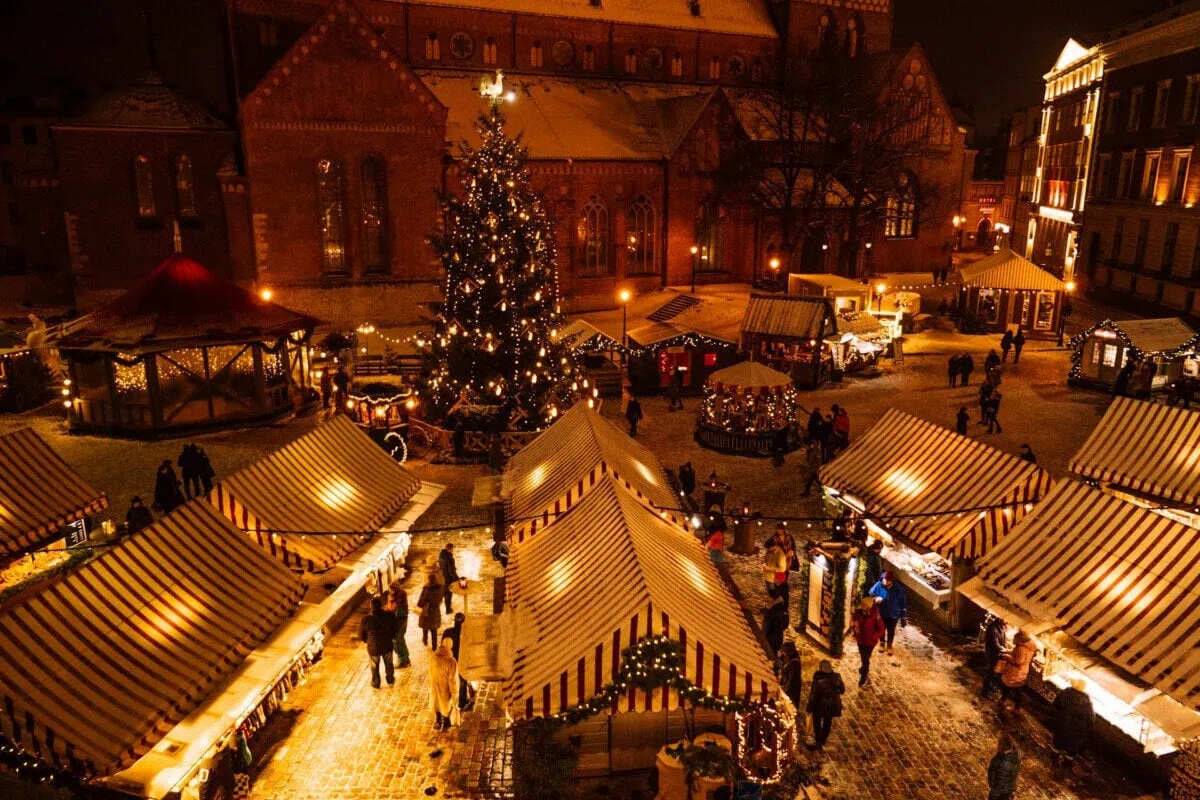
Riga’s Christmas market fills Dome Square (Doma laukums), the wide cobbled plaza beneath the twin spires of Riga Cathedral at the heart of the Latvian capital’s Old Town. Latvia’s official tourism board confirms the 2026/27 season runs from 27 November 2026 to 4 January 2027, a stretch of nearly six weeks covering Advent, Christmas and New Year. Wooden chalets ring the square selling amber jewellery, hand-knitted wool and piping-hot Riga Black Balsam, all inside a UNESCO World Heritage-listed Old Town built from medieval brick and swirling Art Nouveau stonework.
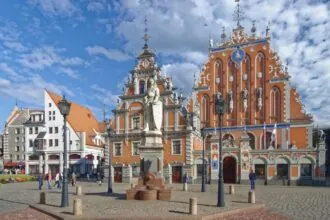
Riga makes its own claim to Christmas tree history, and it deserves an honest hearing rather than a marketing line. A cobblestone marker nearby records that the Brotherhood of the Blackheads, a merchants’ guild, decorated a fir tree in 1510 and burned it at the close of the celebrations, a story often repeated as the world’s first public Christmas tree, though Tallinn documents a rival claim from 1441. Around the market itself, stalls sell piparkūkas gingerbread, honey, wickerwork and wooden toys, while food vendors serve grey peas with bacon and cups of mulled wine that regularly sell out on the coldest evenings.
What separates Riga from Vienna or Prague is genuine affordability paired with a backdrop few other European capitals can offer. Riga holds one of the largest concentrations of Art Nouveau architecture anywhere in Europe, and the ornate facades a short walk from Dome Square give this market a distinctly different visual character from the purely medieval settings of Tallinn or Vilnius. This guide covers the market, the food and crafts worth seeking out, how to get around the Old Town through a Baltic winter, and how Riga fits into a wider multi-city Christmas trip.
Riga Christmas Market: Quick Facts
| Detail | Information |
|---|---|
| Location | Dome Square (Doma laukums), Riga Old Town, with additional stalls and festive events at Līvu laukums and Vērmanes dārzs |
| 2026/27 dates | 27 November 2026 to 4 January 2027 (confirmed via LiveRiga, Riga’s official tourism board) |
| Typical hours | Around 10am/11am to 9pm on weekdays, until 10pm on Fridays and Saturdays, shorter on Christmas Eve |
| Entry price | Free to enter; costs apply only to food, drink and craft purchases |
| Nearest transport hub | Riga Central Station and the Old Town bus/tram stops around Grēcinieku iela and 13. Janvāra iela, all within a 10 to 15 minute walk |
Dome Square: Riga’s Christmas Market Setting
Dome Square takes its name from Riga Cathedral, the largest medieval church in the Baltic states, whose brick facade and famous organ loom over the market from one side of the plaza. The market itself has run here in roughly its current form since 2000, when the modern tradition was revived after decades without an organised Christmas market in the square.
A large decorated Christmas tree stands at the centre of the square for the full run of the market, with a formal lighting concert usually held in the market’s opening days. Around it, roughly 80 to 100 wooden chalets sell local crafts and food, a scale that sits between Tallinn’s compact horseshoe of stalls and the much larger markets of Central Europe.
Because the square is broad and open rather than tightly enclosed, Riga’s market feels noticeably less crowded than Tallinn’s Raekoja plats even at similar visitor numbers. This makes an evening visit comfortable even on the busiest December weekends, without the shuffling, elbow-to-elbow feel that smaller market squares can produce.
Weekday hours generally run from around 11am to 9pm, stretching to 10pm on Fridays and Saturdays and closing slightly earlier on Sundays, though stallholders can vary this at their own discretion. Christmas Eve typically sees shorter hours, often closing by early evening so vendors can join their own family celebrations.
A rotating stage programme runs through the season, with DJ sets on Friday evenings, choirs and folk ensembles on Saturdays, and a dedicated Santa’s house for children most days. Entry to Dome Square is free, with costs limited to whatever food, drink or crafts visitors choose to buy.
Best for a short trip. Compare rooms by neighbourhood, price and guest rating before you book.
Compare hotelsBest for families, or any stay past about four nights. A kitchen and a washing machine start paying for themselves.
Browse rentalsBest if you have already picked a hotel. Checks the big booking sites for the same room and shows who is cheapest.
Check dealsLatvian Crafts and What’s on the Stalls
The single most distinctive product on sale at Dome Square is Baltic amber jewellery, sold as necklaces, rings and loose beads in shades running from pale honey to near-black. Latvia sits on the same amber-rich Baltic coastline as Lithuania and the Kaliningrad region, and prices here run noticeably lower than in tourist-heavy amber shops further west.
Hand-knitted wool goods are the other genuine local specialism, with mittens, scarves and traditional patterned sweaters made by small producers rather than imported wholesale. A pair of wool mittens typically costs from around €10 to €18 (about £8.60 to £15.50 / $11.70 to $21), while a full sweater runs from roughly €40 to €70 (about £34 to £60 / $47 to $82).
Wickerwork, wooden toys and hand-carved candlesticks fill out the craft stalls, drawing on a genuine rural Latvian tradition of woodworking rather than generic festive merchandise. Beeswax candles are a particularly common find, reflecting Latvia’s long tradition of beekeeping, and make an easy, lightweight gift to carry home.
Several stalls sell Latvian honey directly from small producers, often flavoured with local herbs or served alongside honey-based liqueurs. It’s a genuinely regional product rather than something rebranded for tourists, and prices for a jar typically run from around €6 to €10 (about £5.20 to £8.60 / $7 to $11.70).
Craft demonstrations happen regularly through the season, with woodworkers and knitters often working at their own stalls rather than simply selling finished pieces. It’s a useful way to see how the goods on sale are actually made, and stallholders are generally happy to explain their techniques to interested visitors.
Riga Black Balsam, Mulled Wine and Festive Food
Riga Black Balsam is Latvia’s national drink, a dark herbal liqueur made to a recipe dating to 1752 from 24 natural ingredients, bottled at a hefty 45 percent ABV. At the Christmas market it’s rarely drunk neat, and is far more commonly stirred into hot blackcurrant juice, coffee or hot chocolate at market stalls, warming rather than overpowering.
Standard mulled wine is just as widely available, served warm in ceramic mugs from around €4 to €6 (about £3.40 to £5.20 / $4.70 to $7), with a spiced non-alcoholic version on offer at most stalls too. Both versions typically include roasted almonds and cinnamon, giving the whole square a distinctive spiced aroma from mid-afternoon onward.
Piparkūkas, Latvia’s spiced gingerbread biscuits, are sold both plain and elaborately iced, often shaped as stars, hearts or tiny houses intended as tree decorations. A bag of a dozen typically costs around €5 to €8 (about £4.30 to £6.90 / $5.85 to $9.35), and several stalls let visitors decorate their own for a small extra fee.
On the savoury side, look for grey peas with bacon, a traditional Latvian Christmas Eve dish of stewed grey peas and fried pork served with rye bread, alongside smoked meats and cheeses from regional producers. A full portion generally costs from around €7 to €10 (about £6 to £8.60 / $8.20 to $11.70).
Sklandrausis, a traditional Latvian rye-crust tart filled with sweetened carrot and potato, occasionally turns up at food stalls too, though it’s best known as a year-round rather than specifically festive treat. Most vendors accept contactless card payment, but it’s worth carrying a little cash for the handful of smaller stalls that still prefer it.
The 1510 Christmas Tree: Riga’s Disputed Claim to History
Riga’s claim to Christmas tree history rests on a specific, dated event rather than vague folklore. Records held by the Brotherhood of the Blackheads, a merchants’ guild active in the city since the 14th century, describe members decorating a fir tree with artificial roses in the marketplace in 1510, dancing around it, then setting it alight at the close of the celebrations.
A stone marker set into the cobblestones at Town Hall Square (Rātslaukums), a short walk from Dome Square, commemorates the spot in eight languages and is often cited as marking the world’s first public Christmas tree. It’s worth being honest about what that claim actually rests on before repeating it as settled fact.
Tallinn makes a competing claim of its own, pointing to city council records from 1441 describing musicians paid to play beside a tree on Raekoja plats. Historians who’ve examined both claims generally conclude the dispute comes down to definition, not error: Riga’s account describes a decorated, ritually burned tree, Tallinn’s an official civic event of a different kind.
Given the close trading and guild relationship between the two Hanseatic cities at the time, some historians suggest similar traditions could plausibly have developed in both places around the same period. Neither city has definitively “won” the argument, and both continue to promote their own version as part of local Christmas heritage.
What isn’t in dispute is that Riga’s own tradition has run long enough to matter, with a decorated tree standing on Dome Square every winter and the city marking the connection through its own Christmas Tree Trail, a citywide art installation inspired by the 1510 story. Visitors curious about the claim can see the commemorative marker for themselves at Rātslaukums, a five-minute walk from the market.
Getting to Riga: Airport and Rail Arrival
Riga International Airport (RIX) is the main gateway for most visitors, sitting around 10km southwest of the city centre and served by a wide network of European budget and full-service carriers. It’s the busiest airport in the Baltic states, which generally means more direct routes and more competitive winter fares than flying into Tallinn or Vilnius.
From the airport, bus 22 is the standard public transport link into the centre, running regularly through the day with a reduced overnight service. A single ticket costs €1.50 bought on board or €1.15 pre-purchased, and the journey to the edge of the Old Town takes roughly 30 to 40 minutes depending on traffic and stop pattern.
A pre-booked taxi or private transfer takes around 20 to 25 minutes in normal conditions, longer after snowfall, and typically costs from around €15 to €25 (about £13 to £21.50 / $17.50 to $29) depending on time of day and operator. Ride-hailing apps including Bolt operate widely across Riga and are generally the most straightforward option for late-evening arrivals.
Travellers arriving overland reach Riga Central Station (Centrālā stacija), which sits right beside the Central Market halls and roughly a 10-minute walk from Dome Square through the edge of Esplanade park. International rail links into Latvia remain limited compared with Western Europe, so most overland arrivals come by coach rather than train.
For travellers combining Riga with a wider regional trip, the Interrail Latvia Pass covers domestic rail travel within the country, though it’s worth checking route coverage carefully since Latvia’s passenger rail network is smaller than its Baltic neighbours’. Booking any onward bus or rail travel a little in advance is generally worthwhile during the December market season.
Getting Around Riga’s Old Town in Winter
Riga’s Old Town is genuinely compact, walkable end to end in around 15 to 20 minutes, and almost every major sight sits within easy reach of Dome Square on foot. This makes the Old Town itself easy to navigate without transport once you’ve arrived, though the approach from outside the historic core is a different matter in winter.
Beyond the Old Town, Riga is served by an extensive network of trams, trolleybuses and buses run by the city operator Rīgas Satiksme, including 11 tram lines that cover most of the wider city efficiently. A single ticket costs €1.15 pre-purchased or €1.50 bought on board, while a 24-hour pass at €3.60 (about £3.10 / $4.20) pays for itself after three single trips.
Visitors staying several days and planning to explore beyond the Old Town should consider the 72-hour pass, priced at €7.80 (about £6.70 / $9.10), which covers unlimited travel across trams, trolleybuses and buses citywide. It’s a straightforward way to combine market visits with day trips to Riga’s Art Nouveau district or the wider city without buying individual tickets each time.
Riga’s Old Town streets are genuinely cobbled and uneven, and December brings a real risk of ice forming on top of already-worn stone, particularly on the narrower lanes away from the main squares. Boots with real grip matter more here than in most European cities, and walking pace naturally slows once temperatures drop below freezing.
Public transport generally continues on a reduced schedule around 24 to 26 December, running less frequently than a normal weekday, and trams tend to cope with heavy snow better than buses or taxis. Between a short airport bus route and a fully walkable Old Town, a car is entirely unnecessary for a Riga Christmas trip.
Beyond Dome Square: Līvu Laukums and Vērmanes Dārzs
Dome Square isn’t the only festive spot in Riga’s Old Town during December. A short walk away, Līvu laukums, a smaller square framed by pastel-coloured guild buildings, often hosts its own additional stalls and seasonal decoration as part of the wider market programme.
Outside the Old Town walls, Vērmanes dārzs, one of Riga’s oldest public parks, typically runs a smaller, more locally focused market alongside its own festive lighting. Visitors who’ve found Dome Square well-covered for shopping often rate Vērmanes dārzs slightly higher for genuinely home-made food and crafts, even if it draws fewer photographs.
The two sites sit close enough together that visiting both in a single afternoon is entirely realistic, particularly since the walk between them passes through some of the Old Town’s prettiest lit streets. Neither requires a ticket or booking, and both operate on broadly similar hours to the main Dome Square market.
Riga’s Christmas Tree Trail, an annual citywide art installation inspired by the 1510 story, adds another reason to walk beyond the main square. Artists and designers decorate trees at locations across the city each winter, turning a stroll between squares into something closer to an open-air exhibition.
Together, these secondary sites mean a Riga Christmas visit rewards more than a single stop at Dome Square. Building in an hour or two to wander Līvu laukums and Vērmanes dārzs gives a fuller sense of how the whole city celebrates the season, rather than treating the main market as the entire experience.
Best if you can move a day either way. Shows how the fare changes across the month.
Compare flightsBest if you want maps and messaging working the moment you switch your phone on.
See eSIM plansBest if you would rather not work out the transport on arrival. Book it now and forget it.
View transfersRiga’s Art Nouveau Backdrop
Riga holds one of the largest concentrations of Art Nouveau architecture anywhere in Europe, a fact recognised directly in the city’s UNESCO World Heritage listing alongside its medieval core. It’s a genuinely different backdrop from the purely Gothic or medieval settings of Tallinn and Vilnius, and one worth building extra time around a Christmas market visit to see properly.
The showcase street is Alberta iela, roughly a 20-minute walk or a short tram ride from Dome Square, lined with elaborate facades designed largely by Mikhail Eisenstein, whose swirling, sculptural style is instantly recognisable even to visitors with no architectural background. Many of the buildings are especially striking after dark, when window lighting picks out details easy to miss in daylight.
The Riga Art Nouveau Centre, housed at Alberta iela 12 in a building completed in 1903, gives visitors a look inside a restored period apartment complete with original fittings and furniture. It’s a manageable, focused stop rather than a sprawling museum, and pairs naturally with an afternoon spent walking the surrounding streets.
Closer to the market itself, Elizabetes iela holds several further Eisenstein-designed buildings, meaning a genuinely rewarding Art Nouveau walk doesn’t require straying far from the Old Town core. Combining this architecture with the market makes a Riga Christmas trip feel distinct from a straightforward repeat of Tallinn or Vilnius.
December daylight is short, so an Art Nouveau walk generally works best scheduled for late morning or early afternoon, leaving the market itself for the evening once the lights and stalls are at their most atmospheric. Splitting a day this way avoids trying to cram both into the same few darkening hours.
Riga’s Christmas Concerts: Carols, Organs and the Great Guild
Beyond the market stalls, Riga’s Advent and Christmas season brings a genuinely dense programme of concerts, and the city council publishes a fresh listing each year covering dozens of performances across churches, guild halls and culture centres. Past seasons have included choral concerts at the Great Guild, home to the Riga Chamber Choir “Ave Sol,” alongside smaller children’s ensembles performing at the Small Guild just across the street.
Riga Cathedral runs its own year-round programme of short organ recitals, known as Concerto Piccolo, most days at midday, and past Advent seasons have added special evening concerts to the regular schedule. Tickets for the standard daytime recital cost around €15 (£12.90/$17.55), and the cathedral’s own concert listings page is the most reliable source for exact festive-season dates once they’re published.
Smaller, more traditional performances happen outdoors too, with past years seeing costumed carol groups singing in Bastejkalns and Vērmanes Garden on Christmas Eve itself, and open-air concerts on the grounds of St Saviour’s Anglican Church over the Christmas period. None of this requires a ticket, and stumbling across one of these free performances while walking between the market and the Old Town is one of the more memorable ways to experience a Riga Christmas.
Because the exact concert calendar changes every year, it’s worth checking the city’s own festive listings at svetki.riga.lv a few weeks before travelling, since specific venues, dates and free outdoor performances are usually only confirmed a month or so in advance.
Ice Skating at Esplanāde Park
A short walk from Dome Square, Esplanāde park hosts a public ice-skating rink each winter, set up in front of the Rainis monument and running from early winter through into spring, weather permitting. It’s a genuinely popular local spot rather than a tourist novelty, and it sits close enough to the Art Nouveau district that skating and an Alberta iela walk fit naturally into the same afternoon.
Skating itself is free for anyone bringing their own skates, and rental skates cost around €2.49 (£2.14/$2.91) for adults and €2 (£1.72/$2.34) for children. The rink typically opens on weekdays from 11am to 10pm and weekends from 9am to 10pm, with short maintenance breaks through the day for resurfacing the ice.
Heated changing rooms and toilets sit right beside the rink, and festive lighting and decorations are usually added as Christmas approaches, making an evening skate a genuinely atmospheric way to end a day at the Christmas market. As with most outdoor rinks this far north, unusually mild weather can occasionally force a temporary closure, so checking conditions on the day is sensible if skating is the main reason for a visit.
The rink sits close enough to Vērmanes dārzs, covered earlier in this guide as a smaller market site, that combining the two into one outing works well for anyone who’s already walked that far from Dome Square.
The Yule Log and Riga’s Older Winter Traditions
Long before Dome Square filled with wooden chalets, Latvia marked the winter solstice with a very different set of customs, and several of them still surface in Riga each December. The best known is bluķa vilkšana, or Yule log dragging, in which a log symbolising the old year’s misfortune is pulled through the streets by costumed participants before being burned in a bonfire, traditionally at Town Hall Square (Rātslaukums), a short walk from the market.
The costumes descend from an older masked-mumming tradition known as ķekatas (or budēļi and other regional names), in which groups dressed as bears, storks, death figures and other characters went door to door around the solstice, believed to drive out evil spirits and bring good fortune for the year ahead. It’s the same folk tradition, rooted in the Blackheads Guild’s own 15th-century Riga records, that eventually softened into the modern figure of Santa Claus.
A gentler modern echo of these older customs is the lighting of candles marking the Twelve Holy Nights, a tradition some Riga churches and public clocks still observe between Christmas and Epiphany, with a new candle lit each evening. It’s a quiet, easy-to-miss detail for visitors who know to look for it, quite different in tone from the market’s brighter commercial bustle just a few streets away.
None of this is staged specifically for tourists, and timings vary from year to year, so it’s worth checking Riga’s official events listings for the current season’s exact dates rather than planning a visit purely around catching a Yule log procession. Even without a firm date to aim for, knowing the older story behind Riga’s Christmas adds a genuinely different layer to a visit built mostly around Dome Square.
New Year’s Eve in Riga
Riga’s main New Year’s Eve celebrations centre on the Daugava riverfront, where crowds gather along the embankment and on bridges to watch a midnight fireworks display reflected across the water. Old Town squares, including Dome Square and Līvu laukums, typically run their own smaller concerts and gatherings earlier in the evening.
Streets around the main riverside viewing points tend to get genuinely busy from mid-evening onward, and arriving with plenty of time to find a spot is worth building into any plan. As with most European capitals, the best free views cluster around the bridges and open embankment rather than the narrowest Old Town lanes.
Public transport schedules on New Year’s Eve and New Year’s Day can run reduced or altered hours, and it’s worth checking Rīgas Satiksme’s published timetable close to the date rather than assuming a normal service. The Old Town’s walkability is a genuine advantage here, since most central accommodation is within comfortable walking distance of the riverfront.
Restaurants across the Old Town run their own New Year’s Eve dinners, often with set festive menus, and booking ahead is strongly advisable given how quickly the best-located tables fill for the evening. Several venues extend hours well past midnight, giving visitors somewhere warm to continue celebrating once the fireworks finish.
Because the exact programme can shift year to year, it’s worth checking Riga’s official tourism site (liveriga.com) closer to the date for the confirmed 2026/27 schedule rather than assuming an identical repeat of previous years. Details of road closures and any changes to the fireworks format are typically published a few weeks in advance.
Riga’s December Weather and What to Pack
December in Riga runs properly cold, with average daytime highs falling from around 2°C (36°F) at the start of the month to close to freezing by New Year, and overnight lows dropping to roughly minus 2°C to minus 4°C (24°F to 29°F). The cold builds steadily through the month rather than arriving all at once.
Snow is a realistic part of a December visit, with snowfall increasing noticeably through the month and around 28 percent of December days seeing some form of precipitation. A genuinely white, snow-dusted Dome Square isn’t guaranteed on any single visit, but it’s a real possibility rather than a rare event here.
Daylight is short across the whole month, with only around seven hours between sunrise and sunset even at the start of December, shrinking further by the winter solstice around 21 December. Sunset falls close to 3.45pm for much of the month, so an itinerary built around an afternoon-into-evening market visit works better than trying to see everything before lunch.
Wind off the Gulf of Riga is the detail most first-time visitors underestimate, and it can make the open expanse of Dome Square feel considerably colder than the narrower, more sheltered lanes nearby. Layering matters more than any single heavy coat, since it’s easier to adjust through a day that moves between outdoor squares and warm indoor stops.
Pack proper thermal layers, a windproof and waterproof outer shell, and boots with real grip for icy cobblestones, since worn medieval paving combined with cold and damp is a genuine trip hazard without the right footwear. A warm hat, gloves and thick socks are worth prioritising over sheer bulk of outerwear.
Best if you would rather spend the money on the trip than on the room. Compare hostels by location and rating.
Search hostelsBest arranged before you fly rather than after. Covers claim handling, plus lounge access on eligible delays.
Explore AirHelp+Best if your room is not ready yet. Left luggage booked in advance, so you are not hunting for a locker.
Check storageShop and Museum Opening Hours During December
General retail hours in Riga run fairly standard through most of December, typically 10am to 7pm on weekdays with slightly shorter hours at weekends, before shifting for the holiday period itself. Shopping centres and department stores commonly extend hours in the run-up to Christmas to cover busier evening footfall.
On Christmas Eve (24 December), most local shops and services close early or shut entirely, since the day functions as the main family gathering occasion in Latvian tradition rather than a shopping day. Restaurants either close for the evening or fill quickly with pre-booked family groups, so walk-in dining options thin out considerably.
Most museums and major attractions stay open for tourists through 25 and 26 December, though individual venues sometimes close fully on Christmas Day itself and on New Year’s Day, so checking specific opening hours in advance is worthwhile. The Riga Art Nouveau Centre and Riga Cathedral both tend to keep at least reduced hours over the period.
Supermarkets generally close entirely on 25 December, reopening on a limited basis the following day, while major chains typically shorten their hours on both 24 and 31 December. It’s worth stocking up on essentials a day ahead rather than assuming normal opening on the holidays themselves.
The Christmas market itself runs to its own published hours throughout the season regardless of what surrounding shops are doing, though individual stallholders may still close early or take the day off entirely on Christmas Day. Restaurants and bars across the Old Town remain the most reliable option for eating out on the holidays themselves.
Christmas Day, Boxing Day and New Year’s Day: What’s Open in Riga
Latvia does not shift public holidays to the nearest Monday, so closures follow the exact calendar date each year regardless of which day of the week it falls on. This makes it worth checking the calendar carefully when planning a visit that spans 24 December to 1 January, rather than assuming a UK-style bank holiday pattern.
25 December and 1 January are the two days most individual venues, from smaller museums to some restaurants, choose as full closure days, even when the wider attraction network stays open for tourists. 26 December tends to be quieter than a normal day but rarely sees a full citywide shutdown in the way 25 December does.
Public transport runs on a reduced schedule across 24 to 26 December, offering a genuinely functioning but less frequent service rather than a shutdown, and a similar pattern applies around New Year. Trams and trolleybuses tend to keep closer to normal frequency than some bus routes over the holiday period.
Hotels, taxis and ride-hailing apps including Bolt, along with duty pharmacies and tourist information points, stay open throughout the holiday period without exception. This makes basic logistics straightforward even on 25 December or 1 January, when almost everything else in the city slows down considerably.
1 January itself is typically the quietest day of the whole period, with many shops closed and the city moving at a noticeably slower pace than usual. It’s a reasonable day to plan for a late start, a long walk through the Old Town, and a proper sit-down lunch rather than any heavy sightseeing schedule.
Reaching Tallinn and Vilnius by Bus
Riga’s central location within the Baltics makes it a natural midpoint for a multi-city Christmas trip, sitting almost exactly between Tallinn and Vilnius with strong direct bus links to both. This geography is a genuine practical advantage over basing a trip in either neighbouring capital instead.
Heading north to Tallinn, Lux Express runs the fastest direct service at around 3 hours 35 minutes, with fares from roughly €17 (about £14.60 / $20). FlixBus and Ecolines both also serve the route with journey times stretching to around 4.5 to 5 hours on slower services, and fares from as little as €9 to €10 (about £7.70 to £8.60 / $10.50 to $11.70) when booked in advance.
Heading south to Vilnius, the journey is broadly similar in length, with FlixBus’s fastest departures taking around 3 hours 35 minutes and fares from roughly €9 (about £7.70 / $10.50). Lux Express and Ecolines also run the route, with journey times up to around 4 hours and fares typically from €12 to €18 (about £10.30 to £15.50 / $14 to $21).
Both routes run with genuinely frequent daily departures throughout December, and all three operators sell tickets online in advance, which is worth doing during the market season when demand on both routes tends to push up walk-up prices. Buses on both routes are modern, heated coaches with onboard toilets and wifi as standard.
With roughly 3.5 to 5 hours between each capital, a well-planned itinerary can realistically fit all three Baltic Christmas markets into a single week-long trip, splitting two or three nights between each city. Riga’s central position means it works equally well as a starting point, a midpoint stopover, or a final stop before flying home from RIX.

Where to Stay Near Riga’s Christmas Market
Staying inside or immediately around the Old Town puts Dome Square within a five to fifteen minute walk of most accommodation, avoiding any reliance on late-night transport after an evening at the market. Mid-range December rates for a central hotel typically run from around €70 to €120 a night (about £60 to £103 / $82 to $140).
Budget travellers can find well-reviewed guesthouses and apartments just outside the Old Town walls, particularly around the Central Market or the edge of Esplanade park, for meaningfully less than equivalent Old Town addresses. These locations still sit within an easy 10 to 15 minute walk of the market itself.
Travellers prioritising a quieter night’s sleep should note that accommodation directly on or overlooking Dome Square can pick up noise from the market and its stage programme into the evening, particularly on Friday and Saturday nights. A room one or two streets back generally offers a reasonable compromise between proximity and quiet.
December is Riga’s peak tourist season alongside summer, so booking accommodation well in advance is genuinely worthwhile, particularly for stays that span a weekend or the New Year period itself. Prices climb noticeably for the final week of December compared with earlier in the market’s run.
Apartment rentals are a genuine alternative to hotels for longer stays, especially for groups or anyone wanting a kitchen to cook with after a day at the market. Several well-reviewed options sit within the Old Town itself, offering the convenience of a central hotel at a noticeably lower nightly rate.

Rupert’s Handy Travel Tips
Riga surprised me the first time I visited, that wide open square in front of the cathedral gives the market a breathing room the tighter Baltic squares just don’t have.
- Walk to Rātslaukums for the tree marker: it’s easy to miss the actual 1510 commemorative stone if you only stick to Dome Square, and it’s a five-minute detour worth making.
- Do Alberta iela in daylight, the market at night: the Art Nouveau facades reward good light, while the market square is at its best once the stalls and tree are properly lit.
- Book your bus onward early: both the Tallinn and Vilnius routes fill up on December weekends, and advance fares run meaningfully cheaper than walk-up prices.
- Try the Black Balsam warm, not neat: stirred into hot blackcurrant juice or coffee, it’s a genuinely different (and friendlier) drink than the straight liqueur.
- Pack boots with real grip: Riga’s cobblestones get properly icy, and the wrong footwear will slow down every single day of a winter visit.
- Visit Vērmanes dārzs if Dome Square feels busy: it’s a short walk away and generally quieter, with a more local feel to the stalls.
Want to meet the reindeer behind our travel tips? Find out more in our page Who is Rupert?.




Frequently Asked Questions
When is Riga’s Christmas market in 2026?
According to LiveRiga, Riga’s official tourism board, the 2026/27 Christmas market runs from 27 November 2026 to 4 January 2027 at Dome Square (Doma laukums) in the Old Town.
Is the Riga Christmas market free to visit?
Yes, entry to Dome Square and the market is completely free. Costs only apply to food, drink and craft purchases, most of which are noticeably cheaper than at equivalent markets in Western or Central Europe.
Did Riga really have the world’s first Christmas tree?
It’s a genuinely disputed claim rather than settled fact. Riga’s Brotherhood of the Blackheads guild recorded decorating a fir tree in 1510, but Tallinn makes a rival claim from 1441, and historians generally treat both as legitimate depending on how “first Christmas tree” is defined.
How do I get from Riga Airport to the Old Town?
Bus 22 runs regularly from the airport to the city centre for €1.15 to €1.50 and takes roughly 30 to 40 minutes. A taxi or Bolt ride takes around 20 to 25 minutes and typically costs from €15 to €25.
Can I visit Riga, Tallinn and Vilnius on the same Christmas trip?
Yes. Direct buses connect Riga to both cities in roughly 3.5 to 5 hours with multiple daily departures from Lux Express, Ecolines and FlixBus, making a three-capital Baltic Christmas itinerary realistic over a single week.
How cold does it get in Riga during the Christmas market season?
Average daytime temperatures in December typically sit between 0°C and 2°C (32°F to 36°F), with overnight lows dropping to around minus 2°C to minus 4°C (24°F to 29°F). Wind off the Gulf of Riga can make it feel noticeably colder, especially across the open expanse of Dome Square.
Do I need cash at Riga’s Christmas market?
Not really. Most stalls accept contactless card payment, though it’s worth carrying some euros in cash for the handful of smaller vendors who still prefer it.
What’s the difference between Dome Square and Vērmanes dārzs?
Dome Square (Doma laukums) is the main, larger Christmas market in the heart of the Old Town, while Vērmanes dārzs is a smaller, more locally focused market in a park just outside the historic centre. Both run through the same season and are an easy walk apart.
Further Reading
Riga pairs naturally with the Baltics’ other major festive destination, and our Tallinn Christmas Market guide covers Raekoja plats in full, including the city’s own rival claim to the first Christmas tree and how the ferry and bus links between the two cities compare. Reading both guides together is the easiest way to plan a two or three-capital Baltic Christmas trip without missing a key detail on either leg.
For travellers weighing up Riga against markets further afield, our European Christmas Markets Guide compares major market cities across the continent on cost, crowds and atmosphere, and is a useful starting point for deciding which other destinations to pair with a Baltic winter trip. It’s particularly worth checking before committing to flight dates that lock in a fixed itinerary.
Anyone planning to explore Latvia beyond Riga itself should also look at our Interrail Latvia Pass guide, which lays out domestic rail coverage and how it fits into a wider regional trip. Between these three guides, there’s enough here to plan a genuinely well-rounded Riga Christmas visit rather than a single evening at Dome Square.
Outside the festive season, our Things to Do in Riga guide covers the same Old Town year-round, and our Riga Airport Transfers guide covers getting in from RIX, including how bus and taxi services run over the Christmas and New Year period.
Visitors arriving by cruise ship earlier or later in the season, or wondering whether a ferry to Riga still runs, should also see our Riga Cruise Port and Ferry Guide, which covers the city’s cruise terminal and the current state of ferry travel in full.