Reviewed by our editorial team Published
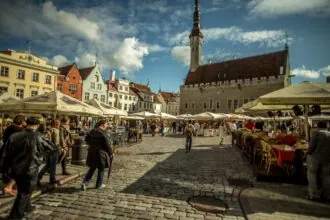
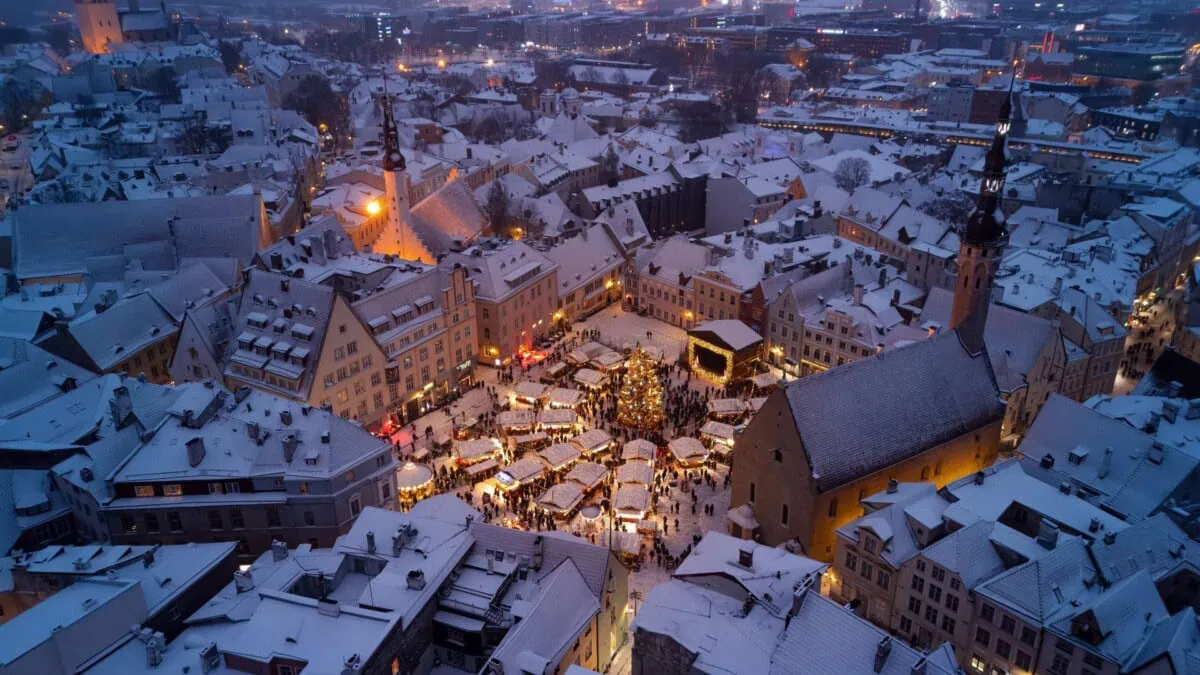
Tallinn’s Christmas market fills Raekoja plats, the medieval Town Hall Square at the centre of one of Europe’s best-preserved walled old towns, and it’s the setting more than the scale that makes this market worth planning a trip around. Cobbled streets, Gothic spires and a working 15th-century town hall wrap tightly around a single square strung with fairy lights, and the whole thing is compact enough to properly explore in an afternoon. Estonia’s tourist board confirms the 2026 market runs from 20 November 2026 to 6 January 2027, one of the longer seasons among Europe’s major markets.
The centrepiece is Tallinn’s Christmas tree, and the city makes a genuine historical claim here: a tree has stood on this exact spot since 1441, making it, by Tallinn’s own account, the first public Christmas tree ever displayed in Europe. Around it, a modest ring of wooden stalls sells Estonian handicrafts, wool knitwear, amber jewellery and gingerbread, alongside food stalls serving sauerkraut, grilled sausages and the Baltic mulled wine known as glögi. A small carousel and a rotating programme of choirs and folk performers round out the square.
What sets Tallinn apart from Prague, Vienna or Budapest isn’t drama or scale, it’s genuine value alongside genuine atmosphere. Prices across food, drink and accommodation run noticeably lower than in Western or Central European capitals, and the city’s compact Old Town means almost nothing requires a taxi or tram. Tallinn also sits within easy reach of Helsinki by ferry and Riga by bus, making it a natural anchor for a short multi-city Baltic winter trip rather than a single isolated stop. This guide covers the market itself, what to eat, how the city compares on cost, and how to build day trips around it.
Tallinn Christmas Market: Quick Facts
| Detail | Information |
|---|---|
| Location | Raekoja plats (Town Hall Square), Tallinn Old Town |
| 2026/27 dates | 20 November 2026 to 6 January 2027 (confirmed via Visit Estonia) |
| Typical hours | 10am to around 8pm to 9pm daily, food and drink stalls often later |
| Entry price | Free to enter; costs apply only to food, drink and crafts |
| Nearest transport hub | Tallinn Old City Harbour (Terminal A/D) for ferries, a 10-minute walk |
Raekoja Plats: Tallinn’s Historic Market Square
Raekoja plats has functioned as Tallinn’s civic heart since the Middle Ages, and its Gothic Town Hall, completed in 1404, still stands watch over the square exactly as it did when the first Christmas tree tradition reportedly began here. The market itself is modest by the standards of Vienna or Cologne, typically around 30 to 40 stalls arranged in a horseshoe around the central tree, but the setting more than makes up for the smaller footprint.
Stalls sell a genuinely local mix of goods rather than generic festive merchandise: hand-knitted wool sweaters and mittens in traditional Estonian patterns, amber jewellery sourced from the Baltic coast, wooden toys and ceramics from small regional workshops. Prices for a pair of wool mittens typically run from around €8 to €15 (about £7 to £13 / $9 to $17), noticeably cheaper than equivalent crafts in Western European markets.
The square sits inside the walled Old Town, a UNESCO World Heritage Site, so every approach to the market is on foot through narrow medieval streets rather than a modern shopping district. This makes the walk to the market as much a part of the experience as the market itself, particularly after dark when the surrounding lanes are lit by wrought-iron lanterns and shopfronts rather than street lighting.
A small stage beside the tree hosts a rotating programme of local choirs, brass ensembles and children’s performances most evenings and weekend afternoons throughout the season. Because the square is enclosed on all sides by historic buildings, sound carries well and the acoustics genuinely add to the atmosphere rather than getting lost outdoors. Evenings from around 5pm to 7pm tend to be the liveliest and most photogenic time to visit.
See hotel options and places to stay in Tallinn.
Browse hotelsBrowse apartments, holiday homes and self-catering stays in Tallinn.
View rentalsSee hotel prices from multiple booking sites in one search.
Compare ratesGlögi, Gingerbread and Baltic Market Food
The signature drink at Tallinn’s market is glögi, the Baltic and Nordic take on mulled wine, served warm with raisins and almonds at the bottom of the cup. A standard cup typically costs around €4 to €5 (about £3.50 to £4.40 / $4.30 to $5.40), with a non-alcoholic version made from spiced berry juice widely available for drivers, children or anyone avoiding alcohol. Both versions are served in the same style, so it’s easy to order either without feeling like an afterthought.
Estonian gingerbread, or piparkoogid, is the other essential purchase, sold both as plain spiced biscuits and as elaborately iced shapes intended as tree decorations or gifts. Some stalls offer gingerbread decorating stations where visitors can ice their own biscuits for a small fee, a popular activity for families with younger children. A bag of a dozen plain gingerbread biscuits typically costs around €5 to €7 (about £4.40 to £6.10 / $5.40 to $7.60).
On the savoury side, look for grilled sausages, sauerkraut with smoked pork, and verivorst, a traditional Estonian blood sausage typically served around Christmas. Portions are generous and priced from around €6 to €9 (about £5.30 to £7.90 / $6.50 to $9.70) for a full plate, which is meaningfully cheaper than comparable food at markets in Germany, Austria or France.
Most stalls accept contactless card payment, which is close to universal across Estonia generally, so carrying cash is far less necessary here than at many other European markets. Euro is the only currency accepted on-site, and it’s worth declining any on-screen currency conversion offer at checkout in favour of your own bank’s exchange rate.
A Fairytale Old Town, Without the Crowds
Tallinn’s Old Town is genuinely one of the best-preserved medieval city centres left in Europe, with intact city walls, defensive towers and cobbled lanes that most visitors describe as feeling closer to a film set than a working modern capital. Unlike Prague or Vienna, both of which can feel overwhelmed by December tourist numbers, Tallinn’s Old Town retains a genuinely lived-in, local atmosphere even at the height of the Christmas season.
Beyond Raekoja plats itself, the surrounding streets are worth a slow winter wander in their own right. Viru Gate, one of the original medieval entrances to the city, is particularly striking when lit for the season, and the vantage points on Toompea hill above the Old Town give a genuinely dramatic view down over the market square and red-tiled rooftops.
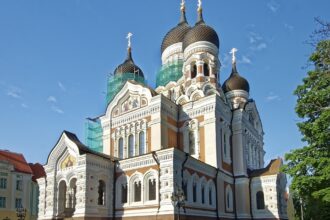
Because the whole historic centre spans less than a square kilometre, visitors can comfortably combine the Christmas market with the city’s major sights in a single day without feeling rushed. Alexander Nevsky Cathedral, St Olaf’s Church and the various medieval guild halls along Pikk street are all within a 10 to 15 minute walk of the market square.
Evenings are when the setting earns its “fairytale” reputation most fully. With modern traffic largely absent from the pedestrianised core and the market’s warm lighting reflecting off centuries-old stone facades, Tallinn at night in December has a quieter, more intimate feel than the bigger-name market cities, which is precisely the point of difference worth knowing before you book.
Getting There and Where to Stay
Tallinn Airport (Lennart Meri Tallinn Airport) is unusually close to the city centre, and a straightforward Tallinn airport transfer by tram, taxi or pre-booked shuttle takes as little as 15 to 20 minutes to reach the Old Town. Tram line 4 runs directly from the airport towards the city centre and is the cheapest option for travellers happy to walk the final few minutes to Raekoja plats.
Travellers arriving by sea should note that Tallinn’s Old City Harbour, used by ferries from Helsinki and Stockholm, sits roughly a 10-minute walk from the market square, making a same-day arrival and market visit entirely realistic. This is one of the reasons Tallinn works so well as a winter city-break destination for travellers already in Helsinki or Stockholm.
For accommodation, staying inside or immediately around the Old Town puts the market within a five to ten minute walk of most hotels, with mid-range December rates typically running from around €70 to €110 a night (about £62 to £97 / $76 to $119), noticeably lower than equivalent central hotels in Vienna, Prague or Copenhagen. Budget travellers can find well-reviewed guesthouses just outside the city walls for meaningfully less.
December daylight in Tallinn is short, with sunset around 3.30pm to 4pm, so building an itinerary around late-morning sightseeing and an afternoon-into-evening market visit generally works better than trying to see everything before lunch. Wrapping up warm matters more here than in most European market cities, since the Baltic wind off the Gulf of Finland can make the square feel noticeably colder than the thermometer alone suggests.
Pairing Tallinn with Helsinki or Riga
Tallinn’s geography makes it one of the easiest cities in Europe to combine with a second capital on the same trip. The ferry crossing to Helsinki takes roughly two to two and a half hours depending on the operator, with multiple daily sailings throughout December, and several operators run dedicated festive sailings with their own Christmas market or decorations on board. A round-trip economy ferry ticket typically costs from around €30 to €50 (about £26 to £44 / $32 to $54) depending on how far in advance it’s booked.
Heading south instead, Riga is roughly four and a half hours away by direct bus, with several daily departures and fares typically from around €15 to €25 (about £13 to £22 / $16 to $27) one way. Riga runs its own well-regarded Christmas market in its Old Town, making a two-city Baltic Christmas trip a genuinely realistic long weekend rather than an ambitious stretch.
Both routes are well suited to travellers who want more than one market experience without the cost or complexity of flying between destinations. Tickets for both the Helsinki ferry and the Riga bus can be booked online in advance, which is worth doing in December when festive-season demand on both routes tends to push up walk-up prices.
For travellers with more time, a three or four night trip that splits nights between Tallinn and one neighbouring capital allows for a relaxed pace rather than a rushed single-day crossing, and keeps overall trip costs well below what a comparable multi-city trip through Western Europe would run.
Ice Skating, Carousel Rides and Other Market Activities
Beyond the stalls, the square offers a handful of genuine activities rather than browsing alone. A small carousel operates on Raekoja plats throughout the season, a simple but popular stop for children and one of the more photographed spots in the square after dark.
A short walk away, the Old Town Ice Rink sets up on Harju Street, right beside St Nicholas’ Church, and stays open from 30 November through to the end of March. It runs daily from 10am to 10pm, making it easy to fit a skate in either before or after a visit to the market itself.
Several stalls run gingerbread decorating stations throughout December, where visitors can ice and personalise their own piparkoogid for a small fee, a genuinely hands-on activity rather than just a food purchase. It’s one of the market’s most popular stops for families with younger children.
Craft demonstrations are a regular feature too, with woodworkers, knitters and amber jewellers often working at their own stalls rather than simply selling finished pieces. It gives visitors a proper look at how the goods on sale are actually made.
A rotating programme of choirs, brass ensembles and folk performers takes to the small stage beside the Christmas tree most evenings and weekend afternoons. Timing a visit for early evening captures the market at its liveliest.
None of these activities require advance booking, which fits the market’s generally low-key, walk-up character compared with the more heavily ticketed extras found at some larger European markets.
Christmas Lights, Switch-On and Other Festive Events in Tallinn
Tallinn’s Christmas tree and festive lighting on Raekoja plats go up for the market’s confirmed opening on 20 November 2026, per Visit Estonia. In previous years the lighting has often coincided with the first Sunday of Advent, so the exact ceremony pattern can shift a little year to year even though the market’s own opening date is now confirmed.
Beyond the main square, most of Tallinn’s public squares put up their own Christmas trees each winter, and the city genuinely spreads festive decoration well past the Old Town rather than concentrating it all on Raekoja plats.
The Tallinn Winter Festival runs across mid-December, with classical concerts, including works by Estonian composer Arvo Pärt, staged inside the 13th-century Holy Spirit Church, whose acoustics suit choral and organ music particularly well. Performances typically start around 7pm.
Toompea hill and the surrounding viewpoints are lit for the season too, and the walk up from the market square after dark is worth doing purely to see the lit rooftops and church spires from above.
On New Year’s Eve itself, several Old Town restaurants, including the medieval-themed Olde Hansa, run costumed feast nights with traditional Estonian dishes and old-fashioned entertainment, a distinctly Tallinn way to see out the year that has nothing to do with the market itself.
Taken together, this spread of events means a December visit rewards more than a single afternoon at the market, particularly for anyone staying two or three nights in the city.
Compare routes and fares for your journey to Tallinn.
Compare flightsUse an eSIM to get online without hunting for a local SIM after arrival.
See eSIM optionsArrange a private airport pickup for your trip to Tallinn.
Check transfersShop Opening Hours in Tallinn During December
General retail hours in Tallinn run fairly standard through December, typically 10am to 6pm on weekdays and slightly shorter, often 10am to 5pm, on Saturdays. Department stores and the city’s shopping centres tend to stay open later, commonly until around 8pm or 9pm daily.
Estonia has no blanket Sunday closing law, and Sunday trading is genuinely normal here, more so than in several neighbouring countries. Most supermarkets, including the major Selver, Rimi and Maxima chains, open seven days a week, though some shopping centres have trimmed their Sunday hours slightly in recent years.
In the run-up to Christmas, many shops in the Old Town and the main shopping centres extend their hours slightly to cover the busier evening footfall from market visitors, though this varies store by store rather than following one fixed citywide rule.
Smaller independent shops, particularly craft and souvenir stores around the Old Town, often keep more flexible hours during the market season, sometimes staying open later on evenings when the square is busiest.
Convenience stores and petrol station shops fill the gap outside standard hours, and several central branches operate close to around the clock, useful for anything needed late at night or early morning.
As with most of the practical detail in this guide, none of this affects the Christmas market itself, which runs to its own separate daily hours regardless of what the surrounding shops are doing.
Christmas Day, Boxing Day and New Year’s Day: What’s Open in Tallinn
Tallinn’s museums, including the Tallinn City Museum’s various sites, close completely on 24, 25 and 26 December and again on 1 January, following Estonia’s standard public holiday pattern. The working day immediately before Christmas Eve and before New Year’s Eve is also shortened by three hours, so 23 and 31 December both see earlier closing times than usual.
Shops generally follow a similar pattern: supermarkets and shopping centres close earlier than normal on 24 and 31 December, then most close entirely on 25 December, with some, particularly in the Old Town, reopening on a limited basis for 26 December and 1 January.
Public transport runs on a Sunday-style timetable across the Christmas period itself, from 24 to 26 December, which means a reduced but still fully functioning service rather than a shutdown. Trams and buses continue as normal, just less frequently than on a typical weekday.
Restaurants and bars across the Old Town are a reliable exception and generally stay open throughout the holidays, including Christmas Day itself, which makes finding somewhere warm to eat straightforward even when shops and museums are shut.
Attractions like Kiek in de Kök and the Bastion Tunnels close on public holidays along with the museums, so anyone hoping to see the city’s underground passages should plan that visit for a non-holiday day either side of Christmas.
The Christmas market itself falls within its published running dates over the whole period, though individual stallholders may keep shorter hours or close early on Christmas Day at their own discretion, so it’s worth treating it as a likely but not strictly guaranteed constant that day specifically.
New Year’s Eve in Tallinn
Tallinn moved away from a traditional fireworks display for New Year’s Eve in its most recently confirmed season, choosing instead to protect the environment and local wildlife from noise and pollution. In its place, the city staged a free concert and light show on Freedom Square (Vabaduse väljak) from 11pm, with a specially composed light show set to music at 11:50pm ahead of midnight.
The council’s own reasoning, given by Tallinn’s mayor at the time, was that fireworks are visually striking but come at a real cost to air quality and animal welfare, a rationale that may well continue to shape how future New Year’s Eves in the city are run.
Streets immediately around Freedom Square close to traffic for several hours either side of midnight to accommodate the event, and several central bus routes are diverted for the same window, though tram services generally continue with only brief interruptions.
Public transport runs with extended hours into the small hours of 1 January, with key tram and bus routes adding extra departures at around 20-minute intervals until roughly 3am. Getting back to a hotel without a taxi is generally straightforward as a result.
Away from Freedom Square, several Old Town restaurants run their own celebrations, including costumed medieval-style feast nights at venues like Olde Hansa, for anyone who would rather see in the new year indoors with a proper sit-down meal.
Because the city’s approach to New Year’s Eve has changed recently, it’s worth checking Tallinn’s official city website (tallinn.ee) closer to the time for the confirmed 2026/27 programme rather than assuming an identical repeat of the most recent event.
Tallinn’s December Weather and What to Pack
December in Tallinn is properly cold, with average daytime highs of around 2°C (36°F) and overnight lows dropping to about minus 3°C (27°F). Nights sit well below freezing for most of the month, and the cold is a fairly constant feature of a December visit rather than something that comes and goes.
The city is wetter than many visitors expect, with around 57mm of precipitation falling across roughly 21 days in a typical December, putting the chance of some form of rain or snow on any given day at around 70 percent. A good share of this falls as snow once temperatures drop, though a guaranteed white market scene still isn’t something to count on.
Humidity averages around 89 percent, among the highest of any major European Christmas market city, making the cold feel considerably sharper than the raw temperature suggests. Daylight is limited too, with only around 21 hours of sunshine across the whole month.
Wind off the Gulf of Finland is the detail most visitors underestimate. Raekoja plats sits somewhat sheltered by the surrounding buildings, but the walk to the Old City Harbour or along the open stretches near the city walls feels considerably colder than the square itself.
Pack proper thermal layers, a windproof and waterproof outer shell, and boots with real grip for icy cobblestones, since the combination of cold, damp and uneven medieval paving is a genuine trip hazard without the right footwear. A warm hat and gloves are not optional extras here.
The upside of the cold and the short days is the atmosphere it creates. Raekoja plats lit up against an early winter darkness is a large part of what gives Tallinn’s market its fairytale reputation in the first place.

Rupert’s Handy Travel Tips
Tallinn is one of my favourite winter surprises, small enough to feel manageable and pretty enough that I keep finding new corners of the Old Town each visit.
- Layer up more than you think you need: the wind coming off the Gulf of Finland makes Raekoja plats feel noticeably colder than the forecast temperature alone suggests.
- Visit Toompea hill for the view: the lookout points above the Old Town give a genuinely striking view down over the lit market square, and it’s a quiet five-minute detour most visitors skip.
- Book your ferry or bus in advance: both the Helsinki ferry and the Riga bus fill up on December weekends, and advance fares are meaningfully cheaper than walk-up prices.
- Try the non-alcoholic glögi too: it’s not just a fallback option, the spiced berry version is genuinely good and worth ordering even if you’re not avoiding alcohol.
- Go late afternoon for the best light: Tallinn’s December sunset is around 3.30pm to 4pm, so an early evening visit catches the market at its most atmospheric without needing to stay out too late.
Want to meet the reindeer behind our travel tips? Find out more in our page Who is Rupert?.




Frequently Asked Questions
When is the Tallinn Christmas market in 2026?
According to Visit Estonia, Tallinn’s 2026 Christmas market runs from 20 November 2026 to 6 January 2027 at Raekoja plats (Town Hall Square) in the Old Town.
Is the Tallinn Christmas market free to visit?
Yes, entry to the market square is free. Costs only apply to food, drink and craft purchases, most of which are noticeably cheaper than at equivalent markets in Western or Central Europe.
Why is Tallinn’s Christmas tree considered historically significant?
Tallinn claims that a Christmas tree has stood on Raekoja plats since 1441, which, by the city’s own account, makes it the first public Christmas tree ever displayed in Europe. The tradition continues on the same spot every winter.
Can I visit Tallinn and Helsinki’s Christmas markets on the same trip?
Yes. The ferry between Tallinn and Helsinki takes roughly two to two and a half hours with multiple daily sailings in December, making a two-capital Baltic Christmas trip straightforward to plan even over a long weekend.
How cold does it get in Tallinn during the Christmas market season?
Average daytime temperatures in late November and December typically sit between 0°C and 4°C (32°F to 39°F), though wind chill off the Gulf of Finland can make it feel considerably colder, especially in the evenings. Warm, windproof layers are worth prioritising over sheer bulk.
Do I need cash for the Tallinn Christmas market?
Not really. Contactless card payment is close to universal across Estonia, including at most market stalls, so carrying cash is less necessary here than at many other European Christmas markets.
Is there a Christmas lights switch-on event in Tallinn?
Tallinn’s tree and festive lighting on Raekoja plats go up for the market’s confirmed opening on 20 November 2026. In past years this has often lined up with the first Sunday of Advent, though the exact date can shift slightly year to year.
Does Tallinn have fireworks on New Year’s Eve?
Not currently. Tallinn moved away from a traditional fireworks display in its most recently confirmed season, replacing it with a free concert and light show on Freedom Square, partly for environmental and animal-welfare reasons.
Further Reading
For a fuller picture of the city beyond the Christmas season, our Best Things to Do in Tallinn guide covers the Old Town’s major sights, museums and viewpoints in detail, including several worth adding to a December itinerary once the market stalls close for the night. Anyone keen to understand why the Old Town looks and feels the way it does should also read our Tallinn UNESCO guide, which explores the medieval fortifications and architecture that make this one of Europe’s best-preserved historic centres.
Travellers flying in should check our Tallinn airport transfers guide before landing, since it lays out every option from the tram to pre-booked shuttles and typical journey times into the Old Town. If a single city isn’t enough, our Best Day Trips from Tallinn guide covers the Helsinki ferry, the Riga bus and several closer options in more detail than this page has room for, including seasonal timetables and ticket-booking advice.
If Tallinn is one stop on a wider winter tour of Europe, our European Christmas Markets Guide compares market cities across the continent and is a useful starting point for deciding which other destinations to pair with a Baltic winter trip. Between the three, there’s enough here to plan a genuinely well-rounded Tallinn Christmas visit rather than a single afternoon at the market square.