Reviewed by our editorial team Updated
Porto Torres Ferry Routes: Sardinia’s Gateway to Spain, France and Italy
Porto Torres, on Sardinia’s northwest coast near Alghero and Sassari, is the island’s most genuinely international port. Unlike Olbia or Cagliari, it receives direct scheduled ferries from three different countries rather than just from mainland Italy.
From here, Corsica Ferries runs direct services to and from France, Grimaldi Lines connects to Barcelona in Spain, and several operators including GNV and Tirrenia link the port to Genoa and Civitavecchia on the Italian mainland.
This guide covers every scheduled route into Porto Torres in detail: crossing times, operators, realistic prices, what the terminal itself is like, and how to continue on to nearby Alghero and Sassari once you arrive.
Unlike Olbia, which mostly handles mainland Italy traffic, or Cagliari, which serves longer overnight Italian routes, Porto Torres genuinely functions as a border port between three different countries, which shapes almost everything about how it operates.
If you are researching Sardinia’s ferry network more broadly, our island-wide Sardinia Ferry Routes hub covers Olbia and Cagliari too, and explains how all three main ports fit together.
That wider hub is also the place to check the inter-island crossing from Palau to La Maddalena and the routes into Sardinia’s other two major gateways, if Porto Torres turns out not to be the right port for part of your trip.
Whether you are driving down through France or Spain, island-hopping from Corsica, or simply comparing mainland Italy departure points, the sections below should cover whichever route brought you here.
Porto Torres also sits within easy reach of Alghero and Sassari, so even if your final destination is elsewhere in northwest Sardinia, arriving here rarely means a long onward transfer compared with some other ports.
Treat every crossing time and fare below as a realistic guide rather than a fixed promise, since schedules on the international routes in particular can shift noticeably between seasons and even from one year to the next.
Porto Torres Routes at a Glance
Before going into detail on each crossing, here is a quick overview of every scheduled route into Porto Torres, the operator running it, and a realistic crossing time to expect.
| Origin | Operator | Crossing Time |
|---|---|---|
| Toulon, France | Corsica Ferries | Approximately 13 to 15 hours |
| Nice, France | Corsica Ferries | Approximately 10.5 hours |
| Barcelona, Spain | Grimaldi Lines | Approximately 13 hours |
| Genoa, Italy | GNV, Tirrenia | Approximately 10 to 14 hours |
| Civitavecchia, Italy | Grimaldi Lines | Approximately 8 hours |
| Ajaccio, Corsica | Corsica Ferries | Approximately 4.5 hours |
| Propriano, Corsica | Corsica Ferries | Approximately 3.75 hours |
As the table shows, journey times range from under four hours on the shortest Corsica crossing to well over half a day on the longest French and Spanish routes, so choosing carefully matters for your overall itinerary.
Frequency also varies considerably: the Italian mainland routes generally run daily or several times a week, while the international France, Spain and Corsica services are often weekly or twice-weekly, particularly outside peak summer.
These figures are seasonal averages rather than a fixed year-round timetable, and it is well worth checking the specific dates of your trip directly with the operator rather than relying on the general pattern described here.
All the routes listed here carry vehicles as well as foot passengers, and all but the shortest Corsica crossings are long enough that a private cabin is well worth considering rather than a standard reclining seat.
Prices generally track distance and demand fairly closely, so the longer France and Spain routes sit at the higher end of the fare range, while the short Corsica crossings from Ajaccio and Propriano are noticeably cheaper.
If more than one route works for your itinerary, comparing total journey time against price is usually more useful than focusing on either figure alone, since the cheapest option is not always the most convenient once you factor in overnight cabin costs.
Best for two or three nights. The widest choice of rooms, with filters for free cancellation and included breakfast.
View staysBest for groups who want one address and separate bedrooms rather than three hotel rooms.
See holiday homesBest if you have already picked a hotel. Checks the big booking sites for the same room and shows who is cheapest.
Check dealsDriving Down Through France: Toulon and Nice Routes
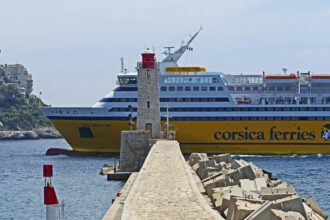
Corsica Ferries is the main operator connecting France directly to Porto Torres, running services from both Toulon and Nice that make this port the natural Sardinian arrival point for anyone driving down through France.
The Toulon route is the longer of the two, typically taking around 13 to 15 hours, with a handful of sailings a week rather than a daily service, especially outside the summer peak.
The Nice route runs faster, at roughly 10.5 hours, generally overnight, with around one sailing a week through much of the year and a slightly busier timetable in summer.
Both routes carry vehicles, and given the length of the crossing, most travellers book a cabin rather than a reclining seat, particularly on the longer Toulon sailing.
For the fuller picture of what each French port offers more broadly, including their other Mediterranean connections, see our dedicated Ferry Routes from Toulon and Ferry Routes from Nice guides.
Marseille does not currently have a frequent direct sailing to Porto Torres, but travellers departing from there can read about the wider network in our Marseille Ferry Routes guide, including onward connections via Corsica.
Driving from further north or west in France, both Toulon and Nice sit within a reasonable day’s drive of much of the country, making either a genuinely practical starting point for a road trip that ends in Sardinia.
Because these French routes run less frequently than the Italian mainland crossings, particularly outside summer, it is worth checking the timetable several weeks ahead rather than assuming a sailing will be available on short notice.
Porto Torres, Sardinia to Toulon Ferry Crossings & Times
Compare ferry crossings between Porto Torres, Sardinia and Toulon with Ferryhopper. The live timetable shows scheduled departure and arrival times so you can choose a suitable sailing in either direction.
Select the date you want to travel. The times shown on the right-hand side are the scheduled departure and arrival times for each ferry.
Availability can change quickly, particularly during weekends and the summer season. Some sailings may stop accepting bookings a few hours before departure. If a timetable is blank, there may be no available sailings for today. Try moving to a later date to check future services.
This is the timetable for the outward direction. Use it to check sailings from Porto Torres, Sardinia to Toulon for the date you plan to travel.
This is a separate timetable for the opposite direction. It does not select a return ticket for the journey above. Use it to check sailings from Toulon to Porto Torres, Sardinia.
Looking for different ferry routes or other ferry options?
Compare routes, operators, sailing times and prices with Ferryhopper or Direct Ferries.
The Only Spanish Link: Barcelona to Porto Torres
Grimaldi Lines runs the only regular direct service between Spain and Sardinia, connecting Barcelona to Porto Torres in around 13 hours, almost always as an overnight sailing.
This route typically operates a couple of times a week, using Grimaldi’s larger cruise-style ferries, which include cabins, a restaurant, a bar and outdoor deck space for the long crossing.
It is a genuinely useful option for travellers based in Catalonia or driving down through Spain, since it removes the need to route via France or mainland Italy to reach Sardinia by sea.
Vehicles are carried as standard, and given the length of the crossing, booking a cabin well in advance for summer sailings is strongly recommended, since capacity on this route is more limited than the Italian mainland services.
Because this is currently the only scheduled Spain to Sardinia route, it is worth checking the timetable carefully well ahead of travel, since sailing frequency can shift noticeably between seasons.
Travellers coming from further west in Spain will usually find Barcelona the most practical departure point regardless, given its size and the range of onward transport connecting it to the rest of the country.
Combining a few days in Barcelona with the overnight sailing is a popular way to link a Spanish city break with a Sardinian holiday, rather than treating the crossing as a purely functional transfer.
Porto Torres, Sardinia to Barcelona Ferry Schedules & Tickets
Check the current Porto Torres, Sardinia to Barcelona ferry schedule with Ferryhopper. Change the date to compare available crossings, departure times and bookable tickets for both directions.
Select the date you want to travel. The times shown on the right-hand side are the scheduled departure and arrival times for each ferry.
Availability can change quickly, particularly during weekends and the summer season. Some sailings may stop accepting bookings a few hours before departure. If a timetable is blank, there may be no available sailings for today. Try moving to a later date to check future services.
This is the timetable for the outward direction. Use it to check sailings from Porto Torres, Sardinia to Barcelona for the date you plan to travel.
This is a separate timetable for the opposite direction. It does not select a return ticket for the journey above. Use it to check sailings from Barcelona to Porto Torres, Sardinia.
Want to compare alternative ferry routes and more sailing options?
Compare routes, operators, sailing times and prices with Ferryhopper or Direct Ferries.
Mainland Italy Connections: Genoa and Civitavecchia
Genoa is the busiest mainland Italian departure point for Porto Torres, served by both GNV (Grandi Navi Veloci) and Tirrenia, with a combined crossing time of roughly 10 to 14 hours depending on the vessel and time of year.
Genoa to Porto Torres is considered one of the more popular routes onto the island, with multiple weekly sailings even outside peak season and daily departures common in summer.
Civitavecchia, Rome’s main port, connects to Porto Torres with Grimaldi Lines, taking around 8 hours, generally overnight, and is a practical choice for anyone flying into Rome before continuing by sea.
Both mainland routes carry vehicles, and cabins are widely available, though booking ahead for July and August sailings is sensible given how popular these two crossings are with Italian holidaymakers.
Compared with the Civitavecchia to Olbia route, the Porto Torres sailing tends to see slightly less demand, which can occasionally mean a marginally easier booking experience in the shoulder months either side of summer.
Genoa is well connected by rail to much of northern Italy, making it a practical departure point even without a car, since foot passenger fares and connections are considerably simpler to arrange than a vehicle booking.
Civitavecchia‘s proximity to Rome means many travellers combine a few days in the capital with the ferry crossing, treating the sailing itself as the natural transition point between an Italian city break and a Sardinian beach holiday.
Porto Torres, Sardinia to Genoa Ferry Times & Departures
Use Ferryhopper to check live sailings between Porto Torres, Sardinia and Genoa in both directions. Select your travel date to compare scheduled ferry departures, sailing times and available tickets.
Select the date you want to travel. The times shown on the right-hand side are the scheduled departure and arrival times for each ferry.
Availability can change quickly, particularly during weekends and the summer season. Some sailings may stop accepting bookings a few hours before departure. If a timetable is blank, there may be no available sailings for today. Try moving to a later date to check future services.
This is the timetable for the outward direction. Use it to check sailings from Porto Torres, Sardinia to Genoa for the date you plan to travel.
This is a separate timetable for the opposite direction. It does not select a return ticket for the journey above. Use it to check sailings from Genoa to Porto Torres, Sardinia.
Want to compare different routes and other ferry options?
Compare routes, operators, sailing times and prices with Ferryhopper or Direct Ferries.
Corsica’s Short Hops: Ajaccio and Propriano
Corsica Ferries also runs shorter services from two Corsican ports, Ajaccio and Propriano, both considerably quicker than the France, Spain and mainland Italy crossings above.
Ajaccio to Porto Torres takes around 4.5 hours, while Propriano, further south on the Corsican coast, is slightly quicker still at roughly 3.75 hours, making it the fastest way to reach Porto Torres from Corsica.
Both routes typically run around once a week rather than daily, so they suit a planned itinerary rather than a spontaneous crossing, and checking the current timetable well ahead is worthwhile.
These routes are a useful alternative to the much shorter but less flexible Bonifacio to Santa Teresa Gallura crossing further north, particularly if your Corsican trip is based around Ajaccio or the west coast.
Vehicles are carried on both routes, and given the shorter crossing time compared with the mainland France and Spain services, a cabin is less essential, though still available for those who prefer one.
Ajaccio, Corsica‘s largest town, has good onward transport links across the island, making it a sensible starting point if you are touring Corsica before continuing on to Sardinia rather than travelling there directly.
Propriano is smaller and quieter than Ajaccio, but its shorter crossing time makes it worth the detour if minimising time at sea matters more to you than the size of the departure town itself.
The Porto Torres Ferry Terminal
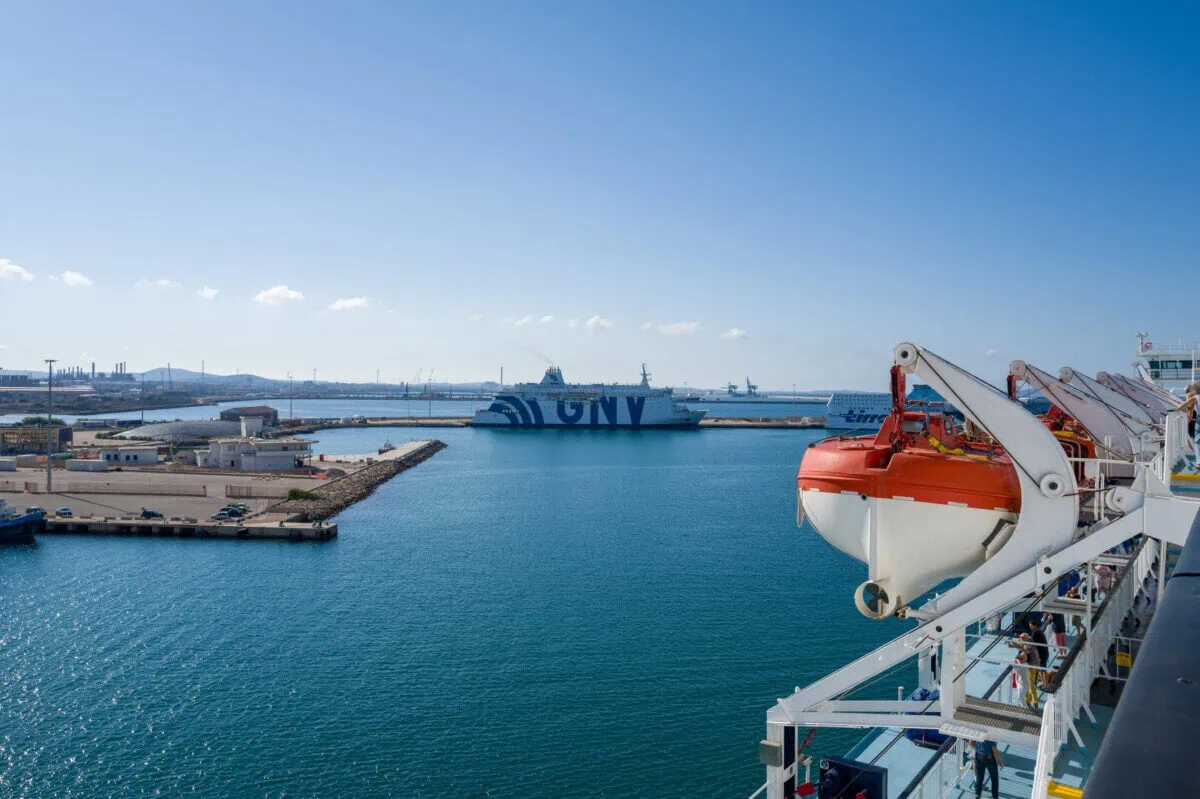
The ferry terminal, officially the Stazione Marittima, sits close to Porto Torres town centre, with the historic Basilica di San Gavino just a short walk away if you have time to spare before or after your crossing.
The port itself is organised across several docks, including the Ponente and Dogana Segni terminals, so check your ticket or booking confirmation carefully for which specific dock your operator uses.
Corsica Ferries publishes an overview of the terminal on its own site, including which dock its France-bound sailings use. Checking this alongside your booking confirmation at corsica-ferries.co.uk is a sensible extra step before you travel.
Porto Torres Marittima train station is only around 2 kilometres from the port, giving a straightforward option for foot passengers arriving or departing without a car.
Vehicle check-in for the longer international routes typically opens 90 minutes to 2 hours before departure, and arriving in good time is sensible, particularly for the Barcelona and Toulon sailings which run less frequently than the Italian mainland routes.
Basic facilities including cafes and a ticket office are available at the terminal, though it is a smaller and quieter port than Olbia, so do not expect an extensive range of shops or restaurants while you wait.
Taxis are usually available outside the terminal building, though numbers can be limited outside the main sailing times, so booking one in advance is sensible if you are arriving on an early morning or late evening ferry.
Signage at the port is generally in both Italian and English, and staff are used to dealing with international passengers given the range of countries this terminal serves.
Getting to Alghero and Sassari
One of the main reasons travellers choose Porto Torres is its proximity to Alghero and Sassari, both easily reached by road or rail without a long transfer from the port.
Alghero sits around 35 to 40 minutes away by car, and regional buses and taxis also cover the route, making it a practical base even if you are arriving without your own vehicle.
Sassari, Sardinia’s second-largest city, is closer still, generally under 20 minutes by car, and is well connected to the wider regional rail network for onward travel further into the island.
Alghero-Fertilia Airport, roughly 24 kilometres from the port, is the closest airport, useful if your trip combines a flight one way with a ferry the other rather than sailing both directions.
If Alghero is your main base, our Things to Do in Alghero and Alghero Airport Transfers guides are the natural next stops for planning the rest of your stay.
Car hire desks are available at Alghero-Fertilia Airport rather than at the ferry terminal itself, so travellers arriving without their own vehicle usually pick up a rental once they reach the airport or Alghero town centre.
Regional trains connect Sassari onward to much of northern and central Sardinia, so even if your final destination is further afield, Porto Torres rarely means a difficult or lengthy first leg of the journey.
Best for finding routes the airlines do not sell as a single ticket. Combines carriers to bring the fare down.
Search flightsBest for anyone whose home plan charges by the megabyte abroad. Pay a fixed price up front.
Check eSIMsBest after a long flight or a late landing. Price agreed before you travel, and no taxi queue.
Check transfersTickets, Prices and Booking
Prices vary considerably by route and season. As a rough guide, a foot passenger fare on the international France or Spain routes typically runs from around €40 to €90 (£35-78 / $44-98) one way, higher than the shorter Italian mainland crossings.
Adding a standard car generally costs an extra €80 to €180 (£70-157 / $87-196) on the longer international routes, with the shorter Corsica crossings from Ajaccio and Propriano typically working out noticeably cheaper.
A private cabin is well worth the extra cost on any crossing over eight hours, particularly the Toulon, Nice and Barcelona routes, all of which run overnight and last well into double digits of hours.
Booking directly through each operator’s website is usually the most reliable way to secure a specific sailing, though ferry comparison sites are useful for checking availability across Corsica Ferries and Grimaldi Lines at once.
For travel in July and August, booking at least a month ahead is strongly advisable, particularly for vehicle space on the France and Spain routes, which run less frequently than the mainland Italy services.
Refund and amendment policies differ between operators, so read the terms carefully at the time of booking, especially if your travel dates are not yet fully fixed when you reserve a sailing.
Early booking also tends to offer a wider choice of cabin grades and vehicle deck positions on the longer routes, which is worth factoring in alongside price when comparing sailing options.
Travelling with a Car
Every route into Porto Torres covered in this guide carries vehicles, making it a popular arrival point for travellers driving down through France or Spain who want their own car for the rest of their Sardinian trip.
Vehicle check-in generally opens 90 minutes to 2 hours before departure on the longer international routes, and arriving early is sensible given the lower sailing frequency compared with Olbia‘s mainland Italy services.
Campervans and larger vehicles are typically charged by length rather than a flat rate, so check the specific tariff for your vehicle when booking, since this can add significantly to the total fare.
Hire car agreements sometimes restrict cross-border ferry travel, so if you are bringing a rental car from France, Spain or Italy, check the terms of your contract before booking a Porto Torres crossing.
Once you have arrived, our Road Trip Around Sardinia guide shows how a Porto Torres arrival fits into a wider driving itinerary covering Alghero, the north coast and beyond.
Roof boxes, bike racks and trailers are usually accepted but may carry an extra charge or require advance notice, so declare any unusual load when booking rather than at the port on the day.
Fuel prices in Sardinia are broadly comparable with mainland Italy, France and Spain, so there is little practical advantage to filling up specifically before boarding unless your onward drive is particularly long.
Which Route Is Right for You?
If you are driving down through France, the Toulon or Nice routes with Corsica Ferries are the obvious choice, with Nice offering the shorter crossing of the two.
If you are coming from Spain, the Barcelona to Porto Torres route with Grimaldi Lines is currently the only direct option, so your choice really comes down to timing rather than picking between operators.
If you are flying into Rome first, Civitavecchia offers the fastest route into Porto Torres of any of the longer crossings, at around 8 hours compared with 10 or more from Genoa.
And if your trip is based in Corsica, Propriano offers the shortest overall crossing into Porto Torres, useful if you want to minimise time on the water before continuing your Sardinian holiday.
Families with young children often prioritise the shorter Corsica crossings over the longer France and Spain routes, simply to reduce the time spent on board before reaching dry land again.
Travellers without a car have more flexibility to choose based purely on price and schedule, since none of the vehicle-related booking constraints apply to a foot passenger ticket on any of these routes.
Practical Tips for Ferry Travel to Porto Torres
Double-check which dock your specific sailing uses, since Porto Torres has several separate terminal areas rather than a single unified building like some larger Italian ports.
Pack for the crossing itself on the longer routes; even with a cabin booked, having snacks, water and entertainment on hand makes an 8 to 15 hour sailing considerably more comfortable.
Keep passports and vehicle documents easily accessible on the international France and Spain routes, since border checks at these crossings are more thorough than on domestic Italian sailings.
Build some flexibility into your onward plans, since the lower frequency on the France, Spain and Corsica routes means a missed or delayed sailing can have a bigger knock-on effect than on the busier Olbia crossings.
If you are travelling without a car, our guide to Getting Around Sardinia Without a Car covers onward travel by train and bus once you step off the ferry.
Check your phone’s roaming arrangements before crossing between countries, particularly on the France and Spain routes, since data charges can catch travellers out during a long crossing spent browsing to pass the time.
Finally, build a little flexibility into the days either side of a long crossing, since delays of an hour or two are not unusual on the international routes, particularly during unsettled weather.

Rupert’s Handy Travel Tips
Porto Torres is one of the most useful ports in Sardinia if you are arriving from France or Spain, here is how to make the crossing smooth.
- Book Barcelona sailings early: it is the only direct Spain to Sardinia route, so capacity is more limited than the Italian mainland services.
- Choose Nice over Toulon for speed: the Nice crossing is around four hours shorter than the Toulon route.
- Use Propriano from Corsica: it offers the shortest crossing time of any Corsican departure point into Porto Torres.
- Base yourself in Alghero: it is only around 35 to 40 minutes from the port and has far more restaurants and hotels nearby.
Want to meet the reindeer behind our travel tips? Find out more in our page Who is Rupert?.




Frequently Asked Questions
Which countries have direct ferries to Porto Torres?
France, Spain and mainland Italy all have direct scheduled routes, plus two shorter crossings from Corsica.
How long is the ferry from Barcelona to Porto Torres?
Around 13 hours with Grimaldi Lines, almost always as an overnight sailing.
Is there a ferry from Toulon or Nice to Porto Torres?
Yes, both with Corsica Ferries; Nice takes around 10.5 hours while Toulon takes 13 to 15 hours.
What is the fastest way to reach Porto Torres from Corsica?
Propriano, at around 3.75 hours, is slightly faster than Ajaccio’s roughly 4.5 hour crossing.
Can I take a car on these ferries?
Yes, every route covered in this guide carries vehicles as standard alongside foot passengers.
How far is Porto Torres from Alghero?
Around 35 to 40 minutes by car, with regional buses and taxis also covering the route.
Do I need to book a cabin?
It is not compulsory, but strongly recommended on the longer France and Spain routes, most of which run overnight.
How far ahead should I book in summer?
At least a month ahead for July and August, particularly for vehicle space on the France and Spain routes.
Further Reading
For the wider picture of getting to Sardinia by sea, including Olbia and Cagliari, see our island-wide Sardinia Ferry Routes hub, which also covers the inter-island hop from Palau to La Maddalena.
Travellers arriving from France can find more detail in our Ferry Routes from Toulon, Ferry Routes from Nice and Marseille Ferry Routes guides, each covering the wider Mediterranean network from those ports.
Once you have arrived, our Things to Do in Alghero and Getting Around Sardinia Without a Car guides both make useful next reads for the rest of your trip.