Reviewed by our editorial team Published
A Regional Airport Shared Between Two Cities, 25 Kilometres Out
Münster shares its airport with a city that sits 35 kilometres away, and that single fact shapes almost every transfer decision covered in this guide. Münster Osnabrück Airport sits in the small town of Greven, roughly 25 kilometres (16 miles) north of central Münster, a genuine distance closer to what travellers find at Leipzig’s airport than to the compact, city-edge hubs at Nuremberg or Bremen.
It is worth saying plainly that FMO is a small regional airport. It handled a little over 1.28 million passengers in 2024, a fraction of what Germany’s major hubs handle, and its schedule leans heavily on leisure and charter routes to destinations like Palma de Mallorca and Antalya rather than a dense network of direct flights from across Europe. Anyone hoping for a wide choice of direct connections into Münster itself is likely to be disappointed.
That matters because a genuinely large number of visitors reach Münster without ever landing at FMO at all. Many arrive instead through Dortmund Airport (DTM) or Düsseldorf Airport (DUS), both larger hubs with far more direct European routes, and simply take the train onward. This guide covers that option honestly, alongside every realistic way of getting from FMO itself into the city.
For anyone who is flying directly into FMO, though, there is still a full set of options worth understanding: the S50 and R51 buses into Münster Hauptbahnhof, taxis, pre-booked private transfers, and hiring a car. Driving and parking at the terminal are covered too, for anyone being dropped off or collecting a vehicle.
Whatever the budget, luggage load, or travel style involved, it is worth taking a moment to check which option below genuinely fits the trip, rather than assuming FMO works the same way as one of Germany’s bigger, more central airports.
| Transfer Option | Typical Journey Time | Approximate Cost | Best For |
|---|---|---|---|
| S50 / R51 Bus | ~25-35 mins to Münster Hbf | €6.20 (£5.33/$7.25) | Budget travellers, light luggage |
| Taxi | ~20-25 mins | €70-95 (£60.20-81.70/$81.90-111.15) | Door-to-door convenience |
| Private Transfer | ~20-25 mins | From €55 (£47.30/$64.35) | Families and groups |
| Car Hire | Flexible | Varies by season | Exploring the Münsterland beyond the city |
| Self-Drive/Drop-off | ~25-30 mins | Parking from €3.50 (£3.01/$4.10) | Travellers with their own car |
Meet FMO: A Small Regional Gateway Built for Two Cities
Münster Osnabrück Airport, generally shortened to FMO (its ICAO code is EDDG), sits in the town of Greven in North Rhine-Westphalia. Development began in 1967 with assistance from the British Army of the Rhine, which helped level the site, and the airport officially opened on 27 March 1972. Its first charter flight departed for Palma de Mallorca the following year, and it gained international airport status in 1986.
The airport’s name reflects the two cities it was built to serve, sitting between Münster and Osnabrück, though notably closer to neither than either city’s own centre would suggest. That dual role, and the modest population either city can supply on its own, is part of why FMO has stayed a genuinely small regional operation rather than growing into a major hub.
The passenger side runs from a single, compact terminal complex, split into Terminal 1 for arrivals and Terminal 2 for departures, an unusual layout worth knowing in advance since it affects where a pre-booked driver or a lift home should actually be waiting. Five jet-bridge stands handle mid-sized aircraft such as the Boeing 737 and Airbus A320.
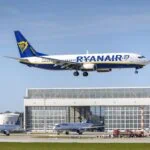
FMO’s route network is genuinely leisure-focused. The busiest routes by passenger numbers in 2023 were Palma de Mallorca, Antalya, and Munich, and the main scheduled carriers include Ryanair, Lufthansa, and Eurowings, alongside a range of charter operators serving Mediterranean beach destinations. There is little in the way of long-haul or year-round business-route traffic here.
Taxi ranks, car hire desks, and the airport’s own car parks all sit within a short walk of Arrivals, so nothing here involves a long trek before a transfer even begins. The sat-nav address is Airportallee 1, 48268 Greven, and the airport is reached from the A1 motorway via the dedicated Münster/Osnabrück Airport exit.
Best for a short trip. Compare rooms by neighbourhood, price and guest rating before you book.
Compare hotelsBest for families, or any stay past about four nights. A kitchen and a washing machine start paying for themselves.
Browse rentalsBest if you have already picked a hotel. Checks the big booking sites for the same room and shows who is cheapest.
Check dealsThe S50 and R51 Buses Into Münster City Centre
Unlike some of Germany’s regional airports, FMO has no railway station of its own, so the S50 and R51 bus lines are the main public transport link into Münster. Both are run as part of the regional network, with timetables published on rvm-online.de and at the airport’s own arrival information page. The stop for both lines sits directly outside Terminal 1 (Arrivals), a short walk from the exit doors and clearly signposted from the baggage hall, so there is no shuttle bus or separate building to find.
The S50 is the faster of the two, running roughly hourly through the daytime and stopping less often, while the R51 also runs roughly hourly but calls at more stops along the way. Because the two lines interleave for part of the day, a bus is generally available roughly every 30 minutes at busier times, rather than the hour’s wait a single line would give on its own.
The journey to Münster Hauptbahnhof takes around 25 to 35 minutes, reflecting the genuine 25-kilometre distance involved, with both lines terminating at the ZOB, the central bus station right beside the Hauptbahnhof’s main entrance, so arriving passengers are within a couple of minutes’ walk of the train platforms and the station taxi rank. A standard single ticket costs around €6.20 (£5.33/$7.25). Since these are ordinary regional bus services rather than a dedicated airport shuttle, the nationwide Deutschland-Ticket should also be valid on both lines, worth considering for anyone staying in Germany for a month or longer.
For late evenings and early mornings, a separate direct night bus (D50) runs roughly hourly between the terminal and Münster, taking around 25 minutes and filling the gap once the S50 and R51 have finished for the day. Tickets for the S50, R51 and D50 can all be bought directly from the driver when boarding, in cash or by card, or booked in advance through the BuBiM app, RVM’s own ticketing app for the WestfalenTarif zone these routes fall under, which also sells the Deutschland-Ticket and shows live departure times from the airport stop.
For solo travellers and couples with light luggage and a hotel near the Hauptbahnhof or the old town, the bus is the sensible default. Given the distance from FMO, though, it is worth checking the next departure time before heading down to the stop, rather than assuming one will be along within a few minutes.
Getting a Taxi or Ride-Hail Into Münster
There is no single taxi monopoly here: the airport’s own arrivals page lists seven separate local firms licensed to work the rank, rather than one dominant operator. Named partners include FMO Taxi Osterhaus, stationed at the terminal itself, alongside Taxi Massarczyk + Jacob, Das freundliche Taxi am FMO, Taxi Memmeler, and Premium Transfer Greven. Ranks are generally available outside the terminal buildings, though given how small FMO is compared with a major hub, it is worth calling ahead for very early or very late flights rather than assuming a queue of cars will be waiting.
Because the airport sits a genuine 25 kilometres from central Münster, fares run noticeably higher than at some of Germany’s closer regional airports. A typical journey into the city works out at somewhere in the region of €70-95 (£60.20-81.70/$81.90-111.15), with the exact fare depending on traffic, time of day, and the precise drop-off point.
Journey times generally run between 20 and 25 minutes via the A1 motorway in normal traffic, and rates rise slightly in the evening, overnight, and on Sundays and public holidays compared with the weekday daytime tariff. Given the distance, taxi apps such as FreeNow are worth checking too, since app-based booking uses the same regulated tariff as a metered taxi and lets you confirm a price before setting off.
For groups of four or five travelling together, a larger vehicle can usually be requested through a taxi firm, and given the distance involved, splitting the fare between several passengers often works out comparable to the cost of several separate bus tickets. Accessible vehicles can typically be requested when booking or calling ahead.
First-time visitors sometimes budget for FMO the way they would for a closer, city-edge airport, and that assumption almost always comes up short once the meter starts running. Given how far FMO genuinely sits from Münster, the taxi mainly earns its place over the bus for late-night arrivals, heavy luggage, or a straightforward preference for door-to-door convenience.
Booking a Private Transfer Into the City
Because FMO splits arrivals and departures across two separate terminal buildings, a pre-booked private transfer removes one specific headache that catches out first-time visitors here: knowing exactly where a driver is standing. A driver typically waits inside Terminal 1, arrivals, holding a name board, so there is no guesswork after a long charter flight into a terminal complex that looks unfamiliar on the way out.
Because the price is agreed before travel, there is no surprise if traffic on the A1 is heavier than expected, and no awkward moment watching a meter run during a longer-than-usual wait at the rank. Fixed-price private transfers to central Münster typically start from around €55 (£47.30/$64.35) for a standard car, reflecting the guaranteed pickup and the genuine 25-kilometre distance being covered.
Journey times are broadly similar to a taxi, usually around 20 to 25 minutes depending on traffic and the exact drop-off address. The real advantage is not speed but certainty, since families, business travellers, and anyone arriving with a lot of luggage tend to find the guaranteed pickup point worth the extra cost over a standard taxi, especially at an airport this far from town.
Most operators also offer larger vehicles for groups, and some can arrange transfers beyond Münster itself, including to Osnabrück or smaller Münsterland towns. This suits anyone continuing straight on from the airport without wanting to change transport again partway through the trip.
A private transfer is especially worth considering for very early departures or very late arrivals, when bus frequency drops right back and a small local taxi fleet may occasionally be stretched. As with any private transfer booking anywhere, it is always worth confirming a driver’s name and flight details in advance, and comparing a couple of providers rather than assuming the first result online is the best value.

Compare Airport Transfer Companies
Pre-booking your airport transfer can save time and reduce stress when you arrive. Whether you need a private taxi, shared shuttle or executive transfer, comparing providers can help you find the best price and service for your journey.
We’ve selected three trusted airport transfer companies so you can compare prices, vehicle options, cancellation policies and customer reviews before you travel.
Hiring a Car for the Münsterland Region
A hire car earns its keep at this particular airport more than at most, simply because the region it opens up, the flat, cycle-path-laced Münsterland countryside, is genuinely awkward to reach by bus or train. Rental desks include Avis and Sixt, alongside several smaller local operators, with counters located close to the arrivals terminal.
After collecting the keys, the rental car areas sit close to the terminal building, so there is no long shuttle transfer needed to reach the vehicle. Rates vary considerably by season, vehicle class, and how far in advance a booking is made, and pre-booking online rather than turning up on the day can bring a genuinely worthwhile saving.
A hire car is particularly useful here given how far FMO already sits from central Münster, and it comes into its own for reaching destinations that are awkward by public transport, such as the wider Münsterland countryside, the towns around Osnabrück, or a road trip further into North Rhine-Westphalia or across the nearby Dutch border via the A30.
Inside Münster itself, a car is rarely the best choice. The city is famous for its cycling culture and has a dense local bus network, parking in the centre can be limited and metered, and much of the old town around the Prinzipalmarkt favours walking and cycling over driving.
Hiring a car purely to reach the city centre and then leaving it parked outside a hotel for the whole stay rarely pays off in a city built as thoroughly around cycling and dense bus routes as Münster is. In that scenario, the S50 or R51 bus is both cheaper and less stressful, and the car ends up as a sunk cost, though the calculation shifts more in the car’s favour here than at closer German airports given the 25-kilometre distance involved.

Compare Car Hire Prices in Münster
If you are planning to explore beyond Münster, hiring a car can give you much more flexibility over where you go and how long you spend there.
Compare prices through Discover Cars and EconomyBookings to check vehicles, rental conditions and offers from multiple car hire companies before you book.
Driving Yourself: Routes, Drop-Off and Parking at Greven
Two motorways feed the terminal directly, which is worth knowing before typing an address into a sat-nav. Drivers coming from the south or east use the A1 motorway via the dedicated Münster/Osnabrück Airport exit, while anyone arriving from the Netherlands typically joins via the A30 motorway and the Ibbenbüren exit instead. Full directions are published on the airport’s official website. The sat-nav address is Airportallee 1, 48268 Greven.
Given the distance involved, the drive into central Münster typically takes around 25 to 30 minutes outside peak hours, with rush-hour traffic on the A1 being the main variable. Osnabrück is a broadly similar drive in the opposite direction.
Short-term drop-offs are possible in the dedicated short-stay area (P1) directly outside the terminal, with charges starting from around €3.50 (£3.01/$4.10) for the first 30 minutes, rising to around €6.00 (£5.16/$7.02) for up to an hour. Anyone staying longer, whether to help with luggage or wait for a delayed arrival, needs one of the longer-stay car parks instead.
FMO’s standard car parks (P2 to P4) charge around €3.00 (£2.58/$3.51) an hour, with daily rates typically running from around €29-34 (£24.94-29.24/$33.93-39.78) depending on which car park is used, while pre-booking a longer holiday stay online in advance through the airport’s EASY PARK system is generally cheaper than paying on the day.
Accessible spaces and a number of electric vehicle charging points are available across the car parks. For most city-centre visitors, driving is really only worth it for a drop-off or collection, since once actually in Münster, the local bus network and the city’s famously cycle-friendly streets will almost always be simpler than finding somewhere to park.
Onward Travel From Münster Hauptbahnhof (and Why Some Flyers Skip FMO)
Given FMO’s genuinely limited route network, it is worth being upfront that a significant number of visitors reach Münster without ever landing at the local airport. Larger hubs such as Dortmund Airport (DTM) and Düsseldorf Airport (DUS) offer far more direct European routes, and both connect onward to Münster by rail, making the train a genuinely practical alternative rather than a last resort.
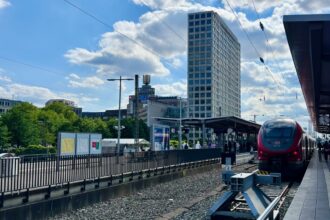
Münster’s own station, Münster (Westf) Hauptbahnhof, is a well-connected regional hub in its own right, handling around 65,000 passengers a day across nine platforms. Direct trains run to Osnabrück, Dortmund, Cologne, and Düsseldorf throughout the day, with further connections onward to Hamburg and Berlin. Full timetables are published on bahn.com.
Travellers flying into Dortmund Airport can take that airport’s own coach or shuttle service into Dortmund Hauptbahnhof, then a direct IC or Eurobahn train onward to Münster, a journey of around 29 minutes running roughly hourly. Our own Dortmund Airport Transfers guide, linked below, covers that first leg of the journey in full.
Travellers flying into Düsseldorf Airport can pick up a direct train from the airport’s own station to Münster, with the fastest services taking around 1 hour 19 minutes and the typical journey running closer to 1 hour 35 to 40 minutes depending on the connection. That single change-free option can be genuinely more relaxing than a short-hop flight into a small regional airport 25 kilometres outside the city.
Neither route suits everyone, and a direct flight into FMO still makes sense for anyone whose specific route is served there, or for leisure travellers heading to the Mediterranean rather than into Münster itself. For everyone else, though, it is worth genuinely comparing the total door-to-door time and cost of both options before assuming FMO is the obvious choice simply because it carries the city’s name.
Münster Hauptbahnhof’s own connections are worth setting out clearly for anyone planning a longer trip either side of the flight. The table below covers the fastest verified journey times from the station to the nearest major cities, whether that means changing airports partway through the trip or simply continuing onward by rail after landing at FMO.
| Mode | Destination | Journey Time | Direct? |
|---|---|---|---|
| Regional Train (RE) | Osnabrück | ~24 mins | Yes |
| ICE / IC Train | Dortmund | ~29 mins | Yes |
| ICE Train | Düsseldorf | ~1 hr 16 mins | Yes |
| IC / ICE Train | Cologne | ~1 hr 56 mins | Yes |
| ICE Train | Hannover | ~1 hr 36 mins | Yes |
| ICE Train | Hamburg | ~2 hrs 19 mins | Yes |
| ICE Train | Berlin | ~3 hrs 21 mins | Usually one change |
Best for finding routes the airlines do not sell as a single ticket. Combines carriers to bring the fare down.
Search flightsBest if you want maps and messaging working the moment you switch your phone on.
See eSIM plansBest if you would rather not work out the transport on arrival. Book it now and forget it.
View transfersWhich Münster Airport Transfer Option Is Best?
Working out the best Münster Airport transfer really starts one step earlier than at most cities, with the question of which airport to actually fly into. FMO’s distance from the centre and its narrow, leisure-heavy schedule mean the right transfer answer often gets decided before a flight is even booked.
For travellers who are genuinely flying into FMO, solo visitors and couples with light luggage heading to a hotel near the Hauptbahnhof or the old town should default to the S50 or R51 bus. It is simple, considerably cheaper than a taxi, and a realistic door-to-door estimate including the walk from Arrivals is usually around 35 to 45 minutes.
Families, late-night arrivals, and anyone carrying substantial luggage should lean toward a taxi or a pre-booked private transfer. Given how far FMO sits from town compared with airports like Bremen or Nuremberg, both options cost noticeably more here, so it is worth budgeting accordingly rather than assuming city-airport pricing.
Travellers planning to explore the Münsterland or the wider region towards Osnabrück should seriously consider car hire, since FMO’s distance from the centre already makes a car more appealing here than at some closer German hubs.
Finally, for anyone still choosing which airport to fly into in the first place, it is genuinely worth weighing FMO’s limited direct routes against flying into Dortmund or Düsseldorf and taking the train onward. Given how well connected Münster Hauptbahnhof is, that combination often works out just as convenient, and sometimes cheaper, than a direct flight to a small regional airport 25 kilometres outside the city.

Rupert’s Handy Travel Tips
Flying into Münster Osnabrück Airport, or thinking about it? Rupert has a few tips that can save both time and money:
- Check whether Dortmund or Düsseldorf actually serves your route better: FMO’s schedule is leisure-focused, so a flight into a bigger hub plus the train onward can genuinely beat a direct flight into FMO.
- Combine the S50 and R51 for a 30-minute frequency: neither line alone runs more than hourly, but together they give a bus roughly every half hour at busier times.
- Budget more for a taxi than you would at a closer German airport: FMO sits a genuine 25 kilometres from Münster, so fares typically run to €70-95 rather than the €20-30 seen at some city-edge airports.
- Double-check which terminal your driver is waiting at: FMO splits arrivals and departures across two separate terminal buildings, which catches out a surprising number of private transfer pickups.
- Book a private transfer for very early or late flights: bus frequency drops right back overnight, and a pre-booked driver avoids relying on a small local taxi fleet at an unusual hour.
- Consider car hire more seriously here than elsewhere: given the distance into town, a hire car makes more sense at FMO than at some of Germany’s closer city airports, especially for trips into the wider Münsterland.
Want to meet the reindeer behind our travel tips? Find out more in our page Who is Rupert?.




Frequently Asked Questions About Münster Airport Transfers
What is the fastest way to get from Münster Airport to the city centre?
The S50 bus is the fastest scheduled public transport option, reaching Münster Hauptbahnhof in around 25 to 35 minutes, though a taxi via the A1 can be similarly quick at around 20 to 25 minutes.
Does Münster Osnabrück Airport have its own train station?
No. FMO has no railway station of its own, so the S50 and R51 buses are the main public transport link into Münster Hauptbahnhof.
How far is FMO from Münster city centre?
Münster Osnabrück Airport is located approximately 25 kilometres (16 miles) north of central Münster, in the town of Greven, and around 35 kilometres south of Osnabrück.
What ticket do I need for the bus from FMO?
A standard single ticket for the S50 or R51 costs around €6.20 (£5.33/$7.25), and the nationwide Deutschland-Ticket should also be valid on both services.
Are taxis available at FMO?
Yes. Several local taxi firms serve the airport, with fares to central Münster typically €70-95 (£60.20-81.70/$81.90-111.15) given the airport’s distance from town.
Should I fly into FMO or a different airport for Münster?
It depends on the route. FMO suits travellers whose specific flight is served there, but many visitors find flying into Dortmund or Düsseldorf and taking the train onward works out just as convenient, given FMO’s limited leisure-focused schedule.
Is it worth hiring a car at FMO?
It can be, more so than at some closer German airports, since FMO sits a genuine 25 kilometres from town. Within Münster itself, the local bus network and the city’s cycling infrastructure are still usually simpler than driving.
Does FMO have separate arrivals and departures terminals?
Yes. FMO is split into Terminal 1 for arrivals and Terminal 2 for departures, which is worth checking before arranging a pickup point.
Further Reading & Related Guides
Once the transfer itself is sorted, our own Things to Do in Münster guide covers the Prinzipalmarkt, the Dom, the Aasee and the rest of the city in full, including the bicycle culture and the Kiepenkerlviertel’s restaurants. For anyone still deciding which airport to fly into, our Dortmund Airport Transfers guide covers the coach-based alternative into Münster discussed above in full.
If onward rail travel is part of the plan, our German Rail Tickets Explained guide breaks down the Deutschland-Ticket and regional fares that cover the S50 and R51, while our Interrail Germany Pass Guide explains when a country-specific pass beats buying tickets individually for a longer trip through North Rhine-Westphalia and beyond.