Reviewed by our editorial team Updated
Why Choose the North Macedonia Pass
The Interrail North Macedonia Pass is one of the most underrated rail passes in Europe. While it does not offer the high-speed prestige of countries such as France, Germany, or Italy, it delivers something many larger rail networks no longer provide: a slower, more authentic style of rail travel that feels deeply connected to the landscapes and communities it passes through.
For travellers exploring the Balkans, the pass offers an affordable and flexible way to experience a country that many visitors overlook entirely. North Macedonia sits in a strategically important position between Serbia, Greece, Kosovo, and Bulgaria, making it a useful link within wider regional rail adventures. Even though international services can sometimes be limited or seasonal, the domestic rail network still provides important connections to border regions and major population centres.
One of the biggest strengths of the pass is simplicity. Rail tickets in North Macedonia are relatively cheap already, but using the pass removes the need to repeatedly queue at stations, navigate local booking systems, or worry about changing plans at the last minute. Many stations remain traditional in style, with limited English signage and basic facilities, so having your travel already loaded into the Rail Planner app makes journeys considerably easier.
The pass also allows travellers to experience a side of Europe that still feels relatively untouched by mass tourism. The line between Skopje and Bitola passes through agricultural plains, mountain foothills, and smaller towns where daily life moves at a slower pace. Meanwhile, the route south towards Gevgelija follows sections of the dramatic Vardar River valley, creating some surprisingly scenic stretches of railway.
Culturally, the pass opens access to a fascinating mix of influences. North Macedonia blends Ottoman, Byzantine, Slavic, and Mediterranean heritage, and travelling by rail gives you a much more grounded sense of the country than flying or taking direct tourist transfers. Journeys feel local rather than commercialised, which is part of the appeal.
For travellers who enjoy slow travel, budget-friendly rail journeys, and the feeling of discovering somewhere still relatively under the radar, the Interrail North Macedonia Pass offers a rewarding and highly distinctive experience.
Quick Facts / Pass Overview
| Feature | Details |
|---|---|
| Pass Type | Mobile-only Interrail One Country Pass |
| Travel Validity | Flexible travel days within 1 month |
| Operators Included | Makedonski Železnici (MŽ) |
| Main Routes Covered | Skopje–Bitola, Skopje–Gevgelija, Skopje–Tabanovce |
| Reservations Required? | Rarely required on domestic services |
| Best For | Budget travellers, Balkan itineraries, slow travel |
| Not Included | Local buses, city transport; international trains to Belgrade/Thessaloniki (currently suspended for construction) |
| Delivery Format | Digital mobile pass via Rail Planner app |
The Interrail North Macedonia Pass is designed around flexibility rather than speed. The rail network itself is relatively compact compared to Western Europe, but it still covers the country’s most important domestic corridors and several key international gateways.
The pass is valid on trains operated by Makedonski Železnici (MŽ), the country’s state railway operator. Services include both regional and longer-distance domestic trains linking the capital Skopje with destinations such as Bitola, Prilep, Veles, Kumanovo, and Gevgelija near the Greek border.
Train frequency is lower than many travellers may be used to elsewhere in Europe. On some routes you may only find two or three departures per day, so careful planning pays off. However, services are generally reliable enough, and the slower pace becomes part of the overall experience rather than simply a drawback.
One major advantage is the lack of compulsory reservation fees. Unlike countries such as Spain, France, or Italy, most domestic trains in North Macedonia operate with open seating. This means you can travel more spontaneously, board trains without extra booking steps, and avoid the hidden costs that sometimes make Interrail less attractive in Western Europe.
The pass becomes especially useful when combined with wider Balkan travel. Domestic coverage extends to important border stations including Tabanovce towards Serbia and Gevgelija towards Greece, making it easy to connect onto broader regional itineraries.
Overall, the North Macedonia Pass is less about speed and luxury, and more about flexibility, simplicity, and experiencing one of Europe’s lesser-known rail networks in a more immersive way.
Browse hotels and accommodation for your visit to North Macedonia.
View staysExplore holiday homes and apartments around North Macedonia.
See holiday homesSee hotel prices from multiple booking sites in one search.
Compare ratesKey Operators and Rail Network Size
Rail travel in North Macedonia is operated almost entirely by Makedonski Železnici, commonly abbreviated to MŽ. Unlike larger European countries with a mixture of private companies, regional operators, and competing high-speed brands, the Macedonian rail system remains centrally managed and relatively straightforward. For Interrail users, this simplicity is actually a major advantage, because the pass works across the country’s entire active passenger network.
The rail network itself is modest in size, covering roughly 925 kilometres of track. Compared to major European rail nations this is extremely small, but the lines that do exist connect most of the country’s key urban centres and border corridors. The backbone of the system is the important north-to-south railway running from Tabanovce near the Serbian border through Kumanovo, Skopje, and Veles, before splitting southwards.
One branch heads towards Gevgelija at the Greek border, while the other runs southwest through Prilep to Bitola, one of the country’s most historically significant cities. These routes form the core of passenger rail travel in North Macedonia and handle the vast majority of domestic services.
There are also secondary lines stretching westwards towards Kičevo, although frequencies are lower and infrastructure is more basic. Historically, there were ambitions to expand stronger east-west international rail links towards Bulgaria and improve connectivity across the Balkans, but infrastructure modernisation has progressed slowly.
Train speeds remain relatively modest, typically averaging around 50 to 70 km/h, meaning buses are often faster for pure journey times. However, trains provide a more relaxed and scenic experience, particularly on rural stretches through river valleys, farming regions, and mountain foothills.
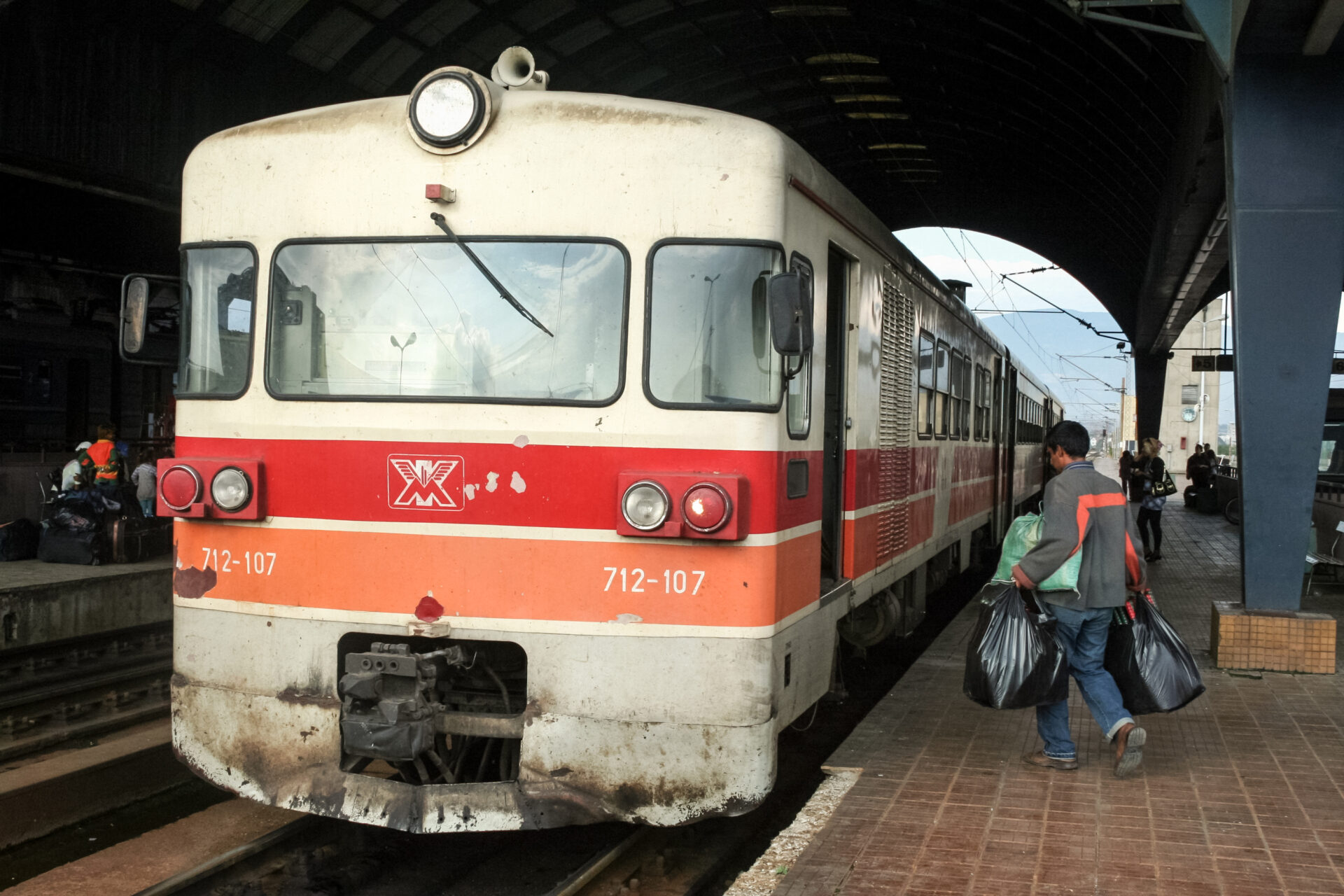
Rolling stock is a mixture of older Yugoslav-era equipment, Soviet-influenced locomotives, and a smaller number of refurbished or modernised units introduced in recent years. Comfort standards are basic but functional. Most trains offer standard second-class seating, while first class is limited and often unavailable on regional services.
Although the network is small, it delivers something many larger systems have lost: a genuine feeling of travelling through everyday local life rather than simply moving between tourist centres. That authenticity is one of the strongest arguments for exploring North Macedonia by rail.
Transport Hubs and Major Routes
The entire North Macedonian railway system revolves around Skopje, the country’s capital and largest transport hub. Nearly all major domestic rail services begin, end, or pass through the city, making it the natural starting point for most Interrail journeys within the country.
Skopje Railway Station handles domestic services towards Bitola, Gevgelija, Kumanovo, Tabanovce, and Kičevo, alongside occasional international connections depending on timetable availability. The station itself is functional rather than modern, but it remains the operational heart of the national network.
The country’s most important rail corridor is the north-south route running from the Serbian border at Tabanovce through Kumanovo, Skopje, and Veles. From Veles, the network divides into two main branches.
The southeastern branch heads towards Gevgelija, following sections of the scenic Vardar River valley before reaching the Greek border. This is one of the country’s most strategically important railway lines, historically linking North Macedonia with Thessaloniki and the wider Greek rail network.
The southwestern branch runs through Prilep to Bitola, offering one of the most scenic and culturally interesting journeys in the country. Travellers pass agricultural plains, vineyards, mountain scenery, and smaller towns that still retain strong Ottoman and Yugoslav influences.
Veles itself acts as a key junction point within the network. While relatively small, it plays an important operational role because it connects the southern and southwestern branches of the railway system.
Internationally, the two most important border gateways are Tabanovce for Serbia and Gevgelija for Greece. As of 2026, however, no international passenger trains are running from North Macedonia to Belgrade or Thessaloniki, due to ongoing construction works on the connecting lines in Serbia. Travellers relying on cross-border rail should always check current schedules before assuming a through service exists.
Although the network may appear limited compared to Central Europe, the major routes still allow travellers to explore the country’s most important regions while linking into wider Balkan itineraries. The system’s simplicity is actually one of its strengths, making route planning relatively straightforward for pass holders.
Example Ticket Prices vs Pass Value
One of the most important things to understand about the Interrail North Macedonia Pass is that domestic rail tickets in North Macedonia are already extremely cheap by European standards. Unlike countries such as Switzerland, France, or even Italy, this is not a destination where the pass automatically saves huge amounts of money on every journey.
For example, a standard second-class ticket from Skopje to Bitola typically costs around €5 to €6 (£4.50–£5.50 / $5.50–$6.50), despite covering more than 200 kilometres and taking roughly four hours. Journeys from Skopje to Gevgelija, close to the Greek border, often cost around €4 to €5 (£3.50–£4.50 / $4.50–$5.50), while shorter routes such as Skopje to Tabanovce near Serbia can cost less than €3 (£2.50 / $3.25).
At first glance, this can make buying separate tickets appear more economical than purchasing a pass. However, the true value of the pass lies elsewhere. The biggest advantage is flexibility. Instead of repeatedly buying tickets at stations, dealing with timetable uncertainty, or locking yourself into fixed plans, the pass allows you to travel spontaneously across the network whenever services are available.
This becomes especially valuable because station infrastructure in North Macedonia can be inconsistent. Some smaller stations have limited English signage, short opening hours, or older ticket systems. With the pass already loaded into the Rail Planner app, you avoid many of these logistical frustrations entirely.
The pass also becomes more attractive once international journeys enter the picture. Cross-border rail travel in the Balkans can involve multiple tickets, changing operators, and irregular schedules. Using the pass for domestic segments simplifies these journeys considerably, especially if you are linking into a wider Interrail Global Pass itinerary.
There is also a psychological advantage that many Interrail travellers appreciate. Once your pass is activated, you stop thinking about the cost of every individual journey. That freedom encourages more spontaneous stops, detours, and shorter regional trips that you might otherwise avoid if buying separate tickets each time.
Ultimately, the North Macedonia Pass is not about dramatically undercutting already cheap fares. Its real value comes from convenience, flexibility, and the ease of exploring the country without constantly worrying about local ticketing systems.

Interrail North Macedonia Pass Prices (Flexi Passes)
As of 2025, the Interrail North Macedonia Pass remains one of the cheapest and most accessible One Country Interrail Passes available anywhere in Europe. Pricing reflects the relatively small size of the national rail network, but that lower cost also makes the pass appealing for travellers exploring the Balkans on a tighter budget.
For younger travellers aged 12 to 27, the pass starts at around €46 (£40 / $50) for 3 travel days within one month. A 4-day pass costs roughly €57 (£50 / $62), while a 5-day pass rises to around €67 (£58 / $72). Travellers wanting more flexibility can choose a 6-day pass for approximately €77 (£67 / $83), while the largest standard option, offering 8 travel days, costs around €95 (£83 / $103).
Adult travellers aged 28 to 59 pay slightly more. Prices begin at approximately €51 (£44 / $55) for a 3-day pass, increasing to around €63 (£55 / $68) for 4 travel days and roughly €74 (£64 / $80) for 5 travel days. A 6-day adult pass usually costs about €85 (£74 / $92), while the full 8-day version comes in at approximately €104 (£90 / $112).
Senior travellers aged 60 and above benefit from discounted pricing similar to youth fares. A 3-day senior pass costs roughly €46 (£40 / $50), increasing to around €57 (£50 / $62) for 4 travel days, approximately €67 (£58 / $72) for 5 days, and about €77 (£67 / $83) for 6 travel days. The largest 8-day senior pass is normally priced at around €95 (£83 / $103).
Families also benefit from the Interrail system. Children aged 4 to 11 can travel free when accompanied by an adult pass holder, making the pass a potentially good-value option for slower family-focused Balkan itineraries.
For most travellers visiting North Macedonia specifically, the 3-day or 4-day pass is usually the most practical choice. The rail network is relatively compact, and many of the country’s main routes can comfortably be explored within a handful of longer travel days.
Longer pass durations become more useful for travellers combining domestic rail journeys with wider regional exploration towards Serbia, Greece, or other Balkan countries. They also work well for travellers who enjoy slower itineraries with multiple stopovers rather than simply travelling between major cities.
Although buying individual rail tickets in North Macedonia can sometimes appear cheaper on paper, the pass offers something harder to measure financially: flexibility, spontaneity, and the convenience of being able to travel without repeatedly navigating local ticket offices or changing plans around fixed bookings.
How the North Macedonia Pass Works
The Interrail North Macedonia Pass works entirely through the official Rail Planner app, meaning there is no physical paper pass to carry. Once purchased through Interrail.eu or another authorised reseller, the pass is delivered digitally and linked directly to your smartphone using an activation code.
The pass operates using a flexi-day system, which means you receive a set number of travel days to use within a one-month period. On each activated travel day, you can take unlimited journeys on participating Makedonski Železnici (MŽ) trains across the country. This system works particularly well in North Macedonia because train services are relatively infrequent, allowing travellers to concentrate longer journeys onto selected travel days while using non-travel days for sightseeing or local exploration.
Using the pass is straightforward. Before boarding, you simply open the Rail Planner app, activate your chosen travel day, and add the journey you plan to take. The app then generates a QR code which ticket inspectors scan on board the train. Because many Macedonian stations remain small and fairly traditional, the mobile system removes the stress of repeatedly buying paper tickets or dealing with limited station facilities.
One of the biggest advantages of using Interrail in North Macedonia is the lack of mandatory seat reservations. Most domestic trains operate with open seating, meaning you can simply board and sit wherever space is available. This creates a far more flexible experience than in countries where Interrail users face constant reservation fees and compulsory bookings.
The pass is also useful when combined with broader Balkan rail travel. Domestic coverage extends to important border stations such as Tabanovce towards Serbia and Gevgelija towards Greece, allowing travellers to combine the pass with onward international tickets or a wider Interrail Global Pass.
Although the railway network is relatively small, the pass system itself is simple, flexible, and easy to manage, making it ideal for travellers who want a more relaxed style of rail travel without complicated booking procedures.
Where You Can Travel with the North Macedonia Pass
The Interrail North Macedonia Pass covers the country’s entire active passenger rail network operated by Makedonski Železnici (MŽ). While the network is far smaller than those found in Central or Western Europe, it still connects the country’s key cities, regional centres, and international border corridors.
Almost all journeys begin in Skopje, the country’s capital and main railway hub. From here, travellers can head north towards Kumanovo and Tabanovce near the Serbian border, south through the Vardar River valley towards Gevgelija and the Greek frontier, or southwest towards Prilep and Bitola.
The Skopje to Bitola route is often considered the most rewarding domestic journey. The line passes through fertile agricultural plains, smaller market towns, vineyard regions, and mountain foothills before reaching Bitola, one of North Macedonia’s most historically important cities. The route feels distinctly local and provides a far more immersive experience than travelling by motorway coach.
The southern corridor towards Gevgelija is another important route covered by the pass. This line roughly follows the Vardar River and acts as North Macedonia’s main rail connection towards Greece. However, as of 2026 there is no through passenger service running onward to Thessaloniki, since construction works on the connecting lines have suspended international trains, so travellers heading into Greece currently need to arrange a bus onwards from Gevgelija.
The pass also covers smaller branch services such as the route towards Kičevo, offering access to quieter rural regions rarely visited by mainstream tourists. These slower branch lines provide an interesting glimpse into daily life across the country’s interior.
One important limitation is that the railway network does not directly reach Lake Ohrid, one of North Macedonia’s biggest tourist destinations. However, many travellers use the pass to reach Bitola or Kičevo before continuing onwards by bus.
Although coverage is relatively limited compared to larger countries, the pass still provides access to every major active passenger corridor in North Macedonia, making it an effective tool for exploring the country at a slower and more authentic pace.
Compare routes and fares for your journey to North Macedonia.
Compare flightsChoose an Airalo eSIM and arrange mobile data before you arrive.
Browse eSIMsCheck private pickup options and plan your onward journey before arrival.
View transfersHow to Buy the Interrail North Macedonia Pass
The easiest way to buy the Interrail North Macedonia Pass is online through the official Interrail.eu website. The pass is also available through authorised retailers such as Rail Europe and selected European rail agencies, but purchasing directly through Interrail is usually the simplest and most reliable option.
Because the pass is fully digital, there is no need for physical postage or station collection. After purchase, you receive an activation code which can be added directly into the Rail Planner app on your smartphone. This means you can buy the pass from anywhere in the world and have it ready for travel within minutes.
One major advantage of the Interrail system is flexibility before departure. The pass does not need to be activated immediately after purchase. In most cases, travellers have up to 11 months to begin using the pass, allowing you to secure pricing well in advance while keeping your travel dates relatively flexible.
Payment options typically include major debit cards, credit cards, PayPal, Apple Pay, and other online payment systems depending on your country. Prices are normally displayed in euros, though some resellers may offer local currency conversion during checkout.
Although it is technically possible to buy rail tickets locally within North Macedonia, relying on local station offices is not always ideal for international travellers. Some smaller stations have limited opening hours, basic facilities, or limited English-language support. Buying the pass online before arrival avoids these issues entirely and allows you to begin travelling immediately.
Once the pass is loaded into the app, all travel management happens digitally. You activate travel days directly from your phone, add journeys into your travel diary, and present the generated QR code when ticket inspectors arrive onboard.
For most travellers, purchasing online before arriving in North Macedonia is by far the most convenient and stress-free option.

Explore Europe by Train with Rail Passes
Travelling by train in Europe can quickly become expensive if you book individual tickets. Rail passes offer a flexible way to travel across one or multiple countries with a single ticket, making it easier to plan your journey.
Rail Europe allows you to compare and buy a wide range of rail passes, including Interrail-style options, helping you choose the best pass for your route and travel style.
Top Routes and Itineraries with the North Macedonia Pass
Although North Macedonia has a relatively compact rail network, the Interrail North Macedonia Pass still allows travellers to build several rewarding itineraries combining scenic journeys, historic towns, and international Balkan connections.
The country’s standout domestic journey is the route between Skopje and Bitola. This line takes around four hours and passes through agricultural landscapes, mountain scenery, vineyards, and smaller towns including Prilep, which is known for its Ottoman-era history and dramatic rocky surroundings. Bitola itself is one of the country’s most attractive cities, filled with neoclassical architecture, cafés, and traces of its former importance within the Ottoman Empire.
Another key route is the line south from Skopje to Gevgelija near the Greek border. Following stretches of the Vardar River valley, this journey combines practical transport value with scenic rural landscapes. Note that continuing onwards to Thessaloniki by rail is not currently possible, since international services on this corridor are suspended for construction works, so onward travel into Greece means switching to a bus at the border.
Travellers planning wider Balkan itineraries often use the northern route towards Tabanovce and the Serbian border. This line historically provided access towards Niš and Belgrade, but international passenger trains on this corridor are currently suspended due to construction works on the Serbian side, so onward travel to Serbia currently means a bus connection rather than a through train.
Shorter branch lines, including services towards Kičevo, offer slower and more rural experiences for travellers wanting to explore beyond the country’s main corridors. These routes are less about efficiency and more about experiencing local life and landscapes.
A practical itinerary for a shorter trip might involve spending several days in Skopje, taking the train to Bitola, returning north through Veles, then travelling south towards Gevgelija before continuing onwards into Greece. Travellers with more time can combine the rail network with buses to destinations such as Lake Ohrid or regional mountain areas.
The pass works best when approached as a tool for slow Balkan exploration rather than rapid point-to-point transport. Travellers who embrace the slower pace usually find the journeys themselves become part of the experience.
Seat Reservations and Supplements
One of the biggest advantages of using the Interrail North Macedonia Pass is the simplicity of the reservation system. Unlike many rail networks in Western Europe, where Interrail users often face expensive compulsory reservations, most trains in North Macedonia operate with completely open seating.
For the vast majority of domestic journeys, you simply activate your travel day in the Rail Planner app, board the train, find an available seat, and show your QR code when the conductor checks tickets. There are usually no additional reservation costs, no complicated booking systems, and no need to secure seats weeks in advance.
This flexibility is particularly useful because train frequencies in North Macedonia are relatively limited. If you decide to change your plans or take an earlier or later service, you can normally do so without penalty. That freedom creates a much more relaxed travel experience than in countries where every journey must be tightly scheduled around reservation quotas.
On busier services such as Skopje to Bitola or Skopje to Gevgelija, trains can become fairly full, especially during weekends or holiday periods, but overcrowding on the scale seen elsewhere in Europe is relatively uncommon. In practice, most travellers will still find seating without difficulty.
The main exceptions would involve international trains, but as of 2026 no such services are running towards Serbia or Greece, with construction works on the connecting lines suspending cross-border passenger traffic entirely. When international services do eventually resume, expect a small supplement or reservation fee, generally low compared to reservation-heavy countries such as France or Spain.
Travellers should also remember that onboard facilities are fairly basic. Most trains do not offer restaurant cars, premium seating, or modern entertainment systems. Bringing water, snacks, and a portable charger is strongly recommended, particularly on longer rural routes.
Overall, North Macedonia is one of the easiest Interrail countries for spontaneous rail travel. The lack of reservation complexity is a major part of the pass’s appeal.
Benefits of the North Macedonia Pass
The Interrail North Macedonia Pass offers a very different experience from the polished high-speed rail products found elsewhere in Europe, but for the right traveller that difference is exactly what makes it valuable.
One of the biggest benefits is affordability. This is one of the cheapest Interrail One Country Passes currently available, making it attractive for backpackers, younger travellers, and anyone building a lower-cost Balkan itinerary. Even though domestic tickets are already inexpensive, the pass still provides excellent convenience and predictable budgeting.
Flexibility is another major strength. Because reservations are rarely required, travellers can move around the country without constantly committing to fixed departure times. You can decide to stay longer in Skopje, make an unplanned stop in Prilep, or change your route entirely without worrying about wasted ticket costs.
The pass also works particularly well for travellers exploring multiple Balkan countries. North Macedonia sits between several important regional corridors, allowing easy onward travel towards Serbia and Greece. When combined with buses or a wider Interrail Global Pass, the country becomes a useful stepping stone within southeastern Europe.
Another major advantage is authenticity. North Macedonian trains are primarily used by locals rather than tourists, creating a much more grounded and genuine atmosphere than heavily touristed rail routes elsewhere in Europe. Travellers often find themselves sharing compartments with commuters, students, families, and regional travellers rather than organised tour groups.
Scenic value also plays an important role. Routes through the Vardar valley, agricultural plains, and mountain foothills provide a slower and more immersive way to experience the country’s landscapes. While buses are often faster, trains allow you to actually absorb the scenery rather than simply rushing through it.
Finally, the pass supports lower-impact travel. For environmentally conscious travellers, rail remains one of the most sustainable ways to move around the Balkans while still reaching many of the country’s key destinations.
For travellers seeking flexibility, local atmosphere, and slower-paced exploration, the benefits of the North Macedonia Pass go far beyond simple ticket savings.
Drawbacks and Limitations
While the Interrail North Macedonia Pass offers flexibility and affordability, it is important to understand its limitations before planning a trip entirely around rail travel.
The biggest drawback is the size of the railway network itself. North Macedonia has a relatively small passenger rail system, with fewer than 1,000 kilometres of active track. Compared to countries such as Germany, Austria, or even neighbouring Serbia, rail coverage is limited and many tourist destinations remain inaccessible directly by train.
One of the clearest examples is Lake Ohrid, arguably the country’s most famous tourist destination. There is no direct railway to Ohrid, meaning travellers must combine trains with regional buses or road transfers. Similar limitations apply to several mountain regions and smaller rural attractions across the country.
Train frequency is another challenge. On many routes, only two or three services operate each day. Missing a departure can mean waiting several hours for the next train, which requires more careful planning than travellers may expect from other European rail systems.
Journey speeds are also relatively slow. Average operating speeds often sit between 50 and 70 km/h, meaning buses frequently outperform trains for pure travel time. For example, the journey between Skopje and Bitola can take nearly four hours by rail despite the relatively short distance involved.
Infrastructure and onboard comfort can also feel dated. Rolling stock is often older, air conditioning may be inconsistent during summer, and onboard catering is generally unavailable. Travellers expecting modern Western European standards may find the experience basic.
International services are the clearest current limitation. As of 2026, no international passenger trains run between North Macedonia and either Belgrade or Thessaloniki, because of ongoing construction works on the connecting lines. Travellers planning onward Balkan travel should budget for a bus connection at the border rather than assuming a through train is running.
Finally, travellers making only one or two domestic rail journeys may find separate point-to-point tickets cheaper overall than buying the pass itself. The pass delivers its best value when used flexibly across multiple journeys or broader Balkan itineraries.
Who the Pass is Best For
The Interrail North Macedonia Pass is best suited to travellers who value flexibility, cultural immersion, and slower-paced exploration rather than high-speed convenience or luxury rail travel.
Backpackers and younger travellers are among the strongest target audiences for the pass. With relatively low pricing and strong youth discounts, it provides an affordable way to explore the Balkans without constantly purchasing individual tickets. The freedom to change plans spontaneously also fits naturally with backpacking-style travel.
The pass is also ideal for travellers who genuinely enjoy the journey itself. North Macedonian rail travel is not polished or glamorous, but it feels authentic. Trains pass through agricultural regions, smaller towns, and mountain landscapes rarely seen by mainstream tourists, offering a more grounded perspective on the country.
Slow travellers and cultural explorers often appreciate the pass most. Instead of rushing between attractions, rail travel encourages a steadier pace that allows time to experience local cafés, smaller stations, and everyday life. Sharing compartments with local passengers rather than large tourist groups creates a far more immersive atmosphere.
The pass also works well for experienced Interrail travellers building larger Balkan itineraries. North Macedonia connects naturally with routes towards Serbia and Greece, making it a useful regional link when combined with wider European rail travel.
Families can also benefit, particularly because children under 12 years old travel free with an accompanying adult pass holder. Although facilities are basic, trains generally offer more freedom of movement than long-distance buses, which can make journeys more comfortable for families travelling slowly through the region.
However, the pass is less suitable for travellers on very short city breaks or those focused purely on efficiency. If you only plan a single return journey between Skopje and another city, buying local tickets may be simpler and cheaper.
Ultimately, the North Macedonia Pass is best for travellers who see transport as part of the adventure itself rather than simply a way of reaching the next destination.
Compare hostels and budget-friendly accommodation around North Macedonia.
Browse hostelsGet help with compensation, eligible lounge access and disruption support.
Explore AirHelp+Leave your luggage somewhere convenient and enjoy North Macedonia hands-free.
View storageTips for Using the North Macedonia Pass
Travelling with the Interrail North Macedonia Pass is relatively straightforward, but a few practical tips can make the experience significantly smoother and more enjoyable.
The most important advice is to always check timetables carefully before travelling. Train frequencies in North Macedonia are far lower than in most of Western Europe, and many routes only operate a handful of services per day. Missing a departure between cities such as Skopje, Bitola, or Gevgelija can easily disrupt an entire day’s itinerary. While the Rail Planner app is useful, travellers should also double-check information through official MŽ timetable updates whenever possible.
It is also wise to arrive at stations early, especially in smaller towns. Many stations remain fairly traditional, with limited digital signage, minimal English-language information, and basic facilities. Giving yourself an extra 20 to 30 minutes before departure removes unnecessary stress and provides time to confirm platforms or carriage positions.
Comfort preparation matters more here than on many modern European rail networks. North Macedonian trains are functional rather than luxurious, and onboard facilities can be limited. Bringing water, snacks, a portable charger, and a light jacket for changing temperatures is strongly recommended, particularly on longer journeys through rural areas.
Travellers should also expect to combine rail and bus transport during their trip. The railway network does not reach every major destination, and some of the country’s biggest attractions require onward road connections. Lake Ohrid, for example, usually involves continuing by bus from Bitola, Kičevo, or Skopje. The pass still works well as the backbone for the longer rail sections of these itineraries.
Flexibility is one of the pass’s greatest strengths, so it helps to embrace a more relaxed travel mindset. Trains here are less about efficiency and more about the experience itself. Slower speeds, mountain scenery, local passengers, and quieter stations are all part of what makes rail travel in North Macedonia feel different from the heavily commercialised rail corridors elsewhere in Europe.
Finally, travellers planning onward Balkan travel should keep a close eye on international service updates. Cross-border trains towards Serbia and Greece can occasionally change, operate seasonally, or face infrastructure-related disruptions. Having backup bus options in mind is always sensible.
With realistic expectations and a flexible attitude, the North Macedonia Pass becomes an enjoyable and surprisingly rewarding way to explore one of southeastern Europe’s least explored rail networks.
Apps for Train Travel
The Interrail North Macedonia Pass works through the Rail Planner app, which is your essential tool for storing and activating your pass. It generates the QR code shown to inspectors and helps you keep track of your travel days. Once timetables are downloaded, it works offline, useful in rural areas with weak mobile coverage.
For local train information, the official Makedonski Železnici (MŽ) website and its mobile-friendly pages are worth checking. While not always perfectly updated, they usually provide the most reliable domestic timetables. Some independent apps, like Moovit or Google Maps, can also help identify stations and urban bus connections once you arrive.
If your journey continues into neighbouring countries, it’s wise to download the relevant operator apps too. For Serbia, the Srbija Voz app provides timetables and some booking options. For Greece, TrainOSE (Hellenic Train) offers similar coverage. This ensures smoother cross-border planning, since schedules can differ significantly once you leave North Macedonia.
Another handy tool is Entur, a European journey planner that increasingly covers Balkan services. While not perfect, it can show connections between trains and buses, helping you build itineraries that combine modes of transport.
Finally, don’t overlook general travel tools like Maps.me or Rome2Rio for identifying onward bus routes to places like Lake Ohrid, which are not connected by train.
Together, these apps make it easy to combine the pass with real-time information, ensuring that even in a country with modest infrastructure, you stay informed and flexible. With Rail Planner as your foundation and a few local apps for support, navigating North Macedonia by rail becomes much more straightforward.


App availability and prices vary by country. Some of these may not appear in your local App Store or Google Play.

Rupert’s Handy Travel Tips
I’ve explored North Macedonia’s rails a couple of times now, and here’s what I’d want you to know before you set off.
- Base yourself in Skopje: almost every domestic line starts, ends, or passes through the capital, so it makes the simplest hub for day trips to Bitola, Veles, or Gevgelija.
- Expect traditional stations: many are small and old-fashioned, with limited English signage and basic facilities, so build in extra time and don’t rely on finding staff who speak English.
- Pre-load your journeys in the Rail Planner app: download timetables before you travel, since mobile coverage can be patchy in rural areas and you’ll still need the app offline to show your QR code.
- Don’t count on international trains right now: there’s currently no passenger service running to Belgrade or Thessaloniki because of construction works on the connecting lines, so plan a bus for the border crossing instead.
- Pair rail with buses for onward Balkan travel: the railway doesn’t reach Lake Ohrid or several other highlights, so treat the train as the backbone of your trip and fill the gaps with regional buses.
Want to meet the reindeer behind our travel tips? Find out more in our page Who is Rupert?.


Frequently Asked Questions about the Interrail North Macedonia Pass
Do I need seat reservations on North Macedonian trains?
No. Almost all domestic trains operate with open seating. International services such as Skopje-Thessaloniki or Skopje-Belgrade would typically require a small reservation fee, but these routes are currently suspended due to construction works, so the question doesn’t arise for now.
Is Lake Ohrid accessible with the pass?
Not directly. The pass will take you as far as Bitola or Kičevo, from where you’ll need to continue by bus. Many travellers combine rail and bus to reach Ohrid.
Are trains reliable in North Macedonia?
Trains generally run as scheduled, but services are infrequent and sometimes subject to delays. Always check timetables in advance and allow flexibility.
Does the pass cover international journeys?
The pass is valid up to border stations like Tabanovce (towards Serbia) and Gevgelija (towards Greece). As of 2026, there are no international passenger trains running beyond these borders to Belgrade or Thessaloniki, due to construction works on the connecting lines, so onward travel currently means a bus rather than a train.
How long is the pass valid after purchase?
You must activate the pass within 11 months of purchase. Once activated, you have one month to use your chosen number of travel days.

Further Reading & Related App Guides
Want to plan your Balkan rail adventure with confidence? These related guides will help you explore, connect, and travel smarter across Europe. If North Macedonia is just one stop on a longer trip, our Main Interrail Pass Guide is the best place to start, since it explains how the wider Interrail system works and helps you compare which country passes, or a Global Pass, suit your route.
Once you’ve settled on a route, our Train Booking Apps Guide covers the tools worth having alongside Rail Planner for booking onward journeys, while the Ferry Booking & Tracker Apps Guide is handy if your Balkan itinerary stretches towards the Greek islands or the Adriatic coast.
For staying connected on the road, particularly useful given the patchy mobile coverage in some of North Macedonia’s rural stations, take a look at our eSIM Apps Guide. And once you’ve arrived somewhere like Skopje or Bitola, our Local Transport Apps Guide can help you get around beyond the railway, including the bus connections you’ll likely need for places like Lake Ohrid.