
Reviewed by our editorial team Published
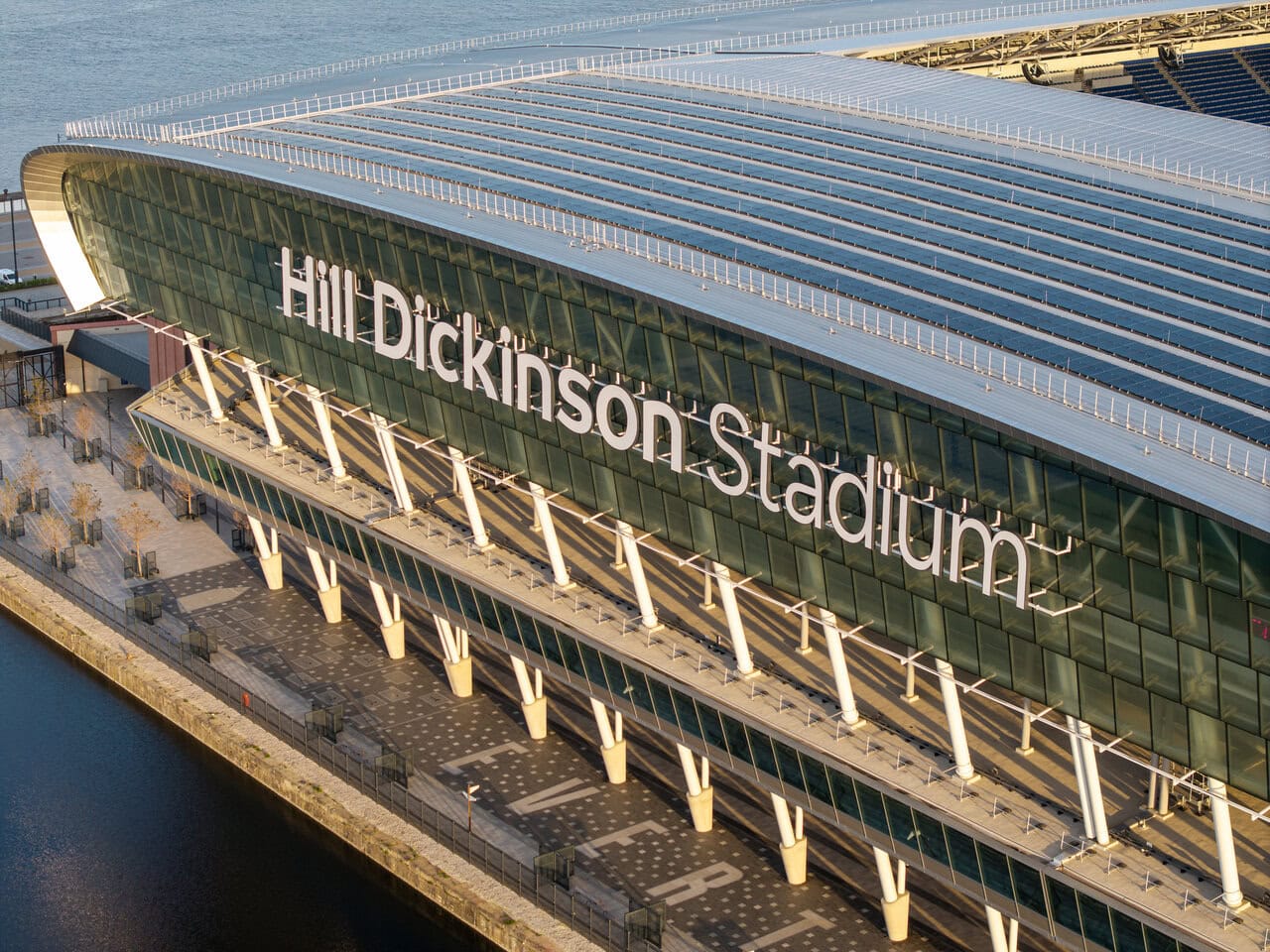
Everton Stadium sits on Liverpool’s northern waterfront at Bramley-Moore Dock, around two miles north of the city centre. The ground is now officially known as Hill Dickinson Stadium for club matches, while UEFA uses the neutral name Everton Stadium for EURO 2028. Its waterfront location makes it very different from Goodison Park, with supporters spread between Merseyrail, dedicated shuttle buses, city-centre walking routes and even special matchday ferries.
For EURO 2028, Liverpool will host five matches at Everton Stadium, including four group games and a Round of 16 fixture. This guide explains the most practical ways to reach the ground from Liverpool Lime Street, Liverpool ONE, Sandhills, the airport and other UK host cities, along with matchday buses, taxis, parking, accessibility and the best way to leave after the final whistle.
If this is your first visit to the city, our Liverpool Travel Guide covers the wider destination, while our Liverpool Airport Transfers Guide explains how to reach the centre from Liverpool John Lennon Airport.
Everton Stadium Transport at a Glance
| Option | Main Stop | Typical Final Leg | Best For |
|---|---|---|---|
| Merseyrail | Sandhills | About 15 to 20 minutes on foot | Most rail users |
| Alternative Merseyrail | Bank Hall | Walk to stadium | Avoiding Sandhills before kick-off |
| City-centre rail | Moorfields | Longer waterfront walk | Visitors staying centrally |
| 919 shuttle bus | Commutation Row | Short walk from Great Howard Street | Lime Street arrivals |
| 929 shuttle bus | Liverpool ONE | Short walk from Great Howard Street | Waterfront and city-centre hotels |
| Mersey Ferry | Pier Head | About 30 minutes on foot | Wirral visitors and scenic arrival |
| Accessible shuttle | Sandhills | Boundary Street, around 175m away | Pre-booked accessible travel |
Sandhills is the main rail station associated with Everton Stadium, but it is not the only option. Merseytravel specifically recommends considering Bank Hall and Moorfields on the way to the match, while Sandhills is the advised station for many post-match journeys because crowd management is designed around the heavier flow there.
The most useful current official source is Merseytravel’s Everton Hill Dickinson Stadium travel advice, which is updated as the transport plan evolves. For EURO 2028, check it again closer to your match because UEFA-specific arrangements may differ from ordinary Everton fixtures.
Using Sandhills Station
Sandhills is the most important Merseyrail station for Everton Stadium. It sits on the Northern Line north of Liverpool city centre and is served by trains towards Southport, Ormskirk, Headbolt Lane and the city-centre loop. The stadium is within walking distance, with the final approach taking roughly 15 to 20 minutes for most visitors.
On major matchdays, expect managed queues and controlled passenger flows. Merseytravel advises that crowd-management systems operate at Sandhills and Liverpool city-centre stations, particularly after the match when thousands of people are trying to reach the same platforms at once. Do not plan a tight onward connection from Lime Street based purely on the normal train journey time.
Current matchday planning uses 15-minute services on the main Merseyrail lines, with longer trains deployed where available. The precise timetable changes by fixture, engineering work and operational requirements, so use the live Merseyrail journey planner on the day rather than relying on a saved timetable.
Sandhills is also the starting point for Everton’s accessible shuttle service, which is covered later in this guide. That makes it particularly important for supporters who need to minimise the walking distance between the railway and stadium.
Browse hotels and accommodation for your visit to Liverpool.
View staysBrowse apartments, holiday homes and self-catering stays in Liverpool.
View rentalsCompare prices for Liverpool hotels across multiple booking sites.
Check dealsBank Hall and Moorfields as Alternatives
Bank Hall can be a useful alternative to Sandhills before a match, particularly if your train is already travelling north on the Merseyrail network. The walk is longer, but spreading supporters between stations can reduce the pressure on the busiest interchange and may be worthwhile if Sandhills is operating controlled queues.
Moorfields is the main city-centre alternative. It is further from the stadium, but the route north through the waterfront and docklands can work well for visitors staying in central Liverpool who would rather walk than make a short rail journey only to queue at the other end.
For fit visitors in good weather, walking from central Liverpool is a realistic matchday option. It also becomes surprisingly competitive after the game when thousands of passengers are queueing for Sandhills. The waterfront setting makes the route more interesting than a typical stadium walk, although the exposed dockside can feel much less pleasant in heavy rain or strong wind.
Getting to Everton Stadium from Liverpool Lime Street
Liverpool Lime Street is the main arrival station for long-distance rail passengers. Direct and connecting trains reach it from London, Manchester, Birmingham, Leeds, Sheffield, Newcastle, Scotland and many other parts of Britain, making it the natural gateway for EURO 2028 supporters arriving from another host city.
The easiest public transport route is normally to connect into Merseyrail. From the Lime Street area you can reach the underground Merseyrail network and travel towards Sandhills, or walk towards Moorfields and board there. On a normal day this is a straightforward city-centre transfer, but matchday crowd controls can add time.
A particularly useful alternative is the 919 matchday shuttle bus from Commutation Row, close to Lime Street. Under the current Everton transport plan, the 919 runs every ten minutes before and after first-team matches, dropping supporters on Great Howard Street for the short final walk to the ground.
Do not book a train home that leaves Lime Street immediately after full-time. Even if your map suggests a short transfer, exiting a 50,000-seat stadium, walking to the station or shuttle stop, queueing and crossing the city centre can all add substantial time.
Matchday Shuttle Buses
Everton’s current matchday transport plan includes four dedicated shuttle bus routes, giving visitors alternatives to the railway and city-centre walk. They start operating around three hours before kick-off, with return services beginning from roughly ten minutes after the final whistle.
| Route | Origin | Current Pattern | Useful For |
|---|---|---|---|
| 918 | Kirkby Bus Station | Timetabled | Kirkby and north-east Merseyside |
| 919 | Commutation Row | About every 10 minutes | Lime Street and city centre |
| 929 | Liverpool ONE Bus Station | About every 10 minutes | Waterfront and central hotels |
| 939 | Bootle Strand | Matchday service | Bootle and northern Liverpool |
The 919 and 929 are the most useful routes for many visitors. The 919 starts at Commutation Row near Lime Street, while the 929 starts at Liverpool ONE Bus Station. Both avoid the need to learn the local Merseyrail network if you simply want a dedicated event service from the centre.
EURO 2028 may use a modified version of this network. The existing shuttle system shows how Liverpool is already moving large stadium crowds, but exact route numbers, stops and frequencies should be rechecked once tournament-specific plans are published.
Regular Buses Near the Stadium
Regular Arriva and Stagecoach routes also serve the wider stadium area, including services along Stanley Road, Great Homer Street, Kirkdale Road and other corridors north of the city centre. These are more useful for local visitors than most first-time tourists, because matchday diversions can change the normal stopping pattern.
Current services in the wider area include routes such as the 20, 47, 52/52A, 53, 55, 310 and 345. Some other routes are diverted away from their normal roads on matchdays to avoid congestion around the stadium.
For most visitors staying centrally, the dedicated 919 or 929 shuttle is easier than trying to interpret a diverted local bus route. Regular buses become more useful if your hotel or accommodation sits directly on one of their corridors.
Taking the Mersey Ferry on Matchday
Everton Stadium is unusual in having a genuine ferry option as part of the matchday transport plan. Mersey Ferries operates special Cross River Shuttle services for Everton first-team fixtures, allowing supporters travelling from the Wirral to cross the Mersey before continuing on foot from the Pier Head.
The stadium is around a 30-minute walk from the Pier Head. That makes the ferry less direct than Sandhills or a dedicated shuttle bus, but it can be a memorable way to arrive and avoids some of the road congestion around the northern docklands.
If you are considering this route, our Mersey Ferries Liverpool Guide explains the river service in more detail. For EURO 2028, check whether special matchday sailings are operating for your fixture rather than assuming the ordinary tourist schedule will match kick-off times.
Travelling to Liverpool by Train for EURO 2028
Liverpool is exceptionally well connected to the other English EURO 2028 host cities. London and Birmingham sit on the West Coast Main Line corridor, Manchester is less than an hour away on many services, and cross-country connections make Liverpool reachable from Newcastle, Leeds, Sheffield and beyond.
Our West Coast Main Line Guide covers the main north-south corridor linking London, Birmingham, Liverpool, Manchester and Glasgow, while our TransPennine Line Guide explains the important east-west route through Liverpool and Manchester.
Manchester and Liverpool are close enough to combine during the tournament. Our Manchester to Liverpool Guide compares the train and coach options, particularly useful if you have fixtures at both Everton Stadium and Manchester City Stadium.
For wider planning, our UK Rail Guide explains ticket types, Railcards and operators. Overseas visitors following several matches should also compare ordinary fares with our BritRail Pass Guide and Interrail Great Britain Pass Guide.
Search flights and useful route combinations for your trip.
View flightsBrowse Airalo eSIM options for convenient travel data.
Check eSIMsCheck private pickup options and plan your onward journey before arrival.
View transfersUsing Seatfrog for Longer Rail Journeys
Seatfrog can be useful if you already hold an eligible ticket on a participating train operator. The app can offer First Class upgrades through auctions or fixed-price offers, which is particularly attractive on longer journeys to Liverpool from London, Birmingham, Glasgow or other distant cities.
Seatfrog does not replace your normal rail ticket or the local journey to the stadium. Think of it as an optional upgrade for the long-distance part of your trip, after which you still use Merseyrail, a shuttle bus or the city-centre walking route. Our Seatfrog App Review explains how the system works and which operators participate.
If your journey uses Avanti West Coast, flexible travellers should also look at Avanti Superfare. Our Avanti Superfare Guide explains how accepting a wider departure window can unlock lower fares on selected routes.
Using National Express to Reach Liverpool
National Express is worth comparing when train fares become expensive around major tournament dates. Liverpool has long-distance coach connections with London, Birmingham, Manchester and other UK cities, and coaches can remain affordable even when the cheapest Advance rail tickets have disappeared.
Our National Express App Review explains routes, Coachcards, mobile tickets and how the booking system works. For EURO 2028, the main compromise is journey time: coaches are usually cheaper than the fastest trains but can be much slower, particularly if motorway traffic is heavy.
Allow a large buffer if you are travelling to Liverpool by coach on matchday itself. A motorway delay is much harder to recover from than arriving the previous evening, and accommodation may be expensive enough during EURO 2028 that people are tempted to cut the timing too fine.
Getting to Everton Stadium from Liverpool John Lennon Airport
Liverpool John Lennon Airport is south of the city, while Everton Stadium is north of the centre, so there is no simple short airport-to-stadium transfer. For most visitors, the sensible approach is to travel into central Liverpool first and then continue by Merseyrail, shuttle bus or taxi.
The Arriva 500 is one of the main airport-to-city bus services, while Liverpool South Parkway provides rail connections after a local bus transfer. Our Liverpool Airport Transfers Guide compares these options in more detail.
If you are flying in for a EURO 2028 match, avoid scheduling a landing only a couple of hours before kick-off. Baggage collection, city-centre traffic, transport queues and stadium security can quickly consume what looks like a generous margin on paper.
Using Manchester Airport for Liverpool
Manchester Airport is another realistic gateway for Liverpool, particularly for international visitors who cannot find a convenient flight into Liverpool John Lennon Airport. The airport has its own railway station and rail connections towards Manchester and Liverpool.
Our Manchester Airport Trains Guide explains the rail station and onward options. Depending on the timetable, you may be able to travel towards Liverpool directly or change in Manchester before continuing west.
For a tournament trip involving both Manchester and Liverpool, flying through Manchester can be particularly useful. The two cities are close enough that you can build an itinerary around matches in both places without repeatedly changing hotels.
Taxis and Private Hire
Taxis and private-hire vehicles operate throughout Liverpool, but the final approach to Everton Stadium becomes less predictable around major events because road restrictions, pedestrian flows and congestion affect the waterfront roads.
A taxi can be useful before the match if you are travelling as a group or carrying luggage, but expect the driver to use a designated drop-off area rather than stopping directly beside your turnstile. After the match, walking away from the immediate stadium perimeter before requesting a private-hire vehicle can make pickup easier.
If your main priority is predictability, Merseyrail or a dedicated shuttle bus is normally safer than a car immediately after full-time. Taxi availability can fall sharply when tens of thousands of supporters all open the same ride-hailing apps at once.
Driving and Parking
Driving directly to Everton Stadium is not the easiest option on a major matchday. Liverpool City Council operates parking controls around the stadium area, while the dockside road network has to accommodate buses, emergency access, pedestrians and local traffic at the same time.
A better strategy is often to park away from the immediate stadium area. Current matchday planning includes parking around Liverpool city centre, Bootle Strand and Kirkby with onward shuttle buses, as well as park-and-ride options at stations across the Merseyrail network.
For EURO 2028, do not assume ordinary Everton parking arrangements will operate unchanged. Tournament organisers may introduce larger exclusion zones, pre-booked spectator parking or temporary park-and-ride sites. Check UEFA and local transport information once the specific match plan is released.
Compare hostels and budget-friendly accommodation around Liverpool.
Browse hostelsGet help with compensation, eligible lounge access and disruption support.
Explore AirHelp+Leave your luggage somewhere convenient and enjoy Liverpool hands-free.
View storageAccessible Travel to Everton Stadium
A free pre-booked accessible shuttle currently runs between Sandhills Station and Boundary Street, stopping around 175 metres from the stadium. This dramatically reduces the walking distance compared with using Sandhills and completing the whole route on foot.
The service must be booked in advance through Everton’s Accessibility Team. The 918, 919, 929 and 939 shuttle buses also use stops that can help visitors with reduced mobility, although individual accessibility requirements should be checked before travelling.
For EURO 2028, accessible transport arrangements may be expanded or reorganised. Anyone who relies on step-free access, wheelchair spaces or a dedicated shuttle should use the final UEFA accessibility information rather than assuming a normal Premier League setup will apply.
Leaving Everton Stadium After the Match
The biggest transport challenge comes after the final whistle. Around 50,000 spectators are leaving a waterfront site with a limited number of obvious corridors back towards the city, railway and shuttle stops, so patience and a flexible plan matter more than chasing the mathematically fastest route.
Merseytravel currently advises Sandhills for many post-match rail journeys, with controlled passenger flows used to regulate the platform load. Dedicated shuttle buses begin operating from around ten minutes after full-time and provide another useful way back towards Liverpool ONE, Lime Street, Bootle and Kirkby.
If the weather is reasonable, walking towards central Liverpool can be a smart alternative. By the time you reach the northern edge of the city centre, the heaviest station and bus queues may have eased, and you can continue to your hotel or Lime Street without being dependent on the first wave of post-match transport.
Leave a generous buffer before any pre-booked train or coach. Tournament matches can include added time and knockout fixtures may go to extra time and penalties, so a return booking based on a normal 90-minute finish is particularly risky during EURO 2028.
EURO 2028 Matches at Everton Stadium
Everton Stadium is scheduled to host five EURO 2028 fixtures. The current UEFA schedule gives Liverpool four group-stage matches followed by one Round of 16 game, making the city an important tournament base rather than a venue used only once or twice.
| Date | Stage | Fixture |
|---|---|---|
| 11 June 2028 | Group stage | D3 vs D4 |
| 14 June 2028 | Group stage | A2 vs A4 |
| 17 June 2028 | Group stage | E2 vs E4 |
| 20 June 2028 | Group stage | C2 vs C3 |
| 24 June 2028 | Round of 16 | Group A runners-up vs Group B runners-up |
The team identities will not be known until qualification and the final tournament draw are complete. Kick-off times for individual fixtures will also be confirmed later, so treat the dates as the firm planning anchor and wait before booking transport that depends on a specific finishing time.

Where to Stay for Everton Stadium
For most visitors, central Liverpool is a better base than trying to stay immediately beside the stadium. Hotels around Lime Street, Liverpool ONE, the waterfront and the Commercial District put you close to restaurants, attractions and several different transport options for matchday.
Staying near Lime Street is particularly useful for intercity rail travellers, while Liverpool ONE and the waterfront work well for visitors who want to use the 929 shuttle or combine the match with sightseeing around the docks.
Our Liverpool Travel Guide gives more detail on the city’s main areas and attractions. During EURO 2028, book accommodation well ahead because Liverpool has only five stadium dates but demand will also come from supporters using the city as a base for nearby Manchester matches.

Rupert’s Handy Travel Tips
Heading to Everton Stadium? Here are a few useful tips before you set off:
- Do not assume Sandhills is your only station: Bank Hall and Moorfields can be useful alternatives before the match, particularly when crowd controls are active.
- Use the dedicated shuttles: The 919 from Commutation Row and 929 from Liverpool ONE are especially useful for visitors staying in the city centre.
- Leave time after full-time: Sandhills uses crowd management and shuttle buses can queue, so avoid a tight train connection from Lime Street.
- Check Seatfrog for the long journey: If your rail operator participates, an upgrade can make a long trip to Liverpool much more comfortable without paying the normal First Class fare.
Want to meet the reindeer behind our travel tips? Find out more in our page Who is Rupert?.


Rupert’s Handy Travel Tips
Heading to Everton Stadium? These are the details most worth remembering before matchday:
- Do not rely on Sandhills alone: Bank Hall and Moorfields can be useful alternatives before a match when crowd controls are heavy.
- Know the shuttle numbers: the 919 from Commutation Row and 929 from Liverpool ONE are particularly useful for visitors staying centrally.
- Consider the ferry: special Mersey Ferry matchday services can create a memorable alternative if you are arriving from the Wirral.
- Leave extra time for Lime Street: the short distance on a map can be deceptive once stadium exits and managed queues are added.
- Recheck everything for EURO 2028: Liverpool already has a mature stadium transport plan, but tournament-specific routes and road restrictions may differ.
Want to meet the reindeer behind our travel tips? Find out more in our page Who is Rupert?.
Frequently Asked Questions
What is the closest railway station to Everton Stadium?
Sandhills is the main Merseyrail station used for the stadium and is around a 15 to 20-minute walk away. Bank Hall is another useful option before matches.
How do I get to Everton Stadium from Liverpool Lime Street?
You can connect into the Merseyrail network for Sandhills, walk to Moorfields and board there, or use the 919 matchday shuttle from Commutation Row near Lime Street.
Can I get a bus from Liverpool ONE to Everton Stadium?
Yes. The 929 matchday shuttle currently links Liverpool ONE Bus Station with the stadium area, making it one of the simplest options for visitors staying around the city centre or waterfront.
Can I take a ferry to an Everton match?
Special Mersey Ferry Cross River Shuttle services operate for selected Everton first-team fixtures. They arrive at the Pier Head, from where the stadium is around a 30-minute walk.
Will these transport arrangements be identical for EURO 2028?
Not necessarily. The current Everton matchday system is the best guide to how Liverpool moves stadium crowds, but UEFA tournament plans may alter shuttle routes, station management and road closures.
Further Reading
For tournament-wide planning, start with our EURO 2028 Travel Guide, which links Everton Stadium with every other venue and the main transport routes between them. If you are making a full weekend of the trip, our Liverpool Travel Guide covers the city’s main attractions and neighbourhoods, while the Liverpool Airport Transfers Guide is useful for flight arrivals and the Mersey Ferries Guide explains the river crossing that can also form part of the matchday transport plan.
Flying in? Read our Liverpool Airport Transfers Guide. If Manchester Airport offers a better flight, our Manchester Airport Trains Guide explains the rail connections, and our Manchester to Liverpool Guide is useful if your EURO 2028 itinerary includes both cities.
For the longer journey to Liverpool, our West Coast Main Line Guide, TransPennine Line Guide and UK Rail Guide explain the main routes and ticket choices. Our Seatfrog App Review can help with First Class upgrades, while the National Express App Review covers the main coach alternative.











