

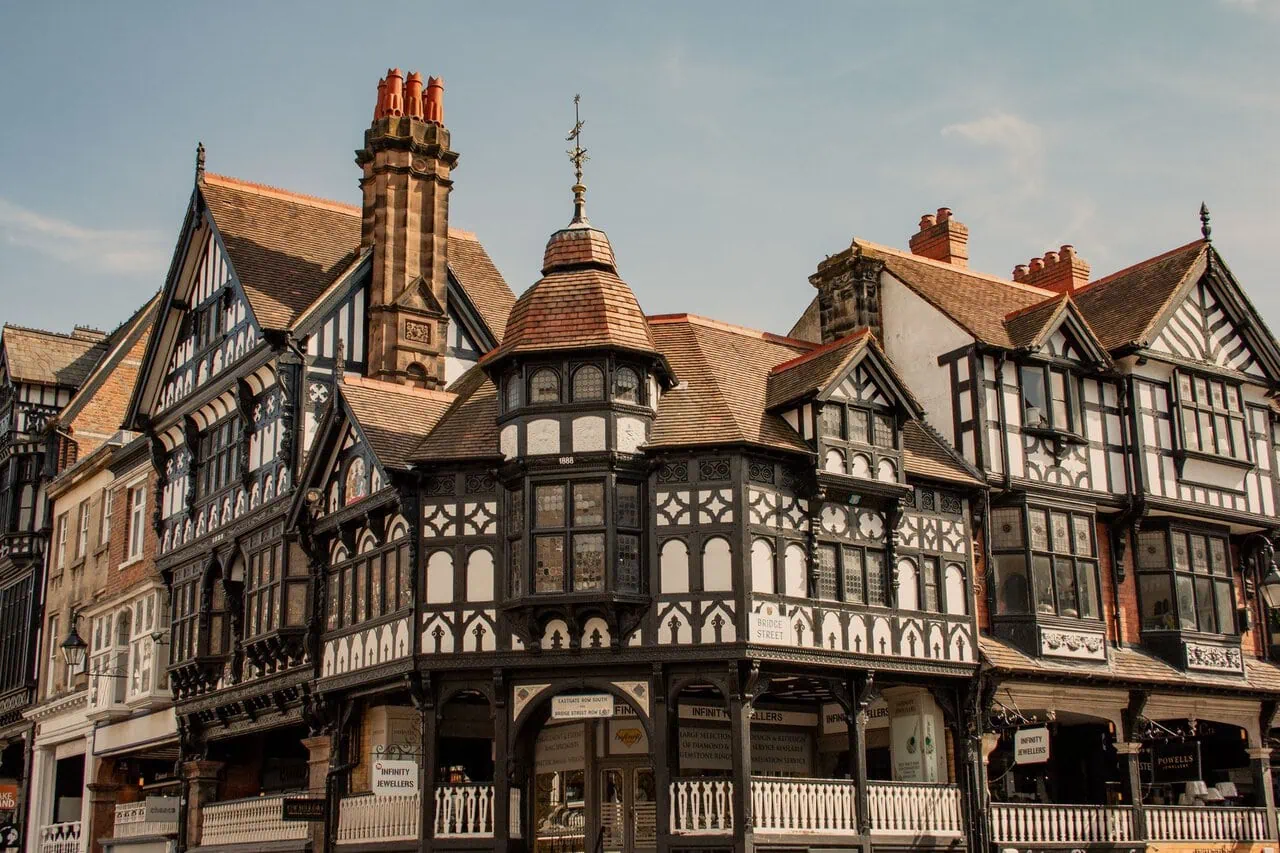
Best Things to Do in Chester
Chester is one of England’s most distinctive historic cities, combining Roman remains, medieval city walls, black-and-white architecture and an attractive riverside setting within a remarkably compact centre. It is the sort of city where simply walking between attractions becomes part of the sightseeing.
Its history stretches back almost 2,000 years. The Romans established the fortress of Deva Victrix here, and traces of Roman Chester remain throughout the modern city. You can see Britain’s largest known Roman amphitheatre, explore the Roman Gardens and encounter archaeological remains beneath buildings and streets.
Above ground, another layer of Chester’s history dominates the centre. The Chester City Walls form a circuit around the historic city, while the unusual two-level Chester Rows run through several of its principal shopping streets. Add Chester Cathedral, the Eastgate Clock and half-timbered buildings and there is an extraordinary amount of historic architecture concentrated into a relatively small area.
The River Dee provides a completely different side to the city. You can walk along The Groves, cross the historic Old Dee Bridge or take a sightseeing cruise along the river.
Further out, Chester Zoo is one of the biggest attractions in the region and can easily occupy an entire day, while the city’s museums, parks, market, racecourse and cultural venues provide plenty of reasons to stay for a weekend rather than visiting for only a few hours.
This guide covers the best things to do in Chester, including the major attractions, free places to visit and some of the easiest ways to explore the city.
| Attraction | Best For | How Long to Allow | Cost |
|---|---|---|---|
| Chester City Walls | History & city views | 1–2 hours | Free |
| Chester Rows | Historic architecture & shopping | 1–2 hours | Free to explore |
| Chester Cathedral | History & architecture | 45–90 minutes | Free to visit |
| Eastgate Clock | Iconic Chester landmark | 10–20 minutes | Free |
| Roman Amphitheatre & Gardens | Roman history | 30–60 minutes | Free |
| Grosvenor Museum | Roman & local history | 1–2 hours | Free |
| Hop-On Hop-Off Bus | First visits & easy sightseeing | 1–2 hours+ | Paid |
| River Dee Cruise | Relaxed sightseeing | Around 30 minutes+ | Paid |
| The Groves | Riverside walks | 30–60 minutes | Free |
| Chester Zoo | Families & wildlife | Full day | Paid |
| Chester Market | Food & independent traders | 1–2 hours | Free to enter |
| Grosvenor Park | Parks & families | 30–60 minutes | Free |
Walk Chester City Walls
If you do only one free activity in Chester, walk the city walls.
The walls form an elevated circuit around the historic centre and provide an unusually good way to understand Chester’s layout. Although their origins stretch back to the Roman fortress, the walls you see today reflect centuries of rebuilding, expansion and alteration rather than surviving as one untouched Roman structure.
You can join the walls at several points, so there is no requirement to begin at a particular entrance. If you have time, completing the entire circuit gives you views over different parts of Chester and brings you close to several attractions covered elsewhere in this guide.
One of the most recognisable sections passes beneath the Eastgate Clock, before the route continues around the historic centre. Elsewhere you’ll see the River Dee, Chester Racecourse and sections of the city that are much easier to appreciate from the elevated walkway than from street level.
The walls are particularly useful because they aren’t isolated from Chester’s other attractions. You can leave the circuit to visit the cathedral, Roman Amphitheatre, River Dee or city centre, then rejoin later if you don’t want to complete the walk continuously.
Allow roughly an hour for an uninterrupted circuit, but considerably longer if you’re stopping for photographs and attractions along the way.
The walls are free to walk, making them an excellent starting point for a first visit. We’d actually do them fairly early in the day: once you’ve seen Chester from above, the relationship between the Rows, cathedral, river, racecourse and Roman sites becomes much easier to understand.
Search accommodation
Browse hotels and accommodation for your journey.
View staysChoose a holiday rental
Browse apartments, homes and self-catering accommodation.
Browse rentalsCheck hotel deals
Compare prices from multiple hotel booking sites.
Check dealsExplore Chester on the Hop-On Hop-Off Bus
If you’d rather get your bearings before exploring on foot, the Chester City Sightseeing open-top bus provides a convenient circuit around many of the city’s major attractions.
The tour currently uses 13 stops, beginning at Chester Bus Interchange and travelling through the city via locations including Foregate Street, Chester Railway Station, St John’s Church, The Groves, Grosvenor Museum, Handbridge, Chester Racecourse and the Cathedral, Town Hall and Chester Market area.
That makes the bus particularly useful if you’re arriving by train. You can join at Chester Railway Station rather than walking into the centre first, then use the circuit as an introduction to the city.
Several of Chester’s biggest sights are accessible along the route. You can hop off for the Roman Amphitheatre, Chester Cathedral, Grosvenor Museum and Chester Castle, while the open upper deck provides views towards the River Dee and Chester Canal as you travel.
The bus also crosses the Dee using both the Grosvenor Bridge and Old Dee Bridge, so this isn’t simply a loop around the shopping streets.
One particularly useful stop is The Groves. From here you can explore Chester’s riverside or connect with cruises operated on the River Dee, making it possible to combine the sightseeing bus and a river trip without travelling back across the city.
Tickets in the product you’ve found are currently advertised from £10 per person, making this relatively inexpensive compared with sightseeing buses in many larger UK cities.
We wouldn’t say you need the bus to explore Chester. The historic centre is compact and extremely walkable. Where it becomes useful is for first-time visitors, families, anyone with limited time or visitors who want an overview before deciding where to spend longer.
Explore the Chester Rows
The Chester Rows are one of the features that make Chester genuinely different from other historic English cities.
Along sections of Watergate Street, Bridge Street, Eastgate Street and Northgate Street, shops and businesses operate on two levels, with covered walkways running above the shops at street level. Staircases lead up from the pavement, allowing you to walk along the elevated galleries and move between businesses above the street.
Their exact origins have been debated, but the Rows developed over many centuries and incorporate buildings from different periods. What you see today is therefore an unusual mixture of medieval structures, later alterations and Victorian restoration.
Don’t just photograph them from the opposite pavement. Go upstairs and actually walk along the Rows. From the elevated galleries you’ll notice details that are easy to miss from street level, including historic shopfronts, timberwork, passageways and views across the streets below.
The Rows remain part of the functioning city centre rather than being preserved purely as a visitor attraction. You’ll find shops, cafés, restaurants and other businesses occupying the buildings, which makes exploring them considerably more interesting than walking through a reconstructed historic quarter.
They are also completely free to explore, although how long you spend here will depend heavily on whether you’re interested in shopping.
For a good introduction, explore sections of Eastgate Street, Bridge Street and Watergate Street, then continue towards the cathedral or Eastgate Clock. Together with the city walls, the Rows are one of the experiences we’d consider essential on a first visit to Chester.
Visit Chester Cathedral
At the heart of the historic city, Chester Cathedral is one of Chester’s most important buildings, with a history stretching back many centuries.
The cathedral developed from the former Benedictine Abbey of St Werburgh, and the building visitors see today contains architecture from several different periods. That long development means you’ll encounter everything from medieval stonework and Gothic architecture to later additions and restoration.
Inside, take time to explore rather than simply looking down the nave and leaving. Among the most interesting features are the medieval choir stalls, cloisters and stained glass, while the former monastic buildings help reveal the cathedral’s earlier life as an abbey.
The cloisters are particularly worth finding. They surround a peaceful courtyard and provide a noticeable contrast to the busy shopping streets immediately outside.
Chester Cathedral also hosts concerts, exhibitions, services and special events, so what you can see may vary depending on when you visit. Some additional experiences can carry a charge even where general access to the cathedral is available without a standard admission ticket.
Its location makes the cathedral exceptionally easy to incorporate into a day in Chester. The Rows, Eastgate Clock, Town Hall and Chester Market are all nearby, while the city walls pass close to the cathedral precinct.
Even if churches aren’t normally high on your sightseeing list, we’d still go inside. The cathedral is an important part of understanding how Roman, medieval and modern Chester overlap within the same compact city centre.
See the Eastgate Clock
Few landmarks are more immediately associated with Chester than the Eastgate Clock, standing above Eastgate Street on the city walls.
The clock occupies the site of the eastern gateway into the Roman fortress, although the present structure belongs to a much later period in Chester’s history. The clock was created to commemorate Queen Victoria’s Diamond Jubilee and has since become one of the city’s most photographed landmarks.
You can see it from Eastgate Street below, but the better experience is to walk across Eastgate itself as part of the Chester City Walls circuit. This brings you directly beneath the clock and gives you an elevated view along one of the busiest streets in the historic centre.
From here, look down towards the Chester Rows on either side of Eastgate Street. It’s one of the best places to appreciate the unusual two-level arrangement of the city’s historic shopping streets.
The Eastgate Clock isn’t an attraction requiring a separate ticket or lengthy visit. Instead, it’s one of those landmarks that fits naturally into exploring Chester on foot.
Combine it with the Rows, cathedral and city walls, all of which are within a few minutes of one another.
And because you can walk directly beneath it for free, there’s little reason to visit Chester without seeing it.
Discover Roman Chester at the Amphitheatre
Modern Chester grew from the Roman fortress of Deva Victrix, and one of the clearest surviving reminders of that period is Chester Roman Amphitheatre.
The remains lie just outside the southeastern corner of the historic city centre, close to Newgate and St John’s Church. Only part of the structure has been excavated and exposed, but archaeological evidence indicates that the complete amphitheatre was considerably larger than the section visible today.
It is regarded as the largest known Roman amphitheatre in Britain, reflecting the importance of Roman Chester as a major military centre.
Don’t expect something resembling the almost-complete amphitheatres you might have visited elsewhere in Europe. Much of Chester’s structure remains beneath the surrounding modern city, so the surviving site requires a little imagination.
That said, its location makes it extremely easy to visit. You can leave the city walls around Newgate, explore the amphitheatre and then continue into the nearby Roman Gardens or towards the River Dee.
The Chester Hop-On Hop-Off bus also serves this part of the city, making the amphitheatre easy to incorporate if you’re using the sightseeing route.
The exposed remains are free to view, so even if Roman history isn’t the main reason for your visit, we’d still stop here. Together with the city walls and Roman Gardens, the amphitheatre provides an important reminder that the street plan of modern Chester sits directly over a Roman military city almost 2,000 years old.
Visit the Grosvenor Museum
For a deeper look at Chester’s past, the Grosvenor Museum brings together archaeology, local history, art and decorative collections in the city centre.
Roman Chester is naturally an important part of the museum. Archaeological finds help explain life in Deva Victrix, providing useful context for the amphitheatre, city walls and other Roman remains you’ll encounter while walking around Chester.
The museum isn’t limited to the Romans, though. Its collections explore later periods of Chester’s development and the wider history of the area, while the museum’s period rooms provide a different way of seeing how domestic life and interiors changed over time.
This makes the Grosvenor particularly useful if you’ve already explored the city outside. Objects that can seem fairly abstract in a museum make considerably more sense after you’ve walked the walls, stood beside the amphitheatre and explored Chester’s historic streets.
The museum is on Grosvenor Street, within walking distance of the Rows, Castle and River Dee. It’s also stop 8 on the Chester sightseeing bus route you’ve found, so visitors using the Hop-On Hop-Off bus can get off virtually beside it.
It’s a particularly useful option when the weather turns against you, and we’d allow at least an hour if you want to explore the collections properly rather than rushing through.
For anyone interested in understanding why Chester looks the way it does today, the Grosvenor Museum is one of the most useful stops in the city.
Walk Through Chester Roman Gardens
Immediately beside the Roman Amphitheatre, Chester Roman Gardens provide another easy way to explore the city’s Roman heritage.
The gardens contain a collection of Roman architectural fragments discovered at different archaeological sites around Chester, including columns and stonework associated with buildings that once stood within the Roman fortress of Deva Victrix.
Rather than thinking of the gardens as a reconstructed Roman settlement, treat them as an outdoor display of archaeological material recovered as the modern city developed. The landscaped setting helps give the remains more context than they would have sitting inside a museum case.
Their location is particularly useful. You can combine Chester Roman Amphitheatre → Roman Gardens → City Walls → River Dee without needing any transport between them.
The gardens also lead towards the riverside, making them a natural transition between exploring Roman Chester and walking down towards The Groves.
They’re free to enter, and you don’t need to allow a huge amount of time. Around 15–30 minutes is enough for most visitors, although anyone particularly interested in Roman history may want longer.
Combined with the Amphitheatre and Grosvenor Museum, the Roman Gardens help turn Chester’s Roman past into something much more tangible than simply reading that the city was founded by the Romans.
Take a Cruise on the River Dee
After spending several hours walking Chester’s historic streets, a River Dee cruise provides a much more relaxed way to see another side of the city.
Sightseeing boats depart from The Groves, Chester’s riverside promenade below the historic centre. From here, cruises travel along the Dee, giving you views of the riverbanks and surrounding landscape that you simply don’t get while exploring the city on foot.
A river cruise works particularly well in Chester because it adds something genuinely different to the city walls and open-top bus. Rather than duplicating the same streets from another vehicle, you’re leaving the historic centre behind and seeing Chester from the water.
The Groves is also stop 6 on the Hop-On Hop-Off bus route you’ve found, so combining the two is straightforward. The sightseeing bus operator specifically highlights the connection here with river cruises operated by Bithell’s Boats.
If you’re visiting during good weather, we’d consider doing the city walls in the morning and saving the river for later in the day. After several hours walking over cobbles, streets and walls, sitting on a boat for a while is particularly welcome.
Cruise schedules can vary seasonally and according to river conditions, so check departure times before building the rest of your day around a particular sailing.
Walk Along The Groves
You don’t have to board a boat to enjoy the River Dee. The Groves is Chester’s main riverside promenade and one of the nicest places in the city for an easy walk.
The promenade runs beside the river beneath the historic centre, with boats operating from the waterfront and views across the Dee. During warmer weather, this part of Chester has a noticeably different atmosphere from the narrow streets and historic buildings above.
It’s also an excellent place to build a break into a busy sightseeing day. After exploring the Roman Amphitheatre and Roman Gardens, you can continue down towards the river rather than immediately heading back into the shopping streets.
From The Groves, you can walk towards the Old Dee Bridge, continue alongside the river or simply stop for something to eat or drink before returning to the centre.
The sightseeing bus stops here as well, giving you the option of arriving by open-top bus, taking a river cruise and then continuing your tour afterwards.
For a completely free Chester experience, combine the city walls, Roman Amphitheatre, Roman Gardens and The Groves. Together they provide several hours of sightseeing without requiring an attraction ticket.
Keep accommodation costs down
Browse hostels and budget-friendly stays.
See hostelsBe ready for flight disruption
Get help with compensation, eligible lounge access and disruption support.
Explore AirHelp+Make the most of your spare hours
Leave your luggage somewhere convenient and explore hands-free.
View storageVisit Chester Zoo
For families in particular, Chester Zoo is one of the biggest reasons to visit the area.
This isn’t an attraction we’d try to squeeze into the end of a city-centre sightseeing day. Chester Zoo is extensive enough to justify most or all of a day, with animals and habitats spread across a large site north of the city centre.
The zoo is home to hundreds of animal species, ranging from elephants, big cats and primates to reptiles, birds and smaller endangered species. Conservation is a major part of its work, both within the zoo and through projects protecting wildlife and habitats elsewhere.
One of the strengths of Chester Zoo is the way different areas are organised into larger habitats and geographical themes rather than simply presenting an endless succession of traditional cages. There is also plenty to see indoors, although you’ll still spend a substantial amount of the day outside.
If you’re travelling with children, don’t underestimate how long you’ll need. Trying to see the zoo in two or three hours will mean rushing past a considerable amount of it.
The zoo sits outside Chester city centre, so you’ll need to plan transport separately rather than expecting to walk there as part of the historic-centre itinerary. Buses connect the city with the zoo, while driving is straightforward if you have a car.
For a weekend in Chester, we’d split things cleanly: one day for Chester itself and one day for Chester Zoo. That gives both the city and the zoo the time they deserve rather than sacrificing half of each.
Explore Chester Castle
At the southwestern edge of the historic centre, Chester Castle reveals another layer of the city’s long history, this time stretching from the Norman period through centuries of military and judicial use.
The original castle was established shortly after the Norman Conquest, although relatively little of that first fortress survives above ground. The most important medieval survival is the Agricola Tower, while the castle complex was substantially remodelled during later centuries.
One of its most interesting features is the 12th-century chapel of St Mary de Castro inside the Agricola Tower. Elsewhere, the castle’s later buildings demonstrate how the site continued to be used long after its medieval defensive role had diminished.
Chester Castle sits close to Grosvenor Museum, the city walls and Chester Racecourse, so it makes sense to explore these together rather than treating the castle as an isolated attraction.
Access to individual buildings can be more restricted than Chester’s permanently accessible outdoor attractions, so check current opening arrangements before visiting if seeing inside is important to you.
Even when access is limited, the castle is useful for understanding another period in Chester’s development. The city isn’t simply Roman and Tudor-looking streets: Norman, medieval, Georgian and Victorian Chester are layered across the same compact centre.
See What’s On at Storyhouse
For something completely different from Chester’s Roman remains and medieval buildings, Storyhouse is the city’s major contemporary cultural venue.
Located close to Chester Cathedral, Storyhouse combines a theatre, cinema, library and cultural spaces within the former Odeon cinema building and a modern extension.
What makes it useful for visitors is that you don’t necessarily need to have planned a theatre trip before arriving in Chester. The programme changes throughout the year and can include plays, musicals, comedy, films, family performances and festivals, so it’s worth checking what’s happening during your stay.
Storyhouse becomes particularly valuable if you’re staying overnight. Most of Chester’s historic attractions close by late afternoon or early evening, whereas a theatre or cinema performance gives you something substantial to do after dinner.
It’s also a good wet-weather option, especially if you’ve already visited the city’s museums and don’t fancy spending several hours walking the walls in heavy rain.
Because Storyhouse is right in the centre, you can easily combine an evening performance with Chester Market, the cathedral area or restaurants around the historic streets.

Visit St John the Baptist’s Church
Close to Chester’s Roman Amphitheatre stands St John the Baptist’s Church, a fascinating building that is easy to overlook when concentrating on the better-known cathedral.
St John’s has ancient origins and was once Chester’s cathedral, before that role eventually became associated with what is now Chester Cathedral.
The surviving church contains architecture from different periods, but one of the most intriguing parts lies outside. Behind the present building are the ruins of the medieval eastern chapels, creating an atmospheric collection of arches and stonework beside the city walls.
Look carefully among the ruins and you’ll find one of Chester’s stranger historical curiosities: a medieval coffin set high into the stonework, traditionally accompanied by the ominous inscription “Dust to Dust”.
The church’s location makes it extremely easy to include. The Roman Amphitheatre, Roman Gardens, city walls and River Dee are all close by, while St John’s is also one of the stops on the Hop-On Hop-Off bus route you’ve found.
We’d particularly recommend walking around the exterior rather than simply entering the church and leaving. The ruined eastern end is arguably the most memorable part of the site.
Relax in Grosvenor Park
Between Chester city centre and the River Dee, Grosvenor Park provides an attractive green break from sightseeing.
The Victorian park contains formal paths, lawns, mature trees and ornamental planting, with its location making it easy to incorporate while walking between the historic centre and riverside.
For families, the park provides somewhere children can have a little more freedom after spending time inside museums or historic buildings. During parts of the year, events and performances also take place within the park.
You don’t need to allocate several hours specifically to Grosvenor Park. Its real advantage is its position: it sits close to The Groves, St John’s Church and the Roman Amphitheatre, so you can simply walk through it as part of a wider route.
A particularly easy circuit is Roman Amphitheatre → St John’s Church → Grosvenor Park → The Groves → Old Dee Bridge. That takes you from Roman and medieval Chester into one of the city’s best green spaces before finishing beside the river.
Like many of Chester’s strongest central attractions, Grosvenor Park is free, making it another useful addition to a day that doesn’t need to revolve entirely around paid admission tickets.
Cross the Old Dee Bridge
At the southern edge of Chester’s historic centre, Old Dee Bridge is one of the city’s most attractive historic river crossings and an easy addition to a walk along The Groves.
A bridge has crossed the River Dee around this location for centuries, with the present medieval stone bridge incorporating seven arches. For a long period it provided the principal route into Chester from the south before newer crossings were constructed.
The bridge is still in use today, but its relatively narrow roadway and stone arches make it feel very different from Chester’s modern river crossings. Walking across also gives you excellent views along the Dee towards The Groves and the riverside.
Once across, you reach Handbridge, where you can turn back towards the city or continue exploring the southern side of the river. The Hop-On Hop-Off sightseeing route also crosses the Old Dee Bridge as it returns towards the historic centre.
Old Dee Bridge works particularly well as the end of a riverside walk. Follow The Groves towards the bridge, cross into Handbridge and look back towards Chester for one of the best river views of the city.
There’s no ticket and no need to make a special journey. It’s simply another piece of historic Chester that remains part of the functioning modern city.
Eat and Explore at Chester Market
For a break between historic attractions, head to Chester Market, part of the Northgate development close to the Town Hall and cathedral.
The modern market brings together independent food traders, bars, shops and other local businesses, making it considerably more useful to visitors than a market aimed primarily at everyday grocery shopping.
It’s particularly good for groups who can’t agree on where to eat. Rather than everyone choosing from one restaurant menu, you can order from different traders and meet back at the shared seating areas.
Its central location also makes it easy to incorporate without restructuring your sightseeing day. Chester Cathedral, Storyhouse, the Rows and city walls are all nearby, and the Hop-On Hop-Off route serves the Town Hall, Cathedral and New Market area.
We’d consider using the market for lunch rather than treating it as a standalone attraction. It gives you an opportunity to try an independent trader while staying right in the middle of the sightseeing area.
It can also be useful later in the day, particularly if you’re staying in Chester overnight and want something more informal than a conventional restaurant.
See Chester Racecourse and the Roodee
Immediately outside the western side of Chester’s walls lies Chester Racecourse, traditionally known as the Roodee.
Horse racing has taken place here since the 16th century, and Chester is widely associated with having Britain’s oldest racecourse still in operation. Its position is particularly unusual: rather than being located miles outside the city, the course sits directly beside the historic centre and the River Dee.
You get one of the best views while walking the city walls. From the elevated section above the racecourse, you can look across much of the course without attending a race meeting.
If racing is taking place during your visit, expect this part of Chester to become considerably busier. Race days attract large crowds into the city, affecting restaurants, bars, hotels and transport as well as the racecourse itself.
If you actually want to attend a meeting, check the racing calendar before booking your Chester trip rather than assuming racing takes place every weekend.
Even for visitors with no interest in horse racing, the Roodee is worth noticing because its history is closely connected with the River Dee. The land occupies an area that was once associated with the river before changes to the Dee’s course and silting altered the landscape.
The Hop-On Hop-Off bus also stops at the racecourse, so it’s easy to see this part of Chester without making a dedicated journey.
Explore Watergate Street and Bridge Street
Although the Chester Rows are an attraction in their own right, Watergate Street and Bridge Street deserve time at ground level as well.
These are among the historic streets radiating through the centre of Chester, lined with an extraordinary mixture of medieval structures, black-and-white revival buildings, historic shopfronts and the elevated Rows.
Bridge Street slopes south towards the River Dee and Old Dee Bridge, making it a natural route between the central shopping area and the riverside. Rather than taking the quickest route down, look above the modern shopfronts: much of Chester’s most interesting architecture is on the upper floors.
Watergate Street runs west towards the city walls and racecourse. Again, the attraction isn’t one particular building but the combination of historic architecture, elevated galleries, passageways and independent businesses.
Some of Chester’s apparently medieval black-and-white buildings are actually Victorian or later interpretations of earlier architectural styles, which is part of what makes the cityscape so interesting. Chester wasn’t frozen at the end of the Middle Ages; successive generations continually rebuilt and reimagined it.
We’d deliberately leave some unstructured time for these streets. Chester is a city where wandering is an attraction in itself, and rushing directly from the cathedral to the amphitheatre to the museum means missing much of what makes the centre distinctive.


Visit the Cheshire Military Museum
Inside the historic Chester Castle complex, the Cheshire Military Museum explores the stories of soldiers connected with Cheshire and the region’s military regiments.
The collections cover several centuries of military history, using uniforms, medals, weapons, photographs and personal objects to tell the stories of the people who served. Exhibitions range from earlier conflicts through the two World Wars and into more recent military history.
This is particularly worthwhile if you’re already exploring Chester Castle. Rather than making a separate journey, you can combine the museum with the castle, city walls, Grosvenor Museum and nearby racecourse.
It’s also a useful indoor attraction for a rainy day, especially for visitors who have already explored the Grosvenor Museum and want something more specialised.
Unlike many of Chester’s free outdoor historic sites, the Cheshire Military Museum normally has an admission charge, so check current prices and opening times before visiting.
You don’t need a particular interest in military equipment to get something from the museum. Much of its strength comes from connecting larger historical events with individual soldiers and local Cheshire communities.
Walk Along the Shropshire Union Canal
The River Dee receives most of the attention from visitors, but Chester also has another significant waterway running through the city: the Shropshire Union Canal.
The canal passes close to the northern side of the historic centre, providing a quieter walking route away from the busiest shopping streets. Its towpath allows you to follow the water past locks, bridges, narrowboats and sections of Chester’s historic landscape.
One of the easiest places to encounter the canal is around the northern city walls. This means you can leave the wall circuit, explore part of the towpath and then return towards the centre without needing transport.
The canal is particularly useful if you’ve already walked along the Dee and want a longer, flatter walk. You don’t need to follow it for miles; even a short section provides a noticeably different perspective on Chester.
Cyclists can also use appropriate sections of the wider canal corridor, although pedestrians and other towpath users need to share the relatively narrow space.
Best of all, walking the canal costs nothing, adding another option to Chester’s surprisingly long list of free activities.
Visit Blue Planet Aquarium
If you’re visiting Chester with children, Blue Planet Aquarium provides another substantial family attraction within easy reach of the city.
The aquarium is at Cheshire Oaks, near Ellesmere Port, so this isn’t somewhere to include while walking around Chester city centre. It works better as a separate half-day attraction or as part of a wider day outside Chester.
Inside you’ll encounter marine and freshwater species from different habitats, but the aquarium is particularly known for its sharks and underwater viewing areas. Walking through the aquarium’s underwater tunnel gives you the chance to watch marine life swimming above and around you.
Because most of the attraction is indoors, Blue Planet becomes especially useful when you’re visiting Cheshire during wet or cold weather and don’t want to build the entire day around outdoor attractions.
Families deciding between this and Chester Zoo should think about how much time they have. Chester Zoo deserves most of a day, whereas Blue Planet can be easier to combine with something else nearby.
And there is an obvious option immediately next door: Cheshire Oaks Designer Outlet. If different members of the family have very different ideas about how they’d like to spend an afternoon, the two attractions can make a convenient combination.


Explore Ness Botanic Gardens
Across the Wirral Peninsula from Chester, Ness Botanic Gardens provides a quieter alternative to the city’s museums and historic attractions.
The gardens overlook the Dee Estuary and contain a substantial collection of plants spread across landscaped grounds. Different areas provide colour throughout the seasons, so this isn’t solely a spring or summer attraction.
Rather than formal gardens surrounding a grand country house, Ness is primarily about the plant collections and landscape itself. Paths lead through different garden areas, lawns and viewpoints, making this somewhere to explore gradually rather than rushing between individual exhibits.
Its position above the Dee Estuary is another reason to visit, particularly when visibility is good.
Ness is outside Chester, so we’d only include it if you have more than one day in the area or your own transport. For a first one-day visit, there is more than enough to see within Chester itself.
For a weekend, however, it provides a useful contrast. After a first day dominated by Roman ruins, medieval walls and busy historic streets, several hours wandering around botanical gardens can make for a much slower second day.
Shop at Cheshire Oaks Designer Outlet
If shopping is part of your trip, Cheshire Oaks Designer Outlet is one of the largest shopping destinations within easy reach of Chester.
Located near Ellesmere Port, the outlet brings together more than 140 stores, with a mixture of designer, fashion, sportswear, beauty and lifestyle brands. The main attraction is the outlet format, with products generally offered below their original recommended retail prices.
This isn’t somewhere we’d recommend sacrificing several hours of a first visit to historic Chester for unless you specifically enjoy shopping. However, it becomes much more practical during a weekend or longer stay, particularly if you’re travelling by car.
Families can also combine Cheshire Oaks with Blue Planet Aquarium, which is immediately nearby. That makes the area useful when some members of the group want to shop while others would rather spend their time looking at sharks.
There are restaurants and cafés around the outlet, so it’s easy to turn the visit into a half-day rather than simply stopping for an hour.
If your priority is independent shopping and a more distinctly Chester experience, spend your time around the Rows and Chester Market instead. Cheshire Oaks is the better option when you’re specifically looking for major brands and outlet shopping.
Best Things to Do in Chester With Children
Chester is particularly good for families because you can combine major paid attractions with plenty of free things to see in the city centre.
The obvious big day out is Chester Zoo. We’d dedicate most of a day to it rather than attempting to combine the zoo with several central Chester attractions.
Within the city itself, walking the Chester City Walls can turn sightseeing into more of an adventure for children, while the Roman Amphitheatre and Roman Gardens provide an opportunity to introduce Chester’s Roman history without spending hours inside a museum.
The Hop-On Hop-Off bus is another useful family option. Children get the novelty of travelling on an open-top double-decker while adults get a sightseeing tour connecting many of Chester’s major attractions.
Head down to The Groves and you can add a River Dee cruise, or simply walk beside the river and continue towards Grosvenor Park and Old Dee Bridge.
For a wet-weather day, consider the Grosvenor Museum, Storyhouse or Cheshire Military Museum. Blue Planet Aquarium provides a much larger indoor attraction if you’re prepared to travel outside Chester.
With younger children, don’t attempt to cover every historical attraction simply because they’re close together. Walls → open-top bus → river → park can make for a much more enjoyable family day than trying to visit six museums and churches.
Best Free Things to Do in Chester
Chester is unusually good for free sightseeing, largely because many of its defining attractions are part of the historic city itself.
Start with the Chester City Walls. Walking the circuit gives you views across the centre, River Dee and racecourse while taking you directly past several other attractions.
You can then explore the Chester Rows, walk beneath the Eastgate Clock and continue towards the Roman Amphitheatre and Roman Gardens without buying an admission ticket.
For another side of the city, head down to The Groves and River Dee, cross Old Dee Bridge and spend some time in Grosvenor Park.
You can also walk beside the Shropshire Union Canal, explore Chester’s historic streets and see Chester Racecourse from the city walls without attending a race meeting.
The result is that you can spend almost an entire day seeing some of Chester’s most recognisable sights for very little money.
If we were putting together a free walking day, we’d use City Walls → Eastgate Clock → Rows → Roman Amphitheatre → Roman Gardens → Grosvenor Park → The Groves → Old Dee Bridge as the backbone of the route.
Things to Do in Chester When It Rains
Chester is at its best when you can wander between its historic streets and city walls, but rain doesn’t have to ruin the day. There are enough indoor attractions in and around the centre to put together a good wet-weather itinerary.
Start with the Grosvenor Museum, where the collections cover Roman Chester, local history, art and decorative objects. It’s particularly useful on a rainy day because you can spend considerably longer here than you might during good weather, while also learning more about many of the Roman and historic sites you’ll see around the city.
The Cheshire Military Museum provides another indoor option, particularly if you’re interested in military and regimental history. As it’s within the Chester Castle complex, you can combine the two whenever access arrangements allow.
Chester Cathedral is another obvious place to escape the weather and deserves time inside regardless of the forecast. Explore the medieval choir stalls, cloisters and architecture rather than treating it simply as somewhere to shelter from a shower.
Nearby, Storyhouse combines a cinema, theatre, library and cultural spaces. Check the programme during your visit and you may be able to turn a particularly wet afternoon into a film, performance or other event.
For lunch, Chester Market is especially useful in poor weather. Its indoor food hall brings together numerous independent traders and gives you somewhere to eat without committing to a conventional sit-down restaurant.
The Chester Rows also come into their own during unsettled weather. Their historic covered upper-level walkways provide some protection while you’re exploring shops, cafés and businesses in the centre, although you’ll still need to venture outside between different sections.
If you’re travelling with children and don’t mind leaving Chester, Blue Planet Aquarium near Cheshire Oaks provides a much larger indoor attraction and can occupy a substantial part of the day.
And don’t automatically abandon the city walls because of a brief shower. Chester’s weather can change quickly, so we’d use the museum, cathedral, market and Rows strategically, then return to the walls, Roman sites and River Dee whenever conditions improve.
Things to Do in Chester at Night
Chester doesn’t stop being interesting when its museums and historic attractions close. In fact, the city centre becomes particularly atmospheric after dark, when the crowds thin and many of its historic buildings are illuminated.
For an evening performance, check what’s on at Storyhouse. Its programme includes theatre, cinema, comedy, music and other live events, making it one of the easiest ways to build an evening around something other than eating and drinking.
Chester also has plenty of historic pubs, bars and restaurants tucked into the Rows and surrounding streets. Exploring the centre after dark gives you a very different impression from the busy daytime shopping streets.
The River Dee is another option during the lighter months. An evening walk around The Groves and Old Dee Bridge can be particularly pleasant before heading back into the centre for dinner.
Race days create a completely different atmosphere. When there’s a meeting at Chester Racecourse, the city centre becomes considerably busier into the evening, so book restaurants and accommodation early if your visit coincides with a major fixture.
We’d also walk through Eastgate Street after dark to see the Eastgate Clock and surrounding historic architecture illuminated. You don’t need a formal nighttime attraction to enjoy Chester — much of the appeal comes from simply seeing the historic centre after the day-trippers have gone home.


How Long Do You Need in Chester?
You can see many of Chester’s headline attractions in one full day, but we’d choose two days if this is your first visit and you don’t want to rush.
With half a day, concentrate entirely on the historic centre. Walk part of the city walls, see the Eastgate Clock and Rows, visit the Roman Amphitheatre and finish beside the River Dee.
With one full day, you can complete the city walls, explore Chester Cathedral, visit the Grosvenor Museum and Roman sites, walk along The Groves and still have time for either the Hop-On Hop-Off bus or a River Dee cruise.
A two-day visit gives Chester much more room to breathe. Use the first day for the historic city and dedicate the second to Chester Zoo, which deserves considerably more than a rushed afternoon.
With three days, you can start looking beyond the city. Blue Planet Aquarium, Ness Botanic Gardens and Cheshire Oaks are all possible additions, depending on your interests.
For most first-time visitors, we’d recommend a weekend in Chester. The centre is compact, but there is enough to see that trying to tick everything off in a few hours rather defeats the point of visiting such a walkable historic city.
Plan Your Chester Sightseeing Route
Chester is compact enough that you don’t need an elaborate itinerary, but exploring attractions in a sensible order will prevent unnecessary backtracking.
A good starting point is the Eastgate Clock. From there, explore the Rows before heading towards Chester Cathedral and the surrounding historic streets.
You can then join the city walls and follow them towards Newgate, leaving the walls to explore the Roman Amphitheatre, St John’s Church and Roman Gardens.
From the Roman Gardens, continue downhill towards Grosvenor Park and The Groves. This is a good point to take a River Dee cruise if you’re planning one, or simply follow the waterfront towards Old Dee Bridge.
From the river, work back towards Grosvenor Museum and Chester Castle, before continuing along the walls towards Chester Racecourse and Watergate Street.
The Hop-On Hop-Off bus gives you another option. You could ride a complete circuit early in the day to understand the layout, then use individual stops to move between areas later.
The important thing is not to over-plan. Chester is one of those places where historic buildings, Rows, passageways and unexpected views are part of the attraction, so leave some time simply to wander.

Rupert’s Handy Travel Tips
Heading to Chester? Here are a few useful tips to help you make the most of your visit:
- Walk the walls early: The city walls are one of the best ways to understand Chester’s layout and will help you spot several places you’ll want to return to later.
- Don’t stay at street level: When exploring the centre, remember to climb the stairs and walk along the Chester Rows. They’re one of the features that make the city genuinely unusual.
- Group the Roman attractions together: The Amphitheatre, Roman Gardens and Grosvenor Museum can easily be incorporated into the same part of your sightseeing day.
- Leave time for the river: The Groves, Old Dee Bridge and River Dee provide a welcome change after several hours exploring historic streets. You can also take a sightseeing cruise from The Groves.
- Give Chester Zoo its own day: If you’re staying for a weekend, don’t try to squeeze the zoo into the end of your city sightseeing. It’s large enough to justify most or all of a separate day.
Want to meet the reindeer behind our travel tips? Find out more in our page Who is Rupert?.
Frequently Asked Questions
What are the best things to do in Chester?
For a first visit, we’d prioritise walking Chester City Walls, exploring the Chester Rows, visiting Chester Cathedral, seeing the Eastgate Clock and discovering the city’s Roman history. Leave time for the River Dee as well, either walking along The Groves or taking a sightseeing cruise.
Is Chester worth visiting?
Yes. Chester packs an unusual amount of history into a compact centre, with Roman remains, medieval walls, the two-level Rows, historic streets and the River Dee all within walking distance. It works particularly well for a day trip or weekend.
Can you walk around Chester easily?
Yes. Chester is an extremely walkable city, and most of its central attractions are close together. The Hop-On Hop-Off bus is useful if you want an overview or don’t want to walk as much, but you don’t need it to explore the historic centre.
How long does it take to walk Chester City Walls?
Allow around an hour for the complete circuit if you’re walking continuously. We’d allow considerably longer because you’ll probably stop for photographs and leave the walls to explore attractions along the route.
Are Chester City Walls free?
Yes. Walking Chester City Walls is free, making it one of the best things to do in the city if you’re visiting on a budget.
What are the Chester Rows?
The Chester Rows are historic two-level shopping galleries found along several streets in the city centre. Shops and businesses occupy both street level and elevated covered walkways reached by steps from the pavement.
What Roman attractions can you see in Chester?
Chester’s Roman attractions include the Roman Amphitheatre, Roman Gardens and archaeological collections at the Grosvenor Museum. The city walls also have Roman origins, although the surviving walls reflect many later periods of rebuilding.
Is Chester Cathedral worth visiting?
Yes. Chester Cathedral developed from the former Benedictine Abbey of St Werburgh and contains medieval architecture, choir stalls, cloisters and later additions. Its central location makes it very easy to include in a sightseeing day.
Can you take a boat trip in Chester?
Yes. River Dee sightseeing cruises depart from The Groves, providing a relaxing alternative to exploring entirely on foot.
Is Chester Zoo in the city centre?
No. Chester Zoo is north of the city centre and requires a separate journey. We’d normally dedicate most or all of a day to the zoo rather than trying to combine it with a full day exploring historic Chester.
What can you do in Chester for free?
You can walk the city walls, explore the Rows, see the Eastgate Clock, visit the Roman Amphitheatre and Roman Gardens, walk along The Groves, cross Old Dee Bridge and explore Grosvenor Park without buying attraction tickets.
What can you do in Chester when it rains?
Good wet-weather choices include the Grosvenor Museum, Chester Cathedral, Cheshire Military Museum, Storyhouse and Chester Market. The covered sections of the Chester Rows are also useful when the weather is unsettled.
Is Chester good for a weekend?
Yes. Spend the first day exploring historic Chester, the walls, Rows, Roman attractions and River Dee, then use your second day for Chester Zoo or continue exploring the city at a slower pace.
Can you visit Chester from Liverpool or Manchester?
Yes. Chester has direct rail connections with both Liverpool and Manchester, making it possible to visit as a day trip. Chester is also a useful stop if you’re putting together a longer trip around northwest England.
Further Reading & Related Guides
If Chester forms part of a longer trip around northwest England, our Manchester Travel Guide and Liverpool Travel Guide are natural places to continue planning. Both cities can be reached from Chester by train, making it easy to combine two or even all three destinations within the same trip.
Travelling to Chester by rail? Our Train Booking Apps guide explains the different apps and services you can use to plan journeys and buy tickets around Britain. If you’re travelling on an eligible Avanti West Coast service, our SeatFrog guide explains how its upgrade system works and when bidding for a better seat can make sense.
For a longer rail trip around Britain, have a look at our UK Rail Rover Tickets guide. Rover tickets can provide a more flexible alternative to buying individual journeys when you’re planning multiple rail trips across a particular region or over several days.
Finally, our eSIM Apps guide compares options for staying connected while travelling. It’s particularly useful for overseas visitors who want mobile data for maps, train times, attraction bookings and local transport without relying on public Wi-Fi.