Reviewed by our editorial team Published
Île de Ré is one of the best car-free island destinations on the French Atlantic coast, particularly if you are already staying in La Rochelle. The island is just over 30 km long and connected to the mainland by bridge, but visitors can also arrive by regional coach, seasonal passenger boat, taxi or bicycle. Once on the island, a combination of the year-round regional bus, seasonal Respi’Ré shuttles, independent taxis and around 138 km of cycle paths makes it realistic to explore without driving.
The island has ten distinct villages, and choosing the right one matters because Île de Ré is not a single compact resort. Saint-Martin-de-Ré is the obvious first-time base, Le Bois-Plage-en-Ré and La Couarde-sur-Mer are strong choices for beaches and central positioning, Ars-en-Ré and Loix suit a quieter stay around the salt marshes, while Saint-Clément-des-Baleines and Les Portes-en-Ré feel much wilder and more remote.
Île de Ré at a Glance
| Question | Useful Answer |
|---|---|
| Best first-time base | Saint-Martin-de-Ré |
| Best central bases | Le Bois-Plage-en-Ré or La Couarde-sur-Mer |
| Best for beaches | Le Bois-Plage-en-Ré, La Couarde-sur-Mer and Saint-Clément-des-Baleines |
| Best for nature | Loix, Ars-en-Ré, Saint-Clément-des-Baleines and Les Portes-en-Ré |
| Best for cycling | Almost anywhere on the island |
| Cheapest way from La Rochelle | Regional bus 150 |
| Most scenic way from La Rochelle | Seasonal boat to Saint-Martin-de-Ré |
| Car essential? | No |
Getting to Île de Ré from La Rochelle
For most visitors without a car, bus 150 is the simplest and cheapest option. The Nouvelle-Aquitaine regional service runs throughout the year between La Rochelle and all ten Île de Ré villages. In La Rochelle, the most useful boarding point is the gare routière beside La Rochelle-Ville railway station, while some journeys also serve Belvédère and La Rochelle-Île de Ré Airport.
The current regional fare is €2.50 single or €4.50 return, with children under four travelling free. Ordinary passenger seats do not normally need to be reserved, and tickets can be bought from the driver. In summer, routes 151 and 152 supplement route 150 and use different stopping patterns, so visitors should check the route number rather than assuming every coach follows exactly the same path across the island.
Journey times depend heavily on traffic over the bridge, particularly on summer weekends. As a practical guide, Rivedoux-Plage is the quickest island stop from La Rochelle, Saint-Martin-de-Ré is usually around the middle of the journey, and the western villages such as Ars-en-Ré, Saint-Clément-des-Baleines and Les Portes-en-Ré take considerably longer. In busy periods, allow extra time and avoid planning a tight connection onto the final return coach.
Bikes can travel on selected route 150 coaches using the CarVélo system. Equipped coaches can carry up to five bicycles, carriage is free, and a bike space must be reserved by 17:00 on the day before travel. This is particularly useful if you want to cycle on the island but do not want to ride across the bridge from La Rochelle.
Seasonal Boat to Saint-Martin-de-Ré
Croisières Interîles operates a seasonal passenger boat between La Rochelle and Saint-Martin-de-Ré. The crossing generally takes around one hour to one hour ten minutes and normally operates during the main visitor season rather than all year. It is far more expensive than the bus, but it delivers passengers directly into the island’s best-known harbour and makes the journey itself part of the day out.
The boat is best for visitors whose main destination is Saint-Martin-de-Ré. If you want the lighthouse, beaches around Le Bois-Plage, salt marshes around Ars, or the far western villages, the bus is usually more practical because it carries you deeper into the island. Always check the live sailing calendar because departure times and operating dates change through the season.
Compare hotels and other places to stay for your trip.
Check availabilityBrowse apartments, homes and self-catering accommodation.
Browse rentalsCompare hotel deals from multiple booking sites in one search.
Compare pricesGetting Around Île de Ré by Bus and Shuttle
Route 150 is the backbone of public transport on Île de Ré. It links La Rochelle with the island throughout the year and serves all ten villages, making it much more useful than a simple airport or commuter service. For a visitor, that means you can use the same regional network to reach Saint-Martin-de-Ré, continue towards Ars-en-Ré and the western end, or travel back east without needing a car.
Summer services 151 and 152 are designed to increase capacity and improve coverage. They do not simply duplicate route 150. The airport’s current transport information describes 151 as serving Les Portes-en-Ré via the south of the island and 152 as serving Loix via the north. During peak season, these extra lines can make certain beach and village journeys significantly easier.
Respi’Ré provides the island’s free local shuttle network. Seasonal village shuttles connect settlements, beaches and local visitor areas, while the summer network is particularly useful at the western end. The current summer timetable, for example, shows a free shuttle linking Phare des Baleines, La Conche, Petit Bec, Les Portes-en-Ré and Trousse-Chemise, with some end-to-end journeys taking roughly half an hour.
There is also a free transport-on-demand service covering designated Respi’Ré stops. The service is designed for local point-to-point journeys and requires advance booking rather than simply waiting at a stop. It can be especially useful if you are staying away from the main route 150 corridor or need to reach a village service at a time when a regular shuttle is inconvenient.
Do not treat timetable journey times as guarantees in high summer. Traffic over the bridge and through village centres can cause delays, and the official transport material specifically warns that services are subject to road conditions. For an important train, flight or dinner reservation, build in a margin rather than choosing the final possible connection.
How Long Do Bus Journeys Take?
The official tourist office gives a useful overall range of around 30 minutes to Rivedoux-Plage and up to around two hours to Les Portes-en-Ré from La Rochelle. The exact time depends on the route, stop and traffic. Current summer timetable examples show how quickly journey times increase as you travel west across the island.
| Example Journey | Indicative Time | Practical Note |
|---|---|---|
| La Rochelle to Rivedoux-Plage | About 30–45 min | First village after the bridge |
| La Rochelle to Saint-Martin-de-Ré | About 1 hr–1 hr 15 | Varies by route and stops |
| Saint-Martin to Le Bois-Plage | About 10 min | Useful central-island hop |
| Le Bois-Plage to La Couarde | About 10 min | Often quicker than cycling in poor weather |
| La Couarde to Saint-Clément | About 35–40 min | Longer western-island section |
| Saint-Clément to Les Portes | About 15–20 min | Summer shuttle may also help locally |
| La Rochelle to Les Portes-en-Ré | Up to about 2 hr | Allow more in heavy bridge traffic |
For live planning, use the official Île de Ré transport page rather than treating these as fixed scheduled times. Different 150, 151 and 152 journeys serve different stops, and summer congestion can add significant delay even when the published timetable looks straightforward.
Taxis and VTCs on Île de Ré
There are taxis on Île de Ré, but there are no formal taxi ranks. The official tourist office describes the island’s taxis as independent operators, so it is better to reserve rather than expect to find a queue of vehicles outside a village square. Local operators provide journeys between villages as well as transfers to La Rochelle railway station and airport.
Taxis are most useful for evening travel, luggage and the more remote western villages. Services such as Taxi Maylis, Ré Taxi Bus and Ré Voyages operate across the island, with some offering larger vehicles for groups. If you are staying in Les Portes-en-Ré, Saint-Clément-des-Baleines or Loix and have an early train or flight from La Rochelle, booking in advance is considerably safer than relying on a same-day request.
A taxi can also solve awkward cross-island journeys that would require a long wait or change by public transport. Fares depend on route, timing and operator, so it is better to request a quote than publish a fixed island fare that may quickly become outdated.
Cycling on Île de Ré
Cycling is arguably the best way to experience Île de Ré. The island has around 138 km of cycle paths and is mostly flat, with routes linking every village, major beaches, vineyards, salt marshes and the northern nature reserve. You do not need to be a serious cyclist to make a bike useful here.
For a first visit, hire a bike close to the area you actually want to explore. Taking a bus to Le Bois-Plage and cycling through the central villages, or starting in Ars-en-Ré and riding through the salt marshes towards Saint-Clément-des-Baleines, is usually more enjoyable than trying to cross the entire island in one day.
Electric bikes are widely available and make longer cross-island journeys much easier in wind. The main challenge is not gradient but distance, summer heat and headwinds across exposed salt-marsh sections. Cycle paths can also become busy in July and August, so allow extra time around village centres, beaches and market areas.

The Ten Villages of Île de Ré
Rivedoux-Plage
Rivedoux-Plage is the first village after the bridge and the easiest island base for La Rochelle access. It is younger than the other Île de Ré communes, becoming a separate village in 1928, but it still delivers the classic island combination of white houses, oysters, cycling and sea views. Its position between the Pertuis Breton and Pertuis d’Antioche gives it two very different shorelines.
The main attraction is the pair of long sandy beaches. The north coast is popular for walking, cycling and kitesurfing, while the south-facing beach looks towards La Rochelle and Île d’Aix. Rivedoux was historically an important oyster-farming area, so seafood and oyster huts are a natural part of a visit rather than an add-on created for tourists.
Rivedoux works particularly well for short stays and early departures. You are close to the bridge, La Rochelle airport and the mainland, which reduces the risk of a long transfer from the far west of the island. It also has several bus stops on the regional route, and local taxi/VTC company Ré Voyages is based in Rivedoux-Plage.
Choose Rivedoux if convenience matters more than postcard prestige. It is less historic than Saint-Martin or La Flotte, but it is practical, beach-oriented and easier for anyone who plans to move frequently between the island and La Rochelle. Accommodation ranges from hotels and rentals to campsites, and the village is a sensible base for visitors with a car who want to minimise time in bridge traffic.
For a day visitor, Rivedoux is also a useful starting point rather than just somewhere to pass through. You can walk the waterfront, have oysters, spend time on one of the two beaches and then continue by bus or bike towards La Flotte or Sainte-Marie. Its closeness to the mainland makes it one of the easiest villages to combine with only a partial day on Île de Ré.
Sainte-Marie-de-Ré
Sainte-Marie-de-Ré has one of the strongest traditional village identities on the island. It sits among vineyards on the south-eastern side and feels more rural than nearby Rivedoux. The official tourism material emphasises its agricultural heritage, stone houses, narrow lanes and long relationship with wine production, which shaped the village economy for centuries.
The coast here is very different from the broad swimming beaches farther west. Sainte-Marie is known for old fish locks visible at low tide, rocky foreshore and coastal walks. That makes it a good choice for visitors interested in landscape, heritage and photography rather than someone whose only priority is a conventional sandy beach day.
Sainte-Marie is a strong place to stay if you want a quieter atmosphere without being remote. You remain on the eastern side of the island, within relatively easy reach of La Rochelle, but you are far enough from the bridge to feel properly settled into island life. Local cycle routes make La Flotte, Rivedoux and Le Bois-Plage realistic day rides.
The village also works well for food-focused travellers. Vineyards, local markets and producers sit naturally alongside the cycling and coastal experience. Accommodation includes hotels, holiday rentals and campsites, and the village is a particularly good fit for couples or repeat visitors who do not need Saint-Martin’s harbour activity every evening.
Sainte-Marie is especially rewarding if you like exploring on foot at low tide and by bike inland. The fish locks and coastal geology give the shoreline real character, while the vineyard lanes inland create a completely different landscape. It is also a good place to stay if you want a quieter evening base but still want straightforward cycling access to the eastern half of the island.
La Flotte
La Flotte is one of the island’s prettiest harbour villages and is officially listed among Les Plus Beaux Villages de France. Flower-filled lanes, a waterfront promenade and a compact harbour give it much of the charm visitors associate with Île de Ré, but it generally feels more intimate than Saint-Martin-de-Ré.
The village market is one of La Flotte’s major attractions. Its medieval-inspired covered setting adds atmosphere, while the harbour area is lined with restaurants and cafés. Arnérault beach is close enough to combine with the village centre, making La Flotte a good choice for a mixed day of food, walking and a little beach time.
History extends beyond the harbour. The ruins of Abbaye des Châteliers and Fort La Prée sit nearby and explain different periods of the island’s development and defence. These sites make La Flotte stronger for a multi-day stay than a village that offers only a beach and market.
La Flotte is an excellent base for visitors who want atmosphere without being too far west. It has hotels, guest houses, holiday rentals and residences, easy cycling towards Saint-Martin and Sainte-Marie, and regular bus access. For first-time visitors who find Saint-Martin too busy or expensive, La Flotte is one of the best alternatives on the island.
La Flotte also works very well as a half-day destination from Saint-Martin or Rivedoux. The harbour, market and coastal promenade are close enough together that you can see the village without rushing, while the abbey and Fort La Prée justify staying longer if you have a bike. For accommodation, it strikes a useful middle ground between a historic village atmosphere and practical access to the eastern side.
Saint-Martin-de-Ré
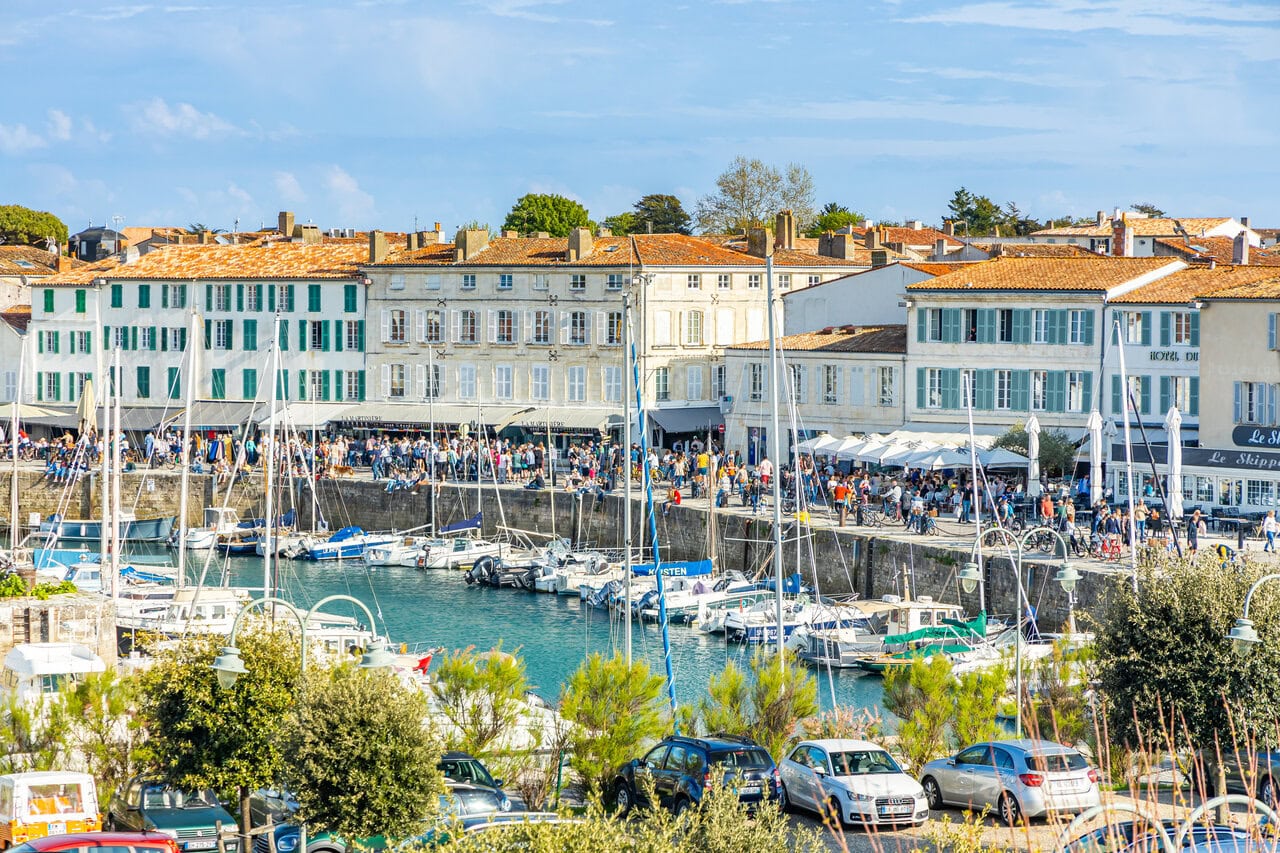
Saint-Martin-de-Ré is the island’s best-known village and the easiest recommendation for a first visit. Its harbour, restaurants, shops and historic streets are enclosed by Vauban fortifications that form part of a UNESCO World Heritage listing. The village feels unmistakably maritime and is the one place where a visitor can spend most of a day without needing onward transport.
The fortifications are the defining sight, but the village has plenty within them. Narrow lanes lead past historic houses and the Hôtel de Clerjotte, while the harbour remains the social centre. The seasonal boat from La Rochelle arrives here, which makes Saint-Martin uniquely convenient for visitors who want a scenic car-free day trip.
Public transport is straightforward by island standards. Regional coaches serve Saint-Martin throughout the year, taxis operate from the village by reservation, and cycle paths radiate towards La Flotte, Le Bois-Plage and La Couarde. It is also one of the easier places to find restaurants open outside the absolute peak of summer.
Stay in Saint-Martin if you want the most complete visitor infrastructure. The village has some of the island’s most polished hotels as well as rentals and a tourist residence. The trade-off is price and popularity. In July and August, the harbour can feel busy, so travellers who value tranquillity may prefer La Flotte, Ars or Loix.
Saint-Martin is also the easiest village for evenings without a car. Restaurants, bars, shops and accommodation are concentrated around a walkable centre, so you are less dependent on a late bus or pre-booked taxi after dinner. That makes it particularly attractive for short breaks, couples and visitors arriving by the seasonal boat who want the simplest possible island experience.
Le Bois-Plage-en-Ré
Le Bois-Plage-en-Ré is one of the best choices for families and beach-focused stays. The village sits on the south coast beside long sandy beaches and has a more relaxed resort character than the historic harbour villages. Gros Jonc and Gollandières are among the most useful beaches for swimming, watersports and long days by the sea.
The village is also home to the largest seasonal market on Île de Ré. From spring through the main visitor season, the market becomes a major morning attraction with food, local produce, crafts and everyday holiday shopping. That makes Le Bois-Plage particularly convenient for self-catering visitors staying in a rental or campsite.
Its central position is a major practical advantage. The official tourist office recommends Le Bois-Plage, together with La Couarde, as a useful central base for longer weekends because it is easy to cycle east towards Saint-Martin or west towards the salt-marsh villages. A local taxi service, Ré Taxi Bus, is also based here and operates year-round.
Choose Le Bois-Plage if you want beaches first and sightseeing second. Accommodation includes hotels, numerous campsites, holiday villages and rentals. It is especially strong for families who want space, cycling and easy food shopping without having to return to a busy harbour every evening.
Le Bois-Plage is also one of the easiest villages for a car-free week. The market helps with self-catering, the beaches are close, bike hire is widespread and buses put Saint-Martin and La Couarde within easy reach. If you want to spend most days cycling or on the beach rather than moving accommodation, this is one of the island’s most practical choices.
La Couarde-sur-Mer
La Couarde-sur-Mer is perhaps the island’s most practical central base. It sits almost halfway along Île de Ré and gives cyclists straightforward access in both directions. The village itself has flower-lined lanes, a welcoming centre and a long history as one of the island’s early seaside resorts.
The real strength is the coastline. More than five kilometres of sandy beach stretch along the south side, from Les Prises towards Petites Folies, with swimming, sailing, paddleboarding and other watersports. La Pergola is also a recognised surf area, giving the village a slightly more active beach identity than some quieter neighbouring settlements.
La Couarde works extremely well without a car. Regional buses serve the area, cycle routes connect it with Saint-Martin, Le Bois-Plage, Loix and Ars, and the village’s central position means no single part of the island feels excessively distant. Summer concerts around the bandstand and seasonal market activity add atmosphere after the beach.
Stay here if you want balance. La Couarde is not as architecturally dramatic as Saint-Martin, nor as remote as Les Portes, but it combines beaches, food, cycling and access better than almost anywhere else. Holiday rentals, campsites and visitor accommodation make it particularly suitable for a week-long stay.
La Couarde is also a very good compromise for visitors who want to use buses as well as bikes. Its central position means eastbound and westbound journeys are both manageable, and summer services increase the number of practical connections. If you are unsure which village to choose for a first longer stay, La Couarde is one of the safest all-round choices.
Loix
Loix is one of the island’s quietest and most distinctive villages. It sits on its own peninsula surrounded by salt marshes and Atlantic water, creating a feeling of separation even though it remains connected by road and cycle paths. The village has earned the Cittaslow label, which suits its deliberately unhurried character.
Salt production and marshland scenery are central to the experience. Cycle routes cross the wetlands and lead past the old tidal mill and salt-marsh landscape. The nearby salt ecomuseum helps explain how the island’s sauniers work and why salt remains such an important part of Île de Ré’s identity.
Loix is better for slow travel than for a rushed checklist. Its market is smaller and more intimate than those in Le Bois-Plage or Saint-Martin, while the surrounding paths reward visitors who are happy to cycle, stop and explore. Summer route 152 improves public transport access, but outside peak periods you should check the current route 150 pattern carefully.
Stay in Loix if peace matters more than nightlife. It is particularly good for couples, cyclists and repeat visitors who already know the major sights. Accommodation tends towards rentals, campsites and smaller properties rather than a large concentration of hotels, which helps preserve the village’s quieter atmosphere.
Loix is best treated as a destination rather than a place you happen to pass through. The peninsula road and cycle paths lead you into a self-contained landscape of marshes, workshops and low-key village life. That makes it especially rewarding for a slow afternoon or overnight stay, but less suitable if your priority is frequent evening transport or a large choice of restaurants.
Ars-en-Ré
Ars-en-Ré is one of the most characterful villages on the island. Its black-and-white church spire rises to around 42 metres and has long served as a navigation landmark for sailors entering the Fier d’Ars. The village combines a working harbour, historic streets and immediate access to the salt-marsh landscape.
This is one of the best bases for exploring the northern half of Île de Ré by bicycle. Around sixty salt workers continue to work the surrounding marshes, and cycle paths lead towards Loix, Saint-Clément-des-Baleines and Les Portes-en-Ré. The landscape feels broader and wilder here than around the island’s eastern villages.
Ars is also strong for food and village atmosphere. The harbour, market and local producers give you plenty to do between rides, while the black-and-white spire makes the village immediately recognisable. It is a better choice than Saint-Martin for visitors who want a polished village without the same level of summer crowds.
Stay in Ars if you want access to the salt marshes and western island without being completely remote. Hotels, campsites and rentals are available, and buses connect the village with La Rochelle and the rest of the island. For a three- or four-night cycling stay, Ars is one of the strongest bases.
Ars also suits visitors who want a village with enough life to stay interesting after a day outdoors. The market, harbour and local food producers give you reasons to remain in the village, while the bus and cycle network keeps Saint-Clément and Les Portes accessible. It is a particularly good choice for couples who want scenery without giving up restaurants and basic services.
Saint-Clément-des-Baleines
Saint-Clément-des-Baleines is the village for the lighthouse and Atlantic scenery. It sits between the ocean and the Fier d’Ars salt-marsh landscape at the north-western end of the island. The atmosphere is noticeably wilder than around Saint-Martin, and the surrounding cycle paths make the lighthouse a natural focal point for a day outdoors.
Phare des Baleines is the major attraction. The lighthouse complex includes the Grand Phare, museum and old tower, with different ticket combinations available. Nearby La Conche des Baleines provides a long sandy beach, so the most satisfying visit combines the lighthouse with coastal time rather than treating the attraction as an isolated stop.
Public transport is surprisingly useful in summer. In addition to the regional bus, the free Respi’Ré western shuttle links the lighthouse area with La Conche, Petit Bec and Les Portes-en-Ré. That makes it possible to build a car-free day around the lighthouse, beach and northern villages, although frequencies remain seasonal.
Stay here if you want sea, cycling and a quieter rhythm. There are campsites, rentals and visitor accommodation around the area, but fewer evening options than in Saint-Martin or La Flotte. If you need a taxi for an early departure, reserve it rather than assuming a vehicle will be waiting locally.
Saint-Clément is particularly strong for a two-part day built around the lighthouse and coast. Visit Phare des Baleines early, then continue to La Conche or use the seasonal shuttle towards Les Portes. That gives the village more depth than a simple lighthouse stop and makes it one of the best places to experience the wilder western side without committing to staying in Les Portes.
Les Portes-en-Ré
Les Portes-en-Ré is the island’s nature-focused escape. At the far western end, it is surrounded by dunes, pine woods, beaches and wetlands. The nearby Lilleau des Niges nature reserve attracts large numbers of migratory and resident birds and gives this part of Île de Ré a very different feel from the harbour villages farther east.
The beaches are a major reason to come. Trousse-Chemise is the famous name, but La Patache, La Loge and Petit Bec give visitors several very different coastal settings. Petit Bec is also known as a surf spot, while Trousse-Chemise combines beach and pine forest in one of the island’s most recognisable landscapes.
Transport requires more planning here than elsewhere. Route 150 reaches the western end and summer shuttles improve local connections, but journeys back to La Rochelle are long enough that you should not casually miss your intended bus. Taxis operate by reservation, and this is one of the places where booking one in advance can be worth the cost for an early or late journey.
Stay in Les Portes if you actively want to be away from the busier centre of the island. Rentals, campsites and high-end holiday properties cater to longer stays. It is less suitable for a visitor who wants to eat out somewhere different every night, but excellent for cycling, beaches, birdwatching and a slower holiday.
For a day trip, Les Portes needs a little more discipline than the central villages. Pick one or two priorities, such as Trousse-Chemise and Lilleau des Niges, then work backwards from the return bus or shuttle. Trying to combine several beaches, the nature reserve and the lighthouse in one short visit usually means spending too much of the day moving between stops.
Where to Stay on Île de Ré
For a first visit, Saint-Martin-de-Ré is the easiest base. It has the strongest concentration of restaurants, hotels, visitor facilities and transport, while the seasonal La Rochelle boat arrives directly into the harbour. It is the best choice if you want to minimise planning and are happy to pay for convenience.
For a longer weekend, Le Bois-Plage-en-Ré and La Couarde-sur-Mer are arguably better positioned. The official tourist office specifically recommends these central villages for visitors who want to explore in both directions. They also work particularly well for families, beach holidays and self-catering stays.
For quieter stays, look west. Ars-en-Ré gives you character and services without feeling isolated, Loix is ideal for salt marshes and cycling, while Saint-Clément-des-Baleines and Les Portes-en-Ré suit travellers who want beaches, nature and a slower pace. Rivedoux-Plage is the practical choice for airport access and frequent trips back to La Rochelle.
Accommodation covers virtually every style, including hotels, guest houses, holiday rentals, tourist residences, campsites and holiday villages. Île de Ré has a particularly strong self-catering market, which suits longer stays because village markets and local food producers are such an important part of the experience.
Markets, Food, Oysters and Salt
Markets are part of everyday island life rather than simply tourist attractions. From April to October, markets operate daily in the main season, usually in the morning, while winter schedules reduce to selected days. Le Bois-Plage has the island’s largest seasonal market, La Couarde is known for a friendly family atmosphere, and Loix offers a much smaller, quieter market.
Oysters are one of the foods most closely associated with Île de Ré. Oyster huts around the island sell or serve locally produced shellfish, and the industry remains visible around the coastal villages. In 2026, the new Festi’Cabanes programme runs from June into September at participating oyster huts, combining tastings with evening DJ sets.
Salt is just as important to the western half of the island. Salt marshes around Loix, Ars-en-Ré and the Fier d’Ars are still worked by sauniers, and visitors can buy traditional sea salt and fleur de sel directly from local producers. Cycling through the marshes gives much more context than simply buying a packet in a souvenir shop.
Wine, potatoes and seafood complete the island’s food identity. Sainte-Marie retains a strong vineyard heritage, while local potatoes are another speciality worth looking for in markets and restaurants. If food is important to your trip, plan at least one morning around a market and one meal or tasting around an oyster hut.
Compare routes and fares for your next trip.
Compare flightsBrowse Airalo eSIM options for convenient travel data.
Check eSIMsCheck private airport pickup options and plan the first part of your journey in advance.
View transfersAnnual Events and When to Visit
Summer is the busiest events season, with concerts, village festivals, night markets and family programming across the island. In 2026, Saint-Martin-de-Ré hosts Les Martinelles in July, while Festi’Cabanes runs through several oyster huts from June to September. Individual village calendars change every year, so check the official events programme for your exact dates.
European Heritage Days in September are particularly well suited to Île de Ré. Churches, museums, guided tours and heritage sites across several villages take part, giving visitors access to local history that is sometimes less visible during a normal beach holiday. September also has the advantage of warmer sea temperatures with fewer peak-summer crowds.
April to June and September are excellent months for cycling. The island is active enough for markets and seasonal services, but temperatures and traffic are generally easier than in the height of summer. July and August provide the fullest bus and shuttle network, but they also bring the largest crowds, highest accommodation demand and most pressure on bridge traffic.
How to Spend a Day on Île de Ré from La Rochelle
A day trip works best if you choose one part of Île de Ré and enjoy it properly. The island is long enough that trying to combine Saint-Martin-de-Ré, Ars-en-Ré, Phare des Baleines and Les Portes-en-Ré in one day usually means spending too much time on buses. From La Rochelle, there are two particularly good car-free approaches: a relaxed harbour day built around the seasonal boat, or a bus-and-bike day that gives you more freedom to explore beaches and villages.
Option 1: Boat to Saint-Martin-de-Ré
Start with the morning Croisières Interîles sailing from La Rochelle when the seasonal service is operating. The crossing normally takes around one hour to one hour ten minutes and brings you directly into Saint-Martin-de-Ré harbour. Because sailing times change through the season, treat the operator timetable as the framework for the day rather than fixing exact times months in advance.
Spend the first part of the morning exploring Saint-Martin on foot. Walk around the harbour, continue through the narrow streets and take time to see the Vauban fortifications that form part of the UNESCO World Heritage listing. This is one of the few Île de Ré villages where you can comfortably spend several hours without needing another form of transport.
Have lunch around the harbour or pick up food from the village before hiring a bike. A short afternoon ride towards La Flotte is realistic for most casual cyclists and gives you a second village without turning the day into an endurance trip. Alternatively, ride south towards Le Bois-Plage if you would rather spend part of the afternoon near the beach.
Return to Saint-Martin with plenty of time before the sailing back to La Rochelle. Do not plan the final cycling leg so tightly that a puncture, headwind or busy summer cycle path could make you miss the boat. This version of the day is best for first-time visitors who want history, food and atmosphere rather than trying to see the full island.
Option 2: Bus 150, Bike and Beach
Take an early route 150 coach from the gare routière beside La Rochelle-Ville station and travel to Le Bois-Plage-en-Ré or La Couarde-sur-Mer. These central villages are better starting points than the far western end for a one-day visit because they reduce time spent on the bus and put beaches, cycle routes and neighbouring villages within easy reach.
Hire a bike after arrival and use the morning to explore a short section of the island. From Le Bois-Plage, Saint-Martin-de-Ré is a straightforward ride, while La Couarde gives you easy access west towards Loix or east towards Le Bois-Plage. Keep the route deliberately modest so you have time to stop rather than simply count kilometres.
Plan lunch around a village market, café or local producer, then spend part of the afternoon on the beach. Gros Jonc and Gollandières are good choices around Le Bois-Plage, while La Couarde has a long stretch of sandy coastline. This gives the day a much better balance of cycling, food and sea than spending several hours travelling to the lighthouse and back.
Return the bike and take a late-afternoon or early-evening coach back to La Rochelle. Check the live timetable before starting the day and avoid relying on the final possible bus, especially in July and August when bridge traffic can delay services. If your return connects with a train or flight, leave a generous margin.
Which Day Trip Is Better?
Choose the boat itinerary if Saint-Martin-de-Ré is your main priority and you want the journey to feel part of the experience. It is more expensive but simpler, scenic and very easy to understand. Choose the bus-and-bike itinerary if you care more about beaches, cycling and seeing more than one village for a fraction of the transport cost.
For a first visit, resist the temptation to include the whole western end of the island. Phare des Baleines, Ars-en-Ré and Les Portes-en-Ré deserve their own day or an overnight stay. A successful day trip from La Rochelle should leave time to enjoy Île de Ré rather than proving that you can cross it.
Accessibility
Accessibility varies considerably across Île de Ré. Modern buses and many visitor facilities are designed with accessibility in mind, but historic streets, beach access, boat boarding and older buildings can create difficulties. The island’s tourist offices can provide current information for specific attractions and mobility needs.
Every one of the ten villages has a tourist-office reception point, which is particularly useful if you need local advice rather than general island information. If step-free transport or an adapted taxi is essential, arrange it before travelling rather than assuming availability on arrival.

Rupert’s Handy Travel Tips
Heading to Île de Ré? Here are a few useful tips to help you make the most of the island:
- Pick one part of the island: Île de Ré is longer than it looks, so one or two villages make a much better day than trying to rush from Rivedoux to Les Portes and back.
- Check the return bus first: bridge traffic can affect timings in summer, so avoid relying on the final possible connection back to La Rochelle.
- Book bike carriage ahead: selected route 150 coaches carry bikes, but spaces are limited and need advance reservation.
- Use the boat for Saint-Martin: the seasonal sailing from La Rochelle is much dearer than the bus, but it is a memorable choice when Saint-Martin-de-Ré is your main destination.
- Consider a central base for longer stays: Le Bois-Plage-en-Ré and La Couarde-sur-Mer make it easier to explore both ends of the island by bike.
Want to meet the reindeer behind our travel tips? Find out more in our page Who is Rupert?.


Further Reading
If Île de Ré is one part of a longer La Rochelle stay, our Day Trips from La Rochelle guide compares the island with Île d’Aix, Rochefort, Châtelaillon-Plage, Saintes, Cognac, the Marais Poitevin and other realistic excursions from the city.
For getting to the island without a car, our La Rochelle Public Transport guide explains the regional coach station, route 150, railway connections, Yélo buses, harbour boats, bikes and parking. If you are arriving by air, the La Rochelle Airport Transfers guide covers the airport bus, taxis and onward links towards the island.
Do not rush straight out of La Rochelle either. Our Things to Do in La Rochelle guide covers the Old Port, towers, aquarium, museums, beaches and boat trips, so it is easy to combine one or two days in the city with a separate full day on Île de Ré.