
Reviewed by our editorial team Updated
Escape the City for a Day
One of Glasgow’s biggest advantages as a base is just how much of Scotland sits within easy reach. Loch Lomond, the historic city of Stirling, the dramatic scenery of Glencoe, and the seaside charm of Ayr are all achievable as day trips, whether you are travelling by train, coach, hire car, or organised tour.
This guide runs through the best options within roughly two hours of the city, covering how to get to each, what to expect once you arrive, and which suit a relaxed half-day versus a full day out. Several of these destinations, particularly Loch Lomond and Stirling, can even be combined into a single busy day if you plan the timings carefully, since both sit on the same rail corridor north of the city.
If you would rather stay closer to the city itself, our Things to Do in Glasgow guide covers the museums, galleries, and neighbourhoods worth exploring without leaving town.
| Destination | Journey Time | Best Transport | Ideal For | Time Needed |
|---|---|---|---|---|
| Loch Lomond (Balloch) | 45 mins | Train | Scenic cruises, walking and nature | Half or full day |
| Stirling | 40 mins | Train | History, Stirling Castle and the Wallace Monument | Full day |
| Falkirk Wheel & Kelpies | 30–40 mins | Train + bus/taxi or car | Families and engineering enthusiasts | Half day |
| Ayr | 50 mins | Train | Beaches, Robert Burns and coastal scenery | Full day |
| Inveraray | 1 hr 45 mins | Car or organised tour | Castles, seafood and Highland scenery | Full day |
| Luss | 1 hr | Car or cruise | Pretty village and Loch Lomond views | Half day |
| Glencoe | 2.5 hrs | Car or organised tour | Highland landscapes and hiking | Full day |
| Oban | 3 hrs | Train | West Highland Line, seafood and island ferries | Full day |
Loch Lomond Cruise
Loch Lomond is Britain’s largest expanse of freshwater by surface area, stretching some 22.6 miles from north to south, and sits at the heart of Scotland’s very first National Park, officially opened by Princess Anne on 24 July 2002. ScotRail trains run directly from Glasgow Queen Street to Balloch, at the loch’s southern tip, taking around 45 minutes with frequent departures throughout the day.
Balloch itself has everything needed for a full day out: the Loch Lomond Shores retail and leisure complex, a Sea Life aquarium, and departure points for several cruise operators offering everything from a quick one-hour loop to longer sailings that take in the loch’s wooded islands, of which there are around thirty scattered across the water depending on the season and water level.
The largest of these, Inchmurrin, is in fact the biggest freshwater island anywhere in the British Isles, while smaller Inchconnachan has hosted a colony of wallabies since they were introduced there in 1940, a genuinely odd detail that cruise commentary rarely fails to mention. A cruise is the best way to appreciate the scale of the loch, overlooked from the shore by Ben Lomond, at 974 metres the most southerly Munro in Scotland, and most operators offer a live commentary covering the history and legends of the area.
Some cruises also stop at Luss, covered further down this page, allowing you to combine both in a single outing. Booking online ahead of a summer weekend is worth it, as the most popular sailings can sell out, particularly around midday.
See hotel options and places to stay in Glasgow.
Browse hotelsBrowse apartments, homes and self-catering accommodation in Glasgow.
Browse rentalsCompare prices for Glasgow hotels across multiple booking sites.
Check dealsStirling
Stirling punches well above its size historically, having controlled the lowest crossing point of the River Forth for centuries and seen some of Scotland’s most decisive battles fought nearby, including Bannockburn, whose battlefield and visitor centre sit just outside the town. Direct trains from Glasgow Queen Street take under 40 minutes, making it one of the most straightforward day trips on this list.
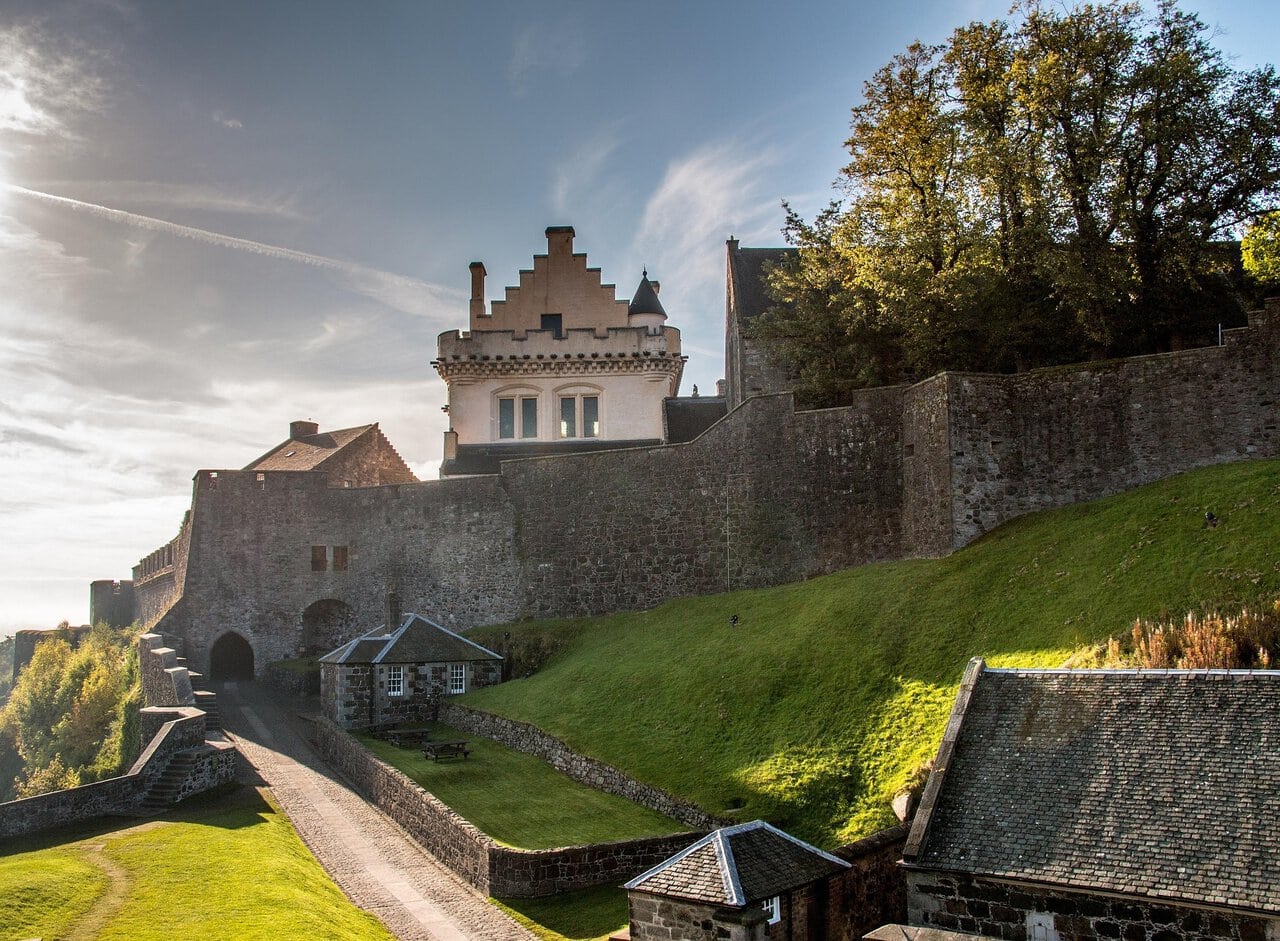
Stirling Castle, perched dramatically on a volcanic crag above the town, rivals Edinburgh Castle for scale and history, and was a favoured residence of the Stewart monarchs, including Mary, Queen of Scots, who was crowned there as an infant. The Great Hall and Royal Palace have been carefully restored, giving a vivid sense of Renaissance royal life, right down to the reconstructed tapestries and painted ceiling roundels known as the Stirling Heads.
A short walk or bus ride away, the National Wallace Monument commemorates William Wallace’s victory at the nearby Battle of Stirling Bridge in 1297. The tower’s 246-step climb rewards visitors with sweeping views across the Forth Valley towards the Highlands, and the exhibition inside includes Wallace’s own claymore sword, one of the more evocative artefacts on display anywhere in the region.
Stirling’s compact old town, with its cobbled streets and historic church, is easily covered on foot between the castle and the station, making it comfortable to see everything in a single day without needing a car.
Falkirk Wheel
The Falkirk Wheel is the world’s only rotating boat lift, opened in 2002 to reconnect the Forth and Clyde Canal with the Union Canal after decades of disuse. Watching the huge steel structure smoothly rotate boats between the two canals, an 80-foot height difference, is a genuinely impressive piece of modern engineering, and the whole rotation uses roughly the same amount of electricity as boiling eight household kettles thanks to the way its counterbalanced design distributes the weight of the water evenly.
Boat trips through the wheel itself run regularly from the visitor centre and are the best way to experience the mechanism up close, though the site is also free to view from the surrounding paths and viewing platforms without booking a ride, making it a flexible stop even for visitors on a tight budget.
Falkirk sits roughly midway between Glasgow and Edinburgh, reachable by train to Falkirk High or Falkirk Grahamston followed by a short bus or taxi, or by car in around 30 to 40 minutes from the city centre.
The Wheel pairs naturally with the Kelpies, covered next, since both sit within the same part of Falkirk and are commonly visited together in one trip.
Kelpies
Standing over 30 metres tall in Helix Park, the Kelpies are two monumental horse-head sculptures created by Glasgow-based artist Andy Scott and completed in 2013. They take their name from shape-shifting water spirits of Scottish folklore, said to lurk in lochs and rivers, while also honouring the working Clydesdale horses once used to haul barges along the very canals the Falkirk Wheel now connects.
The sculptures sit in freely accessible parkland and can be visited and photographed at any time, day or night, at no cost, which explains why they turn up so often in photographs of Scotland taken at dawn or dusk. A small charge applies for the 25-minute guided tour that takes visitors inside the structures themselves, which is worth it for anyone curious about the steel skeleton and engineering that lets each head weigh over 300 tonnes while still appearing to rear gracefully out of the ground.
Trains from Glasgow Queen Street reach Falkirk in around 20 minutes, with the Kelpies a short bus or taxi ride from the station. By car, the journey takes roughly 35 to 40 minutes via the M80.
Given how close they sit to the Falkirk Wheel, most visitors combine both into a single half-day trip before returning to Glasgow.
Ayr
On the Ayrshire coast, Ayr offers a proper seaside day out, with a long sandy beach, a promenade lined with cafes, and views across the Firth of Clyde to the Isle of Arran. Frequent trains run direct from Glasgow Central, taking around 50 minutes.
The town is inseparable from Scotland’s national poet: nearby Alloway is the birthplace of Robert Burns, and the Robert Burns Birthplace Museum there covers his life and work in detail, alongside the atmospheric ruins of Alloway Kirk, made famous in his poem “Tam o’ Shanter,” where the poem’s drunken protagonist is chased by witches after stumbling upon their revels.
Ayr Racecourse hosts major fixtures including the Scottish Grand National, and the surrounding area offers several well-regarded golf courses, including layouts close to the world-famous links at Turnberry further down the coast, for anyone looking to combine culture with a round.
The direct train connection and easy walk from the station to the seafront make Ayr one of the more relaxed, low-effort day trips on this list.
Inveraray
Set on the shores of Loch Fyne, Inveraray is a striking whitewashed Georgian town built by the Dukes of Argyll as a planned settlement in the 18th century, replacing an older village that once stood closer to the family seat. The drive from Glasgow, via Loch Lomond and the dramatic “Rest and Be Thankful” pass, is one of the most scenic routes covered in this guide.
Inveraray Castle, still the seat of the Duke of Argyll and the Clan Campbell chief, is one of Scotland’s most recognisable castles, with fairy-tale turrets and an interior famous for its lavish state rooms and an unusually elaborate armoury display of historic weaponry, much of it arranged in decorative patterns across the walls rather than tucked away in cases.
The town itself is small and easily walkable, with the striking Inveraray Jail, a former courthouse and prison now open to visitors, and the loch views providing a scenic backdrop to lunch at one of the seafood restaurants Loch Fyne is known for, since the loch itself has supplied Scotland with oysters and kippers for generations.
As there is no direct train, Inveraray is best reached by car or as part of an organised coach tour, covered later in this guide, and works well combined with a stop in Luss along the way.
Luss
The picture-postcard village of Luss, on the western shore of Loch Lomond, is one of the most photographed spots in the national park. Originally known as Clachan Dubh, meaning “the dark village,” its sandstone cottages were built to house workers from local slate quarries and cotton mills during the 18th and 19th centuries, and now line neat, flower-filled lanes that lead straight down to a pebble beach on the loch.
The village found a wider audience in the 1980s and 1990s as the setting for the long-running Scottish soap opera Take the High Road, and its streets still draw visitors curious to see the real locations behind the show. Luss has no train station, so it is usually reached by car, coach tour, or as a stop on certain Loch Lomond cruises departing from Balloch, and the village makes a natural pairing with a cruise, covered earlier on this page, for anyone driving the western shore road.
A short walk from the village centre leads to Luss Pier and a quiet churchyard, both offering views back across the loch towards Ben Lomond, which dominates the skyline on clear days.
Given its small size, an hour or two is enough to explore Luss on foot, making it easy to combine with a longer day covering Loch Lomond and onward to Inveraray or Glencoe.
Search routes and flight options for your trip to Glasgow.
Search flightsUse an eSIM to get online without hunting for a local SIM after arrival.
See eSIM optionsCheck private pickup options and plan your onward journey before arrival.
View transfersGlencoe
For dramatic Highland scenery within a day’s reach of Glasgow, nothing quite matches Glencoe. Steep, brooding mountains rise directly from the glen floor, and the valley is instantly recognisable from countless films and photographs of the Scottish Highlands, having appeared in several major film productions drawn to its raw, untouched scenery.
The glen is also steeped in history, most notably the Massacre of Glencoe in 1692, when members of Clan Campbell killed dozens of MacDonalds under their own roof after being billeted with them for nearly two weeks, a betrayal of Highland hospitality that still shapes the area’s identity today. The Glencoe Visitor Centre covers this history alongside the geology and wildlife of the glen, including displays on the ancient volcanic activity that shaped its distinctive peaks.
Walking routes range from gentle valley floor paths suitable for most visitors to serious mountain routes up peaks like the Three Sisters, which should only be attempted by experienced, well-equipped hikers given how quickly Highland weather can change, sometimes within the space of an hour.
There is no direct train to Glencoe, and the drive takes around two and a half hours each way, so most visitors without a car join an organised day tour, covered further down this page, which typically also stops at Loch Lomond and Glen Coe village.
Oban
The west coast harbour town of Oban is often called the “Gateway to the Isles,” and the direct train from Glasgow Queen Street is itself part of the appeal: the West Highland Line has been voted the world’s most scenic rail journey by Wanderlust magazine, and the roughly three-hour journey passes Loch Lomond, Rannoch Moor, and the mountains around Glen Orchy.
Oban’s train station sits just a few hundred metres from the CalMac ferry terminal, making it possible to walk straight from the platform onto a ferry bound for Mull, Iona, or other islands in the Inner Hebrides, without needing a car at any point.
The town itself is worth exploring even without continuing to the islands: Oban Distillery offers tours and tastings in the town centre, having produced whisky here since the late 18th century, and McCaig’s Tower, an unfinished Victorian folly modelled on Rome’s Colosseum and built to provide work for local stonemasons during a period of unemployment, overlooks the harbour and makes for an easy walk with excellent views.
Given the length of the journey, Oban is best treated as a full day trip rather than combined with another stop, or as the starting point for a longer island-hopping adventure.
Choosing Between Train, Bus and Car
Train is the easiest option for Loch Lomond, Stirling, Falkirk, Ayr, and Oban, all served directly from Glasgow Queen Street or Glasgow Central with no need to navigate unfamiliar roads. Our Glasgow Public Transport Guide covers how to buy tickets and plan connections from the city.
A hire car becomes essential for Inveraray, Luss, and Glencoe, none of which have a direct rail link, and gives the flexibility to combine several stops along the same route, such as Loch Lomond, Luss, and Inveraray in a single day. Our Glasgow Airport Transfers guide covers where to pick up a hire car if you are arriving by air.
Coach and bus services connect many of these destinations too, generally at a lower cost than the train but with longer journey times, and are worth checking via Traveline Scotland if you are travelling on a tighter budget.
Whichever option you choose, checking the return timetable before you set off is worth it, particularly for destinations with less frequent evening services such as Oban and Ayr.
Explore the Scottish Highlands on an Organised Day Tour
If you only have one day to experience the Scottish Highlands, an organised coach tour from Glasgow offers an excellent way to see some of Scotland’s most famous landscapes without worrying about driving, navigating unfamiliar roads or coordinating public transport connections.
One of the most popular options is the Loch Ness, Glencoe and Highlands Tour, which departs from Killermont Street, opposite Buchanan Bus Station, and lasts around 11½ hours. Travelling in a comfortable, air-conditioned coach, you’ll journey north through some of the country’s most spectacular scenery while your guide shares stories about Scotland’s history, culture and legends along the way.
The first refreshment stop is on the shores of Loch Lomond, giving you a chance to stretch your legs before continuing through Rannoch Moor and the dramatic landscapes of Glencoe. This part of the journey is widely regarded as one of the most scenic drives in Britain, with towering mountains, deep glens and sweeping moorland providing countless opportunities for photographs.
After passing beneath Ben Nevis, the UK’s highest mountain, the tour continues to Fort Augustus at the southern end of Loch Ness. Here you’ll have free time to explore the village or, for an additional charge, join a one-hour cruise on Loch Ness. Whether you’re hoping to catch a glimpse of the legendary Nessie or simply enjoy the scenery, it’s one of the highlights of the day.
The return journey takes you through the beautiful landscapes of Perthshire, including the Forest of Atholl, before arriving back in Glasgow during the evening. Although it is a long day with several hours spent travelling by coach, the route allows you to experience far more of the Highlands than would be practical using public transport in a single day.
This tour is particularly well suited to visitors without a hire car who want to experience Loch Ness, Glencoe and the Scottish Highlands in one memorable trip. Comfortable footwear and clothing suitable for Scotland’s ever-changing weather are recommended, and it’s worth remembering that there are no toilets on the coach, with the first comfort stop taking place around 90 minutes after departure.
Save Money on Train Travel Around Scotland
If you are planning to visit more than one destination by train, it is worth looking beyond standard point-to-point tickets. Scotland has several rail passes and ranger tickets that can significantly reduce the cost of exploring the country, particularly if you’re making multiple day trips from Glasgow.
For visitors travelling extensively around Britain, the BritRail Pass offers unlimited rail travel across the national network for a set number of days. It can represent excellent value if your itinerary includes journeys such as Glasgow to Stirling, Oban, Edinburgh, Inverness or even further south to destinations in England and Wales. Because it allows unlimited travel on valid days, it also gives you the flexibility to make unplanned stops along the way without worrying about buying additional tickets.
If you’re travelling as a European resident, the Interrail Great Britain Pass works in a very similar way, providing unlimited rail travel throughout England, Scotland and Wales. It is particularly useful for visitors combining Glasgow with cities such as Edinburgh, York, Liverpool, Manchester or London, while still allowing scenic day trips to places like Loch Lomond, Stirling and Oban.
For travellers concentrating on Scotland, it is also worth investigating ScotRail’s Ranger and Rover tickets. These regional passes offer unlimited travel within specific parts of the country for one or more days and can provide excellent value if you plan to visit several destinations in the same area. For example, some ranger tickets cover routes through the Highlands or the west coast, making them an economical alternative to buying separate tickets for each journey.
Finally, don’t overlook Advance rail tickets if your travel plans are fixed. Booking several weeks ahead can often produce substantial savings on longer journeys, particularly on popular routes such as Glasgow to Oban or Glasgow to Inverness, although these tickets are tied to a specific train and have less flexibility than a rail pass.
If you’re unsure which option offers the best value, compare the total cost of your planned journeys before booking. A rail pass is usually worthwhile when you’re travelling on several longer routes, while regional ranger tickets can be ideal for exploring one part of Scotland in depth. Our guides to the BritRail Pass, Interrail Great Britain Pass and Ranger & Rover Tickets explain each option in more detail and help you decide which is best for your trip.

Rupert’s Handy Travel Tips
Planning a day trip out of Glasgow? Here are a few useful tips before you set off:
- Check train departure stations: Some services leave from Queen Street and others from Central, so double-check before you travel.
- Book Highland tours early: Glencoe and Loch Lomond and Highlands tours sell out fast in summer, especially at weekends.
- Pack for changeable weather: Highland weather can shift quickly, even if it looks clear leaving Glasgow.
- Confirm your return time: Evening services to Oban and Ayr are less frequent, so know your last train before you go.
Want to meet the reindeer behind our travel tips? Find out more in our page Who is Rupert?.


Frequently Asked Questions
What is the best day trip from Glasgow without a car?
Loch Lomond is the easiest, with a direct 45-minute train from Glasgow Queen Street to Balloch and cruises departing right by the station.
Can I visit Stirling Castle as a day trip from Glasgow?
Yes, direct trains from Glasgow Queen Street take under 40 minutes, making Stirling one of the quickest historic day trips available.
How do I get to Glencoe without a car?
There is no direct train, so an organised day tour departing from central Glasgow is the simplest option for visiting Glencoe without driving yourself.
Are the Kelpies free to visit?
Yes, the sculptures sit in freely accessible parkland at all times. A small charge applies only for the guided tour that goes inside the structures.
How long does the train from Glasgow to Oban take?
Around three hours, following the West Highland Line, voted the world’s most scenic rail journey, with the ferry terminal a short walk from the station.
Further Reading
If you are staying in the city rather than heading out for the day, our Things to Do in Glasgow guide covers the best museums, galleries, and neighbourhoods, and our Glasgow Public Transport Guide explains how to plan train and bus journeys from the city.
If you are arriving by air, our Glasgow Airport Transfers guide covers hire car pickup, and our Where to Stay in Glasgow guide can help you choose a base close to Queen Street or Central Station for early departures.
Cruise passengers should see our Glasgow Cruise Port Guide for everything on the Greenock terminal before or after your day exploring further afield.











