Reviewed by our editorial team Updated
Discover Scotland’s Largest City
Glasgow is Scotland’s largest city, and while it often lives in Edinburgh’s shadow when it comes to tourism, it holds one of the best collections of free museums and galleries anywhere in Britain. Where Edinburgh trades on castles and closes, Glasgow trades on Victorian architecture, world-class art, and a genuinely warm welcome that visitors consistently remark on long after they have left.
The city grew wealthy on shipbuilding and trade along the River Clyde, and that history shapes almost everything worth seeing today, from the grand Merchant City warehouses to the transport treasures inside the Riverside Museum. Later chapters added a UNESCO City of Music designation and a reputation as one of the friendliest big cities in Europe, a reputation that shows up in small ways, from strangers giving directions unprompted to the easy conversations struck up in pubs.
Much of what makes Glasgow so rewarding to visit is that its best attractions cost nothing to enter. Kelvingrove, the Riverside Museum, the Hunterian, Glasgow Cathedral, the Gallery of Modern Art and the Necropolis are all free, which means a genuinely full itinerary is possible without a ticket budget eating into food, shows or the odd taxi on a wet evening.
This guide covers the essential sights, from the West End’s museums and university to the Merchant City’s boutiques and George Square’s civic grandeur, along with practical advice on shopping, nightlife, and shows. If you have just landed, our Glasgow Airport Transfers guide covers the journey in, and our Glasgow Public Transport Guide explains how to get between everything listed below.
Kelvingrove Art Gallery and Museum
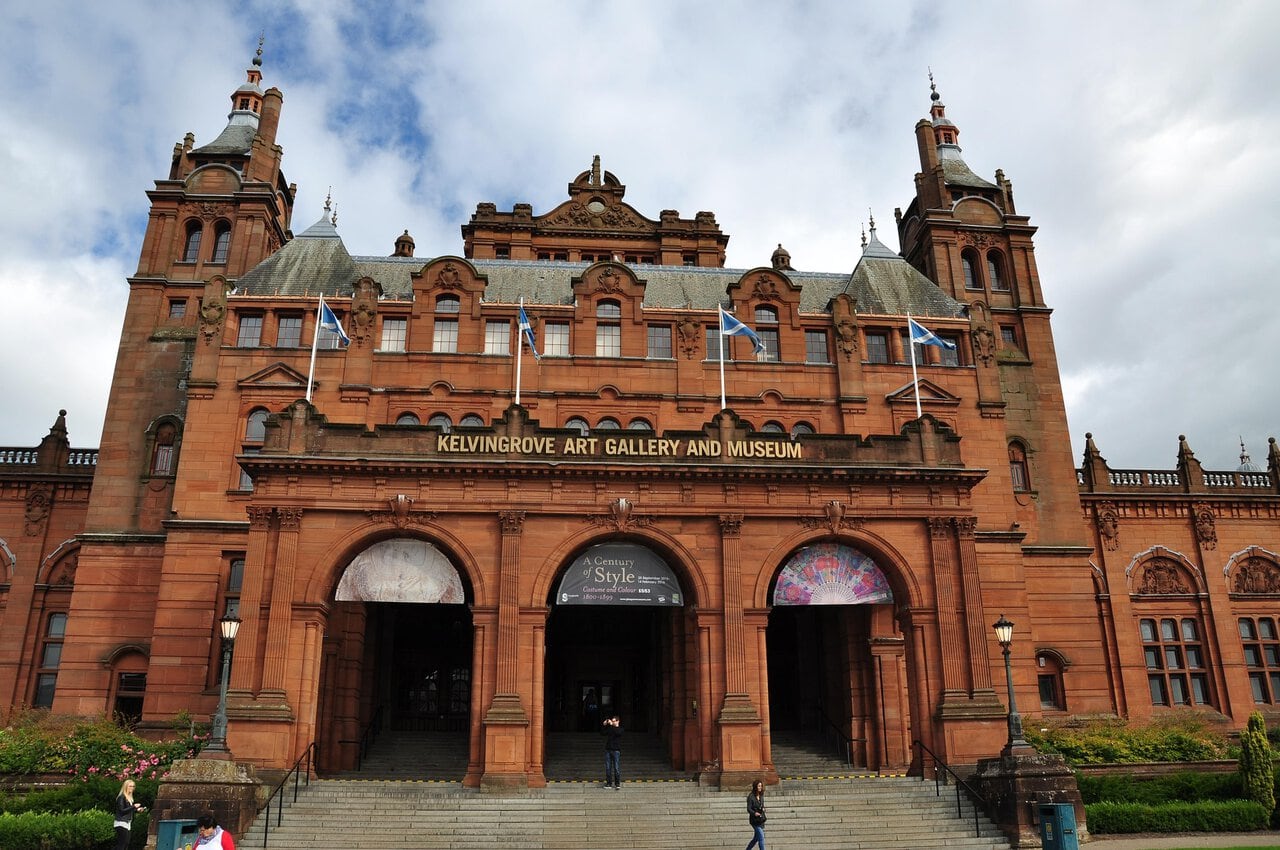
Kelvingrove Art Gallery and Museum is Glasgow’s most visited attraction and, remarkably, entirely free to enter. The red sandstone building sits in Kelvingrove Park in the West End, funded originally from the profits of the 1888 International Exhibition, an event that drew over 5.7 million visitors to Glasgow at the height of the city’s industrial confidence. The purpose-built museum opened its doors in 1901 and remains, more than a century later, the most visited museum in the United Kingdom outside London, drawing well over a million visitors a year.
Following a three-year, £27 million restoration, the museum reopened in 2006 with its 22 galleries reorganised into two halves, Life and Expression. The Life galleries cover natural history, human history and prehistory, including a full-size Spitfire suspended from the ceiling of the main hall, while the Expression galleries hold the fine art collection, much of it built on a bequest from the Glasgow collector Archibald McLellan.
The standout piece is Salvador Dalí’s Christ of St John of the Cross, given its own dedicated ground-floor display since its purchase in 1944, a decision considered controversial at the time given the painting’s modernist style and religious subject. Elsewhere in the collection sit Rembrandt’s Man in Armour, Titian’s Christ and the Adulteress, and rooms devoted to the Glasgow Boys, the Scottish Colourists and Charles Rennie Mackintosh, including a reconstructed tearoom interior originally designed for Ingram Street in the early 1900s. There is a persistent local myth that the building was accidentally built back to front and that its architect threw himself from one of the towers in despair, though the grand entrance was in fact always intended to face into the park.
Opening hours run 10am to 5pm Monday to Thursday and Saturday, with a later 11am start on Friday and Sunday. Donations are welcomed but never required, and free digital audio guides are available to download before you arrive. The building’s 1901 Lewis and Co organ still gets played for free daily recitals, which draw a crowd of their own.
Kelvingrove sits an easy walk from the University of Glasgow and the Botanic Gardens, making the West End an easy half-day or full-day loop on foot. Our Glasgow Subway Guide covers the Kelvinhall stop that serves this whole area.
See hotel options and places to stay in Glasgow.
Browse hotelsBrowse apartments, holiday homes and self-catering stays in Glasgow.
View rentalsSee hotel prices from multiple booking sites in one search.
Compare ratesSee Glasgow on a Hop-On Hop-Off Bus Tour
A hop-on hop-off sightseeing bus is one of the easiest ways to get your bearings in Glasgow, particularly if you are visiting for the first time or only have a day or two in the city. The open-top, double-decker route connects many of Glasgow’s biggest attractions, including George Square, Glasgow Cathedral, Glasgow Green, the Riverside Museum, Kelvingrove Art Gallery and Museum, the Scottish Event Campus and the Clydeside Distillery.
The full circuit takes around 100 minutes, but the real advantage is the freedom to leave the bus whenever something catches your attention and rejoin a later service. That makes it possible to build your own itinerary rather than following a rigid guided tour, while still avoiding the need to work out bus routes between attractions spread across different parts of the city.
Tickets are generally available for one or two days, with buses running more frequently during the main summer season. English commentary is supplemented by an audio guide in several languages, and live English-speaking guides are often available between spring and early autumn. The buses are also wheelchair accessible, although temporary roadworks can occasionally affect individual stops.
The main starting point is close to George Square, but you can usually join at any operating stop along the route. A one-day ticket works well for a compact sightseeing trip, while a two-day ticket gives you enough time to explore major museums and neighbourhoods without feeling rushed.
University of Glasgow
Founded in 1451, the University of Glasgow is the fourth-oldest university in the English-speaking world, and its Gothic Revival main building, designed by Sir George Gilbert Scott, is one of the city’s most photographed landmarks. The tower and quadrangles are freely open to wander, and the atmospheric cloisters beneath the main building are a favourite quiet spot, later made famous as a filming location that many visitors now specifically seek out.
Within the campus sits the Hunterian Museum, Scotland’s oldest public museum, founded in 1807 from the collection of anatomist William Hunter. Entry is free, and the collection ranges from Roman artefacts found along the Antonine Wall to a significant display on the university’s own history of scientific discovery, including work connected to Lord Kelvin, who taught physics and engineering here for more than fifty years and whose name now marks Kelvingrove Park and the museum both.
Self-guided tours are easy to follow using the university’s own campus tour materials, and guided historical tours run at set times for visitors who want the fuller story behind the buildings. The surrounding streets of the West End, with their sandstone terraces, are worth a wander in their own right, and the area has a genuinely different, more studenty atmosphere than the city centre a mile or so away.
Combine a visit here with Kelvingrove and the Botanic Gardens, both a short walk away, for one of the best free days out anywhere in the city.
Spend a Day at Glasgow Science Centre
Glasgow Science Centre is one of the city’s strongest family attractions, with three floors of interactive exhibits, demonstrations and hands-on activities covering everything from space and the human body to energy, engineering and emerging technology. It sits beside the River Clyde, close to the Scottish Event Campus, and is easy to combine with other attractions in the wider riverside area.
Much of the experience takes place inside the Science Mall, where visitors can explore themed zones such as BodyWorks, Powering the Future and Quantum Technologies. There are optical illusions, practical experiments, puzzles and large-scale interactive displays designed to make scientific ideas accessible without turning the visit into a classroom lesson.
Live demonstrations in the Science Show Theatre add variety during the day, while the Space Zone and Planetarium offer a more immersive introduction to astronomy and the solar system. It is worth checking exactly what is included before booking, as Planetarium shows, Glasgow Tower and IMAX screenings may require separate tickets rather than being covered by standard entry.
The centre is fully wheelchair accessible and includes quiet spaces, accessible facilities and an on-site café. Families can easily spend several hours here, and under-16s must be accompanied by an adult.
Glasgow Cathedral and the Necropolis
Glasgow Cathedral, also known as the High Kirk of Glasgow or St Mungo’s Cathedral, is dedicated to the city’s patron saint and founder, who established a monastery on this site in the 6th century. Construction of the current building began in the 12th century, with most of what stands today dating from the 13th and 14th centuries, and it remains the only mainland Scottish cathedral to have survived the Reformation of 1560 with its structure largely intact, a period when most of the country’s Catholic buildings were stripped, damaged or demolished outright.
The lower crypt is considered one of the finest in Europe and houses the tomb of Saint Mungo himself, a genuinely rare thing to be able to stand beside in a working British cathedral. Entry is free, though as an active church, hours shift seasonally: 9:30am to 5pm daily from April to September (1pm start on Sundays), and 10am to 4pm from October to March, with the building closed for lunch between 12:30pm and 1:30pm most days.
Immediately behind the cathedral, a footbridge nicknamed the “Bridge of Sighs” leads up into the Necropolis, a dramatic Victorian hillside cemetery holding around 50,000 burials, of which roughly 3,500 are marked by the elaborate monuments, obelisks and mausoleums that give the site its distinctive skyline. It is free to enter and open from dawn until dusk, and the summit offers one of the best skyline views in Glasgow, particularly at sunset.
The layout was deliberately modelled on Paris’s Père Lachaise cemetery, and the scale of the monuments reflects the wealth of the Victorian merchants who commissioned them, part of a nineteenth-century shift in attitude that saw death treated with ceremony, symbolism and remembrance rather than simple fear. It is an unusual but memorable stop, and considerably quieter than the city centre attractions nearby.
The cathedral and Necropolis sit close to Glasgow Queen Street Station, making them an easy add-on to a day exploring Merchant City and George Square, both covered further down this page.
Tour the Clydeside Distillery
The Clydeside Distillery combines whisky production with Glasgow’s industrial history, making it a good choice even for visitors who are not already whisky experts. It occupies the restored Old Pumphouse at Queen’s Dock, a riverside building dating from 1877, and the tour connects the story of Scotch whisky with the history of trade along the Clyde.
The experience begins with the Dockside Story, which introduces the surrounding area through archive footage, displays and animation. A guide then leads visitors through the working production spaces, explaining the stages of malting, mashing, fermentation and distillation before reaching the Still House, where copper stills overlook the river.
The tour finishes with a tasting of three Clydeside drams, chosen to demonstrate how different casks influence the flavour and character of the spirit. The guided visit lasts around an hour, making it easy to fit into a wider day exploring Finnieston, the SEC or the Riverside Museum.
Visitors should bring valid identification, and those who are driving can usually request takeaway tasting containers rather than drinking during the tour. Children are permitted and are normally offered Irn-Bru instead of whisky. Arriving at least ten minutes before the booked start time is sensible, as tickets are collected from the distillery shop.
Riverside Museum
Designed by the late Zaha Hadid, the Riverside Museum is Glasgow’s transport museum and one of the most architecturally striking buildings in the city, its wave-like zinc roof sitting right on the banks of the River Clyde. The design won the European Museum of the Year award shortly after opening, a rare honour that speaks to how deliberately the building itself was conceived as part of the visitor experience rather than simply a container for the collection inside. Entry is free, with the same hours as Kelvingrove, 10am to 5pm Monday to Thursday and Saturday, and 11am to 5pm on Friday and Sunday.
Inside, a recreated 1930s Glasgow street scene, complete with cobbles, shopfronts, and a mocked-up subway station, sits alongside vintage cars, trams, bicycles, and an SPT subway carriage. Interactive displays and a basketball court and skate spot built into the museum floor make it a genuine hit with children as well as transport enthusiasts, and the sheer range on show, from horse-drawn carts through to modern motorbikes, tells the story of how Glaswegians actually moved around their own city over the past two centuries.
Moored on the river directly outside is the Tall Ship Glenlee, one of only five Clyde-built sailing ships still afloat anywhere in the world. Boarding the ship and exploring its decks makes a natural extension to a Riverside Museum visit, and gives a genuine sense of scale that photographs of the ship from the riverside walkway simply cannot convey.
The museum sits a short distance from the city centre and connects well onward to the Finnieston area and the SEC campus, both covered in our Commonwealth Games Glasgow Venues Guide.
Compare routes and fares for your journey to Glasgow.
Compare flightsUse an eSIM to get online without hunting for a local SIM after arrival.
See eSIM optionsCheck private pickup options and plan your onward journey before arrival.
View transfersStep Aboard the Tall Ship Glenlee
Moored beside the Riverside Museum, the Tall Ship Glenlee offers a rare chance to explore a fully restored nineteenth-century sailing ship in the heart of Glasgow. Built in 1896, the three-masted barque spent decades carrying cargo around the world before later serving as a naval training vessel.
Visitors can walk across the historic decks, explore the lower levels and learn how crews lived and worked during long voyages. Exhibitions trace the Glenlee’s transformation from British merchant ship to Spanish naval vessel and eventually to a floating museum, while also placing the ship within the wider story of Glasgow’s shipbuilding and maritime heritage.
The average visit lasts around 40 minutes, although anyone reading the displays in detail may spend longer. The ship has an onboard café and a small nautical gift shop, and its position next to the free Riverside Museum makes the two attractions an easy pairing for a full afternoon by the Clyde.
Accessibility is better than might be expected for a historic vessel, but some areas remain difficult because of narrow spaces, steep sections and tidal changes affecting the gangway. A lift is available, although visitors who depend on it should check that it is operating before travelling.
Glasgow Botanic Gardens
Tucked into the West End along the River Kelvin, the Glasgow Botanic Gardens cover around 50 acres and are free to enter, open daily from 7am until dusk. The grounds are a favourite spot for locals to walk, picnic, or simply escape the city centre for an hour, and unlike some botanic gardens elsewhere, they feel like a genuine part of the neighbourhood rather than a formal attraction set apart from everyday life.
The undisputed highlight is the Kibble Palace, a soaring Victorian glasshouse originally built in the 1860s and moved to the gardens in 1873. Inside, it houses tree ferns, exotic plants, and a collection of marble statues beneath curved glass and iron, a combination that feels closer to a Victorian pleasure garden than a modern botanical display. Glasshouse hours run 10am to 6pm from April to September, dropping to 10am to 4:15pm over the winter months.
Beyond the Kibble Palace, the gardens include a working kitchen garden, an arboretum, and riverside paths that connect through to the wider Kelvingrove area. A small tea room operates seasonal hours for a coffee stop between the glasshouses and the main gate, and on a sunny weekend the lawns fill with students from the neighbouring university making the most of the space.
The gardens pair naturally with a visit to the University of Glasgow and Kelvingrove, both within easy walking distance, making the whole West End an ideal free day out.
Take a Guided Tour of Ibrox Stadium
A guided tour of Ibrox Stadium gives visitors a behind-the-scenes look at the home of Rangers Football Club and complements the separate Rangers Museum experience at Edmiston House. The tour lasts around 90 minutes and is led by a knowledgeable guide who explains the history of the club, the stadium and the people associated with both.
The route includes access to the home and away dressing rooms, the players’ tunnel, the dugout and the Trophy Room. One of the architectural highlights is the marble staircase inside the historic Archibald Leitch Main Stand, which gives the stadium a very different character from a modern purpose-built arena.
Visitors also see areas such as the Blue Room and the former managers’ room before walking down the tunnel towards the pitch. Sitting in the dugout and taking photographs with the stadium behind you are among the most memorable parts of the experience, particularly for supporters who have only previously seen Ibrox from the stands on matchdays.
Tours begin at the main entrance to Edmiston House, where the guide meets the group before leading everyone across to the stadium. Comfortable shoes are sensible because the visit involves a fair amount of walking.
It is worth checking the exact ticket inclusions before booking. The attraction information states that Rangers Museum admission may require a separate ticket, despite the stadium tour listing appearing to mention museum entry elsewhere. Anyone planning to visit both should confirm the current arrangement at the time of booking rather than assuming one ticket covers everything. Reservations may also be required for access to the Blue Sky Lounge.
Explore Rangers Football Club Museum
The Rangers Football Club Museum at Edmiston House traces more than 150 years of one of Scotland’s most successful football clubs. It is designed as a self-guided experience, allowing visitors to move at their own pace through trophies, historic shirts, photographs, documents and interactive displays.
The trophy room is one of the main highlights, but the museum goes beyond silverware by exploring the people, matches and moments that shaped the club. Interactive screens allow younger visitors to build their own Rangers team and experiment with formations, while displays cover both men’s and women’s football.
A typical visit lasts around 90 minutes, and timed entry helps prevent the museum becoming too crowded. There is also a café and club shop within Edmiston House, making it easy to extend the visit before travelling back into central Glasgow.
It is important to note that museum entry does not include an Ibrox Stadium tour. Anyone hoping to visit the dressing rooms, tunnel or pitchside areas will need to book a separate stadium experience. The venue is wheelchair accessible and operates as a cashless site, so visitors should bring a payment card.
Merchant City
Merchant City takes its name from the eighteenth-century tobacco and sugar merchants who built their warehouses and townhouses here, and their grand sandstone buildings now house boutique shops, restaurants, and some of the city’s better bars. Cobbled lanes and converted warehouses give the area a very different character to the modern shopping streets nearby, and it is one of the few parts of central Glasgow where you can still trace the layout of the eighteenth-century city fairly precisely from the street plan alone.
The Italian Centre, with its designer boutiques and pavement cafes, and the restored City Halls, home to the Royal Scottish National Orchestra’s chamber concerts, are two of the district’s best-known landmarks. Ingram Street and Wilson Street are worth a slow wander for independent shops and galleries you will not find on the main high street, and several of the buildings along them retain original merchant-era signage and stonework if you look up rather than straight ahead.
Merchant City sits within easy walking distance of both George Square and Glasgow Cathedral, making it a natural link between the civic centre and the older parts of the city to the east.
In the evening, the district becomes one of Glasgow’s more relaxed nightlife spots, with cocktail bars and restaurants taking over from the daytime shopping crowd, a theme we cover in more detail in the nightlife section below.
Go Behind the Scenes at Celtic Park
A guided tour of Celtic Park offers football supporters the chance to see parts of the stadium that are normally closed on matchdays. The one-hour tour explores the history and culture of Celtic Football Club while taking visitors through some of the ground’s most recognisable areas.
The route typically includes the boardroom, home dressing room, players’ tunnel, dugout and pitchside area. Walking down the tunnel and emerging beside the pitch is the standout moment for many visitors, particularly when the guide explains how the stadium atmosphere changes on major European and domestic match nights.
Tours begin near the Celtic Park Sports Bar, and visitors should arrive at least ten minutes before the scheduled start. The experience involves a fair amount of walking and some steps, so comfortable footwear is recommended.
Availability may change once football fixtures are confirmed, especially around home matches and European games. Anyone booking well in advance should keep an eye on messages from the operator in case the tour needs to be moved to another date.
Compare hostels and lower-cost places to stay in Glasgow.
Search hostelsFlying to Glasgow? Get fast compensation payouts, eligible lounge benefits and expert help when flights go wrong.
See AirHelp+ benefitsArriving before check-in or leaving later? Store your luggage and make more of your time in Glasgow.
Store your bagsGeorge Square
George Square is Glasgow’s civic heart, laid out in the 1780s and dominated on its eastern side by the City Chambers, a lavish Italian Renaissance-style building completed in 1888 that still serves as the seat of Glasgow City Council. Free guided tours of the interior run on select weekdays and reveal marble staircases and mosaic ceilings that few visitors expect from the outside, a genuine contrast that catches most first-time visitors off guard.
The square itself is home to twelve statues, including a column topped by Sir Walter Scott, along with monuments to Robert Burns, James Watt, and Queen Victoria. It regularly hosts events, from the winter Christmas markets to public screenings during major sporting tournaments, and rarely sits empty for long even outside of scheduled events.
Sitting directly between Queen Street Station and Buchanan Street, George Square is one of the most convenient orientation points in the city centre, and a natural starting point for exploring on foot in any direction.
Our Glasgow Public Transport Guide covers how Queen Street Station connects into the wider rail, bus, and Subway network from here.
Visit the Scottish Football Museum and Tour Hampden Park
The Scottish Football Museum and Hampden Park Stadium Tour provides the broadest overview of the national game in Glasgow. Rather than focusing on one club, the museum follows Scottish football from its earliest days through to the present, with major trophies, historic objects and displays covering the players, managers and teams that shaped the sport.
One of the most important exhibits is the Scottish Cup, recognised as the oldest national association football trophy in the world. The museum also includes the Scottish Football Hall of Fame, celebrating figures who made a lasting contribution both domestically and internationally.
The stadium tour takes visitors beyond the galleries and into the operational areas of Hampden Park. Stops usually include the dressing rooms, warm-up areas, tunnel and pitchside seating, before finishing near the steps used for trophy presentations.
This is a particularly good option for families and visitors with a general interest in football history rather than allegiance to a specific Glasgow club. The tour is wheelchair accessible throughout, and the meeting point is normally inside the Hampden Park café beside the museum reception and stadium shop.
River Clyde
The River Clyde made Glasgow’s fortune, and its industrial past as one of the world’s great shipbuilding rivers is still visible along its banks today. A well-maintained riverside walkway runs from the Riverside Museum past the Finnieston area and on towards the SEC campus, making for a pleasant traffic-free stroll of an hour or more, with benches and interpretive plaques dotted along the route explaining what once stood where you are standing.
Along the way, the striking Clyde Arc, nicknamed the “Squinty Bridge” for its angled design, and the towering Finnieston Crane, a preserved giant cantilever crane once used to load steam locomotives for export, both stand as reminders of the river’s industrial heyday, when Clyde-built ships and locomotives were sent to every corner of the British Empire.
The riverside path also leads directly to the Scottish Event Campus (SEC) and the OVO Hydro arena, two of the city’s major event venues, and onward towards Glasgow Green. It is an easy way to link several attractions without needing public transport for short hops, and gives a very different perspective on the city than the shopping streets a few minutes’ walk inland.
For visitors interested in the river’s role in hosting major events, our Commonwealth Games Glasgow Venues Guide covers the SEC and nearby venues in detail.

Catch a Show or Concert
Glasgow holds UNESCO City of Music status, and its live music scene backs that up night after night. The OVO Hydro, part of the Scottish Event Campus on the Clyde, is one of the busiest arenas in Europe, hosting major touring artists in a purpose-built venue with excellent sightlines from almost every seat in the house.
For something with more history, the Barrowland Ballroom, in the East End, is a legendary mid-size venue with a sprung dancefloor and a reputation among touring musicians as one of the best rooms in the UK to play, a reputation built up over decades of hosting acts on their way up rather than only established headliners. Its neon sign is a Glasgow landmark in its own right, and photographs of it turn up in almost every serious book written about the city’s music history.
Theatre lovers are equally well served: the Theatre Royal is home to Scottish Opera and Scottish Ballet, while the King’s Theatre hosts touring West End productions and pantomime. Both sit close to the city centre and are easily combined with dinner in Merchant City beforehand.
Checking listings before you travel is worth it, since the city’s biggest nights, particularly at the Hydro, sell out well in advance, sometimes within minutes for the most in-demand acts.
Best Shopping Streets
Glasgow is widely regarded as the UK’s second-best shopping destination outside London, and its central “Style Mile” links three main streets. Pedestrianised Buchanan Street is the smartest of the three, home to flagship and designer stores along with the elegant Princes Square shopping centre, tucked behind a striking Art Nouveau facade that is easy to miss if you are not looking up as you pass.
Argyle Street and Sauchiehall Street complete the trio, covering a wider mix of high street chains, department stores, and independent shops. Sauchiehall Street in particular has seen significant investment in recent years, with a growing number of bars and restaurants alongside its retail units, part of a broader push to keep the street lively into the evening rather than emptying out once the shops close.
For something different, The Barras market in the East End, held Saturdays and Sundays near the Barrowland Ballroom, is Glasgow’s famous weekend market for vintage clothing, antiques, records, and bric-a-brac, with a character all its own that owes as much to the traders themselves as to what they are selling.
Merchant City, covered earlier on this page, rounds things out with boutique and designer shopping away from the main crowds, particularly around the Italian Centre.
Nightlife
Glasgow’s nightlife spreads across a few distinct areas, each with its own character. The West End, anchored by the University of Glasgow, has a relaxed, studenty feel, with traditional pubs and the cobbled, lantern-lit Ashton Lane packed with bars and restaurants just off Byres Road, widely considered one of the most photogenic corners of the entire city after dark.
Merchant City leans smarter, with cocktail bars and later-opening restaurants filling the converted warehouses, while the city centre around Sauchiehall Street holds most of Glasgow’s larger clubs and late-night venues, the natural choice if a long night out rather than a few relaxed drinks is the plan.
For a quieter evening, several of the museums and galleries covered earlier on this page, including Kelvingrove, occasionally host after-hours events, so it is worth checking listings if your visit coincides with one.
Whichever area you choose, the Glasgow Subway and late-running buses make it easy to get back to your accommodation without needing a taxi, a topic our Glasgow Subway Guide covers in full.

Planning the Perfect Visit
Glasgow rewards visitors who group attractions by neighbourhood rather than crisscrossing the city. Treat the West End (Kelvingrove, the university, the Botanic Gardens) as one day, and the city centre and Merchant City (George Square, the Cathedral, shopping) as another, with the Riverside Museum and Clyde walkway fitting neatly alongside either.
Because so many of Glasgow’s best sights, including Kelvingrove, the Riverside Museum, the Hunterian, and the Cathedral, are completely free, it is possible to enjoy a genuinely full itinerary on a modest budget, with money better spent on food, shows, and the odd taxi on a wet evening. Most visitors find two full days covers the essentials comfortably, while four or five days allows time to add in the street art trail, the parks, and a proper night out without feeling rushed.
Scotland’s weather is unpredictable year-round, so building in a museum or gallery for a rainy afternoon alongside outdoor time in the Botanic Gardens or along the Clyde is a sensible way to plan, rather than committing an entire day to outdoor sightseeing and hoping for the best.
Our Where to Stay in Glasgow guide can help you pick a base close to the areas that interest you most, and our Day Trips from Glasgow guide is worth reading if you have an extra day to spare beyond the city itself.

Rupert’s Handy Travel Tips
Exploring Glasgow’s sights? Here are a few useful tips to make the most of your visit:
- Take advantage of free entry: Kelvingrove, the Riverside Museum, the Hunterian, and the Cathedral are all free, so save your budget for food and shows instead.
- Group sights by neighbourhood: Tackle the West End in one day and the city centre in another to avoid unnecessary backtracking.
- Book big shows early: Hydro concerts and popular theatre productions sell out fast, especially at weekends.
- Pack for all weather: Scotland can turn from sunshine to rain within the hour, even in summer.
Want to meet the reindeer behind our travel tips? Find out more in our page Who is Rupert?.


Frequently Asked Questions
Is Kelvingrove Art Gallery and Museum free to visit?
Yes, entry is completely free, though donations are welcomed. It is open 10am to 5pm Monday to Thursday and Saturday, and 11am to 5pm on Friday and Sunday.
Is the Riverside Museum worth visiting?
Yes, it is one of Glasgow’s best free attractions, combining a striking Zaha Hadid-designed building with a huge transport collection and the historic Tall Ship Glenlee moored outside.
How much does it cost to visit Glasgow Cathedral and the Necropolis?
Both are free to enter, though the cathedral welcomes charitable donations. Hours vary seasonally, so check ahead if you have a specific time in mind.
What is the best shopping street in Glasgow?
Buchanan Street is the smartest of the city’s three main shopping streets, with Argyle Street and Sauchiehall Street offering a wider mix of high street and independent shops.
How many days do I need to see Glasgow’s main attractions?
Two full days covers the highlights comfortably, one for the West End’s museums and university, and one for the city centre, Merchant City, and the Cathedral.
Further Reading
If you have just landed, our Glasgow Airport Transfers guide covers the journey into the city, and our Glasgow Public Transport Guide and Glasgow Subway Guide explain how to get between the sights above.
To make the most of your stay, our Where to Stay in Glasgow guide covers the best areas to base yourself, and our Day Trips from Glasgow guide is well worth reading if you have extra time for Loch Lomond, Stirling, or the west coast.
Football fans should see our How to Get to Hampden Park guide, and anyone visiting for the Games should read our Commonwealth Games Glasgow guide and Commonwealth Games Glasgow Venues Guide.