
Reviewed by our editorial team Updated
Getting Around Glasgow with Ease
Glasgow has one of the most compact and visitor-friendly transport networks of any UK city, built around a small circular Subway, a dense suburban rail network, and frequent bus routes run mainly by First Glasgow. Most attractions, hotels, and neighbourhoods sit within easy reach of at least one of these three modes, and it rarely takes more than a couple of changes to get anywhere a visitor is likely to want to go.
This guide walks through every practical way to get around the city, from the Subway’s fifteen stations to contactless payment and daily price caps, so you can pick the right ticket and route for your trip without overthinking it.
If you are arriving by air, our Glasgow Airport Transfers guide covers the journey from the terminal into the city, which connects directly into the network described below.
For a full deep dive into the Subway specifically, including its complete station list and history, see our dedicated Glasgow Subway Guide.
Glasgow Subway
The Glasgow Subway, operated by SPT, is a small circular underground line of fifteen stations that takes just 24 minutes to complete a full loop of the system, a fact the original operators were proud enough of to advertise the whole network with the slogan “Round the City in Half an Hour” when it first opened. It is the third-oldest underground metro system in the world, opening on 14 December 1896 shortly after London and Budapest, and remains one of the easiest ways to hop between the city centre and the West End.
The system was originally cable-hauled, similar to San Francisco’s famous cable cars, and only switched to electric operation in 1935. Its familiar nickname, the Clockwork Orange, only dates from a major refurbishment between 1977 and 1980, when the entire network was rebuilt and the trains repainted in the bright orange livery that has stuck ever since, alongside the fact that trains run in both a clockwise and anticlockwise direction around the same circular route. Brand new trains were introduced across the network as recently as 2023, so the rolling stock riding those historic tunnels today is considerably more modern than the system’s Victorian origins might suggest.
Trains run every four minutes at peak times, with services operating 06:30 to 23:40 Monday to Saturday and a shorter 10:00 to 18:12 on Sundays. An adult single fare starts at just £1.80 to travel anywhere on the line.
Key stops for visitors include Buchanan Street and St Enoch for the city centre, Hillhead and Kelvinbridge for the West End, and Ibrox for match days at Ibrox Stadium.
For the complete station-by-station breakdown, fares, and accessibility notes, our Glasgow Subway Guide covers everything in full detail.
Compare hotels and other places to stay in Glasgow.
Check availabilityExplore holiday homes and apartments around Glasgow.
See holiday homesCompare prices for Glasgow hotels across multiple booking sites.
Check dealsTrains Across the City
Glasgow’s two main stations, Glasgow Central and Glasgow Queen Street, anchor an extensive ScotRail suburban network that reaches far beyond the city centre. Central handles routes south and west, including services toward Greenock and the Ayrshire coast, while Queen Street serves routes north and east, including Edinburgh and the Highlands, a division that catches out visitors more often than any other detail of the network.
Suburban services run frequently to stations such as Partick, Hyndland, and Mount Florida, the latter being the closest station to Hampden Park. These local trains are often the fastest way to cover longer distances within the city, particularly during rush hour when roads are busiest, and many run considerably more frequently than a visitor unfamiliar with the network might expect.
It is worth noting that the Subway and the suburban rail network are entirely separate systems, run by different operators, so a Subway ticket will not cover a ScotRail journey and vice versa, even where the two run close together.
If your trip includes a cruise departure, our Glasgow Cruise Port Guide explains the direct train route from Glasgow Central to Greenock Central for Ocean Terminal departures.
For match or event day travel, our How to Get to Hampden Park guide covers the full rail and walking route from Mount Florida in detail.
Local Bus Services
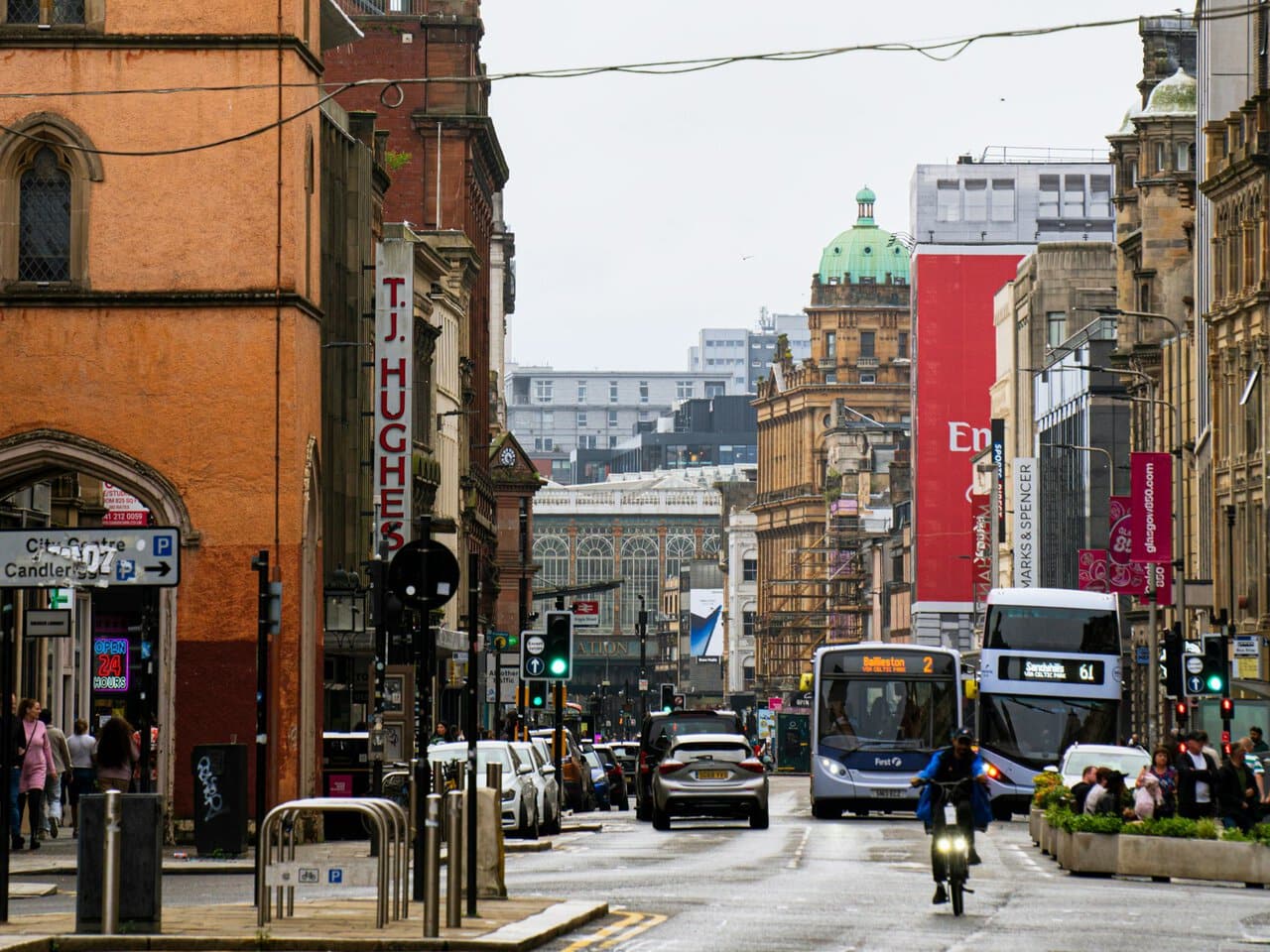
First Glasgow operates the vast majority of city bus routes, covering areas the Subway and rail network do not reach directly, including many outer neighbourhoods and cross-city journeys that would otherwise require multiple changes between different lines.
Buses are especially useful for reaching Finnieston, the Scottish Event Campus, and other riverside areas that sit a little further from Subway stations. Fares can be paid by contactless card, the First Bus App, or exact cash onboard, though contactless is by far the most convenient for visitors unfamiliar with the exact fare structure.
Route numbers and stops are clearly displayed at bus shelters throughout the city, and live arrival times are available through the First Bus App, which is worth downloading before you arrive rather than trying to work it out at a stop with limited signal.
Buses also provide a useful backup route to Glasgow Airport and other transport hubs when Subway or rail services are disrupted, so it is worth knowing at least one bus route as an alternative for your usual journey.
Airport Express
The Glasgow Airport Express, Service 500, connects Glasgow Airport to Buchanan Bus Station in just 15 minutes, with buses departing every 10 minutes throughout most of the day and an hourly overnight service, making it a genuinely round-the-clock option rather than one that leaves late arrivals stranded.
Single fares cost £11 for adults and £6.50 for children, with return tickets priced at £17.50 and £10.50 respectively. Tickets can be bought via the First Bus App, online in advance, or onboard using contactless, cash, or card.
The service departs from Stance 1 at the airport and Stance 46 at Buchanan Bus Station, stopping at central points including Queen Street Station and North Hanover Street along the way, so it is worth checking which of these stops sits closest to your accommodation before boarding.
Our full Glasgow Airport Transfers guide compares this against taxis and private transfers if you are travelling with heavier luggage or a larger group.
Contactless and Smartcards
The Subway now accepts contactless bank cards and mobile wallets directly at the gates, with no registration required, a relatively recent addition that has made the system considerably more approachable for first-time visitors than the old paper ticketing it replaced. The system automatically applies the best-value fare, capping spending at £3.40 per day and £15.50 per week when the same card is used for every tap.
For longer stays, the Subway Smartcard offers season tickets and pay-as-you-go balances, with registration costing £5. Children under five travel free when accompanied by a fare-paying adult, and concession fares apply for eligible National Entitlement Card holders after 09:00 on weekdays.
First Glasgow buses also accept contactless payment directly onboard, and the First Bus App allows tickets to be bought and stored on a smartphone in advance, which is often quicker than fumbling for change while other passengers wait to board.
Using the same contactless card for every journey throughout your stay is the simplest way to benefit from daily and weekly capping without having to plan your ticket type in advance.
Useful Apps for Getting Around
The free ScotRail app is worth downloading before you travel if your trip involves any train journeys at all, whether that is a short hop to Mount Florida or a longer trip out to Loch Lomond. It sells mTickets, including Flexipass and season tickets, directly on your phone with no booking or card payment fees, and lets you pay with Apple Pay rather than entering card details manually. Its Live Times feature shows platform numbers and real-time disruption alerts, while the Journey Tracker gives a running update on exactly where your specific train is, genuinely useful if you are trying to judge whether you have time for one more coffee before it arrives.
One practical reason to buy through the app rather than on board: since 1 July 2026, ScotRail has tightened its penalty fare policy for anyone who boards without a valid ticket despite having had the opportunity to buy one before travelling. You will be charged whichever is higher between a flat £10 minimum fare and the full undiscounted single or return fare, with no railcard or other discounts applied at that point. Buying your ticket through the app before you board, rather than assuming you can sort it out with the conductor, avoids this entirely.
For buses, the First Bus App, already mentioned above, covers live arrival times, route planning, and mobile tickets across the city’s bus network, and is worth having installed alongside the ScotRail app rather than relying on either alone.
The Subway has its own dedicated SPT Subway app, which lets you buy mobile tickets and display a QR code at the gate, though now that contactless tap-in and tap-out works directly at every station, many visitors find they do not need it for a short visit. Our Glasgow Subway Guide covers this in more detail.
For journeys that combine several of these modes, or that head further afield than Glasgow’s own network reaches, Google Maps is generally the simplest all-in-one option for working out walking times and connections, while Traveline Scotland pulls together timetables from operators right across the country, which is particularly useful for day trips that rely on a bus route the city’s own apps do not cover.
Best Ticket for Your Trip
For a short city break sticking mainly to the Subway, contactless pay-as-you-go is almost always the best choice, since the automatic daily cap of £3.40 beats buying an all-day paper ticket at £4.45.
If your trip involves a mix of Subway, train, and bus travel across several days, the ZoneCard is worth considering, offering unlimited travel across all three modes within a chosen zone, which suits visitors staying outside the immediate city centre.
SPT’s Roundabout day tickets combine Subway and rail travel for a single flat price, which can work out cheaper than paying separately if you plan to explore both the centre and the wider region in one day.
Whichever ticket you choose, our Glasgow Subway Guide has a complete fares table if you want to compare exact prices before you travel.
Compare routes and fares for your journey to Glasgow.
Compare flightsUse an eSIM to get online without hunting for a local SIM after arrival.
See eSIM optionsArrange a private airport pickup for your trip to Glasgow.
Check transfersReaching Popular Attractions
The Subway covers most of the city’s headline sights directly. Kelvinhall station sits a short walk from Kelvingrove Art Gallery and the University of Glasgow, while St Enoch and Buchanan Street put you right in the heart of the shopping district and Merchant City.
For sights further out, such as the Riverside Museum or the Scottish Event Campus, a short bus or taxi ride from the nearest Subway or rail station usually completes the journey, since the riverside sits a little beyond easy walking distance from most stops, particularly if you are carrying anything heavier than a light bag.
Our full Things to Do in Glasgow guide lists the nearest station or bus route for every major attraction in the city, making it easy to plan an efficient day of sightseeing.
If you are staying further afield, our Where to Stay in Glasgow guide breaks down which neighbourhoods offer the easiest access to the attractions you most want to see.
Travelling During Major Events
Glasgow’s transport network gets noticeably busier during major events, including football matches at Hampden Park and Ibrox, concerts at the Scottish Event Campus, and the Commonwealth Games returning to the city in 2026. Services generally run more frequently around these events, but stations near venues can still feel crowded well before and after the event itself.
Arriving a little earlier than usual and having your ticket or contactless card ready before reaching the gates helps avoid bottlenecks at busy stations, particularly at Mount Florida and Ibrox on event days, when queues can build quickly right at the barriers.
Our Commonwealth Games Glasgow guide covers transport planning for the 2026 Games specifically, including how to reach each competition venue.
Checking SPT and ScotRail travel alerts on the morning of any major event is worthwhile, since temporary timetable changes or extra services are common around large crowds.
Accessible Transport
The Subway provides a range of accessibility features, including induction loops at ticket offices, tactile paving and maps for visually impaired passengers, colour-contrast stair nosings, and double-height handrails, many added as part of the network’s ongoing modernisation programme.
The Thistle Assistance Card helps older passengers and those with disabilities access support across the network, and station-by-station access guides detail exactly which stops have stairs, escalators, or lifts before you travel.
ScotRail stations across the city generally offer step-free access to platforms, though provisions vary by station, so checking ahead with ScotRail directly is worthwhile if this is essential to your journey.
First Glasgow buses operate low-floor, wheelchair-accessible vehicles across the network, and assistance dogs are welcome on all Subway, rail, and bus services throughout the city.

Rupert’s Handy Travel Tips
Getting around Glasgow for the first time? Here are a few useful tips before you travel:
- Use one contactless card for everything: Daily and weekly Subway caps only apply if you tap with the same card every time.
- Download the ScotRail and First Bus apps early: Between them they cover live times, mobile tickets, and route planning across the city.
- Mount Florida for Hampden: It’s the closest rail station to the stadium, but expect crowds on match days.
- Check alerts on event days: Major games and concerts can mean extra services or temporary changes.
Want to meet the reindeer behind our travel tips? Find out more in our page Who is Rupert?.


Frequently Asked Questions
What is the easiest way to pay for Glasgow’s Subway?
Tapping a contactless bank card or mobile wallet directly at the gates is the easiest option, with fares automatically capped at £3.40 a day.
How many stations does the Glasgow Subway have?
Fifteen stations arranged in a circular loop, with a full circuit taking around 24 minutes.
How do I get from Glasgow Airport to the city centre?
The Airport Express Service 500 runs every 10 minutes and reaches Buchanan Bus Station in around 15 minutes, with adult singles costing £11.
Which ticket is best for a short visit to Glasgow?
Contactless pay-as-you-go on the Subway usually works out cheapest for short stays thanks to the automatic daily price cap.
What happens if I board a ScotRail train without a ticket?
Since 1 July 2026, you will be charged whichever is higher between a £10 minimum fare and the full undiscounted fare, with no railcard discounts applied, so it is worth buying through the ScotRail app before you travel.
Is Glasgow’s transport network accessible?
Yes, the Subway, buses, and most ScotRail stations offer step-free access, induction loops, and other accessibility features, though it is worth checking specific stations in advance.
Further Reading
For a full breakdown of the Subway’s stations and fares, see our Glasgow Subway Guide, and for arrivals from the airport, our Glasgow Airport Transfers guide covers every option in detail.
Our Things to Do in Glasgow and Where to Stay in Glasgow guides pair well with this one when planning where to base yourself and what to see.
Heading to a match or event? Our How to Get to Hampden Park and Commonwealth Games Glasgow guides cover event-specific travel in more detail.











