Reviewed by our editorial team Updated
Explore Southwest Ireland
Cork city sits at the heart of one of Ireland’s most rewarding regions for day tripping, and the choice of day trips from Cork is genuinely difficult to narrow down. Within an hour or two of Kent Station or Parnell Place bus station, travellers can reach a medieval castle famous the world over, a harbour town regarded as the country’s culinary capital, the last port of call of the RMS Titanic, and one of the wildest lake valleys in Munster. Southwest Ireland packs an extraordinary amount of history, scenery and food culture into a compact corner of the country, and Cork’s excellent rail and bus links, run largely by Irish Rail and Bus Éireann, make it possible to see much of it without ever renting a car.
This guide covers eleven of the best excursions from the city: Blarney Castle, Kinsale, Cobh, Gougane Barra, Bantry, Killarney National Park, Spike Island, Fota Island, the Ring of Kerry, the Cliffs of Moher and Fastnet Rock and Cape Clear Island. Each one is reachable by public transport, car or organised tour, and each offers something distinct, from the Blarney Stone’s famous “gift of eloquence” to the glacial valley where the River Lee rises in West Cork. For a broader look at what the city itself has to offer before or after your day trip, our guide to things to do in Cork is a useful companion piece to this one.
Before diving into each destination in detail, the table below gives a quick comparison of journey times, the best public transport option, and how much time to set aside for each trip.
| Destination | Journey Time | Best Public Transport | Ideal Time Needed |
|---|---|---|---|
| Blarney Castle | Around 20 to 25 minutes by bus | Bus Éireann route 215 from Cork bus station | 3 to 4 hours |
| Kinsale | Around 48 minutes by bus | Bus Éireann route 226 from Kent Station | 4 to 6 hours |
| Cobh | 26 to 30 minutes by train | Irish Rail suburban line from Kent Station | 3 to 4 hours |
| Gougane Barra | Around 1 hour 15 minutes by car | No direct service; self-drive or organised tour | 2 to 3 hours |
| Bantry | Around 2 hours by bus | Bus Éireann route 236 from Cork bus station | Full day |
| Killarney National Park | Around 1 hour 25 minutes by train (change at Mallow) | Irish Rail via Mallow, or Bus Éireann Expressway 40 | Full day |
| Spike Island | 26 to 30 minutes by train to Cobh, then a 15-minute ferry | Irish Rail to Cobh, then the ferry from Kennedy Pier | About 3.5 hours on the island, plus travel |
| Fota Island | 15 to 20 minutes by train | Irish Rail Cork to Cobh line to Fota station | 2.5 to 3 hours for the Wildlife Park |
| Ring of Kerry | Around 9 hours door to door on a guided tour | No practical scheduled service; organised coach tour from central Cork | Full day |
| Cliffs of Moher | Well over 2 hours each way by car, or around 10 hours door to door on a tour | No practical scheduled service; organised full-day tour | Full day |
| Fastnet Rock & Cape Clear Island | About 100km by road to Baltimore, then around 6 hours afloat and ashore | No direct service; organised tour with transport from Cork | Full day |
Kiss the Blarney Stone
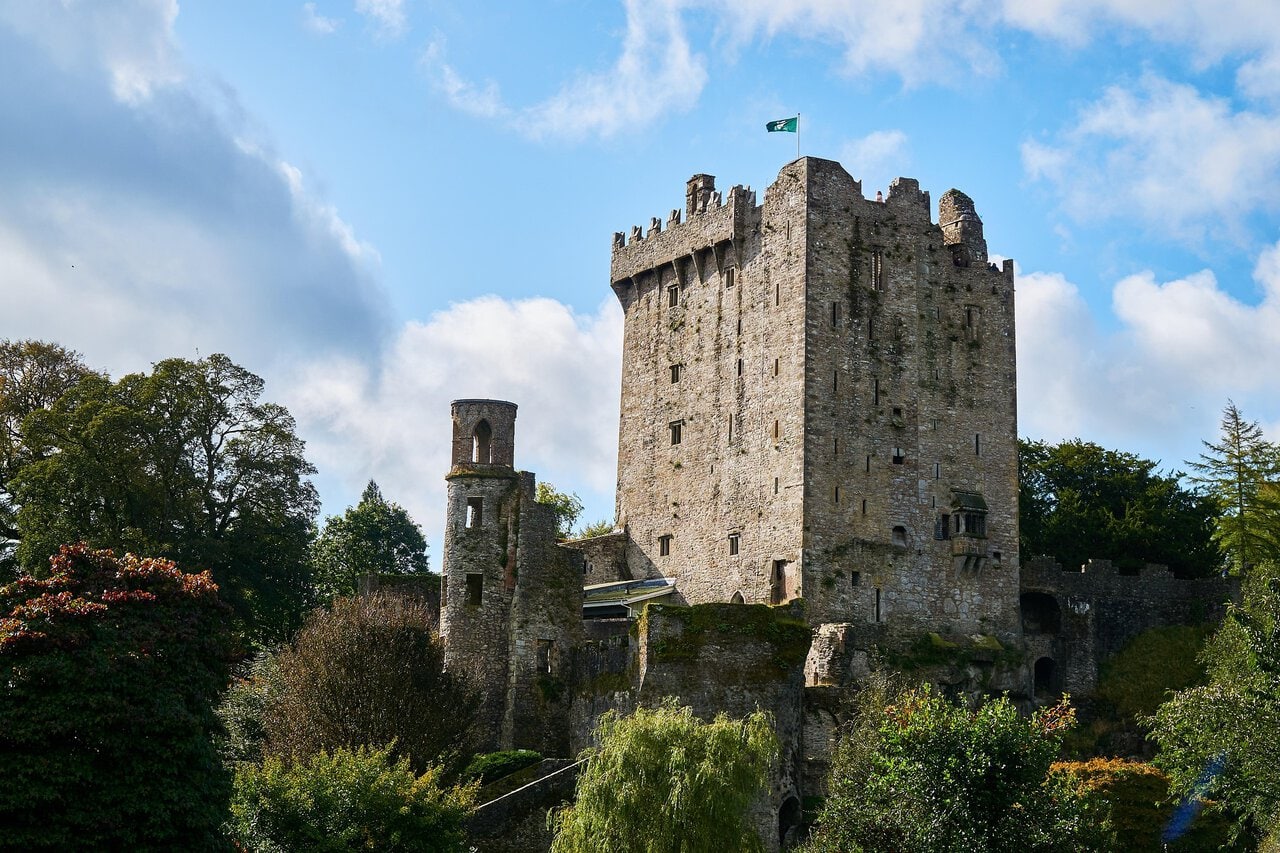
Blarney Castle is the single most popular day trip from Cork, and it is also the easiest to reach without a car. Bus Éireann’s route 215 runs directly from Cork’s city bus station to Blarney village, taking around 20 to 25 minutes, with departures roughly every 30 minutes at peak times and hourly outside of rush hour. The castle is barely a five minute walk from the village bus stop. Drivers can cover the 8 kilometre route northwest of the city in a similar amount of time via the N20 and R617, and parking is available on site.
The castle itself was built around 1446 by the Munster chieftain Cormac MacCarthy, and it is the tower house’s battlements that hold the famous Blarney Stone, said to grant the gift of eloquence to anyone who leans backward to kiss it. The tradition has drawn visitors from across the world for generations, and the surrounding Blarney Castle Gardens reward a slower pace, with the Poison Garden, the Rock Close and extensive parkland all included in the ticket price.
Adult admission currently costs €22 (£19 / $26), with concessions at €17 (£15 / $20) and children aged 6 to 16 at €10 (£8.50 / $11.50). Opening hours run from 9am to 6pm in the summer months and 9am to 5pm in winter, with last admission earlier than closing time. Because the queue for the stone itself can build up by mid morning, an early start from Cork is the best way to make the most of a half day trip here.
Browse hotels and accommodation for your visit to Cork.
View staysBrowse apartments, homes and self-catering accommodation in Cork.
Browse rentalsCompare prices for Cork hotels across multiple booking sites.
Check dealsDiscover Colourful Kinsale
Kinsale lies around 25 kilometres south of Cork city and is one of the most rewarding day trips from Cork for anyone who enjoys good food and coastal walking. Bus Éireann’s route 226 runs from Kent Station to Kinsale via Cork Airport, taking approximately 48 minutes with roughly hourly departures throughout the day, which makes the trip straightforward even without a car. If you are flying in or out during your stay, it is worth reading our guide to Cork Airport transfers alongside this route, since the same bus corridor links the airport to the town. Drivers can expect around 30 minutes via the R600.
The town’s pastel coloured shopfronts along Pearse Street and the harbour front give Kinsale its reputation as one of the prettiest towns in Ireland, but its history runs deeper than its looks. The Battle of Kinsale in 1601 was a pivotal moment in Irish history, when Spanish forces landed to support Hugh O’Neill and Red Hugh O’Donnell against the English, and the town’s star shaped Charles Fort, built in 1677, still overlooks the harbour mouth today and is open for guided tours.
Kinsale has also long been known as the gourmet capital of Ireland, home to the Kinsale Good Food Circle and a dense cluster of seafood restaurants around the marina. With a population of just under 6,000, it feels intimate rather than touristy, and it also happens to be one of the two official endpoints of the Wild Atlantic Way, making it a natural stop for anyone tackling that route from the south.
Visit Historic Cobh
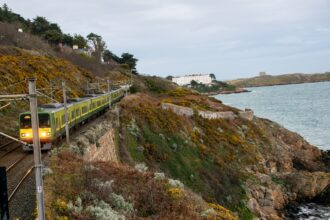
Cobh is the simplest of all the day trips from Cork to organise, since it sits directly on the Irish Rail suburban line out of Kent Station. Trains take just 26 to 30 minutes, run every 30 minutes at weekday peak times and hourly outside of those windows, including on Saturdays and Sundays, and a day return currently costs around €10 (£8.50 / $11.50). The station in Cobh sits right on the waterfront, so there is no onward journey needed once you arrive.
The town’s history is inseparable from the sea. Known as Queenstown from 1849, after a visit by Queen Victoria, until it reverted to its Irish name Cobh in 1920, the port was for decades the departure point for Irish emigration. An estimated 2.5 million of the roughly six million Irish people who emigrated to North America between 1848 and 1950 left from this harbour, a story told in detail at the Cobh Heritage Centre and beside the striking statue of Annie Moore, the Cobh teenager who became the first immigrant processed through Ellis Island in 1892.
Cobh also holds a darker maritime distinction as the final port of call of the RMS Titanic, on 11 April 1912, before she set out across the Atlantic on her maiden voyage. The Titanic Experience Cobh, housed in the original White Star Line ticket office, tells that story in detail. Above the town, the twin spires of St Colman’s Cathedral dominate the skyline and are visible from almost every angle of the harbour, making the short walk up from the station worthwhile on its own.
Escape to Gougane Barra
Gougane Barra is the quietest and most dramatic of the day trips from Cork on this list, and it is also the one place here without a straightforward public transport link. The glacial valley lies around 68 kilometres west of Cork city, reached by driving along the N22 through Ballincollig and Macroom before turning onto the R584, a journey of roughly 1 hour 15 minutes. There is no direct Bus Éireann service into the valley itself, so a hire car or an organised day tour is the practical way to get there.
The reward for the drive is one of the most atmospheric small sites in Munster. According to tradition, St Finbarr, who later founded the monastery that grew into the city of Cork, built a monastery on the island in Gougane Barra’s lake during the sixth century. The current hermitage buildings date from around 1700, when a priest named Denis O’Mahony retreated to the island, and the nineteenth century oratory on the site remains a popular spot for wedding photography thanks to its richly decorated interior.
Gougane Barra is also the source of the River Lee, which rises in the hills above the lake before flowing all the way through Macroom and Cork city to the sea. The surrounding forest park, managed by Coillte, has waymarked walking trails through Sitka spruce plantations with views back over the lake, making this an ideal spot for a couple of hours of quiet walking away from the busier tourist trail.

Experience Bantry
Bantry sits at the head of Bantry Bay in West Cork and makes for a fuller day trip than most on this list. Bus Éireann’s route 236 runs from Cork bus station to Bantry, with the journey taking around 2 hours and roughly six departures a day. Drivers can make the same trip via the scenic N71 in around 1 hour 20 minutes, and the same route continues on to Glengarriff for anyone wanting to combine the two.
The town’s centrepiece is Bantry House, seat of the White family since the eighteenth century. Richard White rallied local forces against a failed French invasion attempt in 1796, when a fleet under General Hoche anchored in the bay but was unable to land troops due to storms, and he was later created 1st Earl of Bantry in recognition of his efforts. The house’s terraced gardens, including the famous stone staircase known as the Hundred Steps, were laid out by the second Earl after his travels in Europe and offer sweeping views out over the bay. Bantry House has been open to the public since 1946 and is still lived in by descendants of the White family, with adult admission currently around €14 (£12 / $16).
Beyond the house, Bantry’s Friday market has been running since the eighteenth century and remains one of the best in West Cork for local produce and crafts. The town also serves as a jumping off point for the Sheep’s Head and Beara peninsulas, both quieter and less crowded alternatives to the Ring of Kerry for anyone with extra time to spare.
Explore Killarney National Park
Killarney National Park is technically over the county boundary in Kerry, but it remains one of the most popular day trips from Cork thanks to a fast and reliable rail connection. Irish Rail services from Kent Station require a change at Mallow, typically with a transfer of only a few minutes, and the full journey to Killarney takes around 1 hour 25 minutes. Bus Éireann’s Expressway route 40 runs directly from Cork bus station to Killarney bus station in around 1 hour 50 minutes, calling at Macroom and Ballyvourney along the way.
The park itself covers around 10,000 hectares and was Ireland’s first national park, established after the Bourn Vincent Memorial Park was gifted to the state in 1932. Within its boundaries sit the Lakes of Killarney, the nineteenth century Muckross House and its walled gardens, the medieval Ross Castle on the shore of Lough Leane, and the popular Torc Waterfall walk. The park is also home to the last surviving indigenous herd of red deer in Ireland, present in the area since Neolithic times.
Beyond the lakes, the park rises into the McGillycuddy’s Reeks, Ireland’s highest mountain range, and holds UNESCO Biosphere Reserve status. Because Killarney town itself sits right at the park’s edge, it is entirely possible to walk from the train or bus station straight into the grounds of Muckross House within about twenty minutes, making this one of the easiest national parks in Ireland to reach without a car.
Explore Spike Island
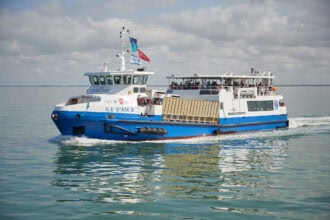
Spike Island sits out in Cork Harbour and pairs naturally with a trip to Cobh, since the ferry across departs from Kennedy Pier, right in the town centre next to the Titanic Experience. The crossing takes around 15 minutes each way, and tickets are sold as a combined package covering the return ferry and a guided tour with one of the island’s storytellers. Adult admission currently costs €27.95 (£24 / $32), with senior and student tickets at €23.95 (£20.50 / $28), children under 12 at €14.95 (£13 / $17) and a family ticket at €74.95 (£64 / $87). Advance online booking is strongly recommended, particularly at weekends, since the ferry cannot wait for latecomers and sailings are limited by boat capacity.
Spike Island has earned its nickname as Ireland’s Alcatraz through a history that stretches back centuries. General Sir Eyre Coote laid the foundation stone of the island’s star shaped fortress in 1804, and the site later became a convict depot in 1847 as transportation numbers surged during the Famine, growing at one point into what is thought to have been the largest prison in the British Empire. Its more recent history as a prison continued into modern times, with the facility only closing in 2004, and the island’s museums and exhibitions now cover this entire span from monastery to fortress to prison.
The island covers around 104 acres and a full visit, including the ferry crossing, typically takes about 3.5 hours, with walking trails and more than a dozen exhibitions to explore alongside the guided tour. It is open daily from April to October, weekends only in February, March and November, with daily access during mid term breaks. Spike Island was named Europe’s Leading Tourist Attraction at the World Travel Awards in 2017, a recognition that helped put it on the map alongside better known European landmarks. Combined with the Titanic Experience and Cobh’s waterfront, covered earlier in this guide, it makes for a full and rewarding day out from the same train journey.
Search routes and flight options for your trip to Cork.
Search flightsUse an eSIM to get online without hunting for a local SIM after arrival.
See eSIM optionsCheck private pickup options and plan your onward journey before arrival.
View transfersVisit Fota Island
Fota Island near Carrigtwohill is one of the easiest day trips from Cork by train, sitting directly on the Cork to Cobh suburban rail line with its own dedicated station. The journey from Kent Station takes around 15 to 20 minutes, and the station sits within walking distance of both of the island’s main attractions, which stand adjacent to one another and can comfortably be combined in a single day.
Fota Wildlife Park is Ireland’s only conservation focused open plan zoo, run by the Zoological Society of Ireland across 100 acres of parkland, with many animals, including kangaroos, roaming freely alongside walking visitors. Its best known feature is Ireland’s only Cheetah Run, a daily demonstration in which a lure travels along a wire at speeds of up to 65 kilometres per hour to encourage the cheetahs’ natural hunting instincts, alongside walk through enclosures for lemurs. The park opens daily from 9.30am, and adult admission costs €22.50 (£19 / $26) at the gate, with discounted online tickets, concessions and family packages also available. The park suggests allowing around 2.5 to 3 hours for a visit.
Next door, Fota House & Arboretum offers a very different kind of visit. The Regency era mansion was remodelled in the 1820s for the Smith-Barry family to designs by architects Sir Richard Morrison and his son William, and it is maintained today by the Irish Heritage Trust with guided tours available as a separate ticket. The surrounding 11 hectare arboretum, with its ornamental pond, orangery and sun temple, is managed instead by the OPW and holds one of the finest collections of rare and tender trees and shrubs in Ireland, with free entry to the grounds. Because that entry is free, the OPW Heritage Card covered further down this page buys you nothing at Fota, and Fota House itself is ticketed separately by the Irish Heritage Trust and is not on the card either. The only charge on site is a €3 (£2.50 / $3.50) fee to bring a car onto the grounds.
Take a Guided Day Trip to the Ring of Kerry
The Ring of Kerry is arguably Ireland’s most famous scenic drive, and while it sits well beyond a comfortable independent day trip from Cork by public transport, a guided day trip to the Ring of Kerry makes it genuinely achievable in a single day without needing to hire a car yourself or navigate the peninsula’s narrower sections.
Coaches typically depart central Cork early in the morning and loop around the Iveragh Peninsula, taking in the Kerry Bog Village at Glenbeigh, coastal viewpoints looking out towards the Skellig Islands, and the picturesque village of Sneem, before continuing into Killarney National Park itself.
A guide narrates the journey throughout, covering the history of the route and the towns along the way, which adds genuine context that would otherwise be missed on narrow roads better suited to concentrating on driving than sightseeing.
These tours typically run for around nine hours door to door, making for a long but genuinely rewarding day, and remove the stress of navigating tour coach traffic on the Ring’s narrower stretches, since self-drivers are advised to travel counter-clockwise specifically to avoid meeting coaches head-on. Booking a few days ahead during summer is sensible, as seats on the more popular departures do sell out.
See the Cliffs of Moher and More in a Day
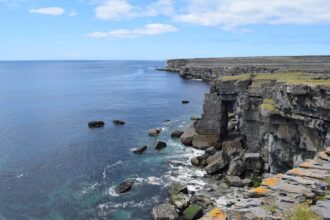
The Cliffs of Moher sit well over two hours from Cork by car, making them a genuinely long day out rather than a simple half-day trip, but a Cliffs of Moher and more full-day tour from Cork handles the entire route for you, with several worthwhile stops built into the journey both ways.
The typical itinerary heads north through Limerick, with a brief photo stop beside King John’s Castle on the banks of the River Shannon, before continuing on through the Burren region of County Clare to the cliffs themselves. Visitors usually get around ninety minutes at the cliffs, including a complimentary ticket to the Atlantic Edge exhibition, before a lunch stop in either Liscannor or Doolin. On the return leg, many of these tours call at Bunratty Castle for a short stroll around the grounds and a coffee before the final drive back through the Golden Vale to Cork.
Given the distance involved, this is very much a full-day commitment, typically around ten hours door to door, so it suits visitors who want to tick off one of Ireland’s most famous natural sights without the logistics of arranging trains, buses and connections across three counties in a single day.
Cruise to Fastnet Rock and Cape Clear Island
For something entirely different from the castles and coastal drives covered elsewhere in this guide, a Fastnet Rock Lighthouse and Cape Clear Island tour heads out from West Cork onto the open Atlantic itself. Baltimore, the usual departure point, lies about 100 kilometres southwest of Cork city, so this one begins with a long road leg before you even reach the water. Departing by ferry from Baltimore or Schull, the crossing takes in the island-studded waters of Roaring Water Bay, part of what is locally known as Carbery’s Hundred Isles, before landing at Cape Clear Island, Ireland’s most southerly inhabited island and one of the country’s few remaining Gaeltacht, or Irish-speaking, communities.
Visitors typically get a couple of hours of free time on Cape Clear to explore its heritage centre, standing stones and walking trails, with lunch available at one of the island’s small bars or restaurants, before re-boarding for the final stretch out to Fastnet Rock itself. Nicknamed Ireland’s Teardrop, since it was the last piece of the country many emigrants saw as their ships sailed for America, the lighthouse is the tallest and widest rock lighthouse in Ireland and the UK, and boats typically circle it at close quarters so passengers can get a proper look before heading back to port. Dolphins, seals and, in summer, whales are regularly spotted along the way.
The full tour usually runs to around six hours including the island stop, and sailings are weather dependent, so it is worth building some flexibility into your schedule if you are combining this with other West Cork plans, such as a stop in Bantry or a drive out along the Beara or Sheep’s Head peninsulas covered earlier in this guide.
Travel Along the Wild Atlantic Way
Several of the destinations covered here, particularly Kinsale, Bantry and the coastline beyond it, sit directly on Ireland’s official coastal touring route, the Wild Atlantic Way. Kinsale marks one of the two official endpoints of the 2,500 kilometre route, which stretches all the way north to Donegal, and it is a common starting point for visitors basing themselves in Cork before heading further west into Kerry and beyond.
Rather than repeat the full route here, our dedicated Wild Atlantic Way guide covers the entire journey in detail, from the discovery points and signature viewing spots to suggested itineraries for those with a week or more to spare. If any of the day trips above leave you wanting more of the coast, that guide is the natural next stop for planning a longer trip beyond Cork.
Choosing Between Train, Bus and Car
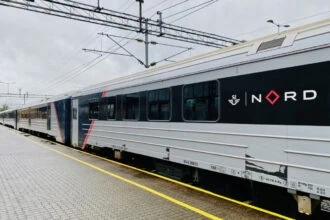
For destinations directly on the rail network, Cobh and Killarney are best reached by Irish Rail, since both routes are frequent, fast and drop you within walking distance of the main sights. Blarney, Kinsale and Bantry are all served by Bus Éireann, and while the buses are comfortable and reliable, journey times are naturally longer than a direct train and timetables thin out in the evenings, so it is worth checking the return schedule before setting off, particularly on Sundays.
A car becomes genuinely useful for two of the destinations on this list. Gougane Barra has no direct bus service at all, and Killarney National Park is far easier to explore in depth, including the Gap of Dunloe and Ladies View, with your own transport rather than relying on connecting buses within the park itself. Car hire is widely available at Cork Airport and in the city centre, and driving in West Cork is generally straightforward outside of the narrow lanes around Gougane Barra and the Beara Peninsula, though visitors used to driving on the right should allow extra time to adjust on the first day.
For a simple rule of thumb, if your day trip involves Cobh or Killarney, take the train. If it involves Blarney, Kinsale or Bantry, the bus is perfectly workable and considerably cheaper than car hire and parking. If Gougane Barra is on your list, or the Ring of Kerry and Fastnet Rock are further afield than public transport can practically reach, a car or an organised tour is the more practical choice.
Compare hostels and budget-friendly accommodation around Cork.
Browse hostelsAccess compensation support, eligible lounge benefits and faster payouts when flights go wrong.
See the benefitsArriving before check-in or leaving later? Store your luggage and make more of your time in Cork.
Store your bagsBooking an Organised Day Tour
For travellers who would rather not manage timetables and transfers, several operators run organised day tours out of Cork covering the destinations in this guide. Paddywagon Tours departs from Cork city on coach tours that typically combine Blarney Castle with Kinsale or the wider West Cork coastline, while operators such as Butler’s Buses specialise in shore excursions for cruise passengers arriving into Cobh, running combined itineraries that take in Blarney Castle, Cork city and Kinsale in a single day.
An organised tour is particularly worth considering for Gougane Barra, the Ring of Kerry, the Cliffs of Moher and the Fastnet Rock crossing, all covered above, since none of these have a straightforward public transport option, and for anyone wanting to see several sights in one day without the logistics of connecting timetables. Most day tours include commentary on the history covered in this guide, from the Battle of Kinsale to the story of Cobh’s emigrants, and many can be booked directly online with pickup from central Cork.
Using the OPW Heritage Card from Cork
For anyone planning to visit several state managed heritage sites during a stay in Ireland, the OPW Heritage Card is worth considering before setting out from Cork. The card gives unlimited admission for 12 months to every fee-charging heritage site run by the Office of Public Works, more than 90 of them nationwide, from castles and monastic ruins to historic gardens. That is a count of the sites the card admits you to, not of the OPW’s wider heritage estate, which runs to some 780 properties, most of them free-to-enter monuments with no ticket desk at all. Pricing currently stands at €40 (£34 / $46) for an adult, €30 (£26 / $35) for a senior aged 60 or over, €10 (£8.50 / $11.50) for a student, and €10 (£8.50 / $11.50) for a child aged 12 to 18, with a family card covering two adults and children at €90 (£77 / $104). Children under 12 are admitted free to OPW sites regardless of the card.
Several of the destinations covered in this guide are genuinely OPW managed sites and fall under the card. Charles Fort in Kinsale, the star shaped seventeenth century fortress overlooking the harbour mouth described earlier in this guide, is one of them. The arboretum and gardens at Fota House & Arboretum, covered above, are OPW managed but free to walk into, so the card makes no difference there. Within Killarney National Park, also covered above, Ross Castle is an OPW site included on the card, though it is worth noting that neighbouring Muckross House is managed separately by its own trustees and is not covered by the Heritage Card, so it still requires its own ticket.
Whether it pays for itself depends on how many ticketed sites you actually stack up. Charles Fort and Ross Castle are around €5 (£4.50 / $6) each on the gate, so those two alone come nowhere near the €40 (£34 / $46) adult card; it only starts to make sense once other OPW sites further afield, from the Rock of Cashel to Dublin Castle, are added into a longer itinerary. Our dedicated OPW Heritage Card guide covers the full list of participating sites nationwide and how to buy the card in advance of a trip.

Rupert’s Handy Travel Tips
I’ve hoofed it round most of these routes myself, so here’s what I’d want to know before setting off from Cork.
- Buy a return ticket: Both Irish Rail and Bus Éireann sell return fares that work out cheaper than two singles, and you can usually buy them on the day at Kent Station or the bus station kiosk.
- Check Sunday timetables: Services to Blarney, Kinsale and Bantry all run less frequently on Sundays, so plan your return journey before you set off rather than after you arrive.
- Start early for Blarney: The queue for the stone builds up fast after mid morning, so catch one of the first buses out if kissing it matters to you.
- Pack for changeable weather: Gougane Barra and Killarney National Park are both more exposed than the city, so bring a waterproof even on a bright Cork morning.
- Combine Cobh with the train, not the bus: The train drops you right on the waterfront in Cobh, saving a walk that the bus route doesn’t offer.
- Book Fastnet Rock crossings with flexibility in mind: Sailings depend on the weather, so avoid scheduling anything tight either side of it.
Want to meet the reindeer behind our travel tips? Find out more in our page Who is Rupert?.



Frequently Asked Questions
Can you visit Blarney Castle and Kinsale in one day from Cork?
Yes, both are short trips from Cork on separate bus routes, and with an early start it is possible to see Blarney Castle in the morning and Kinsale in the afternoon, though it makes for a fairly full day given the travel time between them.
Do I need a car to visit Gougane Barra?
Effectively yes, since there is no direct Bus Éireann service into the valley. A hire car or an organised day tour is the practical way to reach it from Cork.
How much does it cost to kiss the Blarney Stone?
Entry to Blarney Castle and Gardens, which includes access to the stone, currently costs around €22 (£19 / $26) for adults, €17 (£15 / $20) for concessions and €10 (£8.50 / $11.50) for children aged 6 to 16.
Is there a direct train from Cork to Killarney National Park?
Not quite. Irish Rail services from Cork require a short change at Mallow, but the transfer is typically only a few minutes and the whole journey takes around 1 hour 25 minutes.
What is the best day trip from Cork by public transport?
Cobh is the easiest, since it sits directly on the Irish Rail suburban line from Kent Station with a journey time of under half an hour and frequent departures throughout the day.
Can I visit the Ring of Kerry from Cork in a single day?
Yes, though it is a long day. A guided day tour is the most practical option, since it removes the need to drive yourself on the peninsula’s narrower roads and typically runs around nine hours door to door.
How do I get to Fastnet Rock from Cork?
Boat tours depart from Baltimore or Schull in West Cork rather than Cork city itself, so most visitors book a combined tour that includes transport from Cork alongside the sea crossing to Cape Clear Island and Fastnet Rock.
Further Reading
If you are flying into or out of Cork during your trip, it is worth planning your route to and from the airport alongside these excursions, since several of the buses covered in this guide, including the Kinsale service, pass directly through it. Our guide to Cork Airport transfers covers the options in detail.
For those extending their trip beyond a single day, our full Wild Atlantic Way guide picks up where Kinsale and Bantry leave off, covering the entire coastal route north through Kerry, Clare, Galway, Mayo and Donegal.
And before you head out on any of these excursions, it is worth spending a morning or evening in the city itself. Our guide to things to do in Cork covers the English Market, the city’s museums and its riverside walks, all of which pair well with the day trips covered here.
And if your trip continues further afield by train, our Ireland Rail Network guide explains how these routes connect into the wider national network beyond Cork.