Reviewed by our editorial team Updated
Discover Ireland’s Rebel City
Cork likes to do things its own way. Ireland’s second-largest city, home to roughly 224,000 people according to the 2022 census, has spent centuries being fiercely, cheerfully independent of Dublin, and that spirit is stamped on everything from its street layout to its nickname. Locals still call it the Rebel City, a title that traces back to Cork’s support for the Yorkist cause during the Wars of the Roses in the late 15th century, and which took on fresh meaning during the Irish Civil War when Corkonians backed the anti-Treaty side. The city itself is older still, reputedly founded as a monastic settlement by Saint Finbarr in the sixth century, before Vikings established a trading port here around 915 to 922 AD.
Most visitors arrive through Cork Airport, which sits just 6.5 kilometres (four miles) south of the city centre and had its busiest year on record in 2025, handling 3.46 million passengers. If you’re planning your journey in from the runway, our Cork Airport Transfers guide covers every option for getting into town, from taxis to buses, so you can get straight to exploring rather than working out logistics on arrival.
This guide covers the essential things to do in Cork, from grazing your way through the English Market and ringing the famous Shandon Bells to walking the banks of the River Lee and finding out what happened inside Cork City Gaol. Compact, walkable and built around water, Cork rewards visitors who wander rather than rush, and by the end of this page you’ll have a proper local’s itinerary for exploring it.
Before getting into the detail, here is a quick-reference table of the main sights covered below, with roughly how long to set aside for each and what it will cost.
| Attraction | Area | Price | Time to Allow |
|---|---|---|---|
| English Market | City centre | Free to browse | 45 to 90 minutes |
| Shandon Bells & St Anne’s Church | Shandon (northside) | From €6 (£5 / $7) | 30 to 45 minutes |
| Cork City Gaol | Sunday’s Well | €12 (£10 / $14) adult | 1.5 to 2 hours |
| St Fin Barre’s Cathedral | South of the city centre | €8 (£7 / $9) adult | 30 to 45 minutes |
| Elizabeth Fort | Barrack Street | Free; guided tour €5 (£4.50 / $6) | 30 to 60 minutes |
| University College Cork & Glucksman Gallery | Western Road | Free | 1 to 2 hours |
| Wander along the River Lee | Mardyke & Fitzgerald’s Park | Free | 1 to 2 hours |
| Crawford Art Gallery | Emmet Place | Closed until 2028 | N/A |
| St Patrick’s Street | City centre | Free to browse | 30 to 60 minutes |
| Hop-on hop-off bus | Departs Grand Parade | €20 to €23 (£17 to £20 / $23 to $27), 24-hour pass | 1 hour full loop, or all day |
| Cork Harbour scenic cruise | Departs the city | Varies by operator | 2 hours |
| Cork’s food scene | English Market & city centre | Varies by venue | Half a day or an evening |
| Cork after dark | Coburg Street, North Mall & Emmet Place | Varies by venue | 3 to 4 hours |
Explore the English Market
No list of things to do in Cork gets far without the English Market, a covered food market that has traded on the same site since 1788. The current Victorian structure took shape through the 19th century, with its ornamental Princes Street entrance built in 1862 by architect Sir John Benson and the Grand Parade entrance completed in 1881. Today around 130 traders operate under its cast-iron roof, selling everything from fresh fish and spiced beef to drisheen and buttered eggs, alongside artisan cheese, chocolate and coffee stalls.
The market survived the Great Famine and two serious fires, in 1980 and 1986, after which careful restoration work earned it a Europa Nostra Gold Medal for heritage conservation. Its royal seal of approval came in 2011, when Queen Elizabeth II toured the stalls during her historic state visit to Ireland, a visit repeated by then Prince Charles in 2018. Both were served by the market’s best-known fishmonger, Pat O’Connell. Chef Rick Stein has called it the best covered market in the UK and Ireland, and film fans might recognise it as a filming location for The Young Offenders.
The market is open Monday to Saturday, 8am to 6pm, and closed on Sundays and bank holidays. Arrive hungry, take your time, and treat it as a browsing experience as much as a shopping trip. Grab a coffee from one of the stalls, sit at the balcony café overlooking the trading floor, and watch Cork go about its business below.
See hotel options and places to stay in Ireland.
Browse hotelsBrowse apartments, homes and self-catering accommodation in Ireland.
Browse rentalsSee hotel prices from multiple booking sites in one search.
Compare ratesClimb the Shandon Bells
On the northside of the city, overlooking the River Lee, stands St Anne’s Church, Shandon, home to the famous Bells of Shandon and the oldest church still in active use in Cork city, with continuous services dating back to 1722. It’s one of a small number of Irish churches that still ring their original 18th-century bells, and it’s one of the few places in the world where visitors are actually allowed to play them themselves.
Climbing the tower means tackling 132 steps, but the reward is a full 360-degree view across Cork’s rooftops and the River Lee valley, plus a close-up look at the tower’s famous four-faced clock, nicknamed locally as the “four-faced liar” for its historic habit of showing a different time on each face. Partway up, visitors reach the belfry itself, where numbered ropes let you pull out a simple tune, whether that’s a hymn or, more commonly among tourists, the theme from a football anthem.
The church and tower are open Monday to Saturday from 10am to 4:30pm and Sunday from 11:30am to 4:30pm, with last entry 30 minutes before closing. Admission for climbing the tower and ringing the bells starts at around €6 (£5 / $7) per adult. It’s a short, steep visit, best paired with a wander around the surrounding Shandon Quarter, home to the Firkin Crane and the old Butter Market.
Visit Cork City Gaol
Cork City Gaol is no longer a working prison, it closed for good in 1923, and has instead operated as a restored heritage museum since 1993, so don’t worry, you won’t be locked up. Construction of the castellated, fortress-like building began with its boundary walls in 1818, and it accepted its first prisoner in 1824. From 1878 onward it operated as a female-only prison, and walking through its atmospheric cells today gives a genuinely unsettling sense of what conditions were like for the men, women and children once held here.
Restored cells are furnished with wax figures and period detail recreating scenes from the prison’s history, with audio guides available to bring the stories to life as you walk the wings. The site also houses the Radio Museum Experience, tracing the story of Irish broadcasting from the former governor’s house, which once served as the transmission studio for 6CK, one of Ireland’s earliest radio stations.
Cork City Gaol is open daily from 10am to 5pm between March and October, and 10am to 4pm from November to February, with the museum closed between 22 and 26 December. Adult admission is €12 (£10 / $14), with concessions at €9.50 (£8 / $11) for students and seniors, €7.50 (£6.50 / $8.50) for children aged three to seventeen, and a family ticket at €37 (£32 / $43). It sits a little outside the city centre, roughly a 20-minute walk along the river from Shandon, making it easy to combine both attractions in one afternoon.
Visit St Fin Barre’s Cathedral
Rising above the south channel of the River Lee, St Fin Barre’s Cathedral stands on the same low hill where Saint Finbarr is traditionally said to have founded his sixth-century monastic settlement, the original foundation from which Cork takes its name and its earliest history. The Church of Ireland cathedral visitors see today is a much younger addition to that story, designed by English architect William Burges, who won a design competition for the site in 1862. Construction followed soon after, with the foundation stone laid in 1865, the building consecrated in 1870, and decorative work on the exterior continuing until 1879.
Burges worked in an Early French Gothic Revival style, and his original budget of £15,000 swelled to more than £100,000 by completion, largely because he personally designed everything from the statuary to the mosaics and stained glass. His best-known gift to the building is the golden angel that stands on the choir roof holding two four-foot trumpets, facing east toward the spot where Saint Finbarr is said to be buried. Local legend holds that the angel will sound her trumpets on Judgment Day, and that Cork should worry if she ever falls or her gilding turns green. Just as memorable is the 24-pound cannonball that hangs on a chain inside the cathedral, fired from Elizabeth Fort during the Siege of Cork in 1690 and lodged in the tower of the earlier cathedral on this site until that building was demolished to make way for Burges’s design.
St Fin Barre’s Cathedral is open to visitors Monday to Saturday, typically from 10am to 1pm and 2pm to 5:30pm, with last admission 30 minutes before closing, and it is closed to tourists on Sundays to allow for worship. Adult admission costs around €8 (£7 / $9), with a concession rate of around €7 (£6 / $8) for students and seniors. Even viewed from outside, the cathedral’s three spires and dense stonework rank among the most photographed sights in Cork, especially from across the river along Proby’s Quay.

Explore Elizabeth Fort
A short walk south of the city centre on Barrack Street, Elizabeth Fort is one of Cork’s most overlooked attractions, a star-shaped fortress built in 1601 under Sir George Carew and named for Queen Elizabeth I. The original earth, stone and timber structure did not last long, it was attacked and damaged within two years of completion, and the fort was rebuilt in solid stone during the 1620s, with further reconstruction following fresh damage in 1649. Its distinctive star-shaped bastions, designed to give defenders clear lines of fire along every wall, place it among a small number of surviving fortifications of this type in Ireland.
Elizabeth Fort’s role changed repeatedly over the centuries that followed. It operated as a military barracks from 1719, held prisoners, many of them women, awaiting transportation to penal colonies in Australia from the early 19th century until the convict depot closed in 1837, and later served as a food depot during the Great Famine. It remained in continuous military, judicial or police use right up until 2013, including a spell occupied by the Black and Tans during the War of Independence, before being burned by anti-treaty forces during the Civil War in August 1922 and later rebuilt. It was Elizabeth Fort’s own cannon, fired during the Siege of Cork in 1690, that sent the cannonball now hanging inside St Fin Barre’s Cathedral across the city.
Today the fort is open to the public with free general admission, making it one of the best value things to do in Cork, with guided tours available for a small charge of around €5 (£4.50 / $6). Opening hours run Monday to Saturday from 10am to 5pm and Sunday from midday to 5pm over the summer months, with slightly shorter Tuesday to Saturday hours over winter. Once inside, visitors can walk the full circuit of the ramparts for panoramic views across Cork’s rooftops and the River Lee valley, alongside a small exhibition on the fort’s history and a handful of buildings now used for short-term visitor accommodation.
Wander University College Cork’s Campus
A short walk west of the city centre, University College Cork (UCC) opened its doors in 1849, at the height of the Great Famine, and its grounds have grown into one of the city’s most rewarding free attractions, largely thanks to the Gothic and Hiberno-Romanesque architecture scattered across its 50-acre campus. The Main Quadrangle’s cloistered Stone Corridor houses Ireland’s largest collection of Ogham stones, an early form of written Irish carved into standing stones dating from the fifth to seventh centuries, while UCC’s Crawford Observatory remains the only observatory on any Irish university campus.
Nearby, the Honan Chapel is a small but exquisite Romanesque Revival building dedicated to Saint Finbarr and funded by the wealthy Honan merchant family, its interior filled with stained glass by Harry Clarke, the same Cork-connected artist whose work also features in the Crawford Art Gallery’s collection covered elsewhere in this guide. The campus arboretum, meanwhile, is home to more than 2,500 trees, including California Redwoods and a Wollemia nobilis, one of the rarest tree species on the planet.
At the university’s main entrance on Western Road stands the Lewis Glucksman Gallery, an award-winning contemporary art museum designed by O’Donnell + Tuomey and opened in October 2004 by then President Mary McAleese. Free to enter, it has been named among the “1001 Buildings You Must See Before You Die” and won the European Art Museum Award in 2023, with a permanent collection of more than 350 works alongside a changing programme of exhibitions, talks and workshops, plus a riverside café that makes a pleasant stop after a walk around the grounds.
The campus is a ten-minute walk from the city centre, or reachable on bus routes 205 and 208, and both the grounds and the Glucksman Gallery are free to explore independently, though guided campus tours also run for anyone who would rather have the history explained as they go.
Wander Along the River Lee
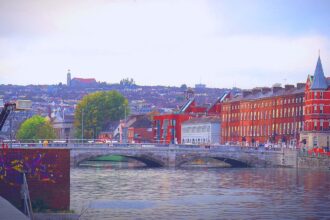
The River Lee is the reason Cork looks and feels the way it does. Flowing 90 kilometres (56 miles) from its source in the Shehy Mountains to Cork Harbour, the river splits into two channels as it reaches the city, creating the island on which Cork’s entire historic centre sits. That split geography is why the city is criss-crossed by so many crossings, 42 bridges span the Lee in total, with 29 of them within Cork city itself.
For a proper riverside walk, head west from the city centre along the Mardyke towards Fitzgerald’s Park, an 18-acre Victorian park named after Lord Mayor Edward Fitzgerald in 1901. Inside you’ll find the free-to-enter Cork Public Museum, sculptures by Cork-born artist Seamus Murphy including a well-known bust of Michael Collins, and riverside paths that lead further out to the open green space of the Lee Fields, popular with joggers and dog walkers year-round. The park is free too, and the museum opens Tuesday to Friday from 10am to 4pm, Saturday from 11am to 4pm and, between May and September, Sunday from 2pm to 4pm. Allow one to two hours for the walk out along the Mardyke and back with a stop inside.
Back in the centre, the quays along both channels make for an easy, flat evening stroll, past converted warehouses, university buildings and the elegant curve of the South Mall. Cork’s history of flooding, its streets have flooded more than 100 times since the mid-19th century, is a direct legacy of this watery geography, and it’s part of what gives the city its distinctly Venetian, low-lying charm.
Compare routes and fares for your journey to Ireland.
Compare flightsUse an eSIM to get online without hunting for a local SIM after arrival.
See eSIM optionsHave a private airport pickup arranged before you travel.
Book a transferDiscover Crawford Art Gallery
The Crawford Art Gallery is Cork’s leading fine art collection, housed in a building with roots going back to 1850, when it began life as the Cork School of Design. It was extended in the 1880s with funding from the Crawford family of local brewers, becoming the Crawford School of Art in 1885, before the building transitioned to gallery and museum use from 1979 onward. It was formally designated a National Cultural Institution in 2006, and in its last full year before closure welcomed 265,438 visitors in 2019 alone.
Among its most striking holdings are a set of plaster casts of classical Greek and Roman statues by the sculptor Antonio Canova, brought to Cork directly from the Vatican in 1818. The wider permanent collection spans work by William Orpen, Jack B. Yeats, Cork-born sculptor John Hogan, stained-glass master Harry Clarke and photographer Bob Carlos Clarke.
Important to know before you plan a visit: the gallery closed its doors in September 2025 for a major €93 million redevelopment, and it isn’t expected to reopen until before Christmas 2028. It’s still very much worth knowing about, and worth building into a future trip, but for now the collection is offsite and the building itself is a construction site. Keep it on your radar for when it reopens, and in the meantime admire the gallery’s handsome exterior on Emmet Place as you pass by, or see Harry Clarke’s stained glass at the Honan Chapel, covered earlier in this guide.
Browse St Patrick’s Street
St Patrick’s Street, universally known to locals simply as Patrick’s Street or “Pana,” is Cork’s principal shopping thoroughfare, and its distinctive curved shape has a very literal explanation: it was built directly over a former channel of the River Lee. The varying width of that old waterway is why the street bends and widens as it runs from Patrick’s Bridge down towards the Grand Parade, giving it a shape unlike almost any other Irish high street.
Much of what you see today dates from a major rebuilding period in the early 20th century, after the street was heavily damaged during the Burning of Cork on the night of 11 to 12 December 1920, when British forces set fire to shops including the Munster Arcade and Grant’s department store. The rebuilt street, completed through the 1920s, blends Art Deco influences with earlier 18th and 19th-century buildings, giving it a streetscape that still turns heads among architecture fans.
Today it’s home to the big international retailers alongside independent Cork institutions, and it links directly to the pedestrianised lanes around Oliver Plunkett Street and French Church Street, where you’ll find most of the city’s independent boutiques and coffee shops. At roughly 500 metres from Patrick’s Bridge down to the Grand Parade, and repaved in 2004 with widened pavements and pedestrian plazas, it’s an easy, flat walk from one end to the other. Browsing costs nothing beyond whatever you buy, 30 to 60 minutes is about right for a full pass along it, and it makes a natural spine to build the rest of your day’s wandering around.
See the City on a Hop-On Hop-Off Bus
For a fast overview of Cork before deciding where to spend more time, the city’s open-top hop-on hop-off bus tour covers most of the sights in this guide in a single loop. Bright red double-decker buses depart from a stop on Grand Parade outside Cork City Library, running roughly every 20 to 30 minutes with a first departure around 9:30am, and a 24-hour ticket lets you get off and back on as many times as you like.
The route takes in Cork City Gaol, St Anne’s Church at Shandon, University College Cork, Crawford Art Gallery, St Patrick’s Street, McCurtain Street’s Victorian Quarter, Kent Train Station and St Patrick’s Quay, with a recorded commentary running throughout and drivers often adding their own local colour on top. It is a genuinely useful option for visitors with limited time, arriving by cruise ship through Cobh, or anyone who would simply rather get their bearings from an open top deck before exploring specific sights on foot.
Tickets cost in the region of €20 to €23 (£17 to £20 / $23 to $27) for a 24-hour pass, with concessions available for students and seniors, and the buses are wheelchair accessible. It is worth checking with the driver for the last departure time of the day, since this can shift slightly depending on the season.
Take a Cork Harbour Scenic Cruise
Cork Harbour is one of the largest natural harbours in the world, and the view from the water is genuinely different to anything you’ll see walking the city’s quays. A 2-hour guided Cork Harbour scenic cruise departs from the city and takes in the full sweep of the harbour, including views of Cobh’s cathedral spire, Spike Island and the naval and merchant shipping history that has shaped this stretch of coastline for centuries.
A guide narrates the cruise throughout, covering everything from the harbour’s role as the final port of call for the Titanic in 1912 to its long naval and maritime trading history, making it a genuinely informative couple of hours rather than just a scenic boat ride. It is a particularly good option for anyone who has already explored the city on foot and fancies a change of pace and perspective for an afternoon.
Booking ahead online is worth doing, particularly in peak summer months, and it pairs naturally with a day trip out to Cobh itself, covered in full in our Day Trips from Cork guide.
Experience Cork’s Food Scene
Cork calls itself Ireland’s food capital, and it has the credentials to back it up. The city and county account for roughly one fifth of Ireland’s Michelin-starred restaurants, an extraordinary concentration for a place this size, built on a foundation of exceptional local produce pulled straight from the English Market and the surrounding countryside and coastline.
Within the city itself, chef Takashi Miyazaki’s Ichigo Ichie, tucked away on Sober Lane, held a Michelin star for its refined Japanese kaiseki cooking before reinventing itself as a more casual bistro and natural wine bar, now recognised with a Michelin Bib Gourmand. Elsewhere in the city, Bib Gourmand listings reward relaxed, produce-driven spots serving everything from modern Irish cooking to seafood-forward small plates, proof that Cork’s food reputation isn’t confined to special-occasion dining.
For a more everyday taste of the city, graze your way through the English Market itself, still the best single introduction to Cork’s food culture, or head to the surrounding streets around French Church Street and MacCurtain Street, where a dense cluster of independent cafés, wine bars and restaurants has grown up in recent years. Costs run the whole range, from a few euro for a market lunch to a full tasting menu, so this is one to budget by venue rather than by the city, and it is worth setting aside half a day or a full evening to do it properly. Whatever your budget, food in Cork is rarely an afterthought, it’s usually the main event.
Enjoy Cork After Dark
Cork’s pub scene runs deep, and few venues capture that better than Sin É, a traditional pub on Coburg Street that has stood since 1889 and has hosted live Irish traditional music every week for well over 50 years. Sessions run nightly from around 6pm, and the pub has been voted one of the best places in the world to spend St Patrick’s Day. It’s an essential stop for anyone wanting to hear proper trad music in an unpretentious setting rather than a tourist-oriented show.
On the brewing side, the Franciscan Well Brewery on the North Mall has been pouring its own craft beer since 1998, on a site that once housed a Franciscan monastery founded in 1219, whose old well still sits in the beer garden today. By 2018 the brewery was producing around 90,000 kegs a year, and its beer garden remains one of the most relaxed spots in the city for a summer evening pint.
For a more formal night out, Cork Opera House traces its roots to 1855, when it opened as the Athenaeum, before a fire destroyed the original building in December 1955. Its modern replacement opened in October 1965 and now seats around 1,000 people in its main auditorium, alongside the smaller 100-seat Half Moon Theatre, which hosts everything from comedy to live music. Pubs and trad sessions are free to walk into, with only the price of a drink to pay, while theatre and concert tickets vary by show, and an evening taking in a session, a pint and a performance realistically runs to three or four hours. Between theatre, trad sessions and craft beer, Cork’s evenings are every bit as rewarding as its daytime attractions.
Compare hostels and lower-cost places to stay in Ireland.
Search hostelsAccess compensation support, eligible lounge benefits and faster payouts when flights go wrong.
See the benefitsLeave your luggage somewhere convenient and enjoy Ireland hands-free.
View storagePlanning the Perfect Visit
Cork is a genuinely compact city, and its main attractions, the English Market, Shandon, the Gaol and Patrick’s Street, all sit within about a 20-minute walk of one another, so a focused visit of two full days is enough to cover everything in this guide comfortably, with a third day useful if you want a slower pace, extra time in the pubs and restaurants, or a scenic harbour cruise. Spring and early autumn tend to offer the most reliable balance of mild weather and thinner crowds, though Cork’s food and pub culture make it a genuinely enjoyable city break at any time of year.
If you have extra time on top of exploring the city itself, Cork makes an excellent base for exploring further afield. Places like Kinsale, Blarney and the wider county coastline are all within easy reach, and our Day Trips from Cork guide runs through the best options depending on how much time you have and whether you’re travelling by car or public transport.

Rupert’s Handy Travel Tips
Cork is small enough to explore on foot, so pack comfortable shoes and let the city’s hills and river bends do the work of guiding you.
- Go early to the English Market: arrive before 10am on a Saturday to browse the stalls before the crowds build up.
- Mind the hills around Shandon: the northside streets leading up to St Anne’s Church are steep, so pace yourself on the walk up.
- Book Cork City Gaol tickets online: it can get busy with school groups on weekday mornings, so an early or late slot is quieter.
- Check the Crawford Art Gallery’s status before visiting: the gallery is closed for redevelopment until 2028, so don’t build a trip around it just yet.
- Use the hop-on hop-off bus on your first morning: it’s a quick way to get your bearings before deciding which sights to explore properly on foot.
- Carry cash for smaller stalls: most English Market traders take cards now, but a few of the smaller ones still prefer cash.
Want to meet the reindeer behind our travel tips? Find out more in our page Who is Rupert?.




Frequently Asked Questions
Is the English Market free to enter?
Yes, there’s no admission charge to walk around the English Market, you simply pay for whatever food or drink you buy from the individual stalls.
How many days do I need in Cork?
Two full days is enough to see the highlights covered in this guide, including the English Market, Shandon Bells, Cork City Gaol and Patrick’s Street, with a third day useful if you want to slow down or add a day trip.
Is Cork City Gaol suitable for children?
Yes, it’s a family-friendly museum rather than a working prison, with a child ticket priced at €7.50 (£6.50 / $8.50) and a family ticket at €37 (£32 / $43), though very young children may find some of the cell displays a little intense.
Can I still visit the Crawford Art Gallery in 2026?
No, the gallery closed in September 2025 for a major redevelopment and isn’t expected to reopen until before Christmas 2028, so it’s worth checking its status again closer to any future visit.
Is the hop-on hop-off bus worth it in a city as walkable as Cork?
It’s most useful on your first morning to get orientated, or if you have very limited time, since it covers most of the city’s main sights in a single loop. Cork itself is compact enough to explore fully on foot after that.
How far is Cork Airport from the city centre?
Cork Airport is around 6.5 kilometres (four miles) south of the city centre, and our Cork Airport Transfers guide covers all the transport options for getting into town.
Further Reading
If you’re still working out how to get from the runway into the city, our Cork Airport Transfers guide breaks down every taxi, bus and transfer option available, along with realistic journey times so you can plan your arrival with confidence.
Once you’ve covered the city itself, it’s worth thinking about what lies beyond it. Our Day Trips from Cork guide rounds up the best excursions within easy reach, from harbour towns to castles, for travellers who have a bit of extra time built into their itinerary.
And if Cork is your gateway to exploring further along the coast, our Wild Atlantic Way Guide is the natural next stop, covering the full route north from West Cork all the way to Donegal for anyone extending their trip beyond the city.
If your trip continues elsewhere in Ireland, our Ireland Rail Network guide explains how Cork connects to Dublin, Galway and the rest of the country by train.