Reviewed by our editorial team Updated
Pompeii: A City Frozen in Time
Few places anywhere in the world allow you to step so completely into the past as Pompeii. Rather than looking at isolated ruins or reconstructed buildings, you’re walking through an entire Roman city, complete with streets, houses, temples, bakeries, bathhouses, theatres and marketplaces that were suddenly frozen in time when Mount Vesuvius erupted in AD 79. It is this remarkable level of preservation that makes Pompeii one of the world’s greatest archaeological sites and one of Italy’s most visited attractions.
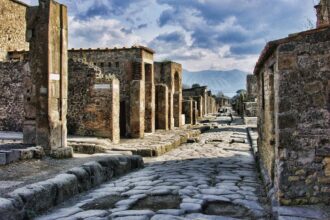
Unlike many ancient cities that evolved over centuries, Pompeii’s destruction preserved a unique snapshot of everyday Roman life. Walking along the original stone streets, you’ll see the worn cart tracks left by ancient wagons, public drinking fountains that once supplied fresh water, election slogans still painted on walls and homes decorated with colourful frescoes that have survived for almost two thousand years. Even ordinary details, such as bakeries with bread still inside ovens, wine bars and small family homes, help visitors appreciate that Pompeii wasn’t simply a collection of monuments but a thriving community.
The site is also remarkable for its emotional impact. The famous plaster casts of victims, created by filling the cavities left in the volcanic ash, provide an incredibly moving reminder that this was a real city inhabited by thousands of people whose lives were changed forever within a matter of hours. Combined with the ever-present silhouette of Mount Vesuvius rising above the ruins, it’s impossible not to reflect on the immense power of nature and the fragility of even the most prosperous civilisations.
Recognising its exceptional historical importance, Pompeii was inscribed as a UNESCO World Heritage Site in 1997, alongside nearby Herculaneum and the archaeological area of Torre Annunziata. Today it welcomes millions of visitors every year, making it one of the most important cultural attractions not only in Italy but anywhere in Europe.
Whether you’re fascinated by Roman history, archaeology, engineering or simply want to experience one of the world’s greatest historical sites for yourself, Pompeii rarely disappoints. Few places combine such extraordinary historical significance with such accessible, immersive exploration, allowing visitors to spend several hours wandering through streets that have remained largely unchanged since the first century AD.
UNESCO World Heritage Status
In 1997, Pompeii, together with Herculaneum and the archaeological sites of Torre Annunziata, was designated a UNESCO World Heritage Site. The inscription recognised not only the extraordinary preservation of the ancient cities but also their unparalleled contribution to our understanding of Roman civilisation.
UNESCO describes Pompeii as one of the world’s most complete surviving examples of an ancient urban settlement. Unlike many archaeological sites where only monumental buildings remain, Pompeii preserves an entire community, from elegant villas and temples to bakeries, taverns, workshops and ordinary family homes. This exceptional level of preservation provides historians, archaeologists and visitors with an incredibly detailed picture of everyday life during the Roman Empire.
The designation also acknowledges the site’s continuing importance for archaeological research. Excavations continue to reveal new discoveries, with remarkably preserved frescoes, inscriptions, mosaics and household objects still being uncovered today. Modern conservation now places greater emphasis on preserving existing remains rather than exposing new areas, ensuring future generations can continue to experience Pompeii much as visitors do today.
UNESCO status brings international recognition but also significant responsibilities. The archaeological park is carefully managed to balance conservation with the needs of the millions of visitors who explore the city every year. Measures such as timed entry tickets, daily visitor limits and ongoing restoration projects all help protect this irreplaceable site while allowing people from around the world to experience one of history’s greatest surviving cities.
Standing among Pompeii’s remarkably preserved streets, it’s easy to understand why UNESCO considers it a place of Outstanding Universal Value. Few locations anywhere on Earth allow you to walk so directly through the daily lives of people who lived two millennia ago, making Pompeii not only one of Italy’s greatest treasures but one of humanity’s most important cultural landmarks.
Learn More from UNESCO
This destination is connected to a UNESCO World Heritage Site, recognised for its outstanding cultural, historical, or natural importance. You can explore official listings, background information, and protected heritage sites through UNESCO’s global database.
Compare hotels and other places to stay for your trip.
Check availabilityBrowse apartments, homes and self-catering accommodation.
Browse rentalsCompare hotel deals from multiple booking sites in one search.
Compare pricesPompeii by the Numbers
Understanding Pompeii’s remarkable scale helps explain why it remains one of the world’s most important archaeological sites. These figures highlight both the size of the ancient city and the extraordinary effort that has gone into preserving it for future generations.
| Fact | Details |
|---|---|
| Founded | Around the 7th–6th century BC |
| Destroyed by Vesuvius | AD 79 |
| UNESCO World Heritage Site | Since 1997 |
| Excavated Area | Approximately 44 hectares |
| Estimated Population | Around 11,000–12,000 people |
| Annual Visitors | More than 4 million |
| Time Needed to Visit | 3–4 hours for highlights, 5–6 hours for a more complete visit |
| Number of Buildings Excavated | Over 1,000 |
| Length of Streets | Several kilometres of walkable Roman roads |
| Distance from Naples | Around 25 km |
| Distance from Sorrento | Around 17 km |
| Nearest Station | Pompei Scavi – Villa dei Misteri |
| Visitor Cap | Approximately 20,000 visitors per day (timed entry applies during busy periods) |
These numbers only tell part of the story. What makes Pompeii so extraordinary isn’t simply its size, but its remarkable level of preservation. Unlike many ancient sites where only foundations remain, visitors can still walk through complete streets, enter homes decorated with colourful frescoes, stand inside Roman bathhouses and theatres, and see everyday objects left behind nearly two thousand years ago. It’s this unique combination of scale, authenticity and preservation that makes Pompeii unlike any other archaeological site in Europe.
Pompeii at a Glance
Before working through Pompeii’s full story in detail, it genuinely helps to see the essential facts at a glance, given how much history, from its founding centuries before Rome’s rise to its eventual rediscovery, genuinely lies behind this single archaeological site.
Given how many distinct chapters make up Pompeii’s story, from its origins as a Samnite and Roman settlement through catastrophe and centuries of obscurity to modern excavation, understanding this timeline before exploring the ruins themselves genuinely enriches what you’ll see on the ground.
The table below groups the key historical milestones and practical facts, giving you a realistic starting point before reading the detailed sections that follow on the eruption itself, the site’s rediscovery, and how to actually visit today.
Use this table as a quick reference, then read on for genuinely useful detail on Pompeii’s history, layout and how best to reach the site from wherever your trip begins.
| Date | Milestone |
|---|---|
| 7th-6th century BC | Founded by the Osci near the Sarno River |
| 80 BC | Becomes a Roman colony after Sulla’s siege |
| 62 AD | Major earthquake damages the city |
| 24 August 79 AD | Mount Vesuvius erupts, burying Pompeii |
| 1599 | Accidental rediscovery by Domenico Fontana |
| 1748 | Systematic excavation begins |
| 1863 | Fiorelli introduces the plaster cast technique |
| 1997 | Inscribed as a UNESCO World Heritage Site |
From Roman Port to Buried City: A Brief History
Pompeii’s story genuinely began centuries before its famous destruction, founded around the seventh or sixth century BC by the Osci, an indigenous Italic people who recognised the strategic value of a hill overlooking the mouth of the Sarno River. This position genuinely made the settlement an important trading node between the coast and inland Campania.
Over the following centuries, Pompeii genuinely passed through the hands of several successive powers, with Greeks, Etruscans and Samnites all attempting to control the increasingly prosperous town before it eventually became a Roman colony in 80 BC, following a siege by the forces of Sulla. Renamed Colonia Cornelia Veneria Pompeianorum, the city entered its most prosperous period under Roman rule.
Given its position within the fertile Bay of Naples region, Pompeii genuinely flourished as a wealthy resort town, its streets lined with elegant villas, thriving businesses and public buildings reflecting the considerable prosperity of its roughly eleven thousand residents. A devastating earthquake in 62 AD damaged much of the city, with reconstruction still genuinely underway when catastrophe struck less than two decades later.
Given how much civic pride and investment genuinely went into rebuilding after the earthquake, the tragic irony of Pompeii’s story is that its citizens were actively renewing their city right up until the moment Vesuvius erupted, believing themselves to be recovering rather than facing an even greater disaster.

The Eruption of 79 AD
The eruption of Mount Vesuvius on 24 August 79 AD genuinely stands as one of history’s most thoroughly documented natural disasters, thanks almost entirely to the eyewitness account of Pliny the Younger, who watched the catastrophe unfold from across the bay and later described it in letters to the historian Tacitus. His account remains the only surviving eyewitness record, and volcanologists still use the term “Plinian eruption” in his honour.
Within roughly twenty four to thirty hours, Pompeii genuinely lay buried beneath four to six metres of ash, pumice and volcanic debris, a catastrophic sequence beginning with a column of pumice raining down before deadly pyroclastic flows swept through the streets. Approximately two thousand of the city’s eleven thousand residents genuinely perished, many overcome by the intense heat rather than surviving long enough to suffocate.
The eruption’s aftermath genuinely reshaped the entire landscape, with the coastline receding several kilometres and the Sarno River altering its course entirely, forcing the handful of surviving residents to relocate elsewhere rather than attempt to rebuild. Survivors and opportunistic looters did tunnel into the buried ruins in the immediate aftermath, recovering some valuables before the site genuinely faded from memory.
Given how completely the eruption genuinely erased Pompeii from the landscape, knowledge of its exact location gradually disappeared over the following centuries, with only a dim local folk memory of “La Civita,” or “the city,” surviving in the area above the buried ruins.
Rediscovery: From Accident to Excavation
Pompeii’s rediscovery genuinely began by accident, when the architect Domenico Fontana stumbled upon ancient walls and frescoes in 1599 while digging an underground water channel, though he failed to recognise their genuine significance at the time. Nearly one hundred and fifty years would pass before anyone properly investigated the buried city beneath.
Systematic excavation genuinely began in 1748, commissioned by King Charles III of Bourbon and directed by the Spanish engineer Rocque Joaquin de Alcubierre, though these early efforts functioned essentially as treasure hunts aimed at recovering artefacts for the royal collection rather than understanding the site scientifically. An inscription discovered in 1763 finally confirmed the ruins genuinely were Pompeii.
The site’s modern scientific era genuinely began in 1860, when Giuseppe Fiorelli became director of excavations and introduced the systematic regio and insula numbering system still used to navigate the site today. Fiorelli’s most celebrated innovation, developed in 1863, involved pouring plaster into voids left by decomposed bodies within the hardened ash, creating the hauntingly lifelike casts of victims that remain among Pompeii’s most powerful and recognisable images.
Excavations continued genuinely expanding throughout the twentieth century, with archaeologist Amedeo Maiuri leading extensive work between 1924 and 1961 that uncovered the celebrated Villa of the Mysteries, before the site was formally recognised as a UNESCO World Heritage Site in 1997.
How to Get to Pompeii
One of the reasons Pompeii is such a popular day trip is that it’s incredibly well connected. Whether you’re staying in Naples, Sorrento, Rome or elsewhere in Campania, there are several straightforward ways to reach the archaeological park, making it easy to include in almost any itinerary.
For most visitors, the easiest option is the Circumvesuviana Railway, which runs directly between Naples, Herculaneum, Pompei Scavi – Villa dei Misteri and Sorrento. Trains operate frequently throughout the day, with the station located only a minute or two from the site’s main Porta Marina entrance. It’s inexpensive, reliable and by far the transport method used by the majority of independent travellers.
If you’d prefer a more comfortable journey, the Campania Express follows the same route but offers reserved seating, air conditioning and luggage space. Although tickets cost more than the ordinary Circumvesuviana, many visitors appreciate the quieter carriages and guaranteed seat, particularly during the busy summer season.
Visitors arriving from Rome usually take a high-speed Trenitalia or Italo train to Naples Central Station, before transferring to either the Circumvesuviana or Campania Express for the final part of the journey. The entire trip typically takes around two and a half hours, making Pompeii perfectly achievable as a long but rewarding day trip from the Italian capital.
Another popular option is joining an organised tour, particularly from Naples, Sorrento or the Amalfi Coast. These often include return transport, entrance tickets and an expert guide, with many combining Pompeii with Mount Vesuvius, Herculaneum or a local vineyard in a single day.
It’s also perfectly possible to reach Pompeii by taxi, private transfer or hire car. Parking is available close to the archaeological park, although traffic around the site can become heavy during weekends and throughout the summer months. Unless you’re planning to continue elsewhere afterwards, public transport is usually the simpler option.
Whichever method you choose, remember that the station closest to the ruins is Pompei Scavi – Villa dei Misteri. Don’t confuse it with the separate Pompei station on the national railway network, which serves the modern town and leaves you with a considerably longer walk to the archaeological entrance.
If you’re exploring Campania as part of a longer rail holiday, it’s also worth checking whether the Italia in Tour pass could save you money. The pass offers unlimited travel on many regional trains across Italy, including Trenitalia regional services to Pompei station from cities such as Naples, Salerno and beyond. However, it’s important to remember that Italia in Tour is not valid on the Circumvesuviana Railway, which is operated separately by EAV. If you’re travelling from Sorrento or using the Circumvesuviana from Naples, you’ll still need to buy a separate ticket for that part of your journey.
Search routes and flight options for your journey.
Search flightsChoose an Airalo eSIM and arrange mobile data before you arrive.
Browse eSIMsBook a private airport transfer in advance and have your ride planned before you arrive.
Check transfersReaching Pompeii from Italy’s Major Cities
Pompeii is one of Italy’s easiest archaeological sites to reach thanks to its excellent rail connections. While visitors staying in Naples or Sorrento can arrive in well under an hour, high-speed trains also make day trips possible from cities much further afield. Use the table below as a quick guide before reading the detailed transport advice later in this guide.
| Departure City | Typical Journey Time | Direct? | Changes Required |
|---|---|---|---|
| Naples | 35–40 mins | Yes (Circumvesuviana/Campania Express) | None |
| Sorrento | 30–35 mins | Yes (Circumvesuviana/Campania Express) | None |
| Salerno | 35–45 mins | Yes (Regional Train) | None |
| Rome | 2 hrs 20 mins–2 hrs 45 mins | No | 1 change in Naples |
| Florence | 4 hrs 15 mins–5 hrs | No | 1–2 changes |
| Bologna | 4 hrs–4 hrs 45 mins | No | 1 change in Naples |
| Milan | 5 hrs 15 mins–6 hrs | No | 1 change in Naples |
| Venice | 6 hrs–7 hrs | No | 1–2 changes |
| Bari | 3 hrs 45 mins–4 hrs 30 mins | No | Usually 1 change in Naples or Salerno |
| Reggio Calabria | 4 hrs 30 mins–5 hrs 30 mins | No | Usually 1 change in Salerno or Naples |
Good to know: If you’re arriving by regional Trenitalia services, you’ll normally use Pompei station in the modern town. If you’re travelling on the Circumvesuviana or Campania Express, you should leave the train at Pompei Scavi – Villa dei Misteri, which is the station closest to the archaeological park’s main entrance.
Buying Tickets, Visitor Limits and the Campania Artecard
Planning your visit to Pompeii has become slightly more important in recent years, as the archaeological park now operates a daily visitor limit alongside timed entry tickets during the busiest periods. While it’s still perfectly possible to buy tickets on the day outside the peak season, visitors travelling between March and October, during school holidays or on weekends are strongly advised to book in advance to guarantee entry.
Standard adult admission is typically around €18–23, although prices can vary depending on temporary exhibitions and special events. Reduced admission is available for eligible EU citizens aged 18 to 25, while visitors under 18 generally receive free entry on presentation of valid identification. Tickets can be purchased through the official Pompeii website, authorised ticket partners or as part of many organised tours.
If you’re planning to visit several attractions across Campania, it’s also worth considering the Campania Artecard. Depending on the version you purchase, the pass includes free or discounted admission to Pompeii along with dozens of other attractions such as Herculaneum, the National Archaeological Museum of Naples, Castel Sant’Elmo and the Royal Palace of Caserta. For visitors spending several days exploring the region, the Artecard can offer excellent value while simplifying ticket purchases throughout your trip.
Visitors travelling around Italy on regional trains may also come across the Italia in Tour rail pass. While this can represent excellent value for journeys on Trenitalia Regional services, it’s important to remember that it does not cover the Circumvesuviana Railway, which is operated separately by EAV. If you’re travelling from Sorrento or using the Circumvesuviana from Naples, you’ll still need to purchase a separate railway ticket for that part of the journey.
Although tickets are sometimes available at the entrance, booking online remains the safest option during the busy tourist season. Not only does this guarantee your preferred entry time, but it also allows you to begin exploring almost immediately rather than spending valuable sightseeing time queuing at the ticket office.
Beware of Unofficial Guides and Ticket Sellers
As one of Italy’s most visited attractions, Pompeii inevitably attracts a number of unofficial guides and ticket sellers around the entrances. Most visitors have no problems whatsoever, but understanding how the system works before you arrive will help you avoid unnecessary expense and confusion.
The first thing many visitors notice when leaving Pompei Scavi – Villa dei Misteri station is a kiosk advertising itself as a tourist information point. Despite its appearance, this is not an official Pompeii visitor centre but a private business selling tours and other travel services. While there’s nothing inherently wrong with booking through private operators, it’s important to understand that you aren’t speaking to official archaeological park staff.
You may also encounter individuals approaching visitors offering guided tours, skip-the-line tickets or discounted admission. Some are fully licensed guides, while others are not. If you decide to join a guided tour, it’s always worth booking through a recognised company in advance or using one of the officially authorised guides operating inside the archaeological park. This ensures you’re receiving accurate historical information while avoiding any uncertainty over pricing or legitimacy.
Official entrance tickets should always be purchased through the Pompeii Archaeological Park, authorised ticket partners or as part of a reputable organised tour. Avoid anyone claiming they can bypass the official visitor limits or provide access outside the normal ticketing system, as legitimate entry is always controlled through the site’s official procedures.
Fortunately, the vast majority of visitors experience no issues at all. A little preparation, booking tickets in advance and politely declining unsolicited approaches means you can begin your visit with confidence and focus on exploring one of the world’s greatest archaeological sites rather than worrying about who to trust.
Should You Join a Guided Tour?
Pompeii is one of those rare attractions that can be enjoyed in several different ways. Some visitors love the freedom of wandering independently with a guidebook or audio guide, while others prefer having an expert archaeologist explain the stories hidden behind the ancient streets, houses and temples. Neither approach is wrong; it simply depends on the type of experience you’re looking for.
Exploring independently gives you complete flexibility. You can spend as long as you like photographing the Forum, linger inside beautifully preserved villas or simply wander down quiet side streets imagining what daily life was like nearly two thousand years ago. Picking up a map at the entrance or downloading the official guide before you arrive allows you to explore entirely at your own pace.
A guided tour, however, adds an extra layer of understanding that’s difficult to achieve alone. Experienced guides explain the significance of the buildings, point out details that many visitors walk straight past and bring the city’s inhabitants back to life through stories of merchants, politicians, gladiators and ordinary families. Rather than seeing a collection of ancient ruins, you’ll begin to understand how Pompeii actually functioned as a living Roman city.
Many organised tours also remove much of the practical planning. Return transport from Naples, Sorrento or the Amalfi Coast, pre-booked admission tickets and carefully planned walking routes allow you to concentrate entirely on the experience rather than navigating logistics. Some excursions even combine Pompeii with Mount Vesuvius, Herculaneum or a local vineyard, creating a memorable full-day experience.
If you have a strong interest in Roman history or archaeology, we’d recommend joining a guided tour or hiring an official guide for at least part of your visit. If you simply want to explore at your own pace, Pompeii is equally rewarding independently. Whichever option you choose, allowing at least three to four hours inside the archaeological park will ensure you experience far more than just the headline attractions.
Planning Your Route Around Pompeii
One of the biggest mistakes first-time visitors make is assuming they can simply wander through Pompeii and somehow see everything. In reality, the archaeological park covers around 44 hectares, with miles of ancient streets, hundreds of buildings and countless fascinating details. Even spending an entire day here won’t allow you to explore every corner, so having a rough plan before you arrive will make your visit far more rewarding.
For most visitors, three to four hours is enough to experience Pompeii’s essential highlights without feeling rushed. This allows time to explore the Forum, visit several of the city’s best-preserved houses, walk along the Via dell’Abbondanza, see the Stabian Baths, admire the famous plaster casts in the Garden of the Fugitives and finish at the spectacular Villa of the Mysteries if time allows. Those with a particular interest in Roman history could easily spend five to six hours exploring in greater detail.
If you’re arriving via the Circumvesuviana or Campania Express, you’ll usually enter through Porta Marina, the entrance closest to Pompei Scavi – Villa dei Misteri station. From here, most visitors naturally reach the Forum first before gradually working their way east through the city. This route avoids unnecessary backtracking and places many of Pompeii’s best-known attractions in a logical order.
Don’t try to visit every building you pass. Many houses look similar from the outside, and it’s far better to spend time appreciating Pompeii’s most significant sites than rushing through dozens of smaller rooms simply to cover more ground. Taking regular breaks, refilling your water bottle at the free drinking fountains and occasionally sitting in the shade will also make the experience considerably more enjoyable, particularly during the hotter summer months.
If you’re planning to combine Pompeii with Mount Vesuvius or Herculaneum on the same day, it’s even more important to prioritise your route. Focus on the headline attractions first so that, if you’re running short of time later in the afternoon, you won’t miss the sites that make Pompeii one of the world’s greatest archaeological treasures.
The Forum: The Heart of Ancient Pompeii
If there is one place that every visitor to Pompeii should make their first priority, it is the Forum. This vast open square formed the political, religious, commercial and social heart of the ancient city. Much like a modern town centre, almost every aspect of daily Roman life revolved around this remarkable space. It was here that people shopped, attended religious ceremonies, conducted business, heard political speeches and gathered to celebrate important civic events. Standing here today, surrounded by remarkably preserved ruins with Mount Vesuvius rising dramatically beyond the columns, it’s easy to imagine the energy and activity that once filled this extraordinary place.
The Forum was surrounded by many of Pompeii’s most important buildings. At its northern end stood the impressive Temple of Jupiter, while nearby were the Temple of Apollo and the Temple of Venus, reflecting the enormous importance religion played within Roman society. The magnificent Basilica, one of the oldest surviving Roman civic buildings anywhere in the world, acted as the city’s law courts and business centre, while merchants traded beneath elegant colonnades lining the square.
One of the Forum’s greatest attractions today is the incredible sense of space and scale. Although many buildings survive only as walls and columns, the layout remains remarkably easy to understand. Looking across the open square towards Mount Vesuvius provides one of Pompeii’s most iconic photographs and helps visitors appreciate just how close the volcano really is. If possible, arrive early in the morning, when the softer light creates beautiful photographs and the square is still relatively quiet before the larger tour groups arrive.
Many of Pompeii’s principal streets radiate directly from the Forum, making it the perfect place to begin your exploration of the city. From here you can easily continue towards the Stabian Baths, the magnificent House of the Faun, Via dell’Abbondanza and countless other highlights without unnecessary backtracking.
Perhaps the most remarkable thing about the Forum is that it never existed as a museum or monument. It was simply the beating heart of a thriving Roman city, where ordinary people lived their lives, argued over politics, bought food, attended religious festivals and met friends. Once you begin imagining those everyday scenes, the ruins suddenly become far more than ancient stones; they become the centre of a living, breathing community frozen forever in time.
Compare hostels and budget-friendly places to stay.
Browse hostelsAccess compensation support, eligible lounge benefits and faster payouts.
See the benefitsLeave your luggage somewhere convenient and explore hands-free.
View storageThe Amphitheatre and Pompeii’s Public Buildings
While Pompeii’s elegant villas attract much of the attention, the city’s remarkable collection of public buildings reveals just as much about everyday Roman life. Together they demonstrate the wealth, ambition and sophistication of Pompeii before the eruption, showing how the city invested heavily in entertainment, culture, religion, sport and public wellbeing.
The undisputed highlight is the magnificent Amphitheatre of Pompeii, built around 70 BC and recognised as the oldest surviving Roman amphitheatre anywhere in the world. Constructed more than a century before Rome’s famous Colosseum, it could accommodate around 20,000 spectators, almost twice Pompeii’s estimated population. Gladiatorial contests, animal hunts and public spectacles attracted visitors from across the region, making it one of the city’s most important social venues.
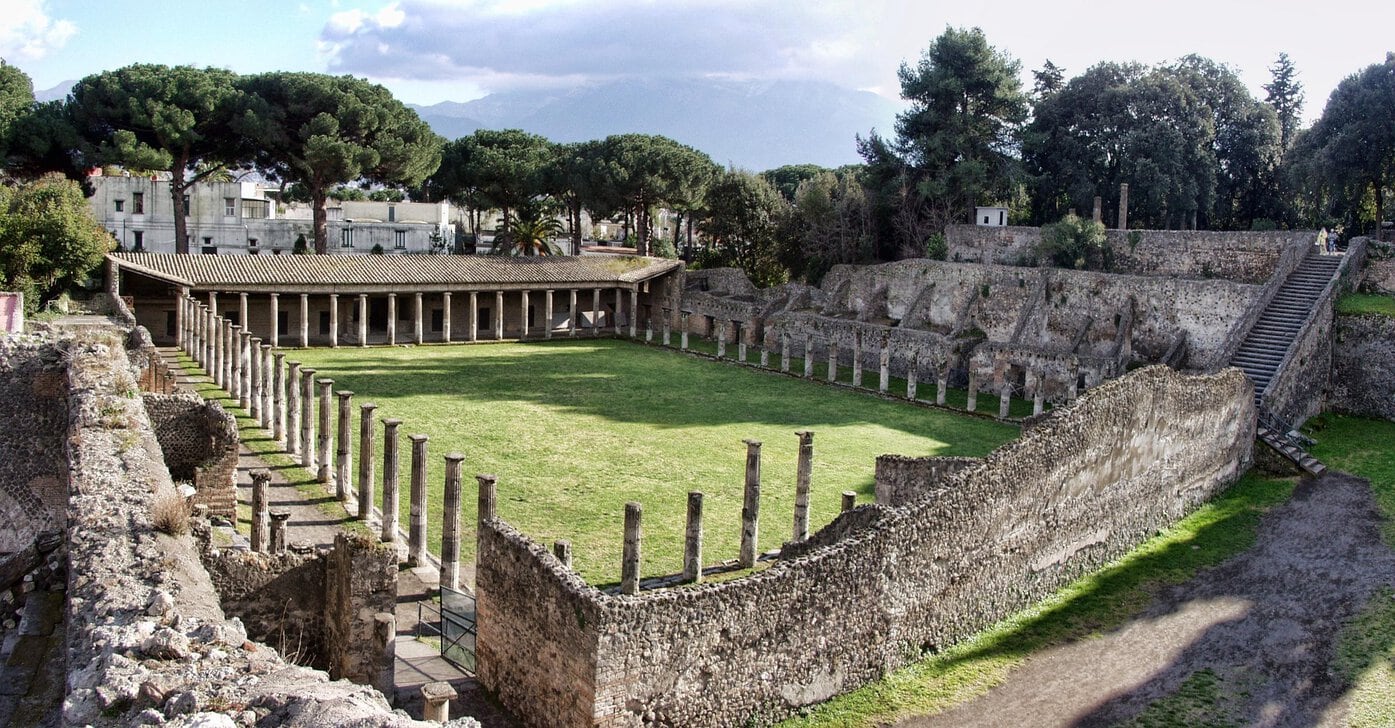
Nearby lies the vast Palestra Grande, a huge open exercise ground where young Romans trained, exercised and competed in athletic events. Today it frequently hosts temporary exhibitions that provide additional context to the archaeological discoveries throughout the site.
Pompeii also possessed two theatres, reflecting the city’s surprisingly rich cultural life. The larger theatre staged dramatic productions, musical performances and public celebrations, while the smaller Odeon, often known as the Small Theatre, hosted poetry readings, concerts and more intimate performances. Sitting among the stone seating today, it’s easy to imagine audiences gathering here nearly two thousand years ago.
Beyond these headline attractions you’ll encounter market buildings, government offices, public fountains, temples and civic monuments that once supported every aspect of Roman life. Each one tells part of the story of a prosperous provincial city whose citizens enjoyed many of the same public services and entertainments we expect today.
Walking through these public spaces helps visitors appreciate that Pompeii wasn’t simply a collection of impressive buildings. It was a living city, full of politicians, merchants, actors, gladiators, priests and ordinary families, all going about their daily routines until the eruption of AD 79 brought life to an abrupt end.
The Garden of the Fugitives
Few places within Pompeii leave as powerful an impression as the Garden of the Fugitives. While the city’s magnificent villas, temples and theatres demonstrate the achievements of Roman civilisation, this quiet corner of the archaeological park reminds visitors of the terrible human tragedy that unfolded when Mount Vesuvius erupted in AD 79. It is one of the most emotional places anywhere in Italy and an essential stop during any visit.
The garden is home to some of Pompeii’s most famous plaster casts, created using a pioneering technique developed by archaeologist Giuseppe Fiorelli during the nineteenth century. As the bodies buried beneath the volcanic ash gradually decomposed, they left hollow spaces within the hardened deposits. By carefully filling these cavities with plaster, archaeologists were able to preserve the victims’ final positions with extraordinary accuracy, creating hauntingly lifelike reminders of the disaster.
Today you can see individuals lying exactly where they fell as they attempted to escape. Some appear to be protecting loved ones, others seem to be covering their faces, while several remain frozen in the final moments of panic as devastating pyroclastic flows swept across the city. These aren’t sculptures or artistic interpretations. They are faithful casts of the spaces left by real people, making them among the most moving archaeological discoveries ever made.
The Garden of the Fugitives sits towards the eastern side of Pompeii, making it slightly quieter than the Forum during the busiest part of the day. Many visitors naturally become much quieter here, taking time to reflect on the personal stories behind the ruins they have spent the day exploring. Suddenly the elegant villas, busy streets and bustling marketplaces become something far more meaningful; they become the homes and workplaces of people whose ordinary lives were interrupted forever.
Although photography is permitted, this is one place where many visitors instinctively lower their cameras. Spending a few quiet moments here provides a powerful reminder that Pompeii isn’t simply an archaeological site or tourist attraction. It is, above all, the preserved remains of a community whose tragic story continues to resonate almost two thousand years later.
The Baths, Bakeries and Everyday Roman Life
One of the reasons Pompeii captivates visitors so completely is that it preserves far more than magnificent temples and wealthy villas. It also reveals the ordinary routines of everyday people. Walking through the city’s streets, you’ll encounter bakeries, cafés, shops, public baths, wine bars, laundries and workshops, allowing you to experience what daily life in a Roman city genuinely looked like nearly two millennia ago.
The beautifully preserved Stabian Baths are among Pompeii’s most impressive public buildings. Bathing wasn’t simply about keeping clean. The baths acted as important social centres, where people exercised, relaxed, met friends, discussed politics and conducted business. Visitors today can still identify the changing rooms, cold baths, warm rooms, steam rooms and even the sophisticated underfloor heating system, demonstrating the remarkable engineering skills of the Romans.
Elsewhere throughout Pompeii you’ll discover numerous bakeries, many still containing the original lava stone millstones used to grind flour and the ovens where fresh bread was baked each morning. Perhaps most astonishingly, archaeologists uncovered carbonised loaves of bread still sitting inside some ovens at the moment the eruption struck, creating one of the most remarkable snapshots of everyday life ever discovered.
Scattered throughout the streets are dozens of thermopolia, the Roman equivalent of today’s cafés, takeaway restaurants or street food stalls. Their distinctive stone counters, complete with large storage jars built into the surface, once served hot meals and drinks to customers who either lacked cooking facilities at home or simply wanted a quick meal while going about their day. These humble establishments demonstrate that convenience food is far from a modern invention.
Perhaps the most unexpected discoveries are the countless examples of Roman graffiti still visible on walls throughout the city. Political advertisements, election slogans, humorous messages, business notices and personal comments survive remarkably well, reminding visitors that the people of Pompeii worried about politics, work, money, relationships and everyday life just as we do today. These small details transform Pompeii from a collection of impressive ruins into a genuine city filled with real people, making it one of the most fascinating archaeological sites anywhere in the world.

Houses and Villas: Daily Life Preserved
Exploring Pompeii’s private houses and villas genuinely offers the most intimate window into ancient daily life anywhere on the site, given how remarkably well preserved many interiors genuinely remain nearly two thousand years later. The House of the Faun, among the largest and most opulent private residences ever excavated, takes its name from a bronze statue found within its elegant central courtyard.
The House of the Vettii, a merchant family’s residence, showcases genuinely extraordinary frescoes across multiple rooms, offering some of the finest surviving examples of Roman decorative painting anywhere in the ancient world. Given how vividly these interiors genuinely capture wealthy Roman taste and daily domestic routine, they consistently rank among visitors’ most memorable stops.
The Villa of the Mysteries, sitting slightly outside the main city walls, holds what many consider the single most important surviving fresco cycle from antiquity, depicting a series of genuinely mysterious ritual scenes whose exact meaning still divides scholars today. Given its distance from the main entrances, reaching it requires a little extra walking, though it consistently rewards the effort.
Beyond these headline residences, wandering the site’s more modest streets, lined with smaller workshops, bakeries and simple homes, genuinely rounds out the picture of Pompeii as a working, layered city rather than simply a collection of grand monuments.
What Should You Wear and Bring?
A visit to Pompeii involves far more walking than many people expect. The archaeological park covers around 44 hectares, with several kilometres of ancient Roman streets to explore, many of them paved with uneven volcanic stones that have survived for almost two thousand years. Wearing the right clothing and bringing a few essential items will make your visit considerably more comfortable, particularly during the warmer months.
The single most important item is a pair of comfortable walking shoes. While sandals may seem appealing during the summer, many of Pompeii’s streets are surfaced with large basalt paving stones, complete with raised kerbs, stepping stones and uneven sections polished smooth by centuries of use. Supportive trainers or walking shoes provide far better grip and comfort, especially if you’re planning to spend three to five hours exploring the site.
During the summer, temperatures regularly exceed 30°C, and much of Pompeii offers very little natural shade. A wide-brimmed hat, sunglasses and high-factor sunscreen are strongly recommended, even if you’re only planning a morning visit. The reflected heat from the ancient stone streets can make the archaeological park feel considerably hotter than nearby coastal areas.
It’s also worth bringing a refillable water bottle. Fortunately, Pompeii has numerous free drinking water fountains scattered throughout the site, allowing visitors to refill bottles without needing to purchase expensive drinks. Staying hydrated is essential, particularly between June and September, when even experienced travellers can underestimate how warm the site becomes.
A fully charged mobile phone or camera is another essential. Pompeii is one of the most photogenic archaeological sites in the world, with spectacular views towards Mount Vesuvius, beautifully preserved frescoes and countless fascinating architectural details. If you’re planning to use a digital map, audio guide or translation app, carrying a portable power bank is also worthwhile.
Finally, avoid bringing unnecessary luggage. Large bags quickly become uncomfortable after several hours of walking, and you’ll enjoy your visit much more if you’re travelling light. A small backpack containing water, sun protection, comfortable footwear and a camera is all most visitors need for an unforgettable day exploring one of the world’s greatest archaeological sites.
Food, Drink and Visitor Facilities
Given Pompeii’s size, most visitors spend at least half a day exploring the archaeological park, making it important to know what facilities are available before you arrive. Fortunately, the site is well equipped to support visitors, with cafés, toilets, drinking water, gift shops and rest areas located throughout the complex.
There are several cafés and refreshment kiosks both inside and close to the archaeological park where visitors can purchase sandwiches, pizza, salads, snacks, coffee, ice cream and cold drinks. Prices are naturally a little higher than elsewhere, but they’re generally reasonable considering the location. If you’re planning to spend the entire day exploring, stopping for lunch provides a welcome opportunity to rest your feet before continuing.
One of Pompeii’s most appreciated facilities is its network of free drinking water fountains. Fresh drinking water is available at various points throughout the site, allowing visitors to refill bottles as often as necessary. During the height of summer, these fountains are invaluable and can save both money and unnecessary plastic waste.
Toilets are available near the main entrances and at several locations within the archaeological park. They’re clearly signposted on the official visitor map, so it’s worth picking one up when you enter. Baby-changing facilities are also available in selected areas, making the site easier to visit with young children.
The archaeological park also has several gift shops selling guidebooks, maps, locally produced souvenirs, postcards and educational material. If you’re interested in learning more after your visit, these shops stock an excellent selection of books covering Roman history, archaeology and the latest discoveries from Pompeii.
Before leaving, many visitors choose to spend a little time in the surrounding modern town of Pompei, where you’ll find an even wider choice of cafés, restaurants and shops. It’s the perfect place to enjoy a relaxed meal while reflecting on everything you’ve experienced before continuing your journey through Campania.

Is Pompeii Accessible?
Considering that Pompeii preserves the original streets of an ancient Roman city, accessibility has naturally presented significant challenges. Nevertheless, the archaeological park has made enormous progress in recent years to ensure that as many visitors as possible can experience this extraordinary site, regardless of age or mobility.
The greatest obstacle is the city’s original road surface. Much of Pompeii still consists of large volcanic paving stones, uneven walkways, raised kerbs and ancient stepping stones that were designed for Roman carts rather than modern wheelchairs or pushchairs. Walking therefore requires sensible footwear and a little extra care, particularly after wet weather when some surfaces can become slippery.
To improve accessibility, Pompeii has introduced a dedicated ‘Pompeii for All’ accessible route, allowing wheelchair users and visitors with reduced mobility to reach many of the site’s principal attractions using specially prepared pathways. This route includes highlights such as the Forum, several important houses and a number of public buildings, making it possible to enjoy many of Pompeii’s greatest treasures without needing to navigate every uneven street.
Visitors travelling with pushchairs can also make use of the accessible routes, although some areas of the archaeological park remain difficult to reach due to their historic nature. Families with very young children may find a lightweight pushchair easier to manage than a larger travel system.
Accessible toilets and visitor facilities are available within the archaeological park, while staff at the entrances are happy to provide information about accessible routes and current conditions. If you have specific mobility requirements, it’s worth checking the latest accessibility information before your visit, as ongoing conservation work occasionally affects certain areas.
Although Pompeii will never be completely step-free due to its unique archaeological importance, the improvements made in recent years mean that many more people can now experience one of the world’s greatest historic sites than ever before.
Can You Visit Pompeii and Mount Vesuvius in One Day?
One of the most popular questions visitors ask is whether it’s possible to combine Pompeii with Mount Vesuvius in a single day. The simple answer is yes, and it’s one of the most rewarding day trips you can take while staying in Naples, Sorrento or elsewhere in Campania. After all, seeing both the city that was destroyed and the volcano responsible for its destruction provides a much deeper understanding of one of history’s most famous natural disasters.
The key is to start early. We’d recommend arriving at Pompeii soon after opening time and spending around three to four hours exploring the archaeological park. This gives you enough time to see the major highlights without feeling rushed before continuing to Vesuvius during the afternoon.
Reaching Mount Vesuvius usually involves taking a shuttle bus from Pompeii to the visitor car park near the summit, followed by a 20 to 30-minute uphill walk to the crater itself. The path is well maintained but fairly steep in places, so comfortable footwear and plenty of water are essential, particularly during the hotter months.
The reward is extraordinary. Standing on the rim of one of the world’s most famous volcanoes while looking down across Pompeii, the Bay of Naples, Sorrento and the surrounding countryside offers one of southern Italy’s most unforgettable panoramas. It’s also a powerful moment, allowing visitors to appreciate the immense force that reshaped the region nearly two thousand years ago.
If you’d rather not organise the logistics yourself, numerous organised tours combine Pompeii and Mount Vesuvius, including transport, entrance tickets and expert guides. These are particularly good options for first-time visitors, removing the need to coordinate trains, shuttle buses and ticket reservations while ensuring you make the most of both remarkable destinations.
Can You Visit Pompeii and Herculaneum in One Day?
Absolutely. In fact, visiting Pompeii and Herculaneum on the same day is one of the best ways to understand the devastating impact of the AD 79 eruption of Mount Vesuvius. Although both cities were destroyed by the same volcanic event, they tell two very different stories and complement each other perfectly. If you have a full day available, combining the two creates one of the most rewarding historical experiences anywhere in Italy.
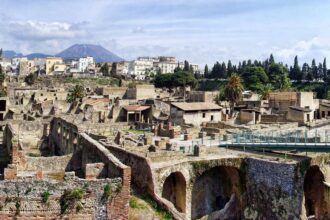
While Pompeii impresses through its sheer size, public buildings and remarkably complete street network, Herculaneum offers a much more intimate experience. The smaller site is exceptionally well preserved, with many buildings surviving to their original height. Visitors can admire wooden doors, balconies, roof structures, colourful frescoes and intricate mosaics that rarely survive elsewhere in the Roman world. Exploring both sites allows you to appreciate how differently they were buried and preserved during the eruption.
The logistics are surprisingly straightforward. Both archaeological parks are served by the Circumvesuviana Railway and the more comfortable Campania Express, making it easy to travel between them without needing a car. Most visitors begin at Pompeii, spending around three to four hours exploring the larger site before continuing to Herculaneum, where two to three hours is usually enough to see the principal highlights. Travelling between the two takes only around 20 minutes by train.
If you’re travelling from Naples, Sorrento or elsewhere in Campania, this combination makes excellent use of your day. Many organised excursions also include both archaeological sites with an expert guide, while some extend the itinerary even further by adding a visit to Mount Vesuvius or a local vineyard.
Although it makes for a full day of sightseeing, combining Pompeii and Herculaneum provides a much richer understanding of Roman life than visiting either site alone. If you have enough time during your holiday, we’d strongly recommend experiencing both. Together they tell one of history’s most remarkable stories and rank among the greatest archaeological treasures anywhere in the world.

Is Pompeii Worth Visiting?
With millions of visitors every year, it’s perfectly reasonable to wonder whether Pompeii genuinely deserves its reputation as one of Italy’s greatest attractions. After spending even a few hours wandering its remarkably preserved streets, the answer quickly becomes clear. Yes, without question.
What makes Pompeii truly exceptional isn’t simply its age or historical importance. It’s the extraordinary feeling that you’re walking through a real Roman city, rather than looking at isolated ruins behind barriers. You can stroll along the original streets, step inside family homes, stand in ancient bathhouses, explore bakeries where bread was still baking when disaster struck and admire colourful frescoes that have survived for nearly 2,000 years. Very few places anywhere in the world offer such a vivid connection with everyday life in the ancient past.
The site also appeals to an incredibly wide range of visitors. History enthusiasts will find enough archaeology to fill several days, while families often enjoy imagining what life was like for the children who once lived here. Photographers are rewarded with spectacular views towards Mount Vesuvius, beautifully preserved architecture and countless fascinating details around every corner. Even visitors with little prior interest in Roman history are often surprised by just how immersive the experience becomes.
Of course, Pompeii isn’t a small attraction. Expect to walk several kilometres over uneven stone streets, particularly if you want to see the major highlights. During the height of summer it can also become extremely hot, making an early morning arrival highly recommended. However, these are relatively small considerations when compared with the scale and significance of what awaits inside the archaeological park.
Perhaps the greatest compliment that can be paid to Pompeii is that it doesn’t simply teach you about history; it allows you to experience it. Standing in the Forum beneath the shadow of Mount Vesuvius, reflecting quietly in the Garden of the Fugitives, or wandering through homes whose owners never returned creates memories that remain with visitors long after they leave Italy.
If you’re travelling anywhere in Campania, whether staying in Naples, Sorrento, the Amalfi Coast or beyond, Pompeii deserves a place at the very top of your itinerary. Quite simply, it is one of the most extraordinary historical sites on Earth and a destination that almost every traveller remembers as one of the highlights of their entire trip to Italy.

Rupert’s Handy Travel Tips
Pompeii’s history genuinely enriches what you see, so here’s what I’d want to know before exploring.
- Pick up a site map at the entrance: the regio and insula numbering system makes finding specific buildings much easier.
- Don’t miss the Villa of the Mysteries: it sits a little further out, but the fresco cycle is genuinely unmissable.
- Read up on Pliny the Younger beforehand: his letters bring real context to what you’re walking through.
- Alight at Pompei Scavi, not Pompei town: whichever city you travel from, this mix-up is the most common mistake.
- Allow extra time from Rome: the journey takes around two and a half hours each way, so start early.
Want to meet the reindeer behind our travel tips? Find out more in our page Who is Rupert?.




Frequently Asked Questions
When did Mount Vesuvius erupt and bury Pompeii?
On 24 August 79 AD, burying the city within roughly twenty four to thirty hours under ash and pumice.
How was Pompeii rediscovered?
Accidentally in 1599 by architect Domenico Fontana, though systematic excavation didn’t begin until 1748.
Who created the famous plaster casts of victims?
Giuseppe Fiorelli, in 1863, by pouring plaster into voids left by decomposed bodies in the hardened ash.
How many people died in the eruption?
Approximately two thousand of the city’s roughly eleven thousand residents perished.
Is Pompeii a UNESCO World Heritage Site?
Yes, inscribed in 1997 alongside Herculaneum and Torre Annunziata.
How do I get to Pompeii from Rome?
A high speed train to Naples, around seventy minutes, followed by the Circumvesuviana to Pompei Scavi, roughly two and a half hours total.
Further Reading
Planning a visit from Sorrento specifically? Our Pompeii from Sorrento guide covers the train journey, tickets, entrances and essential highlights in full practical detail.
Planning more day trips in the region? Our Day Trips from Sorrento guide covers Capri, Positano and the wider Amalfi Coast.
If you’re connecting through Naples, our Naples Airport Transfer Guide and Naples Ferry Routes Guide cover onward connections to Capri, Ischia and beyond.
If you’re travelling around Italy more widely, our Train Booking Apps Guide will help you book rail journeys with confidence.