Reviewed by our editorial team Updated
Hamburg Airport: The One That Never Had to Move
Hamburg Airport (HAM) is a rare thing among major European hubs: it has never moved. It has operated from the same site in Fuhlsbüttel since 1911, and because the city grew up around it rather than the airport being relocated out of the way, it now sits barely 9 kilometres (5.6 miles) north of the centre, with its own S-Bahn platform built directly beneath the terminal roof.
That proximity is the single fact shaping everything below. Where a poor transfer choice at Munich or Berlin can easily add another 20 minutes on top of an already long run into town, getting it wrong at HAM barely matters: even a taxi caught in traffic on the surrounding roads rarely takes more than 10 to 15 minutes longer than the fastest option.
The airport’s S-Bahn station sits directly under Arrivals, and it is genuinely the anchor for almost every option covered in this guide. Take the lift down from the terminal, and the S1 line is waiting to feed straight into Hamburg’s combined S-Bahn, U-Bahn, and bus network on a single ticket, with no separate zone map or shuttle timetable to work out first.
None of that means every traveller wants the same answer, though. A solo visitor with a rucksack heading for a hostel near the Reeperbahn will make a different call from a family of four landing on a delayed night flight with a stroller and four suitcases, and flight timing changes the picture too, since the quietest hours for both the S-Bahn and the bus network fall overnight.
This guide runs through every realistic way of covering that short run into Hamburg: the S1 S-Bahn, local bus connections, taxis and ride-hailing apps, pre-booked private transfers, hiring a car, and driving yourself, before finishing with what to expect once you reach Hamburg Hauptbahnhof and want to keep moving on to somewhere like Lübeck or Bremen.
| Transfer Option | Typical Journey Time | Approximate Cost | Best For |
|---|---|---|---|
| S-Bahn (S1) | ~25 mins to Hauptbahnhof | €3.80 (£3.27/$4.45) | Budget travellers, most stops |
| Local Bus | ~20-30 mins, varies by route | €3.80 (£3.27/$4.45) | Stops nearer a bus route than the S-Bahn |
| Taxi | 20-30 mins (35-45 peak) | €25-35 (£22-30/$29-41) | Door-to-door convenience |
| Private Transfer | 20-30 mins | Similar to taxi, fixed in advance | Families and groups |
| Car Hire | Flexible | Varies by season | Exploring beyond Hamburg |
| Self-Drive/Drop-off | 20-30 mins | Parking from €4 (£3/$5) | Travellers with their own car |
Understanding Hamburg Airport
Hamburg Airport carries the official name Helmut Schmidt Airport, after the former German Chancellor and Hamburg native. It has operated continuously since 1911, making it one of the oldest commercial airports anywhere in the world.
Unlike many airports of that vintage, it never had to relocate as the city grew around it, and it still sits on its original site in the Fuhlsbüttel district. That history is part of the reason the airport ended up so close to the centre, since it predates the motorway-adjacent, out-of-town sites chosen for most airports built later in the twentieth century.
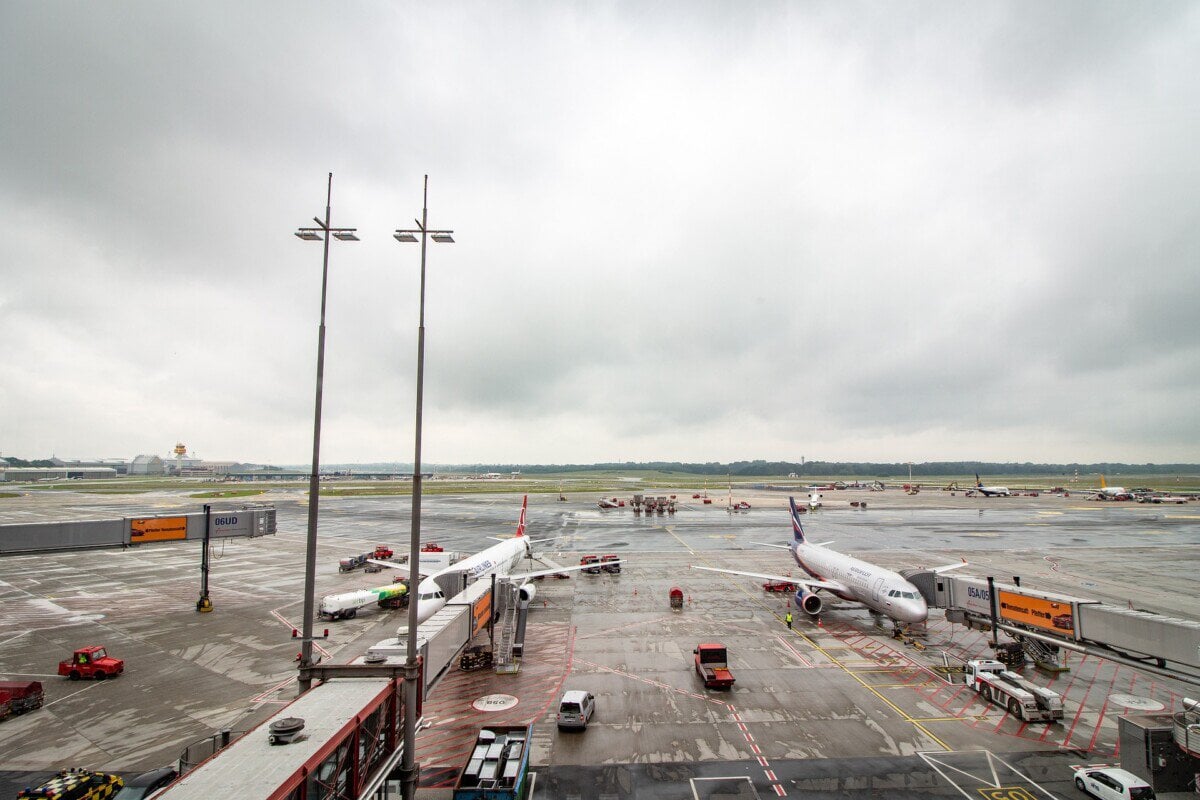
Two terminals, Terminal 1 and Terminal 2, handle passengers today, connected by a covered walkway so a change of terminal never means stepping outside. Terminal 2 is the larger of the two and handles the bulk of scheduled traffic, including most Lufthansa and Star Alliance departures.
The single most useful fact for planning any transfer is that the airport has its own S-Bahn station built directly beneath the terminal complex, reached by lift or escalator from the arrivals level. It is the starting point for the S1 line, which is the backbone of nearly every practical transfer option covered in this guide.
Because the airport sits so close to the centre, transfers here benefit less from advance planning than at some other German hubs, though flight timing and luggage still matter. A traveller heading to a hotel near the Hauptbahnhof can expect a fairly similar journey time whichever option gets picked.
For most visitors, the real decision is rarely whether to use public transport at all, since Hamburg’s network is dense and reliable, but which specific service suits their timing, luggage, and destination. That is exactly what the rest of this guide sets out to answer.
Compare hotels and other places to stay for your trip.
Check availabilityExplore holiday homes and apartments for your trip.
See holiday homesCompare prices from multiple hotel booking sites.
Check dealsS-Bahn to Hamburg: The S1 Line Explained
For most travellers, the S-Bahn is the natural way into Hamburg from the airport. The S1 line runs directly from the airport station and uses the same integrated ticketing as the rest of the city’s U-Bahn, bus, and regional network, with full timetables published on the S-Bahn Hamburg airport page.
The S1 reaches Hamburg Hauptbahnhof in around 25 minutes, calling at stops including Ohlsdorf and Barmbek along the way. Services run roughly every 10 minutes through the core of the day and every 20 minutes outside peak hours, operating from around 04:30 until shortly after 01:00.
A standard single ticket for the ride costs €3.80 (£3.27/$4.45) for an adult fare in zones A and B, with a day ticket working out at around €8.40 (£7.22/$9.83) for anyone planning several trips. Tickets can be bought from machines on the platform, through the official hvv App (the Hamburger Verkehrsverbund’s own journey planner and ticket shop, covering the S-Bahn, U-Bahn, and buses across the whole network), or from ticket counters inside the terminals. For the full breakdown of Hamburg’s ticket types, fare zones and the city’s harbour ferries, see our Hamburg Public Transport guide.
A useful quirk to know before boarding is that the S1 divides at Ohlsdorf station, with only the front three carriages continuing to the airport while the rear three peel off toward Poppenbüttel. Anyone boarding at Hauptbahnhof or another central stop should check the platform display for the correct carriages rather than assuming any door will do.
The one real drawback is luggage and stairs, since the platform sits below ground, though lifts are available for anyone travelling with a pushchair or heavy suitcases. Given how short the whole journey is, even a traveller who normally avoids trains after a long flight will rarely find the S1 much of a hardship here.
For nearly everyone landing here with a central Hamburg hotel booked, the S1 is the option worth defaulting to first. It is quick, frequent, and considerably cheaper than a taxi, and it rarely needs much more thought than checking the next departure board.
Bus Options at Hamburg Airport
Alongside the S-Bahn, a handful of local bus routes call at Terminal 1, useful for anyone whose accommodation sits closer to a bus stop than a train platform. Unlike some German airports, Hamburg has no separate branded express coach into the centre, so the buses here mainly work as connectors into the wider transport network rather than a direct alternative to the train.
Line 274 runs to Ohlsdorf, where it meets both the U1 underground line and the S-Bahn, making it a reasonable option for reaching stops the S1 does not cover directly. Line 292 connects the airport to Langenhorn Markt and Ochsenzoll, useful mainly for the northern suburbs rather than the centre.
The X95 runs a longer route out toward Pinneberg and Elmshorn, which is of little use for a straightforward city-centre transfer but worth knowing about for onward travel further north-west. A night bus, line 606, covers the airport during the hours the S1 runs less frequently, though services are far sparser than during the day.
Standard HVV fares apply across the bus network, so a single ticket costs the same €3.80 (£3.27/$4.45) as the S-Bahn, and the same tickets and apps work across both. There is no need to buy a separate bus-specific fare or worry about compatibility between the two.
The bus routes are worth a second look before assuming any of them beats a straight run on the S1. Changing at Ohlsdorf for line 274 rarely saves time over simply staying on the train to Hauptbahnhof, so the bus network is worth choosing on stop location rather than on a hunch that it looks more direct on a map.
For most first-time visitors heading to a central hotel, the S1 will do the job better than any bus route, and the bus network is really there as a backup or for destinations away from the direct rail corridor. Anyone unsure which stop is closest should check a journey planner before committing to either option.
Taxi and Ride-Hailing at Hamburg Airport
For a direct, door-to-door journey, a taxi is a straightforward option here. Official taxi ranks are signposted on the arrivals level of both terminals, with licensed vehicles available around the clock regardless of flight time. Two of the city’s own long-running firms, Hansa Taxi (040 211 211) and Taxi Hamburg (040 666 666), both run dedicated airport pickup services and can be booked by phone or through their own apps ahead of landing, rather than relying purely on hailing one at the rank.
Because the airport sits only around 9 kilometres from the centre, fares are noticeably lower than at more distant German airports. A typical journey into Hamburg costs around €25 to €35 (£22-30/$29-41), with the exact fare depending on traffic and the precise drop-off point.
Journey times generally run between 20 and 30 minutes in normal traffic, stretching to 35 to 45 minutes during rush hour on the surrounding roads. Late-evening and early-morning trips are often quicker simply because the roads are clearer.
Ride-hailing apps including Uber and Bolt also operate here, generally picking up from a designated area in the car park rather than directly outside the terminal doors. Fares are broadly comparable to a metered taxi, typically around €20 to €30 (£17-26/$23-35), though the app usually shows an estimate before booking.
For groups of five to seven travelling together, a Großraumtaxi, or people carrier taxi, can be requested at the rank, and it often works out cheaper per person than several separate S-Bahn tickets. Accessible vehicles can usually be requested through the taxi rank staff or the ride-hailing app itself.
A solo traveller with a single bag rarely needs to queue at the rank at all: check the departure board for the next S1 first, since it covers the same nine kilometres for a fraction of the taxi fare. Where a taxi genuinely earns its keep is a late-night landing after the S-Bahn has thinned out, a heavy suitcase count, or a group large enough to split the cost of a Großraumtaxi between them.
Private Airport Transfers From Hamburg Airport
A pre-booked private transfer suits anyone who would rather have the ride into town settled before the plane even leaves the ground, instead of queuing at a rank after a long flight. Operators typically send a named driver into the arrivals hall holding a board with your name on it, so there is nothing left to negotiate once you are through customs.
Because the fare is agreed in advance, a slow crawl along the B433 during rush hour costs you time rather than money, and there is no meter ticking over while you queue at the rank. Fixed-price transfers to central Hamburg typically run a little above a metered taxi fare, reflecting the guaranteed pickup rather than any real difference in the distance covered.
Timings track a taxi closely, usually 20 to 30 minutes depending on traffic and the exact drop-off address. What you are actually paying for is certainty rather than speed: families, business travellers, and anyone hauling a lot of luggage tend to find a confirmed pickup point worth the extra cost over hoping the rank queue stays short.
Most operators also run larger vehicles for groups, and several will quote transfers well beyond Hamburg itself, out to the coast or further into Schleswig-Holstein, which is useful for anyone continuing straight on without wanting to change transport partway through the trip.
A private transfer earns its cost most clearly around very early departures or very late arrivals, when S-Bahn frequency drops off, and during the city’s genuinely busy stretches, such as the Hafengeburtstag harbour festival each May or a big trade fair week at Hamburg Messe, when the taxi rank can back up further than usual.
For most solo travellers on a budget, the S1 remains cheaper and just as fast given how close the airport already sits to the centre. For anyone who values a stress-free start or end to the trip, though, a private transfer is worth the extra cost over a standard taxi, and it is always worth confirming a driver’s name and flight number in advance rather than accepting an unmarked offer in the arrivals hall.

Compare Airport Transfer Companies
Pre-booking your airport transfer can save time and reduce stress when you arrive. Whether you need a private taxi, shared shuttle or executive transfer, comparing providers can help you find the best price and service for your journey.
We’ve selected three trusted airport transfer companies so you can compare prices, vehicle options, cancellation policies and customer reviews before you travel.
Car Hire at Hamburg Airport
For travellers planning to explore beyond the city itself, hiring a car here can be a genuinely useful option. Major rental companies including Sixt, Hertz, Avis, Enterprise, Europcar, Budget, and Alamo operate desks in a dedicated facility adjacent to the terminals.
After collecting the keys, the rental car parks sit within walking distance of the terminal buildings, so there is no long shuttle transfer needed to reach the vehicle. Rates vary considerably by season, vehicle class, and how far in advance a booking is made, and pre-booking online rather than turning up on the day can bring a genuinely worthwhile saving.
A hire car is most useful for reaching destinations that are awkward by rail, such as the coastline north of Hamburg, the Lüneburg Heath, or a wider road trip through northern Germany and on toward Denmark. It also suits families travelling with a lot of luggage who would rather load a boot once than manage stairs and platforms at the S-Bahn station.
Inside Hamburg itself, a car is rarely the best choice. The city has an extensive S-Bahn, U-Bahn, and bus network, parking in the centre can be expensive and hard to find, and much of the old town and harbour district favours walking over driving.
Hiring a car purely to reach a central hotel, and then leaving it parked outside for the rest of the stay, is money spent solving a problem the S1 already solves for a few euros. Hamburg’s compact centre, restricted parking, and dense rail network mean a rental car earns its cost only once it is actually being driven somewhere the train does not reach.
The travellers who benefit most from car hire here are those planning multi-stop trips around northern Germany or the wider Baltic coast, rather than anyone whose plans are limited to Hamburg’s well-connected centre.

Choose Car Hire for Hamburg
A rental car may be the most practical option if you want to explore areas beyond central Hamburg without being tied to bus or train schedules.
Comparing both Discover Cars and EconomyBookings can help you see a broader range of prices and vehicle options before booking.
Driving and Parking at Hamburg Airport
Anyone being dropped off, collecting a hire car, or driving their own vehicle to the airport can reach it via the motorway network on the A7, leaving at the Schnelsen Nord junction, or directly via the B433. Full directions are published on the Hamburg Airport transport and parking page.
From either route, the journey into the centre typically takes around 20 to 30 minutes depending on the time of day, with rush-hour traffic on the surrounding roads being the main variable. Outside peak hours, and especially early morning or late evening, the drive can be noticeably quicker once the surrounding roads clear of commuter traffic.
Short drop-offs are possible at the terminal kerbside, and short-term parking is available from around €4 (£3/$5) for the shortest stays. Anyone staying longer, whether to help with luggage or wait for a delayed arrival, needs to use one of the paid multi-storey or open-air car parks instead.
The airport offers more than 12,000 parking spaces across several car parks close to the terminals, with multi-storey options such as P1 and P2 sitting closest to Arrivals, at around €28 to €38 (£24-33/$33-44) and €22 to €30 (£19-26/$26-35) a day respectively. Shuttle-linked options further out, such as P3, P4, and P5, run considerably cheaper, from around €7 (£6/$8) a day for the most economical option.
Accessible parking spaces are provided close to the terminal entrances for travellers with limited mobility, and electric vehicle charging points are available across several of the car parks. Booking a parking space online in advance is generally cheaper than paying on arrival, particularly across a longer stay.
Driving only really earns its keep here as a drop-off or a car-hire collection. Once you are actually in Hamburg, hunting for a parking space in the centre costs more in time and money than the S1 ever will, and that is before factoring in how easy the S-Bahn makes the return trip once the car goes back to the rental desk.
Compare routes and fares for your next trip.
Compare flightsBrowse Airalo eSIM options for convenient travel data.
Check eSIMsArrange a private pickup before travel instead of sorting transport after landing.
Book a transferWhich Hamburg Airport Transfer Option Is Best?
There is rarely a single right answer for every trip through Hamburg Airport, since destination, luggage, budget, and how many people are travelling together all point in different directions, though the airport’s short hop from the centre means timing matters less here than at almost any other major German airport.
For solo travellers or couples heading to a hotel near the Hauptbahnhof or another central station, the S1 is almost always the right call. It is fast, frequent, and considerably cheaper than a taxi, and a realistic door-to-door estimate including the walk from Arrivals is usually somewhere around 30 to 35 minutes.
If a hotel sits closer to a bus stop than a station, one of the local bus routes can work just as well, particularly line 274 for anywhere near Ohlsdorf. Neither the bus nor the S1 needs booking in advance, so the choice really comes down to which stop is closer to the final destination.
Families, late-night arrivals, and anyone carrying substantial luggage should lean toward a taxi or a pre-booked private transfer. The private transfer costs a little more but removes the uncertainty of a queue at the rank, and because the drive in rarely exceeds half an hour, neither option costs anywhere near what the same choice would at a more distant airport.
Travellers planning to push on into northern Germany or along the Baltic coast should weigh up car hire, but it is worth being realistic about whether the car will earn its keep once you are back inside Hamburg’s tightly packed, well-served centre, where a parked rental just becomes a daily fee for nothing. Anyone being dropped off, and anyone collecting a hire car, should budget for a straightforward 20 to 30 minute drive rather than expecting anything longer.
If there is one rule of thumb worth taking from all this, it is to let luggage and timing decide rather than habit: light bags and a willingness to navigate a platform point towards the S1 or a local bus, heavy suitcases and late-night landings point towards a taxi or a pre-booked transfer, and only a trip that genuinely continues past Hamburg justifies a hire car. Nowhere else in this guide’s cluster of German cities does the geography do quite so much of the work: with just nine kilometres between the terminal and the Hauptbahnhof, almost every option here lands inside the same half-hour window, so picking one and getting moving beats agonising over marginal differences between them.
Continuing Onward From Hamburg Hauptbahnhof
Because the S1, the local buses, and most taxi and private transfer routes all end up at or near Hamburg Hauptbahnhof, the station works as a genuine gateway for anyone whose trip does not stop in Hamburg itself. Long-distance ICE, IC, and regional RE services leave from the same building used by airport arrivals, so continuing the journey rarely means crossing the city at all, just changing platforms.
Tickets for these onward legs are bought separately from the HVV fare that covers the ride in from the airport, and booking ahead online is usually cheaper than buying at the station on the day. Seat reservations are optional on most routes but worth adding for a Friday afternoon departure, when trains out of Hamburg fill up fast. The table below covers some of the nearest major cities reachable directly from Hauptbahnhof, using typical Deutsche Bahn journey times.
| Mode | Destination | Journey Time | Direct? |
|---|---|---|---|
| ICE | Berlin Hbf | About 1 hour 48 minutes | Yes |
| RE / ICE | Bremen Hbf | About 56 minutes | Yes |
| RE / IC | Lübeck Hbf | About 43 minutes | Yes |
| ICE | Hannover Hbf | About 1 hour 15 minutes | Yes |

Rupert’s Handy Travel Tips
Flying into Hamburg Airport? Rupert has a few tips that can save both time and money:
- Check the board for the S1, it splits at Ohlsdorf: ride in one of the front three carriages if heading to the airport, since the rear three peel off toward Poppenbüttel.
- Buy a standard zone A/B ticket: the airport sits just inside the city’s own HVV tariff zones, so the fare stays low compared with airports further out.
- Use the designated ride-app pick-up point for Uber and Bolt: it is separate from the taxi rank, so head there rather than waiting at the taxi queue.
- Book a private transfer for very early or late flights: S-Bahn frequency drops overnight, and a pre-booked driver avoids any risk of a longer taxi queue.
- Only hire a car if you are leaving Hamburg: the city’s own transport network is excellent, and parking in the centre is expensive and often restricted.
- Do not expect a long journey either way: HAM is one of the closest major airports to its city centre in Europe, so a 20 to 30 minute transfer is normal whichever option gets picked.
Want to meet the reindeer behind our travel tips? Find out more in our page Who is Rupert?.




Frequently Asked Questions About Hamburg Airport Transfers
What is the fastest way to get from Hamburg Airport to the city centre?
The S1 S-Bahn reaches Hauptbahnhof in around 25 minutes, and it needs no advance booking.
Which S-Bahn line serves Hamburg Airport?
Hamburg Airport is served by the S1 line, running roughly every 10 minutes at peak times and every 20 minutes off-peak.
How far is Hamburg Airport from the city centre?
Hamburg Airport is located approximately 9 kilometres (5.6 miles) north of central Hamburg.
What ticket do I need for the S-Bahn from Hamburg Airport?
A standard single ticket costs €3.80 (£3.27/$4.45) for zones A and B, the same fare that covers local buses.
Are taxis available at Hamburg Airport?
Yes. Official taxi ranks operate around the clock outside both terminals, with fares to the centre typically €25-35 (£22-30/$29-41).
Is Uber available at Hamburg Airport?
Yes. Uber and Bolt both operate from a designated ride-app pick-up point separate from the taxi rank.
Is it worth hiring a car at Hamburg Airport?
Only if travelling beyond Hamburg itself. Within the city, the S-Bahn, U-Bahn, and bus network are usually faster and cheaper than driving.

Further Reading & Related Guides
Once you’re through arrivals, Hamburg’s own city guides are the natural next stop. Our Best Things to Do in Hamburg guide rounds up the sights worth prioritising, our Best Day Trips from Hamburg guide covers Lübeck, Bremen and beyond for anyone extending the stay, and our Hamburg Cruise Port Guide is useful for anyone connecting on to one of the city’s cruise terminals.
Fans heading to a match should also see our How to Get to the Stadium in Hamburg guide, covering both HSV and FC St. Pauli, and our German Rail Tickets Explained guide is worth a read before booking any onward rail journey within the country.
Once you’ve settled in, our Hamburg Sightseeing Cruises guide compares the city’s harbour tours, our Hamburg Hop-On Hop-Off Bus Tours guide compares the sightseeing bus lines, and if your trip falls in December, our Hamburg Christmas Markets guide covers the city’s festive squares.