Reviewed by our editorial team Updated
Munich is Bavaria’s capital and Germany’s third-largest city, a place that manages to feel both grand and easygoing at the same time. Marienplatz, the city’s central square, has been the heart of Munich since the 12th century, and it remains the natural starting point for almost every visit. From here, wide pedestrian streets fan out towards a cathedral with onion-domed towers, a royal palace still full of treasure, and a beer hall that has been serving the same style of Bavarian hospitality for over four centuries.
That mix of history and hospitality runs right through the city. The Residenz and Nymphenburg Palace show off centuries of Wittelsbach rule in gilded detail, while the Deutsches Museum and BMW Welt point firmly towards Munich’s modern identity as a centre of engineering and industry. Somewhere in between sits the English Garden, one of the largest urban parks in the world, where surfers ride a standing wave on a city-centre river and beer gardens fill with locals the moment the sun comes out.
This guide covers 19 things to do in Munich, from the obvious highlights around Marienplatz to art museums, family days out, and a short, respectful look at the Dachau Memorial Site just outside the city. Munich’s own Oktoberfest deserves a guide of its own given how much there is to cover, so it earns only a brief mention here rather than the depth it is due elsewhere.
Whether you have a single day or a full week, the table below is built to help you prioritise: what each sight actually costs, how long to set aside, and what you’ll find in each section of this guide.
| Section | Nearest Station | Time Needed | Price | What You’ll Find |
| Marienplatz and the Rathaus-Glockenspiel | Marienplatz (U/S) | 20-30 minutes | Free | Munich’s central square, its glockenspiel show and the classic first stop on any visit. |
| Munich Hop-On Hop-Off Bus Tour | N/A | N/A | N/A | A flexible bus pass covering thirteen stops across the city on three linked routes. |
| Neues Rathaus Tower | Marienplatz (U/S) | 20-30 minutes | from €7 (£6.02/$8.19) | The viewing platform above Marienplatz for skyline views without leaving the square. |
| Munich CityTourCard | N/A | N/A | N/A | Unlimited public transport bundled with discounts at over a hundred attractions. |
| Munich Official City Card | N/A | N/A | N/A | Transport across the wider M-6 zone plus discounts up to 70% at partner sights. |
| Munich City Pass | N/A | N/A | N/A | An all-inclusive ticket bundling admission to 40+ attractions and guided experiences. |
| Frauenkirche | Marienplatz (U/S) | 30-45 minutes | from €7.50 (£6.45/$8.78) | The twin-domed cathedral that defines Munich’s skyline. |
| Viktualienmarkt | Marienplatz (U/S) | 45-60 minutes | Free to browse | The city’s best-known food market for shopping and snacking. |
| Hofbräuhaus | Marienplatz (U/S) | 1-2 hours | Free entry, pay for food/drink | The world-famous beer hall in the heart of the old town. |
| Residenz Munich and the Wittelsbach Treasury | Odeonsplatz (U) | 1.5-2 hours | €15 (£12.90/$17.55) combo | The former royal palace and its jewel collection. |
| Nymphenburg Palace | Rotkreuzplatz (U1) + tram | Half day | €10 (£8.60/$11.70) | The baroque summer palace and gardens west of the centre. |
| BMW Welt and the BMW Museum | Olympiazentrum (U3) | 2-3 hours | Welt free, Museum €10 (£8.60/$11.70) | Munich’s motoring showcase and museum. |
| Deutsches Museum | Isartor (S) | Half day | €16 (£13.76/$18.72) | One of the world’s largest science and technology museums, on its own island. |
| Third Reich History Walking Tour | N/A | N/A | N/A | A guided walk through the sites tied to the city’s Nazi-era history. |
| English Garden | Universität (U3/U6) | 1-3 hours | Free | A park larger than Central Park, popular for walking and surfing the Eisbach wave. |
| Olympiapark | Olympiazentrum (U3) | 2-3 hours | Free (Tower closed until 2027) | The venue and legacy of the 1972 Munich Olympics. |
| Alte Pinakothek and Pinakothek der Moderne | Pinakotheken (Tram/Bus) | 1.5-2 hours | €9 (£7.74/$10.53) | Munich’s major fine art collections. |
| Dachau Memorial Site | Dachau (S2) + bus | Half day | Free | The former concentration camp memorial, a necessary half-day visit. |
| Beer Gardens Beyond the Hofbräuhaus | N/A | N/A | N/A | Where locals actually go to drink. |
| Weisswurst and Pretzels | N/A | N/A | N/A | What to eat in Munich and where to find it. |
| Shopping in Munich | N/A | N/A | N/A | The main shopping streets from Kaufingerstraße to Maximilianstraße. |
| Munich with Kids | N/A | N/A | N/A | Family-friendly things to do around the city. |
| After Dark in Munich | N/A | N/A | N/A | Bars, clubs and late-night beer gardens. |
| Rainy Day Munich | N/A | N/A | N/A | The best indoor options when the weather turns. |
Marienplatz and the Rathaus-Glockenspiel: A First Look at the City
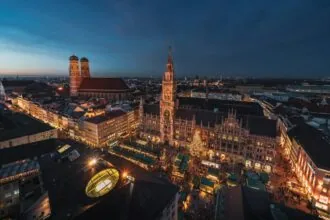
Marienplatz has been Munich’s central square since 1158, and it remains the obvious place to start any visit. The square is flanked by the neo-Gothic Neues Rathaus on one side and framed by the golden Mariensäule column at its centre, a monument erected in 1638 to mark the end of Swedish occupation during the Thirty Years’ War.
The square’s biggest draw is the Rathaus-Glockenspiel, a mechanical clockwork show set into the New Town Hall’s tower. Life-sized figures reenact a 16th-century royal wedding joust and a folk dance said to have lifted the city’s spirits after the plague, with performances running daily at 11am and noon, plus an additional 5pm show between March and October.
Watching the Glockenspiel costs nothing at all, since the whole display is visible from the open square below. Arriving five to ten minutes early is worth doing in peak summer months, when the crowd beneath the tower can grow thick enough to block a clear view of the figures.
Beyond the clockwork show, Marienplatz doubles as Munich’s main shopping crossroads, with the pedestrianised Kaufingerstraße and Neuhauser Straße running west towards Karlsplatz. Both streets are lined with department stores and high-street chains, making the square a natural hub to return to throughout a longer stay.
The square also hosts Munich’s Christmas Market every December and a maypole tradition around May Day, so its character shifts noticeably with the seasons. Outside of those events, expect a busy but manageable public space rather than the packed intensity of somewhere like Trafalgar Square.
Marienplatz sits directly on the U3, U6, S-Bahn and tram network, making it the natural first and last stop of almost any Munich itinerary. Most other entries on this list are within a 20-minute walk or a single train ride from here.
Munich Hop-On Hop-Off Bus Tour: Seeing the City at Your Own Pace
Munich’s Hop-On Hop-Off Bus Tour runs on open-top double-decker buses across three separate routes that link the city centre with sights further out. Between them the routes cover thirteen stops, so travellers can board near Marienplatz and step off wherever the next stop looks interesting.
The City Tour route loops through the historic centre, while a second route runs out to Nymphenburg Palace and Olympiapark, both covered elsewhere on this page. A third route heads north into Schwabing, Munich’s university quarter, for anyone with extra time to spare.
Tickets are sold as either a 24-hour or 48-hour pass, and both let riders hop off at any stop, explore, then rejoin a later bus on the same ticket. Each individual route takes roughly an hour to ride from start to finish if nobody gets off along the way.
Recorded audio commentary plays in ten languages through onboard headphones, covering the history behind each stop as the bus passes it. That makes the tour a reasonable way to get oriented on a first morning in the city, before deciding which sights deserve a longer visit later.
Prices start from around €24 (£21/$28) per adult for the shorter pass, with the two-day option costing more overall but working out cheaper per day for a longer stay. Children usually travel at a reduced rate, and tickets can be booked online in advance rather than queuing at a street kiosk.
Best for two or three nights. The widest choice of rooms, with filters for free cancellation and included breakfast.
View staysBest for longer stays. Whole apartments and houses, so you are not eating out three times a day.
View rentalsBest for double-checking. Runs the same search across several booking sites so you are not leaving money behind.
Compare pricesNeues Rathaus Tower: Munich’s Best View Without Leaving the Square
The Neues Rathaus itself is worth a second look beyond the Glockenspiel, since its elaborate neo-Gothic facade, completed in stages between 1867 and 1908, is covered in statues, gargoyles and turrets far busier than the average town hall. The building’s tower rises 85 metres above Marienplatz, and a lift inside carries visitors up to an observation platform near the top.
From the viewing platform, the outlook stretches across the Altstadt’s red rooftops towards the Frauenkirche’s twin domes, and on a genuinely clear day as far as the Alps on the horizon. Tickets for the tower typically cost around €7 (£6.02/$8.19) for an adult, though access is occasionally suspended for maintenance work.
Because of that occasional closure, it is worth checking the tower’s current status on Munich’s official tourism site before building a visit around it specifically. When it is open, the queue rarely compares to bigger attractions elsewhere in the city, since many visitors do not realise the climb is possible at all.
The tower operates on broadly similar hours to the rest of the building, generally from mid-morning until early evening, with the last ascent around 40 minutes before closing. A full visit, lift ride included, rarely takes more than 20 to 30 minutes.
If the tower happens to be closed during a visit, the Frauenkirche’s south tower a short walk away offers a comparable, sometimes even better, panorama for a similar ticket price. Either viewpoint gives a genuinely useful sense of how compact Munich’s historic centre actually is.
Photographers should aim for late afternoon light, when the sun sits low enough to catch the Frauenkirche’s domes without washing out the rest of the skyline. Both towers close well before sunset in winter, so timing a visit around the season is worth a moment’s thought.
Munich CityTourCard: Free Public Transport and Sightseeing Discounts
The Munich CityTourCard bundles unlimited public transport with discounts at more than a hundred attractions and partners around the city. It covers the U-Bahn, S-Bahn, trams, buses and regional trains within the zones printed on the card, so a single purchase replaces buying individual tickets for each journey. Our Munich Public Transport guide covers those zones and individual ticket prices in full, useful for comparing against the cost of buying tickets separately.
Discounts run up to 50% off admission at museums, tours and attractions that partner with the scheme, several of which appear elsewhere on this page. The card works well for anyone planning to move around the city several times a day rather than sticking to one neighbourhood.
It’s sold in single and group versions, the group option covering up to five people travelling together on one card. Validity runs from 24 hours up to six days, so short weekend visitors and longer stays both have a matching option.
An airport transfer add-on is available on the version that includes the M-6 zone, extending coverage out to Munich Airport itself. Without that add-on, the standard card covers the city’s inner zones only.
Prices start from around €18 (£15/$21) for the shortest 24-hour single ticket, rising with both the duration chosen and whether the group option is selected. It’s worth comparing against the length of an actual itinerary before buying, since a card bought for longer than needed doesn’t save money over paying for transport as it’s used.
Munich Official City Card: Transport Plus Discounts at 100+ Attractions
The Munich Official City Card is a similar concept to the CityTourCard above, but with a slightly different transport zone and a wider discount network. It’s valid across the Munich inner area or the larger M-6 zone, which stretches out to the airport and as far as Dachau.
Coverage includes the S-Bahn, U-Bahn, trams, buses and regional trains within whichever zone is chosen. Children under six travel free on it, and children aged six to fourteen get a reduced rate rather than paying the full adult price.
Discounts run up to 70% off at more than a hundred partner attractions, a noticeably higher ceiling than some competing cards. Featured partners have included the Deutsches Museum, Nymphenburg Palace, the Lenbachhaus gallery and the Munich Stadtmuseum, several of which are covered elsewhere on this page.
Some ticket options bundle in a hop-on-hop-off bus tour as part of the package, which can work out better value than buying that separately. Day-trippers heading further afield sometimes use the discount network for a Neuschwanstein Castle tour booked through the same scheme.
The card is delivered digitally by email, with no physical pickup required before travelling, and it’s sold in options from one to five days. A free-cancellation window of up to 24 hours before use is standard, so it can be booked ahead without much risk if plans change.
Munich City Pass: One Ticket for 40+ Attractions and Transport
The Munich City Pass works differently to the two cards above: instead of a transport-plus-discount model, it bundles genuine admission to more than forty attractions into one all-inclusive ticket. Public transport is available as an optional add-on rather than being included by default.
Included attractions have covered skip-the-line entry to the Deutsches Museum, admission to Nymphenburg Palace, the FC Bayern Museum and SEA LIFE Munich, several of which get their own coverage elsewhere on this page. The pass is pitched at visitors who plan to actually visit a good number of paid attractions rather than mostly using free sights.
It also folds in a handful of guided experiences, including a hop-on-hop-off bus tour, a guided tour of the New Town Hall, an old town walking tour and a bike tour that stops at a beer garden. Booking these through the pass avoids paying for each one separately at full price.
Everything is delivered as digital tickets stored on a smartphone, so there’s no paper voucher to collect or print before arriving. The pass is sold in one to five-day versions, with total savings advertised at over fifty percent compared with buying every included ticket individually.
Prices start from around €39 (£34/$46) for the shortest version, scaling up for longer validity and more attractions used. It suits a visitor planning a genuinely packed few days of paid sightseeing rather than someone sticking mostly to the free things Munich offers, like Marienplatz or the English Garden.
Frauenkirche: The Twin Domes That Define Munich’s Skyline
The Frauenkirche, or Cathedral of Our Dear Lady, is Munich’s largest church and the single most recognisable silhouette on the city’s skyline, thanks to its two onion-domed towers rising 99 metres into the air. Construction began in 1468 and the building was consecrated just 20 years later, remarkably fast for a Gothic cathedral of this scale.
Local legend claims the devil himself left a footprint inside the entrance, supposedly tricked into thinking the architect had built a windowless church, and a dark tile marking the spot is still pointed out to visitors today. Whether or not the story holds up, it remains one of Munich’s most retold pieces of folklore.
Entry to the main body of the cathedral is free, and the plain red-brick Gothic interior is a deliberate contrast to the ornate, gilded churches found elsewhere in Bavaria. The building suffered heavy damage in the Second World War and was carefully restored afterwards, with the current interior reflecting that mid-20th-century rebuild.
Climbing the south tower is the main paid experience here, involving 89 spiral staircase steps followed by a short lift ride up to a sheltered observation deck. Tickets start from around €7.50 (£6.45/$8.78), and the tower operates shorter hours on Sundays and public holidays than during the rest of the week.
The view from the top takes in Marienplatz, the Neues Rathaus tower, and on the clearest days the Alps far to the south, making the two towers a natural pairing for anyone keen on a proper overview of the city. Booking is rarely necessary outside major holidays.
The Frauenkirche sits only a few minutes’ walk from Marienplatz, tucked behind the New Town Hall, so it fits easily into the same morning as the Glockenspiel and a stroll down Kaufingerstraße. Its towers are visible from almost everywhere in the old town, making it a useful landmark for getting oriented on foot.
Viktualienmarkt: Shopping and Snacking at Munich’s Favourite Market
Viktualienmarkt has operated as Munich’s main food market since 1807, when the city’s outdoor produce stalls outgrew Marienplatz and were relocated a short walk south. Today it covers roughly 140 stalls selling everything from Bavarian cheese and cured meats to fresh flowers, spices and regional wine.
The market’s centrepiece is its own beer garden, shaded by tall chestnut trees and run on a rotating basis by six of Munich’s biggest breweries, so the beer on tap changes throughout the year. It is one of the more relaxed places in the city centre to sit down with a litre stein and a pretzel between sightseeing stops.
A maypole decorated in the blue-and-white colours of Bavaria stands at the market’s centre, alongside a small fountain dedicated to Karl Valentin, a beloved Munich-born comedian. Both are minor details, but they capture the market’s role as a genuinely local space rather than a purely tourist-facing attraction.
Prices at the stalls run noticeably higher than a typical supermarket, reflecting the market’s central location and the quality of produce on offer, though a simple snack such as a bratwurst in a roll rarely costs more than a few euros. Browsing costs nothing at all, and it is a pleasant way to spend half an hour between bigger sights.
The market operates Monday to Saturday, generally from early morning until early evening, with individual stallholders setting their own specific hours. Sundays see the market closed, in line with most retail in Germany.
Viktualienmarkt sits only a few minutes’ walk south of Marienplatz, making it easy to fold into the same visit as the Glockenspiel and the Frauenkirche. Arriving hungry rather than full is the smart approach, since the temptation to sample several stalls in a row is genuinely hard to resist.
Best for finding routes the airlines do not sell as a single ticket. Combines carriers to bring the fare down.
Search flightsBest for short trips. Install the eSIM at home and arrive with working data, no shop queue.
Browse eSIMsBest if you would rather not work out the transport on arrival. Book it now and forget it.
View transfersHofbräuhaus: Stepping Inside the World’s Most Famous Beer Hall
The Hofbräuhaus traces its roots back to 1589, when Duke Wilhelm V founded a royal brewery to stop the court from having to import beer from northern Germany. The current building at Platzl, a short walk from Marienplatz, dates from 1897 and has become arguably the most recognisable beer hall on Earth.
Inside, vaulted ceilings and long communal wooden tables set the scene for a genuinely boisterous atmosphere most evenings, with a live oompah band providing music in the main hall. Seating for around 3,000 people across several rooms and a courtyard gives a sense of the scale involved.
Beer here is served in signature one-litre steins known as Maßkrug, and it is entirely normal to share a table with strangers once the hall fills up. A full Bavarian menu covers roast pork, dumplings and pretzels for anyone wanting a proper meal alongside the drink.
There is no entry fee, and no reservation is strictly required outside large groups, though arriving before 6pm on weekdays makes it far easier to actually find a seat. Weekend evenings and the Oktoberfest period in September and October are considerably busier, with queues at the door common during those weeks.
Munich’s own Oktoberfest, held at the Theresienwiese fairground rather than at the Hofbräuhaus itself, deserves a dedicated guide of its own given how much there is to cover, so it earns only this brief mention here. The Hofbräuhaus does run its own smaller Oktoberfest-style tent during the festival for anyone who prefers a permanent building to a canvas one.
The Hofbräuhaus opens daily from 11am until midnight, with the kitchen generally closing a couple of hours before the doors do. It is touristy by reputation, but the atmosphere genuinely earns the crowds, and it remains a fixture on nearly every Munich itinerary for good reason.
Residenz Munich and the Wittelsbach Treasury
The Residenz was the seat of Bavaria’s Wittelsbach rulers for over 400 years, and it has grown into one of the largest city palaces in Germany as a result. Successive dukes, electors and kings each added their own wings and courtyards, leaving a building that mixes Renaissance, Baroque and Neoclassical styles under one roof.
Highlights inside the Residenz Museum include the Antiquarium, a vast barrel-vaulted hall lined with Roman antiquities, and the Ancestral Gallery, hung floor to ceiling with portraits of Wittelsbach family members stretching back generations. A separate ticket covers the ornate Cuvilliés Theatre, a rococo court theatre tucked inside the palace complex.
The adjoining Treasury, or Schatzkammer, holds one of Europe’s most important collections of royal regalia, including crowns, jewelled swords and an elaborate golden statuette of St George slaying a dragon. Many pieces date back centuries and were made for ceremonial use rather than display, which adds a genuine sense of history to the glittering cases.
Admission to the Residenz Museum or the Treasury alone costs €10 (£8.60/$11.70) for an adult, while a combined ticket covering both costs €15 (£12.90/$17.55). Adding the Cuvilliés Theatre pushes the combined ticket to €20 (£17.20/$23.40), and both under-18s and students with valid ID enter free.
Both sections are large enough that rushing through in under an hour rarely does them justice, and most visitors find a proper visit to the museum and Treasury together takes at least 90 minutes. Audio guides are available and worth the small extra cost for context on the more obscure rooms.
The Residenz sits just north of Marienplatz on Odeonsplatz, within easy walking distance of the Frauenkirche and the start of the English Garden. Combining a Residenz visit with a walk through the Hofgarten, the palace’s own formal garden, makes for a naturally paced half-day in this part of the old town.
Nymphenburg Palace: Baroque Grandeur West of the City
Nymphenburg Palace began life in 1664 as a small country villa, a gift from Elector Ferdinand Maria to his wife to celebrate the birth of their son, before growing over the following century into one of Europe’s largest Baroque palace complexes. The result today is a long, symmetrical facade facing a formal canal that stretches for over a kilometre into the surrounding park.
Inside, the highlight for most visitors is the Gallery of Beauties, a room commissioned by King Ludwig I and hung with 36 portraits of the most admired women of his era, ranging from aristocrats to a cobbler’s daughter. The Great Hall, with its ceiling frescoes and rococo stucco work, gives a strong sense of the palace’s later, more theatrical additions.
The surrounding park is arguably as big a draw as the palace itself, dotted with smaller pavilions including the ornate Amalienburg hunting lodge, considered one of the finest rococo interiors anywhere in Europe. These park palaces only open between April and mid-October, so a winter visit means the main building alone.
Admission to the main palace and its Marstallmuseum costs €10 (£8.60/$11.70) for an adult, with a reduced rate of €9 (£7.74/$10.53) for students, and children under 18 enter free. An audio guide adds a further €3.50 (£3.01/$4.10) and is genuinely useful given how sparsely some rooms are labelled.
Opening hours run from 9am to 6pm between April and 15 October, and shrink to 10am until 4pm for the rest of the year, with last admission 30 minutes before closing throughout. Setting aside a half day covers the palace interior and a reasonable stretch of the park without feeling rushed.
Reaching Nymphenburg takes a little more effort than the sights clustered around Marienplatz, generally involving the U1 U-Bahn to Rotkreuzplatz followed by a tram, or a direct tram from the city centre. The extra journey time is a fair trade for a palace and park that feel noticeably calmer than the busier central sights.
A skip-the-line entry ticket covering both the palace and its Museum of Porcelain can be booked in advance, which is worth doing given how far out the site sits from the centre. It includes access to the Marble Hall and the ornate Amalienburg pavilion in the grounds, with prices starting from around €20 (£17/$23) per adult.

BMW Welt and the BMW Museum: Munich’s Motoring Icons
BMW has been headquartered in Munich since the company’s founding in 1916, and the area around its distinctive four-cylinder tower headquarters now forms a genuine attraction in its own right. BMW Welt, the futuristic delivery and exhibition centre next door, showcases the latest BMW, MINI and Rolls-Royce models inside a swooping steel-and-glass structure.
Entry to BMW Welt itself is completely free, and wandering through its multiple levels of current-model showrooms, concept vehicles and occasional motorsport displays makes for an enjoyable hour even for visitors with only a passing interest in cars. New car buyers can also watch their own vehicle handed over on a dedicated delivery platform, a genuine spectacle in itself.
The separate BMW Museum, housed in the distinctive bowl-shaped building beside BMW Welt, charges €10 (£8.60/$11.70) for an adult ticket and traces the company’s full history from early motorcycles through to its most futuristic concept cars. Exhibits are arranged thematically rather than strictly by date, covering design, motorsport and the brand’s aviation origins.
BMW Welt opens daily from around 7:30am, with Sunday hours starting slightly later at 9am, and closes at 6pm across the week. The BMW Museum keeps shorter hours, generally 10am to 6pm, and closes entirely on Mondays.
Both sites sit directly beside Olympiapark, making it easy to combine a visit here with the Olympic grounds on the same afternoon. The nearest station, Olympiazentrum on the U3, drops visitors within a short walk of both buildings.
Car enthusiasts could easily spend three hours or more across the museum and BMW Welt combined, while a quicker visit focused purely on the free showroom can be done in under an hour. Either way, it is one of the more unusual combinations of free and paid attractions anywhere in the city.
Deutsches Museum: Science and Technology on Its Own Island
The Deutsches Museum opened in 1925 on its own island in the River Isar, and it has grown into one of the largest and oldest science and technology museums in the world. Its collection spans everything from early aircraft and historic ships to a real U-boat section and a working planetarium.
Highlights include a full-scale replica coal mine visitors can walk through underground, an original Wright-era aircraft hanging from the ceiling, and hands-on exhibits covering energy, chemistry and computing that are genuinely engaging for children as well as adults. Several exhibition halls remain closed for a long-running renovation, so checking the current floor plan before visiting is worth doing.
Admission for an adult costs €16 (£13.76/$18.72), with a reduced rate of €9 (£7.74/$10.53) for children aged 6 to 17, students and seniors, and a family ticket covering two adults plus their children priced at €33 (£28.38/$38.61). Children under 6 enter free.
The museum opens daily from 9am to 5pm, and booking tickets online in advance is genuinely worth doing, since the museum’s popularity with school groups can mean queues at the ticket desk during term time. A full visit covering the highlights realistically needs half a day.
Beyond the main building, the wider Deutsches Museum network includes separate sites for transport and aviation elsewhere in the Munich area, though the flagship Isar island location remains the one most visitors prioritise on a first trip. Its scale genuinely rewards a slow pace rather than a rushed sprint through every hall.
The museum sits on Museumsinsel, reachable from Isartor S-Bahn station or by tram to Deutsches Museum, both within a short walk of the entrance. It pairs naturally with a walk along the Isar riverbank afterwards, particularly on a warm afternoon.
Third Reich History Walking Tour: Munich’s Difficult Past
Munich played a central role in the rise of the Nazi Party, and a dedicated Third Reich and WWII walking tour traces that history through sites scattered across the city centre. It’s a different kind of visit to the Dachau Memorial Site covered later on this page, focusing on where the movement itself began rather than the camp system it went on to build.
Stops typically include the Feldherrnhalle, the monument where Hitler’s failed 1923 coup attempt, the Beer Hall Putsch, came to a violent end. Guides use this stop to explain how a fringe political movement in 1920s Munich grew into the regime that would later control Germany.
Königsplatz also features, a neoclassical square that the Nazi Party remodelled into a parade ground for mass rallies during the 1930s. The tour usually pairs this with a stop at the Hofgarten, linking the site to the White Rose resistance movement that opposed the regime from within Munich itself.
Guides generally use photographs and archive audio clips alongside their commentary, which helps place flat modern streets back into their historical context. Tours run for roughly two and a half to three hours, covering a walkable route through the old town rather than requiring any transport between stops.
Both small-group and private options are typically available, with prices starting from around €27 (£23/$31) per person for the standard small-group version. It’s a sobering counterpart to the rest of this page’s sightseeing, and pairs naturally with a visit to the Dachau Memorial Site for anyone wanting a fuller picture of the period.
Best if you would rather spend the money on the trip than on the room. Compare hostels by location and rating.
Search hostelsBest arranged before you fly rather than after. Covers claim handling, plus lounge access on eligible delays.
Explore AirHelp+Best for a day with a suitcase and nowhere to put it. Find a storage point near where you already are.
View storageEnglish Garden: A Park Bigger Than Central Park
The Englischer Garten was laid out in 1789 and remains one of the largest urban parks in the world, covering more ground than New York’s Central Park despite sitting just north of Munich’s city centre. Its sweeping meadows, woodland paths and winding streams were designed in the informal English landscape style that gave the park its name.
The park’s best-known quirk is the Eisbach, a man-made stream where a standing wave draws surfers and kayakers to ride it year-round, watched by a permanent crowd of onlookers leaning over the bridge above. It is one of the more unexpected sights in central Munich, and entirely free to watch for as long as anyone cares to stand there.
The Chinesischer Turm, a wooden pagoda-style tower built in 1789 and rebuilt after wartime damage, anchors one of the park’s most popular beer gardens, seating thousands of visitors beneath its shade on a sunny afternoon. A second major beer garden, the Seehaus, sits beside an artificial lake further north and tends to feel a little calmer.
Both beer gardens allow visitors to bring their own food, provided drinks are bought from the venue itself, a long-standing Bavarian tradition that makes the park an easy, affordable place to spend an entire afternoon. Entry to the park itself is, and always has been, completely free.
Cycling and walking paths crisscross the entire park, and hiring a bike from one of the city’s many rental points is a popular way to cover more ground than walking allows. Joggers, sunbathers and picnicking families fill the meadows the moment the weather turns warm.
The park’s southern entrance sits a short walk from Odeonsplatz and the Residenz, while the Universität U-Bahn station provides quick access to the middle sections nearer the Chinese Tower. Setting aside at least two hours here, longer with a beer garden stop, is easily justified given the park’s size.
Olympiapark: Munich’s 1972 Olympic Legacy
Olympiapark was purpose-built for the 1972 Summer Olympics, and its distinctive tent-like roof structure, made from acrylic glass stretched over a steel cable net, remains one of the most recognisable pieces of sports architecture in Germany. The park still hosts concerts, football matches and public events across its stadium, arena and surrounding grounds today.
The Olympic Tower, or Olympiaturm, has normally offered one of the best panoramic views in Munich from its observation deck, but it has been closed for renovation since June 2024 and is not expected to reopen until October 2027. Visitors hoping to climb it should plan around that closure rather than assume it will be open.
Even without the tower, walking the grounds themselves is worthwhile, with an artificial lake, rolling grass hills built from wartime rubble, and wide plazas that feel noticeably calmer than the busier sights nearer Marienplatz. The 1972 Olympic Stadium still stands, though it now hosts occasional events rather than regular sport.
A small Olympic Museum inside the grounds covers the history of the 1972 Games in more depth, including the tragic hostage crisis that unfolded during the event, for visitors wanting more context than a walk through the park alone provides. Entry to the wider park grounds is free, with charges applying only to specific attractions and events.
Boat rental on the Olympic lake and a summer programme of outdoor concerts add extra reasons to visit beyond the architecture itself, particularly between May and September. Winter visits are quieter, though the park’s open plazas can feel exposed on a cold day.
Olympiazentrum station on the U3 line puts visitors within a short walk of the entire park, and the same stop conveniently serves BMW Welt and the BMW Museum next door. Combining the two makes for a natural half-day itinerary on the northern edge of the city.
Alte Pinakothek and Pinakothek der Moderne: Munich’s Great Art Collections
Munich’s three big art museums sit within a few minutes’ walk of each other in the Kunstareal district, and the two most essential for most visitors are the Alte Pinakothek and the Pinakothek der Moderne. Between them, the pair covers everything from Old Masters to contemporary design under one shared ticketing system.
The Alte Pinakothek holds one of the world’s oldest and most important collections of European Old Master paintings, including major works by Rubens, Dürer and Rembrandt spread across grand, purpose-built 19th-century galleries. Its collection of Rubens alone is considered one of the finest anywhere outside Belgium.
The Pinakothek der Moderne, opened in 2002, takes over where the Alte Pinakothek leaves off, covering modern and contemporary art, graphic design, architecture and industrial design across four separate departments under one roof. Its collection includes works by Picasso, Kandinsky and Klee alongside rotating design exhibitions.
Standard adult admission runs €9 (£7.74/$10.53) for the Alte Pinakothek and €10 (£8.60/$11.70) for the Pinakothek der Moderne, with reduced tickets at €6 (£5.16/$7.02) and €7 (£6.02/$8.19) respectively. Both museums drop to a symbolic €1 (£0.86/$1.17) ticket on Sundays, making that the obvious day to visit on a budget.
Note that the Neue Pinakothek, the collection covering 19th-century art that traditionally sat between the two, is currently closed for a long-term renovation with a planned reopening in 2029, and selected highlights from its collection are displayed inside the Alte Pinakothek in the meantime. Anyone specifically chasing 19th-century works should check what is on display before visiting.
The Kunstareal sits a short tram or bus ride from Marienplatz, and combining the Alte Pinakothek with the Pinakothek der Moderne in a single day works well given how close they stand to each other. Budgeting at least three hours between the two avoids feeling rushed through either collection.

Dachau Memorial Site: A Brief, Necessary Half-Day
The Dachau Memorial Site occupies the grounds of the first Nazi concentration camp, opened in 1933 and used as a model for the camp system that followed across occupied Europe. It sits around 16 kilometres north-west of central Munich, in the town of Dachau, and is one of the most visited Holocaust memorial sites in Germany.
The grounds include preserved guard towers, reconstructed barrack buildings, and a permanent exhibition documenting the camp’s history and the experiences of the people imprisoned there. Most visitors describe it as a slow, quiet walk rather than a typical museum visit, and it is not a place to approach casually or rush through.
Admission to the memorial and its exhibitions is completely free, a deliberate choice that keeps the site accessible to as many visitors as possible. The memorial is open daily from 9am to 5pm, with the former crematorium area closing slightly earlier at 4:30pm.
Reaching Dachau from central Munich takes around 25 to 30 minutes by S-Bahn line S2 to Dachau station, followed by a short bus ride to the memorial entrance, and the whole journey is covered by a standard MVV zone ticket. Guided tours in English run regularly and add valuable historical context beyond the site’s own signage.
Because of the weight of the subject matter, this guide keeps its coverage deliberately brief rather than treating Dachau as just another checklist stop alongside beer halls and palaces. Anyone planning a full day of Bavarian day trips, including Dachau alongside places like Neuschwanstein or the Chiemsee, is better served by a dedicated day-trips guide that gives each destination proper space.
A visit here realistically needs a minimum of three to four hours including travel, and most visitors treat it as a standalone half day rather than pairing it with something lighter immediately afterwards. Comfortable shoes are worth wearing, since much of the site is outdoors and involves a fair amount of walking.
A guided day tour from Munich takes care of the public transport connection and adds context from a live English-speaking guide, covering the memorial’s barracks, cells and museum exhibits over around five hours. It’s rated highly by past visitors and includes free cancellation, with prices starting from around €47 (£40/$55) per adult.
Beer Gardens Beyond the Hofbräuhaus: Where Locals Actually Drink
Munich’s beer garden culture runs far deeper than the Hofbräuhaus alone, and working out where locals actually spend their evenings is worth the small effort. A genuine Biergarten tradition dates back to a 19th-century Bavarian law that let breweries sell beer directly from their cellars, provided they did not also sell food, which is why bringing your own picnic remains normal practice today.
The Augustiner-Keller, run by Munich’s oldest brewery, dating back to 1328, is widely considered by locals to serve some of the best beer in the city, poured from wooden barrels rather than modern kegs at its historic beer garden near the main train station. It tends to feel less tourist-heavy than the more famous names closer to Marienplatz.
The Chinesischer Turm beer garden inside the English Garden, covered earlier in this guide, remains one of the most popular for its sheer scale and setting beneath the pagoda tower. The Hirschgarten, further west, is Europe’s largest beer garden by seating capacity and includes a small deer enclosure that gives the venue its name.
Most beer gardens follow the same basic system: order beer and, if wanted, food from the counter or table service, and settle the bill in cash or card depending on the venue. A litre stein typically costs somewhere between €8 and €11 (£6.88-9.46/$9.36-12.87) depending on the location and brewery.
Weather genuinely dictates the beer garden season, with most venues operating fully from April through to September and scaling back or closing outdoor seating once autumn turns properly cold. A sunny afternoon between May and August is when Munich’s beer gardens feel most alive.
Spreading a visit across two or three different beer gardens over a longer stay gives a much better sense of the tradition than sticking to a single famous name. Locals tend to have a firm favourite, and asking a Munich resident which one they prefer is a reliable way to start a genuinely enthusiastic conversation.
Weisswurst and Pretzels: What to Eat in Munich
Bavarian food centres on a handful of dishes that appear on almost every menu in the city, and getting to know them properly adds real depth to a Munich visit. Weisswurst, a pale veal-and-pork sausage traditionally eaten before noon, remains a genuine local ritual rather than a tourist gimmick, usually served with sweet mustard and a soft pretzel.
Speaking of pretzels, Munich’s version, the Brezn, is generally larger, softer and darker than pretzels found elsewhere, and it appears everywhere from beer halls to bakery counters as an everyday snack. Pairing one with a Weissbier, Bavaria’s cloudy wheat beer, is about as classic a combination as the city offers.
Schweinsbraten, a slow-roasted pork shoulder served with a thick gravy and bread dumplings called Knödel, is the standard hearty main course found at nearly every traditional restaurant, and it pairs naturally with the region’s dark Dunkel beer. Portions tend to be generous, and sharing a starter beforehand is common practice.
Obatzda, a tangy, spiced cheese spread made from ripened Camembert and butter, appears on most beer garden menus as a snack for spreading on bread or pretzels, and it is a genuinely distinctive regional specialty worth trying at least once. Leberkäse, a smooth, oven-baked meatloaf served in a bread roll, makes a cheaper, quicker alternative for anyone eating on the move.
A simple meal of Weisswurst, pretzel and a beer typically costs somewhere between €10 and €15 (£8.60-12.90/$11.70-17.55) depending on the venue, while a full sit-down meal with a main course and drink runs closer to €20 to €30 (£17.20-25.80/$23.40-35.10). Viktualienmarkt, covered earlier in this guide, remains the best single place to sample several of these dishes in one visit.
Traditional Bavarian restaurants, known locally as Wirtshäuser, tend to offer the most authentic versions of these dishes away from the busiest tourist streets, often in quieter side streets a few blocks from Marienplatz. Asking a local for a Wirtshaus recommendation nearly always produces a better meal than picking the first restaurant on the main square.

Shopping in Munich: From Kaufingerstraße to Maximilianstraße
Munich’s shopping runs across a clear spectrum, from budget-friendly high street chains to some of Europe’s most exclusive luxury boutiques, and knowing which street suits which budget saves a lot of wandering. Kaufingerstraße and Neuhauser Straße, running west from Marienplatz towards Karlsplatz, form the city’s busiest pedestrianised shopping strip, packed with department stores and mainstream fashion brands.
Maximilianstraße, running east from the National Theatre, is Munich’s answer to Bond Street or the Champs-Élysées, lined with flagship stores for major luxury houses including Prada, Gucci and Louis Vuitton. Window shopping alone is a reasonable way to spend twenty minutes even without a serious budget for it.
The Fünf Höfe, a network of connected courtyards between Theatinerstraße and Kardinal-Faulhaber-Straße, mixes upscale boutiques with quieter cafes and occasional art installations, making it a pleasant detour from the busier main streets nearby. It sits only a couple of minutes’ walk from Marienplatz itself.
For something less polished, the Schrannenhalle, a restored 19th-century market hall beside Viktualienmarkt, hosts a mix of specialty food stalls and small shops worth a browse alongside the outdoor market itself. Schwabing, the district north of the centre near the university, offers a more independent, boutique-driven alternative to the big central shopping streets.
Sunday trading is heavily restricted across Germany, and Munich is no exception, so most shops on Kaufingerstraße and Maximilianstraße close entirely for the day, with only a handful of exceptions inside train stations and airports. Planning any serious shopping for a weekday or Saturday avoids disappointment.
Standard German VAT refund rules apply for non-EU visitors on purchases over a certain threshold, and most larger stores in the city are set up to process the paperwork at the till. Keeping receipts and passport details handy speeds up the process considerably at the airport on departure.
Munich with Kids: Family-Friendly Things to Do
Munich works well as a family destination, with several of its biggest attractions genuinely built with children in mind rather than merely tolerating them. The Deutsches Museum, covered earlier in this guide, remains the standout choice, with hands-on exhibits across energy, chemistry and transport that keep most children engaged for hours rather than minutes.
Munich’s zoo, Tierpark Hellabrunn, is one of the oldest geo-zoos in the world, grouping animals by continent rather than species, and it sits on the southern bank of the Isar within easy reach by tram. A full visit realistically fills half a day, with a strong reptile house and elephant enclosure among the highlights.
The English Garden’s open meadows and the Eisbach surf spot both work well for families with younger children who need space to run rather than another museum to walk through quietly. Renting bikes for the whole family is a popular way to cover the park’s considerable size without tired legs cutting the visit short.
BMW Welt, free to enter and full of gleaming current-model cars, tends to hold the attention of car-mad children for a genuinely surprising length of time, with the added bonus of costing nothing beyond transport there. Olympiapark next door offers open grass hills that are simply fun to run down, no ticket required.
Marienplatz’s Glockenspiel show is a reliable crowd-pleaser for younger children, its moving figures and joust scene working almost like a free puppet show at set times each day. Viktualienmarkt’s food stalls offer easy, low-commitment snacking for families who would rather graze than sit through a full restaurant meal.
Most of Munich’s main sights sit within a compact, walkable core, and the city’s U-Bahn and S-Bahn network is stroller-friendly with working lifts at most central stations. Children under 18 enter free or at a reduced rate at nearly every paid attraction covered in this guide, which keeps a family day out considerably cheaper than the headline adult prices suggest.
After Dark in Munich: Bars, Clubs and Late Beer Gardens
Munich’s evening scene stretches well beyond the beer halls covered earlier in this guide, with distinct neighbourhoods offering genuinely different nights out depending on what a visitor is after. Gärtnerplatz and the surrounding Glockenbachviertel district have become the city’s most fashionable bar area, filled with cocktail bars and a strong LGBTQ+ scene that draws a younger, design-conscious crowd.
Schwabing, once the bohemian heart of the city and still home to student-friendly bars near the university, offers a more relaxed, less expensive alternative to the polished bars closer to the centre. Feierwerk, a converted industrial venue elsewhere in the city, hosts regular live music and club nights across several smaller stages under one roof.
For late-night clubbing, Munich’s electronic music scene centres on a handful of well-established clubs, with door policies that can be selective on busy weekend nights, particularly for anything with a techno reputation to protect. Dress codes are rarely strict, but a bit of effort beyond travel clothes generally helps at the door.
Beer gardens do not simply close the moment daylight fades, and several central locations keep serving well into the evening during the warmer months, with fairy lights and lanterns replacing daylight rather than ending the atmosphere. The Augustiner-Keller and Chinesischer Turm both stay lively considerably later than a typical restaurant closing time.
Live music beyond the beer hall oompah bands is easy to find too, with the Muffatwerk, another converted industrial venue by the Isar, hosting everything from techno nights to jazz and world music across the year. Ticket prices for smaller club nights and gigs typically run somewhere between €10 and €25 (£8.60-21.50/$11.70-29.25) depending on the act.
Public transport in Munich runs on a reduced night-service network of buses after the regular U-Bahn and S-Bahn schedule ends, generally covering the small hours on weekends when demand is highest. A taxi or ride-hailing app remains the simpler option for anyone heading somewhere the night bus network does not cover directly.

Rainy Day Munich: The Best Indoor Options
Munich gets its fair share of grey, drizzly days, particularly in autumn and early spring, and the city has more than enough indoor attractions to fill a full day without ever stepping back outside. The Deutsches Museum alone, covered earlier in this guide, could comfortably absorb an entire rainy afternoon given its scale.
The Residenz and Nymphenburg Palace both work just as well in poor weather as good, since their main draws sit entirely indoors, and a wet day arguably suits the mood of wandering through centuries-old state rooms rather better than blazing sunshine would. The Treasury’s glittering cases feel especially atmospheric under low grey light through the palace windows.
Munich’s art museums, the Alte Pinakothek and Pinakothek der Moderne among them, make an obvious rainy-day pairing, and their Sunday €1 (£0.86/$1.17) ticket is worth timing a wet Sunday around if the schedule allows it. BMW Welt’s covered, glass-roofed halls also stay entirely dry regardless of the weather outside.
For something more playful, the Sea Life Munich aquarium near Olympiapark and the city’s various escape rooms and indoor climbing centres offer a change of pace from museums and palaces, particularly useful with restless children in tow. A long lunch inside the covered Schrannenhalle beside Viktualienmarkt is another easy way to wait out a passing shower.
Even the Hofbräuhaus and other traditional beer halls double as reliable rainy-day refuges, given their scale and covered courtyards, making a wet afternoon a perfectly reasonable excuse to sit down with a proper Bavarian meal for a couple of hours. Shopping along Kaufingerstraße and inside the Fünf Höfe courtyards also stays entirely under cover for long stretches.
Munich’s U-Bahn and S-Bahn network means moving between indoor attractions rarely involves more than a short, covered walk between a station exit and the entrance itself. Packing a proper umbrella rather than relying on shelter alone is still worth doing, since Bavarian weather can turn quickly even between stops.

Rupert’s Handy Travel Tips
Exploring Munich? Rupert has a few tips that can save both time and money:
- Watch the Glockenspiel from the open square, not right under the tower: the wider angle gives a much better view of the moving figures.
- Book Nymphenburg and Residenz tickets online in summer: it skips the queue at the ticket desk on busy weekends.
- Visit the Pinakothek museums on a Sunday if budget matters more than crowds: both drop to a symbolic €1 (£0.86/$1.17) ticket that day.
- Check the Neues Rathaus and Frauenkirche tower websites before you go: access to either is occasionally suspended for maintenance.
- Arrive at the Hofbräuhaus before 6pm on a weekday: it is the easiest way to actually get a table without a long wait.
- If you only have one day, prioritise Marienplatz, Viktualienmarkt and either Nymphenburg or the Residenz: trying to fit in everything else usually means rushing all of it.
Want to meet the reindeer behind our travel tips? Find out more in our page Who is Rupert?.


Frequently Asked Questions About Things to Do in Munich
What is the best first thing to do in Munich?
Most visitors start at Marienplatz to watch the Rathaus-Glockenspiel at 11am or noon, then walk on to the Frauenkirche and Viktualienmarkt nearby.
Is the Neues Rathaus Tower currently open?
It is usually open, but access is occasionally suspended for maintenance, so checking the tower’s current status before visiting is worth doing.
How much does the Deutsches Museum cost?
An adult ticket costs €16 (£13.76/$18.72), with a reduced rate of €9 (£7.74/$10.53) for children, students and seniors.
Is BMW Welt free to visit?
Yes. BMW Welt itself is free to enter, while the separate BMW Museum next door charges €10 (£8.60/$11.70) for an adult ticket.
Do I need to book Nymphenburg Palace tickets in advance?
It is not strictly necessary outside peak summer weekends, though booking online avoids any queue at the ticket desk.
Is Dachau Memorial Site worth visiting from Munich?
Yes, for anyone with a genuine interest in this period of history, though it deserves a slow, respectful half day rather than being rushed alongside lighter sightseeing.
What is a good rainy day activity in Munich?
The Deutsches Museum, the Residenz, and either of the city’s Pinakothek art museums all work well entirely indoors.
Is central Munich walkable?
Yes, most of the sights covered in this guide sit within a compact old town that is easily covered on foot, with the U-Bahn and S-Bahn filling in for anything further out.
Further Reading
Munich is a second flagship stop in AST’s growing Germany cluster, and if you are flying in, our Munich Airport Transfers guide covers every realistic way of reaching the city centre from MUC, including the S-Bahn, the Lufthansa Express Bus, and private transfers.
For another major German city built around a similarly walkable Old Town, our Best Things to Do in Nuremberg guide covers the Kaiserburg, the Christkindlesmarkt, and Nuremberg’s underground bunkers in the same level of detail as this page.
If Berlin is also on the itinerary, our Best Things to Do in Berlin guide rounds up the German capital’s own landmarks, while our German Rail Tickets Explained and Interrail Germany Pass guides both cover the fastest ways to travel between the two cities by train.
Travellers planning an Alpine day trip beyond the city may also want our Visit Zugspitze guide, covering Germany’s highest mountain and its cable car, a popular add-on for anyone basing themselves in Munich for a few days.
Visiting in winter? Our Munich Christmas Markets guide covers the Christkindlmarkt at Marienplatz and the city’s other festive markets in full, worth reading alongside this one if a December trip is on the cards.