Reviewed by our editorial team Published
Getting Around Venice
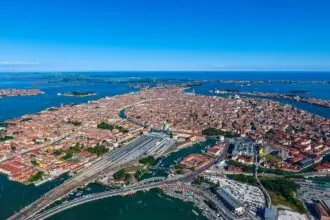
Venice is one of the few cities in the world where no cars or bicycles are allowed on its streets, so every trip through the historic centre happens either on foot or on the water. That simple fact catches out plenty of first time visitors, who arrive expecting a metro or a taxi rank and instead find narrow lanes, humpbacked bridges and a network of canals doing the job instead.
This guide covers the practical side of moving around the city, starting with the vaporetto water bus network that most visitors rely on and the ticket and pass prices that change often enough to catch people out. It also makes the honest case for simply walking large parts of the city, and covers water taxis, the cheap and useful traghetto crossings, and how gondolas actually fit into the picture.
For visitors basing themselves on the mainland in Mestre, there is a short section on trains and buses into the historic centre, since a growing number of travellers choose cheaper accommodation there. Anyone flying in should note that a dedicated airport transfer guide covers Alilaguna boats and other airport specific options in full, so this page only touches on them briefly.
The single biggest mistake new visitors make is treating the vaporetto like a metro system that will always be the fastest way across the city. In the compact historic centre, a short walk is very often quicker than waiting for a boat, boarding it, and riding it around the long way through the canals.
The second most common mistake is buying single tickets one at a time without doing the maths on a multi day pass. Venice’s transport pricing is built around the assumption that most visitors take several rides a day, and the unlimited travel passes reflect that.
Whatever combination of walking, boats and taxis ends up working best for a given stay, it helps to know the real prices and journey times before arriving, rather than working it out under pressure at a crowded ticket machine at Piazzale Roma or the train station.
Walking Is Often the Best Option
Venice’s historic centre is genuinely small, and most of the sights visitors come for, from San Marco to the Rialto Bridge, sit within a comfortable walking radius of each other. Locals cross the city on foot every day, and there is no reason a visitor with reasonable mobility should not do the same for most journeys.
Because vaporetti follow canals rather than straight lines, a boat trip between two central points can easily take longer than walking the same route directly. A short hop that looks obvious on a transport map, such as from the train station toward the Rialto, is frequently faster on foot than waiting for a boat, boarding it, and riding it around the bends of the Grand Canal.
Comfortable, sturdy shoes matter more in Venice than in most cities, since the pavement is uneven stone and every bridge involves a set of steps up and back down. Anyone with a heavy suitcase, a wheelchair, or limited mobility should weigh that against the appeal of walking, since bridges have no ramps in most of the older parts of the city.
Getting mildly lost is part of the experience, and the alleys are narrow enough that a phone map does not always help as much as expected. Venice makes this easier than it sounds with yellow directional signs painted on walls at junctions, pointing toward the main landmarks such as San Marco, Rialto, the train station and Piazzale Roma.
Walking also avoids the queues that build up at busy vaporetto stops during the middle of the day, particularly around San Marco and Rialto in high season. For most itineraries, the most efficient plan mixes walking with the vaporetto, on foot for short central hops and on the water for longer distances or the outer islands.
Occasional high water, known locally as acqua alta, can flood the lowest parts of the city in autumn and winter, and raised walkways are put out along the main routes when it happens. It is worth checking the forecast if visiting between autumn and early spring, but it rarely disrupts a trip for more than a few hours at a time.
Best for two or three nights. The widest choice of rooms, with filters for free cancellation and included breakfast.
View staysBest for longer stays. Whole apartments and houses, so you are not eating out three times a day.
View rentalsBest if you have already picked a hotel. Checks the big booking sites for the same room and shows who is cheapest.
Check dealsThe Vaporetto Network Explained
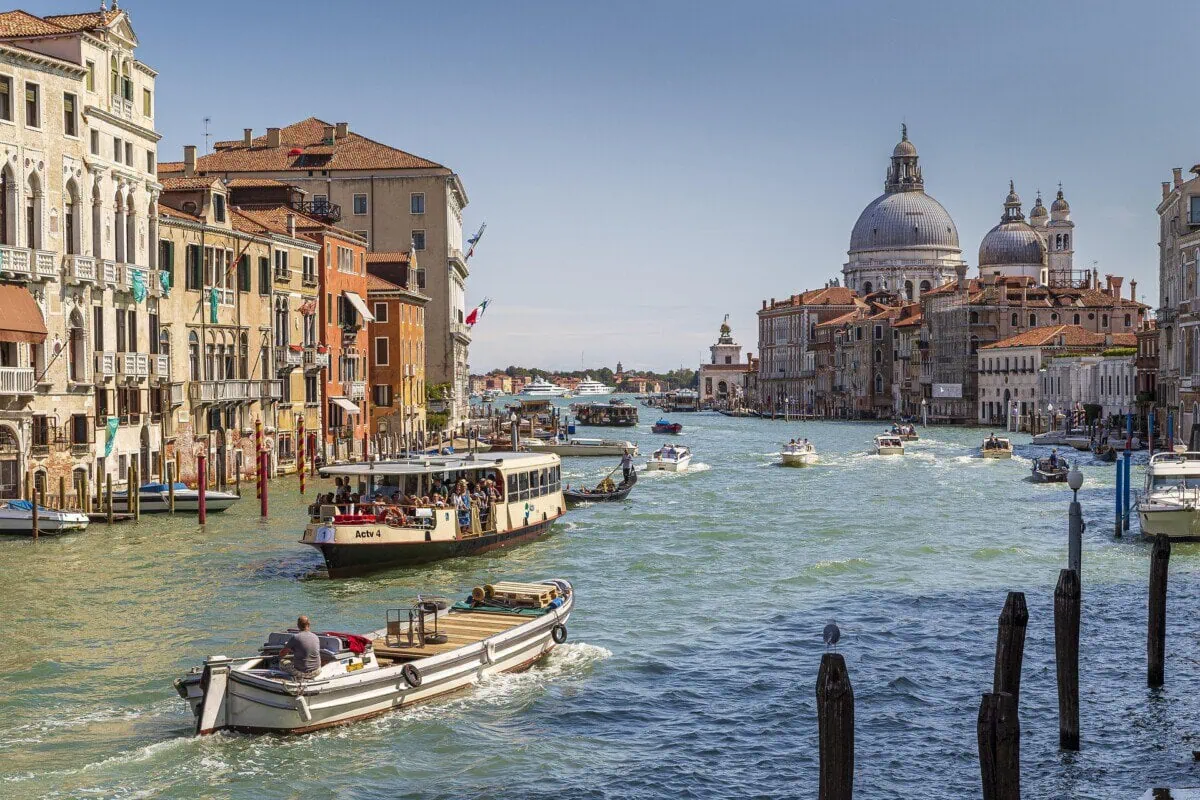
The vaporetto is Venice’s public water bus network, run by the operator ACTV, and it works much like a bus system laid over canals rather than streets. Boats call at fixed landing stages marked with the line number, and electronic display boards at each stop show the next arrival.
Line 1 is the slow, all-stops route along the Grand Canal, running from Piazzale Roma and Ferrovia past Rialto, the Accademia and San Marco out to the Lido. It calls at nearly every stage, making it the natural choice for sightseeing rather than speed.
Line 2 covers similar ground but skips a string of Grand Canal stops before looping south around Giudecca toward San Zaccaria and Tronchetto. It is consistently the faster option between the station and San Marco, and locals default to it whenever the destination matters more than the view.
A separate group of lines reaches the northern islands, with line 12 running from Fondamente Nove through Murano and Burano toward Treporti, and a short shuttle on line 9 covering the final hop from Burano to Torcello.
The Lido is served by several routes at once, including the outer ring lines 5.1 and 5.2, and a weekday express on line 6 running straight from Piazzale Roma. Anyone based on the Lido should expect to use whichever service happens to be waiting.
For a first visit, learning lines 1, 2 and 12 covers almost everything that matters, since together they reach the Grand Canal, San Marco and the main lagoon islands. The table below sets out the fuller network, including frequency and night coverage.
| Line | Route | Frequency (Peak / Off-Peak) | Night Service |
|---|---|---|---|
| Line 1 | Piazzale Roma and Ferrovia to the Lido, calling at almost every Grand Canal stop including Rialto and San Marco | Every 10-12 min daytime; around 20 min in the evening | No, replaced by line N |
| Line 2 | Piazzale Roma to San Marco and San Zaccaria via fewer Grand Canal stops, continuing round Giudecca to Tronchetto | Every 10-12 min daytime; around 20 min in the evening | No, replaced by line N |
| Line 3 (seasonal) | Piazzale Roma and Ferrovia to Murano, weekday mornings and daytime only | Roughly every 20-30 min | No |
| Lines 4.1 / 4.2 | Circular route linking Murano to the city via Fondamente Nove, running in opposite directions | Roughly every 20 min | Reduced Murano night shuttle (line NMU), about every 30 min |
| Line 12 | Fondamente Nove to Murano and Burano, continuing on to Treporti | Every 20 min daytime; around 30 min in the evening | Limited northern lagoon night line (NLN), a handful of sailings only |
| Line 9 | Short shuttle between Burano and Torcello | Roughly every 15 min, core daytime hours only | No |
| Lines 5.1 / 5.2 | Outer ring connecting the Lido with Fondamente Nove around the northern side of the city | Roughly every 20 min | No dedicated night version; use line N for late Lido travel |
| Line 6 | Weekday express from Piazzale Roma direct to the Lido, skipping the Grand Canal | Roughly every 20 min, weekdays daytime only | No |
| Line N | Loops between the Lido, San Marco, Piazzale Roma, Tronchetto and Giudecca | Every 20-30 min until around 1:30am, then roughly hourly | Yes, this is the main night service (approx. 11:30pm-4:30/5am) |
Vaporetto Frequency and Timing
Frequency on the vaporetto network is not fixed, and it changes between the middle of the day and the early morning or late evening. The busiest central lines along the Grand Canal typically run every ten to twelve minutes during the day, dropping to roughly every twenty minutes once evening sets in.
Outer ring lines such as 4.1, 4.2 and 5.1/5.2, along with the main lagoon line 12, generally settle into a twenty minute daytime interval, stretching to around thirty minutes in the evening. Smaller lagoon services run less often again, with some routes closer to hourly than turn-up-and-go.
Seasonal demand shifts these figures, since ACTV adds extra sailings on the busiest lines through summer and during major events such as Carnevale. Winter timetables tend to thin out earlier in the evening and run with slightly wider gaps even in the middle of the day.
Peak season also brings genuine crowding at the busiest stops, particularly San Marco, Rialto and the station, where a boat can fill before everyone waiting manages to board. Letting one boat go and waiting a few minutes for the next is often less stressful than forcing on with luggage.
The regular daytime network generally runs from around 4:30 to 5am until roughly 11:30pm, at which point the reduced night service takes over. Anyone timing a journey to the airport, station or a late dinner should build in a buffer rather than assume the last boat matches their plans.
Night Service and Getting Around After Dark
Once the daytime network winds down, a single reduced service called line N takes over on the Grand Canal and Giudecca Canal, looping between the Lido, San Marco, Piazzale Roma, Tronchetto and back round Giudecca. It generally starts around 11:30pm and continues until roughly 4:30 to 5am, covering the hours when nothing else runs centrally.
Frequency on line N drops sharply compared with the daytime network, with boats generally spaced twenty to thirty minutes apart earlier in the night and closer to an hour apart after around 1:30am. That gap is worth building into any plan for a late dinner or a last drink near the water.
The outer islands keep an even thinner service, with a scaled back shuttle to Murano running roughly every half hour into the small hours, and only a handful of sailings toward Burano. Check the last realistic departure well beforehand.
Standard ACTV tickets and the same time based travel passes used during the day remain valid on every night line, so there is no separate night fare to buy. A ticket still needs validating at the post before boarding.
For a genuinely late arrival, such as stepping off a delayed flight or an overnight train, it is worth confirming a night boat is actually running before setting out on foot, since the wait can be long if one has just departed. A water taxi remains the reliable backup at a higher price.
The safest approach is to treat anything after midnight as a much reduced service, not a direct substitute for daytime. Confirming a return route before heading out avoids the worst case of being stranded at a quiet stop.
Vaporetto Tickets and Travel Passes
A standard single ACTV ticket costs €9.50 (£8.25/$10.25) and is valid for seventy five minutes from the time it is first validated, allowing transfers between lines within that window as long as the direction of travel does not reverse. Tickets must be tapped against the small yellow or grey validation posts at the landing stage before boarding, since inspectors do check and fines for an unvalidated ticket are steep.
Because a single ticket at that price only makes sense for one or two rides, most visitors are better served by one of the time based travel passes sold under the Venezia Unica scheme, which give unlimited vaporetto, bus and tram travel for a set period rather than charging per journey. A one day pass currently costs €25 (£22/$27), which becomes worthwhile after roughly three rides in a single day.
Longer stays are covered by a two day pass at €35 (£30/$38) and a three day pass at €45 (£39/$49), both of which suit a typical short city break that mixes vaporetto rides with plenty of walking. Anyone staying closer to a week is generally better off with the seven day pass at €65 (£57/$70), which comfortably beats buying single tickets for even moderate daily use.
All of these passes can be bought online in advance through the official Venezia Unica website, or from ticket machines and staffed booths at major stops such as Piazzale Roma and the train station. Buying online ahead of arrival avoids queuing on the day, and the pass is then loaded onto a physical card or shown as a digital ticket that still needs to be validated at the post before each boarding.
Children under six travel free, and there are discounted youth rates for visitors aged six to twenty nine through the separate Rolling Venice card, which is worth investigating for longer stays or repeat visits. Prices on official transport tickets do change from year to year, so it is worth checking the official Venezia Unica transport ticket page for the current figures before travelling.
Anyone who would rather not buy anything in advance at all now has a genuine third option alongside single tickets and passes: tapping a contactless bank card or phone wallet directly at the validation post before boarding. This Tap to Pay system automatically works out the cheapest fare or pass rate based on actual use across a stay, and the app section further down this guide covers exactly how it works and when it beats buying a ticket or pass upfront.
The booking widget above covers the full range needed for most stays in one place: the standard 75 minute single ticket, plus 24 hour, 48 hour, 72 hour and 7 day travel passes, so it is worth comparing all five against the trip’s actual length before buying separately elsewhere.
Is There a Good App for the Vaporetto?
There is a genuine official app, and it is worth knowing about even if it is not the whole answer. AVM, the transport authority behind ACTV, publishes the free AVM Venezia Official App for iOS and Android, letting a visitor search timetables, plan a route between two stops, and buy or validate tickets with an on-screen QR code.
The timetable and route planner genuinely earn their place, and downloading the app before arriving is a sensible way to check which line and stop apply to a specific hotel or sight. Its reputation for buying tickets is more mixed, with visitors and forums repeatedly reporting QR scanners misreading or failing outright at busy stops such as San Marco or the train station.
A simpler alternative has largely taken over for paying on the day: ACTV’s validation posts now accept a contactless bank card or phone wallet directly, under a system AVM calls Tap to Pay, with a single tap before boarding a vaporetto. The system automatically reviews a card’s actual usage and retroactively applies the cheapest fare or pass rate that pattern qualifies for, rather than requiring anything to be bought in advance.
Up to five people can travel on one card if they tap within about sixty seconds of each other, though the same card needs using consistently for the system to track usage and apply the best rate correctly. For most short stays, tapping a contactless card is now the easier, more reliable option, with the app better used for its timetable and journey-planning tools than for buying tickets itself.
Anyone who has already bought a multi-day Venezia Unica pass, physical or digital, should stick with that rather than also tapping a card, since Tap to Pay works as a pay-as-you-go alternative rather than something that combines with an existing pass. Mixing the two systems on the same trip risks paying twice for the same journey.
Water Taxis: Fast, Private and Expensive
A water taxi in Venice is a licensed motor launch, officially called a motoscafo, and it is the closest equivalent to a private car in a city with no roads. They operate from marked ranks at the airport, the train station, and other key points, and they are booked either on the spot or in advance through an official operator.
The appeal is obvious: a water taxi goes directly from one address to another without stops, transfers or walking, which matters a great deal for anyone with heavy luggage, young children, or limited mobility. The cost reflects that convenience, and a short hop across the historic centre, such as from the train station to San Marco, typically runs somewhere in the €60-80 (£52-70/$65-86) range for the boat rather than per person.
Official pricing generally covers up to four passengers and a set amount of luggage within that fare, with a surcharge of around €10 per extra passenger beyond four and a smaller charge for extra bags. A night surcharge also applies on most routes for journeys taken late in the evening, on top of the daytime price.
Because the fare is shared across the boat rather than charged per head, water taxis make far more sense for a group or family splitting the cost than for a solo traveller. Sharing a ride with other passengers, where the operator offers it, brings the per person cost down closer to the price of a mid range taxi rather than a private charter.
It is worth confirming the price before boarding rather than after, and sticking to boats waiting at official, marked ranks rather than anyone who approaches with an offer near the station or airport. Unlicensed operators do occasionally target arriving tourists, and a boat without official Venice taxi markings and a visible licence plate is not worth the risk.
Best for finding routes the airlines do not sell as a single ticket. Combines carriers to bring the fare down.
Search flightsBest for short trips. Install the eSIM at home and arrive with working data, no shop queue.
Browse eSIMsBest when public transport has stopped, or when you are travelling with children and bags.
Book a transferThe Traghetto: A Local’s Shortcut
A traghetto is a large, stripped down gondola that ferries passengers straight across the Grand Canal at a handful of fixed points where there is no nearby bridge. It is rowed standing up by two gondoliers in exactly the traditional style, but it is treated by locals as an ordinary piece of transport rather than an experience.
The fare is a flat €2 (£1.75/$2.20) per crossing, paid directly to the gondolier as passengers step aboard, which makes it by far the cheapest way to ride in a gondola anywhere in the city. Most visitors stand for the short crossing rather than sit, since it typically only takes a minute or two from one bank to the other.
Traghetto crossings exist mainly to serve residents getting to work rather than tourists, so the timetable reflects that reality more than sightseeing demand. Several of the handful of remaining crossing points run only in the morning and early afternoon on weekdays, and it is common for a route to be reduced or suspended entirely at weekends.
Because of that limited and locally driven schedule, a traghetto should be treated as a useful bonus if one happens to be running near a planned route, rather than something to plan a day around. Checking locally on the day, or asking at a nearby vaporetto stop, is more reliable than relying on a fixed timetable found online.
For visitors who want the feel of standing in a gondola without paying for a full tourist ride, the traghetto is a genuinely worthwhile detour, and it also happens to be a handy shortcut across the canal in parts of the city where the nearest bridge is a fifteen minute walk away.
Gondolas: An Experience, Not Transport
A traditional gondola ride is not a practical way to get from one place to another in Venice, and it is best understood as a scenic tourist experience rather than a transport option. Gondoliers charge a fixed rate for a set amount of time on the water rather than for a specific point to point journey, and the standard route tends to loop through quieter canals rather than heading somewhere useful.
That is not a criticism of the gondola itself, which remains one of the most memorable things to do in the city, but it belongs in a different category to the vaporetto, water taxi or traghetto covered above. Anyone planning a gondola ride for the experience, including current prices and how to book one, is better served by a dedicated things to do in Venice guide than by a transport page.
The one exception worth remembering is the traghetto described above, which uses an identical style of boat and gondolier but functions purely as a cheap, practical crossing rather than a curated ride. It is entirely possible to experience what a gondola feels like for a couple of euros on a traghetto, then decide separately whether a full tourist gondola ride is worth the considerably higher price.
Connecting to Mestre and the Mainland
A significant number of visitors choose to stay in Mestre, the mainland district that sits just across the lagoon bridge from the historic centre, largely because accommodation there tends to be noticeably cheaper. Since no cars are allowed inside Venice itself, Mestre is also where most rental cars end up parked for the duration of a stay, alongside the large car parks at Piazzale Roma and Tronchetto.
Venice actually has two mainline stations, and knowing which one applies matters more than most visitors realise. Venezia Santa Lucia sits right on the Grand Canal inside the historic centre and is the station almost everyone means when they picture arriving in Venice, while Venezia Mestre is the mainland junction a few minutes away by rail, useful chiefly for its cheaper hotels. Most regional and high speed trains call at both stations, but some long distance and high speed services terminate at Mestre rather than crossing the causeway onward, so it is worth checking the final stop shown on the ticket rather than assuming a train billed as going to Venice reaches the historic centre.
Where a train does terminate at Mestre, the onward connection is straightforward, since local trains between the two stations run every few minutes for most of the day and take only around ten minutes end to end. Regional and high speed tickets covering the short hop are usually accepted on the next available departure without needing to buy a separate ticket.
ACTV buses also connect Mestre to Piazzale Roma, the gateway into Venice for road vehicles, and this route works well for visitors whose accommodation sits closer to a bus stop than to Mestre’s train station. The journey by bus takes a little longer than the train but runs on a similarly frequent schedule through most of the day.
A T1 tram line offers a third option, running from a stop directly outside Mestre station to Piazzale Roma roughly every ten to fifteen minutes. The full route takes about twenty minutes, which makes it a useful backup when a train or bus connection does not line up conveniently.
Either route deposits arriving visitors at the edge of the car free historic centre, from which point the rest of this guide, walking, vaporetti, traghetti and the occasional water taxi, takes over. Travellers arriving by air should note that airport transfers are a separate topic covered in full on this site’s dedicated airport guide, since Alilaguna boats and other airport specific services do not overlap much with the Mestre connection described here.

Rupert’s Handy Travel Tips
Venice is the one city where I genuinely tell people to close the map app and just walk for a while, so here is what else I have picked up along the canals.
- Do the maths before buying single tickets: three vaporetto rides in a day already costs more than a one day pass, so work out roughly how many trips are planned before queuing at the machine.
- Try the traghetto once: two euros for a minute in a real gondola, rowed by real gondoliers, is one of the best value moments in the whole city.
- Agree the water taxi price first: confirm the fare before the boat leaves the dock, and only use boats waiting at an official, clearly marked rank.
- Pack for bridges, not distance: a suitcase with tiny wheels will fight every single bridge, so a bag that is easy to carry up steps matters more than how far you are walking.
- Use line 2 when you are in a hurry: line 1 is the pretty, slow option, but line 2 skips stops and gets to San Marco noticeably faster.
Want to meet the reindeer behind our travel tips? Find out more in our page Who is Rupert?.




Frequently Asked Questions
Do I need a vaporetto pass for a short weekend trip to Venice?
It depends on how much walking is planned, but anyone taking more than two or three vaporetto rides across a weekend will usually save money with a one or two day travel pass rather than buying single tickets.
Is walking really faster than the vaporetto in Venice?
For most short hops in the historic centre, yes, since boats follow the winding path of the canals while a direct walking route often cuts straight across.
How much does a water taxi cost in Venice?
A short private crossing of the historic centre generally falls in the region of sixty to eighty euros for the boat, which is shared across up to four passengers rather than charged per person.
What is a traghetto and is it still running?
A traghetto is a stripped down gondola that ferries passengers straight across the Grand Canal for a couple of euros, and a small number of crossing points still operate on a limited, mostly weekday timetable.
Can I use a vaporetto ticket on the airport bus or boat?
No, airport transfers such as Alilaguna boats and airport buses are ticketed separately from the standard ACTV network, and the details are covered in a dedicated airport guide.
Is Venice easy to get around with a suitcase?
It is manageable but not effortless, since every bridge involves steps, and a bag that is easy to carry matters more in Venice than in almost any other city.
Further Reading
Anyone flying into Venice should read our dedicated guide to the city’s airports, which covers Alilaguna boats, airport buses and taxis in far more depth than fits on a general transport page. It is also worth reading about the Venezia Unica City Pass, which bundles unlimited public transport with entry to a range of museums and attractions and can work out considerably better value than paying for transport and admissions separately.
Once the practical side of getting around is sorted, our guide to things to do in Venice pulls together the sights, experiences and neighbourhoods worth the effort, including a proper look at booking a traditional gondola ride. For visitors with a little extra time, our guide to day trips from Venice covers how to reach places like Burano, Torcello and the wider Veneto region using the same lagoon transport network described above.
Arriving by cruise ship rather than by air? Our Venice Cruise Port Guide covers the transfer from either Porto Marghera or the historic terminal into the city centre, which is a genuinely different journey to the airport routes covered elsewhere on this page.