Reviewed by our editorial team Published
Tallinn, Rīga and Vilnius sit within a few hundred kilometres of each other, yet no single transport system ties the three together in one smooth hop. There is still no finished high-speed rail line joining the Baltic capitals, and the ambitious project that will eventually deliver one, Rail Baltica, remains years from carrying a real passenger.
That story is covered in full on our own dedicated page, Rail Baltica Explained, which tracks the project’s construction progress and its increasingly contested 2030 completion date. For anyone actually booking a trip in 2026 rather than waiting for a future timetable, the more useful question is simpler: how do people really get between these three capitals right now.
The honest answer is that most travellers choose between four genuinely workable options: coach, flight, a self-drive car, or the existing multi-operator rail route that already links all three cities, just slowly. None of these is an obvious universal winner, since each suits a different budget, timeframe and appetite for a long day of travel.
Coach travel is by far the most heavily used option on this corridor, run by established operators offering dozens of daily departures between them. Flying covers the same ground in a fraction of the time in the air, but airport transfers and check-in overhead eat into that advantage more than most travellers expect, especially on the shorter legs.
Driving offers the most flexibility and suits a multi-stop itinerary well, particularly since all three countries sit inside the Schengen Area with no border checks between them. This page sets out each option honestly, including exactly where rail stands today, so a Baltic capitals trip can be planned around real journey times and fares rather than guesswork.
Coach and Bus Travel Between the Capitals
Coach travel is the dominant way most people actually make this journey, and two operators do the bulk of the work: Lux Express and Ecolines. Both run frequent, comfortable services connecting Tallinn, Rīga and Vilnius, with WiFi, power sockets and onboard toilets standard on their main routes.
Tallinn to Rīga is the busiest single leg, with Lux Express running up to a dozen departures a day, largely on an hourly pattern through the middle of the day. The journey takes around four hours, and one-way fares typically range from about €15 (£13/$17) for an advance saver ticket up to roughly €30 (£26/$35) for a standard fare booked closer to travel.
Rīga to Vilnius follows a similar pattern, taking around four hours to four hours twenty minutes depending on the specific departure, with several buses a day from both Lux Express and Ecolines. Fares sit in a comparable range, typically from about €15 (£13/$17) to €25 (£22/$29), and Ecolines’ own timetable confirms multiple daily departures in each direction.
Tallinn to Vilnius direct is the leg most travellers assume doesn’t exist, but it’s actually well served. Lux Express, FlixBus and Ecolines between them run genuine nonstop coaches covering the route, with the fastest direct service taking around seven hours fifty-five minutes and a typical journey closer to nine to nine and a half hours.
Routing the Tallinn-Vilnius leg via Rīga instead, changing coaches rather than staying on a through-service, adds a few hours rather than saving them, so it’s rarely worth it unless a stopover in Rīga is already part of the plan. Direct fares on this longest leg typically start from around €17 (£15/$20) for an advance saver ticket, rising well beyond that for a same-day booking.
Lux Express’s own route and timetable page is the most reliable place to check live departure times and current fares before booking, since prices move with demand and season. Booking a week or two ahead generally secures a meaningfully cheaper fare than a walk-up ticket bought the same day, particularly in summer.

Organise Your your destination Coach Trip with Busbud
You can use Busbud to research bus travel for your destination, check timetables and compare ticket options before booking.
Having the available operators together can make it much easier to plan connections and work out which service fits your schedule.
Flying Between Tallinn, Rīga and Vilnius
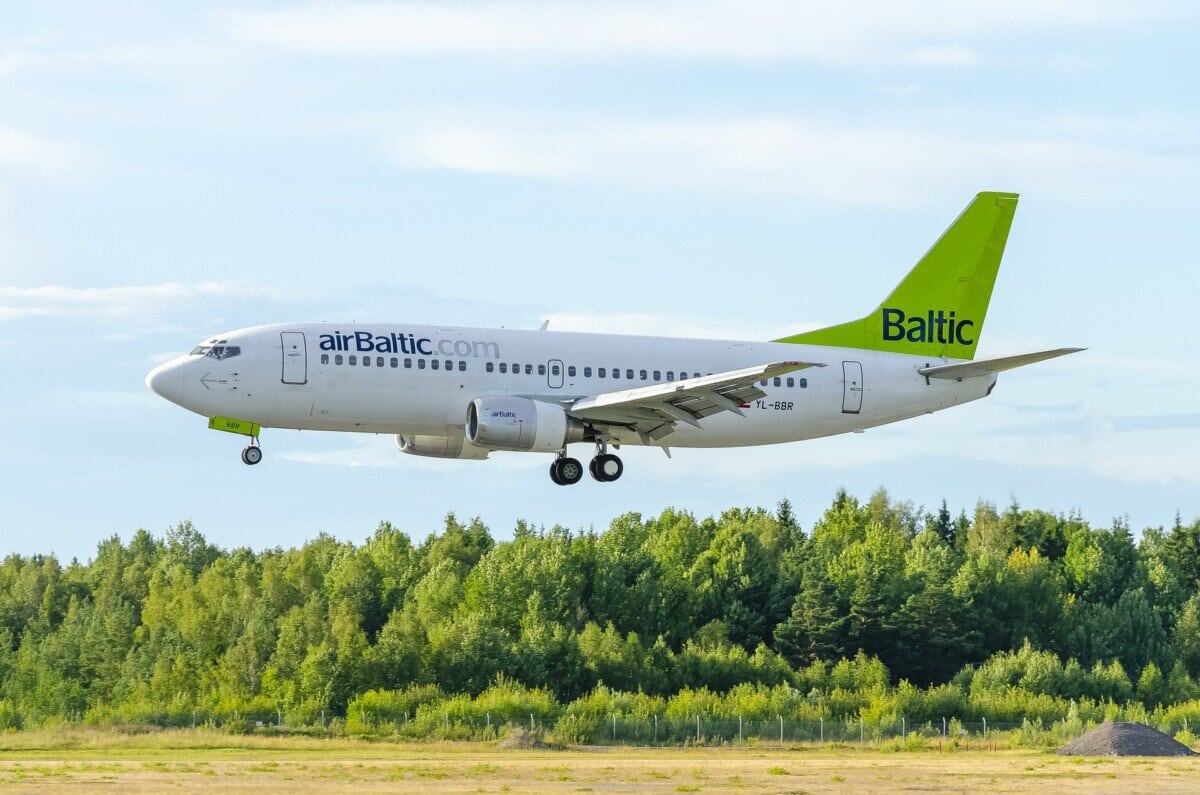
Direct flights exist on all three capital-to-capital routes, which is worth confirming plainly since this kind of regional pairing often has genuine gaps elsewhere in Europe. airBaltic, based in Rīga, operates every leg, and Wizz Air adds a second direct option specifically on Tallinn to Vilnius.
Tallinn to Rīga and Rīga to Vilnius are both short hops, taking around fifty minutes in the air, with airBaltic running roughly four to five daily flights on the former and three to four on the latter. Tallinn to Vilnius direct takes a little over an hour, split between airBaltic and Wizz Air for a combined service of around one flight a day.
The honest catch is that flight time alone flatters the comparison. Add the standard airport arrival window, security and the transfer to and from each city centre, and a fifty-minute flight can easily become a two-and-a-half to three-hour door-to-door journey once both ends are properly accounted for.
That overhead matters most on the shorter legs, where a four-hour coach can end up genuinely competitive with flying once transfers are factored in, particularly since coach stations usually sit closer to a city centre than the airport does. Flying earns its clearest advantage on the Tallinn-Vilnius leg, where the coach alternative runs to eight or nine hours.
Fares vary heavily with how far ahead a ticket is booked, and airBaltic’s own booking pages showed one-way economy fares from around €45 (£39/$52) on these Baltic hops when checked. Booking well ahead of a specific date, rather than close to travel, is the most reliable way to keep this option affordable.
Best if you want daily housekeeping and a front desk. Filter by area first, then by price.
Check availabilityBest for groups who want one address and separate bedrooms rather than three hotel rooms.
See holiday homesBest if you have already picked a hotel. Checks the big booking sites for the same room and shows who is cheapest.
Check dealsDriving and One-Way Car Hire
Driving gives the most control over a Baltic capitals trip, and the distances involved are entirely manageable in a single day. Tallinn to Rīga covers around 310km, mostly via Pärnu, and takes about four hours at the wheel on a road that’s toll-free the whole way.
Rīga to Vilnius is the shorter leg, covering roughly 290-300km in around three and a half hours, again without tolls or vignettes on the Latvian stretch. Both routes are well-maintained, mostly dual-carriageway or good single-carriageway roads rather than anything demanding technical driving.
Border crossings are a non-event in practical terms, since Estonia, Latvia and Lithuania are all inside the Schengen Area, meaning no passport checks or customs stops at either the Valga/Valka or Latvia-Lithuania border. The only real seasonal consideration is winter, when Estonia and Latvia both require winter tyres between December and March and icy conditions are a genuine hazard.
A one-way rental, picking up in Tallinn and dropping off in Vilnius, is where this option gets harder to price. Some providers charge little or no drop fee on this specific corridor because demand runs roughly evenly in both directions, while others quote drop charges running into several hundred euros depending on vehicle class and season.
The only reliable way to know which applies is to compare quotes directly through a rental aggregator for the exact dates and one-way route in question, since the fee swings so widely between providers. Booking a one-way rental well ahead of travel, rather than close to the date, tends to surface the more competitive end of that range.
Rail Between the Baltic Capitals Today
A genuine rail route between all three capitals already exists, it’s just slower and less direct than most travellers expect. LTG Link covers Vilnius to Rīga and on to the Estonian border town of Valga, where Elron takes over for the final leg into Tallinn, with the full Vilnius-Tallinn journey taking around eleven hours with one change.
That’s a real option for anyone building rail into a wider Baltic trip rather than racing between cities, but it is genuinely the slowest of the four modes covered here for a straight capital-to-capital hop. Our dedicated Rail Baltica Explained guide covers this current route in full, including exact fares for every leg and live disruption worth checking before booking.
Rail Baltica itself, the future high-speed line that will eventually cut that eleven-hour journey to well under four, is still under construction and not yet carrying a single passenger. The same guide tracks its real construction progress and the increasingly contested 2030 completion date, rather than assuming a finished line that doesn’t exist yet.
What Rail Baltica Will Mean for the Journey Once It’s Built
Rail Baltica’s entire case for existing rests on one number: cutting today’s eleven-hour, change-at-Valga journey between Tallinn and Vilnius down to well under four hours once the line opens. Early planning documents put the finished Tallinn-Vilnius run at around three hours and thirty-eight minutes, a figure Lithuanian officials have separately echoed when describing what the project should eventually deliver.
That total splits unevenly between the two legs, with Tallinn to Riga projected at around one hour and forty minutes on the finished line, leaving roughly two hours for the longer Riga to Vilnius stretch. Trains are designed to run at up to 249 km/h, which is roughly double the top speed of any passenger train currently operating anywhere in the Baltics.
Progress on the ground varies by country rather than moving as one single project, with roughly 43 percent of the main line reported ready or under construction across all three states. Estonia’s share includes work at Tallinn’s Ülemiste terminal, Latvia’s centres on Riga Central Station reaching its roof stage, and Lithuania has already begun laying track on its first completed section.
None of that guarantees the contested 2030 target holds, and Poland’s own deputy infrastructure minister has already called that date unrealistic, suggesting 2040 as a more honest estimate for the wider Tallinn-Warsaw corridor. A 2024 audit commissioned by the three Baltic states found a funding shortfall running into the billions of euros for phase one alone, and our Rail Baltica Explained guide tracks how that gap is being addressed as the project develops.
For anyone planning an actual trip this year or next, none of this changes which of the four options above is worth booking. Rail Baltica belongs firmly in the someday column of a Baltic itinerary rather than the one being booked now, genuinely worth knowing about but not worth waiting for.
Comparing Your Options
The table below sets all four current options side by side, using the fares and journey times verified above, so it’s easier to weigh time against cost for any specific leg. Treat the “best for” column as a starting point rather than a rule, since a genuine trade-off sits behind every row.
| Mode | Tallinn-Rīga | Rīga-Vilnius | Tallinn-Vilnius | Typical fare | Best for |
|---|---|---|---|---|---|
| Coach | ~4 hours | ~4 hours | ~8-9.5 hours | €15-30 (£13-26/$17-35) | Budget, frequency and most travellers |
| Flight | ~50 mins flying (allow 2.5-3 hrs door-to-door) | ~50 mins flying (allow 2.5-3 hrs door-to-door) | ~65 mins flying (allow 2.5-3 hrs door-to-door) | From €45 (£39/$52) | Speed, especially the Tallinn-Vilnius leg |
| Drive / one-way hire | ~4 hours | ~3.5 hours | ~7-7.5 hours | Rental + fuel; drop fee varies | Multi-stop trips and full flexibility |
| Rail (current route) | ~5h 50m, change at Valga | ~4h 40m, direct on LTG Link | ~11 hours, change at Valga | €9.60-30.50 (£8-26/$11-36) per leg | Rail travel as part of the trip itself |
The Cost of Connecting All Three Capitals
Most travellers doing all three capitals only ever need two of the three possible legs, since a proper loop skips whichever pairing sits between where the trip started and where it finished. Working out a realistic total for those two legs matters more than comparing any single fare in isolation.
Covering both remaining legs by coach, Tallinn to Rīga and then Rīga to Vilnius or the reverse, typically comes to somewhere between €30 and €55 (£26-48/$35-64) once both tickets are booked, with an advance saver fare on each leg keeping the total nearer the bottom of that range. That makes coach comfortably the cheapest way to string all three capitals together in one trip.
Flying both connecting legs instead is far quicker but noticeably pricier, since each hop is priced and booked as its own ticket rather than a single through-fare. Two one-way economy fares at airBaltic’s own advertised starting price put the flying total from around €90 (£78/$104) upward, before any airport transfer at either end is even added.
Driving both legs adds up to around 600 kilometres in total, and fuel alone at current Baltic pump prices works out to somewhere around €70-90 (£61-78/$81-104) for that distance in an average family car. A one-way rental adds its own daily rate on top of that figure, plus whatever drop fee applies, so driving rarely ends up cheaper than the coach once every cost is totalled.
None of these totals include accommodation or the extra day the coach option quietly costs in travel time rather than money. Anyone watching their budget rather than the clock should default to the coach for both legs, while anyone short on days should accept flying’s higher price as the cost of buying that time back.
Planning a Baltic Capitals Trip
Most travellers doing all three capitals in one trip run them in a loop, Tallinn to Rīga to Vilnius or the reverse, rather than backtracking, since coach and flight schedules both favour that direction of travel anyway. Flying into one capital and out of another avoids doubling back entirely and is often only marginally more expensive than a same-airport return.
Allow at least two to three full days in each city to do it justice, on top of whatever travel days sit between them, rather than treating the capitals purely as staging posts. Our own guides to Best Things to Do in Tallinn, Things to Do in Rīga and Best Things to Do in Vilnius each cover a genuinely full itinerary for their city.
A realistic minimum for all three, including travel between them, is around eight to ten days, and closer to two weeks for anyone who wants proper time in each place rather than a rushed skim. Trying to squeeze all three into under a week generally means one city gets shortchanged.
Luggage is straightforward on every option covered here since all four modes operate within the Schengen Area, so there’s no customs step to plan around at any border, only the usual hold-luggage allowances on the flying legs. Coach operators typically allow one hold case per passenger plus hand luggage, similar to a budget airline’s allowance.
Whichever combination of coach, flight, drive and rail ends up making the trip, booking the busier legs, particularly Tallinn-Rīga by coach and any flight, a few weeks ahead rather than a few days keeps both choice and price on the traveller’s side. Season matters too, since summer brings noticeably more competition for seats on every mode covered here.
Best if you can move a day either way. Shows how the fare to Tallinn changes across the month.
Compare flightsBest for anyone whose home plan charges by the megabyte abroad. Pay a fixed price up front.
Check eSIMsBest after a long flight or a late landing. Price agreed before you travel, and no taxi queue.
Check transfersChoosing Between a Loop and a Hub and Spoke Trip
Two structures cover almost every Baltic capitals trip: a loop that flies into one capital and out of another, or a hub and spoke that bases itself in one city and makes return day trips to the other two. Which suits a given traveller best comes down to how much they mind repacking versus how much they mind a long day trip there and back.
Rīga sits almost exactly between the other two, which makes it the obvious base if the hub and spoke structure is chosen. A same-day return to either Tallinn or Vilnius by coach means roughly eight hours of travel in one day, workable but leaving little energy for sightseeing on arrival, while the fifty-minute flight makes a genuine day trip far more realistic.
The loop avoids that round trip entirely and suits anyone spending several days in each city rather than treating two of the three as a quick side trip from a single base. It means packing up and moving on twice rather than once, though flying into one capital and out of another is usually only a little more expensive than a same-airport return.
Rīga to Tallinn and Rīga to Vilnius are the two easiest legs under either structure, well served by coach, flight and the existing rail route covered earlier on this page. Tallinn to Vilnius direct is the one pairing that’s genuinely harder to move between, with the longest coach ride and the thinnest flight schedule of the three, and no direct rail link at all.
That asymmetry is worth building a trip around rather than fighting it. Starting or finishing in Tallinn and Vilnius while routing everything else through Rīga, whether as a loop or a hub, sidesteps the corridor’s one genuinely awkward leg instead of confronting it head-on.
Adding Helsinki to a Baltic Capitals Trip
Tallinn sits closer to a fourth capital than either of its Baltic neighbours, with Helsinki just a short hop across the Gulf of Finland. It is one of the busiest ferry crossings in Europe, and folding it into a Baltic capitals trip needs barely any extra planning beyond booking one more ticket.
Three operators cover the route, with Tallink Silja running the most frequent service at multiple sailings a day, while Viking Line and Eckerö Line each add one daily departure in both directions. The fastest crossing takes around two hours and fifteen minutes, and one-way fares typically run from about €19 up into the mid-thirties depending on operator and season.
Both terminals sit close to their respective city centres, with Tallinn’s port a short walk from the Old Town and Helsinki’s harbours a similar distance from its centre, so there’s no lengthy transfer to plan around. Finland’s own Schengen membership means the crossing carries the same lack of routine border checks as travel between the three Baltic capitals themselves, though a passport is still worth carrying.
The natural place to add Helsinki is at the Tallinn end of either a loop or a hub and spoke trip, either as a first stop before heading south or a last one before flying home. A single overnight or two full days is enough to see Helsinki’s centre without turning a Baltic capitals trip into a five-city sprint.
Booking the ferry follows the same pattern as everything else on this corridor, since a fare booked a few weeks ahead of summer travel comes in noticeably cheaper than one bought the same week. Demand on this specific crossing peaks hard between June and August, so that gap in price is often wider here than on the coach or flight legs further south.

Rupert’s Handy Travel Tips
Four genuine ways to get between the Baltic capitals, and how to pick between them without overthinking it.
- Book the busy Tallinn-Rīga coach ahead: the most popular daytime departures sell out first in summer.
- Don’t assume flying always wins: airport transfers can erase a fifty-minute flight’s advantage on the shorter legs.
- Check for a drop-fee-free one-way rental: the Tallinn-Rīga-Vilnius corridor often qualifies since demand runs both ways.
- Read Rail Baltica Explained before booking rail: it covers the current Valga change and every fare in full.
- Pack for a Schengen border, not a passport check: there’s no border control between any of the three capitals.
- Loop the trip rather than backtrack: fly into one capital and out of another to save a wasted travel day.
Want to meet the reindeer behind our travel tips? Find out more in our page Who is Rupert?.




Frequently Asked Questions About Travelling Between the Baltic Capitals
What’s the fastest way to travel between the Baltic capitals?
Flying is fastest in the air, around fifty minutes between any two capitals, though airport transfers and check-in narrow that advantage considerably on the shorter legs.
Is there a direct train between Tallinn, Rīga and Vilnius?
Not a single through-train. The current route uses LTG Link and Elron with a change at Valga, taking around eleven hours end to end; our Rail Baltica Explained guide covers it in full.
How long does the coach take between the Baltic capitals?
Around four hours each between Tallinn and Rīga, and Rīga and Vilnius, with a direct Tallinn-Vilnius coach taking roughly eight to nine and a half hours.
Do airlines fly direct between all three Baltic capitals?
Yes. airBaltic operates every leg, and Wizz Air adds a second option specifically on Tallinn to Vilnius, though frequency is modest compared with major European routes.
Is Rail Baltica finished yet?
No. The high-speed line remains under construction across all three countries, with an official 2030 target that several officials involved in building it have already called unrealistic.
Is a one-way car rental between the capitals expensive?
It varies by provider. Some charge little or no drop fee on this specific corridor thanks to balanced demand in both directions, while others charge several hundred euros, so comparing quotes directly is worth the time.
Do I need my passport at the borders between the three countries?
No routine checks apply, since Estonia, Latvia and Lithuania are all inside the Schengen Area, though carrying ID with you is still sensible practice.
How much does it cost to visit all three Baltic capitals?
Coach covers the two connecting legs for roughly €30-55 (£26-48/$35-64) combined, flying roughly doubles that before transfers are added, and driving comes down mostly to fuel plus any one-way rental drop fee.
Is it better to loop the Baltic capitals or base yourself in one?
A loop suits longer stays in each city, while basing yourself in Rīga and day-tripping to Tallinn or Vilnius works well if time is tight, since Rīga sits almost exactly between the other two.
Further Reading
For the full story behind why rail remains the slowest option covered here, and exactly when that might change, our Rail Baltica Explained guide covers the entire project’s route, timeline and current construction status alongside the existing multi-operator train journey.
Anyone building out full itineraries in each city should read our Best Things to Do in Tallinn, Things to Do in Rīga and Best Things to Do in Vilnius guides, each covering a genuinely comprehensive list of attractions for its city.
Travellers flying into Rīga specifically should also read our Rīga Airport Transfers guide, which covers every practical way to reach the city centre until RIX eventually gets its own Rail Baltica station.