Reviewed by our editorial team Published
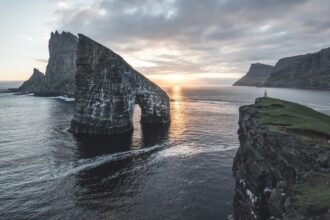
The Faroe Islands are eighteen islands scattered across the North Atlantic, and seventeen of them are inhabited, but the tunnel network linking several of them together has only ever reached so far. Where the tarmac stops, Strandfaraskip Landsins (SSL), the Faroese state ferry and bus operator, takes over the job of getting people, cars and mopeds across open water to islands a bridge or a bored subsea tunnel will likely never reach. For a first-time visitor, that ferry network is not a footnote to a road trip; it is the only way to actually stand on Mykines watching puffins wheel off the cliffs, or to walk the exposed ridge above Kallur Lighthouse on Kalsoy.
This guide works through the whole system properly. It covers the long international crossing that brings cars and foot passengers over from Denmark on the Smyril Line ferry Norröna, the domestic SSL network that stitches the smaller islands together, and, just as importantly, which islands used to need a ferry but are now reached by tunnel instead, since planning around a crossing that closed years ago is an easy and entirely avoidable mistake.
Individual sections then cover each of the main inter-island routes in enough depth to actually plan a trip around: Suðuroy in the deep south, Mykines and its single daily summer sailing, Kalsoy’s short hop to the lighthouse trailhead, Nólsoy as a half-day trip from the capital, and the smaller, often request-only routes out to Hestur, Skúvoy, Svínoy and Fugloy. Booking through SSL’s own system, realistic pricing in DKK and its major currency equivalents, and what actually happens when Atlantic weather cancels a sailing (which it periodically does) round the page out.
Faroe Islands Ferry Routes at a Glance
| Route | Connects | Crossing Time | Typical Price | Notes |
|---|---|---|---|---|
| Smyril Line (Denmark leg) | Hirtshals (Denmark) – Tórshavn | 30-38 hours | Varies by season and cabin | Weekly, twice weekly in summer |
| Smyril Line (Iceland leg) | Tórshavn – Seyðisfjörður (Iceland) | 15 hours | Included in the same Smyril Line fare | Once weekly, mid-March to late November only |
| Route 7 | Tórshavn – Tvøroyri (Suðuroy) | 2 hours 5 minutes | From 88 DKK (£10/€12/$13) foot; 122 DKK (£14/€16/$18) car | 3-4 sailings daily, carries vehicles |
| Route 36 | Sørvágur – Mykines | 45 minutes | From 123 DKK (£14/€16/$18) | Seasonal frequency, weather-sensitive |
| Route 56 | Klaksvík – Kalsoy | 20 minutes | From 105 DKK (£12/€14/$15) foot return; 179 DKK (£21/€24/$26) car return | Up to 8 sailings daily in summer, carries vehicles |
| Route 90 | Tórshavn – Nólsoy | 30 minutes | From 105 DKK (£12/€14/$15) return | Up to 7 sailings daily, foot passengers mainly |
| Route 61 | Gamlarætt – Hestur | Under 20 minutes | From 53 DKK (£6/€7/$8) | 5 sailings daily, book ahead |
| Route 66 | Sandur – Skúvoy | 35 minutes | From 53 DKK (£6/€7/$8) | Seasonal (late May-August), request-based |
| Route 58 | Hvannasund – Svínoy – Kirkja – Hattarvík (Fugloy) | 10-30 minutes per leg | From 105 DKK (£12/€14/$15) | Small vehicles/mopeds only, mostly by request |
All eight routes above are run by SSL, with the sole exception of the international Smyril Line crossing, and every domestic sailing can be booked through SSL’s own online booking system. Two islands that used to need their own dedicated ferry, Sandoy and (for through traffic) parts of Eysturoy, are covered separately below, since a visitor relying on an older guide could easily plan a crossing that no longer exists.
Getting to the Faroe Islands by Ferry from Denmark
The only way to reach the Faroe Islands by sea from mainland Europe is the Smyril Line crossing between Hirtshals, on the northern tip of Denmark, and Tórshavn. It is operated by a single ship, the MS Norröna, a purpose-built multi-purpose ferry launched in 2003 that carries passengers, cars, campervans and freight together on the same crossing.
The crossing itself takes around 30 hours in summer and closer to 38 hours in winter, since the summer timetable calls at fewer intermediate ports. Sailings run weekly year-round, stepping up to twice a week from Hirtshals during the busiest summer weeks, and passengers who want a proper night’s sleep rather than a reclining seat need to book a cabin, which range from simple couchette-style bunks up to outside cabins with a sea view.
Fares vary considerably by season, cabin grade and whether a vehicle is being carried, so rather than quote a single misleading figure it’s worth pricing an actual date directly on Smyril Line’s own booking site. Anyone driving over should also read our Faroe Islands Road Trip guide before boarding, since the toll tunnels waiting on the other end work on a completely different payment system to the ferry itself.
Best for a short trip. Compare rooms by neighbourhood, price and guest rating before you book.
Compare hotelsBest for groups who want one address and separate bedrooms rather than three hotel rooms.
See holiday homesBest for double-checking. Runs the same search across several booking sites so you are not leaving money behind.
Compare pricesContinuing On to Iceland by Ferry
For part of the year, the same Norröna that brings passengers over from Denmark does not stop at Tórshavn. One of the weekly summer sailings continues on from the Faroe Islands to Seyðisfjörður on the east coast of Iceland, turning what starts as a Denmark-to-Faroes crossing into a genuine three-country, one-ship road trip without a single flight booked.
The Faroes-to-Iceland leg adds a further 15 hours on top of the Hirtshals-Tórshavn crossing, bringing the full Denmark-to-Iceland journey to somewhere around 47-48 hours door to door once the connection in Tórshavn is included. It runs just once a week during the season, rather than on every sailing, so anyone building a Faroes-Iceland combination trip needs to check the specific weekly departure that continues onward rather than assuming any Tórshavn sailing will do.
The Iceland service operates only from roughly mid-March to late November. It is paused over winter largely because Seyðisfjörður sits behind a mountain pass that regularly becomes impassable in harsh weather, and Smyril Line has no reliable fallback route into the town once that pass closes.
Anyone planning to drive off the ferry in Iceland should treat the Faroese leg as the easy half of the journey. Seyðisfjörður itself is a small fjord-side town on Iceland’s eastern edge, several hours’ drive from Reykjavík, so the crossing is better suited to a proper Icelandic road trip than a quick add-on to a Faroes-only holiday.
Which Islands Have Swapped Their Ferry for a Tunnel
Not every island that used to need a ferry still does, and getting this wrong is one of the easiest planning mistakes to make from an older blog post or an out-of-date guidebook. Sandoy is the clearest example: until December 2023, reaching it meant a ferry from Gamlarætt on Streymoy across to Skopun, but that route was retired the moment the Sandoyartunnilin opened.
The Sandoyartunnilin runs 10.8 kilometres and drops to around 155 metres below the seabed at its lowest point, replacing what used to be a roughly 30-40 minute crossing with a toll-tunnel drive of well under 20 minutes. The toll is charged automatically by number-plate camera rather than at a manual booth, and it is either paid directly through tunnil.fo or billed straight to a rental company’s invoice, depending on how the car was hired.
Eysturoy tells a slightly different story. It has been road-connected to Streymoy by a surface bridge and causeway since 1973, so it was never genuinely ferry-dependent for through traffic, but the Eysturoyartunnilin, opened in 2020, gives a far more direct route from Tórshavn to the villages around Runavík. It is also the site of the world’s first underwater roundabout, decorated with light art by the Faroese sculptor Tróndur Patursson, and worth a slow drive-through rather than a rushed pass beneath it.
Every other route covered on this page, from Suðuroy down to the smallest request-only crossings, remains genuinely ferry-only for now, with nothing currently under construction. The one exception worth flagging is Suðuroy itself: in February 2026 the Faroese parliament approved a 24.3-kilometre Suðuroyartunnilin, which would eventually link Suðuroy to Sandoy and Skúvoy and retire the Route 7 ferry entirely, though its earliest realistic opening is 2036, so it changes nothing for a visitor planning a trip in the next decade.
Ferry or Subsea Tunnel: Which One You Actually Need
With two tunnels and eight SSL ferry routes now covering the archipelago, it helps to see at a glance which islands you drive to and which still need a boat. The short version: only Sandoy and Eysturoy are reached by tunnel, and every other inhabited island covered on this page remains ferry-only, so the table below works as a quick checklist before assuming a rental car can reach everywhere.
| Destination | How You Reach It | Typical Journey | Good to Know |
|---|---|---|---|
| Sandoy | Subsea tunnel (Sandoyartunnilin) from Streymoy | Under 20 minutes’ drive | Toll billed automatically by number-plate camera; no ferry option remains |
| Eysturoy | Bridge and causeway, plus the Eysturoyartunnilin tunnel, from Streymoy | Direct drive, no crossing needed | Never genuinely ferry-dependent; the tunnel just shortens the route to Runavík |
| Suðuroy | Ferry only (Route 7) | 2 hours 5 minutes | No tunnel planned before 2036 at the earliest |
| Mykines | Ferry only (Route 36), or occasional helicopter | 45 minutes | No road or tunnel access exists at all |
| Kalsoy | Ferry only (Route 56) | 20 minutes | Single-track tunnels wait once ashore, not a subsea crossing |
| Nólsoy, Hestur, Skúvoy, Svínoy, Fugloy | Ferry only (smaller SSL routes) | 10-35 minutes | None currently has any tunnel proposal |
Tunnel tolls are billed automatically through number-plate recognition rather than paid at a booth, with rental companies typically passing the charge on to the card used at pickup, while every row still marked “ferry only” above runs through SSL’s own booking system covered in the next section. Working out which applies before setting off avoids planning a crossing that quietly stopped running years ago.
In practice, a driving-only itinerary can genuinely reach Sandoy and Eysturoy without touching a ferry timetable at all, while Suðuroy, Mykines, Kalsoy and the smaller islands still need a booked SSL crossing regardless of what car is waiting at the terminal. Anyone renting a car and hoping to reach Mykines or Kalsoy on the same trip should read the individual route sections above rather than assume a bridge exists where a boat still runs.

Booking SSL Ferries: Prices, the Online System and Weather
Every domestic ferry route is booked through the same SSL online booking system, and for the two routes that carry the most vehicle traffic, Suðuroy and Kalsoy, booking a car space ahead of time is genuinely worth doing rather than turning up and hoping. Foot passengers can usually board without a reservation, though on the more remote request-only routes even a foot passenger needs to call ahead.
SSL runs three tiers of pricing on most routes: a standard walk-up fare, a slightly cheaper online fare for booking through the website in advance, and a heavily discounted resident fare that only applies to people registered as living in the Faroe Islands. Visitors should plan around the online or standard fare, and booking online where the route allows it is close to free money, since it is simply cheaper for exactly the same crossing.
Several of the smaller routes, including Route 58 to Svínoy and Fugloy and parts of Route 66 to Skúvoy, run on a request-only basis outside their busiest daily slots, meaning a sailing simply does not happen unless someone has called or booked in advance to be on it. This is worth building into any itinerary that includes one of the smaller islands, since arriving at the pier and expecting a boat regardless is a genuine way to be stranded for the day.
Faroese weather closes ferries more often than most first-time visitors expect, particularly on the exposed Mykines and Suðuroy crossings during autumn and winter storms. SSL posts live cancellations on its own timetable pages rather than through a single alert system, so anyone with a tight onward connection, a flight home or a hotel booking that depends on a specific island crossing should build at least one genuine buffer day into the plan rather than scheduling a departure for the same afternoon as the return sailing.
Suðuroy: The Faroes’ Southern Island by Ferry
Suðuroy is the southernmost of the Faroe Islands and, unlike almost everywhere else in the archipelago, has no tunnel or bridge connecting it to the rest of the country. Reaching it means the longest domestic crossing on this page, Route 7, running between Tórshavn and Tvøroyri aboard the M/F Smyril, and that genuine sense of separation is exactly what gives Suðuroy its own distinct culture, dialect quirks and slower pace compared with the more visited northern islands.
The crossing takes 2 hours and 5 minutes each way, with three to four sailings a day on weekdays and a reduced schedule at weekends, and the ferry carries cars, motorhomes and larger vehicles alongside foot passengers. Foot passenger fares run from around 88 DKK (£10/€12/$13) booked online up to 109 DKK (£13/€15/$16) bought at the terminal, with a car costing from roughly 122 DKK (£14/€16/$18) online to 229 DKK (£27/€31/$33) at full price, each way.
Once on the island, Suðuroy rewards a proper two or three-day stay rather than a rushed there-and-back day trip: the sea cliffs and stacks around Beinisvørð and Ásmundarstakkur, the black-sand-adjacent town of Vágur, and a genuinely different pace of life all make more sense with an overnight or two. Booking the car space in advance on Route 7 is worth doing in summer, since it is the single busiest domestic crossing on the network and sailings can fill up with visiting road-trippers.
Mykines: The Puffin Ferry with One Sailing a Day
Mykines is the westernmost inhabited island in the Faroes and has no road or tunnel access at all; a boat from Sørvágur, or an occasional helicopter, are the only ways in. It is also the single most rewarding ferry trip on this whole page for most visitors, since the island’s sea cliffs hold one of the largest and most accessible puffin colonies anywhere in the North Atlantic between roughly April and August.
Route 36 takes 45 minutes each way and runs a genuinely different schedule depending on the season. Through summer, from May to the end of August, there are usually three sailings a day, seven days a week, at 9:30am, 1:30pm and 5:30pm from Sørvágur, while the shoulder months either side drop to a single daily sailing around 10:45am on just three days a week, Tuesday, Thursday and Saturday.
Foot passenger fares run from around 123 DKK (£14/€16/$18) booked online to 153 DKK (£17/€20/$22) at the terminal, and children travel for roughly 70-88 DKK (£8-10/€9-12/$10-13). A landslide closure has periodically affected the walking route out to Mykineshólmur, the small holm at the island’s tip where the puffins and gannets nest, so it is worth checking current access on Visit Faroe Islands’ own site before travelling, since the ferry can be running normally while the headland trail itself is temporarily shut.
Because there is only one sailing a day for much of the year, and no realistic way off the island if a return crossing is cancelled for weather, Mykines is not a trip to build tightly around a same-day flight home. Anyone visiting the wider Faroe Islands attractions covered elsewhere on this site should treat Mykines as the one crossing worth adding a genuine buffer day around.
Best for long or awkward journeys. Builds one itinerary out of separate flights.
View flightsBest for short trips. Install the eSIM at home and arrive with working data, no shop queue.
Browse eSIMsBest if you would rather not work out the transport on arrival. Book it now and forget it.
View transfersKalsoy: The Short Hop to Kallur Lighthouse
Kalsoy is a long, narrow island in the north of the archipelago, reached by Route 56 from Klaksvík, and it has become one of the most photographed hikes in the entire country thanks to the exposed ridge trail out to Kallur Lighthouse. The island also gained a wider audience after a scene from the James Bond film No Time to Die was filmed near its northern tip, though the “007 tombstone” occasionally shown to tourists is a genuine film prop rather than any real grave.
The crossing itself is short, just 20 minutes each way, and runs frequently: up to eight sailings a day through summer, dropping to five or six a day in winter with a lighter weekend schedule. Return foot passenger fares run from around 105 DKK (£12/€14/$15) booked online to 131 DKK (£15/€18/$19), and a car costs from roughly 179 DKK (£21/€24/$26) online to 336 DKK (£39/€45/$49) return.
Kalsoy itself is a single-track road for almost its entire length, running through a string of narrow, unlit tunnels between its villages, so anyone bringing a car over needs to drive slowly and use the passing places properly rather than assuming oncoming traffic will simply give way. It is a genuinely different driving experience to the mainland roads covered in our Faroe Islands road trip guide, and worth reading before taking a car across rather than after. Our Taking the Car section further down this page covers the general lay-by and tunnel etiquette that applies here in more detail.
Nólsoy: A Half-Day Ferry Trip from Tórshavn
Nólsoy sits directly opposite Tórshavn harbour and is, in practical terms, the easiest inter-island ferry trip on this whole page. Route 90 takes just 30 minutes and runs up to seven times a day, which makes Nólsoy a genuinely realistic half-day or even a few-hour add-on to a stay in the capital rather than something that needs its own overnight stop.
The island itself is small enough to explore entirely on foot, with a walking route out to a lighthouse at its southern tip and, in season, one of the larger storm petrel colonies in the North Atlantic nesting nearby. Fares follow the same return-ticket structure as the Kalsoy crossing, running from around 105 DKK (£12/€14/$15) to 131 DKK (£15/€18/$19) per person, and while the route can technically carry a car, the island is genuinely walkable and most day-trippers leave the vehicle behind in Tórshavn.
Because sailings run so frequently compared with the other routes on this page, Nólsoy is a sensible choice for a visitor whose schedule is otherwise tight, or who wants a genuine island crossing without committing an entire day to it. It also pairs naturally with a day based in Tórshavn covered in our Faroe Islands Explained hub guide, which ties the whole cluster of islands together.
The Smaller Routes: Hestur, Skúvoy, Svínoy and Fugloy
Beyond the main routes above, SSL runs several smaller, quieter crossings to islands that see a fraction of the visitors of Mykines or Kalsoy, and are largely aimed at residents rather than tourism, though nothing stops a visitor booking one. Route 61 runs from Gamlarætt, the same pier used for the old Sandoy ferry before the tunnel opened, across to Hestur, a small island with dramatic cliffs and a population in the dozens, with five sailings a day and a crossing of well under 20 minutes.
Route 66 connects Sandur, on Sandoy, with Skúvoy, taking around 35 minutes and running only in season, from late May to the end of August, with several sailings a day that frequently need booking by request rather than simply turning up. Route 58 is the most complex of the smaller network, threading from Hvannasund out to Svínoy in around 30 minutes, then on to Kirkja and finally Hattarvík on Fugloy in short 10-15 minute hops, and only takes smaller vehicles and mopeds rather than a full-size car.
Fares on these routes are noticeably cheaper than the main crossings, with foot passengers on Hestur and Skúvoy paying from around 53 DKK (£6/€7/$8) online to 66 DKK (£8/€9/$10) standard, while Svínoy and Fugloy follow the same pricing as the Kalsoy route. Because several of these sailings genuinely will not run without a phone call ahead, they suit a visitor with a flexible itinerary and a specific interest in one of these smaller islands far more than someone trying to tick off every Faroese island against a fixed schedule.

Best Time to Visit and Coping with a Cancelled Sailing
The summer months, from May to August, offer the calmest seas, the longest daylight and the fullest sailing schedules across every route on this page, and are by far the easiest time to build a multi-island itinerary with any confidence. Mykines in particular is essentially a summer-only proposition in practice, since its winter schedule drops to a single sailing on alternate days and the puffins themselves have left the cliffs by autumn regardless.
Autumn and winter bring a real chance of cancellations on the more exposed crossings, particularly Suðuroy and Mykines, where storm-force winds of the kind seen during Storm Ingunn in January 2024, which produced gusts of around 155 miles per hour on parts of the islands, can shut a route for a full day or more. SSL does not run a single push-alert system for cancellations, so checking the specific route’s own timetable page on the morning of travel is the most reliable way to know a sailing is actually running.
Anyone building a tight itinerary around a flight home or an onward ferry connection should treat at least one buffer day as essential rather than optional, especially around Mykines and Suðuroy in the shoulder seasons. Travellers arriving by air first should also check our Faroe Islands Airport Transfers guide for getting from Vágar to Tórshavn before connecting onward to any of the ferry terminals covered here.
Taking the Car: Which Routes Carry Vehicles
Not every route on this page carries a car, and it is worth checking before planning a road trip around the ferry network rather than assuming every crossing works like Suðuroy or Kalsoy. Route 7 and Route 56 are the two genuine vehicle-carrying routes on the network, while Route 58 takes only small vehicles and mopeds, Route 66 is foot passengers only, and Mykines has no real roads to drive on regardless of whether space exists on Route 36.
Once ashore, single-track driving etiquette takes over, and nowhere matters more than Kalsoy, where the road runs through a string of narrow, unlit tunnels between villages. Faroese convention uses widened lay-bys built into single-track roads for passing oncoming traffic, with the driver nearer one expected to pull in and wait, and slowing well below the posted 80km/h tunnel limit is the sensible approach underground.
Vehicle fares scale with length rather than a flat rate, and vehicles wider than 2.5 metres pay double on the main routes. A standard car under 5.5m on Route 7 runs from around 122 DKK (£14/€16/$18) online to 229 DKK (£27/€31/$33) at full price each way, while the same car on Route 56 to Kalsoy costs from roughly 179 DKK (£21/€24/$26) online to 336 DKK (£39/€45/$49) for the return fare.
Booking a car space through SSL’s own online booking system is genuinely worth doing on both Route 7 and Route 56 during summer, since these are the network’s busiest vehicle crossings and sailings can fill before departure. Foot passengers can usually board without a reservation even when the car deck is full, but a rental car should be booked on rather than simply turning up and hoping.
SSL’s Weather Cancellation and Rebooking Policy
SSL’s own terms and conditions are refreshingly blunt about what happens when the operator itself cancels a sailing for weather: the fare is refunded automatically to the SSL account or card used to book, but rebooking onto a later sailing is left entirely to the passenger rather than handled automatically. There is no separate weather clause buried in the small print, since a weather cancellation is treated the same as any other SSL-initiated cancellation.
The terms are equally blunt about compensation: SSL states plainly that it does not reimburse extra hotel nights, missed flights or other costs caused by a delayed or cancelled crossing, so travel insurance rather than the ferry operator is the right place to look for cover against a weather day. The most useful habit is signing up for SSL’s free SMS notification service, or simply checking the specific route’s own page on ssl.fo, since cancellations are posted route by route rather than through one central alert.
In practice this makes the buffer-day advice elsewhere on this page less about caution and more about how SSL’s own system actually works: a cancelled sailing gets a traveller their money back, not a seat on the next boat, so anyone whose plan depends on Mykines or Suðuroy running on a specific day is the one who has to watch the timetable and rebook, not SSL. Building a spare day around the most weather-exposed routes remains the simplest way to avoid that scramble entirely.
Best for solo travellers and anyone watching the budget. Dorm beds and private rooms in the same search.
Browse hostelsBest for anyone flying more than once or twice a year. Handles the compensation claim so you are not chasing the airline.
See AirHelp+Best for a day with a suitcase and nowhere to put it. Find a storage point near where you already are.
View storagePlanning a Multi-Island Ferry Itinerary
With eight different SSL routes covered on this page, it helps to think in terms of a loose order rather than trying to visit every island in one trip. Most visitors base themselves in Tórshavn or Klaksvík and treat each crossing as its own day trip, returning to the same bed each night rather than island-hopping with luggage in tow, since almost every route above returns to its mainland pier within a matter of hours.
A realistic week might pair a full day for Mykines, built around its single best-weather morning sailing, with a two or three-night side trip to Suðuroy given how much longer that crossing and the island itself both reward, then fill remaining days with the quick, frequent hops to Kalsoy and Nólsoy that fit comfortably either side of a hike or a meal back in the capital. The smaller request-only routes to Hestur, Skúvoy, Svínoy and Fugloy are worth adding only once the main four are booked, since they need a phone call rather than a click and suit a visitor with a free, unplanned day to spare.
The single rule worth applying across the whole itinerary is to put the weather-sensitive routes early rather than last: a Mykines or Suðuroy sailing lost to a storm on day two still leaves room to try again on day four, while the same cancellation on the final full day simply means missing the island altogether. Routes like Nólsoy and Kalsoy, with several sailings a day and comparatively sheltered short crossings, are the safer ones to leave until the end of a trip.

Rupert’s Handy Travel Tips
Planning to island-hop the Faroes by ferry? Here are a few things worth knowing before booking.
- Book online, not at the terminal: the online fare is cheaper than the walk-up price on almost every route, for exactly the same crossing.
- Reserve a car space on Suðuroy and Kalsoy in summer: both routes carry heavy vehicle traffic in peak season and can genuinely fill up.
- Double-check Sandoy isn’t still a ferry in your plan: the old Gamlarætt-Skopun crossing was replaced by a tunnel in December 2023.
- Build in a buffer day for Mykines: there’s often only one sailing a day, and no way off the island if weather cancels the return trip.
- Call ahead for the smallest routes: several sailings to Hestur, Skúvoy, Svínoy and Fugloy run by request only, not on a fixed timetable.
- Check the specific route’s timetable page on travel day: SSL posts weather cancellations there directly rather than through a single alert system.
Want to meet the reindeer behind our travel tips? Find out more in our page Who is Rupert?.




Frequently Asked Questions About Faroe Islands Ferry Routes
How do I book Faroese ferry tickets?
Every domestic route is booked through SSL’s own online booking system, which also offers a cheaper fare than buying at the terminal on the day.
Is the Sandoy ferry still running?
No. It was replaced by the Sandoyartunnilin subsea tunnel in December 2023, and Sandoy is now reached by road rather than by ferry.
How long does the ferry from Denmark to the Faroe Islands take?
The Smyril Line crossing from Hirtshals takes around 30 hours in summer and up to 38 hours in winter.
Can I continue from the Faroe Islands to Iceland by ferry?
Yes, one weekly summer sailing continues from Tórshavn to Seyðisfjörður, adding around 15 hours, but the service only runs from roughly mid-March to late November.
How do I get to Mykines?
Mykines has no road access, so the only options are the Route 36 ferry from Sørvágur, which takes 45 minutes, or an occasional helicopter service.
Can I take a car on the Faroese ferries?
Suðuroy, Kalsoy and several of the smaller routes carry cars, though Mykines, Nólsoy and Hestur are compact enough that most visitors travel on foot regardless.
What happens if a ferry is cancelled by weather?
SSL posts cancellations directly on each route’s own timetable page rather than through a single alert system, so it is worth checking the specific route on the morning of travel, and building in a buffer day for weather-sensitive crossings like Mykines and Suðuroy.
Do I need to book in advance for the smaller islands?
Yes, in many cases. Routes to Skúvoy, Svínoy and Fugloy often run by request only, meaning the sailing simply will not happen unless it has been booked or called in ahead of time.
Can tourists use the ferries without advance reservations?
On the main routes, Suðuroy, Mykines, Kalsoy and Nólsoy, yes: foot passengers can generally turn up and buy a ticket, though booking online is cheaper and reserving a car space is worth doing on Route 7 and Route 56 in summer. The smaller routes to Hestur, Skúvoy, Svínoy and Fugloy are a different story, since several sailings run by request only and simply will not happen without a call or booking ahead, whatever kind of passenger is travelling.
Further Reading & Related Guides
Anyone planning to drive across the Faroe Islands’ toll tunnels between ferry crossings should read our Faroe Islands Road Trip guide, which covers the Eysturoyartunnilin and Sandoyartunnilin toll systems in full alongside single-track road etiquette on islands like Kalsoy.
Visitors flying in first should check our Faroe Islands Airport Transfers guide for getting from Vágar to Tórshavn, and our Faroe Islands things to do guide for what’s actually worth doing on Mykines, Kalsoy and the other islands once the ferry gets there.
Travellers driving onto the Norröna from Hirtshals rather than flying in first should also plan around the crossing itself: our Interrail Denmark Pass guide covers getting around Copenhagen, Aarhus and the rest of Denmark by rail before boarding, and anyone prone to motion sickness on a genuinely long open-sea crossing should read our Seasickness at Sea guide ahead of booking a cabin rather than after departure.
For a wider overview tying the whole archipelago together, our Faroe Islands Explained hub guide is the best starting point before diving into any single island’s ferry crossing in detail.