Reviewed by our editorial team Updated
The Faroe Islands are a genuinely unusual place to plan a trip around: an eighteen-island archipelago in the middle of the North Atlantic, self-governing yet still part of the Kingdom of Denmark, reachable by most visitors through a single small airport on one of its smaller islands. Few European destinations pack this much logistics into so short a distance, from undersea tunnels and inter-island ferries to a healthcare system, currency and shopping culture that quietly differ from the rest of Denmark.
This page exists to pull all of that together in one place. Rather than repeating the deep, attraction-by-attraction detail already covered elsewhere on this site, it works as a genuine starting point: where the islands actually are, how the whole transport network fits together, what happens if something goes wrong medically, roughly what a trip will cost, and where to base yourself once you land.
None of this is guesswork. Every route, fare, tunnel toll and opening pattern below has been checked against current 2026 sources, including the Faroese transport operator’s own timetables and the official tourist board, rather than lifted from whatever the nearest listicle happened to claim.
For genuinely deep dives into specific parts of the trip, this guide links out to three companion pieces already on the site: a full round-up of things to do across the islands, a self-drive road trip guide to the tunnel and ferry network, and a dedicated airport transfer guide covering the journey from Vágar to Tórshavn. Treat this page as the map, and those three as the detail underneath it.
Choose Your Trip
However long you have, the honest answer is that the Faroe Islands reward more time rather than less, since weather delays are common and distances between islands are longer than they look on a map. Here is a quick steer for the three trip lengths most visitors consider, with and without a hire car.
| Trip Length | With a Car | Without a Car |
|---|---|---|
| 3 Days | Base in Tórshavn and cover Streymoy, Eysturoy and one big Vágar excursion at a comfortable pace. | Stick to Tórshavn, Streymoy and one SSL bus day trip; expect to skip Vágar unless it falls on an arrival or departure day. |
| 5 Days | Add Vágar properly, including a weather-dependent Mykines crossing, plus a day around Klaksvík and the northern islands. | Add one northern-islands day by bus and ferry via Klaksvík, and treat a Mykines day trip as possible but weather-dependent and time-tight. |
| 7+ Days | Add Suðuroy or the outer islands, since a car lets you use the extra ferry crossings without losing a driving day elsewhere. | Add Suðuroy as an overnight rather than a day trip, since the SSL ferry and bus connections take longer without a car waiting on the other side. |
Where Are the Faroe Islands?
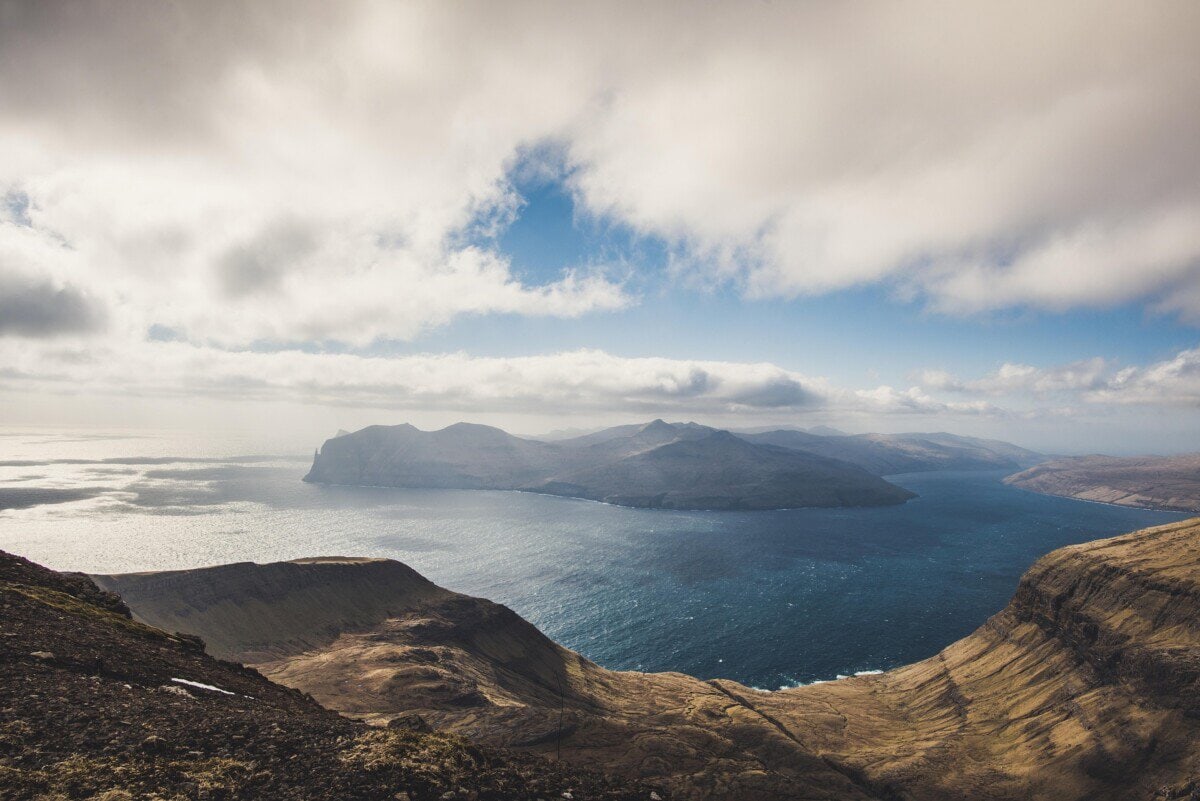
The Faroe Islands sit at roughly 62°N, 7°W in the North Atlantic, almost exactly halfway between Iceland and Norway, and a shorter hop again from Scotland’s Shetland Islands. The Gulf Stream keeps the climate milder than the latitude suggests, though genuinely settled, sunny days are rare at any time of year.
The archipelago is made up of 18 islands, of which 17 are inhabited; only Lítla Dímun has no permanent residents. Total land area is a modest 1,399 km² (540 sq miles), with the highest point, Slættaratindur, reaching 880 m.
Around 56,000 people live across the islands, of whom roughly 22,700 live in or around the capital, Tórshavn, on the largest island, Streymoy. That concentration matters practically: almost everything from hospitals to major shops to the ferry terminal serving the outer islands is based there.
The islands are a self-governing part of the Kingdom of Denmark, with their own parliament (the Løgting), flag and language, Faroese. Despite that Danish link, the Faroe Islands are not part of the EU or the Schengen area, which matters for both healthcare cover and, for non-UK/EU visitors, entry requirements.
Best for two or three nights. The widest choice of rooms, with filters for free cancellation and included breakfast.
View staysBest for groups who want one address and separate bedrooms rather than three hotel rooms.
See holiday homesBest if you have already picked a hotel. Checks the big booking sites for the same room and shows who is cheapest.
Check dealsA Brief History of the Faroe Islands
Norse settlers arrived in the Faroe Islands sometime around the 9th century, bringing with them an early form of self-government: the Ting assembly at Tinganes in Tórshavn, one of the oldest continuously used parliamentary sites in the world. The islands were incorporated into the Kingdom of Norway around 1035, and passed into Danish hands from 1380, when Norway itself entered a union with Denmark.
When Norway and Denmark split apart under the 1814 Treaty of Kiel, the Faroe Islands stayed with Denmark rather than following Norway, a decision still felt in the islands’ constitutional status today. The local Løgting assembly was abolished in 1816 and downgraded to an advisory body, only regaining a genuine legislative role in 1852.
British forces occupied the islands from 1940 to 1945 after Germany invaded Denmark, cutting them off from Copenhagen and giving the Faroese a taste of running their own affairs. That experience fed directly into the 1948 Home Rule Act, which granted the islands substantial self-government while keeping them formally part of Denmark. A further 2005 Takeover Act let the Faroese assume responsibility for additional policy areas from Copenhagen over time, though foreign affairs, defence and the currency peg remain shared with Denmark today.
The Faroese Islands at a Glance
Nine islands cover almost everything a first-time visitor needs to know, from the capital island to the remote puffin colonies at the western edge of the chain.
| Island | Known For | How You Reach It |
|---|---|---|
| Streymoy | Tórshavn, the capital and largest island | Central hub, tunnel/bridge-linked to most others |
| Eysturoy | Gjógv village, the Eysturoyartunnilin undersea roundabout | Tunnel and bridge from Streymoy |
| Vágar | Vágar Airport, Múlafossur waterfall, Lake Sørvágsvatn | Vágatunnilin tunnel from Streymoy |
| Sandoy | Sandy beaches and birdlife, unusual for the Faroes | Sandoyartunnilin tunnel from Streymoy (opened 2023) |
| Borðoy | Klaksvík, the second-largest town | Tunnel and bridge network from Eysturoy |
| Suðuroy | Dramatic southern cliffs, the town of Tvøroyri | Ferry only, around 2 hours from Tórshavn |
| Kalsoy | Kallur Lighthouse, nicknamed “the flute” | Ferry from Klaksvík, around 20 minutes |
| Nólsoy | Puffin colonies, closest island to Tórshavn | Ferry from Tórshavn, around 30 minutes |
| Mykines | The Faroes’ biggest puffin colony, westernmost point | Seasonal ferry or helicopter only |
How Many Days, and Where to Spend Them
Three days is enough for a genuine first taste rather than a rushed tick-box trip. Base yourself in or around Tórshavn and stay on Streymoy and Eysturoy, adding a single bigger excursion out to Vágar for Múlafossur and Lake Sørvágsvatn if the weather cooperates. Trying to cram Suðuroy or Mykines into three days usually means sacrificing something else.
Five days is the point where the islands start to open up properly. Keep the Streymoy and Eysturoy base, but add a full day around Vágar and Mykines, weather and ferry or helicopter availability permitting, and a second day around Klaksvík and the northern islands, including Kalsoy’s Kallur Lighthouse hike if conditions allow.
Seven days or more is where Suðuroy and the smaller outer islands genuinely become realistic rather than a stretch. Suðuroy in particular rewards an overnight rather than a rushed there-and-back day trip, given the roughly two-hour ferry crossing each way from Tórshavn.
Whatever the length of the trip, build at least one genuinely flexible, unplanned day into the schedule. Fog, wind and ferry cancellations are routine here rather than exceptional, and a trip with zero slack is a trip where the first disruption cancels something you actually wanted to see.

Getting There: Vágar Airport and Flight Routes
Almost every visitor arrives through Vágar Airport (FAE), the islands’ only airport, on the island of Vágar roughly 45 km from Tórshavn. Atlantic Airways, the Faroese national carrier, operates the great majority of scheduled flights in and out.
Copenhagen is by far the best-connected hub, with Atlantic Airways and SAS between them running multiple flights a day, year-round, in under two hours. Beyond Copenhagen, Atlantic Airways operates a genuinely wide network of seasonal and twice-weekly direct routes to Vágar from across the Nordics and wider Europe, summarised in the table below.
| Origin | Frequency | Flight Time |
|---|---|---|
| Copenhagen, Denmark | Multiple flights daily, year-round (Atlantic Airways and SAS combined) | Under 2 hours |
| Billund, Denmark | At least 3 times weekly year-round, up to 6 times weekly in summer | Around 2 hours |
| Edinburgh, Scotland | Twice weekly, March to December (no winter service) | Around 1 hour |
| Aalborg, Denmark | Twice weekly, late June to August only | Under 2 hours |
| Reykjavík, Iceland | Seasonal (check current dates) | Not published — confirm with airline |
| Paris (CDG), France | 3 times weekly (Mon/Wed/Fri), April to October | Not published — confirm with airline |
| Barcelona, Spain | Weekly (Wednesdays), late June to September | Around 3.5 hours |
| London Gatwick, UK | Twice weekly (Tue/Sat), late May to August | Not published — confirm with airline |
Atlantic Airways also runs additional seasonal routes to Oslo, Gran Canaria, Tenerife and Katowice; since these vary from year to year, it is worth checking the airline’s own routes page directly for current status and timings before building a trip around one.
Vágar is a genuinely weather-affected airport, with low cloud and sea fog regularly disrupting schedules, so building a spare day into a trip either side of a flight is sensible rather than overcautious. There is also a slower overland-and-ferry alternative for anyone bringing a car from mainland Europe: Smyril Line’s ferry from Hirtshals in Denmark, a crossing of roughly 30-38 hours depending on the season.
The transfer from Vágar to Tórshavn itself, whether by bus, taxi, car hire or private transfer, deserves its own attention given the distance and the weather risk. Our dedicated Faroe Islands airport transfers guide covers every option, current fares and the tunnel toll in full.
Getting Around: Buses, Tunnels and the SSL Network
One company, Strandfaraskip Landsins (SSL), runs almost the entire public transport network as a single integrated system: somewhere in the region of 22-27 bus routes and 7 scheduled ferry routes, with timetables designed to connect rather than compete with each other.
For anyone island-hopping by bus and ferry rather than driving, the Tourist Travel Card is genuinely good value: a 4-day pass costs around DKK 500 (£58/€67/$73) and a 7-day pass around DKK 700 (£81/€94/$102), covering unlimited bus and ferry travel. It does not cover vehicles, the seasonal Mykines ferry, or the Atlantic Airways helicopter service.
| Route | Connects | Journey Time | Frequency |
|---|---|---|---|
| 300 | Vágar Airport ↔ Tórshavn (via Sørvágur, Miðvágur) | 50-55 minutes | Around 7 weekday departures, reduced weekend service |
| 100 | Tórshavn ↔ Vestmanna | Around 1 hour 5 minutes | 8 weekday departures, 3 on Saturday and Sunday |
| 401 (express) | Tórshavn ↔ Klaksvík | Around 30 minutes | 4 departures, weekdays only |
| 400 (regular) | Tórshavn ↔ Klaksvík | Around 1 hour 30 minutes | Around 10 weekday departures, plus weekend service |
There is no dedicated tourist journey-planning app worth relying on, so the practical tool is SSL’s own route overview and booking site, which lists every current bus and ferry timetable and lets you book tickets directly. Checking it against your actual plans, rather than assuming a service simply runs, is worth doing before setting off each day.
Taxis operate across the islands too, concentrated mainly in Tórshavn and Klaksvík, and are generally priced by the car for set inter-town routes rather than a running meter, similar to the fixed-fare model used for the Vágar Airport transfer. Away from the two main towns, firms are thin on the ground, so it is sensible to book ahead through your accommodation rather than expect to hail one on a quiet village street, particularly outside peak summer.
Driving your own hire car remains the most flexible way to see the islands, since the tunnel network reaches far more places than the bus routes do. Our Faroe Islands road trip guide covers every tunnel toll, single-track road rule and car hire detail in full.
Inter-Island Ferries and the Islands You Can’t Drive To
Impressive as the tunnel network is, several islands remain reachable only by boat or air, and SSL runs these crossings as genuine lifeline services rather than sightseeing add-ons. Knowing which islands fall into this category matters for planning, since they cannot simply be added to a road trip itinerary.
| Route | Connects | Journey Time | Frequency |
|---|---|---|---|
| 7 | Tórshavn ↔ Tvøroyri (Suðuroy) | Around 2 hours 5 minutes | Several sailings daily, year-round |
| 90 | Tórshavn ↔ Nólsoy | Around 30 minutes | 7 sailings a day (first 06:45, last 22:00) |
| 56 | Klaksvík ↔ Kalsoy (Syðradalur) | Around 20 minutes | Up to 8 sailings a day in summer, fewer off-season |
| 36 | Sørvágur ↔ Mykines | Around 45 minutes | Seasonal only, 1 May to 31 August |
The biggest of these is Suðuroy, the southernmost island, reached by SSL’s Route 7 car ferry from Tórshavn in around 2 hours 5 minutes, with several sailings a day. Nólsoy, the closest island to the capital, is a much shorter hop on Route 90, around 30 minutes and running frequently throughout the day.
From Klaksvík, Route 56 crosses to Kalsoy in around 20 minutes, with up to eight sailings a day in summer, giving access to the Kallur Lighthouse hike. Mykines, the westernmost island and home to the archipelago’s largest puffin colony, is served by a seasonal, weather-dependent ferry (Route 36) that is not covered by the Tourist Travel Card, so check conditions before relying on it.
Smaller islands including Hestur, Skúvoy, Svínoy and Fugloy all have their own SSL ferry routes too, generally with a handful of sailings a day rather than a frequent shuttle, so the specific timetable for each is worth checking directly on SSL’s site before building a day trip around one. Our dedicated Faroe Islands Ferry Routes guide covers every one of these crossings, including current prices and sailing frequency, in far more depth than fits on this hub page.
For the very remotest spots, particularly Stóra Dímun, the practical option is the Atlantic Airways helicopter service, a heavily subsidised network that residents rely on but which tourists can also book. Fares are not published as a simple fixed rate online, so it is worth checking directly with Atlantic Airways rather than assuming a price; Koltur and the uninhabited Lítla Dímun have no scheduled service of any kind.
Best for finding routes the airlines do not sell as a single ticket. Combines carriers to bring the fare down.
Search flightsBest for anyone whose home plan charges by the megabyte abroad. Pay a fixed price up front.
Check eSIMsBest if you would rather not work out the transport on arrival. Book it now and forget it.
View transfersWhat to Book Before You Arrive
A handful of things genuinely need arranging ahead of arrival rather than sorted on the day. The single biggest one is Mykines: both the seasonal ferry, or the helicopter outside the May-to-August sailing window, and, separately, the official Mykines landing permit system that caps visitor numbers on the island itself, since spaces are limited and do sell out in peak summer.
If a hire car is part of the plan, book it as early as possible, since the national rental fleet is small and disappears fast across June to August. A Suðuroy car ferry crossing is also worth reserving ahead in peak season, since Route 7 sailings can fill with vehicles even though foot passengers rarely have trouble finding space.
Some of the most popular day hikes, including the walk to Lake Sørvágsvatn and Trælanípa, cross private land and require paying a small landowner access fee, usually arranged online or at a self-service kiosk before setting off, rather than assumed to be free open access. Restaurant bookings matter far less outside Tórshavn, though a table at one of the capital’s better-known kitchens is worth reserving a few days ahead in peak season, since seating is genuinely limited.
Highlights: The Faroe Islands’ Unmissable Sights
This is deliberately a taster rather than the full list. Our complete guide to things to do in the Faroe Islands covers twelve individually developed attractions in far more depth than a hub page can.
Mykines is the biggest draw for most visitors, home to the archipelago’s largest puffin colony, with Múlafossur waterfall tumbling into the sea beside the village of Gásadalur nearby as the classic postcard image. The Kallur Lighthouse hike on Kalsoy, made famous by a James Bond film location, Lake Sørvágsvatn’s optical-illusion view from Trælanípa, and the tidal inlet village of Saksun round out the shortlist that most first-time visitors build a trip around, each covered in full, including access details and timing, on the companion guide linked above.
Best Time to Visit and Annual Events
The weather here is cool, wet and windy in every season, so there is no genuinely reliable stretch of sunshine to plan around. That said, June to August brings the mildest temperatures, the longest daylight and the fullest ferry and hiking-trail schedules, making it the practical best window for most visitors.
The biggest date on the calendar is Ólavsøka, the national day, held on 28-29 July in Tórshavn. It combines rowing-boat race finals, the Løgting’s ceremonial reopening after summer recess, folk dancing and live music, and it is worth booking accommodation well ahead if your trip falls around it.
Two major music festivals bookend the summer: the G! Festival in the village of Syðrugøta on Eysturoy, held in mid-to-late July just before Ólavsøka, and Summarfestivalurin in Klaksvík in early August.
The shoulder months of May and September are quieter and cheaper but noticeably wetter and windier, while winter brings very short daylight hours and a genuinely higher risk of ferry and flight disruption. None of this makes winter a bad time to visit, but it does call for a more flexible itinerary.

Who the Faroe Islands Are Genuinely Best For
The Faroe Islands suit travellers who genuinely enjoy dramatic landscapes, hiking and a slower pace more than they mind unpredictable weather. If the appeal is wild coastlines, birdlife, small fishing villages and a strong sense of remoteness, rather than a checklist of famous sights, this is a destination that consistently delivers.
It is a poor fit for anyone chasing guaranteed sunshine or a lively nightlife scene, since even peak summer brings regular cloud, wind and rain, and evening options outside Tórshavn are genuinely thin. Visitors hoping for a car-free trip beyond the capital will also find the islands frustrating, since the bus and ferry network, while genuinely well run, does not reach many of the best viewpoints and trailheads.
Families travelling with very young children or anyone with limited mobility should also go in with realistic expectations, since many of the best-known hikes involve exposed, uneven ground and no real safety barriers, and public transport connections between the most interesting spots are not always frequent. None of this makes the islands unsuitable, but it does mean matching the trip to the traveller matters more here than in most European destinations.
What First-Time Visitors Underestimate
The single biggest miscalculation is distance and driving time. Two points that look close together on a map are often separated by a long single-track road, a mountain pass or a tunnel, and what looks like a 20-minute drive can easily take twice that once traffic, weather and road conditions are factored in.
Weather-driven schedule changes catch out almost every first-time visitor at some point. Fog at Vágar Airport, wind closing a ferry route, or a hiking trail becoming unsafe underfoot are all routine rather than rare, and a rigid, back-to-back itinerary is far more likely to unravel here than in most of Europe. Building slack into every day is genuinely the single best piece of planning advice for the islands.
Outside Tórshavn, the number of restaurants, cafés and shops drops off sharply, and it is easy to assume a village marked on the map will have somewhere to eat or buy supplies when it does not. Stocking up on food and fuel in Tórshavn or Klaksvík before heading out for the day is a habit worth forming early, rather than discovering the gap once it is already inconvenient.
If You Need Medical Treatment
The main hospital for the whole country is the National Hospital (Landssjúkrahúsið) in Tórshavn, with smaller health centres on some of the larger outer islands handling routine care. For a genuine emergency, dial 112, the same number used across Denmark.
For anything urgent but not life-threatening, call 1870 for medical guidance before heading to a hospital, which helps direct you to the right level of care rather than an unnecessary A&E visit.
Despite the link to Denmark, the Faroe Islands sit outside the EU and Schengen, so a standard EHIC or UK GHIC card does not automatically apply here the way it would on the Danish mainland. UK and Nordic nationals are covered under specific national health agreements, but it is worth confirming your own situation before travelling, and everyone else should treat private travel insurance covering treatment outside the EU as essential rather than optional.
The official tourist board’s own health and safety page is worth a look before you go, and pharmacies are readily available in Tórshavn for everyday medication needs.
Best for solo travellers and anyone watching the budget. Dorm beds and private rooms in the same search.
Browse hostelsBest if you have ever given up on a claim. AirHelp checks whether the flight qualifies and pursues it for you.
See the benefitsBest for a day with a suitcase and nowhere to put it. Find a storage point near where you already are.
View storageWhere the Shops Are
Tórshavn’s old town has a genuine shopping street of its own, centred on Dr. Jakobsensgøta, Tróndargøta and Bøgøta, lined with small independent shops in traditional wooden buildings. For everyday needs, the larger SMS Shopping Centre covers clothing, a bookshop, a pharmacy, a supermarket and electronics under one roof.
The standout souvenir is a genuine hand-knit Faroese wool sweater, with local label Guðrun & Guðrun the best-known name after its “Star jumper” appeared in the Danish TV series The Killing. Local ceramics and other small Faroese design brands are also worth seeking out in Tórshavn’s independent shops.
Most shops, including supermarkets, are closed on Sundays, and Saturday hours tend to run shorter than the weekday norm. Card and contactless payment is close to universal, even in the smallest village shops, so there is rarely any real need to carry Danish krone cash.
Some shops participate in a tax-free scheme for visitors, worth asking about directly at the till, though the exact refund mechanics vary depending on your nationality, so it is worth confirming eligibility before you shop rather than assuming it applies.
Where Should You Base Yourself?
Where you base yourself shapes the whole trip more than almost any other single decision, since day-trip range and evening atmosphere vary sharply across even a small archipelago. The table below compares the four most realistic bases for a first-time visitor.
| Base | First-Night Convenience | Day-Trip Range | Atmosphere | Price Level |
|---|---|---|---|---|
| Tórshavn | Best; the largest choice of hotels close to shops and restaurants. | Widest; a central hub reaching Streymoy, Eysturoy and Vágar within a couple of hours. | Small capital city feel, the closest thing to nightlife and dining variety. | Highest overall, though with the widest spread of options. |
| Vágar (airport area) | Very good for very early or late flights and Mykines crossings. | Narrower; strong for western sights, weaker for the north and Suðuroy. | Quiet, small villages rather than a town centre. | Moderate, with fewer choices than Tórshavn. |
| Klaksvík | Good, though fewer flights land nearby and no formal hotels currently operate here. | Strong for Kalsoy, Borðoy and the northern islands. | Genuinely lived-in second town, a useful contrast to the capital. | Similar to or slightly below Tórshavn where rooms are available. |
| Eysturoy (e.g. Gjógv) | Weaker; further from the airport and main services. | Good for the north, weaker for Vágar and Suðuroy. | The most rural and dramatic setting of the four. | Generally the most affordable of the four options. |
Where to Stay
Most visitors base themselves in Tórshavn, which has the largest concentration of hotels, restaurants and onward transport links, and works well as a base for 3-5 nights of exploring in most directions.
Basing yourself near Vágar can make sense around very early or late flights, or before a weather-dependent Mykines crossing, while villages on Eysturoy such as Gjógv, home to the Gjáargarður guesthouse, suit anyone focused on the northern islands.
Klaksvík, the country’s second town, is a genuinely useful base for exploring Kalsoy and the northern islands, though it currently has no formal hotels, only privately rented rooms and apartments.
Capacity across the whole archipelago is genuinely limited, with only around 15 formal hotels nationwide alongside guesthouses and private rentals, so booking well in advance for the June-to-September peak season matters far more here than in most European destinations.
Beyond hotels, a growing number of Faroese families rent out private rooms and cottages through local booking platforms and international sites alike, often the best way to get a genuinely local welcome outside Tórshavn. Formal campsites exist but are far more limited than in mainland Scandinavia, so treat camping as a niche option rather than a fallback if hotels are full.

Is the Faroe Islands Expensive?
In short, yes. Prices generally sit on par with or above mainland Denmark, Iceland and Norway, driven by the cost of importing almost everything to a small, remote population.
A comfortable 4-star hotel room typically runs from around DKK 1,950 (£227/€261/$282) a night, with a quality private rental or guesthouse from around DKK 1,200 (£140/€161/$174) a night. Budget guesthouse rooms and hostel beds exist too, generally from DKK 750-1,000 (£87-117/€101-134/$109-145) a night, with a hostel dorm bed sometimes available for under DKK 300 (£35/€40/$43).
Everyday costs add up quickly too: a coffee is typically around DKK 35 (£4/€5/$5), a pint of beer around DKK 60 (£7/€8/$9), and a petrol-station sandwich around DKK 55 (£6/€7/$8). Overnight visitors aged 16 and over should also budget for a small DKK 20 (£2/€3/$3) sustainability fee per night.
Putting that together, a realistic daily budget per person, excluding flights, runs roughly $120-180 (£97-145/€111-167) for a genuinely budget trip, $220-400 (£177-322/€204-370) for a comfortable mid-range trip, and $500+ (£403+/€463+) for a luxury one.
Self-catering where you can, using the Tourist Travel Card instead of taxis, and building tunnel tolls and ferry fares into your budget from the outset, covered in full in our road trip guide, are the most effective ways to keep costs realistic without cutting the trip short.

Rupert’s Handy Travel Tips
Planning a first trip to the Faroe Islands is mostly about realistic expectations, not complicated logistics.
- Build slack into every itinerary: flights and ferries here run on the weather’s schedule, not yours.
- Get the Tourist Travel Card if you’re island-hopping by bus and ferry: DKK 500-700 covers most of what a visitor needs.
- Book accommodation and car hire early for summer: the whole country has only around 15 formal hotels and a small rental fleet.
- Carry a card, not cash: Faroese businesses are almost entirely card and contactless, even in tiny villages.
- Sort travel insurance before you go: EHIC and GHIC don’t reach the Faroe Islands the way they do mainland Denmark.
Want to meet the reindeer behind our travel tips? Find out more in our page Who is Rupert?.




Frequently Asked Questions About the Faroe Islands
Where are the Faroe Islands located?
They sit in the North Atlantic at around 62°N, roughly halfway between Iceland and Norway, and are a self-governing part of the Kingdom of Denmark made up of 18 islands.
How do you get to the Faroe Islands?
Almost everyone flies into Vágar Airport (FAE). Copenhagen is the main year-round hub, with additional seasonal or twice-weekly direct routes from cities including Edinburgh, Billund, Aalborg, Paris and Barcelona depending on the time of year. A much slower Smyril Line ferry from Hirtshals in Denmark is also an option for anyone bringing a car.
Do you need a car to get around the Faroe Islands?
Not strictly, since SSL’s buses and ferries cover the main routes, but a hire car reaches far more villages, hiking trailheads and viewpoints than public transport does.
Is healthcare covered if I get sick or hurt in the Faroe Islands?
Not automatically. The islands are outside the EU and Schengen, so a standard EHIC or GHIC card does not apply the way it would in mainland Denmark, and private travel insurance covering treatment outside the EU is strongly recommended for most visitors.
Are the Faroe Islands expensive to visit?
Yes, generally on par with or above mainland Denmark, Iceland and Norway, with a realistic daily budget per person running from around $120 (£97/€111) for a budget trip up to $500+ (£403+/€463+) for a luxury one, excluding flights.
When is the best time to visit the Faroe Islands?
June to August brings the mildest weather, the longest daylight and the fullest ferry and hiking schedules, though it is also the busiest and most expensive window, coinciding with events like Ólavsøka and the G! Festival.
Further Reading & Related Guides
Since the Faroe Islands are a self-governing part of the Kingdom of Denmark, travellers combining a trip with mainland Denmark may also find our Interrail Denmark Pass Guide useful for planning onward rail travel once back on the mainland.
Given how remote and weather-dependent this destination is, our eSIM Apps Guide is worth a look for staying connected to check ferry, flight and tunnel-toll updates once you land, since the Faroe Islands sit outside the usual EU roaming umbrella.
Readers curious about how the Faroe Islands fit into wider North Atlantic air travel may also enjoy our Unusual Flight Routes Explained, which covers the archipelago’s limited but genuinely interesting connections to Iceland and Greenland.