Reviewed by our editorial team Published
Gothenburg sits at the point where Sweden’s west coast archipelago, the working Trollhätte Canal and the farmland of Västergötland all meet within roughly an hour’s travel, which makes it one of Scandinavia’s better cities for genuine day trips. A visitor staying just two or three nights in the city can reasonably add a full day exploring somewhere entirely different without needing an overnight stop anywhere else.
Most of the destinations below are reachable by train, regional bus or public ferry rather than a hire car, since Västtrafik’s network stretches well beyond the city limits into Halland and across Västra Götaland. That keeps costs down and avoids the parking hassle that comes with driving into a small fortress town or a lakeside castle on a busy summer weekend.
Anyone flying in through Landvetter should read our Gothenburg Airport Transfers guide first, since a couple of these trips connect more directly from the airport than from the city centre, particularly heading south toward Halland. The city’s own sights, meanwhile, are covered separately in our Things to Do in Gothenburg guide, so this page deliberately stays focused on what lies beyond them.
The choices below range from a fortress island reachable in under two hours by bus and ferry to a lakeside baroque castle that genuinely rewards a car, alongside industrial heritage towns, a beach fortress and Sweden’s self-declared capital of fika. Prices are quoted in Swedish krona (SEK) with approximate GBP, EUR and USD conversions throughout, and travel times assume a normal weekday timetable rather than a disrupted one.
Not every trip suits every season either, since several of these destinations run reduced hours outside the Swedish summer. It’s worth checking the current calendar for a specific date before setting out, rather than assuming a castle or fortress keeps identical hours year round.
Quick Day Trip Comparison Table
| Destination | How to Get There | Approx One-Way Time |
|---|---|---|
| Marstrand | Bus via Ytterby, then passenger ferry | Around 1 hr 30 min |
| Southern Archipelago | Tram/bus to Saltholmen, then ferry | Around 30-40 min |
| Kungälv & Bohus Fortress | Train or bus | Around 35-45 min |
| Varberg | Train (Öresundståg) | Around 40 min |
| Trollhättan | Train | Around 45 min |
| Alingsås | Train | Around 35 min |
| Borås | Train or bus | Around 55 min |
| Tjolöholm Castle | Train to Kungsbacka, then bus 732 | Around 1 hr |
| Läckö Castle | Train to Lidköping, then bus or car | Around 2 hr or more |
| Bohuslän Coast (Fjällbacka) | Bus to Dingle, then train, or bus 875 direct | Around 3 hr |
Treat this table as a starting point rather than a fixed schedule, since connection times shift with the season and a few of these routes run far less often outside summer. The sections below go into each destination in enough depth to actually plan around, including current admission prices where they’ve been verified.
Marstrand and Its Fortress Island
Marstrand is a small island town off the Bohuslän coast, dominated by the 17th-century Carlsten Fortress that sits on a granite outcrop above the harbour. It has been a fashionable sailing and bathing resort since the 19th century, and its wooden waterfront houses and yacht-filled marina still draw a genuinely smart summer crowd.
Reaching it without a car means a bus from Nils Ericson Bus Station toward Ytterby, changing onto a connecting service for the final stretch to the ferry terminal, then a short passenger ferry across the sound. The whole journey runs to around one and a half hours each way, so it suits a full day out rather than a quick half-day visit.
Carlsten Fortress runs daily tours through the main summer season, extending to 10:30am-6pm from July into early August before narrowing back to weekends only outside those months. Adult entry costs around 120 SEK (£8/€10/$11), with children aged five to fifteen charged 60 SEK (£4/€5/$6), and a roughly 45-minute guided tour is included in that price.
Beyond the fortress itself, the real appeal is simply wandering the harbourfront, the wooden guest houses and the open granite rocks that ring the island, none of which cost anything to enjoy. A proper seafood lunch by the water is the other obvious reason to come, and booking a table ahead is sensible through July and August.
The Match Cup Sweden sailing regatta, usually held in July, is worth checking the calendar for before travelling, since it brings noticeably larger crowds and livelier evenings to what’s normally a quiet island. Outside that week, Marstrand makes a genuinely relaxed day out for a family or a couple after a slower pace than the city centre.
Best for two or three nights. The widest choice of rooms, with filters for free cancellation and included breakfast.
View staysBest for longer stays. Whole apartments and houses, so you are not eating out three times a day.
View rentalsBest if you have already picked a hotel. Checks the big booking sites for the same room and shows who is cheapest.
Check dealsThe Southern Archipelago Without a Car
Gothenburg’s southern archipelago, made up of car-free islands including Styrsö, Vrångö, Brännö, Donsö and Asperö, is the simplest day trip on this list to actually pull off. Every island sits on the same public ferry network as the rest of the city, run by the Styrsöbolaget operator on behalf of Västtrafik.
Getting to the ferry itself means a tram or bus to Saltholmen, the departure point at the southern edge of the city, which takes around 25-35 minutes from Central Station. From there, several numbered ferry lines fan out to different islands, and a standard Västtrafik ticket covers the crossing with no separate fare to buy.
The islands themselves are largely residential and unhurried, with red-painted fishing cottages, small sandy coves and a handful of seasonal cafés rather than any real tourist infrastructure. Vrångö and Donsö sit further out and feel the wildest, while Brännö and Styrsö are closer in and easier to combine in a single day.
None of the islands allow cars, so everything is reached on foot along narrow lanes and boardwalks, which keeps them genuinely quiet even in peak summer. Bringing a swimsuit is worth it from June through August, since several of the coves have decent, sheltered bathing spots away from any crowds.
Ferries run frequently through the day, though the timetable thins out considerably in the evening and over winter, so checking the current Västtrafik schedule before the last sailing home is worth doing. This is comfortably the cheapest and least planning-intensive trip on this page, and it works as easily for a half-day as a full one.
Kungälv and Bohus Fortress
Bohus Fortress, just outside the small town of Kungälv, is one of Scandinavia’s largest medieval ruins, built by Norway in the 1300s at a spot where two rivers meet, then fought over repeatedly by Sweden, Norway and Denmark for centuries. Its thick stone walls and round towers still dominate the riverbank today, even in ruin.
Getting there is straightforward: a direct Västtrafik train from Gothenburg Central to Bohus station takes around 43 minutes with hourly departures, or a bus toward Kungälv runs a little faster, at roughly 33 minutes, with services every 10 minutes through the day. Either way, it’s an easy half-day trip that leaves time for something else afterward.
From September through April, the fortress opens Tuesday to Sunday, 11am to 3pm, with longer hours through the main summer season, so it’s worth confirming the exact current calendar before a shoulder-season visit. Adult admission runs to around 120 SEK (£8/€10/$11), with children aged three to twelve charged 60 SEK (£4/€5/$6).
The site is described plainly by its own management as mostly open to the sky, with rocky, uneven ground underfoot, so proper footwear matters more here than at most historic attractions. Wheelchair and stroller access is limited to specific entrances, which is worth checking ahead for anyone with mobility needs.
Kungälv’s own small town centre, a short walk from the fortress, has a handful of cafés and a pleasant riverside path that rounds out the visit nicely. It’s a genuinely easy trip to combine with a later stop in Marstrand for anyone with a full day and a car or a willingness to chain two bus connections together.
Varberg’s Fortress and Beaches
Varberg, on the Halland coast south of Gothenburg, pairs a genuinely imposing medieval fortress with some of the region’s best sandy beaches, giving it a broader appeal than most single-attraction day trips on this list. The fortress overlooks the harbour directly, and the town itself has grown into a relaxed seaside resort around it.
An Öresundståg train runs the route hourly from Gothenburg Central Station, taking around 39 minutes each way, with onboard toilets and space for bikes and luggage on a route that hugs the coastline for much of the journey. A single ticket typically runs to somewhere around 100-150 SEK (£7-10/€9-13/$9-14) depending on when it’s booked.
The fortress itself, home to Hallands Kulturhistoriska Museum, opens Tuesday to Sunday, noon to 4pm, outside summer, extending to daily 10am-5pm from late June through late August. Standard adult admission is 70 SEK (£5/€6/$7), rising to 120 SEK (£8/€10/$11) during the busiest weeks of July and August.
The museum’s best-known exhibit is the Bocksten Man, a remarkably well-preserved medieval bog body discovered nearby in the 1930s, still dressed in the oldest complete set of medieval clothing found anywhere in Europe. It’s a genuinely striking thing to see in person rather than a photograph.
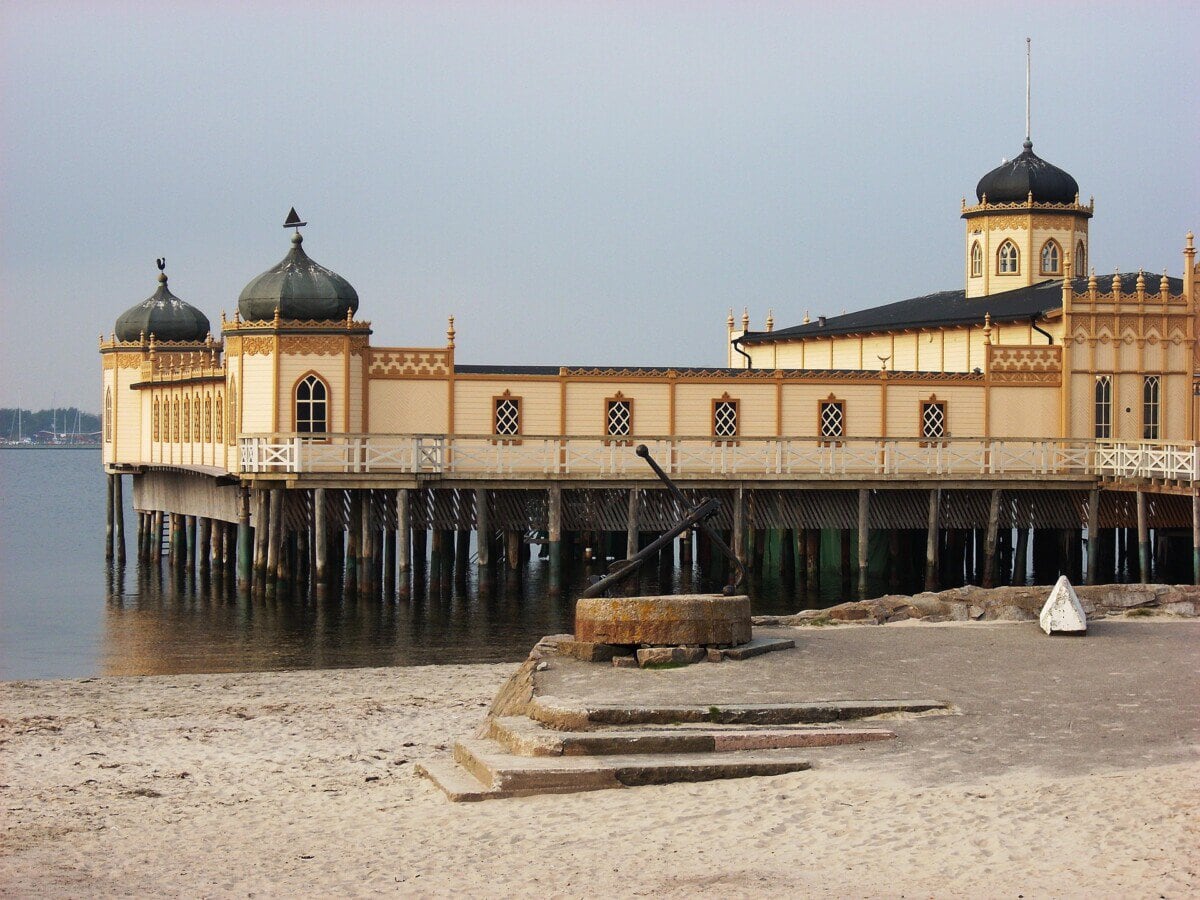
Varberg’s beaches, including the popular Kallbadhuset cold bathhouse jutting out over the water, make this one of the better warm-weather choices on this page, since a swim can genuinely follow the fortress visit rather than competing with it. Note that Varberg sits in Halland county, so it runs on Hallandstrafiken ticketing rather than a standard Västtrafik pass.

Trollhättan’s Waterfalls and Canal Locks
Trollhättan grew up around the point where the Göta River drops sharply toward Lake Vänern, and its combination of a historic canal, working locks and a dramatic gorge still makes it one of West Sweden’s more distinctive industrial towns. The Saab car brand was also built here, and the connection is still visible around town.
A Västtrafik train runs the route hourly from Gothenburg Central, taking around 44 minutes each way on a straightforward regional service with no changes required. The station sits a short walk from the falls and locks area, so no onward bus is needed once you arrive.
It’s worth being honest about the waterfalls themselves: they no longer run at full force continuously the way older postcards suggest, since the river’s flow is now mostly diverted through Vattenfall’s hydroelectric plant. Genuine full releases are scheduled only during the Fallens Dagar festival, held in mid-July, with occasional unscheduled releases tied to lake levels at other times.
Outside festival dates, the draw shifts to the Trollhätte Canal locks themselves, which still lift working boats and pleasure craft roughly 32 metres between Lake Vänern and the lower river, a genuinely impressive piece of 19th-century engineering to watch in action. The nearby Innovatum Science Center and its Saab-focused exhibits fill out a longer visit well.
Anyone planning around the falls specifically should check the current Fallens Dagar dates before booking, since the festival typically runs for only a few days and draws large crowds when it does. Outside that window, Trollhättan is still a worthwhile, quieter half-day trip built around the canal and the gorge itself.
Alingsås, Sweden’s Capital of Fika
Alingsås is a small, well-preserved market town best known today for its wooden old town and an unusually dense cluster of independent cafés, a reputation locals have leaned into by branding the town Sweden’s capital of fika. It makes an easy, low-key contrast to the bigger attractions elsewhere on this list.
The town’s more substantial history runs through Jonas Alströmer, an 18th-century local who introduced the potato to Sweden and built a large-scale draper’s mill here that briefly became the country’s biggest textile operation before it collapsed under fires and bad management by 1779. The annual Potatisfestivalen each summer celebrates that legacy directly.
A Västtrafik train runs hourly from Gothenburg Central Station, with the journey taking around 34 minutes, and SJ’s own long-distance services also stop here roughly every two hours on routes heading further north. Either way it’s one of the shortest genuine day-trip journeys on this page.
Once there, the appeal is mostly about slow wandering rather than ticking off a single sight: the old wooden town centre, the nearby Gräfsnäs castle ruin a short bus ride out, and one of the roughly two dozen cafés that give the town its nickname. None of this requires advance booking or much planning.
It suits travellers who’ve already covered Gothenburg’s main sights and want a gentler afternoon rather than another full-blown attraction, and it pairs naturally with an early return to the city for dinner. A half-day is genuinely enough time to see the town properly.
Borås and West Sweden’s Textile Heritage
Borås built its reputation on textiles, and while the industry has shrunk considerably since its peak, the town still trades on that identity through its Textile Museum and the wider Textile Fashion Center, alongside a genuinely striking outdoor street art scene scattered across the town centre.
Reaching it takes a little longer than most other trips on this list: a direct train from Gothenburg Central takes around 53 minutes, run partly by SJ and partly by Västtrafik depending on the specific departure, while a Västtrafik bus from Åkareplatsen covers the same distance in a similar 56 minutes with far more frequent departures.
The Textile Museum, part of the wider Textile Fashion Center complex near the station, traces the region’s industrial history alongside rotating fashion and design exhibitions, and it’s a genuinely well put-together museum rather than a niche curiosity. Exact opening hours shift seasonally, so it’s worth confirming the current timetable before travelling.
Outside the museum, Borås has become known for its outdoor art installations, including large-scale public sculptures and a genuinely extensive collection of street murals commissioned specifically to give the town a distinct visual identity beyond its industrial past. Walking the town centre with a rough art map is a perfectly good way to spend an afternoon.
It’s a sensible pick for anyone with a genuine interest in textiles, design or street art specifically, rather than a must-do for every visitor, and it works well combined with Alingsås if travelling by car since the two towns sit roughly on the same route out of Gothenburg.
Best for long or awkward journeys. Builds one itinerary out of separate flights.
View flightsBest for short trips. Install the eSIM at home and arrive with working data, no shop queue.
Browse eSIMsBest when public transport has stopped, or when you are travelling with children and bags.
Book a transferTjolöholm Castle on the Kungsbacka Coast
Tjolöholm Castle is an unusual English Arts and Crafts-style manor house built for a wealthy Gothenburg merchant in the 1890s, sitting on a peninsula on the Halland coast surrounded by parkland and stables that are almost as striking as the house itself. It feels distinctly out of place for Sweden, which is much of its appeal.
Getting there without a car means a Västtrafik train to Kungsbacka station, followed by a change onto route 732 bus toward Lekarekulle, with the combined journey taking around an hour each way. Departures on the connecting bus thin out noticeably outside the main season, so checking the return timetable before setting off matters here.
The castle’s opening pattern is genuinely seasonal: it runs Friday to Sunday, 11am to 4pm through much of spring, opens daily over the Easter period, and extends to a fuller summer schedule from June, with guided tours in English running daily from late June through early August. Admission is charged at a modest fee that’s worth confirming directly on the castle’s own site before travelling.
The gardens and grounds, by contrast, stay open every day, all year round, at no charge at all, which makes Tjolöholm a reasonable stop even outside the house’s own opening hours if the goal is simply a coastal walk. The stable block, built with the same architectural ambition as the house, is worth a look even from outside.
It suits visitors with a genuine interest in period architecture or gardens specifically, and it combines naturally with a stop in Kungsbacka’s own small town centre on the way back toward Gothenburg for anyone travelling by car rather than public transport.
Läckö Castle on Lake Vänern
Läckö Castle is genuinely one of Scandinavia’s finest baroque buildings, a white-walled fortress-turned-palace on a peninsula jutting into Lake Vänern with over 240 rooms across its rebuilt 17th-century core. It’s considerably further from Gothenburg than anything else on this list, which is worth weighing honestly before planning around it.
By train, the journey to nearby Lidköping runs to around two hours ten minutes, with only a couple of direct departures a day rather than an hourly service, and the castle itself sits a further short hop beyond the town. A summer-only bus, route 132, covers that final stretch from Lidköping, though it’s worth confirming current times before relying on it.
Given the timetable, this is honestly one of the few trips on this page where a hire car makes a genuine difference, cutting the one-way journey to around 90 minutes on decent roads and removing any dependence on a seasonal bus connection. It’s a fair trip for a longer day rather than a quick add-on.
The castle runs full daily opening with guided tours through the summer months, and adult admission starts from around 110 SEK (£8/€9/$10), with children and young people up to 26 admitted free. Current opening hours and any seasonal closures are best checked on the castle’s own visitor information page before travelling.
The surrounding Kinnekulle region, sometimes called the flowering mountain, adds hiking trails and vineyard visits for anyone stretching this into more than a single day, though that’s genuinely a separate trip rather than something to squeeze into the same afternoon as the castle.
Reaching the Wider Bohuslän Coast
North of Marstrand, the Bohuslän coast stretches through a string of genuinely picturesque fishing villages, with Fjällbacka among the best known, thanks partly to its long-standing connection to actress Ingrid Bergman, who kept a summer house on a nearby island for decades.
It’s worth being upfront that this is a genuine stretch as a single day trip without a car: reaching Fjällbacka by public transport means a bus to Dingle followed by a train connection, or a more direct bus 875, and either route runs to around three hours each way. That’s six hours of travel for one day out.
A hire car changes the equation considerably, since the drive itself takes closer to 90 minutes to two hours depending on how far up the coast you go, opening up a proper loop through villages like Fjällbacka and the granite cliffs at Vetteberget above the harbour. This is the trip on this page best suited to a car specifically.
For travellers without a car and only one day to spare, it’s honestly worth treating the closer Bohuslän stops, Marstrand chief among them, as the realistic version of this coast rather than pushing all the way to Fjällbacka and back in a single exhausting day.
Anyone with more time to spend, whether an overnight stop or a full weekend, gets considerably more out of the far Bohuslän coast than a single rushed day allows, since the villages, coastal hikes and seafood are genuinely worth lingering over rather than ticking off quickly.

Choosing the Right Day Trip for Your Time
With a limited number of days, it helps to sort these trips by how much they actually demand of a traveller rather than just by distance. The southern archipelago and Marstrand both work comfortably without a car and without much advance planning, making them the natural first choices for a single spare afternoon or day.
Kungälv, Varberg, Trollhättan, Alingsås and Borås all sit within an hour of Gothenburg by train or bus, and most fall within the same Västtrafik ticketing zone that covers the city itself, with Varberg the one exception since it crosses into Halland’s own Hallandstrafiken system. Anyone chaining several trips together over a longer stay should factor that boundary in.
Rail travellers continuing further afield in Sweden, rather than just day-tripping from Gothenburg, may find our Interrail Sweden Pass guide useful for working out whether a multi-day rail pass beats individual point-to-point tickets once several of these regional journeys are added together.
Läckö Castle and the far Bohuslän coast around Fjällbacka sit in a different category entirely, since both genuinely reward a hire car and a longer day than the others on this list. Save either for a day when a car is already booked rather than trying to force them onto public transport alone.
Tjolöholm and Bohus Fortress both narrow their opening hours outside the main summer season, so a shoulder-season visit to either needs its calendar checked specifically before travelling, rather than assuming the same hours apply as in July.

Rupert’s Handy Travel Tips
Rupert reckons Gothenburg’s day trips are genuinely underrated, as long as you’re realistic about which ones actually suit public transport.
- Buy one Västtrafik ticket for most of the region: Kungälv, Alingsås, Trollhättan, Borås and the archipelago all run on the same system, though Varberg needs a separate Hallandstrafiken fare.
- Time Trollhättan around Fallens Dagar: the falls only run at full force during the July festival, so check the dates if seeing them in flood matters to you.
- Check Läckö’s summer bus before relying on it: route 132 from Lidköping only runs seasonally, so a hire car is the safer bet outside peak summer.
- Take an early ferry to the archipelago in summer: the Saltholmen boats fill up by midday in July and August.
- Confirm opening days before a shoulder-season castle visit: Tjolöholm and Bohus Fortress both cut back to weekends only outside the main season.
- Book a seafood table ahead in Marstrand: the harbourfront restaurants get busy fast on summer weekends.
Want to meet the reindeer behind our travel tips? Find out more in our page Who is Rupert?.




Frequently Asked Questions About Day Trips from Gothenburg
Do I need a car for day trips from Gothenburg?
Not for most of them. Marstrand, the southern archipelago, Kungälv, Varberg, Trollhättan, Alingsås and Borås are all comfortably reachable by train, bus or ferry, though Läckö Castle and the far Bohuslän coast genuinely reward a hire car.
What is the easiest day trip from Gothenburg?
The southern archipelago islands, reached from Saltholmen ferry terminal on a standard Västtrafik ticket in around 30-40 minutes total, need the least planning of anywhere on this list.
Can I see Trollhättan’s waterfalls at full flow?
Only during the Fallens Dagar festival in mid-July, when Vattenfall schedules genuine water releases; outside that window the falls run at a much reduced flow, and the canal locks are the more reliable attraction.
Is Läckö Castle worth visiting without a car?
It’s possible by train to Lidköping plus a seasonal connecting bus, but the journey runs to two hours or more each way with limited departures, so a car genuinely makes this trip considerably easier.
Which day trip suits castle and fortress fans best?
Läckö Castle and Tjolöholm Castle cover two very different styles, a baroque lakeside palace and an English-style Arts and Crafts manor, while Bohus Fortress and Carlsten Fortress in Marstrand offer a more military, ruined-stone alternative.
Do I need to book anything in advance?
Public transport tickets generally don’t need pre-booking, but guided tours at Tjolöholm and Carlsten Fortress, and a summer lunch table in Marstrand, are worth reserving ahead during July and August.
Further Reading
Anyone flying into the region should also read our Gothenburg Airport Transfers guide, covering Flygbussarna, taxis and car hire from Landvetter Airport in full.
For the city itself before heading further afield, our Things to Do in Gothenburg guide covers Liseberg, the canals and the closer archipelago islands in detail.
Travellers continuing on by rail elsewhere in the country should see our Interrail Sweden Pass guide, covering routes, prices and booking across the wider Swedish network.