Reviewed by our editorial team Updated
Bayern Munich need no real introduction to anyone who has followed European football for more than a season. Germany’s most successful club has won more Bundesliga titles than any other side in the competition’s history and reaches the closing stages of the Champions League more often than almost any team on the continent.
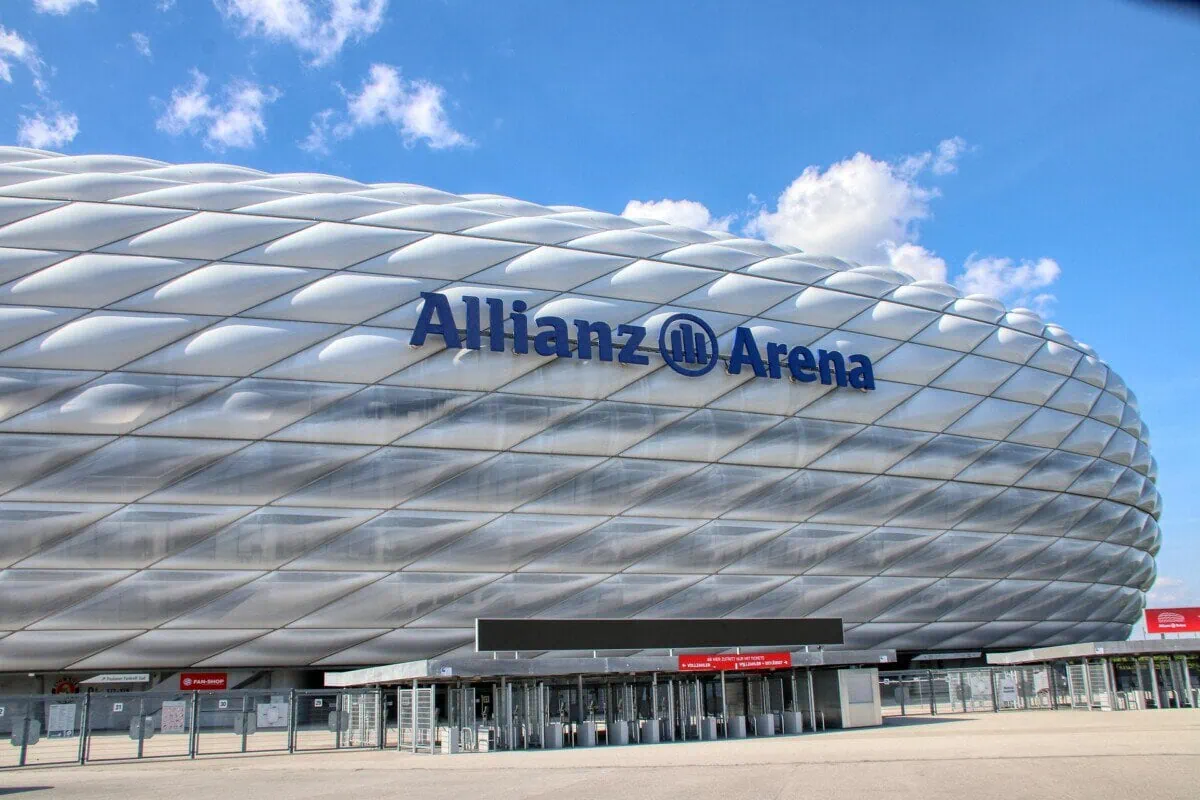
Nothing about a matchday in Munich feels like a modest occasion, and the ground the club calls home reflects that stature from the moment it comes into view. The Allianz Arena opened in 2005 on the northern edge of the city in Fröttmaning, a purpose-built stadium whose translucent white exterior can glow in different colours depending on the fixture.
It has hosted a World Cup semi-final, a Champions League final, and Euro 2024 matches, and it remains one of the most recognisable stadium silhouettes in world football. With a Bundesliga capacity of just over 75,000, it is comfortably one of the biggest and best-supported grounds anywhere in Germany, and Bayern sell out the vast majority of their home fixtures.
What follows is a straight run through the practical side of a matchday at the Allianz Arena: a realistic door-to-seat journey from central Munich, what actually happens once tens of thousands of fans converge on Fröttmaning, an honest look at driving and parking, and how ticket buying works for one of Europe’s most in-demand clubs.
The Allianz Arena is also worth a visit on its own terms, well beyond ninety minutes of football, thanks to the FC Bayern Museum built into the arena itself and guided tours that reach areas normally reserved for players and staff. None of this is difficult to plan around, but knowing what to expect before arriving makes for a considerably smoother day.
| Club | Stadium | Capacity | Nearest Station | League (2025/26) |
|---|---|---|---|---|
| Bayern Munich | Allianz Arena | 75,024 (Bundesliga) | U6 Fröttmaning | Bundesliga |
Transport at a Glance: Nearest Stops for the Allianz Arena
Before the full breakdown below, here is every practical way of reaching the Allianz Arena in one place, since public transport options here are more limited than at many stadiums.
| Mode | Stop / Station | Line(s) | Walk Time to Stadium |
|---|---|---|---|
| U-Bahn | Fröttmaning | U6 (towards Garching-Hochbrück) | 10 to 15 min via the Esplanade to Eingang Süd/Home Fans |
| Bus (matchday evening shuttle only) | Departs Donnersbergerbrücke, arrives Fröttmaning | Free matchday shuttle, no fixed line number, runs 18:00-20:00 every 10 minutes for evening kickoffs | Drops passengers at Fröttmaning, same onward walk as the U6 route above |
There is no tram service and no direct S-Bahn stop at the Allianz Arena itself; regional and S-Bahn journeys all connect onto the U6 at Marienplatz rather than running out to Fröttmaning directly.
The U6 and the Esplanade: How Most Fans Reach Fröttmaning
The single practical fact worth knowing before travelling to a Bayern Munich match is that almost everyone arrives the same way. The U6 U-Bahn line, running towards Garching-Hochbrück, stops directly at Fröttmaning station on the northern edge of the city, and the journey from Marienplatz takes around 16 minutes according to the stadium’s own official directions.
From Fröttmaning station, the walk to the stadium follows a wide, purpose-built approach called the Esplanade, signposted towards ‘Eingang Süd/Home Fans’ for home supporters. The walk itself takes around 10 to 15 minutes depending on which entrance a ticket points to, and the route is flat, well-lit, and easy to follow even for a first-time visitor.
A realistic door-to-seat estimate from Marienplatz runs to roughly 35 to 45 minutes once the walk from the platform and the queue through security and turnstiles are factored in. Munich’s transport network runs a genuinely dense U-Bahn service at the best of times, and the U6 line is generally well used to handling large crowds converging on a single station for a sold-out fixture.
The simplest approach is to buy an MVV ticket covering the journey before setting off rather than queuing at a machine at Fröttmaning itself, since the platform gets busy in the hour before kickoff. Our Munich Public Transport guide breaks down MVV’s ticket types and fare zones in full, worth a look if the U6 is your first ride on Munich’s network. Fröttmaning genuinely sits on the northern edge of Munich, not the quick walk from any other part of town that the short U6 journey time can suggest, so it is worth treating this as a dedicated trip rather than something to fit in on the way to somewhere else.
See hotel options and places to stay for your trip.
Browse hotelsBrowse apartments, homes and self-catering accommodation.
Browse rentalsCompare prices from multiple hotel booking sites.
Check dealsWhat 75,000 Fans Converging on Fröttmaning Actually Looks Like
A 75,000-seat stadium fills a single U-Bahn station well beyond its everyday capacity, and Fröttmaning station together with the Esplanade approach genuinely fills with supporters for twenty to thirty minutes either side of kickoff and full time. Anyone travelling with children or reduced mobility should expect a crowded platform rather than an immediate, comfortable ride back into the city.
Stewards and extra transport staff are a routine sight at Fröttmaning on a matchday, managing the flow of tens of thousands of fans through a station that otherwise serves a fairly quiet stretch of northern Munich the rest of the week. Closer intervals on the U6 are typical around a full house, though the sheer volume of people leaving at once still makes the post-match exit the slowest part of any visit.
There is no significant shuttle-bus network beyond the U6 itself, since the line’s capacity is considered sufficient for a stadium of this size, unlike some grounds that rely on a patchwork of buses to cope with demand. The Esplanade area around the stadium is closed to general traffic on matchdays, which keeps the walking route clear but also means there is nowhere for a car to simply pull up near the gates.
Leaving right on the final whistle rarely produces the quick getaway it promises. The smarter move is either lingering at the stadium for fifteen minutes while the first surge clears, or accepting a slow walk and a packed platform as simply part of the experience, and arriving at least 60 minutes before kickoff is the simplest way to avoid both the inbound crush and any last-minute security queue at the turnstiles.
Building in real time either side of the match, rather than treating a 75,000-capacity crowd as an abstract number, is the single biggest factor in a stress-free Allianz Arena matchday. The stadium’s own scale is exactly why the U6 and the Esplanade, rather than a car, are built to be the default route for almost everyone attending.
Driving to the Allianz Arena: Straightforward In, Slow Getting Out
Driving to the Allianz Arena is entirely possible, and unlike some big European grounds, the stadium actually has purpose-built multi-storey car parks, P1 through P3, right beside the ground. Payment is handled automatically through number-plate recognition at the exit, with a pre-booked space costing €12 (£10/$14) and a same-day arrival costing €15 (£13/$18).
Drivers approaching from the north should take the A99 at exit 12b and use the upper approach level to park and later exit northbound, while anyone coming from the south via the A9 should take exit 73 and use the lower approach level instead. Both routes are clearly signed well before the stadium comes into view, and the system works smoothly on arrival even for a sold-out fixture.
The honest problem is not getting in but getting out. The car parks close four hours after the final whistle, and the stadium’s own information for visiting fans states plainly that emptying the car parks and clearing around 11,000 vehicles takes up to two and a half hours after a match ends, a genuinely long wait compared with the 35 to 45 minute U6 journey covered earlier in this guide.
Taller vehicles, anything over two metres, are directed to a separate away-fans car park rather than the main P1-P3 structures, with online registration priced at €25 (£22/$29) or €30 (£26/$35) if arranged on the day. This applies to larger family vehicles and vans as much as it does to coaches, so it is worth checking a vehicle’s height before assuming a standard space is available.
For anyone within reach of Munich’s rail network, the U6 is simply the faster option, and more importantly the faster way home again once the post-match car park queue is factored in; driving only really makes sense for someone travelling from well outside that network with no other way in. Anyone visiting the stadium on a non-matchday for a tour instead should note that regular parking at the Busparkplatz Nord facility costs a flat €5 (£4/$6) per day, with the first 45 minutes free.
Getting Hold of a Bayern Munich Ticket: Why Demand Never Really Eases
Buying a ticket for a Bayern Munich match is not as simple as picking a date and checking out. Demand for Germany’s most successful club vastly outstrips the roughly 75,000 seats available for almost every home fixture, and the club’s own official ticket service is the only sensible place to start.
Tickets purchased anywhere other than the club’s direct ticket service or its officially recognised partners cannot be guaranteed as valid at the turnstile, and the club is explicit that unauthorised resale generally leads to a ticket becoming invalid before the game even starts. That is a real risk, not a theoretical one, given how many unofficial listings circulate online for a club with this level of global following.
For fans who do end up with a spare ticket, or need to pass one on legitimately, Bayern operate their own official ticket exchange rather than leaving fans to rely on general secondary-market listings, and the club’s own terms also allow a ticket to be transferred personally to a friend or acquaintance. That official exchange is the sensible route for anything beyond a straightforward purchase, since it keeps the transaction inside a system the club itself recognises.
International visitors travelling specifically for a match, particularly as part of a wider trip, sometimes use one of the club’s own authorised travel partners, which package official tickets together with accommodation rather than selling tickets alone. That route tends to cost more than a standard seat but removes any uncertainty for a fan flying in from outside Germany with no flexibility to try again if a ticket falls through.
The plain advice here is to check the official ticket service as soon as a fixture list is confirmed, since popular matches against rivals or in cup competitions can sell out within the club’s own membership priority windows before general sale even opens. Assuming a huge, famous club automatically means tickets stay available right up to matchday is a costly assumption here, since the opposite is generally closer to the truth for Bayern Munich specifically.
What You Can’t Bring: Prohibited Items at the Allianz Arena
The Allianz Arena enforces a strict bag policy that catches out plenty of first-time visitors. Bags larger than A4 size, roughly 21 x 29.7cm, are banned outright, covering backpacks, handbags, gym bags and fabric or plastic carriers alike.
Security confiscates a long list of items at the turnstiles, and liquids and bottles are near the top of it. Glass and plastic bottles of any kind are prohibited, though an empty, transparent PET bottle up to 0.5 litres is allowed through and can be filled inside.
Weapons of any kind, knives regardless of blade length and spray cans are all banned, alongside flammable items and pyrotechnics such as flares and smoke bombs. Professional camera equipment, detachable zoom lenses beyond 200mm and tripods are also refused, though a standard SLR with a fixed lens is generally fine.
Flags are allowed only on wooden poles up to 1.5 metres long and 2cm in diameter, and metal flagpoles over that length are turned away completely. E-scooters, bicycles and umbrellas with metal tips are also on the banned list, so anyone driving in should factor a genuine walk from the car park into their timing.
Anything with a slogan, a large flag or a planned choreography needs written approval from FC Bayern’s fan support team at least a week before matchday, so this is not something to arrange on the day. The full, current list is published on the club’s own Allianz Arena ground regulations page, and it is worth a quick check before travelling since rules are occasionally updated between seasons.
In and Around the Allianz Arena: the FC Bayern Store and Hospitality Options
Beyond the pitch itself, the Allianz Arena runs its own dedicated retail space on matchday and every day in between. The FC Bayern Store sits on Level 3 of the stadium, reached via the staircase in Area H or lift T4 in the Welcome Zone Ost, and covers roughly 1,000 square metres of official kits, replica shirts, flags, accessories and children’s ranges. On a non-matchday it opens from 10am to 6pm daily, closing only on Christmas Day and New Year, while on a matchday it opens two hours before kickoff and stays open for two hours after the final whistle, with museum ticket holders getting early access ahead of the wider crowd.
What the ground does not really have is a cluster of bars or a fan-zone scene right outside the turnstiles. Fröttmaning is a purpose-built stadium precinct rather than an existing neighbourhood, so unlike some Bundesliga grounds tucked into a city district with pubs on every corner, there is little to do here beyond the store and the concourse kiosks before the gates open. Fans looking for a proper pre-match drink overwhelmingly do it in central Munich instead, a point covered in more detail below.
Hospitality is available for anyone wanting more than a standard seat, run directly through FC Bayern’s own ticket office rather than a third party. Packages span the Business Club (Silver, Gold and Platinum tiers), the Säbener Lounge, the Sponsors’ Lounge, the Franz Beckenbauer Lounge and individual Event and Presenter Boxes, and every tier includes a premium buffet from catering partner DO & CO along with drinks and dedicated staff. Lounges open two hours and fifteen minutes before kickoff and stay open until two hours after the final whistle, with the higher tiers also unlocking closer parking in the P0 or S0 garages rather than the standard P1 to P3 structures. Pricing is not published openly and varies by fixture and tier, so anyone interested should go through the club’s official hospitality portal directly rather than a resale site.
Matchday Atmosphere: the Südkurve, the Schickeria and ‘Mia San Mia’
Almost all of the noise inside the Allianz Arena comes from one end of the ground. The Südkurve, the standing terrace behind the south goal, is where Bayern’s organised supporters, led by the Schickeria ultras group, drive the singing, flags and choreography that give the stadium its atmosphere. It is widely regarded as one of the most respected supporter cultures in German football, and its banners carry a genuine political history, including tributes to Kurt Landauer, the club’s Jewish former president who survived Dachau and helped rebuild Bayern after the war.
The phrase ‘Mia san mia’, Bavarian dialect for ‘we are who we are’, sums up how the club talks about itself both on and off the pitch. The traditional matchday anthem, ‘Stern des Südens’ (Star of the South), has anchored the pre-match build-up for years, and since February 2025 a new stadium song, ‘Immer vorwärts FC Bayern’ (‘always forward’), now plays as the teams walk out for every home fixture.
It is worth being honest about the rest of the ground, though. Outside the Südkurve, the remaining 60,000-plus seats are filled largely by tourists and casual attendees rather than vocal regulars, and on a routine league night much of the stadium can stay fairly quiet until the Südkurve drags the rest of the crowd into it. That is not a criticism unique to Bayern, but it is worth knowing before expecting wall-to-wall noise from every seat in a 75,000-capacity stadium.
Search flights and useful route combinations in one place.
View flightsBrowse Airalo eSIM options for convenient travel data.
Check eSIMsBook a private airport transfer in advance and have your ride planned before you arrive.
Check transfersEating and Drinking Around a Bayern Munich Matchday
Inside the stadium, catering runs through a handful of named outlets rather than generic concourse stalls. Paulaner Fantreff North on Level 3 serves bratwurst, currywurst and hot and cold drinks every day the store is open, while Paulaner Fantreff South, Café Rot Weiß and the Arena Bistro open on matchdays only, adding roast pork, schnitzel, cheese spaetzle and vegan or vegetarian options at specific kiosks on Levels 2 and 6. One genuine difference from many English grounds is that Paulaner beer, served in half-litre mugs, can be carried back to your seat and drunk throughout the match rather than only in a concourse area.
Fröttmaning itself is not a neighbourhood with its own pub scene, so most fans do their proper pre-match drinking well before heading out to the stadium. Munich’s city centre does that job instead, with the Hofbräuhaus near Marienplatz and the Augustiner-Keller near the Hauptbahnhof among the traditional starting points before the U6 journey out to the ground.
If eating inside the stadium, the sensible move is to buy before kickoff or wait until well after it, since the matchday-only kiosks and the Arena Bistro see their longest queues in the fifteen minutes either side of half-time, the same pinch point as almost every major European ground. Card and mobile payment are accepted throughout, so there is no need to carry cash specifically for stadium food.
The FC Bayern Museum and Arena Tours: Why the Stadium Itself Is Worth the Trip
Unlike many football grounds that only really come alive on a matchday, the Allianz Arena runs a genuine visitor attraction seven days a week. The FC Bayern Museum sits built into the stadium itself, open daily from 10am to 6pm, and covers the club’s entire history from its founding through decades of Bundesliga and European success.
A museum-only ticket costs €12 (£10/$14) for around 90 minutes, with an audio guide available in 11 languages for international visitors who want the full story without relying on printed signage. Stepping up to the combined Museum plus Arena View ticket, priced at €19 (£16/$22) for the same 90-minute window, adds access to the stadium’s viewing area overlooking the pitch itself.
For a genuinely thorough visit, the FC Bayern Museum plus full Arena Tour runs around two and a half hours for €25 (£22/$29), guided in German and English, and takes in areas of the stadium a standard matchday ticket never reaches. Enthusiasts willing to pay more for the full experience can book the Arena VIP Tour, a three-hour visit priced at €45 (£39/$53) that gives visitors the perspective of a team or VIP guest rather than a standard fan.
What makes the Allianz Arena special is not just the club’s trophy cabinet but the building itself: a translucent exterior made of inflatable panels that can be lit in different colours for different occasions, an interior designed to concentrate noise back onto the pitch, and a role hosting a World Cup semi-final, a Champions League final, and Euro 2024 matches within two decades of opening. Very few stadiums anywhere combine that level of architectural ambition with a club this consistently successful.
Booking a tour slot in advance through the official Allianz Arena website is worth doing, particularly around weekends, since popular time slots for the combined tours can fill up. It is also worth checking the tour calendar around a fixture, since access to some parts of the stadium may be restricted while it is being prepared for a match.

Rupert’s Handy Travel Tips
Heading to a Bayern Munich matchday? Rupert has a few tips that can save both time and a lot of standing around:
- Take the U6 to Fröttmaning, not a taxi: it is around 16 minutes from Marienplatz and the whole route into the stadium is built for it.
- Buy your MVV ticket before you set off: the machines at Fröttmaning get busy in the hour before kickoff.
- If you drive, plan for the exit, not just the arrival: clearing the car parks can take up to two and a half hours after the final whistle.
- Check the official ticket service the moment a fixture is confirmed: Bayern’s demand regularly outstrips supply well before general sale opens.
- Book a museum or tour slot for a separate day if you can: combining a tour with a matchday visit is not always straightforward.
Want to meet the reindeer behind our travel tips? Find out more in our page Who is Rupert?.



Frequently Asked Questions About Getting to the Allianz Arena
How do I get to the Allianz Arena from central Munich?
Take the U6 U-Bahn line to Fröttmaning station, around 16 minutes from Marienplatz, then follow the signed Esplanade walkway towards the stadium.
Is there a shuttle bus to the Allianz Arena?
No. There is no dedicated shuttle-bus network beyond the U6 line itself, since the station’s rail capacity is considered sufficient for a stadium of this size.
Should I drive to a Bayern Munich match?
It is possible, since the stadium has its own P1-P3 car parks, but the honest reality is that clearing around 11,000 vehicles after the final whistle can take up to two and a half hours.
How much does parking cost at the Allianz Arena?
On a matchday, a pre-booked space costs €12 (£10/$14) and a same-day arrival costs €15 (£13/$18). On a non-matchday, regular parking is a flat €5 (£4/$6) per day.
Can I buy Bayern Munich tickets from resale websites?
This is not recommended. The club is explicit that unauthorised resale generally invalidates a ticket, and its own official ticket exchange is the only sanctioned way to buy or pass on a ticket outside the standard sale.
Is it easy to get tickets for Bayern Munich matches?
Generally no. Demand for Germany’s most successful club regularly outstrips the roughly 75,000 seats available, and popular fixtures can sell out within membership priority windows before general sale opens.
Can I visit the Allianz Arena without a match ticket?
Yes. The FC Bayern Museum and several guided tour options run daily from 10am to 6pm, from a 90-minute museum visit to a full three-hour Arena VIP Tour.
What is the capacity of the Allianz Arena?
The Allianz Arena holds 75,024 spectators for Bundesliga fixtures, making it one of the largest football stadiums in Germany.

Further Reading & Related Guides
Landing in the city before a match? Our Munich Airport Transfers guide covers every realistic way of reaching the centre from MUC, while our Best Things to Do in Munich guide rounds up the sights worth prioritising around a matchday visit.
If a match falls on a free day, our Best Day Trips from Munich guide covers Neuschwanstein, Dachau and beyond for the rest of your stay, and our Oktoberfest in Munich guide is worth a look if your visit lines up with the festival. A December matchday pairs well with our Munich Christmas Markets guide, which covers the Marienplatz Christkindlmarkt and the rest of the city’s festive stalls. Heading to the mountains afterwards, our Munich Airport to Ski Resorts guide covers the onward journey to Garmisch-Partenkirchen, Innsbruck and further into Austria, and our German Rail Tickets Explained guide breaks down the Bayern-Ticket and Deutschland-Ticket fares that also cover the MVV network used to reach the Allianz Arena.