Reviewed by our editorial team Updated
Discover the City of Kings and Champagne
Few cities in France combine royal history, world-famous wine, Roman heritage and magnificent architecture quite like Reims. Best known as the birthplace of Champagne and the city where the kings of France were crowned for almost a thousand years, Reims offers visitors an unforgettable mix of history, culture and gastronomy in the heart of the Grand Est region.
Although many travellers arrive simply to visit a Champagne house, Reims has far more to offer than its famous sparkling wine. Beneath its elegant streets lie ancient Roman ruins, while above ground you’ll discover one of the greatest Gothic cathedrals in Europe, impressive museums, beautiful public squares and peaceful parks. Together they create a destination that comfortably rewards several days of exploration.
The city is also wonderfully walkable. Most of the principal attractions are located within a compact historic centre, allowing visitors to move easily between royal landmarks, underground Champagne cellars and lively café-lined streets without needing public transport.
Whether you’re passionate about French history, architecture, fine food, Champagne or simply looking for one of France’s most elegant city breaks, Reims delivers an experience unlike anywhere else in the country.
Visit Reims Cathedral
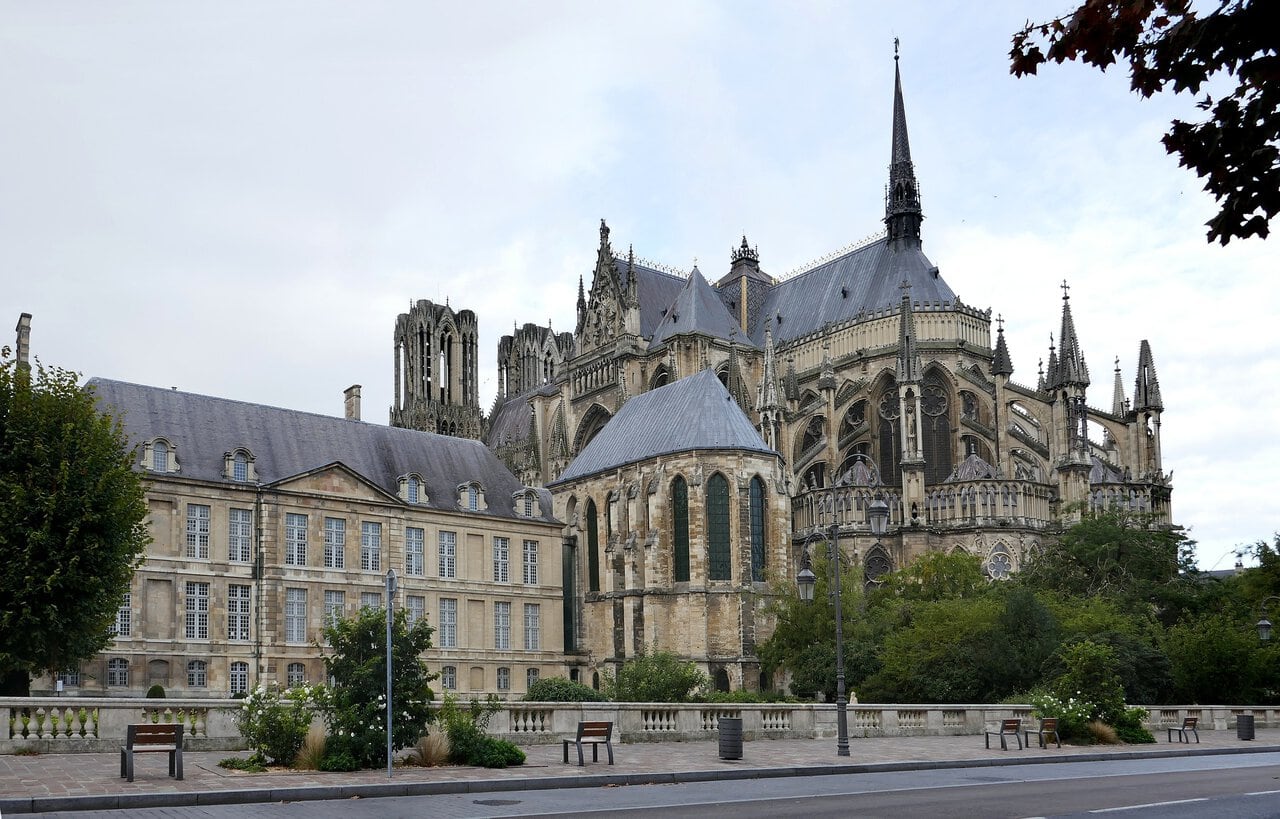
The magnificent Cathédrale Notre-Dame de Reims is undoubtedly the city’s greatest attraction and one of the finest examples of French Gothic architecture ever built. Recognised as a UNESCO World Heritage Site, the cathedral welcomed the coronation of more than 30 French kings, making it one of the most historically significant churches in Europe.
Construction began during the thirteenth century, and the result is nothing short of extraordinary. The vast western façade is covered with more than 2,000 sculptures, each carved in remarkable detail. Among them is the famous Smiling Angel, one of the cathedral’s best-known figures and an enduring symbol of Reims.
Stepping inside reveals soaring stone columns, magnificent vaulted ceilings, colourful stained-glass windows and an atmosphere that perfectly reflects the importance of this remarkable building. Modern stained-glass panels designed by Marc Chagall add another layer of beauty, blending contemporary art with centuries of history.
Whether you’re interested in architecture, religion or French royal history, Reims Cathedral is an unforgettable experience and the highlight of any visit to the city.
Best if you want daily housekeeping and a front desk. Filter by area first, then by price.
Check availabilityBest for longer stays. Whole apartments and houses, so you are not eating out three times a day.
View rentalsBest as a last check before booking. Compares hotel rates across several sites in one search.
Compare ratesExplore the Palace of Tau
Standing beside the cathedral, the elegant Palace of Tau played an essential role in the coronation ceremonies of the French monarchy. For centuries it served as the official residence of the Archbishop of Reims, while newly crowned kings celebrated their coronations here following the ceremony in the cathedral.
Today the palace forms part of the UNESCO World Heritage Site, allowing visitors to walk through magnificent ceremonial halls where countless royal celebrations once took place. Richly decorated rooms display medieval sculptures, precious religious artefacts, historic tapestries and objects connected with the coronation of French monarchs.
Among the highlights are the surviving treasures from the cathedral, including statues removed during restoration work and priceless objects associated with centuries of royal tradition. Walking through the grand reception rooms offers a fascinating insight into the wealth, power and ceremonial splendour that surrounded the French monarchy.
Visiting the Palace of Tau alongside the cathedral provides a much fuller understanding of why Reims became the spiritual home of the French crown for almost 1,000 years.
Discover the Basilica of Saint-Remi
While Reims Cathedral attracts most visitors, the magnificent Basilica of Saint-Remi is equally deserving of your time. Also recognised as a UNESCO World Heritage Site, this remarkable church is one of the largest Romanesque buildings in northern France and has played a central role in French history for more than a millennium.
The basilica is dedicated to Saint Remi, the bishop who famously baptised Clovis I, King of the Franks, around the year 496. This event marked a turning point in French history and established Reims as the traditional city of royal coronations for centuries to come.
Inside, visitors are greeted by a vast and peaceful interior featuring elegant stone arches, beautiful stained-glass windows and the impressive tomb of Saint Remi himself. Compared with the cathedral, the atmosphere here is noticeably quieter, allowing more time to appreciate the remarkable architecture and historical significance without large crowds.
A visit to the basilica also provides the perfect introduction to the neighbouring Musée Saint-Remi, making this part of Reims an essential stop for anyone interested in the city’s extraordinary royal and religious heritage.
Tour a Champagne House
No visit to Reims would be complete without stepping inside one of the city’s famous Champagne houses. Beneath the streets lies an extraordinary network of chalk cellars stretching for hundreds of kilometres, where millions of bottles mature in perfect conditions before being enjoyed around the world.
Many of the biggest names in Champagne welcome visitors, including Veuve Clicquot, Taittinger, Pommery, Ruinart, Mumm and Lanson. Although each house offers a slightly different experience, most guided tours explain the fascinating history of the Champagne industry before taking visitors deep underground into the cool limestone cellars where the wine slowly develops its distinctive character.
Walking through these vast underground galleries is an experience in itself. Some cellars date back to Roman times, while others occupy former chalk quarries known as crayères, many of which are now recognised as part of the UNESCO World Heritage Site celebrating the Champagne region.
Most visits conclude with a guided tasting, allowing you to sample one or more Champagnes while learning how different grape varieties, ageing methods and production techniques influence the finished wine. If you’re visiting during the summer or at weekends, it’s highly recommended to book tours in advance, as the most popular houses often sell out.

Learn the Art of Champagne Making
While tasting Champagne is undoubtedly enjoyable, understanding how it’s made makes every glass even more rewarding. The region surrounding Reims is the only place in the world where sparkling wine can legally be called Champagne, and strict production rules, overseen by the Comité Champagne, the appellation’s official trade body, have been followed here for centuries.
Guided tours explain the traditional method, beginning with carefully harvested grapes, usually Chardonnay, Pinot Noir and Pinot Meunier. After the first fermentation, the wine is bottled before undergoing a second fermentation inside the bottle itself, creating the fine bubbles that make Champagne so distinctive.
Visitors also learn about important stages including riddling, where bottles are gradually rotated to collect sediment in the neck, disgorgement, which removes that sediment, and the addition of the dosage, helping determine whether the finished Champagne becomes Brut Nature, Extra Brut, Brut, Sec or sweeter styles.
Even if you’re not a wine enthusiast, the combination of centuries-old traditions, remarkable engineering and underground cellars makes the Champagne-making process genuinely fascinating. By the end of your visit, you’ll almost certainly appreciate why this sparkling wine has become one of France’s most famous exports.
Visit the Musée Saint-Remi
Housed within the former Royal Abbey of Saint-Remi, the outstanding Musée Saint-Remi offers one of the most comprehensive journeys through the history of Reims and the surrounding region. The museum occupies magnificent monastic buildings that are themselves part of the UNESCO World Heritage Site, making the setting every bit as impressive as the collections inside.
The galleries trace the city’s story from prehistoric settlements and Roman Durocortorum through the Middle Ages and beyond. Visitors can admire beautifully preserved Roman mosaics, archaeological discoveries, medieval sculptures, historic weapons, religious treasures and everyday objects that help bring more than 2,000 years of history to life.
One of the highlights is the collection relating to the city’s Roman past, when Reims was one of the largest and most important cities in northern Europe. These exhibits provide valuable context before visiting other Roman landmarks such as the Porte de Mars and the Cryptoporticus.
Allow plenty of time for your visit, as both the museum and the surrounding abbey buildings contain far more than many visitors expect. Together with the neighbouring Basilica of Saint-Remi, they form one of the most rewarding historical experiences in Reims.
Walk Around Place Drouet d’Erlon
The lively Place Drouet d’Erlon is the social heart of modern Reims and one of the city’s most enjoyable places to relax. This broad pedestrian boulevard stretches through the centre of the city and is lined with restaurants, cafés, boutiques and elegant historic buildings, making it a natural meeting place for both locals and visitors.
Throughout the day, the square has a constantly changing atmosphere. Early mornings see locals enjoying coffee on outdoor terraces, while afternoons bring shoppers and sightseers exploring the surrounding streets. By evening, the cafés and restaurants become particularly lively as people gather to enjoy dinner accompanied, naturally, by a glass of Champagne.
One of the square’s most recognisable landmarks is the Subé Fountain, crowned by a gilded statue representing Victory. It has become a popular meeting point and provides an attractive focal point for photographs, particularly when illuminated after dark.
Whether you’re taking a break between attractions, enjoying lunch on a sunny terrace or simply watching the world go by, Place Drouet d’Erlon perfectly captures the elegant yet relaxed atmosphere that makes Reims such a rewarding city to visit.
Best for finding routes the airlines do not sell as a single ticket. Combines carriers to bring the fare down.
Search flightsBest for anyone whose home plan charges by the megabyte abroad. Pay a fixed price up front.
Check eSIMsBest when public transport has stopped, or when you are travelling with children and bags.
Book a transferDiscover the Roman Porte de Mars
Long before Reims became famous for kings and Champagne, it was the thriving Roman city of Durocortorum, one of the most important settlements in Roman Gaul. The greatest surviving reminder of that era is the impressive Porte de Mars, the largest surviving Roman triumphal arch in France.
Built during the third century AD, the arch once formed part of the city’s defensive walls and marked one of the principal entrances into Roman Reims. Measuring over 32 metres wide, it remains an extraordinary piece of Roman engineering and provides a striking contrast to the Gothic architecture found elsewhere in the city.
Look closely at the stonework and you’ll still see beautifully carved reliefs depicting mythological scenes, agricultural life and decorative motifs that have survived for almost 1,800 years. Despite its age, the monument remains remarkably well preserved and offers a fascinating glimpse into Reims long before it became associated with the French monarchy.
Standing beneath the immense arches, it’s easy to appreciate the scale and importance of Roman Reims. For anyone interested in ancient history, the Porte de Mars is one of the city’s most impressive and often overlooked landmarks.
Explore the Cryptoporticus
Hidden beneath Place du Forum lies one of Reims’ most unusual attractions. The Cryptoporticus is a rare Roman underground gallery dating back almost 2,000 years, making it one of the oldest structures in the city.
Originally forming part of the Roman forum, this semi-subterranean passageway was used as both a storage area and sheltered walkway, protecting merchants and visitors from the weather while supporting the bustling commercial life of ancient Durocortorum.
Walking through its long stone corridors is a fascinating experience. Massive arches, ancient masonry and subdued lighting create an atmosphere unlike anywhere else in Reims, transporting visitors back to the days when Roman citizens walked these same passages nearly two millennia ago.
Only a handful of Roman cryptoporticoes survive anywhere in Europe, making this one particularly significant. Combined with a visit to the nearby Porte de Mars, it provides an excellent insight into Reims’ remarkable Roman heritage.
The Museum of Fine Arts (Closed Until 2027)
The Museum of Fine Arts of Reims (Musée des Beaux-Arts de Reims) holds one of the finest art collections in the Grand Est region, spanning more than five centuries of European artistic achievement. The museum has been closed to the public since September 2019 while its collections are moved and the building is rebuilt and extended, and it is not due to reopen until 2027.
The collection features paintings by renowned artists including Monet, Renoir, Corot, Camille Claudel and many others, alongside sculptures, drawings, decorative arts and regularly changing temporary exhibitions. The collection reflects both the city’s cultural importance and the generosity of local collectors who helped establish the museum.
While the building is closed, the Musées de Reims keep the collection in view through a digital museum on their own website and a continuing programme of loans and off-site displays, covering artistic movements from the Renaissance through to the Impressionists and modern art.
If you are visiting before the new building opens, check the Musées de Reims website for current off-site exhibitions. In the meantime the Musée Saint-Remi and the Palace of Tau both remain open and showcase another side of Reims beyond its cathedrals and Champagne houses.
Climb the Reims Cathedral Towers
For a completely different perspective on the city, climb the towers of Reims Cathedral. The ascent takes visitors high above the bustling streets, offering spectacular views across the rooftops of Reims, the surrounding Champagne vineyards and the magnificent Gothic architecture beneath your feet.
Along the climb you’ll discover details that are impossible to appreciate from ground level. Gargoyles, flying buttresses, carved pinnacles and intricate stone sculptures reveal the extraordinary craftsmanship that went into constructing one of Europe’s greatest cathedrals.
Reaching the upper levels also provides an opportunity to understand the cathedral’s immense scale. Looking down across the vast roof and out towards the elegant boulevards, Roman monuments and distant countryside gives a real appreciation of Reims’ unique blend of royal history, Roman heritage and modern city life.
Although the climb involves a significant number of steps, the panoramic views make it one of the most rewarding experiences in Reims and an essential activity for anyone interested in architecture, history or photography.
Walk Along the Canal de l’Aisne à la Marne
Away from the famous cathedrals and bustling Champagne houses, the Canal de l’Aisne à la Marne offers one of the most peaceful places to explore in Reims. Flowing through the city before continuing into the Champagne countryside, the canal provides a completely different atmosphere, where tree-lined towpaths, narrowboats and waterside cafés replace the busy streets of the historic centre.
The well-maintained paths are ideal for a leisurely walk or cycle ride, allowing visitors to enjoy a slower side of the city. Along the route you’ll pass colourful barges, attractive bridges and quiet green spaces that are popular with both locals and visitors looking to escape the crowds.
The canal also played an important role in the development of Reims, helping transport Champagne, agricultural produce and manufactured goods throughout northern France. Today it remains an active waterway, and watching pleasure boats pass through the locks offers an enjoyable glimpse into a slower pace of travel.
Whether you’re looking for a relaxing stroll, a scenic picnic spot or simply somewhere to unwind after sightseeing, the canal is well worth adding to your itinerary.
Visit the Carnegie Library
One of Reims’ hidden architectural masterpieces is the remarkable Carnegie Library (Bibliothèque Carnegie). Opened in 1928 thanks to funding from American philanthropist Andrew Carnegie, the building is considered one of the finest examples of Art Deco architecture in France.
Even before stepping inside, the elegant façade immediately catches the eye with its symmetrical design, decorative ironwork and beautifully carved stone details. The interior is even more impressive, featuring magnificent mosaic floors, stained-glass windows, marble staircases and finely crafted wooden reading rooms that transport visitors back to the elegance of the 1920s.
Although the library continues to serve local residents, visitors are welcome to admire the architecture and appreciate the remarkable restoration work that has preserved one of Reims’ most beautiful public buildings.
Located just a short walk from Reims Cathedral, the library is easy to include in your itinerary and offers a fascinating contrast to the city’s medieval and Roman landmarks.
Best for short city stops where being central matters more than the room. Dorms and private rooms both listed.
See hostelsBest arranged before you fly rather than after. Covers claim handling, plus lounge access on eligible delays.
Explore AirHelp+Best for a day with a suitcase and nowhere to put it. Find a storage point near where you already are.
View storageTour the Fossier Biscuit Factory
Reims may be best known for champagne, but the city also has a much sweeter local speciality. The famous Biscuit Rose de Reims has been produced for centuries, and a guided visit to the Maison Fossier factory reveals how these distinctive pink biscuits are still made today.
Founded in 1756, Maison Fossier is regarded as the oldest biscuit factory in France and remains the only producer in Reims still making the traditional Biscuit Rose. The company’s history is closely connected with the city’s royal and champagne heritage, and its biscuits were even served during the coronation of Louis XVI in Reims in 1775.
The visit begins with a short historical presentation and film explaining more than two and a half centuries of biscuit-making tradition. You’ll then follow a guided route through an elevated glass gallery overlooking the production workshops, where you can watch the manufacturing process while learning about the ingredients, double-baking method and techniques that give the biscuits their familiar texture and colour.
A highlight of the tour is the tasting session, where visitors can sample several Fossier specialities. These may include Biscuits Roses, macarons, Croquignoles, Craquants Charles VII, gingerbread and Nonnettes. The Biscuit Rose is traditionally dipped into champagne, making this a particularly fitting experience while visiting the heart of the Champagne region.
The tour finishes at the factory outlet, where the full Fossier range is available alongside discounted products, gift boxes and regional treats. It is a useful place to pick up edible souvenirs that are genuinely connected with Reims rather than generic tourist gifts.
Tours are normally offered in French and English, with small groups helping to make the experience more personal. Although the advertised duration is around one to one and a half hours, the exact length may vary. Photography is permitted during the visit.
The factory is easiest to reach by car. Visitors using public transport should expect an additional 15 to 20-minute walk from the nearest tram stop. The viewing gallery is upstairs and there is no lift, so the current tour route is not suitable for wheelchair users or visitors unable to manage stairs. The gallery is also not air-conditioned during periods of very hot weather.
For food lovers, families and anyone wanting to experience something beyond Reims’ champagne houses and cathedral, this is one of the city’s most enjoyable and distinctive guided visits.
Explore the Foujita Chapel
One of Reims’ most unusual attractions is the Foujita Chapel (Chapelle Foujita), a small but extraordinary church decorated by the celebrated Japanese-French artist Tsuguharu Foujita.
After converting to Catholicism in the 1950s, Foujita designed the chapel himself, overseeing everything from the architecture to the stunning frescoes that cover the interior walls. Inspired by both Japanese artistic traditions and European religious art, the result is unlike any other chapel in France.
Inside, visitors are surrounded by beautifully detailed paintings depicting scenes from the Bible, while delicate colours and elegant lines create a calm, contemplative atmosphere. Among the frescoes is Foujita’s own self-portrait, quietly included within one of the biblical scenes as a lasting reminder of the artist’s personal connection to the chapel.
Although smaller than many of Reims’ other attractions, the Foujita Chapel provides a fascinating blend of art, faith and international cultural influences, making it one of the city’s most distinctive hidden gems.
Taste Champagne and Regional Cuisine
No visit to Reims would be complete without experiencing the outstanding food and drink for which the Champagne region is famous. While the city’s sparkling wine is undoubtedly the star attraction, the surrounding countryside also produces exceptional cheeses, meats, biscuits and traditional dishes that deserve equal attention.
Naturally, the highlight is sampling authentic Champagne in the place where it was created. Whether you prefer a crisp Brut, an elegant Blanc de Blancs or a rich Vintage Champagne, enjoying a glass in Reims provides an appreciation that simply can’t be replicated elsewhere. Many restaurants offer carefully selected Champagne pairings that perfectly complement local cuisine.
Food lovers should also try Jambon de Reims, a distinctive local ham coated in breadcrumbs, along with Chaource cheese, fresh regional produce and the famous Biscuits Roses de Reims. These delicate pink biscuits have been produced in the city for centuries and are traditionally dipped into Champagne before eating, creating one of the region’s best-known culinary traditions.
Whether you’re dining in an elegant Michelin-starred restaurant, a traditional French bistro or a welcoming Champagne bar, discovering the flavours of Reims is every bit as memorable as exploring its remarkable history and architecture.

Reims Through the Eyes of French Kings
For almost 1,000 years, Reims stood at the very heart of the French monarchy. Between the coronation of Louis the Pious in 816 and that of Charles X in 1825, almost every King of France was crowned within the magnificent Reims Cathedral, transforming the city into one of the most important royal destinations in Europe.
Walking through Reims today, it’s easy to imagine the extraordinary ceremonies that once filled the city. Kings, queens, bishops, nobles and thousands of spectators gathered here to witness elaborate coronations that combined religious ritual with political power. The newly crowned monarch would then process next door to the Palace of Tau, where lavish banquets celebrated the beginning of a new reign.
The tradition began because Clovis I, King of the Franks, was baptised in Reims by Saint Remi around the year 496. This event became one of the defining moments in French history and established the city as the spiritual home of the monarchy for centuries afterwards.
Exploring Reims Cathedral, the Palace of Tau and the Basilica of Saint-Remi together allows you to follow this remarkable royal story from beginning to end. Few places in France provide such a powerful insight into the rise of the French kingdom, making Reims an essential destination for anyone interested in the nation’s history.
The Best Views and Photo Spots in Reims
With its magnificent Gothic cathedral, elegant boulevards, Roman monuments and world-famous Champagne houses, Reims offers countless opportunities for memorable photographs.
The obvious starting point is Reims Cathedral, where the richly decorated western façade provides one of the most spectacular architectural scenes in France. Visit during the early morning for softer light and quieter surroundings, or return later in the day when the changing sunlight highlights the incredible stone carvings and the famous Smiling Angel.
For panoramic views across the city, climbing the cathedral towers is hard to beat. From the upper levels you’ll enjoy sweeping vistas across the rooftops of Reims, while also gaining a close-up appreciation of the flying buttresses, gargoyles and Gothic stonework that make the cathedral such an architectural masterpiece.
Elsewhere, Place Drouet d’Erlon provides lively street scenes filled with cafés and elegant architecture, while the Canal de l’Aisne à la Marne offers peaceful reflections of boats and bridges. The Porte de Mars, Carnegie Library and the surrounding Champagne streets all provide distinctive backdrops that showcase the many different sides of this remarkable city.
Hidden Corners of Reims
Beyond the famous Champagne houses and royal landmarks, Reims rewards visitors who take the time to wander away from the busiest streets. Quiet squares, elegant courtyards and hidden passages reveal a more relaxed side of the city that many visitors never experience.
Explore the streets surrounding Place Royale and you’ll discover beautiful nineteenth-century architecture, independent cafés and charming boutiques tucked away behind grand façades. Nearby, the smaller streets around the cathedral reveal hidden courtyards, artisan shops and peaceful corners where the crowds quickly disappear despite being only a few minutes from the city’s busiest attractions.
The paths beside the Canal de l’Aisne à la Marne provide another peaceful escape, particularly during the early morning when the water is calm and the city is only just beginning to wake. It’s a completely different atmosphere from the lively Champagne houses and bustling shopping streets.
Sometimes the greatest pleasure in Reims comes from slowing your pace. Step away from the main sights, follow an unfamiliar street and you’ll often discover elegant architecture, quiet gardens and unexpected viewpoints that remind you why Reims is much more than simply the home of Champagne.

Rupert’s Handy Travel Tips
Planning a visit to Reims? Here are a few tips to help you experience much more than just the Champagne houses:
- Book Champagne tours in advance: The most famous houses, including Veuve Clicquot, Taittinger, Pommery and Ruinart, often sell out several weeks ahead during summer and the harvest season.
- Don’t miss the UNESCO trio: Visit Reims Cathedral, the Palace of Tau and the Basilica of Saint-Remi together to fully appreciate why Reims became the coronation city of the French kings.
- Look beyond Champagne: Reims also has a fascinating Roman past. Make time for the Porte de Mars, the Cryptoporticus and the Musée Saint-Remi to discover the city’s history long before sparkling wine made it famous.
- Taste the local specialities: Pair a glass of Champagne with a traditional Biscuit Rose de Reims, or visit the Maison Fossier factory to see how these famous pink biscuits have been made for centuries.
- Stay at least one night: Although Reims makes an excellent day trip from Paris, an overnight stay gives you time to explore the city after the day-trippers leave and enjoy its restaurants, Champagne bars and lively evening atmosphere.
Want to meet the reindeer behind our travel tips? Find out more in our page Who is Rupert?.




Frequently Asked Questions
How many days should you spend in Reims?
One full day is enough to see the main highlights, but two to three days allows time to tour several Champagne houses, explore the museums and discover the city’s remarkable royal and Roman history.
Is Reims worth visiting?
Absolutely. Reims combines a magnificent UNESCO-listed cathedral, world-famous Champagne houses, fascinating Roman monuments and centuries of French royal history, making it one of the country’s most rewarding city breaks.
What is Reims famous for?
Reims is best known as the home of Champagne and the city where almost every King of France was crowned. It is also famous for Reims Cathedral, the Palace of Tau and its extensive underground Champagne cellars.
Can you visit Champagne cellars in Reims?
Yes. Many of the city’s leading Champagne producers offer guided tours of their historic cellars, explaining the production process before concluding with a tasting. Booking in advance is highly recommended.
Is Reims easy to explore on foot?
Yes. The historic centre is compact, with the cathedral, major museums, Roman monuments and many Champagne houses all within comfortable walking distance.
When is the best time to visit Reims?
Late spring, summer and the autumn harvest season are particularly enjoyable, offering pleasant weather and an excellent atmosphere throughout the Champagne region.
What local food should I try in Reims?
Don’t miss Champagne, Biscuits Roses de Reims, Jambon de Reims, regional cheeses and traditional dishes showcasing the flavours of the Champagne region.
Can you visit Reims as a day trip from Paris?
Yes. High-speed TGV trains connect Paris and Reims in around 45 minutes, making the city one of the most popular day trips from the French capital. Our Carte Avantage France guide explains how to save up to 30% on these TGV fares.
Further Reading
Continuing through the Grand Est? Our Visiting Metz guide covers the golden-stone city and its Franco-German heritage, just over an hour away, while our Alsace Wine Route Road Trip guide continues the journey through Strasbourg, Colmar and Alsace’s fairytale wine villages.
Exploring more of Northern France? Our Visiting Lille guide and Visiting Amiens guide cover two more of the region’s finest historic cities.
Travelling around France by train? Our Interrail France Pass guide covers prices and routes for combining Reims with other stops on a longer rail trip.