
Reviewed by our editorial team Updated
Why Sri Lanka’s UNESCO Sites Are Worth Visiting
Sri Lanka UNESCO sites combine ancient kingdoms, sacred Buddhist landmarks, colonial fortifications, mountain scenery, and tropical rainforest into one of the most varied heritage collections anywhere in Asia. Despite the island’s relatively compact size, Sri Lanka contains an extraordinary concentration of historical and cultural sites spread across ancient capitals, tea country, coastal cities, and protected natural landscapes.
What makes UNESCO sites in Sri Lanka particularly impressive is how accessible many of them are. Unlike some countries where heritage sites require long internal flights or difficult overland journeys, travellers in Sri Lanka can often combine multiple UNESCO locations into a single itinerary using trains, private drivers, buses, or tuk tuks. This makes the country especially attractive for travellers wanting a mixture of culture, history, wildlife, and scenery without constantly changing transport methods.
The island’s UNESCO locations also cover remarkably different periods of history. Travellers can explore the towering rock fortress of Sigiriya, walk through the sacred Buddhist temples of Kandy, discover the ancient ruins of Polonnaruwa and Anuradhapura, or wander the colonial streets inside Galle Fort on the southern coast. Few countries offer this level of variety within such short travel distances.
Another major advantage is that many of Sri Lanka’s heritage sites still feel genuinely connected to daily life rather than functioning purely as tourism attractions. Sacred temples remain active religious centres, ancient cities still attract pilgrims, and local communities continue living around many of the country’s most important UNESCO areas.
Quick Overview of Sri Lanka UNESCO Sites
Although Sri Lanka is relatively small geographically, the country contains an impressive collection of internationally recognised cultural and natural heritage locations. Several of the island’s most famous attractions are officially protected as UNESCO World Heritage Sites, helping preserve some of South Asia’s most important historical landscapes.
| UNESCO Site | Type | Region | Best Known For |
|---|---|---|---|
| Sigiriya | Cultural | Central Sri Lanka | Rock fortress and ancient palace |
| Sacred City of Kandy | Cultural | Central Highlands | Temple of the Tooth |
| Ancient City of Polonnaruwa | Cultural | North Central Province | Medieval royal ruins |
| Ancient City of Anuradhapura | Cultural | North Central Province | Ancient Buddhist capital |
| Golden Temple of Dambulla | Cultural | Central Sri Lanka | Cave temple complex |
| Old Town of Galle and its Fortifications | Cultural | Southern Coast | Dutch colonial fort city |
| Sinharaja Forest Reserve | Natural | South West Sri Lanka | Tropical rainforest biodiversity |
| Central Highlands of Sri Lanka | Natural | Hill Country | Tea country mountains and forests |
The most famous site internationally is usually Sigiriya, often referred to as the “Lion Rock” fortress. Rising dramatically above the surrounding plains, the rock citadel has become one of the defining images of Sri Lankan tourism and is frequently considered one of the most spectacular UNESCO locations in Asia.
Meanwhile, the Sacred City of Kandy remains one of the most important Buddhist pilgrimage destinations in the world due to the presence of the Temple of the Sacred Tooth Relic. The city also acts as the gateway into Sri Lanka’s famous hill country rail routes towards Ella and the tea plantations of the central highlands.
Natural heritage is equally important. The Central Highlands of Sri Lanka protect mountain ecosystems, cloud forests, and landscapes associated with the island’s tea industry, while Sinharaja Forest Reserve preserves one of the last major tropical rainforests remaining in the country.
Learn More from UNESCO
This destination is connected to a UNESCO World Heritage Site, recognised for its outstanding cultural, historical, or natural importance. You can explore official listings, background information, and protected heritage sites through UNESCO’s global database.
Compare hotels and other places to stay in Sri Lanka.
Check availabilityExplore holiday homes and apartments around Sri Lanka.
See holiday homesCompare prices for Sri Lanka hotels across multiple booking sites.
Check dealsGeography of Sri Lanka’s UNESCO Locations
One of the biggest advantages of exploring Sri Lanka UNESCO sites is that many of the country’s major heritage attractions naturally group together into regional clusters. This makes it possible to build efficient itineraries using combinations of trains, private drivers, buses, and tuk tuks without needing domestic flights.
Most of the major cultural UNESCO locations sit within central and north central Sri Lanka, particularly around the famous Cultural Triangle. Meanwhile, the country’s natural UNESCO sites are spread across the mountain interior and rainforest regions, while Galle Fort sits on the southern coastline connected by one of Sri Lanka’s most scenic railway lines.
| UNESCO Site | Closest Main City | Closest Railway Station | Region |
|---|---|---|---|
| Sigiriya | Sigiriya / Dambulla | Habarana | Central Sri Lanka |
| Sacred City of Kandy | Kandy | Kandy Railway Station | Central Highlands |
| Ancient City of Polonnaruwa | Polonnaruwa | Polonnaruwa Railway Station | North Central Province |
| Ancient City of Anuradhapura | Anuradhapura | Anuradhapura Railway Station | North Central Province |
| Golden Temple of Dambulla | Dambulla | Habarana | Central Sri Lanka |
| Old Town of Galle and its Fortifications | Galle | Galle Railway Station | Southern Coast |
| Sinharaja Forest Reserve | Deniyaya | No direct railway station | South West Sri Lanka |
| Central Highlands of Sri Lanka | Nuwara Eliya / Ella | Nanu Oya / Ella Railway Station | Hill Country |
Travellers using Sri Lanka’s railways should understand that some UNESCO locations are far easier to access by train than others. Kandy, Galle, and the Central Highlands are particularly well connected by rail, while destinations such as Sigiriya and Dambulla normally require additional road transport from nearby stations like Habarana.
The hill country rail corridor linking Kandy, Nanu Oya, and Ella is especially important because it passes directly through some of the country’s most spectacular UNESCO protected mountain landscapes. Many travellers consider this railway one of the highlights of visiting Sri Lanka itself.
Meanwhile, the Cultural Triangle sites are usually easiest to explore using combinations of tuk tuks, organised drivers, and local buses after arriving by rail in nearby transport hubs.
Ancient City of Polonnaruwa
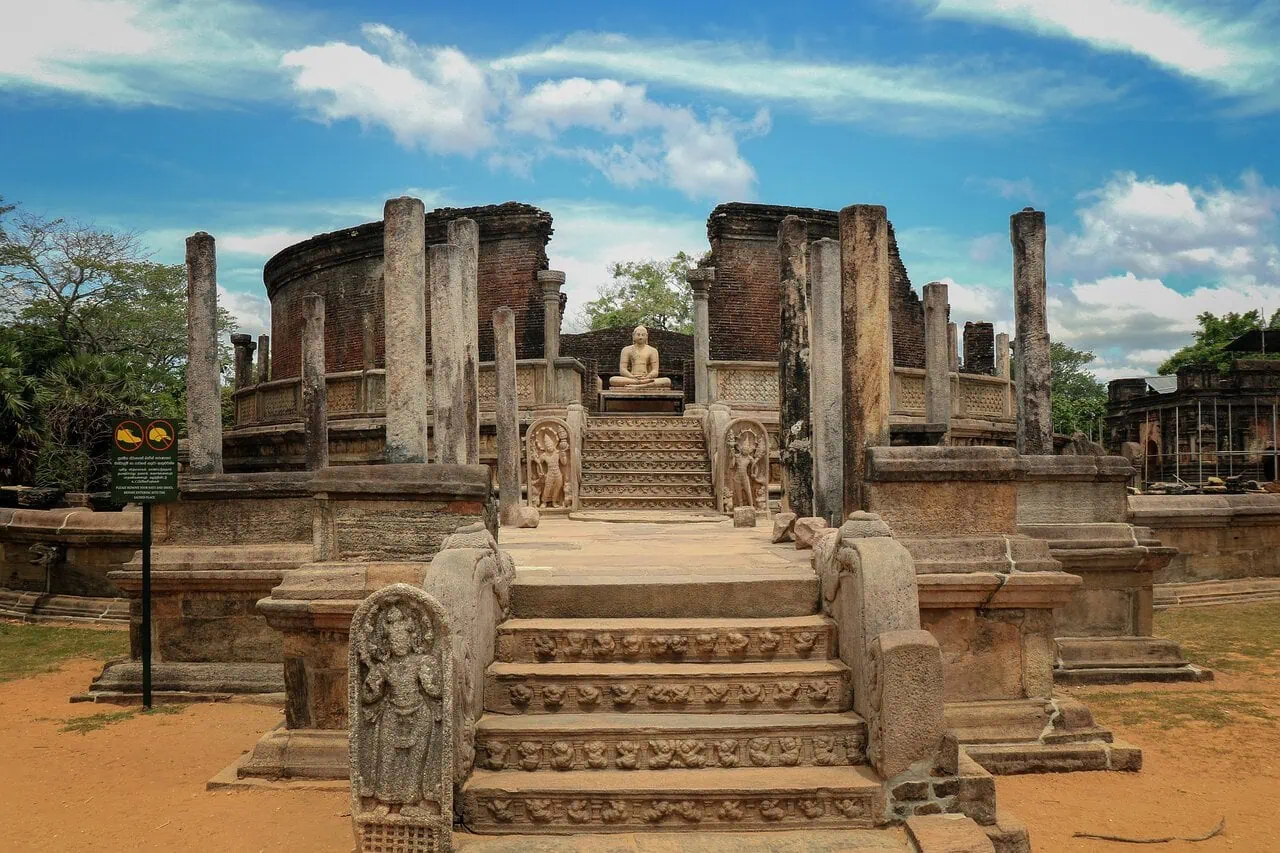
The Ancient City of Polonnaruwa is one of the most important archaeological sites in Sri Lanka and represents the island’s medieval royal capital after the decline of Anuradhapura. Today, the UNESCO protected ruins contain temples, palaces, reservoirs, statues, and ceremonial structures spread across a surprisingly large area.
For many travellers, Polonnaruwa feels slightly less crowded and more atmospheric than Sigiriya, despite being equally important historically. The ruins are surrounded by greenery, lakes, and wildlife, creating a setting that feels more integrated into the natural landscape than many heavily urbanised archaeological sites elsewhere in Asia.
One of the most famous parts of the complex is the Gal Vihara, where enormous Buddha statues have been carved directly into granite rock faces. These sculptures are widely considered some of the finest examples of ancient Sinhalese stone carving anywhere in the world.
The wider archaeological zone also contains the remains of royal compounds, audience halls, bathing pools, and sophisticated water management systems that demonstrate the engineering capabilities of Sri Lanka’s medieval kingdoms. Travellers often underestimate how advanced these ancient cities were for their period.
Most visitors explore Polonnaruwa by bicycle, tuk tuk, or private driver because the archaeological park covers a substantial area. Many travellers combine the site with nearby Sigiriya and Dambulla as part of a multi day Cultural Triangle itinerary.
Ancient City of Sigiriya
The Ancient City of Sigiriya is the most famous of all Sri Lanka UNESCO sites and one of the country’s defining landmarks. Rising dramatically above the surrounding jungle plains, the enormous rock fortress known as Lion Rock dominates central Sri Lanka and attracts travellers from around the world.
Built during the reign of King Kashyapa in the 5th century, Sigiriya functioned as both a royal palace and a defensive fortress. Today, visitors climb a series of staircases attached to the rock face while passing gardens, ancient frescoes, water systems, and the remains of the original fortress complex.
One of the most memorable parts of the ascent is the giant lion staircase platform, which once formed the entrance to the summit palace. Although most of the lion structure has disappeared, the enormous stone paws still remain and have become one of the most recognisable images associated with Sri Lankan tourism.
The summit itself provides panoramic views across forests, villages, lakes, and distant mountain ranges. Early morning climbs are particularly popular because temperatures remain cooler and visibility is often better before afternoon haze develops across the plains.
Many travellers compare Sigiriya with sites such as Machu Picchu or Petra because of the dramatic way the ancient ruins merge with the surrounding landscape. However, Sigiriya retains a distinctly different atmosphere due to its tropical setting and strong Buddhist cultural influence.

Sacred City of Kandy
The Sacred City of Kandy is one of the most important religious and cultural centres in Sri Lanka. Located within the central highlands, the city is best known for the Temple of the Sacred Tooth Relic, one of the holiest Buddhist sites in the world.
According to tradition, the temple houses a tooth relic believed to belong to the Buddha himself. This makes Kandy a major pilgrimage destination for Buddhists from across Sri Lanka and beyond. Even travellers with limited interest in religion often find the atmosphere around the temple fascinating because of the constant mixture of pilgrims, ceremonies, monks, and traditional rituals.
The temple complex itself contains shrines, courtyards, museums, and decorative halls filled with Kandyan architecture and religious artwork. Ceremonial drumming performances associated with daily worship rituals are especially popular with visitors.
Beyond the temple, Kandy is also one of Sri Lanka’s most important transport hubs. The city acts as the starting point for the world famous railway journey towards Ella, often considered one of the most scenic train rides anywhere on earth. Because of this, many travellers naturally combine UNESCO sightseeing in Kandy with hill country rail adventures through Sri Lanka’s tea plantations.
The surrounding highlands also create a noticeably cooler climate compared with the coastal regions of Sri Lanka. This gives Kandy a very different atmosphere from cities such as Colombo or Galle, particularly during the evenings and early mornings.
Old Town of Galle and its Fortifications
The Old Town of Galle and its Fortifications represents a completely different side of Sri Lanka’s UNESCO heritage. Unlike the ancient Buddhist kingdoms of the island interior, Galle reflects centuries of European colonial influence layered onto a tropical coastal setting.
Originally developed by the Portuguese before being heavily expanded by the Dutch during the 17th century, Galle Fort remains one of the best preserved colonial fortifications anywhere in Asia. Thick stone ramparts still surround the historic district, protecting narrow streets filled with churches, boutique hotels, cafés, museums, and colonial era buildings.
Walking through the fort feels dramatically different from exploring places such as Sigiriya or Polonnaruwa. Instead of ancient ruins and Buddhist monuments, visitors encounter Dutch architecture, sea views, lighthouses, courtyards, and trading history connected to European colonial expansion across the Indian Ocean.
The fort walls themselves are one of the biggest highlights. Travellers can walk along large sections of the ramparts while looking out across the Indian Ocean, fishing boats, and crashing waves below. Sunset is especially popular, with both tourists and local residents gathering along the walls during the evening.
Because Galle sits on Sri Lanka’s southern coast, the city is also easy to combine with beach destinations such as Unawatuna, Mirissa, and Hikkaduwa. This makes the UNESCO site particularly attractive for travellers wanting a mixture of history, relaxation, and coastal scenery within the same itinerary.
Sacred City of Anuradhapura
The Sacred City of Anuradhapura is one of the oldest continuously inhabited cities in Asia and remains one of the most spiritually important locations in Sri Lanka. As the ancient capital of Sri Lankan civilisation for well over a thousand years, the city contains enormous dagobas, monasteries, reservoirs, and sacred Buddhist sites spread across a vast archaeological landscape.
Unlike some UNESCO sites that function primarily as historical attractions, Anuradhapura remains an active pilgrimage destination. Pilgrims dressed in white continue to visit temples and sacred shrines daily, creating an atmosphere that feels deeply spiritual as well as historical.
One of the most important sites within the complex is the Sri Maha Bodhi, a sacred fig tree believed to have grown from a cutting of the original Bodhi Tree under which the Buddha attained enlightenment. This makes Anuradhapura one of the most significant Buddhist pilgrimage destinations anywhere in the world.
The archaeological zone itself is enormous. Giant stupas dominate the skyline, while ancient monasteries, ponds, moonstones, and stone carvings are spread across a landscape that can take days to fully explore. Many visitors choose to hire bicycles or tuk tuks because distances between monuments can be surprisingly large.
Compared with Sigiriya, Anuradhapura often feels quieter and more spiritual rather than dramatic. For travellers interested in Buddhism, archaeology, or ancient urban history, it is arguably one of the most rewarding UNESCO sites in the entire country.
Search flights and useful route combinations for your trip.
View flightsUse an eSIM to get online without hunting for a local SIM after arrival.
See eSIM optionsArrange a private airport pickup for your trip to Sri Lanka.
Check transfersGolden Temple of Dambulla
The Golden Temple of Dambulla is one of the most visually impressive religious sites in Sri Lanka and forms a major part of the country’s famous Cultural Triangle. Located between Sigiriya and Kandy, the UNESCO protected complex is best known for its extraordinary series of cave temples carved into a large rock outcrop overlooking the surrounding plains.
The site contains five main cave temples, each filled with enormous collections of Buddha statues, painted ceilings, murals, shrines, and religious artwork. Many travellers are surprised by the sheer scale of the interior decorations, with thousands of square metres of painted surfaces covering walls and ceilings in intricate detail.
The caves have functioned as sacred Buddhist worship sites for centuries and still attract both pilgrims and international visitors. Inside the chambers, travellers encounter reclining Buddhas, meditation statues, royal patronage inscriptions, and murals depicting scenes from Buddhist history and Sri Lankan religious traditions.
The climb to the cave complex is relatively short but can feel steep in Sri Lanka’s tropical heat, particularly during the middle of the day. Along the route, visitors often encounter monkeys, panoramic viewpoints, and sweeping scenery across the forests and plains of central Sri Lanka.
Because of its central location, Dambulla is frequently combined with Sigiriya, Polonnaruwa, and Anuradhapura within multi day UNESCO itineraries. Many travellers also use nearby Kandy as a base before continuing into Sri Lanka’s famous hill country rail routes.
Sinharaja Forest Reserve
The Sinharaja Forest Reserve protects one of the last major areas of primary tropical rainforest remaining in Sri Lanka. Unlike the country’s famous ancient cities and temples, this UNESCO designation focuses entirely on biodiversity, conservation, and the preservation of one of South Asia’s most important rainforest ecosystems.
Located in south western Sri Lanka, Sinharaja is internationally recognised for its remarkable concentration of endemic species. Many of the birds, reptiles, amphibians, and plants found inside the forest exist nowhere else on earth, making the reserve particularly important for wildlife enthusiasts and conservationists.
The rainforest environment feels dramatically different from the dry plains surrounding UNESCO sites such as Sigiriya or Polonnaruwa. Dense vegetation, humid conditions, waterfalls, rivers, and thick jungle trails create a far more remote and adventurous atmosphere compared with the archaeological locations elsewhere on the island.
Birdwatching is especially popular within the reserve. Sri Lanka is considered one of Asia’s best birdwatching destinations, and Sinharaja Forest Reserve contains numerous rare and endemic species that attract specialist wildlife travellers from around the world.
Access to the forest is more complicated than the country’s major cultural UNESCO sites, and many travellers visit with local guides who understand the trail systems and wildlife habitats. Because of this, Sinharaja is often included within longer Sri Lanka itineraries rather than short cultural triangle trips.
Central Highlands of Sri Lanka
The Central Highlands of Sri Lanka UNESCO designation protects some of the country’s most spectacular mountain scenery, cloud forests, and biodiversity rich upland ecosystems. Stretching across parts of Sri Lanka’s famous hill country, the protected area includes national parks, tea plantation landscapes, and some of the island’s highest peaks.
For many travellers, this region represents the scenic heart of Sri Lanka. Rolling tea estates, waterfalls, mist covered mountains, railway viaducts, and cooler temperatures create a landscape completely different from the tropical coastline or dry northern plains.
The UNESCO protected highlands include famous areas such as Horton Plains National Park, the dramatic viewpoint known as World’s End, and montane forest ecosystems supporting rare wildlife and endemic species. These upland environments are considered globally important because they preserve unique biodiversity found only within Sri Lanka’s mountain interior.
The region is also closely connected to Sri Lanka’s internationally famous railways. Scenic train routes between Kandy, Nuwara Eliya, and Ella pass directly through parts of the highlands, giving travellers some of the most photographed rail journeys anywhere in Asia.
Many visitors combine UNESCO exploration with tea plantation stays, hiking, waterfalls, and railway photography throughout the hill country. The cooler mountain climate also makes the region particularly attractive for travellers wanting relief from the hotter coastal conditions found elsewhere in Sri Lanka.
How to Travel Between Sri Lanka’s UNESCO Sites
One of the biggest advantages of exploring Sri Lanka UNESCO sites is that many of the country’s major heritage locations are relatively close together compared with destinations in larger Asian countries. This makes it possible to build efficient multi stop itineraries without requiring internal flights.
Most travellers combine the central UNESCO locations using private drivers, organised tours, trains, buses, or tuk tuks depending on budget and comfort preferences. The country’s famous Cultural Triangle, including Sigiriya, Dambulla, Polonnaruwa, and Anuradhapura, is particularly easy to explore over several days.
Private drivers remain one of the most popular transport options for international visitors because they simplify navigation, reduce travel stress, and allow travellers to visit multiple heritage sites within a single day. Distances in Sri Lanka can appear short on maps, but road conditions and traffic often make journeys slower than expected.
Sri Lanka’s railway network is especially useful for routes connecting Colombo, Kandy, and the central highlands. However, trains are less practical for some Cultural Triangle destinations where road transport remains the main option.
Travellers planning to combine UNESCO sightseeing with beaches, wildlife safaris, and scenic train journeys should allow more time than they initially expect. Although Sri Lanka is geographically compact, the combination of mountain roads, traffic, and slower rail services means journeys can still take several hours between regions.
Best UNESCO Itineraries in Sri Lanka
One of the biggest advantages of exploring Sri Lanka UNESCO sites is that the country naturally supports multiple itinerary styles depending on how much time travellers have available. Some visitors focus entirely on the ancient cities of the Cultural Triangle, while others combine UNESCO locations with beaches, wildlife safaris, tea country rail journeys, and mountain scenery.
For travellers with limited time, a shorter 5 to 7 day UNESCO itinerary usually focuses on Sigiriya, Dambulla, Kandy, and either Polonnaruwa or Anuradhapura. This route concentrates on the island’s most famous cultural heritage locations while minimising long travel days.
Travellers with more time often expand their itineraries to include the southern coast and the Old Town of Galle. Combining inland heritage sites with beaches around Mirissa, Unawatuna, or Hikkaduwa creates one of the most popular travel routes in Sri Lanka because it mixes culture, history, and relaxation within a single trip.
Longer itineraries of 10 to 14 days often include the Central Highlands of Sri Lanka, scenic train journeys towards Ella, tea plantation stays, and wildlife destinations such as Yala National Park alongside UNESCO locations. This broader route gives travellers a much stronger sense of Sri Lanka’s geographical and cultural diversity.
Travellers interested primarily in history and archaeology may prefer to spend additional time in Anuradhapura and Polonnaruwa, where the sheer size of the archaeological landscapes can easily justify full day or multi day exploration.
Best Time to Visit Sri Lanka UNESCO Sites
Choosing the best time to visit Sri Lanka UNESCO sites can be surprisingly complicated because the island experiences different weather patterns across separate regions throughout the year. Conditions in the central highlands can differ dramatically from the southern coast or northern plains.
For most travellers, the best overall period for exploring the central UNESCO locations such as Sigiriya, Dambulla, Polonnaruwa, and Kandy is generally between December and April. During this period, rainfall is often lower across much of central and southern Sri Lanka, creating better conditions for sightseeing and photography.
The central highlands around Kandy, Ella, and the UNESCO protected mountain regions remain cooler than the coastal areas throughout the year. Early mornings and evenings in the hill country can feel surprisingly chilly compared with the tropical heat of Colombo or the Cultural Triangle.
Travellers visiting UNESCO locations during the hotter months should plan carefully around the midday heat. Sites such as Sigiriya and Polonnaruwa involve significant walking with limited shade, making early morning starts highly recommended.
The southern coastal region around Galle is strongly influenced by monsoon patterns, while the central mountains can experience mist, cloud, and heavy rainfall during wetter periods. Because of this, many travellers build flexible itineraries allowing them to adjust beach and mountain sections depending on weather conditions.
Browse hostels and budget-friendly stays around Sri Lanka.
See hostelsFlying to Sri Lanka? Get fast compensation payouts, eligible lounge benefits and expert help when flights go wrong.
See AirHelp+ benefitsLeave your luggage somewhere convenient and enjoy Sri Lanka hands-free.
View storageTickets, Guides and Entrance Fees
Entrance fees for Sri Lanka UNESCO sites are generally higher for international visitors than for local residents, particularly at major attractions such as Sigiriya and Polonnaruwa. Travellers should budget carefully because visiting multiple heritage sites over several days can become surprisingly expensive.
Among all UNESCO locations in Sri Lanka, Sigiriya is usually the most expensive individual ticket. However, many travellers still consider the site worthwhile because of its dramatic scenery, archaeological importance, and iconic status within Sri Lankan tourism.
The Central Cultural Fund ticket price list currently puts adult admission at around $35 (£26 / €31) for Sigiriya, and around $30 (£22 / €26) each for Polonnaruwa and Anuradhapura. Half price tickets for children work out at roughly $20 (£15 / €18) at Sigiriya and $15 (£11 / €13) at the two ancient cities, while visitors from SAARC countries pay half the standard rate. Prices are quoted in US dollars but paid in rupees at the day’s exchange rate, so the local figure shifts from week to week.
Guides are available at most major UNESCO attractions and can significantly improve the experience, especially at archaeological locations such as Anuradhapura and Polonnaruwa where the historical context is not always obvious without explanation. Some travellers choose private guides, while others use local tuk tuk drivers who also provide informal guiding services.
Cash payments remain important at some locations, although digital payment options are slowly becoming more common in larger tourist areas. Travellers should not assume every heritage site entrance accepts international bank cards, particularly outside major cities.
Travellers planning to visit several UNESCO sites over a short period should also think carefully about transport logistics. Hiring a driver for multiple days can sometimes be cheaper and far less stressful than arranging separate tuk tuks and taxis between scattered archaeological locations.
UNESCO Sites Near Colombo
Although many of the most famous Sri Lanka UNESCO sites are located inland, Colombo still works well as a starting point for wider heritage itineraries across the island. As Sri Lanka’s largest city and primary international gateway, most visitors begin their journeys here before travelling towards the Cultural Triangle, hill country, or southern coastline.
The closest major UNESCO location to Colombo is usually the Old Town of Galle and its Fortifications, located several hours south along the coast. The route between Colombo and Galle is particularly popular because travellers can combine UNESCO sightseeing with beaches, surfing towns, whale watching excursions, and coastal resorts.
Rail travel between Colombo and Galle is also highly scenic, with trains running close to the Indian Ocean for substantial sections of the journey. Many travellers specifically choose rail transport for this route because of the coastal views.
Travellers staying in Colombo can also arrange longer excursions towards the inland UNESCO locations, although destinations such as Sigiriya and Polonnaruwa are usually better experienced as part of multi day itineraries rather than rushed day trips.
Because Colombo functions as the country’s primary transport hub, the city also acts as the natural starting point for most UNESCO circuits through Sri Lanka. Trains, buses, domestic tours, and private drivers all radiate outward from the capital towards the island’s major heritage destinations.
UNESCO Sites Near Ella and Kandy
Travellers exploring Sri Lanka’s famous hill country railways will find themselves close to several of the country’s most important UNESCO World Heritage Sites. Both Kandy and Ella act as important gateways into the island’s mountain landscapes, tea country, and cultural heritage regions.
Kandy itself is already one of the country’s most significant UNESCO locations due to the presence of the Temple of the Sacred Tooth Relic. Many travellers spend several days in the city exploring temples, lakeside viewpoints, colonial architecture, markets, and cultural performances before continuing deeper into the central highlands.
The railway between Kandy and Ella is internationally famous for its scenery and passes directly through parts of the Central Highlands of Sri Lanka UNESCO protected region. Tea plantations, waterfalls, forests, mountain ridges, and dramatic railway viaducts make the route one of the most photographed train journeys in Asia.
Although Ella itself is not a UNESCO site, the town functions as an excellent base for exploring Sri Lanka’s mountain landscapes. Travellers often combine train travel with hiking, tea factory visits, waterfalls, and viewpoints such as Little Adam’s Peak and Ella Rock.
Many visitors naturally combine Kandy, the scenic railway, and the Cultural Triangle within a single itinerary because the route creates one of the strongest travel experiences anywhere in South Asia. This combination of UNESCO heritage, mountain scenery, and railway travel is one of the main reasons Sri Lanka has become so popular with independent travellers and backpackers.

Sri Lanka UNESCO Sites Without a Car
Exploring Sri Lanka UNESCO sites without hiring a car or private driver is absolutely possible, although travellers should prepare for slower journeys and more complicated logistics compared with organised tours. Fortunately, Sri Lanka has a large public transport network consisting of trains, buses, tuk tuks, and domestic tour services connecting most major tourist regions.
The easiest UNESCO locations to reach using public transport are usually Kandy and Galle, both of which sit on major railway lines connected directly to Colombo. Train travel in Sri Lanka is often inexpensive, scenic, and highly memorable, particularly in the hill country routes around Kandy and Ella.
The Cultural Triangle sites such as Sigiriya, Dambulla, Polonnaruwa, and Anuradhapura are more complicated without private transport, but they are still manageable using combinations of buses, tuk tuks, and local tours. Many travellers stay in Sigiriya or Dambulla before arranging tuk tuk excursions between nearby archaeological sites.
One challenge for independent travellers is that distances in Sri Lanka often take longer than expected due to traffic, mountain roads, and slower transport infrastructure. Journeys that appear relatively short on maps can still consume much of the day.
Despite this, travelling independently can also create a much more immersive experience. Sri Lanka’s railways, roadside food stalls, local buses, and tuk tuk journeys often become memorable parts of the trip themselves rather than simply methods of transport between attractions.
Safety and Cultural Etiquette at Religious Sites
Many of the most important Sri Lanka UNESCO sites are also active religious locations, particularly Buddhist temples and pilgrimage centres. Travellers should therefore understand basic cultural etiquette before visiting sacred sites such as the Temple of the Tooth Relic, Dambulla Cave Temple, and numerous shrines throughout the country.
Modest clothing is expected at religious sites across Sri Lanka. Visitors should generally cover shoulders and knees before entering temple complexes, and hats should normally be removed inside sacred areas. Shoes must also be removed before entering many temple buildings, so travellers may find lightweight sandals easier than complicated footwear.
Photography rules can vary depending on the location. Some temples allow photography freely, while others restrict flash photography or prohibit images in certain sacred chambers. Travellers should always watch for signs or ask staff when uncertain.
Respectful behaviour around monks, worshippers, and religious ceremonies is also important. Many UNESCO locations remain active places of worship rather than purely tourism attractions, meaning travellers may encounter prayer rituals, offerings, chanting, and pilgrims throughout the day.
The tropical climate also creates practical safety considerations. Sites such as Sigiriya and Polonnaruwa involve significant walking in hot conditions, so carrying water, sunscreen, and sun protection is essential. Early morning visits are often far more comfortable than exploring major archaeological sites during the midday heat.
Apps and eSIMs for Travelling Around Sri Lanka
Using the right apps and mobile data setup can make exploring Sri Lanka UNESCO sites substantially easier, particularly for travellers relying on trains, tuk tuks, buses, and independent travel rather than organised tours. Although Sri Lanka is relatively compact, transport systems can still feel confusing for first time visitors.
One of the most useful travel tools in Sri Lanka is a reliable eSIM or local SIM card. Mobile coverage is generally strong across much of the country, including major tourist regions, railway corridors, and larger towns. Having mobile data available makes it far easier to book transport, check maps, communicate with drivers, and research attractions while travelling between UNESCO sites.
Ride hailing and tuk tuk apps can also be extremely useful in larger cities such as Colombo and Kandy. Services like PickMe have become increasingly important for travellers trying to avoid taxi scams or negotiate fares manually.
Rail travellers should also understand that train reservations in Sri Lanka can become extremely competitive, particularly for the famous hill country routes between Kandy and Ella. Booking assistance apps, online reservation tools, and transport websites can therefore become surprisingly valuable during peak travel seasons.
Travellers planning wider regional journeys may also benefit from offline maps, translation apps, weather apps, and budgeting tools while moving between Sri Lanka’s cultural, coastal, and mountain regions.

Rupert’s Handy Travel Tips
Rupert recommends treating Sri Lanka UNESCO sites as part of a wider island journey rather than trying to rush every major attraction in a few days. Distances in Sri Lanka can look short on maps, but mountain roads, trains, and traffic often make travel slower than expected.
- Climb Sigiriya early in the morning to avoid the worst heat and largest crowds.
- Wear lightweight clothing that still covers shoulders and knees when visiting sacred Buddhist sites such as Kandy and Dambulla.
- Book reserved seats early for the famous Kandy to Ella train because tickets can sell out well in advance.
- Carry cash when visiting archaeological sites because smaller vendors and tuk tuk drivers may not accept cards.
- Allow more time than expected between destinations because travel days in Sri Lanka are often slower than travellers initially assume.
Want to meet the reindeer behind our travel tips? Find out more in our page Who is Rupert?.


Frequently Asked Questions About Sri Lanka UNESCO Sites
How many UNESCO sites are there in Sri Lanka?
Sri Lanka currently has eight UNESCO World Heritage Sites, including cultural and natural heritage locations spread across the island.
What is the most famous UNESCO site in Sri Lanka?
Most international travellers consider Sigiriya the country’s most famous UNESCO site because of its dramatic rock fortress and panoramic views.
Can you visit Sri Lanka UNESCO sites without a guide?
Yes. Most UNESCO locations in Sri Lanka can be explored independently, although local guides can provide useful historical and cultural context at archaeological sites.
What is the Cultural Triangle in Sri Lanka?
The Cultural Triangle refers to the region containing major heritage sites such as Sigiriya, Dambulla, Polonnaruwa, and Anuradhapura.
Which UNESCO site is best for wildlife?
The Sinharaja Forest Reserve is the strongest UNESCO location for wildlife and biodiversity, particularly for birdwatching and rainforest ecosystems.
What is the best way to travel between UNESCO sites in Sri Lanka?
Most travellers use combinations of private drivers, trains, buses, and tuk tuks depending on budget and itinerary style.
Further Reading & Related Guides
If you are planning a wider journey across Sri Lanka, our related travel guides can help you build a smoother itinerary around the country’s major cultural and natural attractions. Travellers exploring the central highlands should also read our guides to the famous Kandy to Ella train and wider Sri Lanka train travel, both of which connect naturally with UNESCO destinations such as Kandy and the Central Highlands of Sri Lanka.
For travellers arriving internationally, our Colombo Airport Transfers guide explains the best ways to reach the city centre and continue towards the Cultural Triangle, southern coast, or hill country. Visitors planning independent travel around the island may also find our Sri Lanka eSIM Guide useful for mobile data, maps, train bookings, and tuk tuk apps while moving between UNESCO sites.
Travellers interested in wider heritage travel across Asia should also explore our growing collection of UNESCO travel guides, alongside our practical transport, rail, and travel planning content designed to help travellers move around complex destinations more confidently.











