Reviewed by our editorial team Updated
Discover Amsterdam’s Excellent Transport Network
Amsterdam is widely regarded as one of the easiest cities in Europe to navigate. The historic centre is compact, largely flat and designed for walking, while an extensive public transport network makes it simple to reach attractions further afield. Whether you’re travelling by tram, metro, bus, ferry, bicycle or train, you’ll rarely spend long trying to work out how to get from one place to another.
Unlike many major cities where different operators run separate services, much of Amsterdam’s public transport is operated by GVB (Gemeentelijk Vervoerbedrijf). This means the same ticket or travel pass can usually be used across the tram, metro, bus and ferry network, making travelling around the city refreshingly straightforward. Visitors can also use OVpay, allowing contactless bank cards, Apple Pay and Google Pay to be used directly on public transport without buying paper tickets.
Amsterdam is also one of the few European capitals where walking often beats public transport. The city’s most popular attractions, including Dam Square, the Royal Palace, Anne Frank House, Jordaan, Nine Streets, the Red Light District and much of the famous Canal Ring, are all within comfortable walking distance of one another. Many visitors find they spend the morning exploring on foot before using a tram or metro to reach places such as Museumplein, De Pijp, Amsterdam Noord or the eastern docklands.
For destinations beyond the city centre, the transport network becomes invaluable. Trams provide the backbone of travel within central Amsterdam, metros offer fast connections to outer districts, buses serve neighbourhoods not reached by rail, while the free GVB ferries connect the city centre with the rapidly developing northern waterfront. Schiphol Airport is also exceptionally well connected by both train and express bus, allowing most visitors to reach the city centre in under half an hour.
This guide explains exactly how each form of transport works, where it goes, how often it runs, how to buy tickets, which travel passes offer the best value and which option is best for different types of journeys, helping you spend less time worrying about transport and more time enjoying Amsterdam.
| Transport | Best For | Cost |
|---|---|---|
| Walking | Historic centre, Canal Ring and neighbourhoods | Free |
| Tram | Museums, shopping districts and city sightseeing | £ |
| Metro | Longer journeys and outer districts | £ |
| Bus | Residential areas, airport routes and night travel | £ |
| GVB Ferry | Amsterdam Noord, NDSM and sightseeing | Free |
| Bicycle | Confident cyclists | £ |
| Taxi | Late-night travel and door-to-door journeys | £££ |
| Hop-On Hop-Off | Guided sightseeing | ££ |
Walking Around Amsterdam
For most visitors, walking is by far the best way to explore Amsterdam. The historic centre measures only a few kilometres across, allowing you to comfortably visit many of the city’s most famous attractions in a single day without needing public transport. In fact, many first-time visitors are surprised by how close everything actually is.
As a rough guide, it’s around 10 minutes on foot from Amsterdam Centraal Station to Dam Square, approximately 15 minutes from Dam Square to the Anne Frank House, and around 25 to 30 minutes from the Anne Frank House to Museumplein. Walking between the Jordaan, Nine Streets, Begijnhof, Rembrandtplein and the Flower Market is equally straightforward, with attractive canals and historic streets connecting almost every major attraction.
Walking also allows you to appreciate what makes Amsterdam so special. The city was largely built during the Dutch Golden Age, and wandering through the UNESCO-listed Canal Ring reveals elegant merchant houses, decorative gables, centuries-old warehouses, hidden courtyards and more than 1,500 bridges crossing the canals. Many of Amsterdam’s best cafés, independent shops and local bakeries are tucked away on side streets that you would never discover if travelling exclusively by tram or metro.
The city is generally very pedestrian friendly, with wide pavements throughout the centre and plenty of pedestrian crossings. However, visitors should always pay close attention to cycle lanes, which are often coloured red and may run between the pavement and the road. Cyclists travel quickly, frequently have priority and rarely stop unexpectedly, so always check both directions before stepping into a cycle lane.
Comfortable footwear is highly recommended. Although Amsterdam appears small on a map, it’s common to cover 10 to 15 kilometres during a full day of sightseeing. Fortunately, if your feet begin to tire, you’ll almost never be more than a few minutes from a tram stop or metro station.
Best for a short trip. Compare rooms by neighbourhood, price and guest rating before you book.
Compare hotelsBest for longer stays. Whole apartments and houses, so you are not eating out three times a day.
View rentalsBest for double-checking. Runs the same Amsterdam search across several booking sites so you are not leaving money behind.
Compare pricesAmsterdam Trams
If walking is Amsterdam’s number one way to explore the city, then the tram network is a close second. Operated by GVB, Amsterdam’s modern tram system forms the backbone of public transport within the city centre and is the mode of transport most visitors will use during their stay.
The network currently consists of 15 daytime tram lines, linking virtually every major tourist area with residential neighbourhoods, railway stations and shopping districts. Trams generally operate from around 6:00am until approximately 12:30am, with the busiest routes running every 5 to 10 minutes throughout most of the day. Evening services remain frequent, while overnight travel is provided by Amsterdam’s network of night buses.
For tourists, several routes are particularly useful. Trams connect Amsterdam Centraal Station with Dam Square, Museumplein, the Rijksmuseum, Van Gogh Museum, Leidseplein, Vondelpark, Heineken Experience, De Pijp, Rembrandtplein and many other popular attractions. Because the trams travel through Amsterdam’s historic streets rather than underground, they’re also an enjoyable way to see more of the city while travelling between destinations.
Buying tickets is simple. The easiest option for occasional journeys is OVpay, where you simply tap your contactless bank card, Apple Pay or Google Pay when boarding and again when leaving the tram. The correct fare is calculated automatically based on your journey. Visitors planning multiple journeys each day may find better value with a GVB Public Transport Ticket, available for 1 to 7 days, which provides unlimited travel on all GVB trams, buses, metro services and ferries.
Tickets can also be purchased through the GVB app, at GVB Service & Tickets offices, from ticket machines at major stations or through selected travel partners before your trip. If you’re using a day pass, remember to check in when boarding and check out when leaving, even though your travel is unlimited.
Amsterdam’s trams are fully accessible, with low-floor vehicles, designated wheelchair spaces and priority seating. Small suitcases are easy to carry onboard, although very large luggage may be awkward during busy commuter periods. Overall, trams are the best choice for travelling between Amsterdam’s main tourist attractions, combining speed, convenience and excellent coverage of the historic centre.
Amsterdam Metro
While Amsterdam’s trams dominate the historic centre, the metro network is the fastest way to travel longer distances across the city. If you’re staying outside the canal belt, attending an event, visiting business districts or travelling to neighbourhoods beyond the tourist centre, the metro can save a considerable amount of time.
The Amsterdam Metro is also operated by GVB and currently consists of five lines:
Line 50 – Isolatorweg ↔ Gein
Line 51 – Isolatorweg ↔ Centraal Station
Line 52 (North/South Line) – Noord ↔ Zuid
Line 53 – Centraal Station ↔ Gaasperplas
Line 54 – Centraal Station ↔ Gein
The newest and arguably most important line for visitors is Line 52, known as the North/South Line. Opened in 2018, it links Amsterdam Noord, Amsterdam Centraal Station, Rokin, Vijzelgracht, De Pijp, Europaplein and Amsterdam Zuid in just a few minutes. It has dramatically reduced journey times across the city and is particularly useful if you’re staying in Amsterdam Noord or arriving by train at Amsterdam Zuid.
Several metro stations are especially useful for tourists. Centraal Station provides connections with trains, ferries, trams and buses, making it Amsterdam’s main transport hub. Rokin is ideal for Dam Square and the Flower Market, Vijzelgracht offers quick access to Museumplein and the Heineken Experience, while Zuid Station is increasingly popular thanks to its excellent rail connections and nearby hotels. If you’re heading to a football match or concert at the Johan Cruijff ArenA, Bijlmer ArenA Station is the station you’ll almost certainly use.
Metro trains generally operate from around 6:00am until shortly after midnight, with services every 5 to 10 minutes during the day on the busiest sections. During peak commuter periods, frequencies can be even higher. The stations are modern, well signposted and equipped with electronic departure boards showing the next trains.
Paying for the metro is exactly the same as using the trams. You can simply tap in and tap out using OVpay with a contactless bank card, Apple Pay or Google Pay, or use a GVB Public Transport Ticket for unlimited travel. Tickets are also available from station ticket machines and GVB service centres.
Most metro stations are fully accessible, with lifts, escalators, tactile paving and level boarding making them suitable for wheelchair users, families with pushchairs and travellers carrying luggage. Because the metro operates almost entirely away from road traffic, it’s often the quickest way to cross the city during busy periods.
Although the metro is excellent for longer journeys, it’s worth remembering that it doesn’t serve every attraction. Once you arrive in the historic centre, you’ll usually switch to walking or the tram for the final part of your journey.
Amsterdam Buses
Although many visitors rely mainly on trams, Amsterdam’s bus network fills the gaps where tram or metro services don’t operate. Buses are particularly useful if you’re staying in residential neighbourhoods, travelling late at night or visiting attractions beyond the city centre.
Within Amsterdam, most buses are operated by GVB, with daytime routes complemented by an extensive network of night buses after the trams and metro stop running. Night buses usually depart from Amsterdam Centraal Station, allowing visitors to return to hotels across the city after an evening out without needing a taxi.
Regional buses are operated by companies including Connexxion, EBS and Arriva. These services connect Amsterdam with surrounding towns and attractions, including destinations such as Volendam, Edam, Marken, Broek in Waterland and parts of Zaanstreek. It’s important to remember that standard GVB tickets are not valid on most regional bus services.
For visitors arriving by air, one of the most useful routes is Amsterdam Airport Express Bus 397, operated by Connexxion. Running between Schiphol Airport and the city centre, it serves popular stops including Museumplein, Rijksmuseum and Leidseplein, making it an excellent alternative to the train depending on where you’re staying. During the night, the N97 Airport Niteliner continues to provide airport connections when other services are less frequent.
Another useful route is Bus 369, which connects Sloterdijk Station with Schiphol Airport. Unlike the Airport Express, this route is included with the GVB Public Transport Ticket, making it useful for visitors staying near Sloterdijk who don’t need to travel via Amsterdam Centraal.
Like the rest of Amsterdam’s public transport system, buses can be used with OVpay, allowing you to tap your contactless bank card or mobile wallet when boarding and leaving the vehicle. Unlimited travel passes also work on eligible services, although it’s always worth checking whether your particular pass covers regional operators before travelling.
Modern buses are low-floor, wheelchair accessible and equipped with dedicated spaces for wheelchairs and pushchairs. Luggage is also generally easy to carry onboard, making buses a practical option for airport transfers and journeys to hotels outside the city centre.
For most tourists, buses won’t be the primary way of exploring Amsterdam, but they’re an excellent backup when travelling to areas beyond the tram network or returning to your accommodation after the trams have finished operating.
Amsterdam’s Free GVB Ferries
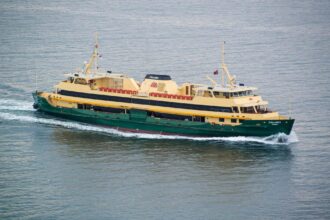
One of Amsterdam’s most underrated forms of public transport is also completely free. The GVB ferry network operates across the River IJ, connecting Amsterdam Centraal Station with the city’s rapidly developing northern districts. Unlike the trams, buses and metro, no ticket is required; simply walk onboard and enjoy the crossing.
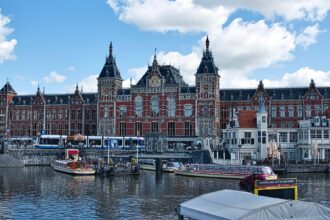
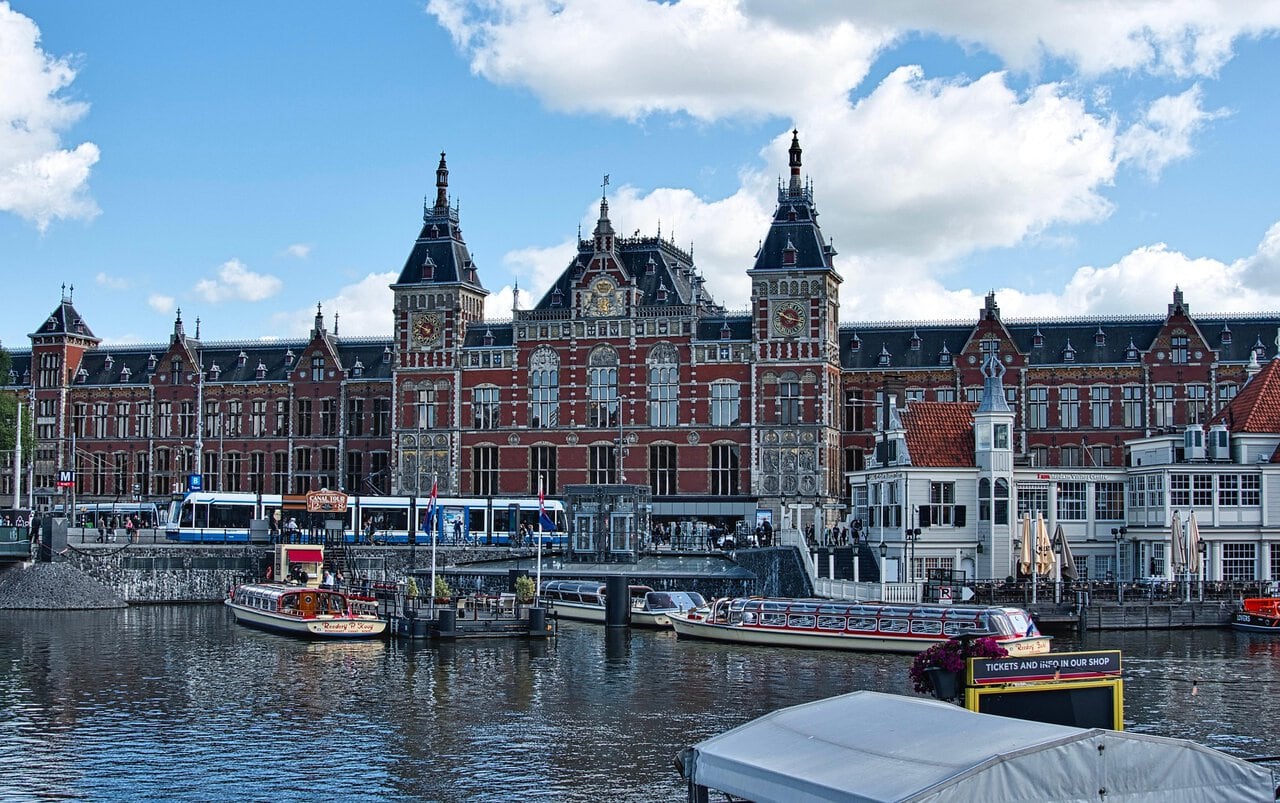
The ferry terminal is located directly behind Amsterdam Centraal Station on the IJ waterfront. Clear signs throughout the station direct passengers towards the ferry docks, where several routes depart from adjacent piers. Because multiple ferries leave from the same area, it’s always worth checking the electronic departure boards before boarding.
The busiest route is the Buiksloterweg Ferry, which departs every few minutes throughout the day. The crossing takes just around five minutes and delivers passengers almost directly outside the EYE Film Museum and the A’DAM LOOKOUT observation tower. It’s the quickest way to reach these attractions and offers excellent views back towards Amsterdam Centraal and the historic skyline.
Another extremely popular service is the ferry to NDSM Wharf. The crossing takes approximately 15 minutes and transports visitors to one of Amsterdam’s most creative neighbourhoods. Once a huge shipbuilding yard, NDSM has been transformed into a vibrant district filled with street art, cafés, markets, cultural venues, creative studios and waterside restaurants. Many visitors make the ferry journey simply to explore this fascinating part of the city.
Several additional ferry routes operate to residential districts across Amsterdam Noord, carrying thousands of commuters every day. Although tourists are less likely to use these services, they demonstrate just how important the ferry network is to everyday life in Amsterdam.
The ferries operate from early morning until late at night, with the busiest routes running every 4 to 10 minutes during the day. Even during quieter periods, waiting times are generally short, making them one of the most convenient forms of transport in the city.
Bicycles are carried free of charge, helping explain why so many commuters combine cycling with the ferry network each day. Wheelchairs, pushchairs and luggage are also welcome, with level boarding making access straightforward for almost everyone.
For many visitors, the ferry becomes far more than simply transport. Standing on the open deck as you cross the IJ provides some of the best free views in Amsterdam, and many people describe it as a mini sightseeing cruise that costs absolutely nothing. If you’re visiting the northern waterfront, taking the ferry is an attraction in itself.
OVpay and Buying Public Transport Tickets
Amsterdam has one of the easiest ticketing systems in Europe, and many visitors won’t need to buy a traditional paper ticket at all. Thanks to OVpay, you can simply use your contactless bank card, debit card, credit card, Apple Pay or Google Pay to travel on most public transport throughout the Netherlands.
Using OVpay couldn’t be simpler. When boarding a tram or bus, or entering a metro or train station, tap your card or mobile device on the card reader to check in. At the end of your journey, tap the same card or device again to check out. The system automatically calculates the correct fare based on the distance travelled. Forgetting to check out may result in a higher charge, so it’s important to remember both parts of the journey.
Visitors planning only a handful of journeys will usually find OVpay the easiest option. However, if you’re expecting to use public transport several times each day, an unlimited travel pass is often much better value.
The GVB Public Transport Ticket provides unlimited travel for 1 to 7 days on all GVB trams, buses, metro services and ferries. It’s ideal for visitors staying entirely within Amsterdam who expect to move regularly between attractions.
Travellers arriving via Schiphol Airport may prefer the Amsterdam Travel Ticket, which combines airport transfers by train or Airport Express Bus 397 with unlimited travel on Amsterdam’s public transport network. It’s particularly convenient if you’re staying in the city centre and don’t want to worry about purchasing separate airport tickets.
If you’re planning to explore beyond Amsterdam, the Amsterdam & Region Travel Ticket offers the widest coverage. In addition to Amsterdam’s transport network, it includes travel to destinations such as Zaanse Schans, Haarlem, Volendam, Marken, Zandvoort, Schiphol Airport and many other locations across the wider region.
Tickets can be purchased through the GVB app, from ticket machines at metro and railway stations, at GVB Service & Tickets offices, online before travelling or through selected travel partners. Regardless of which ticket you choose, always remember to check in and check out whenever your journey begins and ends.
GVB Public Transport Ticket
For visitors planning to spend most of their time within Amsterdam itself, the GVB Public Transport Ticket is usually the simplest and best-value option. Available for 1 to 7 consecutive days, it provides unlimited travel on almost every form of public transport operated by GVB, allowing you to move around the city without worrying about buying individual tickets or calculating fares.
The ticket covers all GVB trams, metro services, daytime buses, night buses and the city’s famous free ferries. Whether you’re travelling between Amsterdam Centraal Station, Museumplein, Leidseplein, De Pijp, Amsterdam Noord or the eastern docklands, one ticket covers virtually every journey you’ll make within the city.
One useful inclusion that many visitors overlook is Bus 369, which runs between Sloterdijk Station and Schiphol Airport approximately every 15 minutes. While the ticket does not include NS trains to Schiphol, Bus 369 provides an alternative airport connection for visitors staying near Sloterdijk or travelling through the western side of Amsterdam.
Using the ticket is straightforward. Once purchased, your digital ticket can be accessed through the GetYourGuide App, allowing you to scan it directly when travelling. GVB also sells its own tickets through the official app, ticket machines and service centres across the city. Whichever version you use, remember to check in when boarding and check out when leaving every tram, bus or metro service.
The GVB Ticket is ideal for visitors staying entirely within Amsterdam. If your plans focus on attractions such as the Rijksmuseum, Anne Frank House, Vondelpark, Jordaan, Dam Square, NEMO Science Museum or the Heineken Experience, this ticket is usually all you’ll need. However, it isn’t suitable for journeys on NS trains or most regional buses, so travellers planning day trips beyond Amsterdam should consider one of the wider travel passes instead.
Best for long or awkward journeys. Builds one itinerary out of separate flights.
View flightsBest for short trips. Install the eSIM at home and arrive in Amsterdam with working data, no shop queue.
Browse eSIMsBest after a long flight or a late landing. Price agreed before you travel, and no taxi queue.
Check transfersAmsterdam Travel Ticket (ATT)
If you’re flying into Schiphol Airport and spending your holiday within Amsterdam, the Amsterdam Travel Ticket (ATT) is often the most convenient transport pass available. Rather than purchasing separate airport transfers and city transport tickets, it combines everything into a single pass that’s valid for 1, 2 or 3 consecutive days.
One of the ticket’s biggest advantages is that it includes second-class NS train travel between Schiphol Airport and Amsterdam’s major railway stations, including Amsterdam Centraal, Amsterdam Zuid, Sloterdijk, Lelylaan, Bijlmer ArenA, Amstel and several others. If your hotel is close to one of these stations, reaching your accommodation couldn’t be much easier.
The pass also includes travel on the Amsterdam Airport Express (Bus 397) and the overnight N97 Airport Niteliner, both operated by Connexxion. Bus 397 is particularly useful because it stops at locations such as Museumplein, Rijksmuseum, Leidseplein and Elandsgracht, making it a better choice than the train for many hotels in the western city centre.
Once you’ve arrived in Amsterdam, the ATT provides unlimited travel on all GVB trams, buses, metro services, night buses and ferries, allowing you to explore the city freely without worrying about individual fares. The ticket is valid from your first check-in until 4:00am after the final valid day, giving you almost a full extra night’s travel at the end of your pass.
The Amsterdam Travel Ticket is not designed for regional sightseeing. While it’s perfect for airport transfers and travelling within Amsterdam, it doesn’t include most regional bus operators outside the city. If you’re planning day trips to places such as Zaanse Schans, Volendam, Haarlem or Zandvoort, you’ll usually achieve better value with the Amsterdam & Region Travel Ticket instead.
For visitors arriving by air who expect to rely on public transport throughout their stay, however, the ATT offers one of the easiest and most hassle-free ways to travel around Amsterdam.
Amsterdam & Region Travel Ticket (ARTT)
Visitors planning to explore beyond the Dutch capital should take a close look at the Amsterdam & Region Travel Ticket (ARTT). While the standard GVB Ticket focuses on Amsterdam itself, the ARTT dramatically expands the area you can explore, making it one of the best-value transport passes for travellers planning several day trips.
Available for 1, 2 or 3 consecutive days, the ticket provides unlimited travel on a wide range of public transport operators throughout the Amsterdam region. This includes GVB trams, buses, metro services and ferries, together with NS trains, Connexxion buses and EBS regional buses, giving you access to destinations far beyond the city centre.
The list of included destinations is impressive. Using a single ticket, you can travel to Schiphol Airport, Haarlem, Zaandam, Zaanse Schans, Volendam, Marken, Zandvoort aan Zee, Purmerend, Hilversum, Weesp, Naarden-Bussum, Beverwijk, Uitgeest and many other towns across North Holland. During the Keukenhof season, the ticket is also valid on the dedicated seasonal bus services connecting Amsterdam, Schiphol, Haarlem and Hoofddorp with the famous flower gardens.
Like the Amsterdam Travel Ticket, you’ll receive an OV-chipkaart, which must be used to check in at the start of every journey and check out when you leave. The ticket remains valid until 4:00am after the final day of validity, giving plenty of flexibility for evening travel.
The ARTT is the perfect choice if your itinerary includes multiple destinations outside Amsterdam. Instead of buying separate train tickets and regional bus fares throughout your holiday, one pass covers almost everything, allowing you to travel spontaneously without worrying about individual ticket prices.
If, however, you’re staying entirely within Amsterdam’s city limits, the additional coverage probably won’t justify the extra cost. In that situation, the GVB Public Transport Ticket remains the better option.
Which Amsterdam Transport Pass Should You Buy?
Choosing the right transport pass depends less on how long you’re staying and more on where you plan to travel. Amsterdam offers several excellent ticket options, but each is designed for a different type of visitor.
If you’ll be spending most of your time within Amsterdam itself, the GVB Public Transport Ticket is usually the best choice. Available for 1 to 7 days, it includes unlimited travel on GVB trams, buses, metro services and ferries, making it ideal for sightseeing around the city. It does not include regional trains or most buses operated by other companies.
Visitors arriving at Schiphol Airport should consider the Amsterdam Travel Ticket (ATT). Available for 1, 2 or 3 days, it includes NS trains between Schiphol and Amsterdam, the Amsterdam Airport Express (Bus 397), the overnight N97 Airport Niteliner, plus unlimited travel on GVB trams, buses, ferries and metro services. For many short city breaks, this eliminates the need to purchase separate airport transfer tickets.
If your itinerary includes destinations outside Amsterdam, the Amsterdam & Region Travel Ticket (ARTT) offers significantly greater flexibility. It covers travel throughout Amsterdam as well as popular destinations including Zaanse Schans, Haarlem, Volendam, Marken, Zaandam, Zandvoort, Schiphol Airport, Hilversum and many other towns across the surrounding region. It’s one of the best-value tickets for visitors planning multiple day trips.
Finally, if you’re also planning to visit numerous museums and attractions, don’t overlook the I amsterdam City Card, which combines unlimited GVB transport with entry to dozens of attractions and a canal cruise. We compare this in detail in our dedicated Amsterdam City Pass guide.

Getting Around Amsterdam from Schiphol Airport
For most visitors, Schiphol Airport is the starting point for exploring Amsterdam, and thankfully it’s one of the best-connected airports in Europe. Whether you’re staying beside Amsterdam Centraal Station, in Museumplein, De Pijp, Amsterdam Zuid or one of the city’s outer neighbourhoods, there are several fast and reliable transport options available.
The quickest way into the city is usually by NS train. Frequent services operate between Schiphol Airport and Amsterdam Centraal Station, with journey times of approximately 15 to 20 minutes. Trains also stop at Amsterdam Zuid, Sloterdijk, Lelylaan, Bijlmer ArenA and several other stations, making them ideal if your hotel isn’t located in the historic centre.
Another excellent option is the Amsterdam Airport Express (Bus 397), operated by Connexxion. Unlike the train, this service doesn’t terminate at Centraal Station. Instead, it continues directly to areas including Museumplein, Rijksmuseum, Leidseplein and Elandsgracht, making it particularly convenient for visitors staying in the western side of the city centre. Overnight, the N97 Airport Niteliner continues to provide airport connections after the regular Airport Express has finished operating.
If you’ve purchased an Amsterdam Travel Ticket, both the NS train and Airport Express Bus 397 are included, together with unlimited travel on GVB trams, buses, ferries and the metro for the duration of your ticket. Visitors staying near Sloterdijk can also take Bus 369, which is included with the GVB Public Transport Ticket, providing another convenient airport connection.
Of course, taxis, private transfers and rideshare services are also available outside the arrivals hall, although they’re significantly more expensive than public transport. If you’re carrying lots of luggage, travelling as a family or arriving very late at night, they can still be a convenient choice.
If you’re unsure which airport transfer is best for your trip, we’ve created a dedicated Schiphol Airport Transfers guide comparing trains, buses, taxis, private transfers and shared shuttle services in much greater detail.
Which Transport Option Is Best?
Amsterdam offers so many transport options that choosing the right one often depends on where you’re travelling and what type of holiday you’re planning. Fortunately, each form of transport has its own strengths.
For exploring the historic city centre, walking remains the clear winner. The canals, bridges, markets and historic streets are best appreciated on foot, and many of Amsterdam’s biggest attractions are surprisingly close together.
If you’re travelling between different neighbourhoods, the tram is usually the most convenient option. With frequent services and stops close to major attractions, it’s the transport mode most tourists use throughout their stay.
For longer journeys across the city, particularly to Amsterdam Noord, Amsterdam Zuid or Bijlmer ArenA, the metro is significantly faster than the tram thanks to its dedicated tracks and limited number of stops.
If you’re travelling after midnight or staying outside the tram network, buses become increasingly useful, while visitors heading north of the River IJ should always take advantage of the free GVB ferries, which double as a short sightseeing cruise.
Cycling is perhaps Amsterdam’s most famous mode of transport and can be a wonderful way to explore, but it’s often better suited to confident cyclists. The city has an outstanding cycling infrastructure, yet local cyclists travel quickly and expect others to understand the rules of the road. First-time visitors may find walking and trams considerably less stressful.
Taxis are available throughout Amsterdam but are generally the most expensive option and are rarely necessary for sightseeing thanks to the city’s excellent public transport network. Likewise, hop-on hop-off buses can be enjoyable for first-time visitors wanting commentary and sightseeing, but they’re not intended to replace Amsterdam’s regular public transport services.
Accessibility on Amsterdam’s Public Transport
Amsterdam has invested heavily in making its transport network accessible, and most visitors with reduced mobility will find it straightforward to travel around the city.
Almost all GVB trams are modern low-floor vehicles, allowing wheelchair users, passengers with pushchairs and travellers with luggage to board with minimal difficulty. Dedicated wheelchair spaces and priority seating are available onboard, while digital displays and audio announcements help passengers identify upcoming stops.
The metro network is generally the most accessible part of Amsterdam’s transport system. Most stations feature lifts, escalators, tactile paving and step-free access, making it particularly suitable for passengers using wheelchairs or mobility aids. Wide platforms and spacious trains also make boarding easier than on many older European metro systems.
Amsterdam’s buses are similarly equipped with low-floor boarding and accessible spaces, while the free GVB ferries provide level access for wheelchairs, bicycles, mobility scooters and pushchairs. This makes visiting destinations such as NDSM Wharf or the EYE Film Museum straightforward for almost everyone.
Even if you’re not travelling with accessibility requirements, these features also benefit visitors with heavy luggage, making Amsterdam one of the easiest European cities to navigate after arriving at Schiphol Airport.

Rupert’s Handy Travel Tips
Amsterdam’s public transport, run by GVB, is one of the easiest systems in Europe to use, but a little planning before you arrive can make your trip even smoother. Here are my top transport tips:
- Stay near a tram stop if possible: Amsterdam’s tram network reaches most of the city’s major attractions, making it easy to get around without relying on taxis.
- Choose the right travel pass: If you’re only exploring Amsterdam, a GVB Public Transport Ticket is usually the best value. If you’re arriving via Schiphol or planning day trips to places such as Zaanse Schans, Volendam or Haarlem, one of the regional tickets could save you money.
- Use the free ferries: The GVB ferries behind Amsterdam Centraal Station are completely free, operate throughout the day and are one of the easiest ways to visit Amsterdam Noord, NDSM Wharf and the EYE Film Museum.
- Take advantage of OVpay: If you don’t need unlimited travel, simply tap your contactless bank card, Apple Pay or Google Pay when you board and leave public transport. There’s no need to queue for individual tickets.
- Be aware of cyclists: Before stepping off the pavement or crossing a road, always check the cycle lane first. Amsterdam’s cyclists travel quickly and quietly, and they usually have priority.
Want to meet the reindeer behind our travel tips? Find out more in our page Who is Rupert?.




Frequently Asked Questions
What is the best way to get around Amsterdam?
For most visitors, the best combination is walking and using the GVB tram network. Amsterdam’s historic centre is compact enough to explore on foot, while trams provide fast and frequent connections to museums, shopping districts and attractions further from the canal belt.
Can I use my bank card on Amsterdam’s public transport?
Yes. Amsterdam uses OVpay, which allows you to travel using a contactless debit card, credit card, Apple Pay or Google Pay. Simply tap the same card or device when you check in and again when you check out at the end of every journey.
Are Amsterdam’s ferries really free?
Yes. All GVB ferries operating across the River IJ are completely free. No ticket or travel pass is required, making them one of Amsterdam’s best-value transport options. They’re also open to cyclists, wheelchair users, families with pushchairs and passengers carrying luggage.
Should I buy a GVB Public Transport Ticket?
If you expect to make several journeys each day using trams, buses and the metro, the GVB Public Transport Ticket often offers excellent value. However, if you’re only making one or two trips each day, paying with OVpay may work out cheaper.
What’s the difference between the Amsterdam Travel Ticket and the Amsterdam & Region Travel Ticket?
The Amsterdam Travel Ticket is designed mainly for visitors arriving through Schiphol Airport, combining airport transfers with unlimited travel within Amsterdam. The Amsterdam & Region Travel Ticket offers much wider coverage, including destinations such as Zaanse Schans, Volendam, Haarlem, Zandvoort and many other places beyond the city.
Can I use the GVB Ticket to travel to Schiphol Airport?
Not on the train. The standard GVB Public Transport Ticket covers GVB-operated services only, although it does include Bus 369 between Sloterdijk and Schiphol Airport. If you plan to travel by NS train or the Airport Express (Bus 397), you’ll need a different ticket, such as the Amsterdam Travel Ticket, or simply pay using OVpay.
Further Reading
Understanding Amsterdam’s transport network is the first step towards planning a great trip, but we’ve created plenty of other guides to help you explore the city with confidence.
If you’re arriving by air, start with our Schiphol Airport Transfers guide, where we compare trains, airport buses, taxis, private transfers and shared shuttles to help you choose the quickest and most convenient route into the city. Once you’ve arrived, our Amsterdam City Pass Comparison explains whether it’s worth combining unlimited public transport with museum admission and attraction tickets.
Planning your sightseeing? Our comprehensive Things to Do in Amsterdam guide brings together the city’s must-see attractions, while our Free Things to Do in Amsterdam guide proves that many of Amsterdam’s best experiences cost nothing at all. If you’re interested in culture, don’t miss our Museums in Amsterdam guide, or our detailed Anne Frank & Jewish History in Amsterdam guide, which explains how to visit some of the city’s most important historical sites.
Seeing Amsterdam from the water is an experience every visitor should consider, so take a look at our Amsterdam Canal Cruises guide to compare the different sightseeing cruises available throughout the year. Alternatively, our Hop-On Hop-Off Bus & Boat guide explains how sightseeing transport compares with Amsterdam’s excellent public transport system.
Finally, if you’re ready to explore beyond the Dutch capital, our Day Trips from Amsterdam guide covers destinations including Zaanse Schans, Haarlem, Utrecht, Delft, Rotterdam, Volendam, Marken, Kinderdijk and Zandvoort, all of which are easily reached using the transport options covered in this guide.