
Reviewed by our editorial team Updated
Explore South Wales Beyond the City
Cardiff makes an unusually good base for day trips. The city sits at the point where the valleys, the coast, and the Wye Valley all meet, and the rail network radiating out from Cardiff Central puts castles, mountains, and beaches within an hour or two of the platform.
This guide covers the excursions that reward the effort most, from the largest castle in Wales just twenty minutes away to the country’s highest peak south of Snowdonia. Most are doable by public transport without a car.
If you have not yet explored the city itself, our Things to Do in Cardiff guide is worth reading first, since several day trips below connect back to sights covered there.
Each section includes the fastest way to get there, roughly how long to allow, and whether it suits a car-free visit. A few, like Pen y Fan, need an early start if you are relying on buses.
| Destination | Journey Time | Best Public Transport | Ideal Time Needed |
|---|---|---|---|
| Caerphilly Castle | 20 mins | Direct train from Cardiff Central | Half day |
| Barry Island | 30 mins | Direct train | Half day |
| Newport & Caerleon | 15 mins to Newport + local bus | Train + bus | Full day |
| Chepstow Castle | 30 mins | Direct train | Half day |
| Tintern Abbey | 1 hr 30 mins | Train to Chepstow + Bus 69 | Full day |
| Wye Valley | 1 hr 30 mins | Train + Bus 69 | Full day |
| Raglan Castle | 1 hr 45 mins | Train to Newport + Bus 60 | Full day |
| Swansea | 50–60 mins | Direct train | Full day |
| Gower Peninsula | 2 hrs | Train to Swansea + local bus | Full day |
| Pen y Fan | 2 hrs | Train to Merthyr Tydfil + T4 bus | Full day |
Climb Pen y Fan in Bannau Brycheiniog
Pen y Fan is the highest peak in South Wales at 886 metres and the summit of Bannau Brycheiniog, the national park still widely known as the Brecon Beacons. The classic route up it starts from the Storey Arms car park on the A470. The Storey Arms circular route covers 4.5 miles (7.2km) and takes around two and a half to three and a half hours, climbing through woodland, crossing a stream on stepping stones, and taking in Corn Du before reaching the summit.
By car, it is roughly an hour from Cardiff via the A470, which runs directly alongside the mountain. Storey Arms itself has limited parking, so the more reliable option is the Pont ar Daf car park, £7.50 ($10 / €9) per vehicle, with charges applying around the clock.
Without a car, take the train to Merthyr Tydfil, around an hour from Cardiff Central, then pick up the T4 TrawsCymru bus, which runs along the A470 and stops close to Storey Arms. Check timetables before you travel, since this route relies on a single bus a few times a day.
Wear proper footwear and check the weather forecast specifically for the summit rather than Cardiff, since conditions at 886 metres can differ sharply from the city, even in summer.
Merthyr Tydfil station is the northern terminus of the Valley Lines network, roughly 30 miles from Cardiff Central via stops like Radyr and Treforest. Transport for Wales runs a half-hourly service on weekdays and Saturdays, dropping to hourly on Sundays. The station sits beside the town’s Tesco, a short walk from the bus station.
Pen y Fan’s summit reaches 886 metres (2,907 feet), the highest peak in Britain south of Snowdonia. A reconstructed Bronze Age cairn tops the summit, built of the same Old Red Sandstone that caps the mountain. On a clear day views stretch to the Bristol Channel, the Gower Peninsula and Exmoor. The National Trust owns and manages the peak, carrying out ongoing erosion-repair work to protect paths worn by the hundreds of thousands who climb it each year.
Browse hotels and accommodation for your visit to Cardiff.
View staysBrowse apartments, homes and self-catering accommodation in Cardiff.
Browse rentalsCompare prices for Cardiff hotels across multiple booking sites.
Check dealsSpend a Day at Barry Island
Barry Island is the easiest day trip on this list, a straightforward thirty-minute train ride from Cardiff Central with services running from around 05:20 to 23:30 throughout the day. It is a proper seaside town rather than a manufactured tourist stop, complete with a sandy beach and a traditional funfair.
Whitmore Bay, the main beach, holds a Blue Flag award and gets busy on warm weekends, so an earlier train secures a better spot on the sand. Barry Island Pleasure Park next to the beach has been operating since the 1920s and still runs a mix of classic rides.
Fans of the sitcom Gavin and Stacey will recognise several spots around the island, since much of the show was filmed here, and a handful of local cafes lean into the connection.
The train station sits a short walk from the seafront, so there is no need for a taxi or bus at the other end. Fish and chip shops along the front make for an easy, unfussy lunch between the beach and the rides.
Barry Island station opened on 3 August 1896, when the line was extended across a purpose-built causeway from Barry station to carry day trippers onto the island. Once served by four platforms for peak bank holiday crowds, it is now a single-platform terminus run by Transport for Wales on the Valley Lines network, with over 82,000 special day return tickets sold there in a single August bank holiday in 1927.
The pleasure park began with a wooden Switchback Railway installed in 1897, and its Scenic Railway coaster, dismantled in 1973, was once the biggest timber rollercoaster in Britain. A visitor boom followed the 1966 opening of a nearby Butlins holiday camp, and today’s park still runs the vintage Ghost Train, dating from 1963. Further along the coast, the Victorian gardens of Cold Knap offer a quieter contrast to Whitmore Bay.
Discover Caerphilly Castle
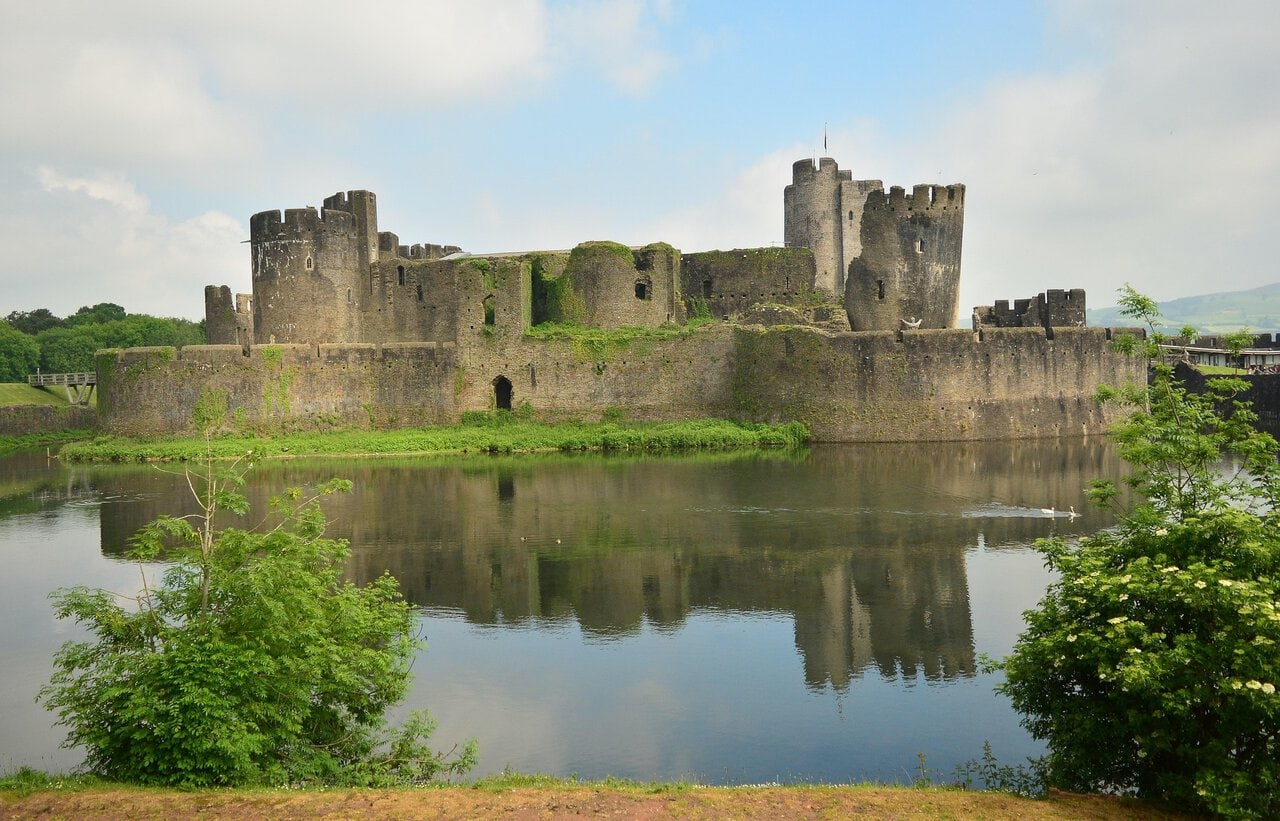
Caerphilly Castle is the largest castle in Wales and the second largest in Britain after Windsor, built by the Anglo-Norman lord Gilbert de Clare in the 1270s. Its concentric rings of walls and water defences were, for their time, some of the most advanced military engineering in Europe.
Trains from Cardiff Central take around twenty minutes, with frequent departures throughout the day, making this one of the simplest half-day trips on this list. The castle sits a short walk from Caerphilly station.
The castle’s most photographed feature is its leaning south-east tower, which tilts more than the tower of Pisa, reportedly the result of Civil War-era attempts to demolish the fortress. The dramatic water defences, largely restored in the twentieth century, are unusual for a Welsh castle. Seasonal opening hours are listed on the Cadw guide to Caerphilly Castle.
Travelling by Transport for Wales train also qualifies you for the Cadw 2-for-1 entry offer: show a valid train ticket for that day at the gate and the cheapest of two tickets is free. The same offer applies at Chepstow Castle, Raglan Castle, and Tintern Abbey, all covered further down this guide.
Caerphilly is served by the Rhymney Line of the Valley Lines network, which runs from Cardiff Central north through Heath and Llanishen before reaching Caerphilly, Bargoed and Rhymney. On weekdays trains run particularly frequently between Cardiff and Caerphilly, with up to six trains an hour southbound. The station itself sits on Station Road south of the town centre, with a small shop and ticket kiosk, putting shops, cafes and the walk to the castle within easy reach.
Inside, don’t miss the Great Hall, rebuilt in 1325–26 for Hugh le Despenser with richly carved windows and surviving carved stone corbels, and the East Gatehouse, modelled on Tonbridge Castle’s 1250s design with twin towers and portcullises. Near the old castle mill stand four replica siege engines. Cadw, which cares for the site, keeps it open year-round, with hours shifting seasonally between 9.30am and 6pm in summer.
Wander Through Tintern Abbey
The roofless ruins of Tintern Abbey sit beside the River Wye and have been drawing visitors since the eighteenth century, when the Romantic poets and painters made the site famous. The Cistercian abbey was founded in 1131 and remains one of the best-preserved medieval monastic ruins in Britain.
Getting there by public transport takes some planning. The most reliable route is the train to Chepstow, then Newport Bus route 69, which runs along the Wye Valley and stops in Tintern village a short walk from the abbey.
As with Caerphilly, arriving by Transport for Wales train qualifies you for the Cadw 2-for-1 offer at the abbey gate, worth remembering if you are travelling as a pair.
The soaring window tracery of the abbey church is the highlight, best appreciated from the far end of the nave looking back towards the great east window. Come outside peak summer weekends if you want the ruins closer to yourself.
Chepstow railway station lies on the Gloucester to Newport line, its Brunel-designed building dating from 1850. Direct trains from Cardiff Central take as little as 30 minutes, with around 40 services a day. To reach the number 69, it’s a ten-minute walk from the station into town to Chepstow bus station, where it leaves from Stand 1; there’s no Sunday service.
Monastic life ended on 3 September 1536, when Abbot Wych surrendered the house to Henry VIII’s commissioners; the roof lead was stripped and sold, and the buildings decayed for centuries. That evocative ruin inspired Wordsworth’s 1798 poem “Lines Written a Few Miles Above Tintern Abbey” and watercolours J.M.W. Turner made after sketching it in 1792. The 13th-century church stretches 228 feet end to end, its roofless nave of six bays rising toward the ruined crossing tower.
Follow the Wye Valley
Tintern Abbey sits within the wider Wye Valley, a designated Area of Outstanding Natural Beauty that follows the river along the border between Wales and England. The valley rewards a slower pace than a single-abbey visit allows, if you have the time for it.
The market town of Chepstow anchors the southern end of the valley and makes a sensible base, with Newport Bus route 69 running north through Tintern towards Monmouth, stopping at several riverside viewpoints along the way.
Walkers can pick up sections of the Wye Valley Walk, a long-distance path that runs the full length of the river, without committing to the entire route. Short stretches near Tintern are well signposted and manageable in a couple of hours.
If you are travelling without a car and want to cover Chepstow, Tintern, and the valley in one day, an early start from Cardiff is essential, since bus frequency drops noticeably in the afternoon.
Chepstow railway station puts the valley within easy reach: direct trains from Cardiff Central take from around 30 minutes. The platform sits just 300 metres from the town centre, with the bus interchange a further five-minute walk beyond it. The old Wye Valley Railway to Monmouth closed to passengers in 1959, so today’s onward journey north relies on the bus link picked up in town.
Further into the gorge, limestone cliffs rise above the river, carved over millennia and now laced with viewpoints. The Eagle’s Nest above Wyndcliff Wood, reached by 365 uneven steps built in 1828 for the Duke of Beaufort, gives views to the Severn estuary and beyond. On the Offa’s Dyke Path, the Devil’s Pulpit looks straight down onto Tintern Abbey. Peregrine falcons nest on the crags, particularly around Symonds Yat Rock further north, and the river was once one of Britain’s premier salmon fisheries.
Explore Newport’s Historic Waterfront
Newport is the most underrated day trip from Cardiff, just fifteen minutes away by train with no stops on the way and departures every fifteen minutes or less throughout the day, making it easy to fit in alongside another destination.
The city’s landmark is the Newport Transporter Bridge, one of only a handful of working transporter bridges left in the world, built in 1906 to carry passengers and vehicles across the River Usk on a suspended gondola rather than a conventional span. It is currently closed for a multi-year restoration, with contractors due to finish work in early 2027 and the bridge and its new visitor centre reopening for the visitor season after that, so it cannot be crossed or visited on a day trip for now. The structure itself remains visible from the riverbank on either side while work continues.
A short bus ride from Newport city centre brings you to Caerleon, the site of a major Roman legionary fortress. The remains of an amphitheatre, barracks, and one of the best-preserved Roman baths in Britain are all open to visitors, and the small on-site museum puts the finds in context.
Newport also has direct Newport Bus services out to both Chepstow and Raglan, so travellers relying on public transport sometimes find it easier to change here rather than routing everything back through Cardiff.
Newport station itself is worth a glance before boarding: a major stop on the South Wales Main Line with four through-platforms, it ranks as the second-busiest railway station in Wales after Cardiff Central. First opened in 1850, the station was substantially rebuilt in 2010, its footbridge clad in the same ETFE material used at Cornwall’s Eden Project.
The bridge itself is Grade I listed, the largest surviving transporter bridge in Britain, its towers rising 73.6 metres and its span reaching 196.56 metres, engineered by Frenchman Ferdinand Arnodin. Caerleon’s fortress, Isca, garrisoned the Second Augustan Legion, whose amphitheatre once held up to 6,000 spectators, now explored via the National Roman Legion Museum.
Experience the Best of Swansea
Wales’ second city sits around fifty-three minutes away by train on average, with services usually under an hour from Cardiff Central, making Swansea comfortably manageable as a day trip despite feeling like a genuinely different city rather than a suburb.
The Maritime Quarter around Swansea Marina has been rebuilt from its docklands past into a waterfront of cafes and the National Waterfront Museum, which covers Welsh industrial history and is free to enter.
Swansea is also the birthplace of Dylan Thomas, and the Dylan Thomas Centre in the Maritime Quarter traces his life and work through original manuscripts and recordings, a worthwhile stop for literature fans.
Beyond the city centre, Swansea is also the gateway to the Gower Peninsula, covered next, which makes it possible to combine both destinations if you leave Cardiff early enough.
Swansea railway station serves as the terminus of the South Wales Main Line, meaning all through trains must reverse here before continuing into west Wales. A £7.5 million redevelopment completed in 2021 saw platform 4 rebuilt and lengthened to 260 metres to accommodate longer trains. From the concourse it is only a three-minute walk into the city centre, passing the ruins of Swansea Castle en route.
Inside the National Waterfront Museum, a Wilkinson Eyre-designed glass extension links to the original Grade II listed warehouse, part of a £33.5 million project completed in 2005. At the Dylan Thomas Centre, the permanent “Love the Words” exhibition displays original letters, photographs and worksheets tracing the poet’s life. Nearby, Swansea Marina holds moorings for 385 boats, while Swansea Museum, founded in 1841, claims the title of the oldest museum in Wales.
Compare routes and fares for your journey to Cardiff.
Compare flightsUse an eSIM to get online without hunting for a local SIM after arrival.
See eSIM optionsArrange a private airport pickup for your trip to Cardiff.
Check transfersUnwind on the Gower Peninsula
The Gower Peninsula was designated the UK’s first Area of Outstanding Natural Beauty back in 1956, and its coastline of cliffs and beaches still lives up to that billing. It sits beyond Swansea, which makes it the most involved day trip on this list without a car.
The route is train to Swansea, then a local bus from Swansea Quadrant Bus Station out to the peninsula. Services are run by a mix of local operators, so checking Traveline Cymru before you set off is worthwhile, since Gower buses are considerably less frequent than the trains that get you to Swansea.
Rhossili Bay, regularly ranked among the best beaches in Britain, is the main draw, a three-mile sweep of sand backed by cliffs with the wreck of the Helvetia visible at low tide. The Worm’s Head headland at its far end is only reachable at low tide, so check tide times before setting out.
Given the travel time involved, Gower works best as a full day trip rather than tacked onto Swansea in the same afternoon. Building in a buffer before the last bus back is sensible, since missing it means a costly taxi.
From Swansea Quadrant Bus Station, the 118 bus, run by Adventure Travel, threads through Sketty, Killay, Parkmill and Reynoldston before reaching Rhossili, a journey of around one hour. Departures run roughly every one to two hours through the day, with services thinning noticeably on Sundays, so travellers heading back to Cardiff should check the return timetable before setting off.
The Helvetia, a Norwegian barque carrying timber from New Brunswick, ran aground here in 1887 after striking the treacherous Helwick Sands in a gale, its anchor tearing free before it settled into the sand for good. Worm’s Head is only safe to cross two hours either side of low tide, a roughly four-hour window, and the coastguard lookout on the headland posts the day’s safe crossing times.
Step Back in Time at Chepstow Castle
Chepstow Castle holds the title of the oldest surviving post-Roman stone fortification in Britain, with construction beginning as early as 1067, only a year after the Norman Conquest. Its position on a cliff above the River Wye made it a key crossing point into Wales for centuries.
Trains run directly from Cardiff Central to Chepstow, and the castle is an easy walk from the station through the compact town centre. This makes Chepstow a natural pairing with Tintern Abbey, since Newport Bus route 69 continues north from Chepstow into the Wye Valley.
As with the other Cadw sites on this list, showing a valid Transport for Wales train ticket at the gate qualifies you for the 2-for-1 entry offer, which stacks well if you are visiting Chepstow and Tintern on the same trip.
The Great Tower, built in the years immediately after the Conquest, is thought to be one of the earliest stone keeps in Britain, predating most of the more famous Norman castles further east.
Chepstow railway station sits on the Gloucester to Newport line, with direct Transport for Wales services from Cardiff Central taking as little as 30 minutes to cover the roughly 25-mile route, and trains running at least hourly throughout the day. From the station it is an easy ten-minute walk downhill through the town centre, past the parish church and high street, to reach the castle gates above the River Wye.
The castle owes much of its scale to William Marshal, who from the 1190s added the gatehouse and drum towers as one of medieval Europe’s most powerful knights. Marten’s Tower later held the regicide Henry Marten, imprisoned there for twelve years until his death in 1680. The castle fell to Parliamentarian forces on 25 May 1648 after a Civil War siege, and its gatehouse still displays the oldest castle doors in Europe, tree-ring dated to the 1160s.
Visit Raglan Castle
Raglan Castle is a later, more domestic addition to this list, a fifteenth-century fortified mansion built for comfort and display as much as defence, with an impressive hexagonal Great Tower known as the Yellow Tower of Gwent.
It is reached by Newport Bus route 60, which runs from Newport out through Monmouthshire. An All Zones day ticket covering the journey costs £9.50 ($12 / €11), and connecting from Cardiff via Newport, covered earlier in this guide, is generally the most straightforward approach without a car.
The castle’s grand staircases, oriel windows, and moated Great Tower reflect the wealth of the Herbert family, who built much of what survives today. It held out longer than almost any other Welsh castle during the Civil War, only surrendering after an eleven-week siege in 1646.
Raglan sees noticeably fewer visitors than Caerphilly or Chepstow, which makes it a good choice if you want a castle without the crowds. It also qualifies for the Cadw 2-for-1 train offer.
The journey starts at Cardiff Central, where trains to Newport run every 15 minutes and take just 15 minutes, arriving direct with no stops in between. From Newport bus station, the number 60 winds through Caerleon and Usk before reaching Raglan’s Beaufort Square, a journey of roughly 40 minutes that turns the approach itself into a scenic tour of Monmouthshire’s market towns.
Inside, the castle reveals its ambition: Sir William ap Thomas began building around 1432, and his son William Herbert expanded it in the 1460s before his execution in 1469, adding Renaissance touches decades ahead of most Welsh castles. The Great Hall, once 64 feet by 28 feet, is flanked by a moat walk encircling the Great Tower, its niches carved for classical statues. When Fairfax’s forces tried to slight the castle after its surrender, the walls proved too strong to fully demolish.
Choosing Between Train, Bus, and Car
For Caerphilly, Barry Island, Newport, Swansea, and Chepstow, the train is almost always the better option: frequent, direct, and free of parking hassles, with the added bonus of the Cadw 2-for-1 offer at eligible castles.
For Pen y Fan, Tintern Abbey, Raglan Castle, and the Gower Peninsula, a car genuinely makes life easier, since these all involve a bus connection with more limited frequency than the rail network. If you are not driving, build slack into your schedule around bus timetables.
Checking Traveline Cymru the night before is worth the two minutes it takes, particularly for Sunday travel, when bus frequencies across South Wales drop noticeably compared with weekdays.
If your trip involves a flight, our Cardiff Airport Transfers guide covers car hire options at the airport, which is worth considering if several of these day trips are on your list.

Compare Trains and Buses with Omio
Choosing between trains and buses is not always obvious. Some routes are faster by train, while others are cheaper or easier by bus. Omio helps you compare routes, journey times, prices, and tickets in one place.
It is useful for city-to-city travel, cross-border journeys, and trips where flexibility matters. You can quickly see which option works best for your route, budget, and schedule before booking.
Booking an Organised Day Tour
If juggling train times and bus connections is not appealing, an organised tour covers several of the destinations above in one trip. One example running from Cardiff Central is an eight-hour Wye Valley and Bannau Brycheiniog tour, priced at around £105 ($133 / €121) per person, that combines Caerleon’s Roman remains, Tintern Abbey, and national park viewpoints in a single small-group day.
These small-group tours typically cap numbers at around six passengers, and the better ones include entrance fees and bottled water in the price, so it is worth checking exactly what is covered before booking.
A guided tour makes the most sense for Pen y Fan and Gower, the two destinations where public transport is least convenient, since a driver removes the timetable stress entirely.
For castle-focused days, self-guided travel by train usually works out considerably cheaper thanks to the Cadw 2-for-1 offer, so a tour is best reserved for the destinations that are genuinely awkward to reach independently.

Rupert’s Handy Travel Tips
Planning a day trip from Cardiff? Here are a few useful tips to make your trip smoother:
- Carry your train ticket all day: You need it at the gate for the Cadw 2-for-1 offer, not just for the journey itself.
- Check bus times before you leave Cardiff: Routes like the T4 to Storey Arms and Gower buses run far less often than trains.
- Check tide times for Rhossili: Worm’s Head is only accessible at low tide, and it is easy to get cut off if you misjudge it.
- Pack for the mountains separately: Weather at Pen y Fan’s summit can be very different from a mild day in Cardiff.
Want to meet the reindeer behind our travel tips? Find out more in our page Who is Rupert?.


Frequently Asked Questions About Day Trips from Cardiff
What is the best day trip from Cardiff without a car?
Caerphilly Castle, Barry Island, Newport, Swansea, and Chepstow are all reachable by direct or near-direct train, making them the easiest options for car-free travellers.
How do you get to Pen y Fan without a car?
Take the train to Merthyr Tydfil, around an hour from Cardiff, then the T4 TrawsCymru bus, which runs along the A470 and stops near Storey Arms.
What is the Cadw 2-for-1 train offer?
Travel to an eligible Cadw site, including Caerphilly, Chepstow, Raglan, and Tintern Abbey, by Transport for Wales train, and the cheapest of two entry tickets is free when you show your ticket at the gate.
Is Barry Island worth visiting?
Yes. It is a thirty-minute train ride from Cardiff Central and combines a Blue Flag beach with a traditional funfair, making it an easy half-day trip.
Can you visit the Gower Peninsula in a day from Cardiff?
Yes, though it takes planning. Train to Swansea, then a local bus from Swansea Quadrant Bus Station, and check Traveline Cymru for bus times before you travel.
Further Reading
Before heading further afield, make sure you have covered the city itself. Our Things to Do in Cardiff guide rounds up the castle, Cardiff Bay, and the arcades, and if you are just landing, our Cardiff Airport Transfers guide covers getting into the city first.
If a match or concert is part of your visit, our guide to reaching Principality Stadium covers matchday travel, and cruise passengers should see our Cardiff Cruise Port Guide for terminal details.
For journeys further into Wales, our Wales Travel Guide covers trains, coastlines, and castles across the country, and our Welsh Trains Guide is worth a read for onward rail journeys beyond the destinations covered here.











