Reviewed by our editorial team Updated
Copenhagen does Christmas differently from almost every other European capital. Instead of one grand square anchoring a single market, the city spreads six distinct sites across its compact centre, from the fairground glow of Tivoli Gardens to the canalside stalls of Nyhavn and a newly returned ice rink at Kongens Nytorv. What ties them together is hygge, the Danish idea of cosiness found in small, shared comforts, which shapes everything from the low-lit wooden chalets to the mugs of gløgg passed between friends.
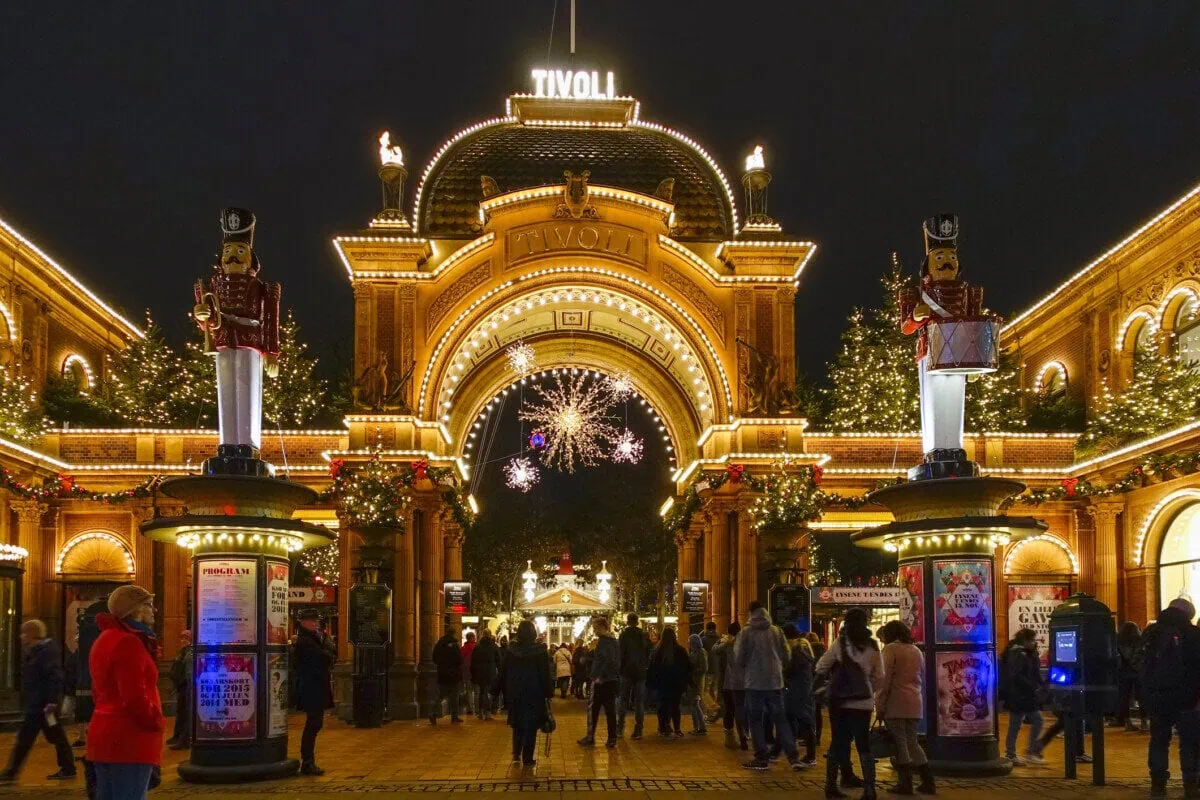
Tivoli itself is the reason so many visitors build a Copenhagen trip around December in the first place. Founded in 1843, it is one of the oldest amusement parks still operating anywhere in the world, and its Christmas season began modestly in 1994 with a handful of market stalls before growing, by 1997, into the sprawling winter spectacle it is today. The gardens now carry roughly a million lights, a thousand dressed spruce trees and forty kilometres of illuminated garland, which is a scale no other market in the city attempts to match.
Beyond Tivoli, Copenhagen’s other five sites reward a bit of planning rather than a single stop. Nyhavn’s coloured townhouses reflect in the canal behind rows of gløgg stalls, Højbro Plads and the Hans Christian Andersen Market sit along the Strøget shopping spine, and Kongens Nytorv has brought back a full-sized public ice rink after a sixteen-year gap. Freetown Christiania, across the harbour, runs a smaller, artisan-led market that looks nothing like the others.
This guide covers all six sites in detail, a sensible walking order for seeing several in one day, the food and drink that actually defines a Danish Christmas market, ice skating and other things to do beyond the stalls, opening hours over the holidays, December weather, and how to get to Copenhagen and where to base yourself. Other guides on this site cover Copenhagen’s wider attractions, day trips and transport in more depth; this one is built specifically around the markets themselves.
Copenhagen’s Christmas Markets at a Glance
| Market | Character | Best For |
|---|---|---|
| Tivoli Gardens | Paid entry, rides, lights and roughly 60 chalets inside the historic gardens | The full Christmas experience, families |
| Nyhavn | Free canalside stalls in front of the coloured townhouses | Photos and atmosphere |
| Højbro Plads | Free market on the Strøget, craft and Danish Realm-themed stalls | Gifts and local produce |
| Kongens Nytorv | Free market plus a large public ice rink around Krinsen | Ice skating |
| Hans Christian Andersen Market | Small free market at Gammeltorv and Nytorv, stalls named for fairy tales | A quieter, storybook stop |
| Freetown Christiania | Free artisan market inside the alternative district’s Grey Hall | Something different from the rest |
Every site except Tivoli is free to browse, and five of the six sit within a comfortable walk of one another through the city centre. The sections below cover each in turn, then set out a practical order for visiting several in a single day.
Tivoli Gardens: Copenhagen’s Christmas Centrepiece
Tivoli Gardens is the reason a Copenhagen Christmas trip is worth planning around a specific set of dates. For 2026 the season runs from 13 November to 3 January 2027, with the gardens open roughly 11am to 10pm Sunday to Thursday and 11am to 11pm on Friday and Saturday, though Tivoli closes fully on Christmas Eve and Christmas Day. Adult entry runs from around 200 DKK (£23/€27/$29), with children aged three to seven from roughly 100 DKK (£11/€13/$15) and under-threes free; a separate ride pass adds from around 99 DKK (£11/€13/$15) on top of entry.
What makes Tivoli different from a typical market square is the sheer density of the display. Roughly a million lights, a thousand dressed spruce trees, seventy thousand baubles and forty kilometres of illuminated garland cover the gardens, and the Tivoli Youth Guard marches through in traditional uniform on selected evenings. Around sixty chalets sell gifts, decorations and food, while the park’s classic rides, including its historic wooden roller coaster, keep running through the season.
Christmas at Tivoli started small, with just a few stalls in 1994, and had grown into a genuine seasonal spectacle by 1997. That history matters for context: this is not an ancient European tradition transplanted to Denmark, but a modern addition to a park that has run continuously since 1843, making it one of the oldest amusement parks anywhere in the world.
Tivoli sits a short walk from Copenhagen Central Station and Rådhuspladsen, making it the natural first or last stop on a day covering several markets. Because it charges admission and gets busy on weekend evenings, arriving on a weekday afternoon or booking a timed ticket in advance through Tivoli’s own website is worth doing rather than turning up and queuing.
Two Tivoli tickets are bookable below. The first is a straight Christmas season entry ticket, covering the lights, chalets and gardens with no rides included. The second bundles entry together with a ride pass, covering unlimited rides for the day, which is worth the extra cost if the classic Rutschebanen coaster or the other rides matter to you as much as the market itself.
Compare hotels and other places to stay for your trip.
Check availabilityBrowse apartments, holiday homes and self-catering stays.
View rentalsCompare hotel prices across multiple booking sites.
Compare ratesNyhavn: The Postcard Canal Market
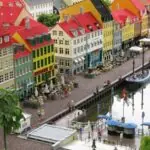
Nyhavn is the image most people picture when they think of Copenhagen, and its Christmas market leans fully into that. A run of small stalls lines the canal in front of the harbour’s famous coloured townhouses, selling gløgg, æbleskiver, decorations and Scandinavian crafts against a backdrop of moored wooden boats and reflected fairy lights.
Entry is free, though prices at the stalls themselves tend to run a little higher than elsewhere in the city, with a cup of gløgg typically from around 80 DKK (£9/€11/$12). That premium is largely the trade-off for the setting: few Christmas markets anywhere in Europe photograph as well as Nyhavn’s does after dark, when the townhouse windows and market lights double up in the water.
The market itself is modest in size compared with Tivoli, and most visitors treat it as a fifteen to twenty minute stop rather than a destination to linger at for hours. It works best combined with a walk along the harbour front itself, since the market stalls only occupy part of Nyhavn’s full length.
Nyhavn sits a short walk from Kongens Nytorv, close enough that the two are almost always covered together, and its own metro stop at Kongens Nytorv puts it within easy reach of the rest of the city. Exact 2026 opening dates for the market stalls had not been published at the time of writing, but the site has run its market every December in recent years, typically from early November through to shortly before Christmas.
Højbro Plads: Crafts, Food and the Danish Realm
Højbro Plads, the square between Strøget and Christiansborg Palace, runs one of the larger and more locally focused markets in the city, with somewhere between thirty and forty stalls depending on the year. Unlike Nyhavn’s postcard setting, this market leans into craft and food rather than views, and gløgg here typically costs a little less, from around 55 DKK (£6/€7/$9).
Recent seasons have brought a new organiser to Højbro Plads, with stalls built around the wider Danish Realm, meaning produce, crafts and traditions from Greenland and the Faroe Islands alongside mainland Danish stock. That is a genuinely distinctive angle among Copenhagen’s markets, and one that rewards a slower browse rather than a quick walk-through.
The square’s position is one of its biggest practical advantages. It sits directly on the walking route between Rådhuspladsen and Kongens Nytorv, right beside the Strøget pedestrian street, so it slots naturally into a day that also covers the Hans Christian Andersen Market and the shops along the way.
Entry is free, and the market typically runs from mid-November into the third week of December, though exact 2026 dates were still to be confirmed at the time of writing. Given its central position, it is easy to fold into a market walk without adding any real detour.
Kongens Nytorv: The Returning Ice Rink and Market
Kongens Nytorv, Copenhagen’s grand royal square, is home to the city’s biggest recent Christmas news: a full public ice rink has returned to the square after a sixteen-year absence. The rink last ran from 1999 until it closed for metro construction in the 2008 to 2009 season, and its 2024 return brought a genuinely large surface, a circular 1,300 square metre rink wrapped around Krinsen, the oval garden at the square’s centre, more than four times the size of the smaller rink that briefly ran in the years just before it.
Skating with skate rental typically costs from around 70 DKK (£8/€9/$10) an hour, and the setting is hard to beat: the rink circles beneath the floodlit facades of the Hotel d’Angleterre, Magasin du Nord department store and the Royal Danish Theatre. A smaller run of market stalls surrounds the square itself, decorated in recent years with oversized baubles and life-size toy soldiers rather than a full chalet market.
Because the square sits at the junction of Nyhavn, Strøget and Bredgade, Kongens Nytorv works as a natural midpoint on any market walk rather than a stop that needs its own separate trip. Its own metro station, on both the M1/M2 lines, makes it one of the easiest sites in the city to reach directly.
Given the rink’s popularity since its return, arriving earlier in the day or on a weekday avoids the longest waits, particularly in the two weekends before Christmas when both the market and the ice draw the heaviest crowds.
The Hans Christian Andersen Market at Gammeltorv and Nytorv
Spread across the twin squares of Gammeltorv and Nytorv, just off Strøget, the Hans Christian Andersen Market is the smallest and most storybook of Copenhagen’s Christmas sites. Each stall is themed around one of Andersen’s fairy tales, from The Little Match Girl to The Snow Queen, and the market leans on traditional Danish food and drink rather than modern gift stalls.
The scale here is deliberately modest, which is part of the appeal. Where Tivoli and Nyhavn can feel crowded on a Saturday evening, Gammeltorv and Nytorv are consistently quieter, making this the market most visitors describe as genuinely hyggelig rather than simply festive.
Food and drink at the fairy tale-themed chalets tends to run slightly cheaper than at Nyhavn, and it is a good spot to try brændte mandler, caramelised almonds sold warm from a paper cone, alongside the usual gløgg and æbleskiver. Père Noël-style meet-and-greets and small children’s activities run through the season on selected days.
Entry is free, and the squares sit two minutes off the main Strøget route between Rådhuspladsen and Højbro Plads, so this is easily folded into the same afternoon rather than needing its own trip. Confirm exact 2026 dates closer to the time, since smaller markets like this one typically publish their calendar later than Tivoli.
Freetown Christiania Christmas Market
For something that looks nothing like the rest of the city’s markets, Freetown Christiania, the self-governing former naval barracks turned alternative community in Christianshavn, runs its own Christmas market inside Grey Hall. Stalls here are largely hand-made and artisan-led, run by the district’s own residents and craftspeople rather than seasonal market traders, and the atmosphere is deliberately unpolished compared with Tivoli’s polished spectacle.
This is the market to choose for visitors who have already done the postcard version of Copenhagen Christmas and want a genuinely different angle on the city’s festive season. Expect pottery, textiles, woodwork and original art rather than mass-produced decorations, alongside food stalls reflecting Christiania’s own community kitchens.
Christiania sits across the harbour in Christianshavn, roughly a twenty to twenty-five minute walk from the central market cluster, or a short ride on the metro to Christianshavn station followed by a walk. It is not somewhere to combine casually with the other five sites in one continuous loop, and is better treated as a deliberate separate outing.
Because Christiania is a residential community as well as a tourist site, standard visitor courtesy applies: photography is restricted in parts of the district, and stallholders generally prefer being asked before their work is photographed. The market’s own opening dates and hours vary more year to year than the city centre sites, so it is worth checking locally on arrival rather than assuming a fixed schedule.
The Best Order to Walk Copenhagen’s Markets
Copenhagen’s centre is compact enough that four of its six markets can genuinely be walked in one afternoon without doubling back. A logical route starts at Tivoli Gardens, near Central Station, then heads north-east across Rådhuspladsen and along Strøget to the Hans Christian Andersen Market at Gammeltorv and Nytorv, continuing a short distance further to Højbro Plads.
From Højbro Plads, the walk continues east along the rest of Strøget to Kongens Nytorv, where the ice rink makes a natural mid-afternoon or early-evening stop, before finishing at Nyhavn, a five-minute walk away, for the canal views once the lights are fully on. Each leg of that route runs roughly ten to fifteen minutes on foot, and the whole loop covers under three kilometres.
Freetown Christiania is the deliberate exception, sitting far enough across the harbour that it makes more sense as its own trip, ideally on a different day or as a standalone morning before heading into the central loop in the afternoon.
Saving Nyhavn for last is a deliberate choice: it is the most photogenic of the six after dark, and finishing there means the day ends on the market most people came to Copenhagen to see in the first place. Weekday afternoons are consistently quieter than the two weekends before Christmas, when Kongens Nytorv’s rink in particular can mean a genuine wait.
Search flights and useful route combinations in one place.
View flightsChoose an Airalo eSIM and arrange mobile data before you arrive.
Browse eSIMsBook a private airport transfer in advance and have your ride planned before you arrive.
Check transfersGløgg, Æbleskiver and Danish Christmas Food
Gløgg, Denmark’s version of mulled wine, is the drink that defines a Copenhagen Christmas market, served warm and spiced with cardamom, cinnamon and cloves, usually with almonds and raisins dropped into the cup. Prices vary noticeably by site, from around 55 DKK (£6/€7/$9) at Højbro Plads or the Andersen Market up to 80 to 100 DKK (£9-12/€11-13/$12-15) at Nyhavn, and alcohol-free versions are widely available for anyone driving or travelling with children.
Æbleskiver, small spherical pancakes fried in a special dimpled pan and dusted with icing sugar, are the other stall food nearly every visitor tries, typically served with jam on the side for around 60 to 80 DKK (£7-9/€8-11/$10-12) for a portion of six. Unlike a filled doughnut, they are plain inside, and the jam and sugar do the work rather than a hidden filling.
Beyond those two staples, expect brændte mandler (caramelised almonds sold warm from a paper cone), pebernødder (small spiced biscuits), and stalls selling flæskesteg sandwiches built around Denmark’s classic roast pork with crackling. Anyone visiting in the run-up to Christmas Eve itself will also hear plenty about julefrokost, the traditional Danish Christmas lunch of pickled herring, liver pâté and akvavit that families and workplaces hold throughout December, distinct from Christmas Day itself.
Prices are consistently lower away from Nyhavn’s harbour-front premium, so spreading food and drink stops across Højbro Plads, the Andersen Market and Kongens Nytorv rather than eating everything at the first stall reached is worth building into the walking route above.
Ice Skating, Lights and Other Things to Do Beyond the Stalls
Beyond browsing stalls, the Kongens Nytorv ice rink is the headline non-market activity of a Copenhagen Christmas trip, and its return after sixteen years has made it one of the city’s most talked-about winter attractions. Skate hire is available on site, and given the rink’s popularity since 2024, arriving earlier in the day genuinely reduces the wait compared with a Saturday evening session.
Inside Tivoli, the rides themselves double as a Christmas attraction once the season’s lights are on, and the park’s Rutschebanen wooden roller coaster, one of the oldest of its kind still running anywhere, is worth riding after dark specifically to see the illuminated gardens from above. The Tivoli Youth Guard’s marching displays run on selected evenings and are free to watch for anyone already inside the gates.
Copenhagen’s churches add a quieter option: Copenhagen Cathedral and several of the city’s other churches run carol services and festive concerts through Advent, most free to attend with donations welcomed. Strøget itself, decorated with lights the length of its pedestrianised run, is worth simply walking even outside the market stops, and the shop windows of department stores like Magasin du Nord get their own seasonal displays.
For a change of pace, a canal boat tour through Nyhavn and the harbour runs year-round and gives a different view of the illuminated waterfront than walking the canal edge alone, particularly once the afternoon light has gone.
Getting Around and Holiday Opening Hours
Copenhagen’s compact centre means most of the market sites are genuinely walkable, but the Metro and S-tog network covers the city well for anyone short on time or based further out, with Kongens Nytorv, Nørreport and Central Station all sitting on or near the main market cluster. A single ticket typically costs from around 24 to 30 DKK (£3-3.50/€3-4/$4-4.50) depending on zones, and the Metro runs through the night on Fridays and Saturdays.
Denmark treats 24, 25 and 26 December, and 1 January as public holidays, and shops, supermarkets and most attractions close completely on those dates, with only small kiosks typically staying open. Strøget’s shops generally run Monday to Friday 10am to 6pm, Saturday 10am to 5pm and Sunday 11am to 4pm outside the holiday closures, though hours often extend slightly in the run-up to Christmas itself.
Tivoli is the one major exception worth planning around specifically: it closes on Christmas Eve and Christmas Day but stays open through the rest of its season, including New Year’s Eve, giving visitors a rare option for something to do in the city on days when almost everything else is shut.
Because the smaller markets publish their exact holiday-period hours later than Tivoli does, it is worth checking each site’s own social channels or the city’s official VisitCopenhagen listings shortly before travelling, particularly for the days immediately around Christmas.

Copenhagen’s December Weather and What to Pack
Copenhagen’s December sits firmly on the cold side of a European Christmas market trip. Daytime highs typically run from around 6°C (43°F) early in the month down to about 3°C (37°F) by New Year, with overnight lows dropping to around -1°C (30°F), noticeably colder than markets further south or west such as Manchester or Strasbourg.
The chance of a wet day sits at around 31% through the month, split fairly evenly between rain and the odd snow shower, and skies are overcast roughly 70% of the time, so a genuinely bright, clear evening at the markets is the exception. Daylight is short even by Northern European standards, falling from around 7 hours 28 minutes on 1 December to just 7 hours 1 minute on the winter solstice, which is exactly why the markets are built to be seen from mid-afternoon into the evening.
A proper insulated winter coat earns its place ahead of anything purely stylish, layered over wool or thermal base layers rather than a single jumper. Given the genuine cold rather than just damp, thermal socks, gloves and a hat matter more here than at a milder market city, especially for standing still at the Kongens Nytorv rink or queuing for a Tivoli ride.
Waterproof, insulated boots are worth the investment too, since cobbled streets and canal-front paths around Nyhavn and Christianshavn can be genuinely slippery when temperatures hover close to freezing. Layering also makes the evening more comfortable, since heated interiors on the Metro or inside Tivoli’s buildings swing the temperature considerably from the street outside.
Getting to Copenhagen and Where to Stay
Copenhagen Airport (CPH) is exceptionally well connected to the city centre, with the Metro running directly from the airport to Kongens Nytorv and the wider network in around 13 to 15 minutes, for a flat fare of about 30 DKK (£3.50/€4/$4.50) despite crossing several fare zones. Trains also run from the airport to Copenhagen Central Station in a similar time, making a taxi genuinely unnecessary for most visitors arriving with luggage.
Anyone arriving overland from elsewhere in Denmark or crossing the Øresund Bridge from Sweden will typically come into Copenhagen Central Station, itself within easy walking distance of Tivoli and the Rådhuspladsen end of the market route. Travellers combining Copenhagen with the rest of Denmark by rail may find our Interrail Denmark Pass guide useful for working out whether a multi-day pass makes sense against individual tickets.
Once in the city, the market route above is entirely walkable, and the Metro and S-tog cover the rest, so a car adds cost and inconvenience rather than saving time. A well-located double room in central Copenhagen in December typically runs from around 1,000 to 1,600 DKK (£115-185/€135-215/$145-235) a night, higher across the two weekends before Christmas.
Staying somewhere within walking distance of Rådhuspladsen, Nørreport or Kongens Nytorv keeps every market site except Christiania within a genuinely short walk, and a two or three-night stay gives enough time to cover all six sites properly, skate at Kongens Nytorv, and still have an evening spare for one of Copenhagen’s other December events without the whole trip feeling rushed.

Rupert’s Handy Travel Tips
Rupert has walked Copenhagen’s market loop more than once, and reckons a bit of planning goes further here than at almost any other Christmas city.
- Book Tivoli ahead for weekends: a timed ticket avoids queuing at the gate on the two Saturdays before Christmas.
- Save Nyhavn for last: it looks best after dark, and finishing the loop there gives the day a proper ending.
- Spread your gløgg stops: Højbro Plads and the Andersen Market are noticeably cheaper than Nyhavn’s harbour-front stalls.
- Skate early in the day: the Kongens Nytorv rink gets genuinely busy from mid-afternoon onward, especially at weekends.
- Treat Christiania as its own trip: it is far enough from the central loop to deserve a separate morning or afternoon.
- Pack for real cold, not just damp: Copenhagen runs colder overnight than markets further south, so proper thermals earn their place.
Want to meet the reindeer behind our travel tips? Find out more in our page Who is Rupert?.



Frequently Asked Questions About Copenhagen Christmas Markets
When do Copenhagen’s Christmas markets open in 2026?
Tivoli Gardens confirms 13 November 2026 to 3 January 2027. Most of the smaller sites, including Nyhavn, Højbro Plads and the Hans Christian Andersen Market, typically open in mid-November and run to just before Christmas, though several had not published exact 2026 dates at the time of writing.
How many Christmas markets are there in Copenhagen?
Six distinct sites: Tivoli Gardens, Nyhavn, Højbro Plads, Kongens Nytorv, the Hans Christian Andersen Market at Gammeltorv and Nytorv, and the alternative market at Freetown Christiania.
Is Tivoli Gardens open on Christmas Day?
No, Tivoli closes on both Christmas Eve and Christmas Day, in line with Denmark’s public holidays, but reopens for the rest of its season including New Year’s Eve.
Is there an ice rink at Copenhagen’s Christmas markets?
Yes, a full-sized public ice rink returned to Kongens Nytorv in 2024 after a sixteen-year absence, with a 1,300 square metre skating surface around Krinsen at the centre of the square.
Are Copenhagen’s Christmas markets free to enter?
Yes, apart from Tivoli Gardens, which charges admission. Nyhavn, Højbro Plads, Kongens Nytorv, the Hans Christian Andersen Market and Freetown Christiania are all free to browse.
What should I eat and drink at a Copenhagen Christmas market?
Gløgg (Danish mulled wine) and æbleskiver (dimpled pancake balls with jam) are the essentials, alongside caramelised almonds, spiced biscuits and, closer to Christmas Eve, the traditional Danish julefrokost spread of pickled herring and roast pork.
Compare hostels and lower-cost accommodation for your trip.
Search hostelsGet fast compensation payouts, eligible lounge benefits and expert help when flights go wrong.
See AirHelp+ benefitsUse convenient luggage storage between arrival, check-in and departure.
Check storageFurther Reading & Related Guides
Copenhagen’s spread of markets is one of several distinct approaches covered in our European Christmas Markets Guide, which rounds up festive cities from Vienna to Sofia and is a useful starting point if you are still deciding between destinations for a winter break.
For anyone extending a Copenhagen trip into the rest of Denmark, our Interrail Denmark Pass guide covers prices, routes and whether a multi-day pass makes sense against buying individual train tickets to cities such as Aarhus and Odense.
Beyond the markets themselves, Copenhagen has plenty to fill a longer festive trip. Our guide to the city’s wider attractions, its best day trips, airport transfer options, night train connections and the short hop across the Øresund Bridge to Malmö in Sweden are all covered in detail elsewhere on this site, useful reading for anyone treating the markets as one part of a longer Scandinavian winter break rather than the whole trip.
If Copenhagen is one stop on a wider European Christmas market tour, it combines naturally by train or short flight with Stockholm, Oslo or Hamburg, each running its own distinct take on the Nordic and German market traditions covered more broadly in our European guide above.