Reviewed by our editorial team Published
Stockholm takes Christmas seriously in a way that’s woven into the calendar rather than bolted on. The season stretches from the candlelit markets of late November through Lucia in mid-December, a proper julbord feast, and a New Year’s Eve built around fireworks over the water and a century-old poetry reading broadcast live on national television.
Unlike cities built around one enormous central market, Stockholm spreads its Christmas markets across several very different settings: the 18th-century village at Skansen, the merchant houses of Stortorget in Gamla Stan, and the garden café at Rosendals Trädgård on Djurgården, each with its own character rather than a single template repeated everywhere.
This guide covers the city’s main markets, a sensible order for visiting several in one day, Lucia and carol traditions, other Christmas events beyond the markets themselves, New Year’s Eve, the food and drink that defines a Swedish Christmas, December weather, and holiday opening hours. Our separate guides cover Stockholm’s wider attractions and day trips in more depth; this one is built specifically around the festive season.
Prices below are quoted in Swedish krona (SEK) with approximate GBP, EUR and USD conversions, and several dates were still to be confirmed for 2026 at the time of writing, so it’s worth checking each venue’s own site closer to your visit.
Stockholm’s Christmas Markets at a Glance
| Market | Character | Best For |
|---|---|---|
| Skansen | Paid entry, candlelit 18th-century village, since 1903 | The full traditional experience |
| Stortorget, Gamla Stan | Free market on the city’s oldest square, since 1837 | History and atmosphere |
| Rosendals Trädgård | Free garden market with organic produce and baking | A quieter, local feel |
| Kungsträdgården | Free ice rink plus a seasonal winter market | Ice skating |
| Drottningholm Palace | Ticketed royal market, one or two weekends only | A grander, less crowded setting |
Every site is free to browse except Skansen and the occasional Drottningholm weekend, and most sit within a manageable distance of each other for anyone planning a single day of market-hopping.
Skansen: Stockholm’s Traditional Christmas Market
Skansen’s Christmas market has run since 1903, making it one of the longest-running festive traditions in the city, and it’s staged inside the open-air museum’s own 18th and 19th-century buildings rather than a purpose-built row of chalets. For 2026, expect the market to run on weekends from late November to around 21 December, typically from 10am to somewhere between 4pm and 5pm depending on the date.
Stalls sell handicrafts, hand-dipped candles, wrapped “secret” gifts, and Christmas sweets, while food stands serve waffles, roasted almonds and, inevitably, plenty of glögg. Costumed staff demonstrate seasonal crafts throughout the museum’s historic townscape, and the Cantare choir performs carols on the market weekends, giving the whole site a genuinely different feel from a standard stall-lined square.
Admission, which also covers the wider Skansen museum and its Nordic zoo, runs to around 250 SEK (£19/€22/$24) for adults, with daily Christmas tree dances scheduled through the afternoon for younger visitors.
Because it’s on Djurgården alongside the Vasa Museum and ABBA Museum, Skansen’s market is easy to combine with a wider day on the island, and its candlelit evenings in particular are worth timing a visit around rather than arriving right at opening.
The market itself is set out around Bollnästorget, one of the open-air museum’s historic squares, and generally runs Friday to Sunday, with hours stretching from 10am to around 5pm on Fridays and Saturdays and closing an hour earlier on Sundays. It began in 1903 as a modest charity bazaar staffed by museum workers and local folk dancers, and that community feel still comes through in how the stalls are run today, well over a century on.
Because the market sits inside a working open-air museum rather than a fenced-off row of chalets, the same ticket also covers the museum’s Nordic zoo, home to moose, lynx and brown bears, so it’s worth allowing extra time beyond the stalls themselves. Families in particular tend to turn the visit into a full afternoon, helped along by the daily Christmas tree dancing and craft demonstrations that run through the museum’s historic lanes alongside the market proper.
Best if you want daily housekeeping and a front desk. Filter by area first, then by price.
Check availabilityBest for families, or any stay past about four nights. A kitchen and a washing machine start paying for themselves.
Browse rentalsBest for double-checking. Runs the same Stockholm search across several booking sites so you are not leaving money behind.
Compare pricesStortorget: The Historic Market in Gamla Stan
Stortorget, the oldest square in Stockholm, has hosted a Christmas market since 1837, making it one of the oldest continuously running Christmas markets anywhere in Scandinavia. Its setting is hard to beat: a small cluster of wooden stalls surrounded by the square’s colourful 17th and 18th-century merchant houses, the same buildings pictured on countless postcards of the city.
The market typically runs from late November through to around 23 December, opening daily from roughly 11am, and it leans toward traditional Swedish crafts, tree decorations, and food stalls rather than modern gift shopping. Entry is free, and the compact size means most visitors treat it as a short, atmospheric stop rather than a destination in its own right.
Because it sits directly beside the Nobel Prize Museum and a short walk from the Royal Palace, Stortorget’s market slots naturally into a wider morning around Gamla Stan rather than requiring a dedicated visit.
Evenings are when the square looks its best, once the surrounding building facades are lit and the crowds from the daytime tourist routes have thinned, making a late afternoon visit the better choice over a rushed midday stop.
The market has been organised since 1915 by Stockholms-Gillet, a local heritage society, and in recent years it has grown to around 30 wooden stalls run by roughly 40 vendors, all clustered on the cobbles of the square itself. Opening hours typically run from 11am daily, staying open later on Fridays and Saturdays than on the rest of the week, so an evening visit at the end of the working week tends to have the liveliest atmosphere.
Alongside the crafts and candles, stalls sell more unusual seasonal food than at some of the other markets, including cured game meats and sausages, caramels and bread, on top of the usual glögg and waffles. Children are generally kept busy with a traditional fishpond game set up among the stalls, a small but genuine touch that’s stayed part of the market for years rather than being added for visitors.
Rosendals Trädgård: A Garden Christmas Market
The organic garden and bakery at Rosendals Trädgård, tucked into the quieter southern side of Djurgården, runs a seasonal Christmas market that trades the postcard backdrop of Gamla Stan for a genuinely local, low-key atmosphere. Stalls focus on homemade produce, wreaths, and baked goods rather than souvenirs, reflecting the garden’s own organic, farm-to-table identity through the rest of the year.
The market typically runs across a handful of weekends in late November and early December, and the garden’s own outdoor café serves cinnamon buns and coffee alongside the stalls, a favourite with Stockholm locals rather than a purely tourist-facing event.
Entry is free, and the setting among greenhouses and orchard trees, even bare in winter, gives it a noticeably different feel from the city’s more famous market squares.
Because it’s a short walk or bike ride from the Vasa Museum and Skansen, Rosendals Trädgård works well as a final, unhurried stop after a busier day of Djurgården’s museums, particularly for anyone wanting a slower pace before heading back into the city.
One of the best-known fixtures of the season here is the Beckmans julmarknad, a weekend market where students from Beckmans College of Design sell their own fashion, product and graphic design work alongside the food stalls; it has typically landed on the first weekend of December in recent years, though the exact dates shift annually and are worth checking closer to the time. A bonfire in the courtyard and hot coffee from the garden café make it an easy market to linger at rather than rush through.
The wider Christmas season at Rosendals Trädgård runs longer than the market weekends themselves, typically stretching from mid-November to just before Christmas Eve, with the café’s own winter menu and Christmas baking available throughout rather than only on market days. That makes it one of the few festive spots in Stockholm worth visiting on a quiet midweek afternoon as well as at the weekend.
Kungsträdgården: Ice Skating and a Winter Market
Kungsträdgården, one of Stockholm’s oldest public parks, turns into the city’s most central winter gathering spot each December, anchored by a free outdoor ice rink that runs through the winter season, weather permitting. There’s no charge to skate, though bringing your own skates is worth it since on-site rental isn’t guaranteed at every session.
Around the rink, a smaller seasonal market sets up in some years, selling gifts, decorations and warm food and drink, though its exact scale and dates vary more from year to year than the more established markets at Skansen and Stortorget.
The park sits at the southern end of Drottninggatan, Stockholm’s main shopping street, so a stop here fits naturally into a day of Christmas shopping rather than needing to be planned as a standalone trip.
Because it’s free and centrally located, Kungsträdgården is one of the easiest festive stops to fold into any Stockholm itinerary, even for visitors with only an hour or two free between other plans.
The rink typically opens in mid-November and runs on through the winter for as long as conditions allow, with the ice maintained artificially so it isn’t dependent on natural freezing the way some of Stockholm’s lake rinks are. Alongside general skating sessions, the park occasionally hosts skating demonstrations, live music and themed disco nights on the ice, so it’s worth checking what’s scheduled if you’re planning an evening visit rather than a daytime skate.
If Kungsträdgården’s rink is busy, Vasaparken, a short metro ride north near Odenplan, is Stockholm’s other well-known central rink and tends to draw a more local, less touristy crowd. Both rinks sit close to plenty of cafés for warming up afterwards, which matters more here than it might sound, since standing around on ice in a Stockholm December gets cold fast.
Drottningholm Palace: A Royal Christmas Market
For a grander, quieter alternative to the city-centre markets, the grounds of Drottningholm Palace, the UNESCO-listed royal residence west of the city, occasionally host a Christmas market across one or two weekends each December. The exact dates vary from year to year and are published on the Royal Court’s own website closer to the season.
The setting, a Baroque palace with formal gardens running down to the water, gives this market a noticeably different atmosphere from the medieval backdrop at Stortorget, and it draws a smaller, more local crowd than the central markets.
Admission and pricing vary by year, and it’s worth checking the palace’s own listings before planning a trip specifically around it, since the market doesn’t run every single weekend of December the way Skansen’s does.
Given its distance from the centre and limited dates, this market suits visitors who’ve already covered the main Stockholm markets and want a different setting rather than a first-time visitor’s only stop.
When it does run, the market has historically fallen on the first Sunday of Advent, with stalls from woodworkers, textile artisans, ceramicists, blacksmiths and doll makers set out in a classical style against the palace’s Baroque facade. Food stalls typically add ham, cured salmon, sausage and marzipan to the usual glögg and preserves, and the on-site Slottsbodens café serves hot chocolate for anyone who wants to warm up between stalls.
Worth flagging honestly: the market has been skipped in some recent years, partly due to nearby roadworks widening Ekerövägen, so its return in any given December is genuinely not guaranteed the way Skansen’s or Stortorget’s markets are. Anyone planning a trip specifically around it should confirm it’s actually going ahead on the palace’s own site before travelling out, rather than assuming it will run simply because it has in the past.
The Best Order to Visit Stockholm’s Markets
Three of Stockholm’s markets, Stortorget, Kungsträdgården and Rosendals Trädgård, can realistically be combined into a single day without excessive backtracking, though they sit further apart than Copenhagen’s or Vienna’s more tightly clustered market squares.
A sensible route starts at Stortorget in Gamla Stan in the late morning, continues north across the bridges to Kungsträdgården for the ice rink and a lunch stop, then finishes on Djurgården in the afternoon, covering Rosendals Trädgård and, if time allows, the larger market at Skansen as the light fades.
Each leg of that route involves a tram, bus or short metro hop rather than a walk, since the sites sit across different parts of the city, so building in transit time matters more here than at a compact single-district market.
Saving Skansen for last is worth doing deliberately: its candlelit buildings look considerably better after dark than in flat daylight, so finishing the day there makes for a stronger final impression than starting with it.
Getting between the markets is straightforward on public transport: tram line 7 runs from T-Centralen out to Djurgården for Skansen and Rosendals Trädgård, while the historic 7N heritage tram runs from Norrmalmstorg, close to Kungsträdgården, directly to Skansen’s gates. Bus 67 from Odenplan and the seasonal ferry from Slussen to Djurgården’s Allmänna Gränd are both useful alternatives if the tram is running behind schedule, which it occasionally does at the busiest points in December.
Given how little daylight Stockholm gets in December, it’s worth building the route around the light rather than strict geography: starting at Stortorget while it’s still bright out and finishing at Skansen once it’s properly dark makes for a noticeably better day than the reverse. Anyone trying to cover all five markets rather than three should treat it as a two-day plan instead of cramming everything into a single, rushed itinerary.
Lucia: Sweden’s Festival of Light
Lucia, celebrated on 13 December, is arguably the single most distinctive date on the Swedish festive calendar, and many locals consider it the true start of the Christmas season rather than the markets themselves. The tradition blends the story of Saint Lucy of Syracuse with older Nordic folklore about light overcoming the darkest part of the year.
Processions feature a girl dressed in a white gown with a red sash, wearing a crown of candles, leading a choir of white-robed attendants and star boys who sing traditional Lucia songs while carrying candles of their own. These processions take place in churches, concert halls, schools, offices and museums right across the city, ranging from grand ticketed choral events to small, informal workplace celebrations.
Many of Stockholm’s churches host free or low-cost carol and Lucia concerts through the surrounding week, and it’s traditional to serve lussekatter (saffron buns), gingerbread biscuits and glögg alongside the singing, making the whole occasion as much about food and drink as music.
Visitors keen to see a procession should check listings at Storkyrkan in Gamla Stan and other central churches in the days around 13 December, since exact times and venues are published closer to the date each year.
The modern, citywide version of the celebration is younger than it might seem: it gained its current shape in 1927, when a Stockholm newspaper ran a competition to select a public Lucia, and the first large public celebration followed at Skansen in 1928. From there the custom spread nationally through the 20th century, evolving from smaller, older regional traditions of white-dressed figures singing during Advent into the standardised processions seen across Sweden today.
The songs sung during the procession borrow their melody from the Neapolitan song “Santa Lucia,” set to Swedish lyrics such as “Natten går tunga fjät” (“The night treads heavily”), and processions typically hand out pepparkakor (gingerbread biscuits) as well as the saffron lussekatter already mentioned. Many workplaces, schools and even hospital wards run their own small, informal version on the morning of the 13th, so it’s worth asking locally rather than assuming the only Lucia events are the ticketed church concerts.
Best for long or awkward journeys. Builds one itinerary out of separate flights.
View flightsBest for short trips. Install the eSIM at home and arrive in Stockholm with working data, no shop queue.
Browse eSIMsBest when public transport has stopped, or when you are travelling with children and bags.
Book a transferOther Christmas Events Beyond the Markets
Beyond the markets and Lucia, Stockholm’s museums and concert halls run a full seasonal programme through December. The Royal Opera House typically stages a festive or New Year’s concert, and several of the city’s churches, including Storkyrkan and churches around Södermalm, hold Advent carol services throughout the month, most free or low-cost to attend.
Many of the city’s major attractions, including the Vasa Museum, ABBA Museum and Fotografiska, stay open on special holiday-period hours through Christmas and New Year, giving visitors something to do even on the days when most shops are closed.
Drottninggatan and the department stores around Norrmalm put on seasonal window displays worth walking past even without buying anything, and Stockholm’s cinemas and theatres typically schedule family-friendly festive programming through the school holidays.
For a quieter alternative to the markets, an evening canal or archipelago boat tour gives a different view of the city’s Christmas lights reflected on the water, particularly around Djurgården and the harbour near Gamla Stan.
Djurgården’s museums also run their own one-off pop-up markets in the run-up to Christmas: in recent years the Nordic Museum has hosted a single-day market in its Great Hall focused on upcycled and handcrafted goods, while the Maritime Museum nearby has run a “World Christmas Market” over a weekend in late November with crafts and food from Baltic, Asian, African and Latin American traditions. Dates for both tend to be announced only a few months ahead, so they’re worth checking closer to the time rather than planning a trip around them in advance.
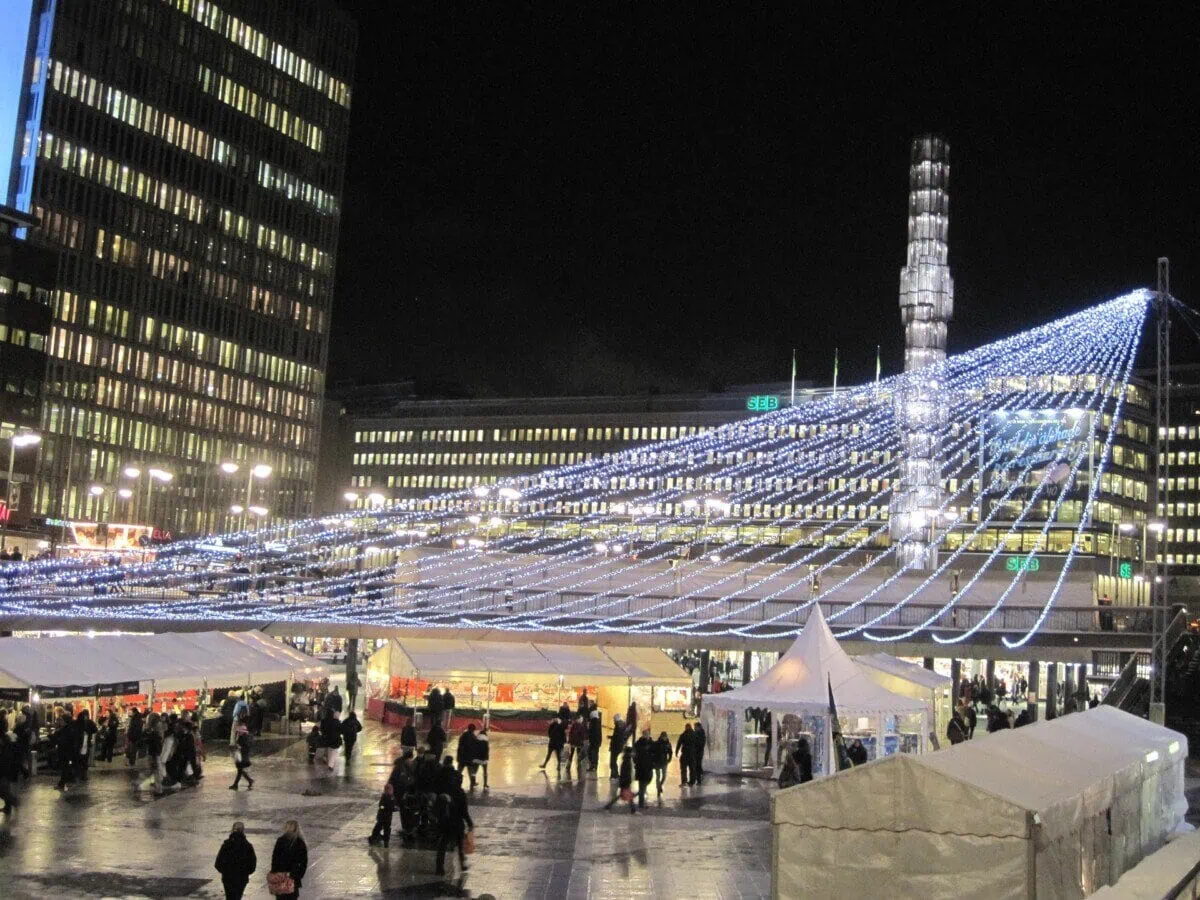
Stockholm’s churches also keep up a busy schedule of Advent and carol concerts through the weeks before Christmas beyond the Lucia-specific events already mentioned, with many, particularly in Gamla Stan and on Södermalm, free to attend or asking only a modest donation on the door. For visitors happy to venture slightly further out, several of the city’s Christmas lights displays along Drottninggatan and around Sergels Torg are worth timing a walk around after dark, when they’re at their most photogenic.
New Year’s Eve in Stockholm
Stockholm’s New Year’s Eve centres on a genuinely unusual national tradition: since the mid-1890s, an actor at Skansen has read Tennyson’s poem “Ring Out, Wild Bells” (Ring, Klocka, Ring in Swedish translation) live on national television just before midnight, a custom that’s been broadcast almost every year for well over a century.
Skansen itself runs extended New Year’s Eve hours, typically 10am to 4pm and then 8pm to midnight on 31 December, followed by normal daytime hours on 1 January, drawing large crowds for the reading and the museum’s own fireworks display over the surrounding water.
For the midnight fireworks over central Stockholm, the best free viewpoints are the clifftop spots on Södermalm: Skinnarviksberget, Monteliusvägen, Fjällgatan, Vita Bergen and Mosebacketerassen all give a wide, elevated view over the water as fireworks go up from multiple points around the city simultaneously.
For a more formal evening, the Royal Opera House typically stages a New Year’s concert, and several central hotels and restaurants run ticketed gala dinners; booking well ahead is essential for either option given how far in advance Stockholm’s New Year’s Eve tends to sell out.
The poetry reading tradition traces back to the actor Anders de Wahl, who recited Edvard Fredin’s Swedish translation, titled Nyårsklockan (“The New Year’s Bell”), at Skansen and continued doing so annually until his death in 1956. The event has been broadcast live on SVT, Sweden’s national public broadcaster, since 1977, and it remains one of the most-watched moments of Swedish television each year, with a rotating cast of well-known actors taking on the reading since.
Unlike cities with one official, centrally organised firework show, Stockholm’s midnight display is genuinely scattered: fireworks go up privately from balconies, rooftops, boats and waterfront gardens right across the city rather than from a single launch point, which is part of why the clifftop viewpoints on Södermalm work so well, since they put dozens of separate displays within view at once. Dress for standing outside in sub-zero temperatures for at least half an hour either side of midnight if you’re heading to one of the viewpoints, since good spots fill up well before the fireworks start.
Glögg, Julbord and Swedish Christmas Food
Glögg, Sweden’s version of mulled wine, is served warm and spiced with cardamom, cinnamon and cloves at every market on this list, usually with almonds and raisins added to the cup, and alcohol-free versions are widely available for drivers and children.
The centrepiece of a Swedish Christmas, though, is the julbord, a lavish buffet traditionally eaten on Christmas Eve at home but served by restaurants across Stockholm throughout December. A proper spread includes several styles of sill (pickled herring), cured and smoked salmon, Swedish meatballs, a mustard-glazed Christmas ham, and Janssons frestelse, a creamy potato and anchovy casserole.
A hot course built around lutfisk, lye-cured fish with a famously divisive texture, remains a fixture on many julbord tables despite being an acquired taste for first-time visitors, while ris à la Malta, a spiced rice pudding, typically closes the meal alongside a glass of julmust, a sweet, dark Christmas soft drink found in every supermarket through December.
Restaurant julbord bookings, including well-known venues like Stadshuskällaren beneath City Hall and Skansen’s own restaurants, sell out well ahead of the season, so booking from early autumn is genuinely necessary rather than optional for a popular sitting.
Prices vary enormously by venue: a typical restaurant julbord in Stockholm runs from around 300 to 1,800 SEK per person (roughly £23-135/€26-160/$29-170), with lunch sittings consistently cheaper than dinner at the same restaurant and weekday prices generally undercutting weekend rates. Budget options do exist at the lower end of that range, while the grander hotel and restaurant spreads sit firmly at the top, so it’s worth deciding on a budget before browsing menus rather than after.
Structurally, a julbord is usually worked through in stages rather than piled onto one plate: cold fish dishes, principally the various sill preparations, come first, followed by cold cuts and pâtés, then the hot dishes such as meatballs, ham and Janssons frestelse, with dessert saved for last. A small glass of akvavit or snaps, traditionally drunk with the herring course, is a fixture at more traditional sittings, though soft alternatives are always available for anyone who’d rather skip the spirits.
Getting Around and Holiday Opening Hours
Stockholm’s metro, buses and trams run on a normal timetable through most of December, though services are reduced on 24, 25 and 26 December and on New Year’s Day itself, so it’s worth checking SL’s holiday schedule before relying on a specific late-night connection.
Sweden observes 24, 25 and 26 December, and 1 January as public holidays, and most shops, supermarkets and offices close completely on those dates, with only small convenience kiosks and some petrol stations typically staying open.
Outside the holidays themselves, Drottninggatan’s shops generally extend their December hours compared with the rest of the year, often opening earlier and closing later in the two weeks before Christmas Eve to accommodate gift shopping.
Several major attractions, including the Vasa Museum and Skansen, stay open on reduced but genuine hours on both Christmas Eve morning and New Year’s Eve and Day, making them useful options for visitors in the city over the holiday period itself.
A single SL ticket for the metro, bus and tram network costs around 43 SEK (roughly £3/€4/$4) and is valid for 75 minutes across unlimited transfers, though anyone covering several markets in one day is generally better off with a 24 or 72-hour travel card bought through the SL app rather than paying per journey. The same app also carries live disruption alerts, worth checking on the reduced-service days around Christmas and New Year when engineering works are more likely to be scheduled.
Restaurants and cafés follow a more varied pattern than shops over the holidays: many close entirely on 24 and 25 December but reopen for at least part of 26 December and New Year’s Eve itself, particularly around Gamla Stan and Djurgården where tourist footfall stays high. It’s worth booking ahead for anywhere you specifically want to eat on those dates, since opening hours can change at short notice and a good number of kitchens run reduced menus even when the doors are open.
Stockholm’s December Weather and What to Pack
Stockholm’s December sits firmly on the cold side of a European Christmas trip. Daytime highs typically run from around 2°C (36°F) early in the month down to about 0°C (32°F) by New Year, with overnight lows regularly dropping below freezing, colder than markets further south such as Copenhagen or Cologne.
Snow is a genuine possibility rather than a novelty, and daylight is short even by Nordic standards, with the sun rising after 8am and setting well before 3pm around the winter solstice, which is exactly why the markets and the Lucia processions are built around candlelight and lit displays.
A genuinely insulated winter coat, thermal base layers, and waterproof, insulated boots matter more here than at a milder market city; cobbled streets around Gamla Stan and the paths on Djurgården can turn icy quickly once temperatures drop.
Gloves, a warm hat and thermal socks are worth packing specifically for standing still at the Kungsträdgården rink or queuing outside Skansen’s market stalls, since the cold there is a different order of magnitude from a quick dash between shops.
Daylight is the bigger adjustment for most first-time winter visitors than the cold itself: around the winter solstice on 21 December, Stockholm gets under six hours of daylight, with the sun not rising until well after 8am and setting again not long after 2pm. That short window is exactly why so much of the city’s Christmas programming, from the markets to the Lucia processions, leans on candlelight rather than daylight for its atmosphere.
Layering matters more than any single item: a base layer, a mid-layer such as fleece or wool, and a properly windproof and insulated outer shell will cope with most December days, and it’s easier to remove a layer inside a warm museum or café than to have brought too little. Anyone planning to be outdoors for extended periods, at the Kungsträdgården rink or during an evening at Skansen, should also consider hand and toe warmers, a small, cheap addition that makes a genuine difference over several hours.
Getting to Stockholm and Where to Stay
Arlanda Airport connects to the city centre by the direct Arlanda Express train in around 20 minutes, or more slowly and cheaply by SL commuter train or bus, all covered in detail in our dedicated Stockholm Airport Transfers guide for anyone flying in specifically for the festive season.
Once in the city, the market route above is entirely manageable by public transport, and a car adds cost and parking headaches rather than saving time given how central most of the sites are.
A well-located double room in central Stockholm in December typically runs from around 1,200 to 1,800 SEK (£90-135/€105-160/$115-170) a night, with prices climbing over the New Year’s Eve weekend itself.
Staying somewhere within reach of Gamla Stan, Norrmalm or Kungsträdgården keeps most of the markets within a short tram or metro ride, and a three or four-night stay gives enough time to properly cover the markets, a julbord dinner, and at least one of the wider events covered above.
The Arlanda Express covers the 18-minute run into the city for around 340 SEK one-way or 640 SEK return (roughly £26/€30/$32 one-way), and while that’s noticeably pricier than the SL commuter train alternative, the time saved is worth it for anyone arriving with limited daylight hours to work with. Bromma Airport, closer to the centre than Arlanda but served by fewer international routes, is worth checking for flights from within Scandinavia and a handful of other European cities.
For a different kind of arrival, overnight ferries with operators including Viking Line and Tallink Silja connect Stockholm with Helsinki, Turku and the Baltic states, docking centrally enough that no separate transfer into the city is usually needed. Combined with a festive city break, an overnight crossing either side of a Stockholm stay is a genuinely different way to bookend the trip rather than flying in and out both ways.

Rupert’s Handy Travel Tips
Rupert reckons Stockholm’s spread-out markets reward a little planning more than most Christmas cities.
- Save Skansen for the evening: its candlelit buildings look far better after dark than in flat daylight.
- Book your julbord early: popular restaurants like Stadshuskällaren take bookings from early autumn and sell out well before December.
- Check Lucia listings close to 13 December: processions and concerts are published nearer the date, and the best ones fill up fast.
- Watch the Skansen poetry reading: it’s broadcast live on Swedish TV every New Year’s Eve and is a genuine slice of local culture.
- Pack for real cold, not just damp: Stockholm runs colder overnight than markets further south, so proper thermals earn their place.
Want to meet the reindeer behind our travel tips? Find out more in our page Who is Rupert?.




Best for solo travellers and anyone watching the budget. Dorm beds and private rooms in the same search.
Browse hostelsBest for anyone flying more than once or twice a year. Handles the compensation claim so you are not chasing the airline.
See AirHelp+Best for the gap between checking out and your train. Drop bags at a shop or hotel nearby and carry on.
Store your bagsFrequently Asked Questions About Christmas in Stockholm
When do Stockholm’s Christmas markets open in 2026?
Skansen typically runs weekends from late November to around 21 December, and Stortorget in Gamla Stan runs daily from late November to around 23 December, though several smaller markets confirm exact dates closer to the season.
What is Lucia and when does it happen?
Lucia is celebrated on 13 December and involves candlelit processions of white-robed singers across churches, schools and workplaces throughout the city, widely seen as the true start of the Swedish Christmas season.
Are Stockholm’s Christmas markets free to enter?
Most are. Stortorget, Rosendals Trädgård and Kungsträdgården are all free to browse; Skansen charges for its wider museum and zoo admission, and Drottningholm’s occasional market varies by year.
What should I eat at a Stockholm Christmas market?
Glögg (Swedish mulled wine) and roasted almonds are the market staples, while a full julbord buffet with herring, ham and Janssons frestelse is the wider Swedish Christmas tradition worth booking at a restaurant.
How does Stockholm celebrate New Year’s Eve?
With fireworks over the water viewed from Södermalm’s clifftop viewpoints, extended hours at Skansen, and a nationally televised reading of Tennyson’s “Ring Out, Wild Bells” that’s been a Skansen tradition since the mid-1890s.
Is Stockholm open on Christmas Day?
Mostly no. Shops and most attractions close on 24, 25 and 26 December, though a handful of major museums run limited holiday-period hours, so checking individual venues in advance is worth doing.
Further Reading
For everything else worth doing in the city outside the festive season, see our Things to Do in Stockholm guide, covering the city’s museums, old town and islands in full.
Anyone extending a Stockholm Christmas trip further afield should also read our Day Trips from Stockholm guide, including several destinations that run their own smaller winter markets.
For getting into the city over the holidays, our Stockholm Airport Transfers guide covers the Arlanda Express, buses and taxis from both Arlanda and Bromma.