Reviewed by our editorial team Published
Munich Airport: Germany’s Best-Connected Gateway to the Alps
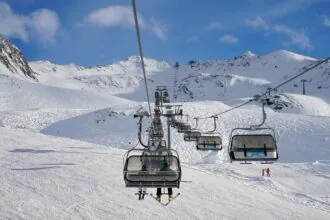
Munich Airport (MUC) sits roughly 28 kilometres from the city centre, but its real value to a winter traveller has nothing to do with Munich itself. It functions as the busiest, best-served entry point into the Bavarian and western Austrian Alps, with a direct rail link from the terminal into a network that fans out towards some of Europe’s most famous ski country within a couple of hours.
Compare that with the alternatives. Innsbruck Airport sits closer to the mountains but flies a fraction of MUC’s routes, and Salzburg Airport is similarly limited outside the winter charter season. For many travellers flying from outside the Alps, especially from the UK, North America, or long-haul, Munich is simply the airport with the most flights, the most competitive fares, and the most reliable rail connections onward.
This guide covers four resort destinations reachable from MUC by public transport: Garmisch-Partenkirchen, gateway to the Zugspitze and Alpspitze ski areas inside Germany; Innsbruck, the Tyrolean capital and jumping-off point for the Stubai Glacier and a dozen surrounding resorts; and, further into Austria, Kitzbühel and Zell am See, two of the country’s best-known winter towns.
The rail backbone changes operator partway. Deutsche Bahn (DB) runs the trains within Germany, and ÖBB (Austrian Federal Railways) takes over on Austrian soil, with the main Munich-Innsbruck-Verona corridor actually run as a joint DB-ÖBB EuroCity service rather than a straightforward handover at the border. Knowing which company to check for timetables and disruption updates matters more than it sounds once a connection is tight.
None of the four routes below is a genuine single-seat journey from the terminal, and this guide says so plainly rather than glossing over it. Every resort needs at least one change, usually at Munich Hauptbahnhof, and the more distant Austrian towns need a second change further down the line, so the sections below give a realistic door-to-resort estimate rather than just the headline train time between two stations.
Alongside the train, every resort here also has a private transfer option worth weighing up, particularly for families travelling with ski bags and boot cases. The sections that follow lay out both routes for each destination, with realistic costs, so the choice comes down to genuine trade-offs rather than guesswork.
| Resort | Country | Direct or Change Needed | Realistic Door-to-Resort Time | Best Transport Option |
|---|---|---|---|---|
| Garmisch-Partenkirchen | Germany | 1 change, at Munich Hbf | About 2 to 2.5 hours | S-Bahn + DB Regio Werdenfelsbahn |
| Innsbruck & Stubai Glacier | Austria | 1 change, at Munich Hbf | About 3 to 3.5 hours | S-Bahn + DB-ÖBB EuroCity |
| Kitzbühel | Austria | 2 changes, at Munich Hbf and Wörgl | About 3.5 to 4 hours | S-Bahn + EuroCity + ÖBB regional |
| Zell am See | Austria | 2 to 3 changes, at Munich Hbf and Wörgl or Salzburg | About 4 to 4.5 hours | S-Bahn + EuroCity + ÖBB regional |
Garmisch-Partenkirchen: Gateway to the Zugspitze and Alpspitze
Garmisch-Partenkirchen is the closest genuine ski town to Munich Airport, and it is the only one of the four covered here that stays entirely inside Germany. It gives access to two separate ski areas: the Zugspitze glacier, reachable via the Bayerische Zugspitzbahn cogwheel railway, and the lower Alpspitze/Garmisch-Classic area served by the Hausberg and Kreuzeck cable cars right above the town.
There is no through-train from the airport itself. The journey requires one change, taking the S8 or S1 S-Bahn from MUC into Munich Hauptbahnhof (about 45 minutes), then switching to a DB Regio regional train running under the Werdenfelsbahn brand, which departs roughly hourly and reaches Garmisch-Partenkirchen station in around 70 to 80 minutes.
On board, the Werdenfelsbahn’s Regional-Express services are simple single-deck regional stock rather than anything with a restaurant car. There is a decent luggage rack at each end of the carriage, but no dedicated ski storage, so anyone travelling with boot bags in peak season weekends should board a stop or two early to guarantee space.
Combined public transport for the whole trip runs to roughly €35 to €40 (£30-34/$41-47) one-way per adult, though a group of two or more should compare that against Bavaria’s own Bayern-Ticket, which covers unlimited regional trains and local transport across the whole state for a flat day rate from around €34 (£29/$40) for the first traveller plus roughly €10 (£9/$12) for each additional person.
A pre-booked private transfer covering the full run from the airport to a Garmisch hotel typically starts from around €190 to €230 (£163-198/$222-269) for a standard car carrying up to three passengers with ski gear, which becomes genuinely worthwhile for a family of four or more once the train fare, the change of platform, and the walk with kit are all weighed against a single door-to-door price.
For a solo traveller or a couple with light hand luggage, the train remains the sensible default given how short the total journey is compared with the other three resorts in this guide. Anyone planning a single-day Zugspitze visit rather than a multi-day ski stay should also read our dedicated Visit Zugspitze guide for the mountain transport system itself.
Best if you want daily housekeeping and a front desk. Filter by area first, then by price.
Check availabilityBest for families, or any stay past about four nights. A kitchen and a washing machine start paying for themselves.
Browse rentalsBest if you have already picked a hotel. Checks the big booking sites for the same room and shows who is cheapest.
Check dealsInnsbruck and the Stubai Glacier: The Cross-Border EuroCity Route
Innsbruck is the natural next step up from Garmisch for anyone wanting a wider choice of resorts, since the Tyrolean capital sits within reach of the Stubai Glacier, Axamer Lizum, and half a dozen other ski areas via its own well-developed local transfer network. It also crosses into a second country, which is exactly where the operator handover matters.
As with Garmisch, there is no direct service from the airport terminal, so the first leg is the same S-Bahn transfer into Munich Hauptbahnhof. From there, however, the onward leg is a genuine through-train: a EuroCity service jointly operated by DB and ÖBB, part of the long-standing Munich-Innsbruck-Verona corridor, running several times a day and covering Munich Hbf to Innsbruck Hbf in around 2 hours without a further change.
Onboard, the EuroCity fleet on this corridor carries a bistro/restaurant car or an at-seat trolley service depending on the specific train, along with proper luggage racks at each carriage end. There is no dedicated ski-storage compartment, and during Christmas, New Year, and February half-term these trains can run close to full, so booking a seat reservation alongside the ticket is genuinely worth the small extra cost.
Fares vary enormously by how far ahead they are booked. Advance-purchase tickets for the Munich Airport to Innsbruck run start from around €20 to €25 (£17-21/$23-29) one-way, while a flexible, buy-on-the-day fare can run closer to €45 to €55 (£39-47/$53-64), so booking even a few days ahead makes a real difference on this route.
A private transfer from MUC directly to Innsbruck or on to the Stubai Glacier typically starts from around €230 to €270 (£198-232/$269-316) for a standard car, which starts to look reasonable once split between three or four people carrying full ski kit rather than trying to manage a change at Munich Hbf with an overloaded luggage trolley.
For genuine depth on getting from Innsbruck itself out to individual resorts and lift bases, our dedicated Innsbruck Airport to the Ski Resorts guide covers that local leg in far more detail than makes sense to repeat here.
Kitzbühel: Two Changes for One of Austria’s Best-Known Resorts
Kitzbühel needs no introduction to anyone who follows ski racing, and its blend of a genuinely pretty medieval town centre with the vast Kitzbüheler Alpen (KitzSki) lift network makes it one of the most-searched Austrian resorts among Munich Airport arrivals. Reaching it, however, is where this guide has to be honest that the journey stops being a simple one-change trip.
After the S-Bahn into Munich Hauptbahnhof, travellers board the same DB-ÖBB EuroCity used for Innsbruck, riding it as far as Wörgl in the Tyrolean lowlands rather than all the way to Innsbruck itself. From Wörgl, a second change onto an ÖBB regional or REX service covers the short final stretch down the branch line to Kitzbühel Hauptbahnhof, a journey of around 20 minutes.
That second leg runs on straightforward regional Tyrolean stock rather than long-distance rolling stock, so there is no restaurant car and only vending-machine catering, but luggage racks are adequate for a couple of ski bags per traveller. Because this branch line runs roughly hourly rather than the more frequent EuroCity corridor, missing a tight connection at Wörgl can add a genuine hour to the day.
All told, a realistic door-to-resort estimate including both changes runs to 3.5 to 4 hours, noticeably longer than the headline train time between the two main stations suggests. Public transport fares for the full run typically total around €45 to €60 (£39-52/$53-70) one-way per adult depending on how far ahead the EuroCity leg is booked.
This is exactly the kind of journey where a private transfer starts to earn its higher price tag. A standard car from Munich Airport straight to a Kitzbühel hotel typically starts from around €260 to €300 (£224-258/$304-351), and for a family of four with full ski kit and two changes to manage otherwise, that becomes a genuinely close call rather than an obvious luxury upgrade.
Anyone travelling solo or as a couple with light luggage and some flexibility on timing will still generally find the train the cheaper, if slower, option, provided the Wörgl connection is booked with a comfortable buffer rather than the tightest scheduled gap.
Zell am See: The Longest of the Four, and Worth Planning Around
Zell am See, paired with the glacier resort of Kaprun, sits further along the same Tyrolean and Salzburg-region rail corridor as Kitzbühel, and it is the most demanding of the four destinations in this guide to reach by public transport. It is included because plenty of travellers genuinely do fly into Munich for it, not because the journey is short.
There are two realistic route options, and which one works out faster depends on the day’s timetable. One follows the same path as Kitzbühel, via Munich Hbf and Wörgl, continuing further down the regional branch line past Kitzbühel to Zell am See; the other runs via Munich Hbf and Salzburg, joining the Salzburg-Tyrol regional line from the opposite direction.
Either way, this is a genuine two-to-three-change journey, not a through-service with a single easy connection, and it deserves to be planned as such rather than treated as an afterthought tacked onto a Munich city break. A realistic door-to-resort estimate, including the walk between platforms at each change, runs to 4 to 4.5 hours door to door.
The regional legs at either end of the journey run on standard Austrian regional stock with vending-machine catering only, so anyone travelling with small children should plan food and drink before boarding rather than relying on an onboard trolley. Combined public transport fares typically run to around €55 to €70 (£47-60/$64-82) one-way per adult.
Given the number of changes involved, a private transfer is genuinely worth serious consideration for Zell am See specifically, more so than for any other resort in this guide. A standard car from Munich Airport typically starts from around €300 to €350 (£258-301/$351-410), and once that is split across a family or a group of four, the time saved (often two hours or more against the train) can matter as much as the money.
Travellers with real flexibility on timing and a genuine tolerance for changing trains twice will still find the public route workable, but anyone arriving on a tight schedule, with young children, or after an overnight flight should budget for the private option here rather than assume the train will be the easy default it is for Garmisch or Innsbruck.
Which Transport Option Makes Sense for You?
The right choice across these four routes depends far more on who is travelling and with how much luggage than on which resort is the final destination. A solo traveller or couple with a single backpack and hired skis waiting at the resort should default to the train for every destination here, since the fare saving over a private car is largest exactly when there is no ski gear to haul between platforms.
A family or group with a full set of ski bags, boot cases, and helmets faces a very different calculation, particularly for Kitzbühel and Zell am See, where two changes with heavy kit is a genuinely different experience from the same changes with hand luggage alone. For those two resorts specifically, the private transfer’s extra cost buys real practical relief, not just comfort.
Anyone travelling on a tight budget should still lean towards the train wherever the schedule allows, booking the EuroCity leg as far ahead as possible to catch the lower advance fares rather than paying the flexible walk-up price on the day. The saving between an advance and a walk-up EuroCity fare alone can cover a meaningful share of a week’s lift pass.
Travellers who are genuinely time-pressed, whether landing late after a long-haul flight or trying to make the most of a short break, should weigh the private transfer more seriously the further the resort sits from Munich. For Garmisch, the time difference between train and transfer is modest; for Zell am See, it can mean arriving in time for an afternoon on the slopes instead of losing the whole first day to travel.
As a general rule, use the train for Garmisch-Partenkirchen and Innsbruck unless luggage or timing genuinely rules it out, and treat a private transfer for Kitzbühel or Zell am See as a legitimate, often sensible choice rather than an unnecessary splash-out, given how many changes the public route actually involves once the headline train times are set aside.
Hiring a Car at Munich Airport for the Drive Up to the Mountains
For anyone who values a flexible itinerary, picking up a car directly at Munich Airport turns the whole trip into a single unbroken journey rather than a series of scheduled connections. Every major rental brand operates from the airport’s own rental centre, including Hertz, Sixt, Europcar, Avis, Budget, Alamo, Enterprise and National, so there is no need to pre-book weeks in advance simply to guarantee a car is available on arrival.
Winter driving in Bavaria comes with a genuine legal obligation rather than a polite suggestion. Germany’s road traffic law, the StVO, requires winter tyres on every wheel whenever conditions turn to black ice, snow, slush or frost, a situational rule rather than a fixed calendar date, though the rough guide among German drivers is “O bis O”, roughly October to Easter. Tyres need the 3PMSF Alpine symbol (a mountain and snowflake pictogram) rather than the older M+S marking alone, and a car caught without compliant tyres in genuinely wintry conditions risks a fine starting at €60 and rising sharply if other road users are put at risk.
The practical upside is that rental companies at Munich Airport fit winter tyres as standard through the whole winter window, typically 1 November to 31 March, at no extra charge, since it is their own legal obligation to hand over a compliant car. It is still worth confirming this at the desk rather than assuming, particularly for a car picked up right at the edge of that date range, and asking whether snow chains are available to reserve, since they can be genuinely necessary on the steeper, less-gritted approach roads into resorts like Kitzbühel.
Crossing into Austria adds a second, overlapping set of rules rather than replacing the German ones. Austria’s own winter tyre law runs from 1 November to 15 April, again triggered by actual road conditions rather than the calendar alone, with a minimum 4mm tread depth for winter tyres against the year-round legal minimum of 1.6mm. Snow chains can also be mandatory on specific signed mountain routes regardless of what tyres are fitted, so it is worth asking the rental desk whether the resort roads on this itinerary, particularly the climbs into Kitzbühel or the Zell am See and Kaprun area, fall into that category before setting off. A car already fitted for German winter law will generally satisfy Austria’s requirement too, but the tread depth and the chain question are worth asking directly rather than assuming.
On cost, a compact car or compact SUV hired for a week through one of the major brands at MUC in ski season typically runs to somewhere around €320 to €420 (£275-361/$374-491), climbing to roughly €500 to €650 (£430-559/$585-761) for a genuine 4×4 or all-wheel-drive model, which is worth the premium for anyone tackling the steeper approach roads above Garmisch or Kitzbühel rather than sticking to the valley floor. Rates spike hard around Christmas, New Year and February half-term, so booking several weeks ahead makes a real difference to the final price.
A couple of other practicalities matter more in winter than at other times of year. Most German rental cars come with an Austrian motorway vignette already fitted if the booking flags cross-border travel, but it is worth confirming this rather than discovering the gap at an Austrian toll gantry, and a satnav or phone-based navigation system genuinely earns its keep on unfamiliar mountain roads in the dark, since several of the final approach roads into these resorts are narrow, switchback lanes rather than anything resembling a motorway.
Explore Munich with a Hire Car
Hiring a car can open up more of Munich and its surrounding region, giving you the freedom to travel beyond the main public transport routes.
Compare offers from Discover Cars and EconomyBookings before booking so you can check both price and rental conditions.
Booking a Private Transfer: What It Actually Costs and When It Beats the Train
Alongside the per-resort transfer prices already covered above, it is worth stepping back and looking at pre-booked private and shared transfer services as their own category, since a specialist ski-transfer operator is a genuinely different product from simply calling a taxi at the arrivals hall. These services are built specifically around ski luggage, quoting a price that already assumes boot bags, boards and boot cases rather than treating them as an awkward extra, and they drop directly at the hotel door rather than the nearest train station.
Pricing generally comes in two shapes. A shared transfer, where the vehicle also picks up or drops other travellers along a similar route, is the cheaper option and on the Munich to Kitzbühel run typically starts from around €42 per person (£36/$49) for a journey of roughly 1 hour 50 minutes. A private transfer, booked exclusively for one party with no other stops, costs more but removes the waiting and detours that come with sharing a vehicle, and on the longer Munich to Zell am See run typically starts from around €72 per person (£62/$84) for a journey of around 2 hours 40 minutes door to door.
The case for booking ahead rather than defaulting to the train comes down to three things: luggage, group size and the exact drop-off point. A family or group of four travelling with a full set of ski bags, boot cases and helmets avoids every platform change and luggage trolley entirely, and the private transfer’s per-car price, split four ways, often works out close to four individual train fares once the hassle of two changes with heavy kit is priced in. A private or shared transfer also removes the walk between platforms altogether and drops directly outside the hotel rather than at a resort’s central station, which matters more than it sounds for Garmisch, Kitzbühel and Zell am See, where the final stretch from the train station to an outlying chalet or hotel would otherwise need a taxi or local bus anyway.
Where the train still wins is flexibility and cost for smaller, lighter-travelling parties. A solo traveller or couple with hand luggage and skis hired locally at the resort will almost always find the train cheaper, and the ability to catch an earlier or later departure without a cancellation fee has genuine value on a trip where flight delays are always a possibility. Anyone weighing the two options is best served by comparing the per-person shared transfer price directly against the advance train fare for their specific dates, since the gap narrows considerably outside peak ski-season weeks.
Compare Airport Transfer Companies
Pre-booking your airport transfer can save time and reduce stress when you arrive. Whether you need a private taxi, shared shuttle or executive transfer, comparing providers can help you find the best price and service for your journey.
We’ve selected three trusted airport transfer companies so you can compare prices, vehicle options, cancellation policies and customer reviews before you travel.

Rupert’s Handy Travel Tips
Heading for the slopes from Munich Airport? Rupert has a few tips worth knowing before you set off:
- Never assume a through-train exists: every route in this guide needs at least one change at Munich Hbf, so build a realistic connection buffer into your plan rather than the tightest scheduled gap.
- Check whether it’s a DB or ÖBB service before you travel: the Munich-Innsbruck EuroCity is jointly run by both, but timetable and disruption updates are easiest to find on whichever operator’s own app covers the specific leg.
- Reserve a seat for peak ski season: Christmas, New Year, and February half-term trains on the Innsbruck corridor genuinely fill up, and a reservation costs very little next to the ticket itself.
- Board a stop or two early with ski bags: none of these regional trains carry dedicated ski storage, so grabbing luggage-rack space before the crowds board makes a real difference.
- Weigh the private transfer seriously for Kitzbühel and Zell am See: two or three changes with full ski kit is a different experience to the same changes with hand luggage alone.
- Book the EuroCity leg in advance where you can: the gap between an advance and a walk-up fare on the Innsbruck corridor is often the price of a lift pass day.
Want to meet the reindeer behind our travel tips? Find out more in our page Who is Rupert?.




Best for finding routes the airlines do not sell as a single ticket. Combines carriers to bring the fare down.
Search flightsBest if you want maps and messaging working the moment you switch your phone on.
See eSIM plansBest after a long flight or a late landing. Price agreed before you travel, and no taxi queue.
Check transfersFrequently Asked Questions About Munich Airport to the Ski Resorts
Is there a direct train from Munich Airport to any of these ski resorts?
No. Every route in this guide needs at least one change, usually at Munich Hauptbahnhof, and the more distant Austrian resorts need a second change further down the line.
Which operator runs the trains from Munich to Innsbruck?
The Munich-Innsbruck EuroCity is jointly operated by Deutsche Bahn (DB) and ÖBB (Austrian Federal Railways) as part of the wider Munich-Innsbruck-Verona corridor.
How long does it take to reach Garmisch-Partenkirchen from Munich Airport?
A realistic door-to-resort estimate is around 2 to 2.5 hours, combining the S-Bahn into Munich Hauptbahnhof with the hourly DB Regio Werdenfelsbahn train onward.
Do I need to reserve a seat for a ski-season train journey?
It is genuinely worth it on the Innsbruck EuroCity corridor during Christmas, New Year, and February half-term, when trains can run close to full.
Is a private transfer worth booking from Munich Airport to an Austrian resort?
For Kitzbühel and Zell am See specifically, yes, particularly for families with full ski kit, since both destinations need two or more train changes that a private transfer skips entirely.
Can I buy one ticket covering the whole Munich Airport to Innsbruck journey?
Yes, a through-ticket covering the S-Bahn and the onward EuroCity can normally be booked as a single fare through either DB or ÖBB’s own booking channels.
Is Kitzbühel or Zell am See easier to reach from Munich Airport?
Kitzbühel is the shorter and simpler of the two, needing two changes and around 3.5 to 4 hours door to door, while Zell am See typically needs two to three changes and closer to 4 to 4.5 hours.
Which resort is best for a first ski trip from Munich Airport?
Garmisch-Partenkirchen is the simplest choice for a first trip, since it needs only one change and stays entirely within Germany, while Innsbruck suits travellers wanting a wider choice of resorts for a similar level of travel effort.
Further Reading & Related Guides
If you are still working out how to get from the terminal into Munich itself before heading on to the mountains, our Munich Airport Transfers guide covers every realistic way of reaching the city centre from MUC, while our Best Things to Do in Munich guide is worth a look if a night or two in the city is part of the plan either side of a ski trip. Early-season skiers passing through in late November or December should also check our Munich Christmas Markets guide before heading up to the mountains.
For a full day trip rather than a multi-day ski stay, our Best Day Trips from Munich guide covers Zugspitze alongside Neuschwanstein and Dachau, and our dedicated Visit Zugspitze guide goes into the mountain transport system itself in far more depth than makes sense to repeat here.
Travelling onward from the Austrian side instead of flying into Munich? Our Innsbruck Airport to the Ski Resorts guide and Salzburg Airport to the Ski Resorts guide cover the same corridor from the Austrian end, and are a useful comparison for anyone weighing up which airport to actually fly into.