Reviewed by our editorial team Published
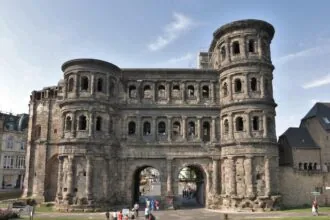
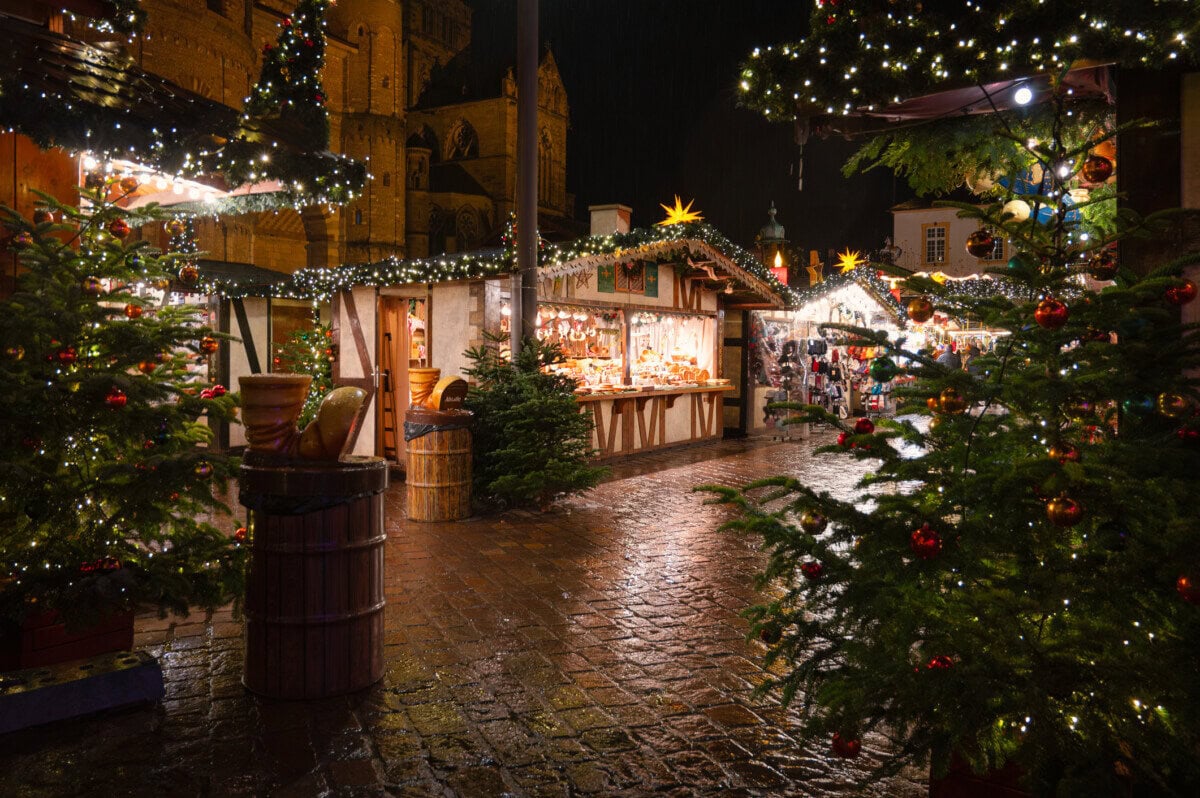
Trier calls itself Germany’s oldest city, founded by the Romans as Augusta Treverorum more than two thousand years before Berlin or Munich existed, and every winter its Roman backdrop becomes the stage for one of the country’s most atmospheric Christmas markets. The Trierer Weihnachtsmarkt fills the medieval Hauptmarkt and spreads around the Domfreihof beside Trier Cathedral, with the soot-blackened Roman gate of the Porta Nigra standing watch a short walk away.
What sets Trier apart from Germany’s bigger, more famous markets is its position at the heart of the Moselle wine region, and the market leans into that identity hard. Trier is the only German Christmas market with an official Glühweinkönigin, or Mulled Wine Queen, whose job is to champion the local Winzerglühwein made from real Moselle grapes rather than the generic spiced wine sold at most other markets.
Beyond the stalls there is a genuine ice rink, a full programme of carol concerts and puppet shows on the Domfreihof stage, and a Christmas-lit shopping street running straight from the Porta Nigra to the Hauptmarkt. In 2026 the market marks its 46th edition, and in 2024 it was named Germany’s best Christmas market by European Best Destinations, a genuine accolade for a market that still draws far fewer overseas visitors than Cologne or Nuremberg.
This guide covers both market sites in detail, exactly what is sold and eaten there, realistic costs in euros, and the practicalities that catch visitors out, including Germany’s stricter Sunday and public holiday shop closures. It also covers the short cross-border train ride to Luxembourg City, a popular add-on for anyone building a two-market Christmas weekend, and what Trier does to see in the new year.
| Market/Location | Approx. Dates (2026) | Hours | Nearest Transport |
|---|---|---|---|
| Hauptmarkt Christmas Market | 20 Nov – 22 Dec 2026 | Mon-Thu 11:00-20:30, Fri-Sat 11:00-22:00, Sun 11:00-20:00 (closed 22 Nov, Totensonntag) | Trier Hauptbahnhof, 15-min walk |
| Domfreihof Christmas Market | 20 Nov – 22 Dec 2026 | Same as Hauptmarkt | Adjoins Hauptmarkt, beside Trier Cathedral |
| Winterland Trier Ice Rink | 18 Nov 2026 – 31 Jan 2027 | Weekdays approx. 13:00-18:30, weekends/holidays approx. 10:00-18:30 | Kornmarkt, 5-min walk from Hauptmarkt |
The Hauptmarkt and Domfreihof Christmas Markets
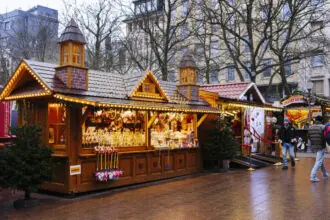
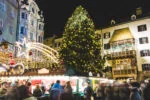
The market is really two connected sites rather than one square. The Hauptmarkt is the historic core, a medieval square ringed by gabled townhouses and the ornate Steipe building, where wooden chalets cluster around the market cross and the Romanesque church of St Gangolf.
A short walk away, the second cluster of stalls fills the Domfreihof, the square beside Trier Cathedral, Germany’s oldest cathedral, and the neighbouring Liebfrauenkirche. This is where the market’s stage sits, in front of the cathedral’s west façade, and where much of the evening entertainment happens.
Across both sites, roughly 90 wooden stalls sell gifts, handicrafts, ornaments and food, with admission free throughout. In 2026 the market runs for its 46th edition, a genuinely long history for a German Christmas market, and in 2024 it was named the best Christmas market in Germany by European Best Destinations.
One quirk worth planning around is that the market closes for a single day partway through its run, on Totensonntag, the last Sunday before Advent begins, which falls on 22 November in 2026. This is a solemn national day of remembrance for the dead in Germany, and it is common practice for German Christmas markets to pause out of respect before reopening the next day.
Ice Skating at Winterland Trier and the Wider Christmas Atmosphere
Trier has a genuine outdoor ice rink, Winterland Trier, set up on the Kornmarkt square just a few minutes’ walk from the Hauptmarkt stalls. It runs for a longer season than the Christmas market itself, from 18 November 2026 through to 31 January 2027, with both hockey and figure skate rentals and an on-site sharpening service.
Opening hours split between a shorter weekday window, roughly 13:00 to 18:30 with two skating sessions, and longer weekend and public holiday hours from around 10:00. Skating is ticketed separately from the free Christmas market, so budget a little extra if the family wants to lace up.
The market itself is officially declared open with a small ceremony on 24 November at 17:00 on the Domfreihof stage, several days after the stalls first open, featuring the Leiendecker Bloas, a well-loved local dialect brass band. It is a distinctly Trier touch, and a reminder that the market is a civic occasion as much as a shopping trip.
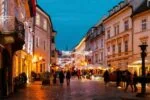
After dark, floodlighting picks out the Porta Nigra and the Hauptmarkt’s medieval gables above the stalls, giving Trier a genuinely different backdrop from purpose-built markets elsewhere in Germany. There is also a nativity scene on the Domfreihof and appearances from Nikolaus, a seasonal touch families with younger children will appreciate.
Best for a short trip. Compare rooms by neighbourhood, price and guest rating before you book.
Compare hotelsBest for families, or any stay past about four nights. A kitchen and a washing machine start paying for themselves.
Browse rentalsBest as a last check before booking. Compares hotel rates across several sites in one search.
Compare ratesCarol Concerts and the Domfreihof Stage Programme
Trier takes its seasonal music seriously. On the stage in front of the cathedral’s west façade, there is a near-daily programme running for most of the market’s four-week duration, mixing traditional carols with family entertainment.
The headline musical draw is the Deutsche Weihnachtsakademie, a touring carol programme that brings in guest tenors, including performer Thomas Kiessling, to sing traditional German Christmas songs in front of the cathedral. It is a genuinely different experience from the recorded music piped through most European markets.
For families, Puppenbühne Rheinland stages puppet theatre performances through the season, and Trier’s own singing Santa Claus makes regular appearances. A children’s choir performance is scheduled for 18 December, timed for the final weekend before Christmas.
Beyond the stage, local artist Roland Grundheber runs hands-on ornament-crafting workshops during the market’s run, and guided historical tours are available exploring the Roman and medieval layers beneath the stalls. Both are worth booking ahead if travelling with children keen to make their own decoration to take home.
Unlike markets that only run background music through speakers, Trier’s stage programme is a genuine reason to plan an evening visit rather than a quick daytime stop. Checking the current Programm listing on the official market website before travelling is worthwhile, since performance times shift through the four-week run and the best carol slots can draw a real crowd around the cathedral steps.
Christmas Shopping on Simeonstraße
Trier’s main shopping street, Simeonstraße, has been a pedestrian zone since November 1971 and runs in a dead straight line from the Porta Nigra down to the Hauptmarkt, making it the natural approach route into the Christmas market for anyone arriving from the station on foot.
The street mixes department stores, a well-stocked bookshop, several cafés, designer boutiques and souvenir shops with genuinely old buildings woven into the retail frontage, including the 1230 Dreikönigenhaus tower and a medieval wine cellar dating to around 1200 that now operates as a restaurant.
Because it is fully pedestrianised and dressed for Christmas alongside the market itself, Simeonstraße functions as an extension of the festive experience rather than a separate errand. It is named after Saint Simeon, a hermit who lived out his final years inside the Porta Nigra, a detail that connects the street directly back to Trier’s Roman gate.
Independent research by property consultancy Jones Lang LaSalle has previously ranked Simeonstraße as the top retail street among German cities of its size, a genuine indicator of how much footfall this one street carries relative to Trier’s modest population. Save any bigger shopping for a weekday or Saturday, for reasons covered below.
What to Buy at the Market: Crafts, Ornaments and Regional Gifts
The roughly 90 stalls across Hauptmarkt and Domfreihof are described by the market’s own organisers as “lovingly decorated,” and the goods on sale lean towards genuine handicrafts rather than mass-produced trinkets. Hand-carved wooden ornaments and traditional German nativity figures are a mainstay, in the same craft tradition found at markets across the country.
Hand-blown glass baubles and decorations turn up at several stalls, alongside more practical wares such as woollens, candles and household gift items, reflecting the market’s roots as a genuine trading event rather than a purely tourist attraction.
What makes Trier’s gift stalls distinctive is the regional angle: several stallholders are Moselle winemakers selling their own bottled Rieslings and Winzerglühwein to take home, a genuine souvenir tied directly to the valley the market sits in rather than a generic gift.
For a more Trier-specific keepsake, look out for small stalls selling Roman-themed trinkets and prints referencing the Porta Nigra and the city’s UNESCO World Heritage status, a souvenir angle unique to Trier among Germany’s Christmas markets.
Because roughly 90 stallholders share only two squares, it is worth walking the full loop of both Hauptmarkt and Domfreihof before buying, since prices and quality for similar wooden ornaments can vary noticeably between neighbouring chalets. Many stalls are run by the same family year after year, so regulars often have a favourite they return to each December.

Winzerglühwein and Other Food to Try at the Trier Christmas Market
The single dish that defines Trier’s market is Winzerglühwein, mulled wine made from real Moselle wine by local winemakers rather than the bulk spiced wine sold at most markets. Trier is the only German Christmas market with an official Glühweinkönigin, whose role each season is to promote this specific regional drink.
Savoury food is well represented too, with a dedicated Reibekuchen (potato pancake) stand a fixture of the market, alongside German Bratwurst and roasted chestnuts sold from braziers, the classic combination found at both Hauptmarkt and Domfreihof stalls.
On the sweeter side, look for sugar-dusted spiral pastries, warm yeast dumplings, and Christmas almond stollen, all genuinely on the market’s own food list rather than generic seasonal filler. Stollen in particular is worth buying whole to take home, since it keeps well.
For an authentic first stop, head to the Domfreihof rather than the busier Hauptmarkt for a Reibekuchen and a cup of Winzerglühwein in front of the cathedral, a combination that captures both the food and the setting in one go.
Non-alcoholic options are easy to find too, with Kinderpunsch, a warm spiced fruit punch, sold alongside the Glühwein at most drinks stalls for anyone travelling with children or driving on. Between the food stands and the wine stalls, it is realistically possible to eat a full evening meal without ever sitting down in a restaurant.
Costs at the Trier Christmas Market
Entry to both the Hauptmarkt and Domfreihof market areas is free, as is standard for German Christmas markets, so the only costs are whatever food, drink and gifts you choose to buy.
A cup of Winzerglühwein typically costs around €5 (£4/$5), and most stalls charge a refundable Pfand deposit of around €3 (£3/$3) on the ceramic mug, returned in cash when you hand the mug back or keep it as a souvenir instead. This deposit system catches out plenty of first-time visitors to German markets, so it is worth knowing in advance.
A Reibekuchen or Bratwurst runs to roughly €5 (£4/$5) to €6 (£5/$7), and a paper cone of roasted chestnuts is typically around €4 (£3/$4). Prices are broadly in line with other German markets, and noticeably cheaper than markets in western European capital cities.
Skating at Winterland Trier is ticketed separately from the free market, and any guided tours or craft workshops carry their own small fee, so families planning a full day of activities should budget beyond the market stalls themselves.
Overall, Trier compares favourably on cost with better-known German markets. A couple can realistically enjoy an evening of Winzerglühwein and Reibekuchen for well under €30 (£25/$32) between them, before factoring in any gifts bought to take home from the craft stalls.
Christmas Opening Hours and Germany’s Stricter Sunday Closing Rules
The Christmas market itself keeps generous hours throughout its run, open Monday to Thursday from 11:00 to 20:30, Friday and Saturday until 22:00, and Sunday until 20:00. That is separate, however, from Trier’s ordinary shops, which follow German law rather than the market’s own hours.
Germany’s Ladenschlussgesetz, the federal shop closing law, treats Sunday as a constitutionally protected day of rest, and this applies across Rhineland-Palatinate as it does in every German state. In practice this means ordinary shops on Simeonstraße close on Sundays, even during the Christmas season, though the market stalls themselves are unaffected since they are not classed as shops under the law.
The same pattern extends to public holidays. Both 25 and 26 December are official public holidays in Germany, Christmas Day and the separate Zweiter Weihnachtsfeiertag, and shops close on both, along with 1 January. This is genuinely stricter than Belgium, where only 25 December is a public holiday and shops can reopen on the 26th, a difference worth knowing if combining Trier with a trip to Bruges or Ghent over the same week.
The practical takeaway is to do any serious Simeonstraße shopping on a weekday or Saturday, and to treat Sundays and the 25th, 26th and 1st as market-and-sightseeing days rather than shopping days, since the Christmas market stalls, cafés and restaurants generally stay open while ordinary retail does not.
Best for long or awkward journeys. Builds one itinerary out of separate flights.
View flightsBest for short trips. Install the eSIM at home and arrive with working data, no shop queue.
Browse eSIMsBest if you would rather not work out the transport on arrival. Book it now and forget it.
View transfersNew Year’s Eve at the Porta Nigra
Trier’s Christmas market closes well before the new year, but the city does not go quiet. On Silvester, the German name for New Year’s Eve, thousands of locals and visitors gather around the floodlit Porta Nigra, which becomes the unofficial focal point for the city’s celebrations.
Private fireworks are widely let off around the Porta Nigra and across the wider old town through the evening and into the early hours, in keeping with the German tradition of buying and setting off your own rockets on 31 December, rather than relying solely on an organised display.
One notable exception is the Hauptmarkt itself, where a fireworks ban is enforced on both 31 December and 1 January to protect the historic medieval square and its buildings, so the heaviest fireworks activity is concentrated around the Porta Nigra rather than the market square.
If visiting for Silvester, dress warmly and expect a lively, crowded but generally good-natured atmosphere, with a visible police presence managing the fireworks. It is a genuinely different experience from the Christmas market weeks, worth extending a Trier trip for if the dates line up.
With the Christmas market itself closed by then, hotels and restaurants around the Hauptmarkt and Simeonstraße stay busy on Silvester night, so book a table or a room well in advance if the new year in Trier is the plan rather than an afterthought.
Roman Heritage, the Moselle Valley and a Day Trip to Luxembourg
No other German Christmas market sits inside a genuine UNESCO World Heritage Roman old town in quite the way Trier’s does. The Porta Nigra, Germany’s best-preserved Roman city gate, anchors the market visually, and Trier’s wider Roman remains, including the Imperial Baths and the amphitheatre, are a short walk from the stalls for anyone extending their visit into daylight hours.
Expect a typical Moselle valley winter: cold, often damp, with temperatures commonly hovering around freezing through late November and December. Layers, a waterproof coat and sturdy shoes for cobbled squares are more useful than a single heavy coat.
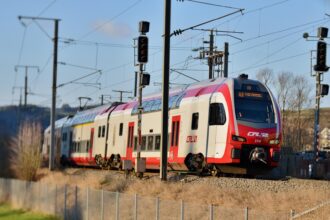
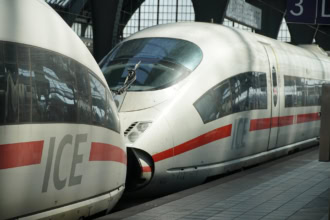
Trier’s other genuine advantage is geography. Luxembourg City is roughly 50 minutes away by direct CFL train, with services running close to hourly, making a two-market day realistic for visitors based on either side of the border. Since public transport within Luxembourg itself is free, the ride is free as far as the last Luxembourg station before the border at Wasserbillig, a detail covered in more depth in our guide to Luxembourg’s free public transport.
Trier also sits within easy reach of Metz and the wider Moselle wine country on the French side of the border, and is well connected by rail for anyone arriving from further afield in Europe. International rail travellers building a wider German itinerary around Trier may find our Interrail Germany Pass guide useful for planning the wider route.
More Than the Market: Trier’s Roman Monuments
Trier’s Christmas stalls sit inside a genuine UNESCO World Heritage Roman old town, and that heritage does not pack away with the chalets in January. The Porta Nigra, the best-preserved Roman city gate north of the Alps, anchors the market by night and remains open to visitors year round, long after the last Winzerglühwein is poured.
A short walk from the Hauptmarkt, the Kaiserthermen, or Imperial Baths, hide a network of underground service corridors that once carried water and heated air beneath the bathing halls. Wandering the tunnels gives a genuinely different sense of Roman engineering than admiring the walls above ground, and the site stays open throughout the festive season and beyond.
Uphill from the baths, the Roman Amphitheatre once held an estimated twenty thousand spectators and still lets visitors descend into the underground cellars beneath the arena floor. Together with the cathedral and Liebfrauenkirche, these monuments form the backbone of a city that was already old when most of Germany’s other Christmas market towns were still forest.
Anyone visiting for the market with a free morning, or planning a return trip once the stalls have packed up, will find the full spread of ruins, wine bars and old town detail covered in our companion guide to Things to Do in Trier. It works as a standalone itinerary for the rest of the year, when the Roman old town has none of the crowds that fill the Hauptmarkt in December.

One-Day Trier Christmas Market Itinerary
For visitors with only one day, Trier rewards splitting it cleanly between Roman daylight sightseeing and after-dark market atmosphere. The following pace works comfortably on foot, since almost every stop below sits within Trier’s compact old town.
Start early at the Porta Nigra, Trier’s blackened Roman gate, before the day-trippers arrive, then walk the fifteen minutes uphill to the Roman Amphitheatre for its underground cellars. From there, double back to the Kaiserthermen, the Imperial Baths, whose subterranean corridors are worth exploring in full; anyone wanting the fuller Roman itinerary, with opening hours and combined tickets, should check our companion guide to things to do in Trier.
By early afternoon, head back toward the centre for lunch near the Hauptmarkt, then spend an hour on Simeonstraße, the pedestrianised shopping street running straight from the Porta Nigra to the market squares. Anyone travelling with children could swap in an hour at the Rheinisches Landesmuseum instead, a warm, indoor stop that pairs naturally with the morning’s Roman sites. Save any serious purchases for a weekday or Saturday, since Germany’s Sunday closing law shuts ordinary shops even during the festive season.
As the light fades, the market itself takes over. Start at the Domfreihof for a cup of Winzerglühwein in front of the cathedral’s floodlit façade, then work across to the Hauptmarkt for the busier stalls, the carol programme and the market cross. Finish with a lap of both squares after dark, when the floodlighting on the Porta Nigra and the medieval gables gives Trier a backdrop no purpose-built market can match.
Trier or Luxembourg Christmas Markets?
Both cities sit less than an hour apart by direct CFL train, so the real question for most visitors is not whether to combine them but which to base themselves in. Trier is the smaller, more traditional market, concentrated around two adjoining squares and built around a single historic backdrop, its Roman Porta Nigra and cathedral.
Luxembourg City’s Winterlights is the bigger, more varied event, spread across six sites with a Ferris wheel, a proper ice rink and a fairground energy that Trier does not attempt. Its UNESCO-listed fortifications and the Grund below give a dramatically different backdrop from Trier’s Roman stonework, closer to a clifftop old town than a single market square.
On cost, the two run close, though Luxembourg’s free public transport and larger food selection make it easy to spend more without noticing. Trier’s Winzerglühwein, made from real Moselle wine, is arguably the single best drink either market pours, and is reason enough to prioritise Trier if only one Glühwein stop fits the day.
For a day trip, basing in Luxembourg and adding Trier suits anyone who wants Roman ruins and a quieter, more concentrated market for an afternoon and evening. Basing in Trier and adding Luxembourg suits anyone chasing scale, an ice rink and a livelier fairground atmosphere, since Luxembourg’s markets run later into the evening across more sites.

Rupert’s Handy Travel Tips
Here is what I have picked up wandering Trier’s stalls with a Winzerglühwein in hand.
- Start at the Domfreihof: it is quieter than the Hauptmarkt and gives you the best photo of the stalls against the cathedral’s west façade.
- Keep small cash on you: plenty of stalls still prefer cash over cards for a quick Glühwein or Reibekuchen.
- Return your mug for the Pfand: hand the ceramic Glühwein cup back for a cash refund, or keep it as a genuine souvenir.
- Book Winterland Trier ahead on weekends: the Kornmarkt rink gets busy on Saturdays and school holidays.
- Do your Simeonstraße shopping on a weekday: shops close on Sundays and on 25, 26 December and 1 January under German law.
- Layer up properly: Moselle valley winters are damp and often hover around freezing, so a waterproof outer layer beats a single thick coat.
- Combine it with Luxembourg City: the CFL train takes around 50 minutes, making a two-market day genuinely achievable.
Want to meet the reindeer behind our travel tips? Find out more in our page Who is Rupert?.


Frequently Asked Questions
When does the Trier Christmas market run in 2026?
The market runs from 20 November to 22 December 2026, and is the 46th edition of the Trierer Weihnachtsmarkt. It closes for a single day on 22 November, Totensonntag, a German day of remembrance.
Is the Trier Christmas market free to visit?
Yes, entry to both the Hauptmarkt and Domfreihof market areas is free. You only pay for food, drink, gifts and any extras such as ice skating or guided tours.
What is Winzerglühwein and why is Trier’s version different?
Winzerglühwein is mulled wine made from genuine Moselle wine by local winemakers, rather than the generic spiced wine sold at most markets. Trier is the only German Christmas market with an official Glühweinkönigin promoting it.
Is there ice skating at the Trier Christmas market?
Yes, an outdoor rink called Winterland Trier operates on the Kornmarkt square from mid-November through to the end of January, a short walk from the Hauptmarkt stalls. Skating is ticketed separately from the free market.
Can I combine Trier with a day trip to Luxembourg City?
Yes, direct CFL trains connect Luxembourg City and Trier in around 50 minutes, running close to hourly, making a two-market day realistic. Travel within Luxembourg itself is free, so the journey is free as far as the border.
Are shops open on Sundays and 26 December in Trier?
No, German law keeps ordinary shops closed on Sundays and on both 25 and 26 December, plus 1 January, which is stricter than Belgium, where only 25 December is a public holiday. The Christmas market stalls themselves are unaffected and stay open on their advertised days.
Further Reading
If you are combining Trier with a stop across the border, our guide to Luxembourg’s free public transport, linked below, explains how the free CFL network works and how far it gets you toward Trier before you need a German ticket: Luxembourg Free Public Transport.
For readers building a wider rail trip around Germany, our Interrail Germany Pass guide covers how to plan a route that takes in Trier alongside other German cities. For the official market programme and any schedule updates, the official Trierer Weihnachtsmarkt website is the best source to check before you travel.
Anyone treating Trier as one stop on a longer festive itinerary might also enjoy our guide to Luxembourg Christmas Markets, which covers the Luxembourg City market in full and pairs naturally with the day trip described earlier in this guide. Together the two guides make it easy to plan a long weekend that mixes Trier’s Roman backdrop with Luxembourg’s own festive Christmas squares.
For the rest of the year, once the stalls have packed up, our guide to things to do in Trier covers the same Roman old town without the Christmas crowds, from the Porta Nigra and Kaiserthermen to the city’s Moselle wine bars and nightlife scene.