Reviewed by our editorial team Published
Prague is one of the few European capitals where the skyline itself is the main attraction. Red roofs, Gothic spires and a hilltop castle sit above a river looped with bridges, and almost everything on this list sits within a compact, walkable core split across the Vltava. That makes Prague unusually forgiving for visitors: you can climb a castle in the morning, wander a medieval square by lunch, and be soaking in a tub of warm beer by early evening without ever needing a taxi.
What makes this city genuinely special is the mix. Prague has the heavyweight historic sights that any European capital can claim: a castle complex, a cathedral, a medieval bridge, a fortress on a hill. But it also has a run of experiences you will not find replicated elsewhere, from a bar carved entirely from ice to a spa built around a bathtub of beer, a robot that mixes cocktails, and a hall of mirrors where baroque concerts still play most evenings. Trying to see all of it in one trip is unrealistic, and trying to rank it is pointless, so this guide works through a wide spread of Prague’s best attractions, mixing well-known landmarks with the paid experiences and free stops in between, rather than ranking one above another.
Before diving in, it is worth knowing that Prague’s public transport network of trams, metro and buses is cheap and covers every attraction on this page, so very little of what follows requires a car or a taxi. Several of the paid sights below, including Prague Castle, the Jewish Quarter and the Astronomical Clock tower, charge separate admission, and buying every ticket individually adds up quickly. Read on for the full detail on each attraction below, including realistic prices and the practical stuff guidebooks tend to skip.
Working out whether a combined sightseeing pass is worth it is worth doing before you start ticking off this list. Our Prague City Pass guide compares five bundled passes covering different combinations of sights, so you can see whether a pass actually saves money for your specific itinerary rather than assuming one automatically will.
Prague Attractions at a Glance
If this is your first visit, the quickest way to narrow the list is by time, cost and the kind of experience you actually want. This table covers the main headline sights and a few of Prague’s more unusual stops before the full detail below.
| Attraction | Time to Allow | Cost | Best For |
|---|---|---|---|
| Prague Castle & St Vitus Cathedral | 2-4 hours | Courtyards free; interiors paid | First visits, history, city views |
| Charles Bridge | 30-60 minutes | Free | Classic Prague views and photography |
| Old Town Square & Astronomical Clock | 1-2 hours | Square free; tower paid | First visits and medieval Prague |
| Josefov Jewish Quarter | 2-3 hours | Paid circuit | History and cultural heritage |
| Petřín Tower | 1-2 hours | Paid | Panoramic city views |
| Vyšehrad | 1.5-2.5 hours | Mostly free | Quieter views and fewer crowds |
| Náplavka riverside | 1-2 hours | Free | Markets, cafés and sunset |
| Mirror Chapel concert | About 1 hour | Paid | Music and baroque interiors |
| Beer spa | 1-2 hours | Paid | An unusual Prague experience |
| Žižkov Television Tower | 1-1.5 hours | Paid observation deck | Modern Prague and skyline views |
Prague Castle and St Vitus Cathedral: Free Courtyards, Paid Treasures
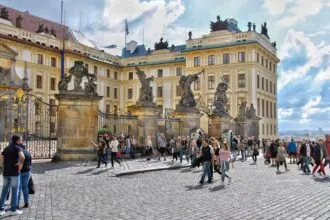
Prague Castle is not a single building but an entire walled complex on top of Hradčany hill, and it is officially the largest ancient castle complex in the world by area. The castle grounds and courtyards are free to enter at any time, which surprises a lot of first-time visitors who assume the whole site requires a ticket. You can wander through the outer courtyards, admire the changing of the guard, and even step into the nave of St Vitus Cathedral without paying a thing.
Paying to go further inside is where most of the value sits, though. Circuit B, the standard ticket, currently runs to around 250 CZK (£9/€10/$12) for adults and 125 CZK (£4/€5/$6) reduced, and covers the choir and crypt of St Vitus Cathedral, the Old Royal Palace, St George’s Basilica, and Golden Lane, the row of tiny historic houses once used by castle staff. Circuit A adds the Castle Treasury, the Powder Tower and an archaeology exhibition for roughly 350 CZK (£12/€14/$17) adult, 175 CZK (£6/€7/$8) reduced.
St Vitus Cathedral deserves its own mention within this, because it is genuinely the centrepiece of the whole complex. The soaring Gothic structure took nearly 600 years to complete, its stained glass includes a famous window designed by Art Nouveau painter Alfons Mucha, and the crypt below houses the tombs of Bohemian kings. If you only pay for one paid extra inside the cathedral, make it the South Tower climb, a steep 287-step spiral that rewards you with one of the best rooftop views in the city, weather permitting.
Golden Lane is worth slowing down for too, since the tiny cottages now hold small exhibits on castle life, armour and, in one case, the house where writer Franz Kafka’s sister once lived. St George’s Basilica, tucked behind, is the oldest surviving church building at the castle and has a starkly plain Romanesque interior that contrasts sharply with the cathedral’s Gothic drama next door.
Because the site is so large and so popular, arriving early morning before the tour groups is genuinely worth the alarm clock. Trams 22 and 23 stop right at Pražský hrad, a short walk from the main entrance, and the climb up from Malostranská metro station on the other side is steep but scenic. Given that the castle sits alongside several other paid sights in this guide, checking whether a Prague City Pass covers your particular mix of attractions is worth ten minutes before you commit to individual tickets. For official opening hours and the current full price list, the official Prague Castle website is the most reliable source.
Best if you want daily housekeeping and a front desk. Filter by area first, then by price.
Check availabilityBest for longer stays. Whole apartments and houses, so you are not eating out three times a day.
View rentalsBest as a last check before booking. Compares hotel rates across several sites in one search.
Compare ratesStrahov Monastery Library: A Baroque Hall of Historic Books
Perched near Petřín Hill on the edge of Hradčany, Strahov Monastery is home to one of the most beautiful libraries in the world, and one that regularly appears on lists of the most photographed library interiors anywhere. Founded in the 12th century, the monastery’s two great halls, the Theological Hall and the Philosophical Hall, hold tens of thousands of historic volumes beneath spectacular baroque ceiling frescoes.
The Philosophical Hall in particular, added in the late 18th century, is the showstopper, its towering fresco depicting the progress of human wisdom stretching the full length of the room above shelves of leather-bound books and a Cabinet of Curiosities holding preserved specimens and antique instruments.
One practical point worth knowing before you go: due to concerns over dust and humidity damaging centuries-old books and frescoes, visitors cannot walk into the halls themselves. Standard admission lets you view both halls from the doorway, which is still spectacular, while special guided tours with limited availability occasionally allow a closer, escorted look.
Library-only admission currently costs around 180 CZK (£6/€7/$9) for adults, while a fuller ticket covering the wider monastery complex, including the picture gallery and church, runs to about 350 CZK (£12/€14/$17). Trams 22 and 23 stop nearby en route to Prague Castle, making the two an easy combination in one morning.
A Medieval Banquet Dinner: Feasting Like Bohemian Royalty
Prague has turned the medieval banquet into something of a national speciality for visitors, and the best-known version, run at a genuine underground stone cellar tavern in the Old Town, leans hard into the theatre of it. Expect swordsmen, jugglers, belly dancers and a fire show performed around the tables while you eat, all under low vaulted ceilings that make the setting feel properly medieval rather than staged in a hotel function room.
There are usually two sittings to choose from. A shorter three-course dinner, typically starting mid-afternoon, runs to around 1,600 CZK (£55/€64/$75) per adult and lasts about two hours, covering soup, a main course and dessert. The fuller five-course evening sitting costs closer to 1,975 CZK (£68/€79/$92) and stretches to two and a half or three hours, adding a cold starter and a warm appetiser around the same main event.
The genuinely appealing part for a lot of visitors is that both options include unlimited beer, wine and soft drinks for the duration of the meal, poured by staff in period costume as part of the performance rather than table service in the usual sense. Children are generally offered a discounted menu, and very young infants often eat free, which makes this a more family-friendly night out than the rowdy medieval-tavern reputation might suggest.
Because this is one of the most popular evening bookings in the city, particularly with stag and hen groups, booking ahead matters. Aim for three to five days’ notice outside peak season, and two weeks or more if you are travelling in summer or around a weekend. Weeknight sittings tend to be calmer and less rushed than Friday or Saturday, if atmosphere over spectacle is more your thing.
Charles Bridge: Prague’s Centuries-Old River Crossing
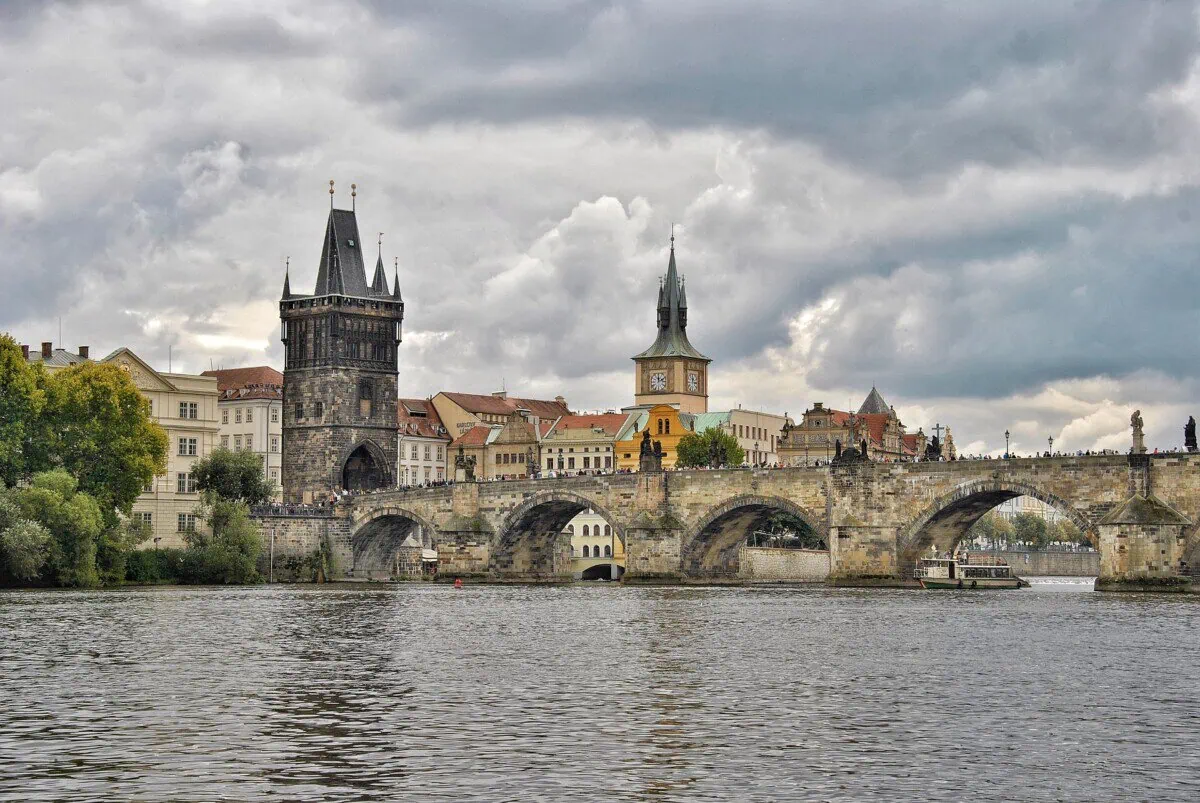
No attraction in Prague is more photographed than Charles Bridge, the 515-metre stone bridge linking Old Town to Malá Strana, built on the orders of Charles IV between 1357 and 1402. It replaced an earlier bridge washed away by flooding, and it remained the only crossing of the Vltava in Prague for centuries, which is part of why so much of the city’s history has flowed literally across it.
Crossing the bridge is, and always will be, completely free, and it should be, given that it is really a pedestrian street as much as a bridge, lined with thirty baroque statues and sculptural groups added between 1683 and 1928. The most famous, a statue of St John of Nepomuk, is worn smooth in places by centuries of visitors touching it for good luck.
Fortified bridge towers guard each end, the Old Town Bridge Tower on one side and the twin Lesser Town Bridge Towers on the other, both of which can be climbed for a modest fee if you want yet another rooftop angle on the city and the river beneath it.
The single most useful piece of practical advice for Charles Bridge is timing. Midday, especially in summer, the bridge becomes a slow-moving crush of tour groups and souvenir stalls. Early morning, right around sunrise, or late evening after most day-trippers have left, the bridge is calm, atmospherically lit and genuinely one of the most romantic spots in Europe.
A Classical Concert in the Mirror Chapel’s Baroque Glow
Tucked inside the Klementinum, the vast former Jesuit college complex in the Old Town, the Mirror Chapel (Zrcadlová kaple) is one of the most visually unusual concert venues in Europe. Built between 1722 and 1726, its walls are lined with an elaborate arrangement of mirrors, marble, gilded stucco and painted frescoes, giving the small baroque room a shimmering, almost kaleidoscopic feel once the lights are up for a performance.
Because the chapel is open only during scheduled events, you cannot simply walk in and look around the way you might with a church. Regular classical concerts, typically staged by chamber ensembles playing Mozart, Vivaldi and Czech composers such as Dvořák and Smetana, are the main way visitors get inside, usually running in the evening for around an hour with no interval.
The two baroque organs at either end of the room, both original 18th-century instruments, are often used as part of the programme, which adds a layer most modern concert halls cannot replicate. The acoustics inside a small mirrored stone room are surprisingly rich for such an intimate space, and seating is close enough that you genuinely feel part of the performance rather than watching from a distance.
Tickets are sold through dedicated classical concert box offices around the Old Town rather than at the door, and because seating is limited, booking a day or two ahead is sensible, especially in peak summer months when several venues around the Klementinum and Old Town run competing evening programmes. Combine it with a walk past the Klementinum’s own astronomical tower and library halls beforehand if you want to make an evening of Czech baroque architecture rather than just the one room.
Old Town Square and the Twin Spires of Týn Church
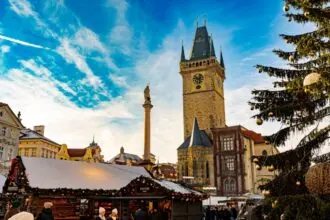
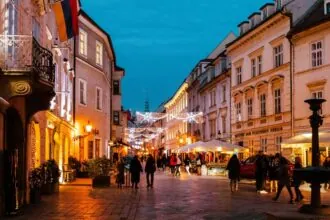
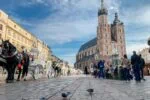
Distinct from the clock mounted on its edge, Old Town Square itself is the historic heart of Prague, a large open cobbled square that has served as a marketplace and gathering point since the 10th century. Ringed by pastel-coloured baroque and Gothic facades, it is genuinely one of the finest surviving medieval squares in Europe, and it is free to simply walk into and sit in at any hour.
Dominating the eastern side are the twin black spires of the Church of Our Lady before Týn, one of Prague’s most recognisable Gothic landmarks, its towers visible from viewpoints across the city. The church’s interior, home to an ornate baroque altar and the tomb of astronomer Tycho Brahe, is free to enter during limited opening hours, though the spires themselves are not open for public climbing.
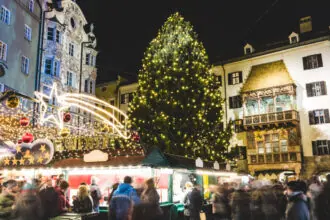
The square is also home to the Jan Hus Memorial, a large Art Nouveau monument to the reformist preacher burned at the stake in 1415, and it hosts seasonal markets throughout the year, most famously the Christmas markets that transform the square every winter with mulled wine stalls and festive lighting.
Because the square sits at the crossroads of nearly every walking route in the Old Town, from the Astronomical Clock to the Jewish Quarter to Charles Bridge, it is worth treating as a hub you will pass through several times rather than a single one-off stop, and worth returning to at different times of day to see how the light and crowds change.
Walking between Prague Castle, Charles Bridge and Old Town Square is easy enough on foot, but if you are short on time or covering ground with kids or tired legs, a hop-on hop-off bus loop links all three, plus stops further out like Vyšehrad, on a single ticket you can jump on and off all day. It will not replace walking the bridge itself, but it is a useful way to stitch together a route on a day when your feet have had enough.
The Astronomical Clock and Its Hourly Walk of the Apostles
Mounted on the south wall of the Old Town Hall, the Prague Astronomical Clock, or Orloj, is one of the oldest working astronomical clocks in the world, dating back to 1410. It is a genuinely complex piece of medieval engineering, tracking Central European time alongside Babylonian time, star time, and a lower calendar dial, and it remains the only clock of its kind still able to measure Babylonian hours, which vary in length with the seasons.
The reason crowds gather on the hour, every hour from 8am to 11pm, is the Walk of the Apostles, a short mechanical show in which two small windows open and figures of the twelve apostles process past, watched over by carved allegorical figures representing a skeleton (Death), a miser, a vain man and a Turk, before a golden rooster crows and the windows snap shut. It lasts under a minute, so arrive a couple of minutes early or you will miss it entirely.
Watching the show itself from the square is completely free, and most visitors are happy stopping there. Paying to go inside the Old Town Hall and up its tower, currently around 350 CZK (£12/€14/$17) for adults, gets you a close-up look at the clock’s inner mechanism and, more importantly, one of the best rooftop views over the whole of Old Town Square.
Given how central this spot is, it is worth timing your visit deliberately: arrive on a quieter hourly mark rather than fighting through the densest midday crush, and remember that the Old Town Hall Tower and the wider Old Town Square, covered separately elsewhere in this guide, are easily combined into one stop.
Best for finding routes the airlines do not sell as a single ticket. Combines carriers to bring the fare down.
Search flightsBest for anyone whose home plan charges by the megabyte abroad. Pay a fixed price up front.
Check eSIMsBest if you would rather not work out the transport on arrival. Book it now and forget it.
View transfersThe Lennon Wall: Prague’s Ever-Changing Graffiti Shrine
Tucked down a narrow lane in Malá Strana, close to the Charles Bridge end of the Lesser Town, the John Lennon Wall is a small but constantly evolving piece of living street art. It began in the 1980s under communist rule, when young Czechs painted John Lennon’s portrait and lyrics of protest and peace on the wall as a quiet act of dissent against the regime, despite regular attempts by authorities to whitewash it.
Today the wall is a genuinely legal, sanctioned canvas, and visitors are encouraged to add their own paint, so what you see changes constantly, sometimes within the same week. There is no single fixed image to look for, since layers get painted over layers, but Lennon-related imagery, peace symbols and messages of love and protest remain the recurring theme.
It costs nothing to visit and takes only 15 to 20 minutes to appreciate properly, making it an easy add-on to a walk through Malá Strana rather than a destination in its own right. Bring your own spray can or marker if you fancy leaving a mark, though be respectful of what is already there.
The wall sits a short walk from the Malostranská metro and tram stop, making it easy to combine with a visit to Petřín Hill, the Lesser Town Bridge Towers, or simply as a quiet stop on the way to or from Charles Bridge itself.
Josefov, the Jewish Quarter: Synagogues and a Difficult History
Josefov, Prague’s historic Jewish Quarter, sits wedged between the Old Town and the river, and is one of the most quietly powerful places to visit in the entire city. Rather than being a collection of separate sights, it is visited as a single ticketed circuit run by the Jewish Museum in Prague, which is genuinely how locals and guides alike think of it, so this guide treats it the same way.
The standard ticket currently covers five synagogues and the Old Jewish Cemetery: the Pinkas, Klausen, Maisel and Spanish Synagogues, plus the cemetery itself, where thousands of tightly packed, tilting headstones date back to the 15th century. The Pinkas Synagogue in particular is deeply moving, its walls inscribed with the names of tens of thousands of Czech Jewish Holocaust victims.
Adult admission on the combined ticket currently costs around 600 CZK (£21/€24/$29), with a reduced rate of 400 CZK (£14/€16/$19) for students under 26 and 200 CZK (£7/€8/$10) for children aged 7 to 15. Note that the Old-New Synagogue, the oldest active synagogue in Europe, is not included in this ticket and requires a separate admission, so budget for that if it is on your list.
Give yourself two to three hours to do the quarter justice rather than rushing through, and go with a genuinely respectful pace, since much of what you are seeing is a memorial as much as a museum. As with Prague Castle, the Jewish Quarter sits close enough to several other paid attractions that checking whether a Prague City Pass covers it alongside your other planned stops is worth doing before buying tickets individually.
The Dancing House: Prague’s Twisting Modern Landmark
Standing out sharply against Prague’s sea of baroque and Gothic architecture, the Dancing House (Tančící dům) is a striking piece of deconstructivist modern architecture on the New Town riverfront, designed by Vlado Milunić alongside internationally renowned architect Frank Gehry and completed in 1996. It replaced a building destroyed by an American bombing raid in 1945, and its unusual twisting form was deliberately controversial when it first appeared.
The design’s concept is genuinely playful once you know it: the solid stone tower represents dancer Fred Astaire, standing steady, while the curving glass tower beside it represents his partner Ginger Rogers, mid-twirl. It is one of the more approachable pieces of modern architecture in the city precisely because the concept is so easy to picture once explained.
Viewing the exterior is entirely free and takes only a few minutes from the surrounding riverside pavement or from across the water. For those wanting more, the building houses a small public gallery along with a restaurant and rooftop terrace offering 360-degree views back over the city, open to diners rather than sightseers passing through.
The Dancing House sits at Rašínovo nábřeží, right on the riverside walk covered later in this guide, making it a natural stop on a longer stroll along the Vltava embankment rather than a dedicated separate trip.
Ice Pub Prague: Cocktails Served at Minus Six Degrees
Ice Pub is exactly what it sounds like, and that is very much the point. Located inside the Karlovy Lázně complex on Smetanovo nábřeží, right by the Old Town end of Charles Bridge, every surface inside is carved from ice: the bar, the tables, the seating, decorative sculptures, and even the glass your drink arrives in.
The room is kept at a genuinely cold minus 7°C (19°F), so on arrival you are handed a thermal jacket and gloves to wear over your regular clothes. Visits are deliberately short, capped at around 20 minutes, which is enough time for photos, a drink and the novelty to properly land without anyone getting uncomfortably cold.
Admission during the day, roughly between noon and 10pm, costs around 300 CZK (£10/€12/$14) and includes your first drink poured into an ice glass, with a choice of vodka-based cocktails or Heineken Extra Cold beer. Overnight, entry itself becomes free but a first cocktail at around 160 CZK (£6/€6/$8) is required, with further drinks at roughly 150 CZK (£5/€6/$7) each.
Because slots are timed and popular at weekends, booking ahead with full pre-payment is strongly recommended rather than turning up and hoping for a spare slot. It pairs naturally with a walk across Charles Bridge itself, given the entrance sits practically at the foot of it on the Old Town side.
Náplavka and the Vltava Riverside: Cafes, Markets and Sunsets
Away from the castle and the crowded squares, the Náplavka embankment along Rašínovo nábřeží in New Town is where Prague genuinely relaxes, and it is one of the best places to see a slower, more local side of the city. By day it is a pleasant riverside walk; by evening and especially at weekends, it transforms into one of the city’s most popular hangout spots.
The undoubted highlight is the Náplavka Farmers’ Market, held every Saturday from roughly 8am to 2pm, running from February through December. Stalls sell seasonal fruit and vegetables, fresh fish, cheeses, pastries and free-range eggs alongside handicrafts, all set against the flowing Vltava and a genuinely lively, unhurried local atmosphere rather than a tourist-focused market feel.
Along the embankment, a string of permanently moored boat bars and cafes stay open through the warmer months, popular with locals for an evening drink with the water lapping just beneath the deck. The whole stretch is free to walk and enjoy, and it connects naturally with the Dancing House at one end, making a joined-up riverside route straightforward to plan.
For a different angle on the same river, a river cruise along the Vltava lets you see Charles Bridge, the castle and this whole embankment from the water rather than the bank. Most operators run daytime sightseeing routes of around 45 minutes to an hour, plus shorter evening cruises past the illuminated skyline, so there is usually a version to fit however much time you have left in the day. It is a genuinely relaxed way to end a long day of walking, letting you sit down while still taking in the same views that have framed the rest of this guide, and our dedicated guide runs through the different operators and routes on offer.
Bernard Beer Spa: Soaking in a Tub of Warm Beer
Beer spas have become one of Prague’s more talked-about novelty experiences, and the Bernard Beer Spa, named after the well-regarded Czech brewery it partners with, is one of the more established versions in the city, with several locations dotted around the Old Town and New Town. The core idea is a private wooden tub filled with warm water infused with hops, brewer’s yeast and other natural ingredients said to be good for skin and circulation.
What makes it more than a novelty soak is the tap built into the tub room itself, letting guests pour their own unlimited Bernard beer to drink while they bathe, followed usually by time to relax on a straw bed or in a small sauna area. Every booking is in a private room, so there is no shared bathing space or awkwardness about company.
A standard 60-minute session for one or two people costs from around 3,290 CZK (£113/€132/$157) total, rising to roughly 5,890 CZK (£203/€236/$280) for three or four people sharing a larger tub. A longer 90-minute version is also available, priced from about 4,990 CZK (£172/€200/$238) for one or two guests. Because the price is per room rather than per person, splitting the cost between two or more people brings it down considerably.
Locations run daily from late morning until around 10pm, and booking a specific time slot in advance is essential, since private rooms are limited and this has become a popular stop for stag and hen parties as well as curious couples. Towels, robes and slippers are provided, so you genuinely need nothing but yourself and a sense of humour.
Best for short city stops where being central matters more than the room. Dorms and private rooms both listed.
See hostelsBest arranged before you fly rather than after. Covers claim handling, plus lounge access on eligible delays.
Explore AirHelp+Best if your room is not ready yet. Left luggage booked in advance, so you are not hunting for a locker.
Check storageMunicipal House: Art Nouveau Splendour and a Concert Hall
Sitting on the border between Old Town and New Town, Municipal House (Obecní dům) is Prague’s grandest Art Nouveau building, constructed between 1905 and 1911 by architects Antonín Balšánek and Osvald Polívka on the site of the former royal court. It was built explicitly as a showcase for Czech cultural life, and it still functions that way today.
Contributions from major Czech artists of the period, including painter Alfons Mucha, decorate the interiors, and the building’s café, with its mahogany panelling and period fittings, is free for anyone to walk into and enjoy a coffee without buying an admission ticket. The same goes for the ornate main foyer, French and Pilsner restaurants, American bar and wine bar.
To see the rest of the building properly, a guided tour, run in both English and Czech and lasting around an hour, currently costs about 320 CZK (£11/€13/$15) for adults, 270 CZK (£9/€11/$13) reduced, or around 660 CZK (£23/€26/$31) for a family ticket. This is the only way to see most of the ceremonial rooms beyond the public café and foyer.
The building’s centrepiece, Smetana Hall, seats nearly 1,300 people and has been home to the Prague Symphony Orchestra since 1942, and it hosts the opening concert of the Prague Spring festival every year. Catching an evening concert there is arguably a better way to experience the hall than a daytime tour alone.
Petřín Tower: A Miniature Eiffel Tower Above Malá Strana
Nicknamed Prague’s own mini Eiffel Tower, Petřín Tower is a 58.7-metre steel lookout built in 1891 at roughly one-fifth the scale of its Parisian inspiration, sitting on top of leafy Petřín Hill above Malá Strana. Climbing the 299 steps to the observation deck is the traditional way up, though a lift is available for an extra charge for anyone who would rather skip the stairs.
The view from the top is arguably better than the one from Prague Castle itself, since you are looking back across the river at the castle, cathedral and Old Town roofscape rather than out over ordinary suburbs. On a genuinely clear day, the panorama is said to stretch far enough to pick out distant Bohemian countryside beyond the city limits.
Getting up the hill itself is part of the experience, traditionally via the Petřín funicular railway, a short cable tram that has run since 1891 alongside the tower. Worth knowing if you are visiting around now: the funicular has been closed for maintenance and was scheduled to reopen around 21 September 2026, so it is worth checking current status before you go, since the walk up from Újezd tram stop, while pleasant, is a genuine hill climb.
Admission to the tower itself currently runs to around 250 CZK (£9/€10/$12) for adults and 170 CZK (£6/€7/$8) for children aged 6 to 15, with the lift add-on priced separately at roughly 150 CZK (£5/€6/$7). A family ticket covering two adults and up to four children is available for around 500 CZK (£17/€20/$24), and the tower’s opening hours shift seasonally, running longest through the summer months.
Vyšehrad: The Quieter Fortress Above the Vltava
Often overlooked by visitors sticking to the Old Town and castle, Vyšehrad is a second, older fortress on a rocky bluff above the Vltava, and it is genuinely one of the best value stops in this whole guide because most of it costs nothing at all. The grounds, parks and ramparts are free to enter, and the views across the river bend below rival anything from the castle side of town, minus the crowds.
Inside the grounds sits the striking Neo-Gothic Basilica of St Peter and St Paul, its interior decorated in Art Nouveau style, and the adjoining Vyšehrad Cemetery, the national burial ground for major Czech cultural figures including composer Antonín Dvořák, crowned by the grand Slavín communal tomb. Nearby, the tiny Rotunda of St Martin, dating to the 11th century, is one of the oldest buildings still standing in Prague.
Beneath the fortress, the Casemates, accessed through Gorlice Hall, hold underground passages and a small exhibition, and require a modest separate ticket if you want to go beneath the surface rather than just walk the grounds above.
Vyšehrad is reached directly by Metro Line C to Vyšehrad station, or by trams 2, 3, 7, 17, 18 and 21 to Podolská vodárna, making it an easy add-on rather than a logistical headache. Given how spread across the city Prague’s best sights are, a hop-on hop-off bus route can be a useful way to string together stops like this one with the castle and Old Town in a single day if you are short on time.

Žižkov Television Tower and Its Crawling Baby Sculptures
Love it or hate it, the Žižkov Television Tower is impossible to miss. At 216 metres, it is the tallest structure in Prague, built in the late 1980s as a functioning broadcast tower, and it remains a genuinely divisive piece of communist-era architecture among locals, some of whom rank it among the ugliest buildings in the world and others who have grown fond of its brutal, futuristic silhouette.
What tips it firmly into “must see” territory for most visitors, though, are the ten enormous crawling baby sculptures installed on its exterior by provocative Czech artist David Černý. Known locally as Miminka, each fibreglass infant weighs around 35 kg and has a featureless, barcode-like slot where a face should be. Installed temporarily in 2000, they proved so popular they were made permanent the following year.
Inside, an observation deck sits roughly two-thirds of the way up, with admission priced from around 350 CZK (£12/€14/$17) for adults, giving a genuinely different angle on the city than the castle-side viewpoints, since you are looking back at Prague from the eastern, less touristy district of Žižkov itself.
The tower sits a short walk from tram stops Jana Želivského or Lipanská, served by lines including 5, 9, 15 and 26, and the surrounding Žižkov neighbourhood, full of local pubs and unpretentious restaurants, is worth exploring a little further if you want a break from Old Town crowds.
Wenceslas Square: Where Modern Czech History Was Made
Longer than it is wide and lined with grand 19th and early 20th-century facades, Wenceslas Square (Václavské náměstí) is less a traditional square and more a broad boulevard running through the heart of New Town. It has been the stage for some of the most important moments in modern Czech history, from the 1969 self-immolation protest of Jan Palach against Soviet occupation to the mass demonstrations of the 1989 Velvet Revolution that ended communist rule.
At its head stands the grand, colonnaded National Museum, its dome visible from much of the square below, in front of a large equestrian statue of Saint Wenceslas, the patron saint of Bohemia, that gives the square its name and doubles as an informal meeting point for locals.
Today the square is a busy mix of shops, cinemas, restaurants and a scattering of nightlife, and while it is less quaintly picturesque than the Old Town, it offers a genuine sense of how modern Prague actually operates day to day, away from the more preserved medieval streets nearby. Walking the full length is free and takes well under half an hour.
Wenceslas Square sits directly on top of two metro stations, Můstek and Muzeum, making it one of the easiest and most central places in the city to start or end a day of sightseeing, with the Prague public transport network radiating out from this stretch of the city to almost everywhere else on this list.
A Robotic-Themed Bar Where the Cocktails Mix Themselves
Just through the archway leading towards Charles Bridge, inside the same Karlovy Lázně complex that houses Ice Pub, Prague’s Robotic Bar takes the novelty-bar concept in a completely different direction: entirely mechanical bartenders. Two robotic arms, working beneath a wall hung with more than 100 spirit and mixer bottles, measure, shake and garnish cocktails in well under 90 seconds each, with the mixing process displayed live on a screen behind the bar.
Entry includes one cocktail of your choice from a menu of around 21 options, ranging from classics to genuinely inventive house creations, plus a handful of non-alcoholic choices such as a virgin piña colada for anyone driving, under 18, or simply not drinking. It is a novelty rather than a serious cocktail bar experience, and it is very much sold as one, but the mechanical theatre of watching robot arms build your drink is a genuinely fun few minutes.
Pricing starts from roughly the equivalent of 250 CZK (£9/€10/$12) per person, and because visits are quick, it slots naturally into an evening that also includes Ice Pub next door or a walk across Charles Bridge, given the shared location right at the Old Town end of the bridge.
As with the other Karlovy Lázně attractions, weekends and evenings get busy, so booking a slot online in advance avoids any wait at what is otherwise a fast-moving, high-turnover bar.

Výtopna: The Bar Where a Model Train Delivers Your Drink
On Wenceslas Square itself, at Václavské náměstí 56 in Nové Město, Výtopna Railway Restaurant turns the simple business of bringing you a drink into a small spectacle. Over 400 metres of model railway track loops through the dining room, and miniature locomotives carry drinks and small items from the bar straight to your table rather than a waiter walking them over.
Main courses still arrive the normal way, brought by staff rather than by train, so the food service itself feels perfectly ordinary. It is only the drinks and small extras, beer, cocktails, wine and soft drinks, that travel the tracks, which keeps the novelty genuinely fun without turning the whole meal into a gimmick.
The menu leans heavily Czech, with svíčková, goulash, fried cheese and schnitzel all on offer, alongside more international options such as burgers, pasta and salads for anyone not in the mood for pub classics. Czech lager is on tap, and the cocktail and wine list gives the trains plenty to carry back and forth.
Being right on Wenceslas Square rather than tucked down a backstreet, prices sit at the moderate-to-premium end rather than cheap pub territory, which is worth knowing before you go. The nearest metro is Můstek, on lines A and B, about a three-minute walk away, and given how popular the trains are with visitors and local families alike, booking a table ahead is worth doing for evenings and weekends.
Kutná Hora: Prague’s Standout Day Trip
About 70 km east of Prague, Kutná Hora is the easiest major excursion to add once you have covered the city itself. Direct trains take roughly an hour, and the headline sight is the Sedlec Ossuary, the small Gothic chapel better known as the Bone Church, where human bones were arranged into chandeliers, garlands and decorative forms in the 19th century.
The UNESCO-listed old town and St Barbara’s Cathedral make it worth turning the outing into a half or full day rather than visiting Sedlec alone. For train options, ticket costs, how the two parts of town fit together and whether to go independently or on a tour, use our dedicated Prague Day Trips guide, where Kutná Hora is covered in full alongside Karlštejn, Karlovy Vary, Český Krumlov, Terezín and Plzeň.

Rupert’s Handy Travel Tips
With twenty attractions to juggle, a bit of planning goes a long way in Prague, so here is what I would genuinely tell a friend before they go.
- Do the castle first thing: arrive right at opening to beat the tour groups, especially in summer when queues for St Vitus Cathedral can stretch out fast.
- Layer up for Ice Pub: the room sits at minus 7°C, so wear something warm underneath the jacket you’re given, not just a t-shirt.
- Check the funicular status: Petřín’s cable railway has had closures for maintenance, so confirm it’s running before you rely on it to get up the hill.
- Vyšehrad is the free castle nobody mentions: if you want castle-style river views without the crowds or the ticket, go there instead or as well.
- Book concerts and the medieval dinner ahead: the Mirror Chapel and the medieval banquet both sell out at weekends, sometimes days in advance in summer.
- Compare a pass before buying single tickets: if you’re doing the castle, the Jewish Quarter and a couple of towers, add up the individual prices before assuming separate tickets are cheaper.
Want to meet the reindeer behind our travel tips? Find out more in our page Who is Rupert?.




Frequently Asked Questions
How many days do I need to see the main things to do in Prague?
Three to four full days lets you cover the castle, Old Town, the Jewish Quarter, Vyšehrad and a couple of the quirkier experiences without rushing, though committed sightseers can hit the highlights in two.
Is Prague Castle really free to visit?
The grounds, courtyards and the nave of St Vitus Cathedral are free to enter, but seeing the choir, crypt, Old Royal Palace, St George’s Basilica and Golden Lane requires a paid circuit ticket, currently from around 250 CZK for adults.
Do I need to book the medieval dinner and beer spa in advance?
Yes, both are genuinely popular with weekend and stag or hen groups, so booking several days ahead outside peak season, and up to two weeks ahead in summer, is worth doing to avoid disappointment.
What’s the best way to get around all these attractions?
Prague’s trams, metro and buses reach every attraction on this list and are inexpensive, so most visitors do not need a car; our Prague public transport guide covers tickets and routes in detail.
Is Kutná Hora worth the trip from Prague?
Yes, for most visitors the Sedlec Ossuary alone justifies the roughly hour-long train journey, and combining it with Kutná Hora’s own old town makes for a satisfying half or full day out.
Are Ice Pub and the Robotic Bar suitable for children?
Ice Pub generally welcomes families, though very young children may find the cold uncomfortable, while the Robotic Bar is more of an adult novelty experience given its cocktail focus, though non-alcoholic drinks are available.
Further Reading
If this guide has left you planning a full itinerary, our Prague public transport guide breaks down trams, metro and ticket types, while the hop-on hop-off bus routes are worth comparing if you would rather let a bus link the castle and Vyšehrad together.
For the paid sights above, particularly the castle, the Jewish Quarter and the various towers, it is worth totting up costs before buying individually, since a Prague City Pass can work out better value. Anyone tempted by the Vltava after reading about Náplavka should also look at our Prague river cruises guide, and if Kutná Hora has caught your interest, the full Prague day trips guide covers it in far more depth.
Finally, a winter visit changes this list considerably once the Christmas markets arrive in Old Town Square, and our airport transfers guide covers the smoothest way to reach the centre on landing.