Reviewed by our editorial team Published
Prague’s public transport network is one of the most complete and easy to use in Europe, and understanding it properly will save visitors real money and real time. The whole system runs under one umbrella called PID (Pražská integrovaná doprava, or Prague Integrated Transport), which covers everything from the metro and trams to buses, the Petřín funicular, ferries and regional trains across the wider Prague region. Inside the city itself, day to day operations are run by DPP (Dopravní podnik hl. m. Prahy, the Prague Public Transit Company), but the ticket you buy works across the whole network regardless of which operator is running the vehicle.
That single ticket structure is one of the best things about visiting Prague. You buy one ticket, validate it once if it is a paper ticket, and can hop between metro, tram and bus for the ticket’s full time window without buying anything new. There is no need to tap in and out per journey the way some European cities work, which makes Prague genuinely simple once the basics click.
This guide goes deep on every part of the system, because getting Prague’s transport wrong, buying the wrong ticket, or skipping validation, is one of the most common mistakes visitors make. We cover all three metro lines, the regular tram network, the bus network, the funicular up Petřín Hill, the current 2026 PID tariff in CZK, GBP, EUR and USD, and exactly how validation works for paper tickets versus the Lítačka app. We also flag the busiest interchange stations. If it is the heritage tram experience you are after rather than the everyday network, our Hop-On Hop-Off guide covers vintage tram 42 in full. Everything below has been checked against the current PID tariff, not guessed.
PID Ticket Prices at a Glance (2026)
Before getting into how each part of the network operates, it helps to see the full 2026 PID fare structure in one place. Prague prices its standard tickets by time rather than by distance or number of stops, so the same ticket covers unlimited transfers between metro, tram and bus for the stated duration. Every price below is quoted first in Czech crowns (CZK), then converted to pounds, euros and dollars using a fixed rate of £1 = 29 CZK = €1.16 = $1.36 for easy comparison.
| Ticket type | Lítačka app | Paper ticket | App price abroad |
|---|---|---|---|
| 30 minutes | 36 CZK | 39 CZK | £1.25 / €1.45 / $1.70 |
| 90 minutes | 46 CZK | 50 CZK | £1.60 / €1.85 / $2.15 |
| 24 hours | 140 CZK | 150 CZK | £4.85 / €5.60 / $6.60 |
| 72 hours | 340 CZK | 350 CZK | £11.75 / €13.60 / $16.00 |
The paper ticket always costs a few crowns more than the same ticket bought through the app, which is Prague’s way of nudging visitors toward digital ticketing. Children under 6 travel free when accompanied by someone over 10, and within Prague itself children aged 6 to 15 also travel free, though 10 to 15 year olds should be ready to prove their age with a passport or ID if a ticket inspector asks. Dogs now travel free alongside a passenger holding a valid PID ticket. None of these single tickets cover the Petřín funicular, which runs on its own separate fare, covered later in this guide.
The Metro: Lines A, B and C
Prague’s metro is the fastest way to cross the city, and it runs on just three lines, each identified by both a letter and a colour on every map and platform sign. Line A (green) is the shortest, running 17.1 km between Nemocnice Motol in the west and Depo Hostivař in the east, with 17 stations including Malostranská, Staroměstská and Náměstí Míru, all useful for reaching the historic centre and Vinohrady.
Line B (yellow) is the longest at 25.6 km with 24 stations, running from Zličín in the southwest to Černý Most in the northeast, and it is the line most visitors use for the airport bus connection at Zličín and for reaching Anděl and Smíchov. Line C (red) covers 21.4 km across 20 stations between Letňany in the north and Háje in the south, passing through the main railway station, Hlavní nádraží, and the busy Muzeum interchange.
Between them the three lines cover just over 63 km and 61 stations, and they cross each other at exactly three points, forming a rough triangle in the centre: Můstek (A/B), Muzeum (A/C) and Florenc (B/C). Trains run roughly from 4:30 to 5am until midnight, with services every 2 to 3 minutes at peak times and every 4 to 10 minutes off peak. The metro does not run overnight: once it closes, night trams and night buses take over completely until the first trains resume the following morning.
Best for a short trip. Compare rooms by neighbourhood, price and guest rating before you book.
Compare hotelsBest for longer stays. Whole apartments and houses, so you are not eating out three times a day.
View rentalsBest for double-checking. Runs the same search across several booking sites so you are not leaving money behind.
Compare pricesTrams: Prague’s Everyday Backbone
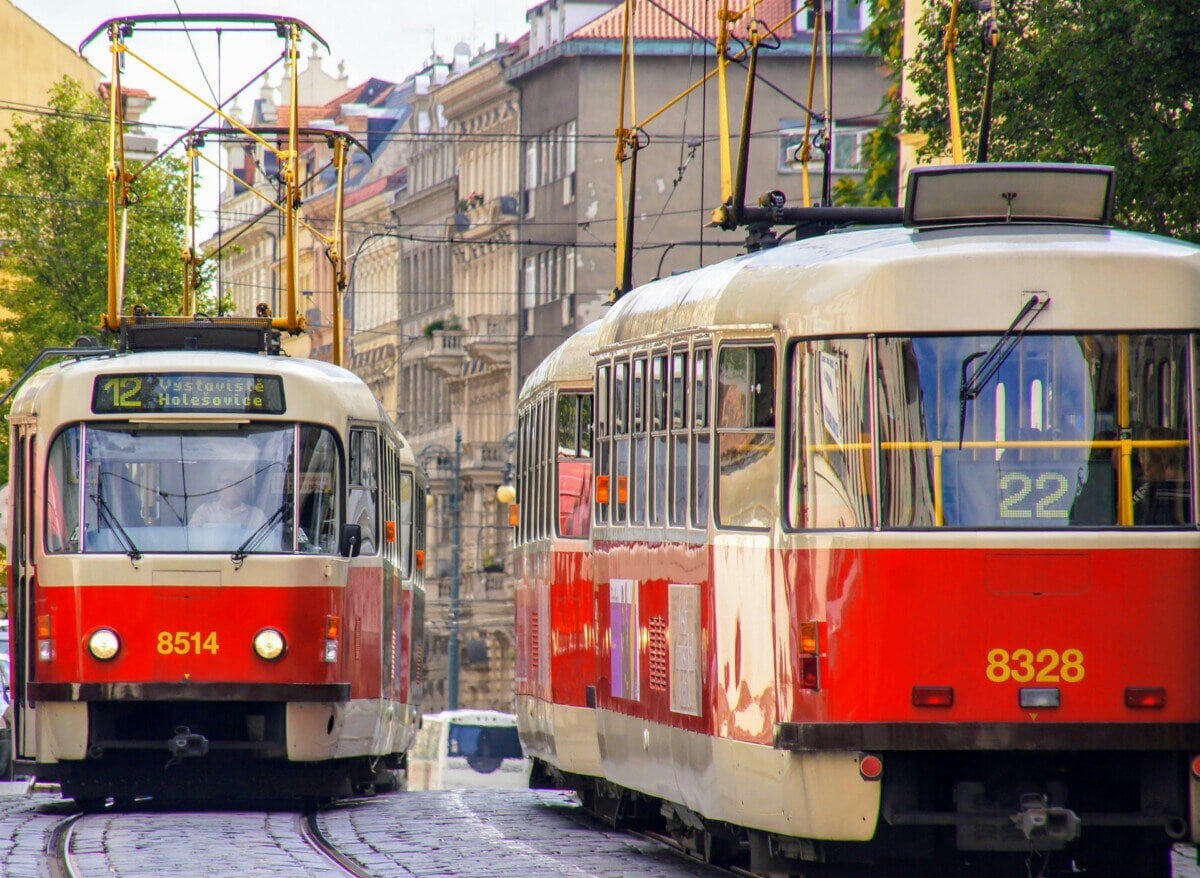
Trams are arguably the best way to actually see Prague while getting somewhere useful, and the network behind them is enormous. DPP runs around 27 day tram routes, numbered from 1 up to 31, across roughly 518 route-km of track and close to 290 stops, which makes it one of the densest tram networks in Europe. Day trams run from around 4:30am until shortly after midnight, with frequency of about every 8 minutes at peak times and every 10 to 20 minutes for the rest of the day.
Once the day network winds down, 9 night tram routes, numbered in the 90s, take over between roughly midnight and 4:30am, running every 30 minutes. Nearly all of them converge on Lazarská in the New Town, which functions as Prague’s unofficial night-time transport hub: whichever night tram you are on, a connection to almost anywhere else in the city is usually a short wait away at Lazarská.
For checking live tram routes and departures, the Lítačka app (covered in Apps Worth Having later in this guide) doubles as a live departures board for your nearest tram stop, so you can see exactly how many minutes until the next one arrives. Tickets themselves are bought and validated exactly as described in How to Buy a PID Ticket below, there is nothing tram-specific to learn beyond that. Between the two schedules, day trams running roughly 4:30am to just after midnight and night trams in the 90s number range roughly midnight to 4:30am, there is always a tram running somewhere in the city.
One quick note for anyone who has read about Prague’s famous vintage trams: the heritage service on line 42, using restored 20th century Tatra cars, is a separate tourist product with its own ticketing, not part of the standard PID network covered here. For full detail on riding it, see our dedicated Hop-On Hop-Off Bus Tours guide. Every other numbered tram line takes a standard PID ticket exactly like the metro and buses.
Buses: Filling in the Gaps
Prague’s bus network is bigger than most visitors expect, with around 154 routes served by more than 1,200 buses and a growing fleet of 37 electric trolleybuses, part of DPP’s push toward a mostly low-emission fleet by 2030. Day routes are numbered in the 100s to 250s, and their main job is connecting outlying residential districts to the nearest metro or tram line, though a handful of routes also run through parts of the historic centre where trams cannot easily reach, including the route across Charles Bridge’s approach roads.
Night buses, numbered from 901 to 917, cover the hours when the metro is closed, working alongside night trams to keep the whole city connected until service resumes each morning. The most visitor-relevant bus routes are 59 and 100, which link Václav Havel Airport Prague to metro stations Nádraží Veleslavín (line A) and Zličín (line B) respectively, plus night buses 907 and 910 covering the same journey after the metro has closed. All of these run on the standard PID ticket, no special airport fare required. Buses must be boarded with a ticket already purchased and validated, since Prague buses do not sell tickets on board, aside from the limited night bus exception noted in How to Buy a PID Ticket below.
For checking bus routes and live departures, the Lítačka app and Google Maps combination covered in Apps Worth Having later in this guide works for buses exactly as it does for trams and the metro. Day bus routes run on a broadly similar schedule to the trams, from the early morning until just after midnight, before the 901 to 917 night bus routes take over until services resume the following morning.
The Petřín Funicular
Tucked into the same PID network is one genuinely charming oddity: the Petřín funicular, a cable railway that climbs from Újezd in the Lesser Town up to Petřín Hill, with a passing stop at Nebozízek roughly halfway up. It reopened on 22 September 2026 after a two year full reconstruction, and now runs daily from 7am to 10:15pm at intervals of about 10 minutes, using new fourth generation cars with better space for prams and bicycles, though the funicular is not wheelchair accessible.
The important detail visitors often miss: the funicular runs on a separate, non-transferable fare. A single ride costs 100 CZK (£3.45/€4.00/$4.70) standard, or 90 CZK (£3.10/€3.60/$4.25) via Lítačka. Standard 30 and 90 minute tickets are not valid here. Only 24-hour and 72-hour PID tickets, Prague season passes, and the Prague Visitor Pass entitle you to ride for free. It is a lovely, low-effort way to reach Petřín Tower and the hillside orchards above the castle without the walk up.
The line itself dates back to 1891, built for the same Jubilee Exhibition that gave Prague the Petřín Tower it climbs toward, and it has been rebuilt and modernised several times since, most recently in this latest 2024 to 2026 reconstruction. Queues build up fast on warm weekends and around sunset, since the view back over the Vltava and Prague Castle from partway up the hill is one of the best in the city, so travelling early or mid morning on a day pass avoids the worst of the wait.
Tariff Zones Explained
PID’s zone map looks intimidating at first glance because it stretches well beyond Prague into the surrounding Central Bohemian region, but the good news for most visitors is that it barely matters. Central Prague, along with all metro lines, trams, city buses, trolleybuses and the Petřín funicular, sits inside a single tariff area called zone P. If you are staying anywhere near the historic centre and sightseeing within the city, a standard single, 24-hour or 72-hour ticket covers zone P and you never need to think about zones again.
Outside zone P, the map spreads into zone 0, zone B and numbered zones 1 through 13 for the wider region, used mainly for regional buses and trains out toward towns like Kutná Hora or Karlovy Vary. The one zone question visitors actually ask is about the airport: Václav Havel Airport Prague is served directly by regular city bus routes 59 and 100, both of which currently run on the standard zone P fare, so a normal 90-minute or day ticket is all you need for those. The premium Airport Express coach runs on its own separate flat fare instead of the zone system. For the full breakdown of every airport transport option and current pricing, see our dedicated Prague Airport Transfers guide.
How to Buy a PID Ticket
There are several ways to get a valid ticket in Prague, and which one makes sense depends on how long you are staying and how comfortable you are with apps. The cheapest and most flexible option by far is the official PID Lítačka app, available for iOS and Android, which lets you buy every ticket type at the lowest available price and activates them instantly with no separate validation step needed. You select the ticket, confirm the purchase, and it starts counting down from the moment you activate it, showing a live QR code and countdown timer that inspectors check directly on your phone.
If you would rather not rely on an app, yellow ticket machines at every metro station entrance and at most major tram stops sell paper tickets and accept both cash and card. These machines have an English language option and are genuinely straightforward: select the ticket duration, pay, and take the printed ticket. Paper tickets are also sold at DPP Info Centres (the main ones sit inside Můstek and Muzeum metro stations), at many newsagents and small shops displaying a PID ticket sticker, and from the driver on some night buses only, though never on day buses or trams themselves.
Whichever route you choose, buy your ticket before boarding a tram or bus, since neither sells tickets on board except for the limited night bus exception above. For a short city break, a 24-hour or 72-hour ticket almost always works out cheaper than paying per journey once you factor in more than two or three trips a day, and it removes any need to think about timing a 30 or 90 minute window around your sightseeing plans.
How to Validate Your Ticket
This is the single most common mistake visitors make on Prague’s public transport, so it is worth explaining properly. A paper ticket, whether bought from a machine, a shop or an Info Centre, is not valid the moment you buy it. It only becomes valid once you physically validate it in one of the small yellow or grey validation machines fitted on board every tram and bus, or at the entrance to every metro station platform. You insert the ticket, it stamps the date, time and a code onto it, and only from that stamped moment does the ticket’s 30 or 90 minute window (or 24 or 72 hour window) begin to count down.
Skip this step and, even with a perfectly valid unstamped ticket in your pocket, an inspector will treat you as a fare dodger and issue an on the spot fine, since there is no way for them to tell an unvalidated ticket apart from one you simply have not paid for. Always validate the moment you step aboard a tram or bus, or before you pass through a metro station entrance, never after.
Lítačka app tickets work completely differently, and this trips up a lot of visitors coming from paper-ticket habits. When you buy a ticket in the app, you also activate it there and then, and that digital activation is itself the validation. There is no physical machine to find and no stamp to add. The ticket simply starts its countdown from the activation time you chose, and the app displays a live QR code and timer that an inspector scans or views directly on your screen. Do not go looking for a validation machine if you are using the app: doing nothing further after activating is exactly correct.
Best if you can move a day either way. Shows how the fare changes across the month.
Compare flightsBest for short trips. Install the eSIM at home and arrive with working data, no shop queue.
Browse eSIMsBest when public transport has stopped, or when you are travelling with children and bags.
Book a transferApps Worth Having
The one app worth installing before you even land is PID Lítačka, the official Prague Integrated Transport app. Beyond selling every ticket type at the app discount, it doubles as a live departures board for your nearest stop and a basic journey planner, so you can check exactly which tram or metro to take and how many minutes until it arrives, all from the same app you use to pay.
For more detailed route planning, especially multi-leg journeys combining metro, tram and a walk, Google Maps works reliably across Prague’s whole PID network and pulls live departure data, making it a solid backup or companion to Lítačka. The official PID website itself is also worth bookmarking, since it carries the full current tariff, zone maps and any short-term service disruptions or planned closures that a mapping app will not always flag. Between an app for tickets and a map for routing, most visitors need nothing else for the length of a typical city break.
It is worth downloading Lítačka before you fly rather than at the airport, since setting up an account and payment method over patchy arrivals hall wifi is far more frustrating than doing it at home on a good connection. Keep a screenshot or two of your zone P map and the ticket price table handy as well, since Prague’s underground platforms and older trams do not always have reliable signal, and an inspector will still expect to see your live QR code rather than a screenshot if you are on the app, so make sure the app itself has loaded properly before you board.
Key Interchange Stations
Můstek sits right at the bottom of Wenceslas Square and is the busiest single interchange in the city, connecting lines A and B. It is genuinely two stations sharing a name, linked by a long underground passage, so allow a few extra minutes if you are switching lines here at rush hour. It is also the closest metro stop to Old Town Square and the Astronomical Clock, so expect it to be crowded almost any time of day.
Muzeum, named for the imposing National Museum building directly above it, links lines A and C and sits at the top of Wenceslas Square, making it a natural second option to Můstek when the square itself is busy. Florenc is Prague’s true multimodal hub: lines B and C cross here, but it is also home to the city’s main long distance coach station and connects to trams 3, 8, 12 and 24, so anyone arriving in Prague by intercity or international bus will almost certainly pass through it.
Further out, Anděl on line B in the Smíchov district functions as a major tram and shopping hub rather than a metro interchange, sitting beneath the large Nový Smíchov shopping centre with dense tram connections fanning out toward Petřín, the Vltava embankments and southern Prague. Knowing these four names in advance makes reading any Prague transport map considerably less confusing.
Getting To and From the Airport
Václav Havel Airport Prague has no metro or tram line reaching it directly, but public transport still gets you into the centre reliably and cheaply. The two main daytime options are bus 59, which reaches metro line A at Nádraží Veleslavín in around 15 minutes, and bus 100, which reaches metro line B at Zličín in around 18 minutes. Both run on a completely standard PID ticket, so a 90-minute or day ticket bought through Lítačka or a machine covers the whole journey including your onward metro leg.
Once the metro closes for the night, night buses 907 and 910 take over the same job, running roughly every 30 minutes and stopping at central points including I.P. Pavlova and Anděl. There is also a separate premium Airport Express coach running a more direct route into the centre on its own flat fare rather than the standard tariff. This section is deliberately brief: for exact current fares, journey times, taxi and private transfer comparisons and full step by step directions, our dedicated Prague Airport Transfers guide covers the whole topic properly.
One practical tip regardless of which bus you take: buy your ticket before boarding, either through Lítačka while you’re still walking through the terminal or from the ticket machine at the bus stop itself, since airport buses follow the same no-ticket-sales-on-board rule as the rest of the city network. Buses run roughly every 10 to 20 minutes during the day, so there is rarely a long wait even if you miss one by a minute.
Common Mistakes to Avoid
A handful of mistakes account for almost every problem visitors run into on Prague’s transport network, and all of them are easy to avoid once you know what to watch for.
Not validating a paper ticket before travelling is by far the single most common mistake, covered in full in How to Validate Your Ticket above: an unstamped paper ticket looks identical to no ticket at all as far as an inspector is concerned. Assuming a Lítačka app ticket needs separate physical validation is the opposite mistake, as explained above, activating it in the app is itself the validation, so there is no machine to find and nothing further to do.
Assuming you can buy a ticket from a tram or day-bus driver catches out plenty of visitors used to other cities. You generally can’t, tickets must be bought before boarding, with the limited night bus exception noted in How to Buy a PID Ticket above. Assuming a standard 30 or 90 minute ticket covers the Petřín funicular is another frequent slip, it doesn’t, only 24-hour and 72-hour tickets or passes ride for free, as covered in The Petřín Funicular section above.
Finally, don’t confuse the heritage tram 42 with the regular network. It runs its own separate ticketing entirely outside standard PID tickets, and is covered in full on our Hop-On Hop-Off guide, not this one.
Staying Safe
Prague is a generally safe city for visitors, and its transport network is no exception, but a little routine common sense goes a long way, exactly as it would on any busy city transport system anywhere else.
Genuine PID ticket inspectors carry an official control badge or ID from the transport operator, though it can look surprisingly informal, sometimes described as little bigger than a keyring. If an inspector approaches and you’re ever in doubt, it’s entirely reasonable to ask to see it clearly before showing your ticket. The standard on the spot fine for an invalid or missing ticket is 1,200 CZK if paid immediately to the inspector, rising to 1,500 CZK if paid within 15 days, or the full 2,000 CZK penalty after that. You’re entitled to ask for an official receipt for any fine paid on the spot, and it’s worth doing so.
The other routine precaution worth taking is against petty theft and pickpocketing, which can happen on crowded trams and metro carriages, especially around busy tourist interchanges like Muzeum and Můstek. Keep bags zipped and valuables close and out of easy reach in a crowd, the same sensible habit worth keeping on any busy city transport network.

Rupert’s Handy Travel Tips
Prague’s transport is brilliant once you know the small rules that trip everyone else up, so here is exactly what I’d want a friend to know before they land.
- Get Lítačka before you land: download the app and set up your ticket type in advance so you are not fumbling at a machine with luggage.
- Validate paper tickets instantly: the second you step onto a tram or bus, find the little machine and stamp your ticket, don’t wait until you’re seated.
- A 24-hour ticket beats counting journeys: if you’ll take more than two or three rides in a day, just buy the day ticket and stop thinking about it.
- Můstek and Muzeum are always busy: if you’re short on time and it’s rush hour, consider walking one stop rather than fighting the interchange crowds.
- Skip the funicular queue with a day ticket: if you already hold a 24 or 72 hour PID ticket, it covers Petřín funicular too, so you don’t need a separate ticket at Újezd.
- Buses need a pre-bought ticket: unlike some cities, you can’t buy a ticket from a Prague bus driver in the daytime, so sort it before you board.
Want to meet the reindeer behind our travel tips? Find out more in our page Who is Rupert?.




Frequently Asked Questions
Do I need a different ticket for the metro, trams and buses?
No. A single PID ticket, whether bought as a 30-minute, 90-minute, 24-hour or 72-hour pass, works across the metro, trams and city buses for its full duration, including transfers between all three.
Does the Lítačka app ticket need validating separately?
No. Activating a ticket in the Lítačka app is itself the validation, and the countdown starts from that moment. Only paper tickets need stamping in the small yellow or grey validation machines on board or at metro entrances.
Is the vintage tram 42 covered by a normal PID ticket?
No. Tram 42 is a separate heritage tourist tram with its own ticketing, not part of the standard PID network. See our Hop-On Hop-Off guide for full detail on riding it.
Can I use a standard 90-minute ticket to and from the airport?
Yes, for buses 59 and 100, which run on the standard zone P fare like the rest of the city network. The separate premium Airport Express coach uses its own flat fare instead.
Does my PID ticket cover the Petřín funicular?
Only if it is a 24-hour or 72-hour ticket, a Prague season pass, or the Prague Visitor Pass. Standard 30 and 90 minute single tickets do not cover the funicular, which runs on its own separate fare.
What happens if I board a tram without a valid ticket?
Ticket inspectors operate regularly across the whole network and issue on the spot fines to anyone without a validated ticket, so always buy and validate before you travel rather than risk it.
Further Reading
Once the ticketing and lines make sense, the rest of a Prague trip tends to fall into place fairly naturally. If sightseeing without the mental load of route planning appeals, our Prague Hop-On Hop-Off Bus Tours guide covers the tourist bus loop and the heritage tram 42 experience in full, both of which sit outside the standard PID ticket covered on this page. For a broader look at where that transport network can actually take you, our Things to Do in Prague guide pulls together the city’s best sights by neighbourhood.
Travellers landing at Václav Havel Airport should read our dedicated Prague Airport Transfers guide before they go, since it covers every transfer option and current pricing in far more depth than the brief overview above. Anyone comparing a multi-attraction pass against paying per PID ticket should also look at our Prague City Pass guide, which explains where a pass earns back its cost and where standard PID tickets are simply the better value.
Finally, if a day away from the capital appeals once you have the transport basics down, our Prague Day Trips guide covers the regional trains and buses that run beyond zone P, and our Prague River Cruises guide is a good next stop for a slower, water-level view of the same city these tickets get you around.