Reviewed by our editorial team Published
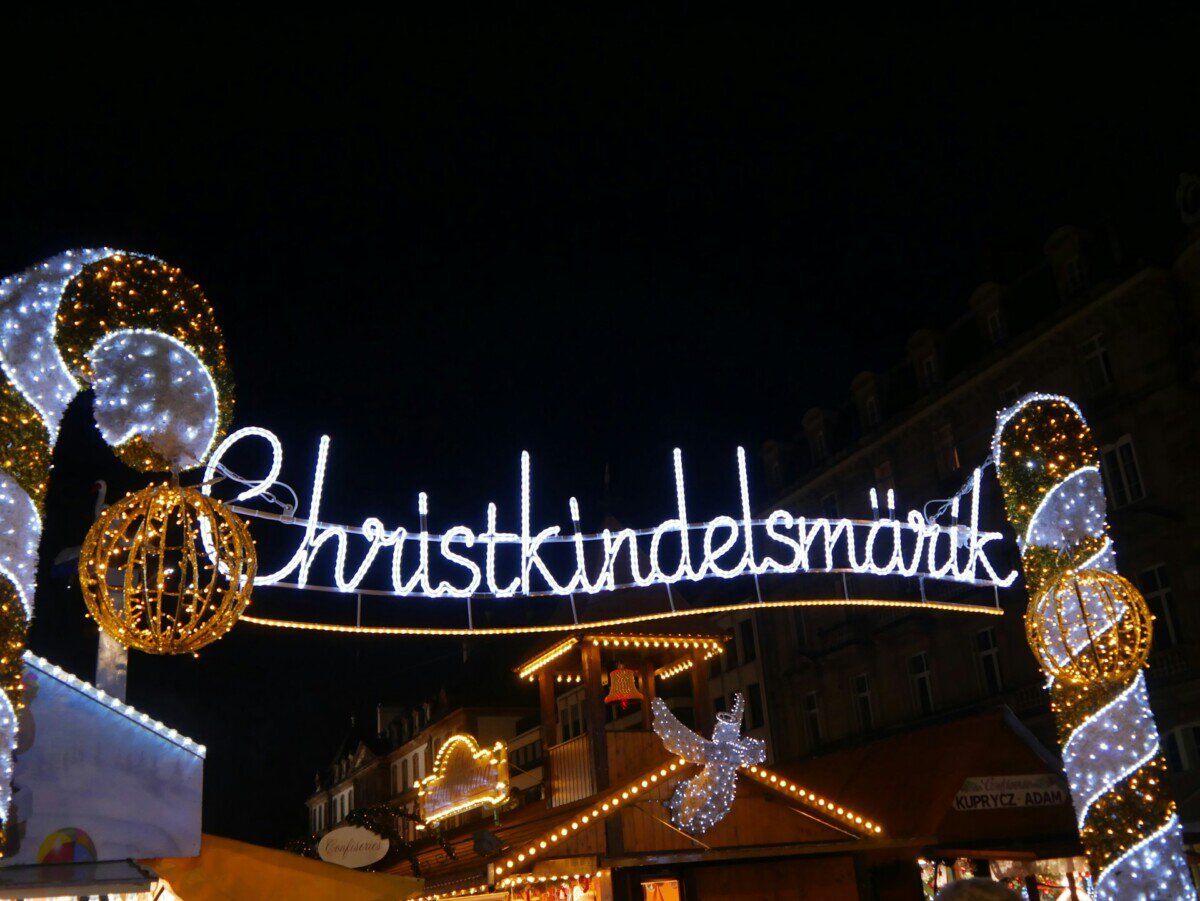
Strasbourg has the strongest historical claim of any Christmas market in France. The Christkindelsmärik first opened on Place Broglie in 1570, making it the oldest documented Christmas market in the country, and the city has leaned into that heritage ever since, branding itself as Capitale de Noël, or Christmas Capital. Rather than one square, the market now spreads across eight separate locations through the Grande Île, the historic island at the heart of the city, each with its own theme and character.
That scale sets Strasbourg apart from most rivals: it is genuinely closer in size to a citywide festival than a single market square. Place Broglie hosts the original Christkindelsmärik, Place Kléber is home to the city’s towering Grand Sapin (Great Christmas Tree), and the area around the Cathédrale Notre-Dame and Petite France’s canals add two more distinct settings entirely. As of research for this guide, Strasbourg’s official tourist office had not yet confirmed exact 2026 dates; last year’s market ran from 26 November to 24 December, and that pattern is the most reliable guide until 2026 dates are formally announced.
Because Strasbourg sits on the border between France and Germany, it also offers a genuinely useful comparison point for anyone weighing up which country’s Christmas market style suits them. This guide covers the market’s layout, the distinctly Alsatian food and drink on offer, how it differs from German and Austrian markets, and the practical details of getting there and staying nearby.
| Square | Market Theme | Highlight |
|---|---|---|
| Place Broglie | Christkindelsmärik | The original 1570 market |
| Place Kléber | Au Pied du Grand Sapin | The city’s giant Christmas tree |
| Place de la Cathédrale & Place du Château | Autour de la Cathédrale | Cathedral backdrop |
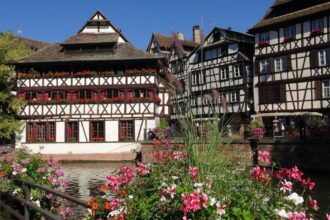
| Place Benjamin Zix & Place Saint Thomas | La Petite France | Half-timbered canal-side setting |
| Place du Temple Neuf | Le Carré d’Or | Boutique gifts and crafts |
| Square Louise Weiss | Les Irréductibles Petits Producteurs | Alsatian farm producers |
| Terrasse Rohan / Place du Marché-aux-Poissons | Le Quai des Délices | Riverside food stalls |
| Place Grimmeissen | Le Marché OFF | Independent and alternative makers |
Place Broglie and Place Kléber: The Historic Heart
Place Broglie is where it all began, and it remains the market’s spiritual centre, hosting the original Christkindelsmärik stalls under strings of lights against the square’s 18th-century facades. This is the square to visit if the market’s history matters to you, since it is the direct descendant of the 1570 original rather than a modern addition.
A short walk away, Place Kléber is dominated by the Grand Sapin, a Christmas tree that typically stands around 30 metres tall and anchors the square as Strasbourg’s most photographed festive spot. Crowds build steadily through December, so an early evening visit in late November, shortly after opening, gives noticeably more room to appreciate the tree and the surrounding stalls.
Both squares sell a similar mix of Alsatian crafts, ornaments and food, so it is entirely realistic to walk between them in under ten minutes. Mulled wine, known locally as vin chaud, typically costs around €4 to €5 (£3.50 to £4.30/$4.50 to $5.60) a cup at either location.
Around the Cathedral and La Petite France
The market surrounding Strasbourg Cathedral makes use of one of the most striking backdrops of any Christmas market in Europe, with the cathedral’s single spire floodlit above the stalls on Place de la Cathédrale and Place du Château. It draws heavy crowds, particularly in the evenings, so this is one area where arriving earlier in the day genuinely changes the experience.
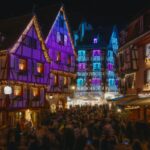
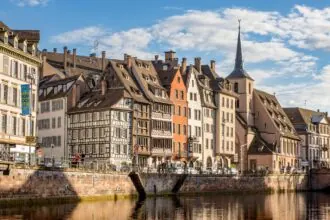
A short walk south-west, La Petite France spreads its stalls across Place Benjamin Zix and Place Saint Thomas, set among the district’s half-timbered houses and canals. This is arguably the most atmospheric single stretch of the whole market, and it tends to feel calmer than the Cathedral squares even at peak times, since the narrow streets naturally spread visitors out.
Both areas are within walking distance of each other, roughly 10 to 15 minutes on foot, and pairing them makes for a natural evening route through the market’s most photogenic corners. Photography is genuinely a reason to visit both, particularly once the canal-side lighting comes on in Petite France after dark.
See hotel options and places to stay in Strasbourg.
Browse hotelsBrowse apartments, holiday homes and self-catering stays in Strasbourg.
View rentalsSee hotel prices from multiple booking sites in one search.
Compare ratesAlsatian Food and Drink: What Makes Strasbourg Different
Strasbourg’s food stalls lean distinctly Alsatian rather than purely German, reflecting the region’s blended French and German heritage. Expect bredele biscuits, small spiced Christmas cookies traditionally baked in dozens of shapes, alongside kougelhopf, the region’s signature bundt-style cake, both of which are harder to find at markets further into Germany proper.
For something heartier, flammekueche (Alsatian tarte flambée, a thin flatbread topped with crème fraîche, onions and bacon) is widely available across the market stalls, typically from around €6 to €8 (£5.20 to £7/$6.70 to $9). Vin chaud remains the dominant drink, though a few stalls also serve Alsace’s own spiced wine variations using regional grape varieties.
Square Louise Weiss is specifically worth seeking out for food, since it is dedicated to independent Alsatian producers selling directly rather than through the standard market vendor system, giving a genuinely local alternative to the busier squares. It tends to be quieter than Place Broglie or Place Kléber, making it a good stop if the crowds elsewhere feel overwhelming.
France, Germany and Austria: Three Different Market Cultures
For a UK reader deciding between a French, German or Austrian Christmas market trip, Strasbourg is a genuinely useful reference point precisely because it sits on the cultural border between France and Germany. Compared with a typical German market, Strasbourg’s food leans more toward French pastry and regional Alsatian specialities than pure bratwurst-and-pretzel fare, and the overall atmosphere tends to feel a little more relaxed and less densely packed with beer-hall style stalls.
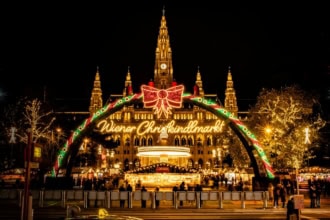
Set against an Austrian market such as Vienna’s, Strasbourg is noticeably larger in geographic spread, with its eight squares covering far more ground than a typical single Austrian Rathausplatz-style market, though Vienna’s markets generally run a broader and more elaborate mulled Punsch selection. Strasbourg’s genuine edge is history: the 1570 founding date predates most comparable German and Austrian markets by well over a century.
In practical terms, this means Strasbourg suits travellers who want a market with real historical weight and distinctly French-Alsatian food, without needing to fly to a specifically German or Austrian city to get a classic European Christmas market experience. It is also the more accessible option for UK travellers thanks to direct Eurostar-adjacent rail connections through Paris.
Getting There and Where to Stay
Strasbourg Airport (SXB) is the main international gateway, though many UK visitors find it easier to fly into Paris and continue by high-speed TGV, which covers the journey in under two hours. Our Strasbourg Airport Transfers guide compares every route from the airport itself, including train, taxi and car hire.
Once in the city, the market’s Grande Île footprint is entirely walkable, and Strasbourg’s compact tram network covers the short distances between squares that are slightly further apart, such as Square Louise Weiss. Budget hotel rooms during the market season typically start from around €90 to €110 (£78 to £96/$100 to $122) a night, rising sharply on December weekends.
Staying within the Grande Île itself puts you within walking distance of all eight market squares, which is worth the modest premium over a hotel further out given how much of the market experience happens on foot in the evenings. Booking several weeks ahead is sensible, particularly for the final two weekends before Christmas.
The Other Squares: Carré d’Or, Quai des Délices and Marché OFF
Beyond Place Broglie, Place Kléber, the Cathedral and Petite France, four more squares round out Strasbourg’s full eight-market spread, and each is worth a detour rather than an afterthought. Place du Temple Neuf hosts Le Carré d’Or, a smaller market dedicated to boutique gifts and craft pieces rather than food, making it the best stop if you are shopping for something considered rather than grazing between stalls. It sits a short walk north of Place Kléber, easy to fold into the same evening.
Along the river, Terrasse Rohan and Place du Marché-aux-Poissons host Le Quai des Délices, a riverside run of food stalls that trades the crowded squares for open embankment views, similar in spirit to Square Louise Weiss but focused on prepared food rather than raw produce. It is one of the quieter spots to eat without losing the market atmosphere entirely.
Place Grimmeissen rounds things out with Le Marché OFF, dedicated to independent and alternative makers working outside the standard market vendor system, a genuine contrast to the more traditional craft stalls found around the Cathedral. Expect a younger, more experimental range of goods here than anywhere else on the route.
None of these four squares demand a special trip on their own, but together they add real variety to what would otherwise be a fairly similar walk between Broglie, Kléber and the Cathedral. Anyone spending more than a single evening in Strasbourg should build at least one of them into a second visit.
Illuminations, Light Trails and the Grand Sapin Show
Strasbourg treats its Christmas lighting as an event in its own right rather than a side detail. Each year, Les Vitrines de Strasbourg organises a formal launch of the city’s illuminations, typically about a week before the market opens, built around a luminous parade of stilt-walkers and illuminated figures that processes from the “Porte de Lumière” through to the Grand Sapin on Place Kléber. In 2025 the launch featured live performances from singer Anne Sila, pianist Riadh Khodri and the Gospel Kids, though the exact 2026 date had not been confirmed at the time of writing.
Once the season is underway, the 30-metre Grand Sapin runs its own hourly light and music show on Place Kléber between 4pm and 9pm, drawing a steady crowd of onlookers even on a cold evening. A self-guided luminous trail then links the Cathedral, La Petite France and the Neustadt district, so the lighting display genuinely extends beyond the market squares themselves.
Elsewhere in the city, an Enchanted Forest installation of giant sparkling trees decorates Rue de la Mésange, an illuminated Advent wreath hangs at City Hall, and a 12-metre Christmas tree built entirely from recycled bottles stands at the train station, a small but genuine sustainability statement for arriving visitors.
Taken together, this makes Strasbourg’s evening walk as much a reason to visit as the stalls themselves. Arriving after dark, once the trail and Grand Sapin show are both running, is genuinely worth timing a visit around.
Concerts, Opera and Other Christmas Events
Strasbourg’s festive programme runs well beyond the market stalls, and several events are worth building a visit around in their own right. The Opéra du Rhin stages a run of Hansel and Gretel through December, alongside a dedicated English-language Christmas concert, while Festival Passions Croisées brings a programme of seasonal performances to Saint-Guillaume Church. For something less formal, the Krismass Show runs as a cabaret-style seasonal production through much of December.
Strasbourg Cathedral adds its own seasonal concert programme to the mix, with choral and organ performances held inside the cathedral through December, distinct from the illuminated market stalls surrounding it outside. It’s a natural stop for anyone who has already spent an evening admiring the cathedral’s floodlit exterior and wants to see the inside put to festive use as well.
For a different pace entirely, La Ronde du Veilleur de nuit offers guided nighttime walking tours through the old town, following the historic role of Strasbourg’s medieval night watchman, a genuinely atmospheric way to see the illuminated streets away from the busiest market squares. On the water, Batorama runs chocolate-themed river cruises past the city’s illuminated riverside, a pleasant option for anyone wanting to see the Christmas lights from a different angle.
Several of Strasbourg’s museums add seasonal exhibitions too, with displays on Alsatian Christmas traditions and regional biodiversity typically running through the first days of January, useful for filling a wet or simply market-weary afternoon. None of these require advance planning beyond checking current listings, but booking ahead for the opera and cabaret performances is sensible given how quickly December weekends sell out.
Taken as a whole, this wider programme is what separates a single evening at the market from a proper multi-day Strasbourg Christmas trip. Anyone staying more than one night should check what is actually on before assuming the market stalls are the full extent of the city’s festive offer.
Compare routes and fares for your journey to Strasbourg.
Compare flightsChoose an Airalo eSIM and arrange mobile data before you arrive.
Browse eSIMsCheck private pickup options and plan your onward journey before arrival.
View transfersShop Hours and the Alsace-Moselle Public Holiday
French shops generally follow standard hours through December: expect most city-centre stores to open from around 9am or 10am to 7pm or 8pm on weekdays and Saturdays, with the usual French rule that shops stay closed on Sundays. Strasbourg is a genuine exception during the festive season, since the city authorises shops to open on the four Sundays of Advent each December, a local arrangement that does not apply for the rest of the year.
Christmas Day (25 December) is a public holiday across France, so shops, banks and most attractions close completely. Strasbourg and the wider Alsace-Moselle region then add a second closure that the rest of France does not observe: 26 December, Saint-Étienne’s Day, is a genuine local public holiday here, a legacy of a law dating to 1892 under German administration that the region kept after reunification with France.
New Year’s Day (1 January) follows the standard national pattern and closes everything as normal. This local quirk catches out plenty of visitors from elsewhere in France, let alone abroad, who assume 26 December is an ordinary working day the way it is in Paris or Lyon.
Anyone planning to shop, bank or visit an attraction on Boxing Day in Strasbourg should treat it as a full public holiday and plan accordingly, checking specific opening hours in advance rather than assuming.
New Year’s Eve in Strasbourg
Strasbourg does not run one official, citywide fireworks display for New Year’s Eve, and celebrations instead centre informally on Place Kléber, where crowds gather beneath the Grand Sapin to see in the new year together. It is a genuinely festive, low-key atmosphere rather than a ticketed event, and anyone wanting to be part of it simply needs to arrive with enough time to find a spot before midnight.
Security measures are taken seriously. Alcohol sales and consumption on public streets are banned from midday on 31 December through midday on 1 January, and the sale, possession and use of category F2 and F3 entertainment fireworks is banned across the city from 1 December through to early January, with a curfew also applying to unaccompanied under-16s from 10pm on New Year’s Eve to 6am on New Year’s Day.
Public transport runs a modified evening schedule to help people get home safely, with some bus routes adjusted from mid-afternoon onward. Given the firework restrictions, visitors expecting a large organised pyrotechnic show, as seen in some other European cities, should adjust their expectations and instead treat Strasbourg’s New Year as a warmer, crowd-and-atmosphere occasion.
Dressing for a long, cold wait outdoors matters more here than anywhere else on this page, since the main draw is simply being present in the old town as midnight arrives. Booking a restaurant table well ahead is worth doing too, since the city’s best-placed spots near Place Kléber fill up weeks in advance.
Strasbourg’s December Weather
Strasbourg sits further from the coast than Cologne, and its December climate is correspondingly a touch colder and more continental. Average daytime highs run around 6°C (42.7°F), with overnight lows regularly dropping close to freezing at around 0.7°C (33.3°F), so a proper winter coat is non-negotiable for evening market visits.
Precipitation is a little lower than Cologne’s, at around 93mm through the month, but Strasbourg has its own distinctive weather quirk: the city sits in the Rhine plain and is well known locally for holding onto thick winter fog even when nearby areas, including the Vosges mountains just to the west, are clear and sunny. A grey, misty day in the old town is a genuine possibility at any point in December.
Snow is possible but not guaranteed, and light frost is more common than a real snowfall most winters. The fog and damp cold together make layering and waterproof footwear the priority over a single heavy coat, since the half-timbered streets and canal-side paths of Petite France get slippery in damp weather.
Packing for Strasbourg in December means preparing for grey, still, foggy days as much as crisp, clear ones, since the two are both genuinely common. A warm hat and gloves matter as much as the coat itself, given how long an evening walking the illuminated squares can run.

Rupert’s Handy Travel Tips
Eight market squares sounds like a lot to cover, but Strasbourg’s Grande Île is small enough to see most of them in a single day. Here’s what I’d plan around.
- Start at Place Broglie: it’s the historic original and usually calmer earlier in the day than Place Kléber or the Cathedral squares.
- Save La Petite France for after dark: the canal-side lighting there is genuinely one of the best sights of the whole market.
- Try flammekueche over bratwurst: it’s the dish that actually distinguishes Strasbourg’s food from a typical German market.
- Check the exact 2026 dates before booking: they weren’t confirmed at the time of writing, so verify with the official Strasbourg tourist office closer to your trip.
- Consider a day trip to Colmar: it’s under an hour away by train and runs its own smaller, equally atmospheric Christmas market if you have extra time in Alsace.
Want to meet the reindeer behind our travel tips? Find out more in our page Who is Rupert?.




Frequently Asked Questions
Is Strasbourg’s Christmas market really the oldest in France?
Yes. The Christkindelsmärik on Place Broglie dates to 1570, giving it the strongest documented claim to being the oldest Christmas market in the country, which is the basis of Strasbourg’s “Capitale de Noël” branding.
When does Strasbourg’s Christmas Market run in 2026?
Exact 2026 dates had not been officially confirmed at the time of writing. Last year’s market ran from 26 November to 24 December, and that is the most reliable pattern to plan around until the Strasbourg tourist office publishes confirmed 2026 dates.
How is Strasbourg’s market different from a German Christmas market?
Strasbourg’s food leans more French-Alsatian, with dishes like flammekueche, bredele biscuits and kougelhopf alongside the usual mulled wine, and the market spreads across eight separate squares rather than one or two central locations.
Can I visit Colmar as a day trip from Strasbourg’s Christmas market?
Yes, Colmar sits under an hour away by train and runs its own smaller, equally festive Christmas market with a fairytale, half-timbered old town setting, making it a natural pairing for anyone spending a few days in Alsace.
Is the whole market free to walk around?
Yes, there is no entry charge to any of the eight market squares; you only pay for food, drink and any items you buy from the stalls.
Is there a Christmas lights switch-on event in Strasbourg?
Yes. Les Vitrines de Strasbourg organises a formal illuminations launch, typically about a week before the market opens, built around a luminous parade to the Grand Sapin on Place Kléber. The exact 2026 date had not been confirmed at the time of writing, so check the city’s official Noël à Strasbourg site closer to your trip.
Is 26 December a public holiday in Strasbourg?
Yes, uniquely within France. Alsace-Moselle observes Saint-Étienne’s Day (26 December) as a full public holiday, a legacy of local law dating to 1892, so shops, banks and most attractions close on Boxing Day here even though the rest of France treats it as an ordinary working day.
Further Reading
Beyond the market squares, Strasbourg has plenty to fill the daylight hours, and our Things to Do in Strasbourg guide covers the cathedral, the old town and the city’s museums in full, so you can plan a rounded visit rather than one built entirely around the evening market crowds.
The market’s setting has official recognition beyond its own branding, too: Strasbourg’s Grande Île, the historic island where most of the market squares sit, has been a UNESCO World Heritage Site since 1988, a status that reflects the same medieval streets and cathedral backdrop the Christmas market sets up in every winter.
If you have a few days to explore Alsace beyond the city itself, our Best Day Trips from Strasbourg guide covers nearby villages and castles worth the short journey, including Colmar’s own fairytale Christmas market, which pairs naturally with a Strasbourg-based trip during the festive season.
For arriving in the region, our Strasbourg Airport Transfers guide covers every route from Strasbourg Airport, including the train and taxi options for reaching the Grande Île.
To weigh Strasbourg against other major European festive cities, our European Christmas Markets Guide rounds up the continent’s best-known markets, dates and travel tips, useful if you’re deciding between a trip to France, Germany or Austria this winter.