Reviewed by our editorial team Published
While most of Europe’s festive cities shiver through freezing December evenings, Lisbon offers something genuinely different: a Christmas city break where daytime temperatures often still reach a mild 14°C to 17°C. This is not a page pretending Lisbon rivals Vienna or Strasbourg for scale, it is a case for visiting a beautifully lit, sunny coastal capital instead of another Alpine wooden village.
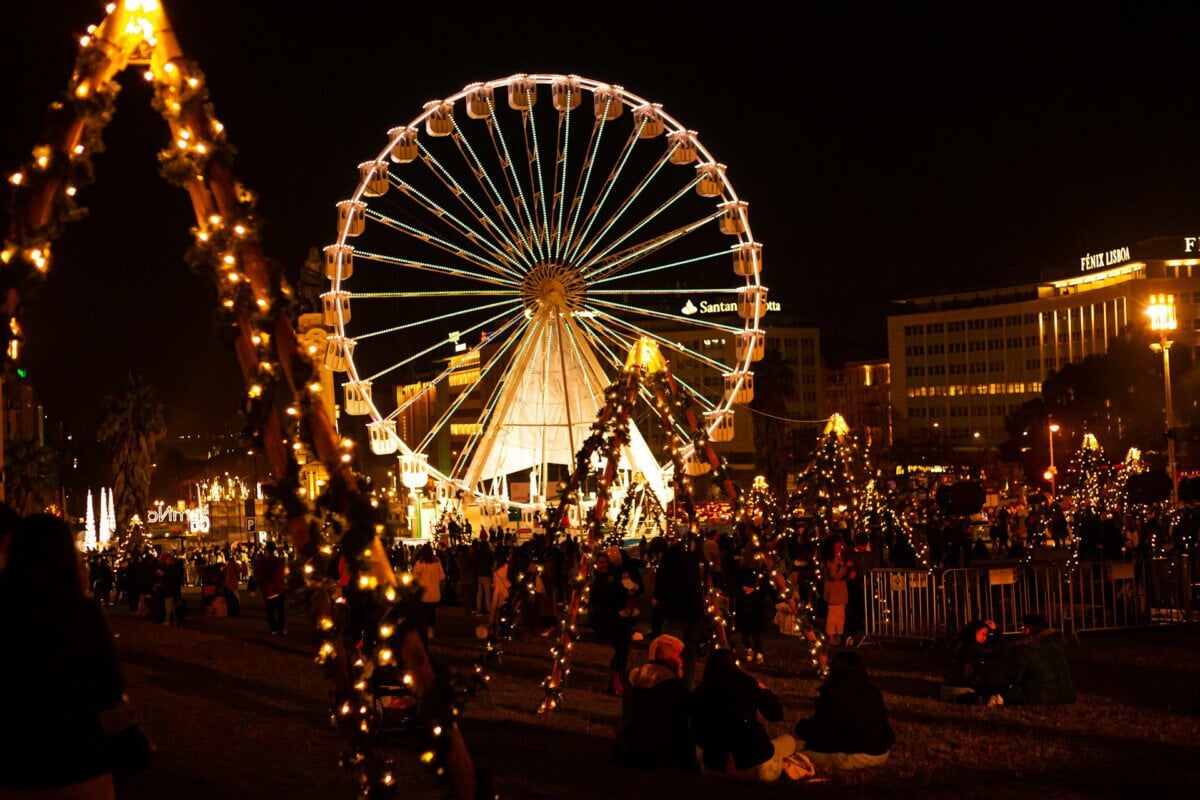
The city’s festive centrepiece is the Rossio Christmas Market, filling the historic Praça Dom Pedro IV and neighbouring Praça da Figueira in the Baixa district with more than 70 wooden chalets. A short walk across the city, Wonderland Lisboa in Parque Eduardo VII adds a ferris wheel and an ecological ice rink, giving visitors a genuine skating experience despite the mild climate outside.
Official 2026 season dates had not yet been confirmed by visitlisboa.com or the individual event organisers at the time of writing. Based on the 2025 season, Rossio’s market ran from 15 November to 22 December and Wonderland Lisboa from 28 November to 4 January, and a similar pattern is reasonably expected for 2026, though dates should be checked closer to travel.
What makes Lisbon worth including alongside Europe’s classic Christmas cities is precisely how different it feels. Instead of mulled wine warming cold hands, there are rooftop bars still open in the evening sun; instead of snow, there are the Baixa district’s famous festive lights strung between Pombaline buildings and reflected on the Tagus.
This guide covers where Lisbon’s markets and lights actually are, what genuinely sets a warm-weather Christmas city apart, the Portuguese food and drink worth trying, and the practical details of getting there and finding somewhere to stay.
Lisbon’s Christmas Markets and Lights at a Glance
| Event | Location | Best For | Highlights | Entry |
|---|---|---|---|---|
| Rossio Christmas Market | Praça Dom Pedro IV and Praça da Figueira, Baixa | Traditional market shopping | 70+ wooden chalets, free Christmas Train, live music | Free |
| Wonderland Lisboa | Parque Eduardo VII | Ice skating and families | Ecological ice rink, heated Ferris wheel, Santa’s Village | Free entry, rides and rink cost extra |
| Baixa-Chiado Christmas Lights | Rua Augusta and surrounding streets | Evening walks and photography | Illuminated arches, decorated shopfronts, Rua Augusta Arch | Free |
| Campo Pequeno Christmas Market | Sagres Campo Pequeno bullring | Families and workshops | Daily craft and cookery workshops, artisan gift stalls | Free |
| Comércio Square and Alfama Lights | Praça do Comércio, Alfama | River views and old-town atmosphere | Riverside decorations, festive lighting over the Tagus | Free |
All five are free to visit, with Rossio, the Baixa lights and Campo Pequeno each a short walk or Metro ride from one another, and Wonderland Lisboa a further 20 to 25 minutes away in Parque Eduardo VII. A single evening comfortably covers Rossio and the Baixa lights, with a second outing worthwhile for the ice rink and Campo Pequeno’s workshops.
Where Lisbon’s Christmas Markets and Lights Actually Are
The Rossio Christmas Market is Lisbon’s main festive market, spread across the historic Praça Dom Pedro IV (universally known as Rossio) and the adjoining Praça da Figueira, where a separate gourmet food section operates. More than 70 wooden chalets sell Portuguese handicrafts and seasonal treats, and a free Christmas Train loops through nearby Baixa streets daily, a popular option for families.
For ice skating, head to Wonderland Lisboa in Parque Eduardo VII, near the Marquês de Pombal roundabout. It features an 800 square metre ecological ice rink, a heated-cabin Ferris wheel with panoramic city views, and a Santa’s Village for children, making it the most fairground-like of Lisbon’s festive events.
Beyond the two main events, Lisbon’s real festive draw is its street lighting. The Baixa grid, particularly Rua Augusta and the streets around the famous triumphal arch, is strung with elaborate illuminated arches every December, and the display extends down to Praça do Comércio on the riverfront, where lights reflect off the Tagus.
A third dedicated market, the Campo Pequeno Christmas Market, runs inside the historic Sagres Campo Pequeno bullring building, reachable by Metro on the red line. Rather than rows of wooden chalets, it centres on daily workshops, ceramics painting, cross-stitch, card-making and sustainable cookery classes, alongside artisan gift stalls, making it a good fit for families over a wet afternoon.
Smaller neighbourhood lights and decorations also appear through Chiado and the hillside streets of Alfama, adding festive character to a wander through Lisbon’s most atmospheric old quarters. None of this rivals a purpose-built German or Austrian market for stalls, but as a citywide lighting display it is genuinely one of Southern Europe’s best.
Because Rossio, the Baixa lights and Praça do Comércio all sit within the same compact downtown grid, most visitors combine all three into a single evening walk, saving Wonderland Lisboa’s ice rink for a separate outing given the short Metro trip or walk required to reach it.
Browse hotels and accommodation for your visit to Lisbon.
View staysBrowse apartments, holiday homes and self-catering stays in Lisbon.
View rentalsCompare hotel deals in Lisbon from multiple booking sites.
Compare pricesA Warm-Winter Alternative to Europe’s Alpine Markets
Lisbon’s genuine point of difference against Vienna, Strasbourg or Salzburg is climate. December daytime temperatures typically sit between 12°C and 17°C, and while evenings are cooler, layered clothing is usually enough without the heavy coats, hats and gloves a Central European market demands.
The contrast holds up in the wider numbers too. Lisbon averages around five hours of sunshine a day in December, more than double the daily total in many Central and Northern European cities at the same time of year, alongside roughly 106mm of rain spread across 14 days, broadly similar total rainfall to further north but with far more sun breaking through between showers.
That mild weather changes what a festive evening actually feels like. Rooftop bars across the city, many with river views over the Tagus, stay genuinely pleasant into the evening, and outdoor seating at restaurants in Baixa and Chiado remains a realistic option through most of December, something no Alpine market city can offer.
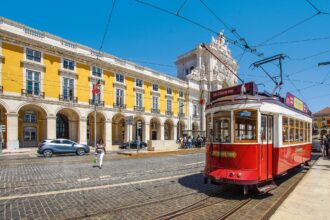
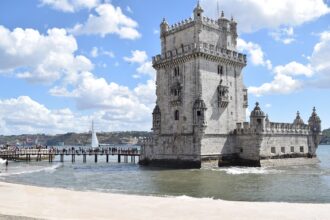
Lisbon also pairs its festive lights with plenty of daytime sunshine, making it a genuinely useful base for combining Christmas atmosphere with regular sightseeing. Visitors can spend mornings exploring Belém’s monuments or riding the famous Tram 28 through the old town in comfortable conditions that a Central European December simply does not allow.
This is not a market city in the traditional sense, and visitors chasing rows of wooden chalets and snow-dusted squares will find Lisbon’s offering modest by comparison. What it offers instead is a genuinely different kind of festive trip, one built around lights, sunshine and warmth rather than the mulled-wine-and-woolly-hats formula found everywhere else on this list.
For travellers who find the cold part of the appeal, Lisbon will disappoint. For anyone who wants Christmas atmosphere without freezing evenings, a genuinely different December city break, and the option of a beach walk in Cascais the same afternoon, it is one of Europe’s most underrated festive destinations.
Portuguese Christmas Food and Drink
Lisbon’s markets serve genuinely Portuguese festive food rather than imported Alpine traditions. Look out for castanhas assadas (roasted chestnuts, sold from street braziers even in Lisbon’s milder climate) and bolo rei, the traditional Christmas fruit cake studded with candied fruit and nuts, widely available from €5 to €12 (£4.30 to £10.40 / $5.50 to $13) depending on size.
Rather than mulled wine, the signature warming drink is ginjinha, a sour cherry liqueur traditionally served in a small chocolate cup, usually costing around €2 to €4 (£1.75 to £3.50 / $2.20 to $4.30) per shot from dedicated kiosks around Rossio. It is stronger and sweeter than mulled wine, and drinking one at a standing-room bar near the square is a genuinely local Lisbon tradition.
Market food stalls also sell pastéis de nata (Portugal’s famous custard tarts) alongside more substantial options such as bifanas (marinated pork sandwiches), typically priced from €3 to €6 (£2.60 to £5.20 / $3.30 to $6.50). The gourmet section at Praça da Figueira leans toward slightly more elevated food stalls, with mains generally costing €8 to €15 (£7 to £13 / $9 to $16).
Christmas Eve itself centres on bacalhau (salt cod), traditionally served boiled with potatoes and cabbage, a dish worth seeking out at a traditional Lisbon restaurant rather than a market stall for the full experience. Many restaurants in Baixa and Alfama run special festive menus through December, typically from around €20 to €35 (£17 to £30 / $22 to $38) per person.
Port wine tastings, widely available across Lisbon’s older neighbourhoods, make a natural addition to a festive evening, and several wine bars near Rossio run seasonal tasting flights specifically aimed at winter visitors looking for something a little different from the standard glass of house red.
Getting to Lisbon and Where to Stay
Lisbon Humberto Delgado Airport sits unusually close to the centre, just 7km from Baixa, with the Metro red line reaching Rossio in around 25 to 30 minutes for a fraction of the cost of a taxi, which typically runs €15 to €20 (£13 to £17 / $16 to $22). This makes Lisbon one of the easiest major European capitals to reach without a lengthy transfer.
The city centre is compact and walkable, though Lisbon’s famous hills mean comfortable shoes matter, and the historic Elevador da Bica and Tram 28 offer a scenic way to cover the steeper stretches between Baixa, Chiado and Alfama. The Metro and tram network covers Wonderland Lisboa and most other festive sights easily.
Accommodation in central Lisbon books up for the festive season, though generally at noticeably lower prices than equivalent Central European market cities, with a well-located double room typically costing from around €90 to €150 (£78 to £130 / $98 to $164) a night in December. Staying in Baixa or Chiado puts most festive lights and markets within easy walking distance.
December in Lisbon does see rain more often than the rest of the year, so a light waterproof is worth packing alongside layers for cooler evenings. Markets and lights typically run into the evening, with Rossio’s stalls generally trading until around 10pm, giving visitors a genuinely long window to combine sightseeing, food and festive shopping in a single mild winter day.
Lisbon’s Christmas Lights Switch-On
Lisbon treats its Christmas lights as a genuine civic event in their own right, not just decoration around the markets. The most recent switch-on took place on Saturday 22 November 2025 at 6:30pm in Terreiro do Paço (Praça do Comércio), the same riverside square that hosts the city’s New Year’s Eve celebrations.
The scale is hard to overstate. The 2025 display covered 182km of illuminated decoration across 46 locations citywide, built from more than 1,050 light structures and almost 6,000 decorative pieces, anchored by a 30-metre Christmas tree in Praça do Comércio itself.
Specific streets get their own themed installations rather than generic strings of bulbs. Rua Garrett in Chiado is strung with soft golden light clouds, Rua do Carmo becomes a luminous tunnel of light and music, and Rua Augusta is lined with illuminated trees running down toward the river.
A firm 2026 switch-on date had not been confirmed at the time of writing, but based on the 2025 pattern, a late November event centred on Terreiro do Paço is a reasonable expectation. Checking Visit Lisboa‘s own listings closer to the date is the most reliable way to catch the exact evening.
Because the display runs across the whole downtown grid rather than one street, it stays lit and worth seeing for the entire season, not just on switch-on night, making it one of the more relaxed ways to build Christmas atmosphere into an evening in Lisbon.
Live Music and Entertainment at Lisbon’s Markets
Rossio’s market is more than stalls. Throughout the season it hosts performances from folk groups, academic tunas (traditional student musical groups dressed in capes, a genuinely Portuguese institution) and philharmonic bands, performing at various points across the Baixa grid rather than one fixed stage.
The free Christmas Train is the market’s other signature activity, looping through Baixa’s streets daily and popular with children and adults alike as a gentle way to see the lights and stalls without walking the whole route on foot.
Wonderland Lisboa’s Santa’s Village adds its own family entertainment alongside the ice rink and Ferris wheel, while the Campo Pequeno market’s daily workshops give a quieter, more hands-on alternative to browsing stalls for families who want to make something rather than just buy it.
Buskers are a fixture of Baixa’s pedestrianised streets year-round, and December brings noticeably more of them out, with guitarists and fado singers a common sight along Rua Augusta as evening crowds gather to look at the lights.
None of this is on the scale of a dedicated Christmas concert series, but between the markets, the street performers and the illuminations themselves, an evening in Lisbon’s Baixa carries a genuine festive soundtrack without needing to seek out a single ticketed event.
Shop, Transport and Attraction Hours Over Christmas in Portugal
Lisbon’s shops keep fairly standard hours through most of December. Central stores in Baixa, Chiado and Avenida da Liberdade generally trade Monday to Saturday until around 7pm or 8pm, with some smaller independent shops closing for a couple of hours at lunchtime, while larger shopping centres tend to stay open later into the evening.
24 December sees shortened hours rather than a full closure, with most shops trading through the morning and into early afternoon before closing so staff can get home for the traditional Consoada family dinner. Buying any last-minute groceries by the 23rd is sensible, since availability drops sharply from midday on the 24th.
Christmas Day itself sees widespread closures. Most supermarkets, shopping centres and traditional stores stay shut on 25 December, with only convenience shops, petrol stations and hotel restaurants reliably open. Unlike Ireland or the UK, however, 26 December is not a public holiday in Portugal, so the city returns to close to normal trading the following day.
The Lisbon Metro runs a shortened service on Christmas Eve, with the last trains leaving terminal stations at around 10:05pm rather than the usual late finish, before reopening at the normal 8am start on Christmas Day itself. Major attractions such as Jerónimos Monastery and Belém Tower close on 25 December along with most of the city’s museums.
The practical takeaway mirrors Dublin’s, if slightly softer: treat 24 and 25 December as reduced or closed days for shopping and sightseeing in Lisbon, but expect a fuller, more normal city again by the 26th, well before most Northern European destinations have reopened.
Search flights and useful route combinations for your trip.
View flightsBrowse Airalo eSIM options for convenient travel data.
Check eSIMsCheck private pickup options and plan your onward journey before arrival.
View transfersNew Year’s Eve in Lisbon
Lisbon’s New Year’s Eve centres on one of Europe’s genuinely great fireworks displays, launched from barges on the Tagus and watched from Praça do Comércio (Terreiro do Paço), the grand riverside square that anchors the whole of Baixa. The free event typically opens with live music and DJ sets from around 10:30pm on 31 December.
The most recent edition ran a full entertainment bill ahead of midnight, including Afro-house, reggaeton and hip-hop sets from local artists and DJs, building the square’s atmosphere for several hours before the display itself. Crowds gather early, and arriving well before 10pm is the only realistic way to get a clear view of the river.
At midnight, a large-scale fireworks show fills the sky above the Tagus, set to an original soundtrack and visible from much of the riverside, including vantage points across the water in Almada for those who prefer to watch from a distance rather than fight the crowds in the square itself.
Entertainment continues after the fireworks, with further DJ sets and performances running into the early hours, and the event is entirely free to attend, unlike Dublin’s ticketed countdown concert. Restaurants and rooftop bars across Baixa and Chiado also run their own New Year’s dinners and parties, many with river views over the display itself.
Public transport runs later than usual to support the event, with the Lisbon Metro extending service until around 3am on New Year’s Eve, a genuinely useful detail for anyone planning to watch the fireworks and get home again without needing a taxi.

Rupert’s Handy Travel Tips
Rupert thinks Lisbon is at its best when you treat it as a sunny city break with festive extras, not a replacement for an Alpine market.
- Pack layers, not heavy coats: Lisbon’s December days are genuinely mild, and a warm jacket is usually enough for the evenings.
- Try ginjinha near Rossio: the sour cherry liqueur served in a chocolate cup is a more Lisbon experience than mulled wine.
- Save the ice rink for a separate trip: Wonderland Lisboa is a short Metro ride from Rossio, so plan it as its own outing.
- Walk Baixa after dark: the illuminated arches over Rua Augusta look far better once the sun has gone down.
- Bring a light waterproof: December sees more rain than Lisbon’s usual sunny reputation suggests.
- Pair it with a beach afternoon: nearby Cascais makes a genuinely realistic half-day trip even in December, something no Alpine market city can offer.
Want to meet the reindeer behind our travel tips? Find out more in our page Who is Rupert?.




Frequently Asked Questions
Does Lisbon have Christmas markets?
Yes, though on a smaller scale than Central Europe. The main event is the Rossio Christmas Market in Baixa, alongside Wonderland Lisboa, a ferris wheel and ice rink at Parque Eduardo VII.
When do Lisbon’s Christmas markets open for 2026?
Official 2026 dates had not been confirmed at the time of writing. Based on the 2025 season, Rossio ran from mid November to late December and Wonderland Lisboa from late November into early January, and a similar pattern is expected, but this should be checked closer to travel.
Is there an ice rink in Lisbon at Christmas?
Yes, at Wonderland Lisboa in Parque Eduardo VII, not at Rossio itself. It is an ecological ice rink alongside a heated-cabin Ferris wheel and a Santa’s Village.
Is Lisbon warm at Christmas?
Mild rather than warm. Daytime temperatures typically sit between 12°C and 17°C in December, noticeably milder than Central or Northern Europe, though evenings are cooler and rain is more common than in summer.
How do I get from Lisbon Airport to the Christmas markets?
Lisbon Airport is around 7km from Baixa, with the Metro red line reaching Rossio in roughly 25 to 30 minutes, considerably cheaper than a taxi.
Is Lisbon a good alternative to Europe’s bigger Christmas markets?
As a market-focused trip, no, the offering is modest by comparison. As a mild, sunny winter city break with genuine festive lights and atmosphere, it is one of the better alternatives in Southern Europe.
Is there a fireworks display in Lisbon on New Year’s Eve?
Yes. A large free fireworks display launches from the Tagus at midnight on 31 December, watched from Praça do Comércio, alongside a free evening of live music and DJ sets from around 10:30pm.
Are shops and public transport open in Lisbon over Christmas?
Shops keep shortened hours on 24 December and mostly close on 25 December, but 26 December is not a public holiday in Portugal, so the city returns close to normal the next day. The Metro closes early on Christmas Eve and resumes normally on Christmas Day.
When are Lisbon’s Christmas lights switched on?
The most recent switch-on was on 22 November 2025 at Praça do Comércio. A 2026 date was not confirmed at the time of writing, but a similar late November event is a reasonable expectation.
Further Reading
Anyone planning a wider stay should read our full guide to things to do in Lisbon, covering the city’s museums, neighbourhoods and attractions beyond the festive season.
Travellers flying in should check our Lisbon Airport Transfers guide, which explains Metro, bus and taxi options into the city centre.
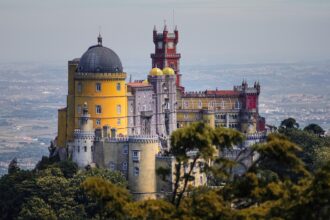
For visitors extending their stay, our Day Trips from Lisbon guide covers excursions to Sintra, Cascais and Fátima, several of which work especially well given Lisbon’s mild December climate.
Comparing Lisbon against Europe’s bigger, colder festive cities before booking? Our European Christmas Markets Guide rounds up major markets by city, typical dates, and what makes each destination distinctive.