Reviewed by our editorial team Updated
Airport Overview and Quick Facts
Bordeaux–Mérignac Airport (BOD) sits around 11 kilometres west of the city centre, in the suburb of Mérignac. It’s a manageable size as French regional airports go, handling a steady flow of domestic and European flights through a single main terminal building split into Hall A and Hall B, with arrivals, car rental desks and the main transport connections all within a short walk of one another.
Unlike many airports where public transport means a long bus ride or an awkward connection into the city, Bordeaux’s tram stop sits directly outside the terminal, a genuine advantage that dates back to a major infrastructure project completed in 2023 and refined further with a line renumbering in December 2025. This makes the tram a realistic option even for first-time visitors juggling luggage and an unfamiliar city, rather than something only confident locals would attempt.
That said, the tram isn’t the only sensible choice, and which option suits you best depends heavily on your circumstances. Taxis, Uber, private transfers and car hire desks are all readily available at the terminal, and each comes with its own trade-off between cost, convenience and journey time. A solo traveller with a single backpack has very different priorities from a family of five with matching suitcases, and this guide is built to help you match your situation to the right option rather than assume one size fits all.
Bordeaux itself is a compact, walkable city once you arrive, so the transfer from the airport is really the only logistical hurdle standing between you and your holiday. Get this part right, and everything else tends to fall into place.
It’s also worth knowing that Bordeaux Airport has grown considerably over the past decade, adding new routes and increasing passenger numbers year on year, which has driven much of the investment in transport links like the tram extension. This ongoing growth means facilities at the terminal itself are generally modern and well maintained, with clear signage in both French and English guiding arriving passengers toward whichever transport option they’ve chosen.
Comparing Your Transfer Options
Before diving into the detail, here’s how the main options stack up against one another at a glance:
| Option | Journey Time | Approx. Price | Best For |
|---|---|---|---|
| Tram (Line F) | 35–45 min | €1.90 (£1.60 / $2.20) | Budget travellers, light luggage |
| Local bus (Liane 1) | 30–45 min | €1.90 (£1.60 / $2.20) | Budget travellers heading to specific neighbourhoods |
| Direct airport shuttle bus (30’Direct) | 30–35 min | €9 (£7.80 / $10.30) online, €10 (£8.70 / $11.50) on board | Travellers heading straight to Gare Saint-Jean |
| Taxi | 20–35 min | €30–€45 (£26–£39 / $34–$52) | Convenience, groups, luggage |
| Uber / ride-hailing | 20–35 min | €20–€40 (£17–£35 / $23–$46) | Similar convenience, often cheaper than taxis |
| Private transfer | 20–35 min | €40–€95 (£35–£82 / $46–$109) | Families, groups, stress-free arrivals |
| Car hire | N/A | Varies | Exploring beyond the city |
A few patterns are worth noting before you choose. Public transport options (the tram and bus) are consistently the cheapest, but both come with genuine luggage constraints and a longer overall journey once you factor in walking to your final accommodation. Taxis and Uber occupy a similar price bracket to one another, with Uber usually coming in a little cheaper, while private transfers cost more but remove almost all of the friction of arriving somewhere new. If your trip extends beyond Bordeaux itself, into wine country or along the coast, car hire becomes worth serious consideration even though it isn’t useful for the city-centre transfer alone.
There’s no single “best” option here, only the option that’s best for your specific trip, budget and tolerance for a bit of hassle in exchange for saving money.
It’s worth reading through each option in more detail below before deciding, since the table above necessarily simplifies some genuinely useful nuances, such as exactly where each service picks up from at the terminal, and which one best suits arrivals outside normal daytime hours when frequencies and availability change considerably.
Compare hotels and other places to stay in Bordeaux.
Check availabilityExplore holiday homes and apartments around Bordeaux.
See holiday homesSee hotel prices from multiple booking sites in one search.
Compare ratesTaking the Tram into the City
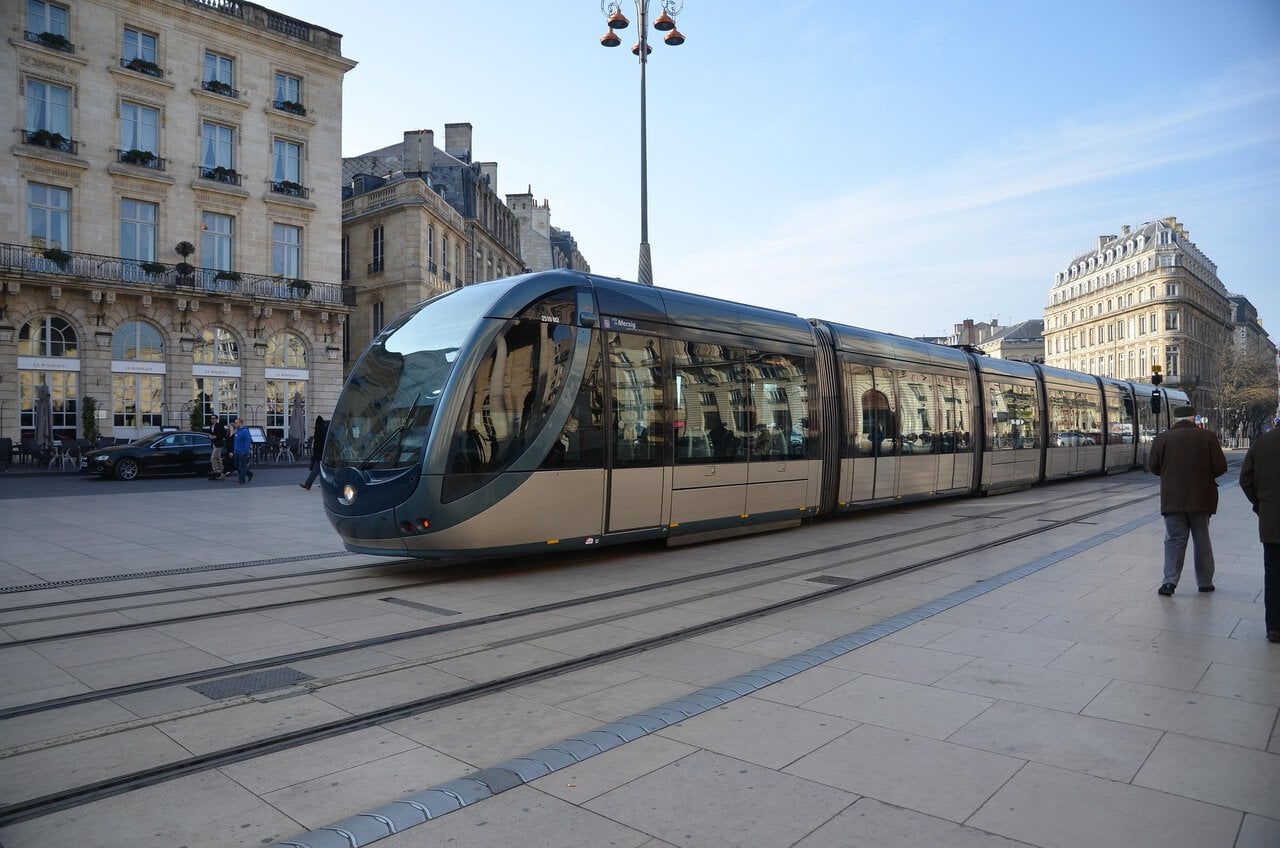
The standout option for most visitors is Tram Line F, which runs directly from a stop right outside the terminal, near Hall B, into the heart of Bordeaux. This is a genuinely direct service rather than one requiring a connection, which sets Bordeaux apart from many airports where public transport means changing at an intermediate station.
Trams run every 10 minutes Monday to Saturday and every 15 minutes on Sundays, tapering off in frequency later at night. Services run from around 5am to midnight, extending to 1am on Thursdays, Fridays and Saturdays. The journey time is around 35 minutes to the central Hôtel de Ville stop, or closer to 45 minutes if you’re continuing all the way to Gare Saint-Jean, the main railway station, since the line runs through several intermediate stops along the way rather than travelling in a straight line.
A single ticket costs €1.90 (£1.60 / $2.20), or €15.70 (£13.60 / $18) for a carnet of ten journeys, and can be bought from ticket machines at the tram stop itself, through the TBM app, or from newsagents inside the terminal building. A single ticket includes free transfers to other trams and buses within the network for a full hour after validation, which is genuinely useful if your accommodation means changing lines partway through the city rather than staying on one tram the whole way.
The main drawback worth flagging honestly is luggage space, which is limited on board and can feel genuinely tight if the tram is busy, particularly during peak commuting hours or around major events in the city. For solo travellers or couples with a single case each, though, it’s hard to beat on value, and it remains by far the most environmentally friendly way into town.
The tram stop itself is step-free and well signposted from the arrivals hall, making it a genuinely accessible option for most travellers, including those with pushchairs, provided the carriage isn’t already at capacity when it arrives.
Local Bus Services
Alongside the tram, the regular city bus network also serves the airport directly, offering an alternative route in for anyone whose accommodation happens to sit closer to a bus stop than a tram stop. The Liane 1 route connects the airport to the Gambetta tram stop, taking a broadly similar 30 to 45 minutes, with identical ticket pricing to the tram at €1.90 (£1.60 / $2.20), since both services are run by the same operator, TBM. Separately, the 30’Direct shuttle coach links the airport with Gare Saint-Jean in around 30 minutes for €9 (£7.80 / $10.30) booked online, or €10 (£8.70 / $11.50) bought on board.
Buses tend to make more intermediate stops along their route than the tram does, weaving through residential streets and smaller junctions rather than following a more direct corridor into the centre. This makes the overall journey feel a little slower in practice, even when the timetabled duration looks similar on paper, simply because of the stop-start nature of city bus routes during busier periods of the day.
For most first-time visitors without strong local knowledge, the tram remains the more straightforward and predictable choice, if only because it’s easier to picture the route and know exactly where you’ll end up. That said, the bus network is worth keeping in mind if you’re staying somewhere the tram doesn’t reach directly, or if you simply prefer buses to trams for practical reasons like accessibility or personal preference. Tickets bought for one mode transfer freely to the other within the same hour, so there’s no financial penalty for mixing and matching as needed during your stay.
It’s also worth knowing that the bus network extends into parts of the wider Bordeaux metropolitan area that the tram simply doesn’t reach, which can matter if your accommodation is in a suburb rather than the historic centre itself. Drivers are generally used to tourists asking for help with tickets or directions, and route maps are displayed clearly at most stops, making the system reasonably approachable even without fluent French. If you’re unsure which service best matches your destination, staff at the airport’s information desk can usually point you toward the right stop and ticket type before you set off.
Using Taxis from the Airport
Taxis are readily available from a designated rank directly outside the arrivals hall, with no need to book ahead or download an app before you land. Bordeaux operates a regulated flat-rate system for airport taxis, meaning fares to the city centre are generally predictable rather than fluctuating wildly with traffic conditions, which takes some of the anxiety out of an unfamiliar arrival.
Fares to the city centre typically work out at around €30 to €45 (£26 to £39 / $34 to $52) depending on your exact destination, rising a little further for journeys out to Gare Saint-Jean or destinations on the opposite side of the city from the airport. The journey itself usually takes somewhere between 20 and 35 minutes, depending on traffic conditions and the time of day, with the longer end of that range applying during the morning and evening rush hours when the roads around the airport and city centre become genuinely congested.
Taxis make the most sense if you’re arriving with heavy luggage, travelling as a family with young children, or simply want to get to your accommodation without the mental overhead of navigating public transport immediately after a flight. It’s worth confirming with the driver that either the meter is running or that you’ve been quoted the correct regulated flat rate before setting off, since this avoids any awkward conversations about pricing once you arrive at your destination. Most drivers are used to tourists asking this and won’t take offence at the question.
Payment is straightforward, with most vehicles accepting card payment as well as cash, though it’s sensible to check this before you set off if you’re relying solely on a card, particularly late at night when card machines occasionally malfunction. If you’re travelling with particularly bulky luggage, such as golf clubs, bicycles or oversized cases, it’s worth mentioning this when you reach the front of the taxi queue, since not every vehicle in the rank will have sufficient boot space, and a slightly larger car can usually be found on request without a long wait.
Uber and Ride-Hailing Apps
Uber operates actively in Bordeaux and is often a noticeably cheaper alternative to a traditional taxi for the same journey, typically costing somewhere between €20 and €40 (£17 to £35 / $23 to $46) to reach the city centre. The exact price is always shown upfront in the app before you confirm your booking, which removes any uncertainty about what you’ll be charged once you’re moving, unlike a metered taxi where the final cost can vary with traffic.
Other ride-hailing apps have a much more limited presence in the city compared with Uber, so it’s generally the most reliable option if you’d rather not queue at the taxi rank or aren’t confident navigating an unfamiliar regulated pricing system in a foreign country. The app also gives you a clear estimated arrival time for your driver, along with their vehicle details and licence plate, which can be reassuring after a long flight when you’re keen to simply get moving.
As with most cities, prices can rise noticeably during busy periods, particularly around rush hour, poor weather, or when flights land in clusters and demand spikes all at once. If your timing isn’t critical, it’s worth checking the fare in the app a few minutes apart to see whether waiting slightly reduces the surge pricing, though this isn’t guaranteed and shouldn’t be relied upon if you’re in a hurry to reach your accommodation.
One practical point worth knowing before you land: pick-up zones for ride-hailing apps at Bordeaux Airport are sometimes separate from the main taxi rank, so it’s worth checking the exact pick-up instructions the app provides rather than simply heading to the same spot as the taxis. This is usually clearly signposted, but it can cause a few minutes of confusion for first-time visitors expecting a single unified pick-up area. Drivers are generally reliable about waiting the few extra minutes this sometimes takes, and cancellation rates at the airport are low compared with busier pick-up points in the city centre itself.
Booking a Private Transfer
For a considerably more relaxed arrival experience, a private transfer can be booked in advance of your trip, with a driver waiting for you inside the terminal holding a sign with your name, your flight tracked in real time in case of delays, and a fixed price agreed well before you even board your flight. This removes essentially all of the uncertainty around cost and logistics that can make an airport arrival stressful, particularly after an overnight flight or a long day of travel.
A standard sedan transfer typically costs somewhere in the region of €40 to €65 (£35 to £56 / $46 to $75), while larger minivans suited to groups of four to seven passengers usually run from about €65 to €95 (£56 to £82 / $75 to $109), scaling with vehicle size rather than distance since the destination is almost always within the city itself. Given how modest the price difference often is compared with a standard taxi, particularly once you account for the certainty of a fixed fare agreed in advance, many travellers find the extra cost genuinely worthwhile for the peace of mind alone.
This option suits families travelling with young children, larger groups splitting the cost between several people, or simply anyone arriving late at night who would rather not deal with taxi ranks, unfamiliar apps, or public transport timetables after a long journey. Many providers also offer child seats on request and are happy to make a brief stop for a supermarket run on the way to your accommodation, a small touch that can make a genuine difference if you’re arriving with young children and need essentials before settling in.
Most private transfer providers also offer a flexible cancellation policy, which is worth checking before you book, since flight delays and schedule changes are a normal part of travel and a good provider will track your flight automatically rather than charging extra for a late arrival.

Arrange Your Bordeaux Airport Transfer
For a straightforward arrival in Bordeaux, Welcome Pickups allows you to pre-book a private transfer from the airport to your hotel or accommodation.
Having the journey arranged in advance means you can leave the terminal without needing to find a taxi or work out local public transport after your flight.
Check prices for your Bordeaux airport journey. You can also check another transfer provider before booking.
Should You Hire a Car?
If your plans extend beyond Bordeaux itself into the surrounding region, hiring a car at the airport is a genuinely sensible option worth serious consideration. Rental desks from all the major international companies are located directly inside the terminal building, meaning you can walk straight from baggage reclaim to your car with minimal fuss, and Bordeaux’s famous wine regions, the Atlantic coast and towns like Saint-Émilion or Arcachon are all considerably easier to reach with your own transport, particularly on days when public transport connections are limited or run only hourly.
Having a car also gives you the flexibility to combine several destinations into one day, stop wherever catches your eye along the way, and avoid being tied to bus or train timetables that don’t always align neatly with opening hours at wineries or attractions. For anyone planning to explore the Médoc wine region or the quieter corners of the Landes de Gascogne Regional Natural Park, a hire car genuinely transforms what’s practically possible during a single day trip from the city.
If you’re staying purely within Bordeaux itself for your whole trip, however, a car is largely unnecessary and can become more of a burden than a benefit. The city centre is compact, walkable and exceptionally well served by trams, while parking in the historic centre can be limited, relatively expensive, and genuinely stressful to navigate given the narrow streets and pedestrianised zones common throughout the old town.
If you do decide a car makes sense for your trip, it’s worth booking ahead rather than expecting to walk up to a desk and drive away immediately, particularly during the busy summer season when demand for rental vehicles across the region is at its highest. Automatic transmission vehicles can also be in shorter supply than manual ones in France generally, so it’s worth specifying this early if it matters to you. Most major rental companies offer collection points both at the terminal and in the city centre itself, which gives you the flexibility to pick up a car partway through your trip rather than committing to one from the moment you land.
Find Car Hire Deals for Bordeaux
A hire car can be useful for exploring Bordeaux and the surrounding area, particularly when the places you want to visit are awkward to reach by public transport.
Using more than one comparison site can help you check prices and rental terms across a wider range of suppliers before deciding which option suits your trip.
Compare routes and fares for your journey to Bordeaux.
Compare flightsUse an eSIM to get online without hunting for a local SIM after arrival.
See eSIM optionsHave a private airport pickup arranged before you travel.
Book a transferJourney Times to Popular Areas
Once you’ve reached the centre, it’s useful to know roughly how long onward journeys take to some of Bordeaux’s most popular neighbourhoods, particularly if you’re deciding where to stay based on ease of access from the airport. These estimates assume travel by taxi or private transfer directly from the airport, since this represents the most predictable point-to-point comparison across different destinations within the city.
| Destination | Approx. Time |
|---|---|
| Place de la Bourse / city centre | 25–35 min |
| Gare Saint-Jean | 30–35 min |
| Chartrons | 25–30 min |
| Mériadeck | 20–25 min |
Worth noting is that these times can extend meaningfully during the morning and evening rush hours, when traffic on the main routes into the city becomes considerably heavier than the figures above suggest. If you’re travelling by tram instead of taxi, add roughly 10 to 15 minutes to each of these figures to account for the fixed route the tram follows compared with a taxi’s ability to take a more direct path depending on conditions.
For anyone choosing accommodation based partly on ease of airport access, Mériadeck and Chartrons both offer a slightly shorter transfer than destinations closer to Gare Saint-Jean, while still placing you within easy walking distance of the city’s main attractions once you’ve arrived and settled in.
These figures also assume relatively normal traffic conditions, so it’s sensible to build in a small buffer if you’re travelling to catch a specific onward train, tour or restaurant booking shortly after landing. Airport arrivals can bunch together around certain times of day, particularly early evening, which occasionally leads to a short wait for a taxi even though the road journey itself remains quick once you’re moving. Private transfers largely sidestep this issue, since your driver is allocated specifically to your flight rather than working from a shared rank, which is one more reason some travellers consider the modest extra cost worthwhile for time-sensitive arrivals.
Which Transfer Option is Right for You?
If you’re travelling light and want the cheapest possible option, the tram is the clear winner, offering a direct, frequent and inexpensive service right from outside the terminal. If you’re arriving with a family, a substantial amount of luggage, or simply want the reassurance of being met and driven straight to your accommodation without any decisions to make along the way, a private transfer or taxi makes considerably more sense, even at a meaningfully higher price point than public transport.
Uber sits somewhere comfortably in between these two extremes, offering much of the door-to-door convenience of a taxi at a price that’s often noticeably lower, provided you’re comfortable navigating the app and don’t mind the small element of price uncertainty that comes with surge pricing during busy periods. It’s a particularly strong choice for solo travellers or couples who want convenience without paying the full private transfer premium.
And if wine country, the coast, or the wider south-west of France feature anywhere in your itinerary, picking up a hire car directly at the airport saves the hassle and cost of arranging one separately later in your trip, while also giving you the flexibility to explore at your own pace rather than working around public transport schedules that don’t always align with what you want to see.
Ultimately, the right choice usually comes down to weighing three things against each other: how much you’re carrying, how much time pressure you’re under, and how much a bit of extra comfort is worth to you in euros. A solo backpacker with a flexible schedule and nowhere urgent to be will naturally lean toward the tram, while a family arriving late at night after a long journey will usually find the extra cost of a private transfer well justified by the reduction in stress alone. There’s no need to commit to the same option for every trip either, and many visitors mix and match depending on how they’re travelling on any given occasion, using public transport on a relaxed day trip and a taxi or transfer when time or luggage make it worthwhile.

Rupert’s Handy Travel Tips
For most visitors arriving during the day, the direct tram offers the best balance of cost, convenience and reliability. It stops right outside the terminal and takes you directly into the heart of Bordeaux without the stress of navigating unfamiliar roads.
If you’re travelling with several large suitcases, young children or arriving after a long-haul flight, it’s often worth paying a little extra for a taxi or pre-booked private transfer. The extra comfort can make a big difference after a long journey.
Flying into Bordeaux late at night or very early in the morning? Check the latest TBM tram timetable before you travel, as services are less frequent outside normal operating hours. If your flight lands after public transport has finished, arrange your transfer before you leave home.
Finally, download the TBM app before you arrive. It makes buying tickets simple, provides live travel information and saves queuing at the ticket machines after your flight.


Frequently Asked Questions
Is there a direct tram from Bordeaux Airport to the city centre?
Yes. Tram Line F runs directly from the stop outside the terminal to central Bordeaux, taking around 35 minutes to Hôtel de Ville and approximately 45 minutes to Gare Saint-Jean.
How much does a taxi from Bordeaux Airport to the city centre cost?
Expect to pay between €30 and €45 (£26 to £39 / $34 to $52), depending on your destination, the time of day and traffic conditions. Official airport taxis operate using regulated fares.
Is Uber available at Bordeaux Airport?
Yes. Uber operates throughout Bordeaux, with journeys to the city centre typically costing between €20 and €40 (£17 to £35 / $23 to $46). Prices vary according to demand but are confirmed in the app before you book.
How far is Bordeaux Airport from the city centre?
The airport is approximately 11 kilometres west of central Bordeaux. A taxi usually takes 20 to 35 minutes, while the tram takes around 35 to 45 minutes depending on your destination.
Does the tram run early in the morning and late at night?
Yes, although services are less frequent outside normal daytime hours. If you’re travelling on a very early or very late flight, check the latest timetable before you travel or consider booking a taxi or private transfer.
Can I pay for the tram or bus with a card?
Yes. Tickets can be purchased using a credit or debit card at the ticket machines outside the terminal or through the TBM mobile app. Cash is also accepted at many ticket machines and sales outlets.
Is it easy to get a taxi after arriving at Bordeaux Airport?
Yes. Official taxis wait at the rank immediately outside the terminal and are usually available throughout the day. During busy arrival periods you may have a short wait, particularly if several flights land at the same time.
Further Reading & Related Bordeaux Guides
Once you’ve made it into the city, our Things to Do in Bordeaux guide covers the best of the historic centre, museums and river cruises to fill your itinerary, whatever your interests or however long you’re staying.
If you’re planning to venture further afield, take a look at our Best Day Trips from Bordeaux guide for ideas including Saint-Émilion, Arcachon and the Médoc, complete with journey times and transport advice for each destination.
And if you fancy trading vineyards for pine forest, a wild river and some genuinely excellent birdwatching, our Landes de Gascogne Regional Natural Park Guide covers everything from canoeing the Leyre to the region’s quietest villages.
Together, these guides should cover most of what you need for a well-rounded trip built around Bordeaux as your base, whether you’re here for a long weekend or planning to explore the wider region in more depth. If you’re continuing your trip by rail afterwards, our Carte Avantage France guide explains how to save up to 30% on TGV and Intercity fares for the rest of your journey.