
Reviewed by our editorial team Updated
Cyclades Ferry Routes Explained: How to Travel Between the Islands
Travelling between the Cyclades islands is one of the easiest and most rewarding ways to explore Greece. Unlike more scattered island groups, the Cyclades are positioned relatively close together, creating a natural network of well-connected ferry routes that make island hopping both practical and enjoyable.
At the centre of this system is Athens (Piraeus Port), which acts as the main gateway into the region. From here, ferries connect directly to major islands such as Santorini, Mykonos, Paros, Naxos, and Milos, with frequent departures throughout the travel season. Once you arrive in the Cyclades, moving between islands becomes even easier, with short and regular crossings linking the most popular destinations.
One of the key advantages of travelling within the Cyclades is the flexibility of routes. You are not limited to returning to Athens between each stop. Instead, you can move directly between islands such as Santorini to Paros, Paros to Naxos, or Mykonos to Paros, allowing you to build efficient and logical itineraries.
Another important factor is the availability of both high-speed and conventional ferries. High-speed services reduce travel times significantly, making it possible to visit multiple islands within a limited timeframe. Conventional ferries, while slower, offer a more spacious and relaxed experience, often at a lower cost.
For most travellers, the Cyclades provide the ideal introduction to Greek ferry travel. The routes are well established, the distances are manageable, and the variety of islands allows you to experience everything from iconic landscapes to quieter, more traditional destinations.
Key Cyclades Islands and Ferry Hubs
Understanding the main islands in the Cyclades island group is essential for planning your route. Each island offers a different experience, and some act as key ferry hubs, making them particularly important when building an itinerary.
Santorini sits at the southern edge of the Cyclades and is one of the most visited islands in Greece. It is known for its dramatic caldera views, cliffside villages, and volcanic landscapes. Ferry connections to Santorini are strong, particularly from Athens, as well as from nearby islands such as Paros and Naxos. It is often used as either a starting point or final destination in an island-hopping route.
Mykonos is another major hub, located in the northern Cyclades. It is famous for its beaches, nightlife, and vibrant atmosphere, but it also plays an important role in the ferry network. Routes from Athens, Paros, and Naxos make Mykonos easy to include in most itineraries, particularly for travellers looking for a more energetic destination.
Paros is widely considered the central connector island of the Cyclades. Its location and strong ferry connections make it one of the easiest islands to include in any route. Ferries link Paros with Athens, Santorini, Mykonos, and Naxos, allowing it to act as a natural bridge between different parts of the region. It also offers a balanced experience, combining beaches, towns, and a lively but manageable atmosphere.
Naxos, the largest island in the Cyclades, provides a more authentic and spacious alternative to its neighbours. It is well connected to Athens and surrounding islands, and its size allows for a wider range of experiences, including long beaches, mountain villages, and local food culture. Naxos is often included as a way to add depth and variety to an itinerary.
Milos is located in the western Cyclades and is known for its unique volcanic landscapes and distinctive beaches. While ferry connections are slightly less frequent than in the central Cyclades, routes such as Milos to Paros and Athens to Milos make it accessible for travellers willing to venture slightly off the main path. It is particularly appealing for those interested in exploration and natural scenery.
By understanding the role of each of these islands, you can build a route that is both logical and varied, avoiding unnecessary travel while maximising what each destination has to offer.
Compare hotels and other places to stay for your trip.
Check availabilityExplore holiday homes and apartments for your trip.
See holiday homesCompare hotel deals from multiple booking sites in one search.
Compare pricesMajor Ferry Operators in the Cyclades
Ferry travel in the Cyclades is operated by several well-established companies, each offering different types of vessels, pricing structures, and onboard experiences. Understanding the key operators helps you make better decisions when choosing between routes, especially when comparing speed, comfort, and cost.
One of the most prominent operators in the region is Seajets, which specialises in high-speed ferries. These services are designed to minimise travel time, making them a popular choice for routes such as Santorini to Paros, Mykonos to Paros, and Athens to Santorini. Seajets is ideal for travellers who want to move quickly between islands, although prices are typically higher and journeys can feel more compact compared to larger vessels.
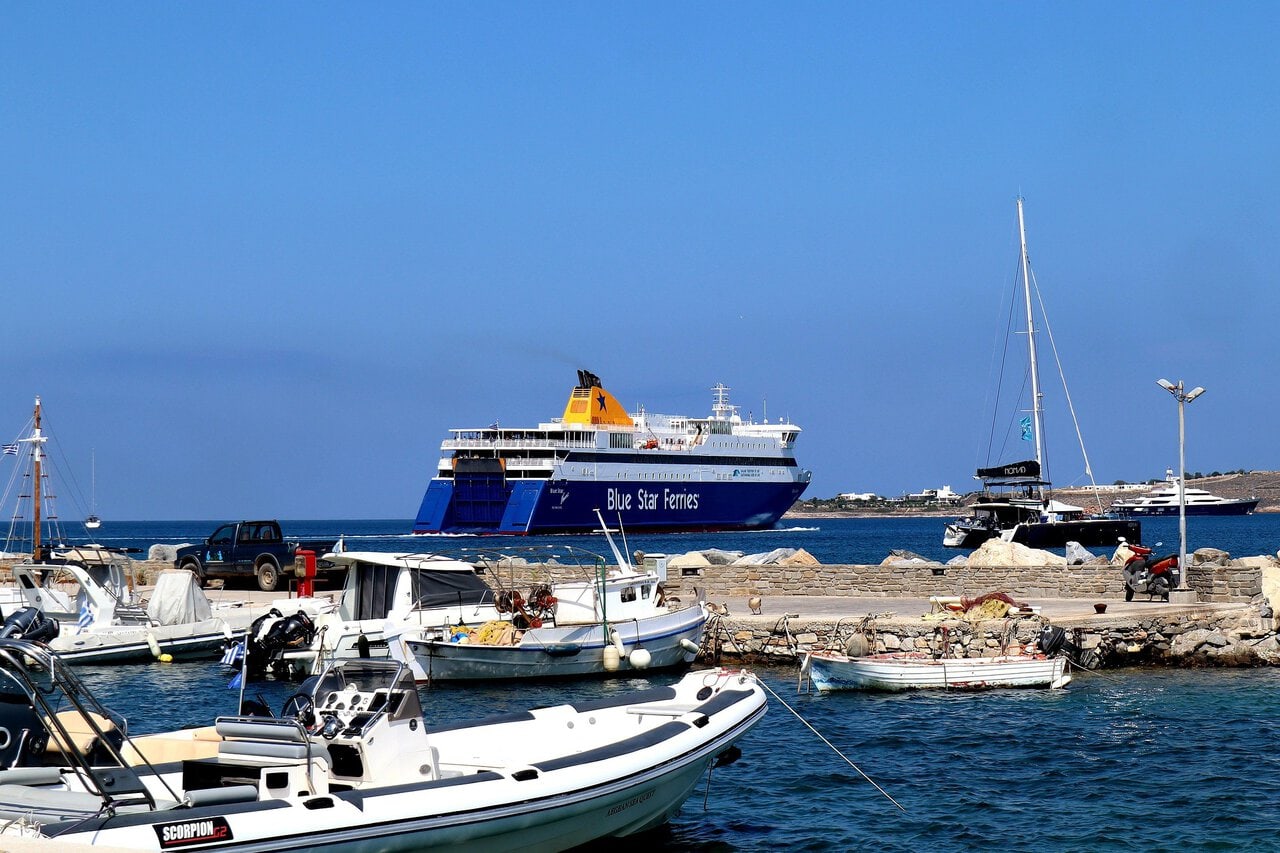
In contrast, Blue Star Ferries focuses on conventional ferry services, offering larger ships with more space and a more relaxed onboard atmosphere. These ferries are commonly used on longer routes, including Athens to Naxos and Athens to Santorini, and often include features such as outdoor decks, lounges, and cabin options. They are particularly popular with travellers who prioritise comfort and value over speed.
Hellenic Seaways operates a mix of services across the Cyclades, including both high-speed and standard ferries. This makes them a flexible option depending on the route, with services connecting key islands such as Mykonos, Paros, and Naxos.
Another important operator is Golden Star Ferries, which runs both fast and conventional routes, particularly between Athens, Mykonos, and Paros. Their vessels are often seen as a middle ground between speed and comfort, offering a balance that suits a wide range of travellers.
Choosing the right operator depends on your priorities. If your focus is on minimising travel time, high-speed services such as those operated by Seajets are usually the best option. If you prefer a more spacious and relaxed journey, particularly on longer routes, operators like Blue Star Ferries provide a more comfortable experience.
By understanding how these operators differ, you can match your ferry choice to your travel style, budget, and itinerary, ensuring a smoother and more enjoyable experience across the Cyclades.
Most Popular Cyclades Ferry Routes
Some ferry routes in the Cyclades are used far more frequently than others, forming the foundation of most island-hopping itineraries. These routes are well served, reliable, and easy to combine, making them the best starting point when planning your journey.
Routes from Athens to the Cyclades are the most common entry points. The Athens to Santorini ferry is one of the busiest in Greece, offering a range of options from fast high-speed services to slower, more relaxed crossings. Similarly, the Athens to Mykonos ferry, Athens to Paros ferry, and Athens to Naxos ferry provide direct access to the heart of the Cyclades.
Once you are within the islands, inter-island routes become the most important part of your itinerary. The Santorini to Paros ferry is one of the most efficient and widely used connections, linking the southern and central Cyclades. From there, the Paros to Naxos ferry offers a short and frequent crossing, making it one of the easiest routes in the region.
Other key connections include the Mykonos to Paros ferry and the Santorini to Naxos ferry, both of which allow you to move between major islands without returning to Athens. For travellers exploring the western Cyclades, the Milos to Paros ferry provides an important link into the central network.
These routes are popular because they combine strong frequency, manageable travel times, and logical positioning, allowing travellers to move smoothly between destinations without unnecessary complexity.
Cyclades Ferry Routes and Travel Times
Understanding travel times between Cyclades islands is essential when planning your itinerary. While distances may appear short on a map, journey times can vary depending on the type of ferry and the number of stops along the route.
High-speed ferries are the fastest option, often reducing travel times significantly. For example, routes such as Santorini to Paros or Mykonos to Paros can take under 2 hours, making them ideal for travellers looking to move quickly between islands.
Conventional ferries, while slower, offer a more relaxed and spacious experience, particularly on longer routes such as Athens to Santorini or Athens to Naxos. These journeys can take several hours, but they often include outdoor seating and additional facilities.
Another factor to consider is whether the ferry is direct or makes multiple stops. Some services call at several islands along the way, increasing total travel time but providing additional flexibility for different routes.
During the summer season, increased frequency allows you to choose between different departure times and ferry types, making it easier to balance speed, cost, and comfort.
By understanding these variations, you can plan your route more effectively, ensuring that travel times fit comfortably within your overall itinerary.
| Route | Typical Travel Time | Ferry Type | Frequency (Summer) |
|---|
| Mykonos → Paros | 40m – 1h 30m | High-speed | Very frequent |
| Paros → Naxos | 45m – 1h | High-speed | Very frequent |
| Santorini → Paros | 1h 45m – 3h | High-speed | Frequent |
| Santorini → Naxos | 1h 30m – 2h 30m | High-speed | Frequent |
| Mykonos → Naxos | 35m – 1h 30m | High-speed | Frequent |
| Milos → Paros | 1h 45m – 4h | Mixed | Moderate |
| Milos → Santorini | 2h – 5h | Mixed | Moderate |
| Paros → Santorini | 1h 45m – 3h | High-speed | Frequent |
| Naxos → Santorini | 1h 30m – 2h 30m | High-speed | Frequent |

Best Cyclades Routes for Island Hopping
Choosing the right route is the most important part of planning a Cyclades island-hopping trip. The goal is to create a journey that flows naturally, avoids unnecessary backtracking, and allows you to experience a variety of islands without spending too much time in transit.
One of the most effective approaches is to move in a logical direction through the islands, rather than jumping back and forth. A classic example is starting in Santorini, then travelling to Paros, followed by Naxos, and eventually returning to Athens. This route works because it follows a natural progression through the Cyclades, with short, well-connected ferry routes at each stage.
Another popular approach is to combine Mykonos with Paros and Naxos, creating a route that balances energy and relaxation. Mykonos provides a lively starting point, while Paros and Naxos offer more space and variety.
For travellers looking to explore further, routes that include Milos can add a more adventurous element, particularly when combined with central islands such as Paros.
The key to a successful itinerary is to focus on quality over quantity. Visiting fewer islands with strong connections and distinct experiences will always provide a better trip than trying to cover too much ground.
By following established routes and understanding how the islands connect, you can create an itinerary that feels smooth, varied, and enjoyable from start to finish.
Sample Cyclades Island-Hopping Itineraries
Planning a Cyclades island-hopping route becomes much easier when you follow proven travel flows that are built around strong ferry connections. The key is to combine islands that are well linked, offer different experiences, and allow you to move efficiently without wasting time in transit.
The itineraries below are based on the most reliable ferry routes in the Cyclades, making them practical as well as inspiring.
7-Day Classic Cyclades Route
If you have one week, this route offers the best balance of iconic destinations and efficient ferry travel.
Start in Athens, then take the Athens to Santorini ferry, one of the most popular and well-served routes in Greece. Spend 2 to 3 days in Santorini, exploring Oia, Fira, and the caldera, as well as enjoying the island’s beaches and viewpoints.
Next, take the Santorini to Paros ferry, which is one of the most efficient inter-island connections. Spend 2 to 3 days in Paros, using it as a base to enjoy Naoussa, Parikia, and the island’s beaches.
From Paros, take a short crossing on the Paros to Naxos ferry, typically under an hour. Spend your remaining 1 to 2 days in Naxos, enjoying a more authentic and spacious island experience with long beaches and traditional villages.
Return to Athens via the Naxos to Athens ferry, completing a smooth, logical loop with minimal travel stress.
This route works because it combines three distinct islands, keeps ferry journeys short, and avoids unnecessary backtracking.
Search flights and useful route combinations in one place.
View flightsBrowse Airalo eSIM options for convenient travel data.
Check eSIMsBook a private airport transfer in advance and have your ride planned before you arrive.
Check transfers10–14 Day Balanced Cyclades Route
With more time, you can build a richer and more varied itinerary, adding additional islands while still maintaining a logical flow.
Begin in Athens, then travel to Mykonos using the Athens to Mykonos ferry. Spend 2 to 3 days in Mykonos, enjoying its beaches, old town, and vibrant atmosphere.
From Mykonos, take the Mykonos to Paros ferry, a short and frequent route that connects you to the centre of the Cyclades. Spend 3 to 4 days in Paros, exploring both its lively and quieter areas.
Next, take the Paros to Naxos ferry, allowing you to experience a larger, more authentic island. Spend 2 to 3 days in Naxos, focusing on both the coast and inland villages.
From there, continue south via the Naxos to Santorini ferry, adding a final highlight to your trip. Spend 2 to 3 days in Santorini, enjoying its unique scenery and atmosphere.
Return to Athens via the Santorini to Athens ferry, completing a route that flows naturally from north to south through the Cyclades.
Short Cyclades Trip (3–5 Days)
For shorter trips, the focus should be on simplicity and efficiency, rather than trying to cover too many islands.
One of the best options is to take the Athens to Paros ferry, spend 2 to 3 days exploring Paros, and then return to Athens. Paros offers a complete experience, with beaches, towns, and nightlife, without requiring additional travel.
Alternatively, you can choose a single standout island, such as Santorini, and travel via the Athens to Santorini ferry. Spending a few days in one location allows you to enjoy the destination without rushing.
For travellers who want a small amount of island hopping, combining Paros and Naxos via the Paros to Naxos ferry is one of the easiest and most efficient options.
Short trips work best when they prioritise quality over quantity, allowing you to enjoy the experience rather than spending most of your time travelling.
High-Speed vs Conventional Ferries in the Cyclades
Choosing between high-speed and conventional ferries is one of the most important decisions when travelling in the Cyclades.
High-speed ferries are designed for efficiency and shorter travel times, making them ideal for routes such as Santorini to Paros, Mykonos to Paros, or Athens to Mykonos. They allow you to visit multiple islands within a limited timeframe, which is particularly useful for shorter trips.
However, high-speed ferries are typically more expensive and can be more affected by strong winds, particularly during the summer months.
Conventional ferries, on the other hand, offer a more relaxed and spacious experience. They are often used on longer routes such as Athens to Santorini or Athens to Naxos, where the journey itself becomes part of the experience. These ferries provide outdoor decks, larger seating areas, and sometimes cabins, making them more comfortable for extended travel.
For shorter routes and tight itineraries, high-speed ferries are usually the best choice. For longer journeys or travellers who prefer a slower pace, conventional ferries provide better value and comfort.
Understanding this balance allows you to choose the right option for each part of your journey.
Ferry Frequency and Seasonality in the Cyclades
Ferry travel in the Cyclades is heavily influenced by seasonality, and understanding this can make a significant difference to your planning.
During the summer months (May to September), ferry services are at their peak. Routes between major islands such as Santorini, Paros, Naxos, and Mykonos operate multiple times per day, giving you a high level of flexibility.
In the shoulder seasons, ferry frequency remains good, but with fewer daily departures. This can still work well, particularly for travellers who prefer quieter islands and less crowded ports.
During the winter months, services are significantly reduced, and some inter-island routes may not operate at all.
One of the most important factors in the Cyclades is the Meltemi wind, which can affect ferry schedules, particularly for high-speed vessels. While cancellations are not common, delays can occur, so it is important to allow some flexibility in your itinerary.
By planning around seasonality, you can ensure your trip runs smoothly and avoid unnecessary disruptions.
How to Book Cyclades Ferry Tickets
Booking Cyclades ferry tickets is simple, but timing and strategy can make a big difference to your experience.
For popular routes such as Athens to Santorini, Santorini to Paros, and Mykonos to Paros, it is best to book in advance, especially during peak summer months. This ensures availability and allows you to choose the most convenient departure times.
Most tickets are issued as e-tickets, allowing you to board directly without collecting physical tickets. This makes the process fast and efficient, particularly at busy ports.
Many travellers prefer to book one-way tickets, giving them the flexibility to adjust their plans as they travel. This works particularly well in the Cyclades, where routes are frequent and well connected.
For longer or more critical routes, it is advisable to book early, while shorter inter-island crossings can often be booked closer to your travel date.
A well-planned booking strategy ensures that your itinerary remains flexible, efficient, and stress-free.
What to Expect on Cyclades Ferry Journeys
Travelling between the Cyclades islands by ferry is not just a way to get from one place to another. It is an important part of the overall experience, and understanding what to expect helps you travel with confidence.
Most ferry journeys offer comfortable seating in air-conditioned lounges, particularly on high-speed vessels. These are designed for efficiency, with airline-style seating that works well for shorter routes such as Mykonos to Paros or Paros to Naxos.
On conventional ferries, the experience is more spacious and relaxed. These ships often include outdoor decks, allowing you to enjoy the sea views and fresh air as you travel between islands. For many travellers, this becomes one of the highlights of the journey.
Facilities on board typically include a café or snack bar, where you can purchase drinks and light meals. This is particularly useful on longer crossings such as Milos to Santorini, where the journey may take several hours.
Luggage handling is generally simple and flexible. Unlike flights, ferries allow you to bring larger bags without strict weight limits, making them ideal for longer trips or multi-island itineraries.
Overall, the experience is designed to be practical, comfortable, and scenic, allowing you to enjoy the journey as part of your trip rather than treating it as a purely functional transfer.
Browse hostels and budget-friendly stays.
See hostelsGet fast compensation payouts, eligible lounge benefits and expert help when flights go wrong.
See AirHelp+ benefitsLeave your luggage somewhere convenient and explore hands-free.
View storageCommon Mistakes When Planning Cyclades Routes
Planning a Cyclades island-hopping itinerary is relatively straightforward, but there are a few common mistakes that can significantly affect your experience.
One of the biggest mistakes is trying to visit too many islands in a short time. While ferry routes are frequent, travel still takes time, and moving too often can leave you feeling rushed. Focusing on fewer islands with strong connections will always result in a better trip.
Another common issue is poor route planning. Travellers sometimes choose islands without considering how they connect, leading to unnecessary backtracking or long travel days. Following logical routes such as Santorini → Paros → Naxos helps keep journeys short and efficient.
Booking too late during peak season is another frequent problem. Popular routes such as Mykonos to Paros or Santorini to Paros can fill quickly, especially in summer, limiting your options.
Many travellers also underestimate the importance of travel timing on the day of departure. Arriving late at the port or not allowing enough time for transport can create unnecessary stress.
Finally, failing to account for weather conditions, particularly strong winds, can disrupt tightly planned itineraries. Allowing some flexibility ensures that your trip remains enjoyable even if minor delays occur.
Avoiding these mistakes makes a significant difference, helping your journey feel smooth, well-paced, and enjoyable.
Who Cyclades Ferry Travel Is Best For
Ferry travel in the Cyclades is particularly well suited to travellers who want to experience multiple islands in a single trip while maintaining flexibility.
For first-time visitors to Greece, the Cyclades provide one of the easiest and most rewarding ways to explore. The islands are well connected, the routes are clear, and the variety of destinations allows you to experience both iconic highlights and quieter locations.
For island hoppers, ferries are essential. They allow you to move naturally between islands such as Mykonos, Paros, Naxos, and Santorini, without needing to return to Athens. This makes it possible to build efficient and varied itineraries.
For couples and relaxed travellers, ferry journeys add a slower and more enjoyable rhythm to the trip. Instead of rushing through airports, you spend time on the Aegean Sea, often with views that become part of the experience.
Ferry travel is also well suited to those who value flexibility, as one-way tickets allow you to adjust your plans as you go, particularly when travelling within the Cyclades.
Overall, the system works best for travellers who want a combination of freedom, variety, and a more immersive travel experience.

Rupert’s Handy Travel Tips
Planning to hop between the Cyclades islands? Rupert has a few tried-and-tested tips to help you travel smarter and avoid common pitfalls.
- Stick to a logical route to avoid wasting time travelling back and forth.
- Book key routes early during peak summer months.
- Choose high-speed ferries for shorter trips and conventional ferries for longer journeys.
- Allow some flexibility in your itinerary in case of weather-related delays.
- Don’t try to visit too many islands. Focus on quality over quantity.
Want to meet the reindeer behind our travel tips? Find out more in our page Who is Rupert?.


Frequently Asked Questions About Cyclades Ferry Routes
What are the best islands to visit in the Cyclades?
The most popular islands include Santorini, Mykonos, Paros, Naxos, and Milos, each offering a different experience.
How easy is it to travel between Cyclades islands?
Travel is generally very easy, with frequent ferry connections between major islands, especially during summer.
What is the best route for island hopping?
A common route is Santorini → Paros → Naxos, or Mykonos → Paros → Naxos, depending on your starting point.
How long do ferry journeys take in the Cyclades?
Most inter-island routes take between 45 minutes and 3 hours, depending on the distance and ferry type.
Should you book ferry tickets in advance?
Yes, especially for popular routes during peak season, to ensure availability and better departure times.

Plan Your Trip: Further Reading & Related Guides
Once you understand how Cyclades ferry routes work, the next step is to start building your own itinerary. Many travellers begin with major connections such as Mykonos to Paros or Santorini to Paros, before continuing with shorter crossings like Paros to Naxos.
If you are expanding beyond the Cyclades, routes such as Santorini to Crete allow you to explore a completely different part of Greece. For a broader overview, our Greek ferries guide explains how all regions connect, helping you plan a wider journey.
By combining these guides, you can move from understanding routes to building a complete and flexible island-hopping itinerary.











