
Why Qantas Matters for International Travellers
Qantas is one of the most recognisable airlines in the world and plays a major role in long-haul travel between Europe, Asia, Australia and North America. For many travellers, especially those flying to Australia, Qantas is one of the main airlines they will compare when booking long-distance flights.
One of the reasons Qantas is so important is geography. Australia is far from almost everywhere, which means long-haul aircraft, stopover hubs and airline partnerships are extremely important, and Qantas has built its network around exactly this type of travel. The airline operates ultra-long-haul flights as well as routes that connect through Asia, Singapore, Dubai and the United States.
Qantas is also a founding member of the Oneworld alliance, which makes it particularly relevant for travellers collecting Avios or other airline miles. Flights with Qantas can be part of wider multi-airline itineraries, meaning travellers can combine flights with British Airways, Qatar Airways, Cathay Pacific, Japan Airlines and American Airlines.
Another reason the airline matters is safety and reputation. Qantas has long been known for a very strong safety record and reliable long-haul operations, which is one of the reasons it remains one of the most respected airlines globally.
For travellers heading to Australia, New Zealand or long-haul destinations across the Pacific, Qantas is often one of the key airlines to consider when planning flights.
A Brief History of Qantas
Qantas is one of the oldest airlines in the world, founded in 1920 in Queensland, Australia. The name originally stood for Queensland and Northern Territory Aerial Services, which reflects the airline’s early role connecting remote parts of Australia.
In its early years, Qantas operated small aircraft carrying mail and passengers across vast distances in Australia. Over time, the airline expanded internationally and became Australia’s national carrier, operating long-haul flights linking Australia with Europe, Asia and North America.
Qantas became famous during the era of long-distance flying because routes between Australia and Europe were some of the longest and most complicated in the world. Historically, flights between London and Sydney involved multiple refuelling stops, and Qantas built its reputation around long-haul travel and international routes.
In more recent years, the airline has focused heavily on non-stop long-haul flights, including ultra-long-haul routes such as Perth to London. These flights are among the longest commercial flights in the world and demonstrate the airline’s focus on long-distance travel.
Today, Qantas operates a large international network as well as a major domestic network within Australia, and it remains one of the most important airlines for travel to and from Australia.
Qantas and the Oneworld Alliance
Qantas is a founding member of the Oneworld airline alliance, and this is one of the most important things to understand about the airline. Airline alliances are extremely important for long-haul travel because they allow airlines to connect routes, share frequent flyer benefits and provide lounge access across multiple airlines.
The Oneworld alliance includes major airlines such as British Airways, Qatar Airways, American Airlines, Cathay Pacific, Japan Airlines, Finnair, Iberia and several others. Because Qantas is part of this alliance, travellers can combine flights across multiple airlines on one ticket, which is particularly useful for complex long-distance journeys.
For example, a traveller might:
– Fly British Airways from London to Singapore
– Continue on Qantas from Singapore to Sydney
– Return via Tokyo on Japan Airlines
All of these flights could be booked as part of one itinerary with shared baggage and frequent flyer benefits.
Alliance membership also affects frequent flyer points. Qantas Frequent Flyer points can be earned on Oneworld airlines, and travellers with airline status may receive lounge access, priority boarding and additional baggage allowances across the alliance.
For long-distance travel, particularly between Europe and Australia, alliances are often more important than the airline itself, because they determine how easily flights can be combined and how loyalty benefits work.
Qantas Hubs: Sydney, Melbourne, Brisbane and Perth
Qantas operates several major hubs across Australia, with the most important airports being Sydney, Melbourne, Brisbane and Perth. These airports act as the main gateways for both international and domestic flights.
Sydney is the airline’s primary hub and the busiest airport in Australia. Many international flights arrive and depart from Sydney, and it is one of the main entry points for travellers arriving in Australia from Europe, Asia and North America. Sydney also connects to a large domestic network, allowing passengers to continue to other Australian cities.
Melbourne is another major hub and handles a large number of international and domestic flights. In many cases, travellers flying to Australia may find flights to Melbourne slightly cheaper than Sydney, depending on the route and airline partnerships.
Brisbane is an important hub for flights to Asia and the Pacific, and it also connects to many domestic destinations across Australia. Perth, on the west coast of Australia, is particularly important for flights to Europe because it is geographically closer than the east coast. This is why non-stop flights between Perth and London are possible, while flights from Sydney usually require a stop.
These hubs allow Qantas to operate a hub-and-spoke network where international passengers arrive in one city and then connect onto domestic flights across Australia. Because Australia is such a large country, domestic connections are often an essential part of international travel, and Qantas operates one of the largest domestic networks in Australia.
For many international travellers, flying to Australia usually involves arriving in Sydney, Melbourne, Brisbane or Perth and then connecting onwards, which is why these hubs are so important to the airline’s overall network.
Qantas Route Network
Qantas operates a large international route network alongside one of the biggest domestic flight networks in Australia. The airline focuses heavily on long-haul international routes and domestic connections, which together form the backbone of its business.
Internationally, Qantas operates flights between Australia and major global cities across Europe, Asia and North America. Key routes include flights from Sydney, Melbourne, Brisbane and Perth to destinations such as London, Los Angeles, New York, Singapore, Tokyo, Hong Kong and several other major international hubs. These routes are extremely important because Australia is geographically isolated, which means long-haul international flights are essential for connecting Australia to the rest of the world.
One of the most famous routes operated by the airline is the non-stop flight between Perth and London. This route is one of the longest non-stop flights in the world and demonstrates how aircraft technology has changed long-haul travel. Instead of stopping in Asia or the Middle East, passengers can now fly directly between Australia and Europe without changing planes, which significantly reduces travel time.
Alongside its international network, Qantas operates a very large domestic network across Australia. Flights between cities such as Sydney, Melbourne, Brisbane, Perth, Adelaide and many regional cities operate frequently throughout the day. For many travellers visiting Australia, a domestic flight with Qantas is often necessary to travel between major cities, because distances are extremely large.
Overall, Qantas’s route network is built around connecting Australia to major global hubs and then connecting passengers onwards through partner airlines, particularly through the Oneworld alliance.
Fleet and Cabin Classes
Qantas operates a mixed fleet of aircraft designed for both short domestic flights and very long international routes. Because Australia is so far from most other countries, the airline operates several aircraft specifically designed for long-haul travel.
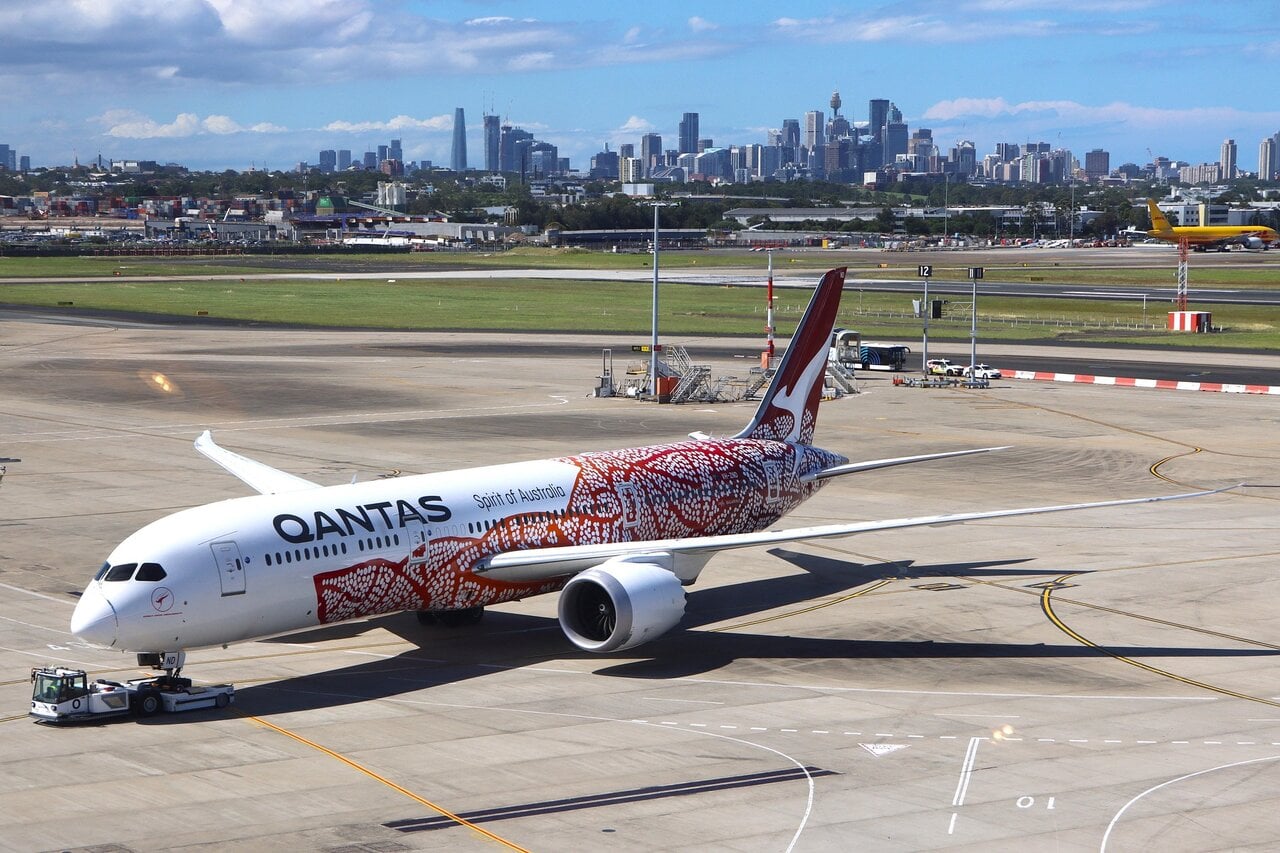
For long-haul international routes, Qantas operates aircraft such as the Airbus A380, Boeing 787 Dreamliner and Airbus A330. These aircraft are used on flights to Europe, North America and Asia. The Boeing 787 Dreamliner is particularly important for ultra-long-haul flights because it is more fuel efficient and designed for very long flights with improved cabin pressure and humidity, which helps reduce passenger fatigue.
On domestic routes within Australia, Qantas operates smaller aircraft such as the Boeing 737 and Airbus A320 family aircraft. These aircraft are used for flights between Australian cities and regional destinations.
Qantas typically offers multiple cabin classes on long-haul flights:
– Economy Class
– Premium Economy
– Business Class
– First Class (on some aircraft such as the Airbus A380)
This range of cabin classes allows the airline to compete with other major international airlines on long-haul routes. On domestic flights, aircraft usually operate economy and business class cabins.
Overall, Qantas positions itself as a full-service premium airline, particularly on long-haul routes, where meals, entertainment and baggage are typically included in the ticket price.
Qantas Economy, Premium Economy, Business and First Class Explained
Qantas offers several different cabin classes on long-haul flights, and the differences between them are significant, particularly on very long flights between Europe and Australia.
Economy Class is the most common cabin and is designed for long-haul travel, with entertainment screens, meals and drinks included. On very long flights, comfort becomes extremely important, and seat pitch, entertainment and cabin environment make a big difference on flights lasting more than 10 hours.
Premium Economy sits between economy and business class and usually includes larger seats, more legroom, better meals and additional baggage allowance. Many travellers choose premium economy on very long flights because it offers significantly more comfort without the cost of business class.
Business Class on Qantas long-haul flights includes lie-flat seats that convert into beds, lounge access, priority boarding and premium meals. On overnight flights, this can make a huge difference to the travel experience because passengers can sleep properly during the flight.
First Class is available on some aircraft such as the Airbus A380 and is designed as a luxury product with very large seats, premium food and high service levels. Not all routes offer first class, so passengers specifically looking for first class should check aircraft types before booking.
On extremely long flights, such as flights between Europe and Australia, the difference between economy, premium economy and business class can be very significant, and many travellers consider upgrading for comfort on these routes.
Qantas Frequent Flyer Programme
The Qantas Frequent Flyer programme is one of the largest airline loyalty programmes in the world and is heavily integrated with the Oneworld alliance. Passengers can earn points when flying with Qantas and partner airlines, and these points can be used for flights, upgrades and other travel rewards.
Because Qantas is part of the Oneworld alliance, points can be earned and redeemed across partner airlines such as British Airways, Qatar Airways, American Airlines and Cathay Pacific. This makes the programme particularly useful for frequent international travellers.
Members earn points based on distance flown, ticket type and airline partner, and higher status levels provide benefits such as lounge access, priority boarding and additional baggage allowance. Over time, frequent travellers can use points for upgrades to business class or for reward flights.
For travellers who regularly fly long-haul routes, particularly between Europe, Asia and Australia, frequent flyer programmes can become very valuable, especially when flights are booked within airline alliances where points and status benefits apply across multiple airlines.
The Qantas App and Digital Travel Tools
Like most major airlines, Qantas has its own mobile app that allows passengers to manage bookings, check in online, select seats, track flights and download boarding passes. For long-haul travel, having the airline app installed can make the airport experience much smoother, especially when flights are delayed or gates change.
The app allows passengers to check in before arriving at the airport, which means many travellers can go straight to baggage drop or security. Boarding passes can be stored on your phone, and the app also provides notifications about boarding times, gate changes and delays.
Another useful feature is managing frequent flyer points. Passengers can track Qantas Frequent Flyer points, status credits and upcoming trips directly in the app, which is particularly useful for frequent travellers who are collecting points for upgrades or reward flights.
Many travellers use flight comparison apps to book flights and then use the airline app afterwards to manage the booking. This is often the best approach because comparison tools help you find cheaper flights, while airline apps help you manage the journey.
Overall, the Qantas app is useful and worth downloading if you are flying with the airline, particularly on long-haul international routes.


How to Book Cheap Qantas Flights
Finding cheap Qantas flights is often about timing, flexibility and comparing routes rather than booking directly with the airline immediately. The biggest mistake many travellers make is only checking one website instead of comparing multiple routes and dates.
Flight prices can vary significantly depending on time of year, day of the week and how far in advance you book. Long-haul flights between Europe and Australia are usually cheapest when booked several months in advance, particularly outside peak travel seasons.
Flexibility is extremely important when booking long-haul flights. Flying a day earlier or later can sometimes save hundreds of pounds, especially on routes between Europe and Australia. It is also worth checking flights from different departure airports. For example, flights from London, Manchester, Paris or Amsterdam may all be priced differently for similar routes.
Another strategy is to consider different stopover cities. Flights to Australia often stop in Singapore, Dubai, Doha, Hong Kong or Los Angeles, and changing the stopover city can sometimes reduce the overall ticket price.
Qantas also occasionally runs sales on international routes, particularly from Europe to Australia, so it can be worth monitoring prices for a few weeks before booking if your travel dates are flexible.
In general, booking long-haul flights two to six months in advance is often a good balance between price and availability, although this varies depending on season and demand.
Qantas Strengths and Weaknesses
Qantas is a very well respected airline, particularly for long-haul travel, but like any airline it has both advantages and disadvantages depending on the route and aircraft.
One of the biggest strengths of Qantas is its long-haul experience and reputation for safety and reliability. The airline has been operating very long flights for decades and is known for strong operational performance on long-distance routes. This is particularly important on routes between Europe and Australia where flights are extremely long and delays can cause major travel disruptions.
Another major strength is the airline’s position within the Oneworld alliance. This allows passengers to earn and use frequent flyer points across multiple airlines, access airport lounges and book multi-airline journeys on one ticket. For long-distance travel involving multiple flights, this can be very useful.
The airline also has a strong domestic network within Australia. This is important because many international travellers arrive in Sydney, Melbourne or Brisbane and then need domestic flights to reach other parts of the country. Having domestic and international flights on the same airline can make connections much easier.
However, there are some disadvantages. Qantas flights are sometimes more expensive than competitors on certain routes, particularly compared to some Asian and Middle Eastern airlines. The airline also has a smaller European network than some competitors, so many European travellers will connect via partner airlines.
Overall, Qantas is generally strongest on routes between Australia, Asia, North America and Europe, particularly when used as part of the Oneworld alliance network.
Who Should Fly Qantas
Qantas is particularly well suited to travellers flying long distances to or from Australia, especially those travelling between Australia and Europe, North America or Asia. Because of the airline’s network and partnerships, it is often used as part of multi-flight itineraries rather than just single direct routes.
The airline is a good choice for travellers who are collecting frequent flyer points within the Oneworld alliance, because flights can contribute towards points and status across multiple airlines. Over time, this can lead to upgrades, lounge access and priority boarding, which makes long-haul travel much more comfortable.
Qantas is also a good option for travellers who plan to travel within Australia after arriving. The airline operates a large domestic network, so arriving in Australia and continuing on a domestic Qantas flight is often straightforward and easy to book on one ticket.
For very long flights, the airline is often considered reliable and comfortable, particularly in premium economy and business class cabins. On routes lasting more than ten hours, comfort becomes very important, and many travellers choose airlines like Qantas because of their experience operating ultra long haul flights.
Qantas may be less suitable for travellers who are simply looking for the absolute cheapest ticket and are not concerned about airline alliances or frequent flyer points. In those cases, some low cost or Middle Eastern airlines may sometimes offer lower prices depending on the route.
Overall, Qantas is usually best suited to long haul travellers, frequent flyers and passengers travelling to Australia who want reliability, alliance benefits and strong long distance flight experience.

Rupert’s Handy Travel Tips
Flying with Qantas or planning a long trip to Australia? Here are a few useful tips to make your journey smoother:
- Break up very long flights: If you are flying to Australia, consider a stopover in Singapore, Dubai or Hong Kong to make the journey easier.
- Check aircraft type before booking: Airbus A380 and Boeing 787 aircraft usually offer the best long-haul cabins.
- Join the Frequent Flyer programme: Even occasional travellers should collect points for future upgrades or reward flights.
- Look at multi-airline tickets: Combining Qantas with Oneworld partner airlines can sometimes be cheaper than booking a single airline return ticket.
Want to meet the reindeer behind our travel tips? Find out more in our page Who is Rupert?.
Frequently Asked Questions About Qantas
Is Qantas a good airline to fly with?
Qantas is generally considered a very good airline, particularly for long-haul flights to and from Australia. It has a strong safety reputation, modern aircraft and a large international and domestic network.
Is Qantas part of an airline alliance?
Yes, Qantas is a founding member of the Oneworld alliance. This allows passengers to earn and use frequent flyer points across partner airlines and access airport lounges depending on status and ticket class.
Where does Qantas fly from in Europe?
Qantas operates flights between London and Australia, including routes via Singapore and non-stop flights between London and Perth. Many European passengers connect onto Qantas flights via partner airlines.
Does Qantas have premium economy?
Yes, Qantas offers premium economy on many long-haul aircraft. Premium economy includes larger seats, more legroom and improved meals compared to standard economy.
Can you earn Avios on Qantas flights?
Yes, because Qantas is part of the Oneworld alliance, you can often earn Avios by crediting Qantas flights to British Airways Executive Club or other Oneworld frequent flyer programmes.
Further Reading & Related App Guides
If you are planning long-distance flights, airline connections or airport travel, these guides will help you plan your journey more efficiently:
Oman Air Travel Guide:
A growing Middle Eastern airline with excellent service, useful for routes between Europe, Asia and the Middle East.
Cathay Pacific Travel Guide:
One of Asia’s leading airlines with strong long-haul routes through Hong Kong to Asia and Australia.
Iberia Travel Guide:
Spain’s national airline and a key Oneworld member with good connections between Europe, Latin America and North America.
Japan Airlines Travel Guide:
Another Oneworld airline with strong routes across Asia and long-haul international flights.
Malaysia Airlines Travel Guide:
Useful for flights across Asia and connections between Europe and Australia.
Best eSIM Apps for Travellers:
Stay connected when you land without airport SIM cards or roaming charges.
Last Updated
March 2026
Affiliate Disclosure
This page contains affiliate links. If you click through and make a purchase or booking, we may earn a small commission at no extra cost to you. This helps support our work and allows us to continue providing detailed, independent travel advice. We only recommend apps and services we personally use or have verified as high-quality.