
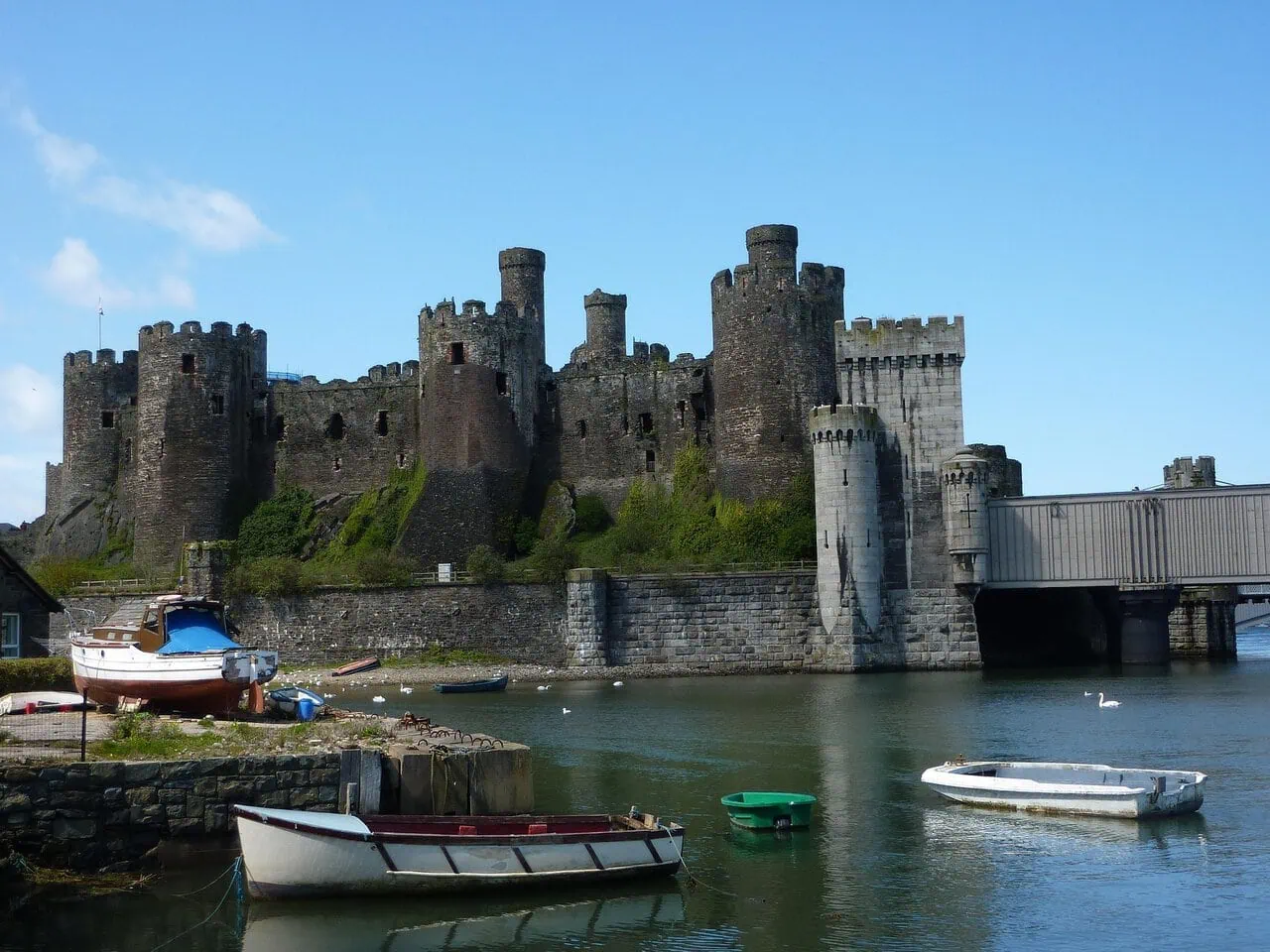
Conwy is often treated as a quick stop on the way to Snowdonia or Anglesey, but it deserves considerably more than a passing glance. This is one of the most complete medieval towns in Britain, built around a UNESCO World Heritage castle and encircled by three-quarters of a mile of intact town walls.
Inside those walls you’ll find Tudor townhouses, the smallest house in Great Britain, and streets that have barely changed shape since the 13th century, all packed into a centre small enough to explore entirely on foot.
Conwy also works well as a base for the water and the hills around it. Boat trips leave directly from the quay, Conwy Mountain rises straight up behind the town, and RSPB Conwy Nature Reserve sits just across the estuary, so there’s plenty beyond the historic centre if you have more than a few hours.
Conwy also sits directly on the North Wales Coast Line, which makes it easy to combine with Llandudno, Bangor or a longer rail trip along the coast, rather than treating it as an isolated day out.
This guide brings together the best things to do in Conwy, from the castle and its Tudor townhouses to boat trips, nature reserves and the smallest house in Great Britain, with enough on getting around, timing and cost to help you plan a full visit.
Whether you’re stopping for an afternoon between Chester and Snowdonia or basing yourself here for a couple of nights, Conwy rewards a slower pace better than most towns of its size. The compact centre means you can walk between every attraction in this guide without needing a car once you’ve parked.
| Attraction | Best For | How Long to Allow | Cost |
|---|---|---|---|
| Conwy Town Walls | History & views | 45–90 minutes | Free |
| Conwy Castle | Medieval history | 1.5–3 hours | Paid |
| Smallest House in Britain | Quick quirky stop | 5–10 minutes | Paid |
| Aberconwy House | Merchant’s house & bookshop | 30–45 minutes | Paid |
| Plas Mawr | Tudor architecture | 45–75 minutes | Paid |
| Conwy Quay & Marina | Harbour views & food | 30–60 minutes | Free |
| River Conwy Boat Trips | Wildlife & scenery | 30 minutes–2 hours | Paid |
| Conwy Mountain | Hiking & viewpoints | 1.5–3 hours | Free |
| RSPB Conwy Nature Reserve | Birdwatching & families | 1–2 hours | Paid |
| Conwy Suspension Bridge | Engineering history | 15–20 minutes | Paid |
| Conwy Morfa Beach | Sand & sea views | 1–2 hours | Free |
Walk the Conwy Town Walls
Few towns in Britain let you walk a complete medieval defensive circuit the way Conwy does, and the town walls are usually the first thing that makes the place feel special. They were built directly alongside the castle in the 1280s, forming one continuous ring rather than a series of separate fortifications.
The walls run for three-quarters of a mile around the old town, studded with twenty-one towers, and following them feels less like sightseeing and more like stepping straight into the castle’s own defences. Each tower once served as a watch post, and several still give a clear sense of how the garrison monitored the town and estuary below.
Around three-quarters of the circuit is open on foot, and the stretch above the harbour delivers some of the best views anywhere on the North Wales coast. From up there you take in the castle, the estuary and Conwy Mountain in a single sweep, a combination that’s hard to match anywhere else in town.
Access is free and the walls stay open during daylight hours year-round, managed by Cadw alongside the castle itself. There’s no need to plan around opening times the way you would for the indoor attractions, so it’s an easy stop to fit in whenever suits your day.
The best walking is from Upper Gate, right by the railway station, towards the castle, though a few sections involve narrow walkways and steep steps that aren’t ideal for anyone uneasy with heights. Handrails cover the trickier stretches, but proper shoes still make a real difference underfoot.
Allow 45 to 90 minutes for a decent stretch, longer if you stop often for photos, and it’s easy to combine with the castle itself since the two sit right beside each other. Early morning or early evening light works particularly well if you’re hoping for a clear shot of the estuary.
Visit Conwy Castle
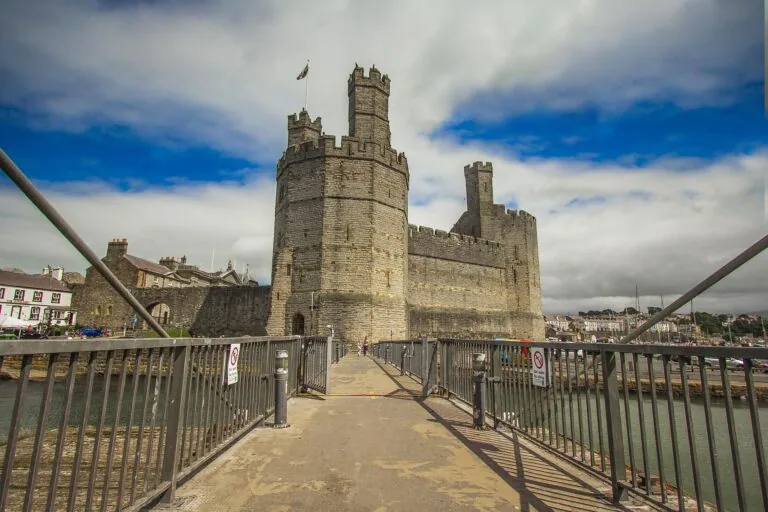
Conwy Castle is the obvious centrepiece of any visit, a UNESCO World Heritage fortress built by Edward I between 1283 and 1289 to secure his conquest of North Wales.
Eight massive towers and largely intact battlements make it one of the most complete medieval castles in Britain, and the climb to the wall-walk is worth every step: panoramic views open up across the estuary, the rooftops of the old town and the mountains of Eryri beyond.
Inside, you can explore the Great Hall, the King’s Apartments and the chapel, with information panels throughout explaining how the castle functioned as both a royal residence and a military stronghold during Edward’s campaign.
The castle sits inside the town walls, a two-minute walk from Conwy railway station on the North Wales Coast Line, and directly beside the main pay-and-display car parks just outside the walls. There’s nowhere to park within the historic centre itself, so arriving on foot from the station or one of those car parks is the easiest approach.
Tickets run from £9.40 (€10.81/$11.94) for a child or student up to £13.50 (€15.53/$17.15) for an adult, dropping slightly outside the summer season. Opening hours vary seasonally, from 9:30am–6pm in July and August down to 10am–4pm over winter, and the castle closes on 24–26 December and 1 January.
Allow at least 1.5 hours to do the towers and battlements justice, longer if you’re stopping often for the views. It’s worth booking a timed slot online on a busy summer day rather than queuing at the gate, especially in July and August.
If you’re also visiting Plas Mawr, ask about the joint ticket, which works out cheaper than paying for both separately. For the full history, tower-by-tower breakdown and visitor tips, see our complete Conwy Castle guide.
See hotel options and places to stay for your trip.
Browse hotelsExplore holiday homes and apartments for your trip.
See holiday homesCompare prices from multiple hotel booking sites.
Check dealsSee the Smallest House in Britain
Squeezed onto the quayside, Quay House is officially the smallest house in Great Britain, measuring just 3.05 metres high and 1.8 metres wide. It’s a genuinely odd, charming stop rather than a footnote, and one of Conwy’s most photographed spots simply because visitors can’t quite believe anyone lived there.
The house was lived in until 1900 by a local fisherman reportedly over six feet tall, and the interior, viewed through a doorway rather than walked into, still shows how a full household once fit inside such a tiny space. Photos inside document the family who lived there and how they made use of every inch.
We wouldn’t build a special trip around it on its own, but it sits directly on the quay, so it costs nothing in extra time to duck in while you’re already down by the harbour. Most visitors combine it with a wander along the waterfront rather than treating it as a separate stop.
Entry costs £1.00 (€1.15/$1.27) for a child and £1.50 (€1.73/$1.91) for an adult, and it’s genuinely a five-minute stop rather than a destination in itself. It’s open from spring to autumn, and it pairs naturally with a wider stroll around Conwy Quay and the marina next door.
The house has featured on Conwy postcards for generations, and a small information board outside explains its history for anyone who arrives to find someone else already peering through the doorway ahead of them. It’s one of those stops that takes barely any planning but sticks in people’s memory of the town.
Visit Aberconwy House
Aberconwy House is a 14th-century merchant’s house on Castle Street, the last of its kind surviving in Conwy and one of the oldest buildings in the town. Run by the National Trust, it combines period rooms with a second-hand bookshop, giving a genuinely rare look at how a medieval Conwy merchant actually lived and worked.
Each room is furnished to reflect a different era of the house’s long history, so you’re walking through several hundred years of continuous use rather than a single fixed snapshot. The ground-floor rooms tend to draw the most attention, with period furniture and household objects set out much as they might once have been.
It’s a manageable stop for anyone short on time, and most visitors get through the house in 30 to 45 minutes, including a browse of the bookshop on the ground floor. Staff are usually happy to point out original features that are easy to miss if you’re moving quickly.
Admission runs from £2.50 (€2.88/$3.18) for a child to £5.00 (€5.75/$6.35) for an adult. Opening days vary seasonally, so it’s worth checking the National Trust website before visiting, particularly outside the main summer months.
The house takes its name from the abbey that once stood on the site, and the exposed timber framing throughout is original rather than restored, a detail staff are usually happy to point out if you ask. It’s only a couple of minutes’ walk from the castle, making it easy to fold into the same visit.
Visit Plas Mawr
Plas Mawr is widely considered the best-preserved Elizabethan townhouse in Britain, built in the 1570s for merchant Robert Wynn. It’s remarkably intact right down to its original, richly decorated plaster ceilings, which alone make it one of the most visually striking interiors anywhere in North Wales.
An audio tour guides you room by room, and it brings the Tudor household back to life far more vividly than the bare walls alone would suggest, from the kitchen to the ornate great chamber upstairs. Along the way you’ll pick up details most visitors never expect from a historic house tour, including how servants moved unseen through the building.
The layout reflects status and hierarchy as much as comfort, with grander rooms reserved for entertaining and plainer ones tucked away for the household staff. It’s an unusually complete window into how a wealthy Elizabethan merchant family actually lived, rather than a stripped-back shell of a building.
Summer admission (1 June–30 September) runs from £7.60 (€8.74/$9.65) for a junior or student to £10.90 (€12.54/$13.84) for an adult. Plas Mawr closes over winter, from November to February, so it’s worth checking dates if you’re planning to visit outside peak season.
Allow 45 to 75 minutes to see it properly, and it sits a short walk from the castle along the High Street, making it easy to combine both in a single morning rather than treating them as separate outings on different days.
Stroll Conwy Quay and the Marina
Conwy Quay is the natural heart of the town for a relaxed wander, lined with fishing boats, seafood stalls and views straight across to the castle walls. It’s free to walk, and it works as well for a ten-minute detour as it does for an hour spent watching the boats come and go.
It’s particularly good value at high tide, when the water comes right up to the quay wall and the whole scene comes alive, so it’s worth timing a visit if you can. Locals often gather along the wall in the evenings, which gives it a genuinely lived-in feel rather than a purely tourist stretch.
Beyond the quay itself, the modern marina is worth a look for anyone interested in boats and coastal life, with pleasure craft moored against the backdrop of the castle and estuary. It’s a genuinely photogenic combination that’s hard to find elsewhere on the North Wales coast, and there’s no admission charge to walk around either.
The quay is also the natural starting point for a boat trip, and it’s an easy combination with the Smallest House, which sits right on the same stretch. Most visitors end up spending longer here than planned simply because there’s always something happening on the water.
Benches along the waterfront make it an easy spot to stop for an ice cream or a coffee, and the whole stretch stays lively well into the evening during the summer months, long after the day-trip crowds have thinned out.
Take a Boat Trip on the River Conwy
Getting out on the water is one of the best ways to see Conwy Castle properly, and several operators run boat trips directly from Conwy Quay. Seeing the castle and walls from the water gives a completely different perspective to walking around them on land.
Options range from short estuary sightseeing cruises to longer wildlife-spotting trips towards Puffin Island and the Great Orme, so there’s a version of this to suit almost any budget or amount of time. Most trips depart regularly through the day in summer, so there’s rarely a long wait to get out on the water.
Wildlife trips regularly turn up seals and a wide range of seabirds, and some operators combine the cruise with commentary on Conwy’s maritime history along the way. It’s a genuine highlight for anyone with even a passing interest in photography or wildlife.
Prices start from around £10 (€11.50/$12.70) for a short sightseeing cruise, rising to £30–£50 (€34.50–€57.50/$38.10–$63.50) for longer wildlife or fishing trips. Most sailings run rain or shine, though it’s worth checking ahead in poor weather.
Booking a spot in advance is sensible in July and August, when the more popular trips sell out. For a full breakdown of every operator, route and price, see our dedicated Conwy Boat Trips & Wildlife Cruises guide, which covers everything from family-friendly harbour cruises to longer seal-spotting excursions.
Walk Conwy Mountain
Conwy Mountain (Mynydd y Dref) rises directly behind the town and offers one of the best viewpoints in North Wales for the effort involved. An Iron Age hillfort sits at the summit, with views stretching across the estuary, Snowdonia and out to Anglesey.
The payoff is genuinely worth the climb even if you’re not an experienced walker, and most routes to the top take 90 minutes to 2 hours there and back. That makes it a realistic half-day addition rather than a serious hiking expedition.
Access is free and the paths are well-used, though proper footwear is worth bringing since the ground is uneven in places, particularly after rain. It’s an easy add-on if you’re already spending a full day in Conwy and want a break from the historic streets.
The best starting point is from the western edge of the town walls, so it’s a natural extension of a longer walk that also takes in the walls themselves. From there the route climbs steadily rather than steeply, which keeps it manageable for most fitness levels.
There’s no café or shelter on the mountain itself, so it’s worth bringing water and something to eat if you’re planning the full loop. A phone with a downloaded map is also useful, since signal can be patchy near the summit.
Search routes and flight options for your journey.
Search flightsChoose an Airalo eSIM and arrange mobile data before you arrive.
Browse eSIMsBook a private airport transfer in advance and have your ride planned before you arrive.
Check transfersVisit RSPB Conwy Nature Reserve
Just across the estuary from the town, RSPB Conwy Nature Reserve is built on land reclaimed during construction of the A55 tunnel. It now attracts a wide range of wetland birds across its lagoons, reedbeds and grassland, and the mix changes noticeably through the year.
Well-maintained paths and hides make it an easy, mostly flat walk suitable for families and pushchairs, whether or not you’d call yourself a birdwatcher. It’s a good counterpoint to a morning spent in the historic centre, since it swaps narrow medieval streets for open water and sky.
Non-member admission runs from £3.00 (€3.45/$3.81) for a child to £6.00 (€6.90/$7.62) for an adult, though entry is free for RSPB members and for anyone aged 16 to 24. The visitor centre has a café and shop, which makes it easy to turn into a longer stop.
Bring your own binoculars if you have them, though the reserve does have some available to borrow. The hides are unheated, so it’s worth dressing for the weather even on a mild day.
It’s an easy walk or short drive from the town centre, making it realistic even on a half-day visit, and it’s a reliable option whatever the season since the birdlife changes rather than disappears.
Cross the Conwy Suspension Bridge
Designed by Thomas Telford in 1826, the Conwy Suspension Bridge was one of the first road suspension bridges in the world. It’s built to echo the battlements of the castle right beside it, a deliberate design choice that still makes it one of the most photographed spots in town.
Crossing on foot or by bike is free, and it frames the castle perfectly from the water, particularly in the late afternoon light. The wooden deck and original ironwork give it a genuinely different feel from a modern crossing.
The restored toll house at the near end can be visited for 50p (€0.58/$0.64) for a child or £1.00 (€1.15/$1.27) for an adult, giving a glimpse of how bridge tolls were collected in the 19th century. It’s open from 17 March to 4 November, 10am to 4:30pm.
It takes only a few minutes to cross, so it’s easy to fold into a wider walk around the castle and quay rather than treating it as a separate outing. Most visitors combine it naturally with a stroll along the walls or a stop at the quay.
The bridge is maintained by the National Trust alongside the toll house, and it’s one of the few places in Conwy where you get a clear, uninterrupted view of the castle’s full length from water level.
Visit the Church of St Mary and All Saints
Tucked among the narrow streets inside the walls, the Church of St Mary and All Saints stands on the site of a 12th-century Cistercian abbey. It retains parts of the original medieval structure, and the building’s long, layered history is easy to trace if you take a few minutes to look properly.
It’s a quiet, atmospheric stop that most visitors walking between the castle and the quay pass right by without noticing, which is part of its appeal if you want somewhere calmer. Inside, the mix of medieval stonework and later additions tells its own story of the town around it.
Entry is free, with donations welcomed, and there’s rarely a queue or a crowd, even during the busiest parts of the summer season. The small churchyard is worth a few minutes on its own, with gravestones dating back centuries set against the backdrop of the town walls.
The church still holds regular services, so it’s worth checking times if you’d rather visit outside of one. The interior is generally open to the public during daylight hours through the week.
It’s an easy detour rather than a dedicated stop, best folded into a walk between the castle and Aberconwy House, since both sit only a few minutes away on foot.
Browse hostels and budget-friendly stays.
See hostelsGet fast compensation payouts, eligible lounge benefits and expert help when flights go wrong.
See AirHelp+ benefitsArriving before check-in or leaving later? Store your luggage and enjoy the extra time hands-free.
Store your bagsShop on Conwy High Street
Conwy’s High Street and Castle Street are lined with independent shops rather than chain stores, which is unusual for a town this size and part of what gives the centre its character. You’ll find Welsh craft galleries, outdoor gear specialists and several bookshops, most run by people happy to talk about what they’re selling.
It’s a pleasant way to fill half an hour between the bigger attractions, particularly if the weather turns and you want somewhere dry without giving up on sightseeing entirely. Several shops double as informal galleries for local artists, so it’s worth a browse even if you’re not planning to buy.
Look out for local Conwy mussels, a genuine local speciality still harvested from the estuary, sold both fresh from the quay and served in several of the town’s restaurants. They’re one of the few souvenirs you can actually eat the same day.
Prices vary by shop, but this is more about browsing than serious souvenir shopping, and nothing here needs advance planning or booking. It sits right along the natural route between the castle, the walls and the quay, so there’s no need for a separate trip.
Most shops keep fairly standard daytime hours and close earlier than you might expect in the evening, so it’s worth timing a browse for the middle of the day rather than after dinner.
Relax at Conwy Morfa Beach
A short walk or drive from the town centre, Conwy Morfa is a wide, sandy beach backed by dunes, with views across the bay towards Llandudno’s Great Orme. It’s considerably quieter than the beaches in Llandudno itself, making it a good option if you want sand and sea air without the crowds.
The dunes behind the beach are worth a wander too, and on a clear day the views towards the Great Orme and along the coast are some of the best in the area. It’s a good spot to slow down after a morning spent on foot in the historic centre.
Access to the beach is free, with a golf club, RNLI lifeboat station and some limited parking nearby. There are no facilities directly on the beach itself, so it’s worth bringing what you need rather than expecting cafés or shops close by.
It works well as a final stop after a day exploring the historic centre, particularly if you’ve got children who need somewhere to run around before heading home. The open space is a welcome contrast after the narrow streets inside the walls.
The beach backs onto the Morfa Conwy area rather than the town centre itself, so it’s a five to ten minute drive or a longer walk from the castle, worth building into your timing if you’re not driving.
Explore Bodlondeb Woods and Park
Just outside Conwy’s medieval walls, Bodlondeb Woods and Park provide an easy escape from the busy historic centre without requiring a car or a long hike. The combination of woodland paths and open green space makes this one of the simplest free additions to a day in Conwy.
The woods sit behind Bodlondeb, the historic house now used as Conwy’s council offices, with paths winding through mature woodland towards the surrounding countryside and coast. It feels surprisingly peaceful considering how close you remain to the castle and town centre.
This is particularly useful for families with younger children who may have had enough of towers, historic houses and narrow streets. There’s room to walk and explore without committing to the considerably longer climb up Conwy Mountain.
The woodland is also good for a short nature walk, particularly during spring and autumn when the trees and woodland floor provide considerably more colour. You don’t need a particular route in mind, and it’s easy simply to wander for half an hour before returning towards town.
Access is free, and you can comfortably incorporate the park into a longer walk from the town centre towards Conwy Morfa or the surrounding coastline.
Allow around 30 to 60 minutes for a casual visit, longer if you’re looking for somewhere quiet to walk. For visitors spending a full day in Conwy, Bodlondeb provides a useful contrast to the castle, walls and busy quayside.

Discover Conwy’s Mussel-Fishing Heritage
You’ve probably noticed Conwy mussels appearing on restaurant menus and at the quayside, but they’re much more than another local food. Mussel fishing has been part of life around the Conwy estuary for generations, creating one of the town’s most distinctive maritime traditions.
The mussels grow naturally in the estuary, where the mixture of fresh and salt water creates suitable conditions for shellfish. Traditionally, mussel gatherers worked the beds according to the tides rather than farming them using the large-scale systems seen in many modern shellfish operations.
The small Conwy Mussel Museum on the quay helps explain this history through equipment, photographs and information about the people who worked the mussel beds. It’s an appropriately modest attraction for an industry that has always been closely connected with everyday working life in the town.
This is particularly worth seeing before or after exploring Conwy Quay, because it gives some context to what would otherwise simply look like a picturesque harbour filled with fishing boats.
You don’t need to allow long. Around 15 to 30 minutes is plenty for most visitors, making it easy to combine with the Smallest House, quay and Suspension Bridge.
Opening arrangements can be seasonal or limited, so check locally rather than building an entire itinerary around the museum being open. Even if you can’t go inside, understanding the mussel industry adds another layer to exploring Conwy’s waterfront.
And if they’re available during your visit, finish the history lesson in the obvious way by trying some locally harvested Conwy mussels.
See Conwy’s Historic Railway Bridge
Thomas Telford’s Suspension Bridge attracts most of the attention beside Conwy Castle, but immediately alongside it is another remarkable piece of 19th-century engineering: the Conwy Railway Bridge.
Designed by Robert Stephenson, the bridge was constructed as part of the railway along the North Wales coast. Rather than using a conventional open bridge structure, Stephenson carried the railway through enormous iron tubes spanning the River Conwy.
The design was pioneering for its time and was closely related to the much larger Britannia Bridge across the Menai Strait, which carried the same railway onwards towards Anglesey. Together, the bridges helped make a continuous rail route along the North Wales coast possible.
The Conwy structure was deliberately given stone towers resembling castle fortifications, helping it sit alongside Conwy Castle rather than appearing completely disconnected from its medieval neighbour.
You can’t explore the railway bridge in the same way as Telford’s pedestrian Suspension Bridge because it remains part of the working railway. The best way to appreciate it is from the surrounding waterfront and bridges, where you can see trains entering and leaving the tubular structure.
It also makes arriving in Conwy by rail considerably more interesting. Trains cross the river immediately before reaching Conwy railway station, depositing passengers virtually underneath the medieval walls.
Combine it with the Suspension Bridge rather than treating the two as separate excursions. Within a few metres you can see medieval military engineering, early Victorian road engineering and pioneering railway engineering spanning almost six centuries.
Walk from Conwy to Llandudno
Conwy and Llandudno are close enough that you don’t have to choose between them or even use transport to travel from one to the other. Following the walking routes towards the coast turns the journey into a proper North Wales walk rather than a few minutes on the train.
One of the most rewarding options incorporates the landscape around the Great Orme, eventually bringing you into Llandudno with views across the bay and towards the town’s Victorian seafront.
This isn’t simply a pavement walk between two neighbouring towns. Depending on the route you choose, expect hills, exposed sections and uneven ground, so walking shoes are considerably more appropriate than footwear intended for sightseeing around Conwy Castle.
The contrast between the two ends makes the walk particularly enjoyable. You begin among Conwy’s medieval castle and walls and finish beside Llandudno’s Victorian hotels, Promenade and pier.
There’s no need to walk back. Conwy and Llandudno both have railway stations, making this particularly easy as a one-way walk. Once you’ve finished exploring Llandudno, take the train back along the coast.
Allow several hours for the walk rather than trying to squeeze it between two timed attractions. Weather also matters more here than it does while exploring the streets of Conwy, particularly if your route crosses higher and more exposed ground.
Our Wales Coast Path guide covers walking around this part of North Wales in more detail, while our Things to Do in Llandudno guide gives you plenty to explore once you reach the other end.
Walk to Deganwy and the Remains of Deganwy Castle
For a completely different perspective on Conwy’s history, cross the estuary towards Deganwy, where the remains of an earlier castle occupy two rocky hills above the modern town.
There’s very little standing masonry compared with Conwy Castle, so don’t arrive expecting another collection of towers and battlements. The attraction here is the combination of the archaeological remains, landscape and history of a site that was important long before Edward I’s fortress dominated the opposite bank.
Deganwy’s strategic position overlooking the Conwy estuary made the site valuable to successive rulers. Fortifications existed here at different periods, and the castle became particularly significant during the struggles between Welsh princes and English kings during the medieval period.
The surviving earthworks and fragments require more imagination than Conwy Castle, but climbing onto the hills immediately explains why this position mattered. There are extensive views across the estuary towards Conwy, the castle, surrounding mountains and North Wales coastline.
For walkers, that’s arguably the biggest reason to come. Looking back towards Conwy Castle from the opposite side of the water provides a completely different sense of the landscape Edward I eventually sought to control.
Access to the hill is free, but expect uneven and potentially muddy ground rather than a managed historic attraction with surfaced paths. Proper footwear makes the climb much more comfortable after wet weather.
Allow around one to two hours for exploring the hills and viewpoints. It’s best suited to visitors with a full day or second day in Conwy who have already seen the castle and want to dig further into the area’s history.
Eat and Drink in Conwy
Conwy Quay is the obvious place to eat, with several seafood stalls and casual restaurants making the most of fresh local mussels and other catch. It’s a good spot to eat with a view, particularly if you can find a table looking out over the water.
The Albion Ale House, a National Trust-owned pub run jointly by four local breweries, is one of the best spots in town for a proper Welsh pint. It’s worth seeking out even if you’re not usually a pub person, since the building itself is part of the appeal.
For something more traditional, the streets inside the walls have a good spread of cafés and pubs, many in buildings that are centuries old in their own right. Prices are generally reasonable compared with bigger tourist towns nearby, particularly away from the immediate quayside.
Booking ahead is worth considering in summer, when day-trip numbers can fill the smaller places quickly, especially at weekends. Most options sit within a few minutes’ walk of the castle and walls, so there’s no need to go looking far once you’re ready for a break.
Conwy mussels are worth trying if you see them on a menu, since they’re landed locally rather than shipped in. Several quayside kitchens serve them simply, with little more than garlic, wine and bread on the side.
Best Things to Do in Conwy With Children
Conwy works well as a family day out, and most of what makes the town appealing to adults works just as well for children. Children generally enjoy climbing the castle towers and battlements, which feel genuinely adventurous rather than just educational.
Most kids don’t need much encouragement to explore every staircase, and the castle in particular tends to hold their attention far longer than adults expect. Ducking into the Smallest House in Britain is usually a hit too, simply because the scale is so obviously strange to anyone under about ten.
RSPB Conwy is a good option for younger children specifically, since the flat paths and hides suit pushchairs and younger legs alike. A short boat trip from the quay is usually popular too, giving a change of pace from walking around on foot.
Conwy Morfa Beach gives somewhere to run around freely after a morning of sightseeing, which is often exactly what children need by mid-afternoon. Most of the town’s core attractions sit within a 10-minute walk of each other, so there’s little need for a car once you’re parked.
Buggies cope reasonably well with the quay and the flatter streets inside the walls, though the town wall walk itself involves steps and isn’t buggy-friendly. It’s worth planning that stretch for when children can walk it themselves.

Best Free Things to Do in Conwy
Conwy is generous with free attractions for a town this size, which makes it a genuinely good-value stop compared with many other historic towns in Britain. Walking the town walls costs nothing and is arguably the single best thing to do in Conwy, free or otherwise.
Crossing the Suspension Bridge, exploring Conwy Quay and hiking Conwy Mountain are all free too, and together they cover history, harbour life and countryside within a short walk of each other. Between them, that’s enough variety to fill most of a day without repeating yourself.
The Church of St Mary and All Saints and Conwy Morfa Beach round things out, both free and both easy to combine with the attractions above. That’s enough to fill the better part of a day without paying a single admission fee.
If you do want to add one paid attraction, the castle is the obvious choice, since it’s the one thing on this list that genuinely can’t be substituted. Everything else here works as a strong, self-contained day even without it.
Combining several of these free stops into one loop, starting at the walls and finishing at the beach or the mountain, makes for a genuinely full day out without a single ticket to buy. It’s a good option if you’re travelling on a tight budget, or simply prefer to spend on food and drink rather than admission fees.
Things to Do in Conwy When It Rains
North Wales weather can turn quickly, but Conwy has enough indoor options to cope with a genuinely wet day. Conwy Castle, Plas Mawr and Aberconwy House all have substantial covered or indoor sections, so a rainy morning doesn’t have to mean cancelling your sightseeing plans.
The Smallest House at least offers a quick dry stop between showers, even if it’s not somewhere you’d want to shelter for long. It’s worth pairing it with one of the indoor attractions rather than relying on it alone.
The independent shops on High Street and the town’s cafés and pubs also give plenty of shelter, and browsing them is a perfectly reasonable way to spend an hour if the rain sets in properly. Several cafés are worth a stop in their own right, rain or not.
The town walls themselves are best avoided in heavy rain, since some sections get slippery, so save that walk for drier weather if you can. A wet day doesn’t have to mean cutting the visit short, it just means reshuffling the order.
It’s worth packing a proper waterproof rather than relying on an umbrella, since several of the best viewpoints, including the top of the town walls, are exposed to the wind coming off the estuary. Plas Mawr and the castle both get noticeably busier on wet days, so booking ahead matters even more than usual.
How Long Do You Need in Conwy?
A focused visit to Conwy Castle, the town walls and the quayside can be done in half a day, which suits anyone combining Conwy with Llandudno or elsewhere on the North Wales coast. It’s enough time to see the highlights without feeling rushed.
With a full day, you can add Plas Mawr, Aberconwy House, a boat trip and time on Conwy Mountain or the beach without feeling rushed. That’s realistically the sweet spot for most visitors who want to see the town properly rather than just the headline sights.
If you’re travelling with children, build in extra time, since the town rewards wandering rather than rushing between fixed stops. Kids in particular will want longer at the castle than adults typically allow themselves.
Conwy also works well as a base for a night or two, particularly if you want to explore Snowdonia or the rest of the North Wales Coast Line at a slower pace. Staying overnight also means you get the town largely to yourself in the early morning and evening, once the day-trip crowds have thinned out.
Either approach works, and it really comes down to whether Conwy is the main event or one stop on a wider North Wales trip. For most first-time visitors, a full day strikes the right balance between seeing everything worthwhile and not feeling rushed.

Getting to Conwy
Conwy railway station sits right beside the town walls on the North Wales Coast Line, with direct services from Chester, Llandudno Junction and along the coast towards Holyhead. That makes the town an easy stop without a car.
The station’s location means you’re inside the walls within a couple of minutes of stepping off the train, which is hard to beat for convenience. For the full route, connections and journey times, see our North Wales Coast Line guide.
Drivers can use several pay-and-display car parks just outside the walls, since the historic centre itself has narrow, largely pedestrianised streets unsuitable for driving through. Don’t be tempted to try finding street parking inside the walls, since it largely doesn’t exist.
The signposted car parks are a short, easy walk from everything covered in this guide, so arriving by car doesn’t put you at any real disadvantage. Buses also serve Conwy from Llandudno and the surrounding area, though the train is generally quicker and drops you closer to the town centre.
There’s no need to book parking or transport in advance outside of peak summer weekends, when the closest car parks can fill by mid-morning. Conwy is also an easy addition to a wider Wales itinerary; see our full Wales Travel Guide for how it fits alongside Snowdonia, the coast and the rest of North Wales.

Rupert’s Handy Travel Tips
Heading to Conwy? Here are a few useful tips to help you make the most of your visit:
- Book the castle in advance in summer: Conwy Castle gets busy on peak summer days, and booking a timed ticket online avoids queuing at the gate.
- Combine the castle and Plas Mawr: Ask about the joint ticket if you’re visiting both, since it’s cheaper than paying separately.
- Wear proper shoes on the walls: Several sections of the town walls involve narrow steps and uneven stone, so trainers or walking shoes are more comfortable than sandals.
- Park outside the walls: The historic centre’s streets are narrow and largely pedestrianised, so use one of the pay-and-display car parks just outside rather than trying to drive in.
- Check opening days before visiting Plas Mawr or Aberconwy House: Both close over parts of the winter, so it’s worth confirming dates if you’re travelling outside the summer season.
Want to meet the reindeer behind our travel tips? Find out more in our page Who is Rupert?.
Frequently Asked Questions
Is Conwy worth visiting?
Yes. Conwy combines a UNESCO World Heritage castle, largely intact medieval town walls, several historic houses and a working harbour within a compact, walkable centre, making it one of the best-value historic towns in Britain for a single visit.
Is Conwy or Llandudno better to visit?
They suit different things. Conwy has the history, the castle and the walls, while Llandudno has the Victorian seafront, pier and Great Orme. Many visitors base themselves in one and visit the other as a short trip, since they’re only a few minutes apart by train or car.
Can you walk the Conwy town walls for free?
Yes. Around three-quarters of the 1,300-metre circuit is open to walk, and access is free year-round.
How long do you need in Conwy?
Half a day covers the castle, walls and quayside, while a full day allows time for Plas Mawr, Aberconwy House, a boat trip and either Conwy Mountain or the beach.
Is there parking in Conwy?
Yes, several pay-and-display car parks sit just outside the town walls. The historic centre itself is narrow and largely pedestrianised, so it’s not practical to drive or park inside it.
Is Conwy good for a day trip from Chester or Manchester?
Yes. Conwy sits directly on the North Wales Coast Line, making it an easy train journey from Chester and a manageable day trip from Manchester, particularly when combined with Llandudno or Snowdonia.
Further Reading & Related Guides
If Conwy Castle is the main draw for your visit, our dedicated Conwy Castle guide covers its history, tower-by-tower layout and visitor tips in far more depth than fits here. For getting out on the water, our Conwy Boat Trips & Wildlife Cruises guide compares every operator and route from the quay.
Conwy sits right on the North Wales Coast Line, so if you’re planning a wider rail trip along the coast towards Llandudno, Bangor or Holyhead, that guide has full timetable and route detail. Travellers heading onward to Ireland may also want our Holyhead to Dublin Ferry guide, since the same line runs straight through to the ferry port.
For the bigger picture of what else North Wales and the rest of the country have to offer, our Wales Travel Guide brings together the national parks, coastline and castles that pair naturally with a visit to Conwy.
Conwy also makes a natural base for exploring the rest of the North Wales coast. Our guides to Things to Do in Llandudno and the Great Orme cover the neighbouring seaside resort and headland, while Things to Do on Anglesey, Things to Do in Caernarfon and Things to Do in Beaumaris round out the wider coastline and its castles. If you’d rather explore on foot, our Wales Coast Path guide covers the best short walks linking all of them together.